Interests and hobbies (e.g., sports participation or crafts) are an important feature in the development of typical children and adolescents (see McHale, Crouter, & Tucker, Reference McHale, Crouter and Tucker2001, for a review), because they offer avenues for social connection (e.g., Werner, Reference Werner1993). In contrast, the restricted and/or circumscribed interests (CIs) often seen in high-functioning autism spectrum disorders (HF-ASD) can have socially isolating effects due to their intensity or unusual nature. However, the quantitative and qualitative differences between interests/hobbies characteristic of typical development and those that are circumscribed, as in HF-ASD, have only begun to be fully distinguished.
One of the defining symptoms of autism spectrum disorder (ASD) is repetitive behaviors and restricted interests (American Psychiatric Association [APA], 2000). Because CIs are a defining symptom of ASD, the ability to distinguish the interests in HF-ASD from those in neurotypical (NT) individuals is critical. CIs, including topics of a nonsocial nature like fossils or vacuum cleaners (e.g., Baron-Cohen & Wheelwright, Reference Baron-Cohen and Wheelwright1999; Klin, Danovitch, Merz, & Volkmar, Reference Klin, Danovitch, Merz and Volkmar2007; Turner-Brown, Lam, Holtzclaw, Dichter, & Bodfish, Reference Turner-Brown, Lam, Holtzclaw, Dichter and Bodfish2011), are pathognomonic with ASD, but they are understudied in high-functioning individuals. The prevalence of CIs in children with HF-ASD is estimated to be 75% to 95% (Klin et al., Reference Klin, Danovitch, Merz and Volkmar2007; Turner-Brown et al., Reference Turner-Brown, Lam, Holtzclaw, Dichter and Bodfish2011). These prevalence estimates are higher than that found in an ASD sample including both lower and higher functioning individuals, which reported lifetime prevalence estimates for CIs based on three items from the Autism Diagnostic Interview—Revised (ADI-R; Szatmari et al., Reference Szatmari, Georgiades, Bryson, Zwaigenbaum, Roberts and Mahoney2006): 56% for CIs, 60% for unusual preoccupations, and 49% for attachment to objects. These findings suggest that CIs are quite common in ASD, but they are more common in HF-ASD. Within HF-ASD, Ozonoff, South, and Miller (Reference Ozonoff, South and Miller2000) compared the prevalence of CIs in 19 children with Asperger syndrome and 21 with high-functioning autism and found no difference between those groups, although both were significantly higher than CIs in typical development (N = 21).
Prior studies of children and adults with ASD show that stereotyped/repetitive behaviors and CIs diverge in function (e.g., Turner, Reference Turner1999), developmental trajectory (e.g., Moore & Goodson, Reference Moore and Goodson2003), and familiality (e.g., Lam, Bodfish, & Piven, Reference Lam, Bodfish and Piven2008). In addition, Carcani-Rathwell, Rabe-Hasketh, and Santosh (Reference Carcani-Rathwell, Rabe-Hasketh and Santosh2006) suggest that the higher order cognitive rigidity behaviors (including CIs) are unique to ASD, while lower order repetitive behaviors relate to intellectual disability (ID) with or without ASD. However, few studies have examined correlates or possible determinants of CIs (Leekam, Prior, & Uljarevic, Reference Leekam, Prior and Uljarevic2011).
Klin and colleagues (Reference Klin, Danovitch, Merz and Volkmar2007) argue that CIs are a larger problem in HF-ASD than in lower functioning ASD and contribute to difficulties in daily functioning and socialization, interfering particularly during self-directed learning and interactions with others and relating to lower socialization abilities later in development. They postulated that “the vast investment made by typically developing individuals in self-referenced social experiences, thoughts, and emotions is replaced with verbally learned, memorized, and manipulated topics of special interest that typically manifest in routinized behavioral or mental manipulations” in individuals with ASD (p. 97). This hypothesized mechanism of social interference was supported by a study by Sasson, Turner-Brown, Holtzclaw, Lam, and Bofish (Reference Sasson, Turner-Brown, Holtzclaw, Lam and Bodfish2008), which demonstrated that individuals with ASD attended more to items that are frequently topics of CIs than to items of a social nature. Klin et al. (Reference Klin, Danovitch, Merz and Volkmar2007) further suggest that CIs may also function to allay anxiety or to make sense of the social world by applying the same methods of learning vast amounts of technical or mechanical knowledge to learning about social interactions. Although CIs can be used therapeutically as motivators/reinforcers to increase socialization (see Baker, Reference Baker2000; Baker, Koegel, & Koegel, Reference Baker, Koegel and Koegel1998; Boyd, Conroy, Mancil, & Nakao, Reference Boyd, Conroy, Mancil and Nakao2007), this does not appear to happen as naturally in ASD as the social sharing of interests in typical development.
Clinicians may struggle in determining whether an interest meets diagnostic criteria by crossing the boundary between a typical interest and a CI. The prevalence estimates of intense interests in NT children show these behaviors are common, particularly in boys, with a developmental peak occurring during the preschool years (DeLoache, Simcock, & Macari, Reference Deloache, Simcock and Macari2007). Nevertheless, even at its peak, the rates of intense interests in NT development are not as high as those found in studies of individuals with ASD (Alexander, Johnson, Leibham, & Kelley, Reference Alexander, Johnson, Leibham and Kelley2008; DeLoache, et al., Reference Deloache, Simcock and Macari2007; Johnson, Alexander, Spencer, Leibham, & Neitzel, Reference Johnson, Alexander, Spencer, Leibham and Neitzel2004; Knickmeyer, Baron-Cohen, Raggatt, & Taylor, Reference Knickmeyer, Baron-Cohen, Raggatt and Taylor2005; Ozonoff et al., Reference Ozonoff, South and Miller2000; Turner-Brown et al., Reference Turner-Brown, Lam, Holtzclaw, Dichter and Bodfish2011).
Part of what is unique about CIs in HF-ASD is the degree of inflexibility the child has around that interest (Turner-Brown et al., Reference Turner-Brown, Lam, Holtzclaw, Dichter and Bodfish2011), suggesting that CIs may relate to executive functioning (EF), which is another area of difficulty in ASD. EF consists of several subdomains that include the abilities to initiate and sustain attention/behavior, inhibit impulses, set goals and make realistic plans, organize information and problem solve, manage information “on-line” in working memory, shift attention and think flexibly, and monitor and regulate one's own behavior (e.g., Gioia, Isquith, Guy, & Kenworthy, Reference Gioia, Isquith, Guy and Kenworthy2000; Kaplan, Reference Kaplan, Boll and Bryant1988; Welsh & Pennington, Reference Welsh and Pennington1988). Just as CIs are costly to individuals with ASD (Klin et al., Reference Klin, Danovitch, Merz and Volkmar2007), so has EF been frequently identified as an impairment in HF-ASD (for review, see Hill, Reference Hill2004; Kenworthy, Yerys, Anthony, & Wallace, Reference Kenworthy, Yerys, Anthony and Wallace2008; O'Hearn, Asato, Ordaz, & Luna, Reference O'Hearn, Asato, Ordaz and Luna2008; Pennington & Ozonoff, Reference Pennington and Ozonoff1996; Sergeant, Geurts, & Oosterlaan, Reference Sergeant, Geurts and Oosterlaan2002), although its universality and primacy have been debated (Hill, Reference Hill2004). The relationship between the EF domains of generativity, cognitive inflexibility, and inhibition, and repetitive behavior more broadly has been explored, but without a focus on CIs specifically (e.g., Kenworthy, Black, Harrison, Della Rosa, & Wallace, Reference Kenworthy, Black, Harrison, Della Rosa and Wallace2009; Lopez, Lincoln, Ozonoff, & Lai, Reference Lopez, Lincoln, Ozonoff and Lai2005; Sayers, Oliver, Ruddick, & Wallis, Reference Sayers, Oliver, Ruddick and Wallis2011; Turner, Reference Turner and Russell1997; Yerys et al., Reference Yerys, Wallace, Harrison, Celano, Giedd and Kenworthy2009; for review see Geurts, Corbett, & Solomon, Reference Geurts, Corbett and Solomon2009). In a notable exception, South, Ozonoff, and McMahon (Reference South, Ozonoff and McMahon2007) explored, but did not find support for, a relationship between CIs and EF in individuals with HF-ASD, although this study cannot be considered definitive, because there were limitations of sample size (ASD, n = 19) and EF measurement tools. Most prior studies, including South and colleagues, correlated performance on lab-based set-shifting measures, not ecologically valid EF measures, with repetitive behavior (Kenworthy et al., Reference Kenworthy, Yerys, Anthony and Wallace2008).
One group of researchers has hypothesized that circumscribed attention in young children with ASD leads to the development of CIs (Sasson, Elison, Turner-Brown, Dichter, & Bodfish, Reference Sasson, Elison, Turner-Brown, Dichter and Bodfish2011; Sasson et al., Reference Sasson, Turner-Brown, Holtzclaw, Lam and Bodfish2008). Their data suggests that circumscribed attention combines difficulty with the EF skills of prioritizing and flexibly shifting attention and a preference for nonsocial, high-interest objects over social information in ASD, which could relate to poor theory of mind. These researchers also suggest that the types of items that later become common CIs, such as trains, computers, and so on, are more interesting to all young children, but they are particularly more so to young children with ASD. However, there are competing genetic, neurologically based, and developmental theories of causation reviewed by Leekam et al. (Reference Leekam, Prior and Uljarevic2011).
There is no widely accepted measure of CIs; most researchers use items from broader established scales. However, this approach presents challenges. Some have used the ADI (Lord, Rutter, & Le Couteur, Reference Lord, Rutter and Le Couteur1994) and the Autism Diagnostic Observation Schedule (ADOS; Lord et al., Reference Lord, Risi, Lambrecht, Cook, Leventhal and DiLavore2000) for examination of CIs, but these instruments contain only a few questions that relate to CIs (Cuccaro, Shao, & Grubber, Reference Cuccaro, Shao and Grubber2003). In addition, using diagnostic data as the dependent variable introduces the risk of circular logic when examining ASD-NT group differences or attempting to correlate ASD symptoms with CIs. Diagnostic measures are further limiting because they are inappropriate for non-ASD children, do not provide continuous scores, and do not probe the content or intensity of the interests (Lam et al., Reference Lam, Bodfish and Piven2008). The Social Responsiveness Scale (SRS; Constantino, Reference Constantino2005) is a widely used continuous measure of ASD-related behavior that is also appropriate for use with NT individuals; however, the SRS combines CIs with other repetitive behaviors on the autistic mannerisms subscale, but this subscale does not load separately from social–communicative behaviors in factor analyses (Constantino et al., Reference Constantino, Gruber, Davis, Hayes, Passanante and Przybeck2004). Turner's (Reference Turner and Russell1997) Repetitive Behavior Interview is fairly lengthy, and the time spent (2+ hr) on a single ASD symptom domain exceeds its clinical utility. The Yale Survey of Special Interests (Klin & Volkmar, 1996, as described in Klin et al., Reference Klin, Danovitch, Merz and Volkmar2007) asks open-ended questions about the child's top three interests that are then coded into categories, followed by quantitative interference ratings. We chose to use the Interests Scale (IS; Bodfish, Reference Bodfish2003), a 40-item checklist that asks the parent or caregiver to rate each area of interest as being present currently or in the past. The parent is then asked several additional questions about the three primary interests, including how intense the interests are, how much they interfere with social interactions and flexibility, and the need for accommodation around those interests. The IS has the advantage of offering a qualitative examination of the content or type of interest as well as providing a quantitative rating of the intensity of the interests, while being quick for a parent to complete.
Although there has been a recent increase in studies related to CIs in HF-ASD, much remains unknown regarding their intensity and content, their relationship to other symptoms and gender, and how best to distinguish typical interests from CIs in ASD. Given that CIs are part of the diagnostic criteria for ASD, and particularly prevalent and important in HF-ASD, we chose to conduct this study with HF-ASD individuals. In addition, for the purposes of this paper, an interest becomes a CI when it is intense and interferes with daily functioning.
The present study directly compares the number, type, and intensity of interests in groups of HF-ASD and NT individuals matched on age, IQ, and gender ratio. Furthermore, we examine how the interests relate to social–communication symptoms/behaviors and EF. We chose social and communication behaviors because they constitute the remaining two components of the triad of impairment in ASD (APA, 2000). We chose EF because it has been linked with restricted or repetitive behaviors and interests (Kenworthy et al., Reference Kenworthy, Black, Harrison, Della Rosa and Wallace2009; Lopez et al., Reference Lopez, Lincoln, Ozonoff and Lai2005; South et al., Reference South, Ozonoff and McMahon2007; Turner, Reference Turner and Russell1997; Yerys et al., Reference Yerys, Wallace, Harrison, Celano, Giedd and Kenworthy2009).
Hypotheses
We hypothesized that (a) individuals with HF-ASD would have fewer interests but have higher intensity or interference ratings than NT individuals, consistent with the notion of a restricted number of interests that are also interfering in daily activities in the HF-ASD group; (b) individuals with HF-ASD would have fewer socially oriented interests and more solitary or object/sensory-focused interests than NT individuals; (c) males and females from both groups would differ in their areas of interest; and (d) the IS would be negatively correlated with IQ and age but positively correlated with measures of autistic symptomatology and repetitive behavior in the HF-ASD group.
Method
Participants
For all participants, informed consent was obtained from parents/caregivers when participants were under the age of 18, and informed assent was obtained from the participants in accordance with the requirements of the institutional review boards from the Children's National Medical Center and the National Institute of Mental Health. Informed consent was obtained from participants ages 18 and older.
ASD
One hundred nine individuals with HF-ASD were recruited for this study through a hospital clinic specializing in ASD and through the community. Thirty-seven individuals (33.9%) were taking at least one psychotropic medication, and 23 individuals (21.1%) were taking two or three medications. Twenty-nine individuals (26.6%) were taking stimulants/Atomoxetine, 18 (16.5%) were taking antidepressants (other than Atomoxetine), 8 (7.3%) individuals were taking atypical antipsychotics, 3 (6.5%) individuals were taking antiseizure medication, and 3 (6.5%) individuals were taking alpha-agonists. Individuals in the ASD group received a clinical diagnosis of autism, Asperger syndrome, or pervasive developmental disorder not otherwise specified based on DSM-IV-TR criteria (APA, 2000). All participants with ASD also met criteria for “broad ASD” based on scores from the ADI or the ADI-R (Le Couteur, Rutter, & Lord, Reference Le Couteur, Rutter and Lord1989; Lord et al., Reference Lord, Rutter and Le Couteur1994) and/or the ADOS (Lord et al., Reference Lord, Risi, Lambrecht, Cook, Leventhal and DiLavore2000), following criteria established by the National Institute of Child Health and Human Development/National Institute on Deafness and Other Communicative Disorders Collaborative Programs for Excellence in Autism (Lainhart et al., Reference Lainhart, Bigler, Bocian, Coon, Dinh and Dawson2006). A full-scale IQ score of at least 70 with either a verbal/verbal comprehension or performance/perceptual reasoning IQ of at least 80 was required for study entry and was derived from testing on a Wechsler instrument: the Wechsler Abbreviated Scale of Intelligence (n = 85), the Wechsler Intelligence Scales for Children—Third Edition (n = 3) or Fourth Edition (n = 18), or the Wechsler Adult Intelligence Scale—Third Edition (n = 3; Wechsler, Reference Wechsler1991, Reference Wechsler1997, Reference Wechsler1999, Reference Wechsler2003). Subjects were also excluded if they had any history of comorbid medical or genetic disorders that would affect brain development and/or cognitive functioning.
NT individuals
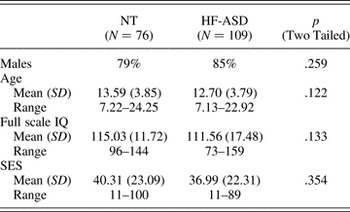
Seventy-six NT individuals were recruited from the community via advertisements. Individuals enrolled in the NT group did not receive diagnostic measures, but they were screened through a brief parent-completed interview and questionnaire. Participants were screened and excluded if they or a first-degree relative were found to have developmental, learning, neurological, or psychiatric disorders, or if the NT individual used any type of psychotropic medication. As with the ASD group, a full-scale IQ score of at least 70 with either a verbal/verbal comprehension or performance/perceptual reasoning IQ of at least 80 was required for study entry and was derived from testing on a Wechsler instrument: the Wechsler Abbreviated Scale of Intelligence (n = 74) or the Wechsler Intelligence Scales for Children—Fourth Edition (n = 2; Wechsler, Reference Wechsler1999, Reference Wechsler2003). The ASD and NT groups did not differ in terms of gender ratio, age, IQ, or socioeconomic status (ps > .05; see Table 1).
Participant demographics

Note: NT, neurotypical; HF-ASD, high-functioning autism spectrum disorder; SES, socioeconomic status. SES was calculated with Hollingshead's (1975) coding (middle class range = 28–43).
Measures
All participants were tested in a laboratory setting within the context of two separate, larger studies. Participation included a 3- to 4-hr testing session with a variety of neuropsychological, diagnostic, and cognitive measures. Participants received monetary compensation for their time.
1. IS: The IS (Bodfish, Reference Bodfish2003) is an informant report of interests that consists of two sections. Part 1 is a checklist of 41 categories of interests (e.g., mechanical systems/actions and numbers/numerical information), and informants are asked to endorse all categories that constitute either a current or a past interest. Only current interests are used for this paper, and a rating of 0 indicates that it is not a current interest of the child's, whereas a rating of 1 indicates it is a current interest. In Part 2, informants are asked to identify the child's current primary, secondary, and tertiary interests and are instructed to answer several questions designed to assess the intensity of each interest (e.g., frequency of specific activity related to interest, degree of interference with other activities, and degree of resistance when interrupted). The IS took parents 10–15 min to complete. The IS yields a total number of current interests endorsed score, with a possible range of 0–41, and a total intensity score, with a possible range of 0–24. Higher scores indicate greater number or intensity of interests. We use both scores in analyses, as well as examine item-level data.
2. Behavior Rating Inventory of Executive Function (BRIEF): The BRIEF (Gioia et al., Reference Gioia, Isquith, Guy and Kenworthy2000) is an informant report of EF in everyday situations. Its 86 items yield eight scales that are collapsed into a broad composite, the global executive composite. Higher scores indicate greater impairment. We chose a parent-report measure because it is more reliable at capturing EF problems seen in ASD (for a review, see Geurts et al., Reference Geurts, Corbett and Solomon2009; Kenworthy et al., Reference Kenworthy, Yerys, Anthony and Wallace2008). For this study, we chose the global executive composite as the key dependent variable in order to limit the number of comparisons/correlations and because CIs may be related to a combination of EF impairments as discussed above. Higher scores are associated with greater impairment.
3. SRS: The SRS (Constantino, Reference Constantino2005) is an informant-report, 65-item questionnaire that assesses behaviors characteristic of ASD, covering interpersonal, communicative, and repetitive/stereotypic behaviors. We use total T scores in our analyses because factor analyses consistently suggest a single-factor solution (Constantino et al., Reference Constantino, Gruber, Davis, Hayes, Passanante and Przybeck2004). Higher scores are associated with greater impairment.
4. Repetitive Behavior Scale—Revised (RBS-R): The RBS-R (Bodfish, Symons, & Lewis, Reference Bodfish, Symons and Lewis1999) is an informant-report, 39-item questionnaire assessing various categories of repetitive behavior, including stereotyped behavior, self-injurious behavior, compulsive behavior, ritualistic behavior, and sameness behavior. Raters are asked to consider the frequency of the behavior, the individual's resistance to interruption while engaging in the behavior, and the extent to which the behavior interferes in daily functioning. We used the RBS-R overall score (sum of the total subscale scores). Higher scores indicate more repetitive behaviors.
Data analysis
Before hypothesis testing, basic psychometrics of the IS were evaluated for each group with descriptive statistics and internal consistency of the total scores (current interests total and intensity score). Spearman or Pearson correlations were used to test our predictions that the IS total scores would be negatively correlated with IQ and age and positively correlated with ADOS, SRS, BRIEF, and RBS-R scores. Multiple linear regressions were used to explore the relationships among IS total scores and age, gender, and full-scale IQ. These demographic variables were entered in the first step of the regression. Missing data reduced the combined sample size to 181; this reduced sample did not differ from the larger sample in any systematic way (e.g., age, IQ, or gender ratio). To explore whether psychotropic medication usage was related to IS scores in this sample, a linear multiple regression was run for the HF-ASD group only.
We predicted that individuals with HF-ASD would have fewer interests and higher intensity or interference ratings than NT individuals. Logistic regression analysis was used to determine whether the IS scores differentiate HF-ASD from NT individuals. The IS total number of interests and the IS intensity ratings were entered stepwise to predict diagnostic group membership using likelihood ratios.
We also hypothesized that individuals with HF-ASD would have fewer socially oriented interests and more solitary or object-/sensory-focused interests than NT individuals and males with ASD would have different interest areas and more intense interests than females with ASD. To qualitatively assess interest areas, we tallied the top three most frequently reported primary interests by group (HFA vs. NT) and gender, and the most frequently reported primary interest by age (in 3-year increments, other than the youngest and oldest age groups: 7 years, 0 months [7;0] to 8;11, 9;0 to 11;11, 12;0 to 14;11, 15;0 to 17;11, and 18;0 to 23) and gender. We also explored item-level differences on the IS between the HF-ASD and NT groups using independent samples t tests.
Corrections for multiple comparisons were instituted throughout using the false discovery rate (FDR) set at q < .05 (Benjamini & Hochberg, Reference Benjamini and Hochberg1995). This correction does not change the original significance value but rather adjusts the level at which a finding should be considered significant.
Results
Psychometrics of the IS
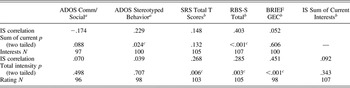
The Cronbach alpha values for the 41 items on the IS were high (0.904), and they were also strong for the eight interference items (0.808). Table 2 presents the correlations between the IS and the ADOS, the RBS-R, the BRIEF and the SRS in the HF-ASD sample only (to avoid artificially increasing the correlation coefficients by including the very low scores on most of those measures in the NT individuals) after FDR correction for multiple comparisons. As expected, the IS scales were strongly positively correlated with the RBS-R. The number of current interests was correlated with the ADOS Stereotyped Behavior Scale. The intensity of interests was also positively correlated with the SRS and the BRIEF. The relationships with the ADOS, the SRS, and the RBS-R lend support for the IS's construct validity.
Interests Scale correlations for high-functioning autism spectrum disorder participants only
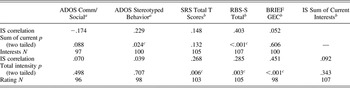
Note: ADOS, Autism Diagnostic Observation Schedule; SRS, Social Responsiveness Scale; RBS, Repetitive Behavior Scale; BRIEF, Behavior Rating Inventory of Executive Function; GEC, Global Executive Composite; IS, Interests Scale.
aSpearman correlation.
bPearson correlation.
cSignificant correlations after false discovery rate correction (q < .05).
Multiple regression analyses revealed that age, gender, and full-scale IQ do not significantly predict either number of interests (R 2 = .012; F = 1.79, p = .52; with none of the covariates approaching significance) or intensity of interests (R 2 = .040; F = 1.04, p = .67; with none of the covariates approaching significance) on the IS. Within the HF-ASD group, psychotropic medication use also did not predict IS scores (number of interests R 2 = .005; F = 0.49, p = .49; intensity of interests R 2 = .009; F = 0.06, p = .82).
We hypothesized that individuals with HF-ASD would have fewer interests and that these interests would be more intense. To examine IS score differences between the groups, a stepwise logistic regression analysis was conducted using likelihood ratios. This analysis revealed that the intensity rating significantly discriminated between the two groups (score = 51.06, df = 1, p < .001), although number of interests did not (score = 0.36) and was excluded from the model. Using the IS intensity rating alone, 81% of the individuals with HF-ASD were correctly classified, and 64% of the NT individuals were correctly classified (model –2 log likelihood ratio = 177.93; Cox & Snell R 2 = .304; Nagelkerke R 2 = .410). A discriminant function analysis was conducted to confirm this finding with similar results. The ability to discriminate between groups using only the intensity rating of the IS is striking because the IS does not have any items assessing the other components of the “triad of impairment” in autism (i.e., social reciprocity and social communication) per se.
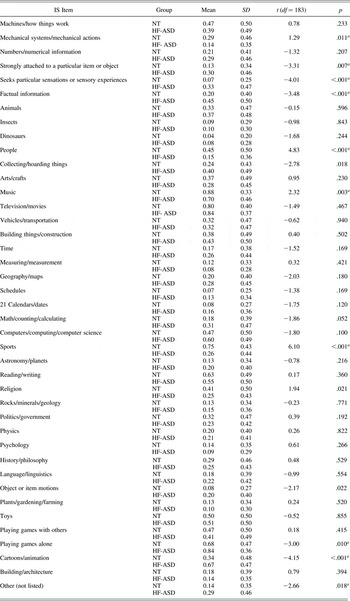
To examine the second hypothesis, that there will be differences in the foci of interests for NT individuals and those with ASD, t tests were conducted on each IS item. Item analyses with FDR correction for multiple comparisons suggest many similarities in areas of interests, with a few notable exceptions. Individuals with HF-ASD were more likely to show interest in factual information, cartoons, playing games alone, attachment to a particular object or item, mechanical systems/mechanical actions, and sensory seeking activities. NT individuals were more likely to be interested in people, music, and sports. The two groups did not differ in many of the other nonsocial interests, such as computers, machines, maps, insects, calendars, or math, although many people assume that these interests are more common in individuals with ASD. See Table 3 for details.
Group differences on IS items

Note: The mean and standard deviation range is 0–1. IS, Interests Scale; NT, neurotypical; HF-ASD, high-functioning autism spectrum disorder.
aThe group difference is significant after false discovery rate correction (q < .05).
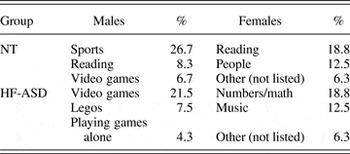
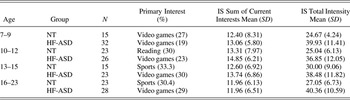
We further explored interest areas in a more qualitative way. At the end of the IS, the caregiver is asked to specify the individual's primary interests. We compared the top three specific interests for males and females with and without HF-ASD (see Table 4). It was compelling to observe that males from both groups shared an interest in video games, but there was no overlap in the primary interests of females from each group; however, this potential gender difference should be interpreted with caution because there were relatively few females in the present study. Age differences were explored in a similar way (see Table 5). It is notable that the primary interest across all ages in the HF-ASD group was video games, while there was a shift away from video games in the NT group, which went from video games in the children, to reading in the preadolescents, to sports in adolescents and young adults.
Primary interests by group and gender

Note: NT, neurotypical; HF-ASD, high-functioning autism spectrum disorder.
IS mean scores and primary interests by group and age

Note: IS, Interests Scale; NT, neurotypical; HF-ASD, high-functioning autism spectrum disorder.
Discussion
We find that (a) interests in HF-ASD individuals are more intense but not more limited in number/scope (i.e., not “restricted”) than those found in NT individuals; (b) fact-, object-, and sensory-oriented interests are greater in HF-ASD, whereas people- and sports-oriented interests are greater in NT individuals; (c) the areas of interest for males and females differ in both groups; and (d) the intensity of interests is associated with other ASD-related behaviors (e.g., symptoms) and difficulties (e.g., EF).
The present study shows that individuals with HF-ASD do not have fewer interests than do NT individuals, contrary to our predictions but consistent with a study that had a similar finding that was published while the present study was under review (Turner-Brown et al., Reference Turner-Brown, Lam, Holtzclaw, Dichter and Bodfish2011). Rather, the intensity of their interests is greater, and their interest areas are less likely to be socially oriented (e.g., interaction with others) and more likely to be object or sensory oriented, consistent with our predictions. This suggests that the DSM-IV criterion, “encompassing preoccupation with one or more stereotyped and restricted patterns of interest that is abnormal either in intensity or focus,” is the best way to distinguish the interests in HF-ASD from those in NT development, not merely the presence of an intense interest nor a restriction in the number of interests (APA, 2000).
There were many intuitive, significant group differences in the interest areas of NT and HF-ASD individuals, such as the HF-ASD group almost exclusively showing interests in a very particular item or object, sensory interests, collecting/hoarding things, and interest in factual information, while interest in sports rarely occurred in HF-ASD. This finding is also consistent with Turner-Brown et al. (Reference Turner-Brown, Lam, Holtzclaw, Dichter and Bodfish2011). The present study extends those findings with a qualitative analysis of the main interest areas broken down by gender and group (i.e., NT vs. HF-ASD), which revealed no overlap in interests in females, while males had an overlapping interest in video games (though they were especially common in HF-ASD). In typical development, common interests are commonly used to make social contacts (e.g., sports, clubs, or summer camps; Werner, Reference Werner1993), but this same process does not always hold true in ASD (Klin et al., Reference Klin, Danovitch, Merz and Volkmar2007). However, CIs can be used therapeutically as motivators/reinforcers to increase socialization (Baker, Reference Baker2000; Baker et al., Reference Baker, Koegel and Koegel1998; Boyd et al., Reference Boyd, Conroy, Mancil and Nakao2007), but it may be more difficult to use the CIs of females with HF-ASD to build social interactions with NT females, given the lack of overlap of typical areas of interest.
Furthermore, this study links everyday EF (BRIEF) with intensity of CIs (regardless of content area) and demonstrates an association between CIs and greater difficulties with social reciprocity and social communication (SRS). Whether intensity of CIs interferes with daily social interactions or is just a proxy for more intensity of autism-related behavior regardless of domain is a question for future research. However, these findings are consistent with Klin and colleagues' (Reference Klin, Danovitch, Merz and Volkmar2007) suggestion that CIs are related to the social and repetitive core symptoms in HF-ASD. CIs may also cause significant family stress, as suggested by Bishop, Richler, Cain, and Lord's (Reference Bishop, Richler, Cain and Lord2007) finding of increased parental stress with higher reports of restricted and repetitive behaviors and interests on the ADI-R. Therefore, treatment of CIs to increase adaptability, reduce social deficits, and reduce parental distress is an important clinical need for individuals with ASD (Boyd, McDonough, & Bodfish, Reference Boyd, McDonough and Bodfish2011). A recent single case design study suggested that training parents to use behavioral methods (discrete trial) to reduce higher order repetitive behaviors in young children with ASD holds promise (Boyd, McDonough, Rupp, Khan, & Bodfish, Reference Boyd, McDonough, Rupp, Khan and Bodfish2011). The strong relationship we have identified between everyday EF and CIs in HF-ASD might offer an additional avenue for therapy in older children and adolescents: cognitive behavioral intervention could improve flexibility, inhibition, generativity, and organization, and thereby reduce the intensity and interference of these behaviors. Such an intervention has recently been developed to improve EF in ASD (Cannon, Kenworthy, Alexander, Werner, & Anthony, Reference Cannon, Kenworthy, Alexander, Werner and Anthony2011), although its effectiveness in reducing the intensity of CIs remains an open question. This intervention model includes the development of alternative intrinsic motivators, because there has been recent evidence suggesting dysfunction in the neural reward system in ASD (Dichter et al., Reference Dichter, Felder, Gren, Rittenburg, Sasson and Bodfish2012). It is also possible that improved social engagement and pragmatic language skills result in a reduction of the intensity of CIs, as can happen in repetitive behaviors (e.g., Koegel, Koegel, Hurley, & Frea, Reference Koegel, Koegel, Hurley and Frea1992), although this is not necessarily supported in HF-ASD (Piven, Harper, Palmer, & Arndt, Reference Piven, Harper, Palmer and Arndt1996).
The measure of interests used here, the IS, appears to be an excellent complementary assessment tool to the ADI/ADOS because it offers a detailed, continuous measure that can be used in both ASD and NT children and adults. This issue is particularly important when looking for measures to assess nonsocial phenotypes in family and/or genetic association studies. For example, a recent compelling study by Smith et al. (Reference Smith, Lang, Kryzak, Reichenberg, Hollander and Silverman2009) identified a strong familial pattern of intense preoccupations but used the ADI-R for the children with ASD and the Modified Personality Assessment Scale—Revised (Tyrer, Reference Tyrer and Tyrer1988) for their biological parents. The IS would allow using the same instrument to assess this domain in the proband and first-degree relatives, whether siblings or parents. In addition, the IS had strong positive correlations with scores on the the ADOS and the RBS-R in the subjects with HF-ASD. These findings lend support for the IS's construct validity by revealing a strong relationship between intensity of CIs and other restricted and repetitive behaviors (RBS-R).
Contrary to previous research in ASD (Klin et al., Reference Klin, Danovitch, Merz and Volkmar2007; Moore & Goodson, Reference Moore and Goodson2003; Ozonoff, et al., Reference Ozonoff, South and Miller2000), we did not find any significant relationships between number or intensity of CIs and age, gender, medication use, or IQ in school age children and young adults. It would be especially important, however, to investigate this with the IS in a younger age range, because both the Moore and Goodson (Reference Moore and Goodson2003) and Klin et al. (Reference Klin, Danovitch, Merz and Volkmar2007) studies showed variation in prevalence of CIs with age. The Ozonoff et al. (Reference Ozonoff, South and Miller2000) study suggested an increase in CIs with age into adolescence, although this trend was not significant and was based on parent recollection. The lack of association with IQ suggests that, within the restricted range of low average to above average IQ, CIs are not related to IQ as they are in samples that include individuals with ID. Inconsistent with our predictions, intensity and number of CIs did not correlate with IQ, although our findings are consistent with a prior study of HF-ASD individuals (Bishop, Richler, & Lord, Reference Bishop, Richler and Lord2006). CIs may be like “insistence on sameness” behaviors in that they are more prevalent in higher IQ individuals with ASD and unlike repetitive behaviors, which are more prevalent in lower IQ individuals with ASD (Richler, Huerta, Bishop, & Lord, Reference Richler, Huerta, Bishop and Lord2010).
The findings of this study, although maximizing ecological validity, are limited due to reliance upon parent-report measures of not only CIs but also many of the correlates. Future research might include cross-informant and observational methods. Moreover, neuroimaging technologies could be used to assess neural underpinnings of intensity of CIs in HF-ASD and NT individuals, similar to prior investigations of interest areas in ASD (Grelotti et al., Reference Grelotti, Klin, Gauthier, Skudlarski, Cohen and Gore2005). Longitudinal studies including preschool aged children could examine the changing nature of interests over time, look for distinguishing patterns in ASD, and explore the potential relationship between CIs and subsequent higher academic pursuits and/or employment opportunities/careers. Finally, our sample was purposely restricted to HF-ASD because of the higher prevalence of CIs in this group and the ability to have age-matched NT controls, but future studies should also include the full autism spectrum and a full range of intellectual abilities. Although we had a full range of IQs above the ID cutoff, our sample was skewed toward higher IQs in both groups (means = 115 and 112), and a study with a lower mean IQ might have a different association with IQ. It would also be interesting to compare the areas of interest in individuals with ID and ASD to those of individuals with ID and no ASD. They may differ in intensity but not in area of interest.
In conclusion, consistent with ASD diagnostic criteria, we find more intense interests among individuals with HF-ASD versus NT using the IS. It is intriguing that the overall number of interests did not differ between HF-ASD and NT individuals, although NT individuals were more likely to show socially oriented interests while individuals with HF-ASD were more likely to show fact-, object-, or sensory-oriented interests. These findings have strong clinical implications regarding the importance of documenting intense, unusual interests as opposed to limited numbers of interests in diagnosing HF-ASDs. Finally, CIs were related to repetitive behaviors (from the RBS-R and the ADOS), and autistic traits in general (from the SRS), which implies that CIs should be important targets of intervention. The association between CIs and everyday executive control difficulties (from the BRIEF) indicates that CI intervention strategies could include teaching EF skills. The BRIEF-CI association also has theoretical implications for our understanding of the link between executive dysfunction and core nonsocial symptoms of ASD. Overall, these findings indicate that measures of CIs, such as the IS, may prove useful in future phenotyping and behavior genetic studies in HF-ASD.