Introduction
The blackspot seabream, Pagellus bogaraveo (Brünnich, 1768), is a commercially important fish species that occurs in the north-east Atlantic and Mediterranean. It is a benthopelagic fish, occurring at depths of up to 800 m, mostly on the continental shelf break and slope (Spedicato et al., Reference Spedicato, Greco, Sophronidis, Lembo, Giordano and Argyri2002), and on sites of high steepness around islands and seamounts in oceanic environments (Menezes et al., Reference Menezes, Sigler, Silva and Pinho2006). It is an omnivorous fish with a preference for animal prey (Stergiou & Karpouzi, Reference Stergiou and Karpouzi2002), including a wide variety of benthic and pelagic organisms (Morato et al., Reference Morato, Solà, Grós and Menezes2001). Studies of the parasite fauna of this sparid fish are scarce, and most information on its parasites comes from general surveys encompassing several fish species from a certain region. Recently, there have been studies on the anisakid nematodes (Costa et al., Reference Costa, Madeira, Pontes and D'Amelio2004a; Hermida et al., Reference Hermida, Mota, Pacheco, Santos, Cruz, Saraiva and Tamagnini2012a) and ectoparasites (Hermida et al., Reference Hermida, Cruz and Saraiva2012b) of P. bogaraveo from Portuguese waters, but knowledge of its gastrointestinal helminth fauna is only just beginning to be gathered.
The gastrointestinal tract of fish is a rich and complex environment that can be exploited by numerous parasites. The helminth parasite fauna of fish is determined partly by the fish species, due to the varying degrees of phylogenetic specificity exhibited by parasites, but certain features of the host, such as depth range and feeding habits, are also important in influencing the probability of contact with different parasite species, and even more so in the case of gastrointestinal parasites which are trophically acquired. These features can vary geographically within the normal range of the species, due to environmental differences such as topography, resource availability and local food web structure (Marcogliese, Reference Marcogliese2002).
At the local level, parasite communities are conditioned by the availability of suitable intermediate hosts, which depends, in turn, on adequate abiotic conditions for their proliferation (Poulin, Reference Poulin1997). Local parasite communities can therefore vary widely among the geographical range of the fish host, especially if there is little contact between regions (Poulin, Reference Poulin1998). In this study, P. bogaraveo specimens from four localities in mainland waters and two Atlantic archipelagos, Madeira and Azores, were sampled and the gastrointestinal communities compared between them.
The ability of different parasite species to exploit specific microhabitats within the host may also affect the structure of parasite communities (Sasal et al., Reference Sasal, Niquil and Bartoli1999). The distribution of species among available niches and the evenness in resource utilization are important ecological properties of parasite communities that have seldom been studied. Keeney & Poulin (Reference Keeney and Poulin2007) have applied the concepts of functional richness and functional evenness, originally defined in the context of other types of ecological communities, to the study of fish parasite communities, and their results show that functional evenness tends to increase with species richness, which suggests that when new parasite species join a community, they do so by filling empty niches, leading to a more even use of resources when more species are present. The distribution of helminths along the gastrointestinal tract is arguably the most important facet of their niche, because it includes not only their spatial distribution, but also captures other features of their microhabitat, such as differences in available nutrients, pH, digestive enzymes of the host and bacterial flora, among others (Keeney & Poulin, Reference Keeney and Poulin2007).
Materials and methods
Collection and examination of fish
A total of 348 specimens of P. bogaraveo from six localities in Portuguese waters were obtained from commercial catches between the years of 2009 and 2011. Sampling was carried out during autumn/winter and spring/summer periods, and the sampled localities were the two Atlantic archipelagos of Madeira (32°22′N–33°8′N, 16°16′W–17°16′W) and Azores (36°55′N–39°45′N, 25°W–31°15′W) and four localities along the Portuguese mainland coast: Matosinhos (41°18′N 8°68′W), Figueira da Foz (40°15′N 8°86′W), Peniche (39°21′N 9°22′W) and Sagres (37°N 8°56′W). The numbers of fish analysed from each locality (N) are presented in table 1. Fish were transported on ice to the laboratory, weighed and measured before being frozen in individual plastic bags. After defrosting, each fish was dissected and analysed for the presence of gastrointestinal helminth parasites. The digestive tract was divided into its natural parts: oesophagus, stomach, pyloric caeca, intestine and rectum; the intestine was further divided at its natural folds into anterior, mid and posterior intestine. All parts were observed separately under a stereomicroscope and parasites were collected, counted, cleaned in saline solution and stored in 70% alcohol (v/v) for further processing. The location of each parasite within the host was recorded. Digenean trematodes and cestodes were stained in carmine following routine laboratory procedures. Nematodes and acanthocephalans were cleared with increasing concentrations of glycerol and temporary mounts were prepared for microscopic observation. All helminths were observed in a Zeiss Axiophot optical microscope and measurements were taken using a digital camera and Axiovision Zeiss Image Analysis System (Zeiss, Oberkochen, Germany).
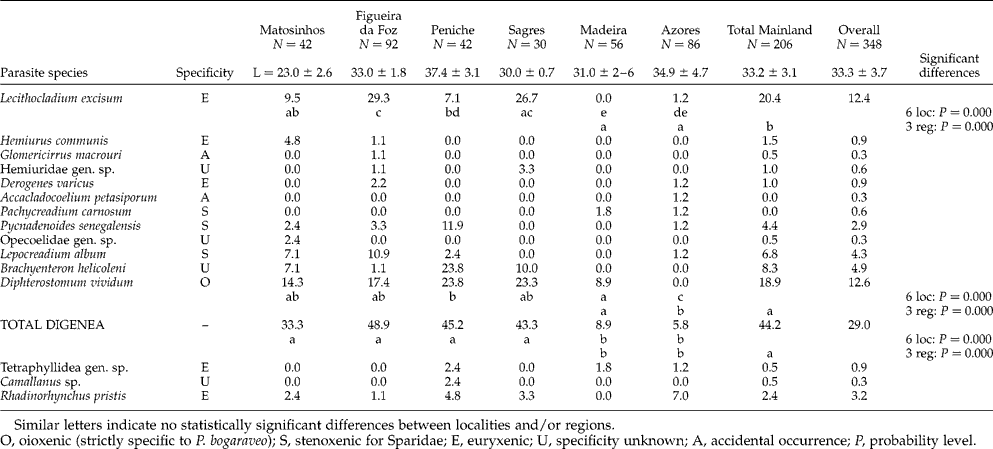
Prevalence (%) of gastrointestinal helminth infection in Pagellus bogaraveo from mainland Portugal (Matosinhos, Figueira da Foz, Peniche and Sagres) and Atlantic archipelagos (Madeira, Azores). Significant differences were detected among six localities and among three regions (Mainland, Madeira and Azores) by chi-square test.

N, Number; L, total length (mean ± standard deviation, in centimetres).
Similar letters indicate no statistically significant differences between localities and/or regions.
O, oioxenic (strictly specific to P. bogaraveo); S, stenoxenic for Sparidae; E, euryxenic; U, specificity unknown; A, accidental occurrence; P, probability level.
Data analysis
Prevalence and intensity of infection were determined according to Bush et al. (Reference Bush, Lafferty, Lotz and Shostak1997). Statistical analyses were performed using IBM SPSS statistics software (SPSS Inc., Chicago, Illinois, USA). Whenever possible, prevalence and intensity of infection were compared between all six localities studied, and also between the three regions (Mainland, Madeira and Azores) using a chi-square test for prevalences, and the non-parametric Kruskal–Wallis test for intensities, followed by multiple comparisons whenever significant differences were detected. The correlation between fish size (total length) and parasite species abundance was analysed by Spearman rank correlation. For all tests, statistical significance was accepted when P < 0.05.
The first-order Jackknife species richness estimator (Jack1) was calculated from abundance data according to Gotelli & Colwell (Reference Gotelli, Colwell, Magurran and McGill2011). Simpson's diversity index, evenness index E and the Berger–Parker dominance index were determined according to Magurran (Reference Magurran1988). Functional richness and functional evenness with regard to niche utilization were determined according to Keeney & Poulin (Reference Keeney and Poulin2007), using the Evar functional evenness index derived from Smith & Wilson (Reference Smith and Wilson1996). Functional evenness was determined using abundance data and also using a rough estimate of biomass, which was obtained by multiplying the number of individuals of each species in each niche by their average length (Keeney & Poulin, Reference Keeney and Poulin2007). Whenever possible, length averages were obtained from measurements of a minimum of ten distended individuals. Separate measurements were taken of male and female acanthocephalans, which present sexual dimorphism.
Results
Helminth species and infection levels
From a total sample of 348 fish obtained from six different localities in Portuguese waters, including the two Atlantic archipelagos of Madeira and Azores, 15 species of gastrointestinal helminths were detected. Digenean trematodes were the most diverse group overall. Ten digenean species were detected: the hemiurids Lecithocladium excisum (Rudolphi, 1819), Hemiurus communis Odhner, 1905 and Glomericirrus macrouri (Gaevskaja, 1973), the derogenid Derogenes varicus (Müller, 1784), the accacoelid Accacladocoelium petasiporum (Odhner, 1928), the opecoelids Pycnadenoides senegalensis Fischthal & Thomas, 1972 and Pachycreadium carnosum (Rudolphi, 1819), the lepocreadiid Lepocreadium album (Stossich, 1890), and the zoogonids Diphterostomum vividum (Nicoll, Reference Nicoll1912) and Brachyenteron helicoleni Bray & Kuchta, 2006. In addition, some damaged specimens were detected which could only be identified as Hemiuridae gen. sp. and Opecoelidae gen. sp. Other helminths detected were the acanthocephalan Rhadinorhynchus pristis (Rudolphi, 1802), the nematode Camallanus sp. Railliet & Henry, 1915 and Tetraphyllidea gen. sp. cestode larvae. Local, regional and overall prevalence values are presented in table 1, as well as statistically significant differences detected between localities or regions.
The prevalence of digeneans showed a striking difference between mainland Portuguese waters and the islands (Madeira and Azores), being significantly higher in all mainland samples and much lower in both archipelagos. The same pattern was observed for the hemiurid L. excisum, which had a global prevalence of 20.4% in the mainland and was the most prevalent species in Figueira da Foz and Sagres, but did not occur in Madeira and had a very low prevalence in the Azores. The most prevalent species overall was the zoogonid D. vividum, which was also the most prevalent species in the two other mainland localities, Matosinhos and Peniche, in the latter having the same prevalence as another zoogonid, B. helicoleni, which occurred in all mainland samples but not in the islands. Diphterostomum vividum did not occur in the Azores, and had a lower prevalence in Madeira (8.9%) than in any mainland location; even so, it was the most prevalent species in this region, where the gastrointestinal helminth community was most depauperate. In the Azores, all species detected had extremely low prevalences, the most prevalent species being the acanthocephalan R. pristis.
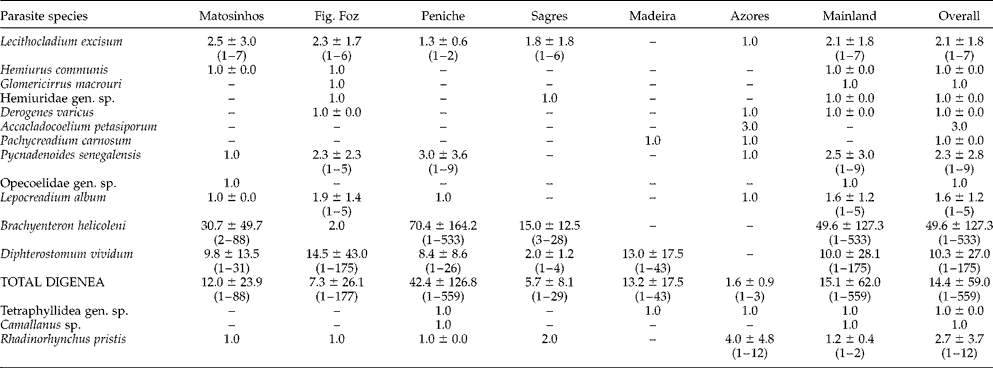
Intensity levels were generally low, and no significant differences were detected between localities or regions (table 2). The helminth species with highest intensity values were the two zoogonid digeneans, D. vividum and B. helicoleni, which presented mean intensities of 10.3 ± 27.0 and 49.6 ± 127.3, respectively, and occasionally reached very high numbers in individual hosts (175 D. vividum in a fish from Figueira da Foz, and 533 B. helicoleni in a fish from Peniche). The only other species to register more than ten individuals in a single host was R. pristis, of which an infrapopulation of 12 individuals (7 males and 5 females) was detected in a fish from Azores.
Intensity (mean ± SD, range) of gastrointestinal helminths in P. bogaraveo from mainland Portugal (Matosinhos, Figueira da Foz, Peniche and Sagres) and Atlantic archipelagos (Madeira and Azores).
Positive correlations were found between fish length and abundance of R. pristis (r= 0.111, P= 0.039) and of P. senegalensis (r= 0.139, P= 0.010).
Helminth communities and niche ranges
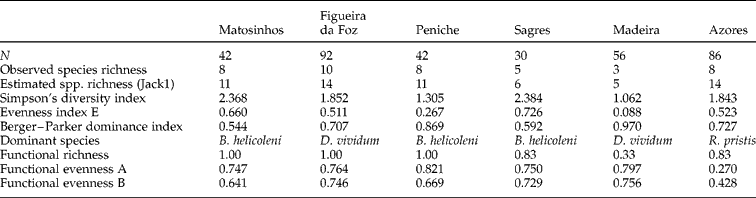
Several ecological parameters were determined in order to compare the six gastrointestinal helminth communities (table 3). Observed species richness was higher in Figueira da Foz (ten species) and lower in Madeira, where only three helminth species were detected. The helminth community of fish from Azores, although presenting high species richness (8) was mostly composed of species that infected no more than a single host. Species richness estimated by the Jackknife 1 method was highest in Figueira da Foz and Azores. Both diversity and evenness were higher in Matosinhos and Sagres. Madeira had the least diverse and most uneven helminth community. The dominant species was always a digenean of the family Zoogonidae except in the Azores, where the acanthocephalan R. pristis was the dominant species. Diphterostomum vividum dominated the communities from Figueira da Foz and Madeira, and B. helicoleni was the dominant species in the remaining mainland localities.
Ecological parameters of the gastrointestinal helminth communities of Pagellus bogaraveo from different localities in Portuguese waters.
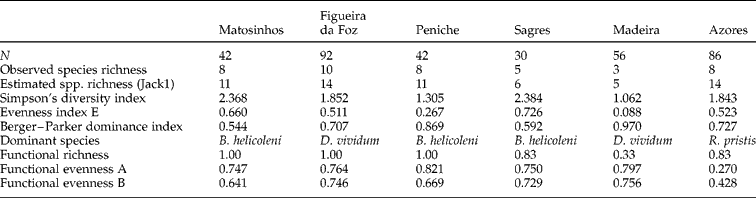
A, based on abundance data; B, based on estimated biomass.
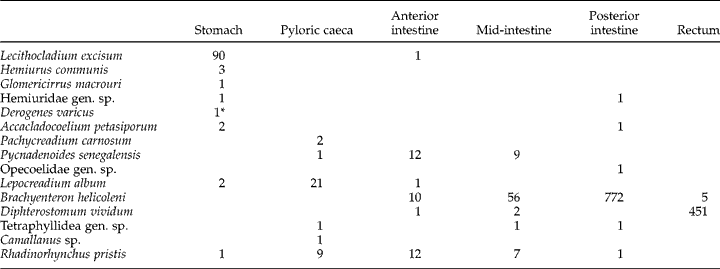
Several species exhibited a preference for particular niches within the gastrointestinal tract of the host. The niche range of each species is presented in table 4. Hemiurids were mainly found in the stomach, the lepocreadiid L. album in the pyloric caeca, and the zoogonids B. helicoleni and D. vividum were mostly detected in the posterior intestine and the rectum, respectively. The acanthocephalan R. pristis had the widest range of all species, occurring in all portions of the digestive tract except the rectum.
Niche range of gastrointestinal helminth parasites of P. bogaraveo and number of helminths of each species detected in each subsection.
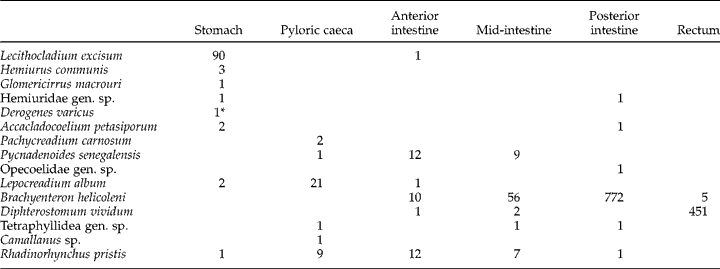
* Two additional specimens were detected on the gills, but were considered to have migrated to that location, and hence were disregarded in this analysis.
The parasite communities of fish from Matosinhos, Figueira da Foz and Peniche exhibited the highest functional richness, meaning that all portions of the gastrointestinal tract considered were occupied by at least one parasite species, whereas in Madeira functional richness was very low, with only two subsections of the intestine being utilized by helminths. Functional evenness was highest in Peniche when calculated from abundance data, but it was higher in Madeira when biomass estimates were used instead; in both cases it was lowest in the Azores community.
Discussion
The hemiurid L. excisum was the most prevalent helminth in P. bogaraveo from mainland waters, as well as the second most prevalent species overall, but it did not occur in Madeira and had a very low prevalence in the Azores. This parasite was also found to be absent in Scomber colias from Madeira and the Canary Islands, whereas it was present in Morocco and Mauritania, and also, albeit with a much lower prevalence, in the Azores (Shukhgalter, Reference Shukhgalter2004; Oliva et al., Reference Oliva, Valdivia, Costa, Freitas, Pinheiro de Carvalho, Sánchez and Luque2008; Costa et al., Reference Costa, Cavallero, D'Amelio, Paggi, Santamaria, Perera, Santos and Khadem2011). It is a euryxenic parasite that occurs in the stomach of numerous fish hosts, and had been detected previously in Portugal (Bray, Reference Bray1973; Rego et al., Reference Rego, Carvalho-Varela, Mendonça and Afonso-Roque1985; Sequeira et al., Reference Sequeira, Gordo, Neves, Paiva, Cabral and Marques2010). The significantly higher prevalence of L. excisum in mainland waters may be related to higher availability of benthic invertebrates that serve as intermediate hosts for this species, especially harpacticoid copepods and polychaetes (second intermediate hosts), on the continental shelf and slope when compared with oceanic habitats such as seamounts (Koie, Reference Koie1991; Marcogliese, Reference Marcogliese2002). These invertebrates tend to increase in eutrophic environments (Pérez-del-Olmo et al., Reference Pérez-del-Olmo, Raga, Kostadinova and Fernández2007), whereas oceanic habitats are characterized by oligotrophic waters and so do not favour their proliferation.
Other hemiurids occurred only in mainland waters (H. communis, G. macrouri and Hemiuridae gen. sp.), but with low prevalences. Hemiurus communis is a euryxenic digenean which also uses harpacticoid copepods as second intermediate hosts (Koie, Reference Koie1995), and had been detected previously in P. bogaraveo from the Atlantic (Nicoll, Reference Nicoll1914; Little, Reference Little1929), whereas G. macrouri is a parasite of macrourids that has also been detected in other deep-water fishes (e.g. Hoplostethus atlanticus) at depths of 500–2000 m, occurring on the edge of the continental shelf on both sides of the Atlantic (Gibson & Bray, Reference Gibson and Bray1986). The occurrence of a single individual of this species in a P. bogaraveo specimen from Figueira da Foz is likely to be accidental and due to a similarity of habitat and feeding habits.
The derogenid D. varicus, another euryxenic species, is one of the most widely distributed digeneans worldwide, usually occurring in small numbers (Manter, Reference Manter1954; Koie, Reference Koie1979), and had been detected previously in P. bogaraveo from the north-east Atlantic (Little, Reference Little1929). Two of the three specimens detected were found in the gill chamber of the host, but this might result from a post-mortem migration from the stomach, as also observed by Kostadinova et al. (Reference Kostadinova, Power, Fernández, Balbuena, Raga and Gibson2003), which is likely since they tend to occupy the cardiac end of the stomach and sometimes the oesophagus (Blair et al., Reference Blair, Bray and Barker1998).
Accacladocoelium petasiporum infected a single fish from Azores. This species had previously been detected in this region in the sunfish Mola mola, at a depth of 245 m (Gaevskaya, Reference Gaevskaya2002). Since sunfish are known to feed mostly on gelatinous zooplankton (Pope et al., Reference Pope, Hays, Thys, Doyle, Sims, Queiroz, Hobson, Kubicek and Houghton2010), these are expected to be the main intermediate hosts of accacoeliid trematodes (Bray & Gibson, Reference Bray and Gibson1977). Pagellus bogaraveo is an omnivorous species that feeds on both benthic and pelagic prey (Morato et al., Reference Morato, Solà, Grós and Menezes2001), and may therefore have acquired this infection accidentally through the ingestion of infected gelatinous organisms.
The opecoelid P. senegalensis has been reported from P. bogaraveo in the Atlantic and Mediterranean (see references in Bartoli et al., Reference Bartoli, Gibson, Bray, Maillard and Lambert1989). Both this species and P. carnosum, which was detected here in P. bogaraveo for the first time, seem to show stenoxenic specificity towards the Sparidae (Bartoli et al., Reference Bartoli, Gibson and Bray2005). This is also the case for L. album, which has been reported mostly from sparid fish in the north-east Atlantic and Mediterranean (Bartoli et al., Reference Bartoli, Gibson and Bray2005).
The most prevalent species overall was the zoogonid D. vividum, which is the only species detected in this study that is strictly oioxenic towards its definitive host, P. bogaraveo (Bray, Reference Bray1987), having been reported from the north-east Atlantic (Nicoll, Reference Nicoll1912, Reference Nicoll1914; Bray & Gibson, Reference Bray and Gibson1986). The other zoogonid detected, B. helicoleni, had only previously been recorded in small numbers from Helicolenus dactylopterus off Scotland, at a depth of 1600 m (Bray & Kutcha, Reference Bray and Kutcha2006). Its presence in P. bogaraveo seems to confirm a preference for the deep-water environment. In the present study, B. helicolenus occurred in all mainland localities but not in the islands. Interestingly, the highest prevalence was detected in the sample from Peniche, whereas a recent parasitological study of H. dactylopterus from the same locality failed to yield any specimens of this zoogonid (Sequeira et al., Reference Sequeira, Gordo, Neves, Paiva, Cabral and Marques2010), suggesting that H. dactylopterus is not its main host in Portuguese waters. However, at the moment it seems premature to try to assess its specificity.
Rhadinorhynchus pristis was the most prevalent species in Azores, having also occurred in all mainland samples, but not in Madeira, which is unexpected since it has been previously detected in other fish species from that region by Costa et al. (Reference Costa, Pontes and Rego2004b, Reference Costa, Santos, Costa, Biscoito, Pinheiro de Carvalho and Melo-Moreira2009). Like most acanthocephalans, it shows little specificity, and its hosts are more likely to be related ecologically through similar diets and habitat preferences than phylogenetically (Kennedy, Reference Kennedy2006). The higher prevalence of R. pristis in Azores might reflect a greater amount of pelagic crustaceans in the diet of P. bogaraveo from this region, as these are used as intermediate hosts by this acanthocephalan (Klimpel et al., Reference Klimpel, Rückert, Piatkowski, Palm and Hanel2006).
Two main patterns were evident in this study: on the one hand, the mainland helminth communities of P. bogaraveo exhibited significantly higher infection levels, especially of digeneans, when compared to the islands; and, on the other hand, the two archipelagos differed a great deal in terms of diversity, with Azores showing higher diversity and evenness, whereas Madeira had a very impoverished helminth community. Sasal et al. (Reference Sasal, Niquil and Bartoli1999) found the diet of the host to be the most important factor affecting digenean diversity in sparid fish from the Mediterranean. Pagellus bogaraveo is a benthopelagic fish with a diverse omnivorous diet that includes benthic and pelagic organisms (Morato et al., Reference Morato, Solà, Grós and Menezes2001), and can thus be in contact with a wide range of potential intermediate and paratenic hosts of helminth parasites. However, helminth richness will be locally conditioned by the availability of suitable intermediate hosts, especially benthic invertebrates in the case of digeneans.
The high diversity and infection levels of digeneans in mainland waters may reflect the high diversity of benthic fauna in continental slope waters, as many of these organisms can serve as intermediate hosts for trematodes (Bray et al., Reference Bray, Littlewood, Herniou, Williams and Henderson1999; Marcogliese, Reference Marcogliese2002). Within mainland waters, the sample from Peniche had the lowest diversity and evenness, as well as the highest prevalence of both zoogonid species. These differences might be related to underwater topology, since one of the largest submarine canyons in Europe occurs in this region, promoting organic enrichment due to high levels of sedimentation and thus causing a severe reduction in diversity of benthic organisms (Cúrdia et al., Reference Cúrdia, Carvalho, Ravara, Gage, Rodrigues and Quintino2004).
Both island systems presented low helminth infection levels, which may be related to the low availability of suitable intermediate hosts. Oceanic environments do not present favourable conditions for the presence of many benthic invertebrates and, even when such conditions are present, such as on seamounts, many invertebrate species are limited in their distributions due to low dispersal capacity (Parker & Tunnicliffe, Reference Parker and Tunnicliffe1994). Although in Azores helminth diversity was relatively high, all digenean species were rare, occurring in only one fish specimen, and may represent accidental infections or reflect migratory events.
The high values of estimated species richness in Figueira da Foz and Azores reflect the high proportion of rare species found in these localities, since the Jackknife 1, like other non-parametric species richness estimators, uses the proportion of rare species detected in the community to infer the existence of undetected species (Gotelli & Colwell, Reference Gotelli, Colwell, Magurran and McGill2011). This is one of the recommended methods to control for the effect of differences in sampling effort on estimates of total parasite species richness (Walther & Morand, Reference Walther and Morand1998). It provides a good estimation of the minimum number of species existing in a community (Gotelli & Colwell, Reference Gotelli, Colwell, Magurran and McGill2011). However, care must be taken when interpreting these results, since many of the rare species detected are probably accidental and their biological significance to the helminth communities of P. bogaraveo is therefore limited. Nonetheless, they reflect the wide diet range of this fish in this region (Morato et al., Reference Morato, Solà, Grós and Menezes2001), which seems to promote contact with many parasite species.
The gastrointestinal helminth community of P. bogaraveo from Madeira was the least rich, and presented the lowest diversity and evenness. Costa et al. (Reference Costa, Melo-Moreira and Pinheiro de Carvalho2012) also detected a less rich helminth parasite fauna in Trachurus picturatus from Madeira when compared with Azores and with a mainland sample from the West African Coast. Both in the case of T. picturatus (Costa et al., Reference Costa, Melo-Moreira and Pinheiro de Carvalho2012) and in the present study, this low diversity reflects a depauperate digenean fauna, which probably results from the absence of suitable intermediate hosts for many species. Furthermore, benthic production is known to decrease at lower latitudes and a shift to pelagic prey tends to occur in subtropical and tropical waters (Marcogliese, Reference Marcogliese2002).
The two zoogonid species exhibited the highest abundance, and dominated all but one of the six component communities in this study. This seems to be in line with the tendency for small-bodied species to occur at higher densities than larger species in most ecological communities, including parasite communities (Poulin et al., Reference Poulin, Luque, Guilhaumon and Mouillot2008), but it might also reflect, in the case of D. vividum, the strict specificity of this species (Bray, Reference Bray1987). Specialization might provide an advantage in competition with euryxenic species, as there is often a trade-off between the ability to use many host species and the average fitness achieved in these hosts (Poulin, Reference Poulin1998).
Azores was the only locality where the dominant species was an acanthocephalan. Helminth communities of marine fish are most often dominated by digeneans, and the occurrence of acanthocephalans is related to host diet (Kennedy, Reference Kennedy2006). The dominance of the P. bogaraveo helminth community by the acanthocephalan R. pristis in Azores has to be viewed in the light of the low abundance of digeneans in this region.
Microhabitat distribution within the gastrointestinal tract has been shown to be an important factor in determining the structure of helminth parasite communities (Sasal et al., Reference Sasal, Niquil and Bartoli1999). In this study several species presented a clear preference for certain regions of the gastrointestinal tract. Unsurprisingly, almost all hemiurids were found in the stomach. With a thick tegument and retractile ecsoma, these digeneans seem to be well adapted to the harsh stomach environment (Gibson & Bray, Reference Gibson and Bray1986), which is often avoided by other helminths due to the low pH.
The zoogonid D. vividum, on the other hand, exhibits a preference for the rectum (Bray & Gibson, Reference Bray and Gibson1986), and in this study 99.7% of all specimens of this zoogonid were in fact detected in that particular niche. The other zoogonid detected, B. helicoleni, had a slightly wider niche range, occurring throughout the intestine, but with 92% of specimens occurring in the posterior intestine, prior to the rectum. The different niche preferences on the part of the two zoogonids may be due to specific requirements, e.g. in terms of nutrients, or it may be related to competition between them, either past or present. Intense competition between abundant species may favour evolutionary divergence of their fundamental niches, leaving only the so-called ‘ghost of competition past’ (Poulin, Reference Poulin2001), and thus effectively avoiding competition. Interestingly, although the two species co-occured in nine fish, they never shared the same microhabitat, and in two cases D. vividum individuals occurred in the mid-intestine, but not in the posterior intestine, when there were B. helicoleni specimens in that niche, suggesting that D. vividum individuals might be occasionally displaced by the other zoogonid, and that current competition between these species may be important in defining their respective niches.
The opecoelid P. senegalensis occurred mostly in the anterior and mid-intestine, and L. album was mostly (88%) detected in the pyloric caeca, as verified by Sasal et al. (Reference Sasal, Niquil and Bartoli1999) in several sparid hosts. Other species occurred in very low numbers, precluding any meaningful observations on their niche range in this host.
The acanthocephalan R. pristis occurred in all regions except the rectum. The wide niche range of this species within the host's gastrointestinal tract might be related to its low specificity, since the anatomy of fish digestive tracts is very variable, which might prevent the evolution of niche specialization in parasites with low specificity towards the fish host. In addition, many acanthocephalan species are known to move within the digestive tract of the host, thus increasing their mating opportunities (Crompton, Reference Crompton1970).
The distribution of organisms in niche space is one of the factors that can determine community properties. Recently, Keeney & Poulin (Reference Keeney and Poulin2007) have applied the concepts of functional richness and functional evenness to fish parasite communities. Functional richness is a measure of the proportion of gastrointestinal subsections that are used by at least one worm, whereas functional evenness measures the evenness of distribution of helminths across all occupied niche sections (Keeney & Poulin, Reference Keeney and Poulin2007). In the present study, functional evenness was generally higher than in the cestode communities of elasmobranch hosts analysed by Keeney & Poulin (Reference Keeney and Poulin2007), and functional richness was similar (between 0.83 and 1.00), except in Madeira where the very impoverished helminth community occupied only 2 of 6 niches within the gastrointestinal tract of the host. Unlike the results of those authors, however, in the present study functional evenness values based on biomass estimates were actually lower than those based on abundance data, except for the Azores community. In the light of the extreme size differences between helminth species, even a rough estimate of biomass such as the one used here is a major improvement over abundance data per se (Keeney & Poulin, Reference Keeney and Poulin2007). Functional evenness calculated using estimated biomass is likely to be a more realistic measure of resource utilization by the helminth community.
Nonetheless, functional evenness must be understood in conjunction with functional richness. Thus, while the Madeira community has a high functional evenness, this refers to the utilization of only two intestinal regions on the part of a very impoverished helminth community, which can be seen by the low functional richness value, indicating that resources are in fact underutilized. In contrast, helminth communities from mainland waters, with a high functional richness and evenness, seem to demonstrate a balanced utilization of niche space, and are likely to represent more stable gastrointestinal helminth communities.
The Azores community clearly shows the lowest functional evenness, whether using abundance or biomass estimates. This low functional evenness reflects the uneven resource use on the part of a helminth community which, although presenting high species richness, diversity and evenness, is in fact constituted almost entirely of rare species. In these circumstances, functional richness and evenness seem to capture relevant aspects of community structure which other commonly used ecological indices miss.
In conclusion, gastrointestinal helminth communities of P. bogaraveo from mainland waters not only presented higher diversity and infection levels, especially of digenean species, but were characterized by high functional richness and evenness, indicating stable communities. In contrast, the gastrointestinal helminth community from Madeira was very depauperate and presented low functional richness, whereas the Azores community, although diverse, had very low functional evenness. These differences are likely to reflect biogeographical differences in the availability of benthic invertebrates and a shift to a more pelagic diet in subtropical waters.
Acknowledgements
The authors would like to thank Fernando Alexandre for proof-reading and helping to improve the manuscript. This work was supported by Fundação para a Ciencia e Tecnologia – FCT (M.H., Grant number SFRH/BD/47767/2008).