Introduction
Environmental degradation and resource depletion have long been intertwined with rapid economic growth (Jiang, Lin, & Lin, Reference Jiang, Lin and Lin2014). Effectively curbing environmental pollution has emerged as a monumental challenge for policymakers. However, due to the high costs of inspections and the inherent limitations in government administrative resources, coupled with information asymmetry, only a fraction of violations can be detected – barely scratching the surface of the problem. This reality presents considerable obstacles to the enforcement of environmental regulations. While punishment can deter repeat offenses by specific offenders, its broader goal is to discourage similar misconduct among other entities from preventing future violations. This raises the question of whether non-offending firms adjust their environmental strategies and strengthen their governance practices upon observing the penalties imposed on their peers. However, estimating their effects poses substantial empirical challenges due to (i) uncertainty regarding which other entities are most likely to respond to peer punishment and (ii) a dearth of ex-post behavioral strategy data on typically scrutinized outcomes. Despite fruitful findings on how environmental regulation affects corporate environmental governance, the scope mainly focuses on penalized firms, potentially understating the efficacy of sanctioning. This article aims to address this gap by investigating whether and how environmental penalties are effective in such general deterrence to peers.
A classic insight of institutional theory is that organizations look to their peers for cues to appropriate behavior (DiMaggio & Powell, Reference DiMaggio and Powell1983). In the social psychology and criminology literature, vicarious punishment describes how observing punishment for misconduct deters others by signaling illegality and severity. The perceived risk of facing future enforcement actions instills fear in observers, triggering a cognitive shift (Yin, Xu, & Wan, Reference Yin, Xu and Wan2014). Even more, organizational forms – groups of presumed similar organizations – tend to infer that actions observed in one member are likely to apply to others within the same category. Thus, instances of corporate deviance can damage the legitimacy of other similar organizations, as audiences tend to generalize negative perceptions from one deviant organization to others in the same category (Jonsson, Greve, & Fujiwara-Greve, Reference Jonsson, Greve and Fujiwara-Greve2009). To avoid such consequences, observers study the failures of firms that have undergone enforcement actions and take steps to prevent similar infractions when tempted by prohibited actions. Viewed in this light, the sanction itself has a learning-inhibiting or general deterrence effect on the observing peers (Trevino, Reference Trevino1992). Especially in environments marked by uncertainty and ambiguous formal regulations, where reliable information comes mainly from the cues furnished by observations or social learning, vicarious punishment is regarded as particularly relevant (Bandura, Reference Bandura, London and Rosenham1968).
China presents a prime opportunity to examine the general deterrence effect of environmental penalties on peers. The country’s evolving legal landscape and significant information asymmetry in the market create a highly uncertain environment for Chinese firms, encouraging them to rely on vicarious learning to gauge appropriate behaviors. Meanwhile, market-oriented incentives such as green taxation and financing remain underdeveloped in China, resulting in ex-post coercive enforcement playing a crucial role in regulating green practices by imposing penalties and raising the costs of non-compliance. For instance, China has implemented the ‘1 + N + 4’Footnote 1 legal framework for ecological and environmental protection, which features a stringent ‘double penalty system’ targeting both enterprises and individuals. By examining the effectiveness and reach of vicarious punishment in shaping firm behaviors in China – the world’s largest transition economy – this study offers a valuable reference for the research on the evaluation of policy deterrence effects in other transition economies, contributing to comparing and understanding the extent to which transgressive behaviors are tolerated across different institutional contexts.
Additionally, observers’ ability to internalize vicarious penalties hinges on an identification process, where they align themselves with the punished individual (Yin et al., Reference Yin, Xu and Wan2014). The closer the match between a company and its peers, the more likely it is to reference their decisions to mitigate potential failure risk. On the one hand, industry-specific constitutive rules typically outline the salient shared attributes of organizations within the same sector. Firms in the same industry often utilize similar resources and technologies and are frequently compared to one another by analysts and the capital market (Kedia, Koh, & Rajgopal, Reference Kedia, Koh and Rajgopal2015). Furthermore, inspection criteria and the likelihood of environmental enforcement actions vary across industries. On the other hand, organizational networks also exhibit a pronounced geographic dimension (Marquis & Tilcsik, Reference Marquis and Tilcsik2016). Businesses located in the same region tend to face similar levels of government enforcement and engage in more frequent managerial interactions than those situated farther apart. This geographic closeness makes them natural peers. Thus, we define peers as firms that are either within the same industry or in the same region. This study investigates the general deterrence effect of regulatory penalties on the environmental governance of industrial or regional peers in China, contributing to the literature.
First, it extends existing research on the deterrence effects of environmental enforcement. Previous studies have primarily focused on the target firms subject to law enforcement (Blundell, Gowrisankaran, & Langer, Reference Blundell, Gowrisankaran and Langer2020; Pan, Han, Li, & Wu, Reference Pan, Han, Li and Wu2022; Wang, Yuan, & Xie, Reference Wang, Yuan and Xie2023). Concentrating solely on the special deterrent effect on sanctioned firms does not fully capture the broader impact of environmental enforcement and will overlook the more profound, socio-pedagogical function of sanctions, which is essential for understanding their full impact (Beccaria, Reference Beccaria2016). In contrast, our study shifts focus from the penalized firms to their industry and regional peers. This represents an early effort to explore the broader implications of vicarious punishment in corporate environmental punishment research. By emphasizing the general deterrence effects of vicarious punishment – where observing firms may be influenced by the enforcement actions against their peers – we highlight that the peers are a crucial link between the specific deterrence effects on treated violators of an enforcement initiative and the general deterrent effect of changing all actual and prospective evaders’ perceptions of the likelihood that evasion will be detected and punished. The current article expands understanding of the scope of regulatory enforcement’s impacts and introduces a new, broader peer-oriented perspective for evaluating the effects of environmental enforcement.
Second, we contribute to a deeper understanding of peer effects from the perspective of inhibitive learning, an aspect that has often been overlooked in previous research. The management and finance literature has extensively examined how peers influence corporate behavior. However, the peer effect commonly discussed – often referred to as contagion or imitative effect – stems from social learning theory and competition theory, arguing that when peers consistently engage in certain behaviors, whether positive or negative, such behaviors gain legitimacy within the group and evolve into generalized rules and strategies. Individuals are more likely to adopt and directly replicate others’ behaviors, either to integrate into groups, compete, engage in interorganizational learning, or simply due to herd mentality, leading to the diffusion of behavior within organizational networks (Aghamolla & Thakor, Reference Aghamolla and Thakor2022; Bird, Edwards, & Ruchti, Reference Bird, Edwards and Ruchti2018; Dahl, Løken, & Mogstad, Reference Dahl, Løken and Mogstad2014; Hasan & Koning, Reference Hasan and Koning2019; Kamiya, Kang, Kim, Milidonis, & Stulz, Reference Kamiya, Kang, Kim, Milidonis and Stulz2021; Sharkey & Bromley, Reference Sharkey and Bromley2015; Tan, Yan, & Dong, Reference Tan, Yan and Dong2022; Truong, Reference Truong2023). In contrast to the imitative effect, we highlight the general deterrence effect driven by inhibitive learning, a less emphasized yet crucial for a comprehensive understanding of organizational behavior. It focuses on learning from failed experiences and choosing to avoid specific actions after perceiving the negative consequences of peers’ behaviors. We contribute to the literature on peer effect from the perspective of firms’ specific behaviors after observing peers’ environmental punishments rather than the likelihood of suffering the same punishment by showing how firms learn from the failures of their peers, leading them to self-regulate.
Third, our study contributes to institutional theory by addressing the need to comprehend the multiple influences that institutions exert on organizations. Organizations are intricately embedded within multiple institutional fields, from which they receive behavioral cues from diverse peer sets and face different institutional prescriptions imposed by various audiences (Marquis & Tilcsik, Reference Marquis and Tilcsik2016). Previous research has often concentrated on institutional transitions within a single field (Pache & Santos, Reference Pache and Santos2013), potentially overlooking the broader context. We not only compare industry and regional peers but also distinguish them based on factors such as distance, social influence, and the competitive and legal environment to test whether organizations seek additional institutional information when selecting and identifying with peers in the same institutional environment. It contributes to better differentiating which organizations within the same institutional context are perceived as the genuinely pertinent reference group or peers for a given firm.
Literature Review and Hypotheses Development
Theoretical Background of Peer Effect
Bandura’s social learning theory (Bandura, Reference Bandura1977) asserts that, as economic agents, businesses engage in transactions through complex and interdependent networks (Collins & Clark, Reference Collins and Clark2003). Within these networks, learning occurs not only through direct experience but also through vicarious means – by observing the behaviors of others (Leary & Roberts, Reference Leary and Roberts2014). Vicarious learning enables individuals to acquire extensive and systematic behavioral patterns simply by observing others, bypassing frequent trial and error. Effective observation impacts generalized rules and strategies, equipping individuals to navigate diverse situations. This vicarious learning can manifest as either an imitative or deterrent effect.
In terms of the imitative effect, individuals, by observing the behavior of others, can make rational judgments about appropriate behavioral strategies based on an analysis of costs and benefits and are more readily accepting others’ behavioral strategies from a socio-psychological perspective. This phenomenon, commonly referred to as the ‘peer effect’, has been extensively studied in various management research areas, including strategic management, organizational response to environmental stimuli, employees’ antisocial behavior, information disclosure, financing decisions, investment strategies, executive compensation, and risk management (e.g., Aghamolla & Thakor, Reference Aghamolla and Thakor2022; Foroughi, Marcus, Nguyen, & Tehranian, Reference Foroughi, Marcus, Nguyen and Tehranian2022; Leary & Roberts, Reference Leary and Roberts2014; Seo, Reference Seo2021; Truong, Reference Truong2023). Particularly in the case of misconducts, these effects are also known as contagion effects. In increasingly competitive markets, firms may adopt strategies such as utilizing low-cost, poor-quality raw materials, exploiting cheap labor, engaging in financial fraud, and aggressively evading taxes to enhance business performance. When such illegitimate practices become commonplace within a peer group, the psychological inertia of firms will be reinforced, fostering imitation among them. The pervasive belief that ‘the law doesn’t fault everyone’ or ‘everyone is doing it’ can diminish feelings of guilt, leading even initially ethical enterprises to align more closely with the normative practices of the broader group of ‘big dye’ and ultimately shift ethical standards.
In terms of the deterrence effect, witnessing another being punished for a particular behavior leads the viewer to expect a higher probability and severity of punishment for similar actions in the future from a social-psychological perspective (Bandura, Reference Bandura1977). Additionally, research on the normative pillar of legitimacy within institutional theory suggests that when organizations lose legitimacy due to misconducts, the assumption of behavioral consistency underlying ‘the fundamental attribution error’ will lead audiences to shift from considering contextual explanations of the deviant act to attributing it to the stable characteristic of the target organization. This shift results in a loss of legitimacy to other organizations in exchange relationships with the delegitimized organization (Suchman, Reference Suchman1995). Such cognition processes contribute to the development of self-restraint. In contrast to the specific deterrent effect of punishment on the individual committing the offense, the impact on observers – who refrain from similar actions in the future – is referred to as the general deterrent effect or vicarious punishment (Becker, Reference Becker1968).
While general deterrence alone cannot fully account for the causes of deviance or nonengagement, it remains a pivotal framework focusing on the deterrent effects of punishment. It has been extensively applied across diverse domains, encompassing criminal offenses, international relations, institutional governance, employees cyberloafing, and corporate financial fraud (Moody, Siponen, & Pahnila, Reference Moody, Siponen and Pahnila2018; Paternoster, Reference Paternoster2010; Przemystaw & Kacprzak, Reference Przemystaw and Kacprzak2021; Song, Ugrin, Li, W, Guo, & Zhang, Reference Song, Ugrin, Li, Wu, Guo and Zhang2021; Wang, Yao, Sensoy, Goodell, & Cheng, Reference Wang, Yao, Sensoy, Goodell and Cheng2022; Yin et al., Reference Yin, Xu and Wan2014). Nevertheless, current research has predominantly concentrated on post-sanction recidivism patterns among peers – such as whether other firms will replicate similar misconduct post-enforcement or the probability of penalty recurrence (e.g., Song et al., Reference Song, Ugrin, Li, Wu, Guo and Zhang2021; Wang et al., Reference Wang, Yao, Sensoy, Goodell and Cheng2022; Yin et al., Reference Yin, Xu and Wan2014) – rather than substantive remediation efforts implemented in response to regulatory actions, which fails to fully elucidate the far-reaching impact of regulatory penalties. We analyze the specific behavioral responses of peers through the lens of green governance of observers following enforcement actions, aiming to reconcile the two key effects of social learning theory – the contagion effect and the deterrence effect.
General Deterrence Effects of Environmental Enforcement
One way to explain behavior is to have consistent group norms. Both institutional theory and social learning theory suggest that individuals acquire knowledge of these group norms and acceptable behaviors by observing others, with the goal of gaining social legitimacy (Song et al., Reference Song, Ugrin, Li, Wu, Guo and Zhang2021). If certain deviant behaviors, such as environmental violations in this context, are widely tolerated, they can evolve into group norms that encourage imitation among individuals (Robinson & O’Leary-Kelly, Reference Robinson and O’Leary-Kelly1998) because people will seek ways to justify improper behaviors. However, an individual’s perception of reinforcement – whether positive or negative – can either reinforce or undermine the learning process. Negative reinforcement, such as sanctions, can disrupt established group norms (Song et al., Reference Song, Ugrin, Li, Wu, Guo and Zhang2021), thereby reducing the likelihood of individuals learning deviant behaviors to avoid potential penalties. Observers of such sanctions develop hypotheses about which environmental behaviors are deemed acceptable or punishable and assess the possibility of these consequences applying to themselves. Wang, Wijen, and Heugens (Reference Wang, Wijen and Heugens2018) found that 25% of the public consciously adhere to rules, 5% attempt to circumvent them, and 75% base their compliance on the enforcement actions against the remaining 5%. Only when this 5% faces arrest or penalties, do the remaining 75% choose to comply with the rules. Consequently, regulatory efforts targeting these ‘bad apples’ can effectively deter potential ‘good apples’ from deviating.
Additionally, punishment can instill fear among observers (Yin et al., Reference Yin, Xu and Wan2014). Environmental penalties impose both direct and indirect economic consequences for businesses. Direct financial impacts include compensatory fines and funds allocated for ecological restoration, while indirect effects involve reputational damage, threats to legitimacy, and operating losses due to production limitations or shutdowns required for remediation following violations (Ma, Ji, Zhai, & Yang, Reference Ma, Ji, Zhai and Yang2022; Sadiq, Haji, Cool, & Rodriguez, Reference Sadiq, Haji, Cool and Rodriguez2010). Observers who witness these penalties and the subsequent adverse market reactions can foresee similar repercussions in comparable situations, promoting them to be more cautious about engaging in environmental violations. Especially an audience judges that a deviant act is contagious when it appears in the press and that the effect will spread to actors connected to the offending business (Adut, Reference Adut2005), leading to a loss of legitimacy for other firms. If consumers or other stakeholders update their perceptions of business risk and prospects based on this information and adjust their behavior in a costly manner (Johnson, Reference Johnson2020), businesses that have not yet been penalized may feel compelled to invest in compliance to avoid becoming the target of future regulation. Consequently, penalties for environmental violations imposed on peer firms can increase observers’ perception of detection risk and potential penalties, deterring future offenses and encouraging firms to improve their environmental governance to gain legitimacy.
Specifically, the general deterrence effect of vicarious punishments manifests in both the process and outcomes of environmental governance. The evaluation and enforcement actions of regulatory bodies are directly influenced by the outcomes of corporate environmental governance. As a result, enterprises may identify easily addressable maintenance issues or process improvements that help reduce pollution through oversight and law enforcement initiatives. Alternatively, firms might opt for symbolic improvements that bring pollution levels within regulatory thresholds to meet inspection criteria (Bu & Shi, Reference Bu and Shi2021). These strategies are designed to ensure compliance with environmental standards while minimizing the risk of future penalties (Shevchenko, Reference Shevchenko2021). However, the process of environmental governance itself plays a crucial role in driving substantive improvements in environmental outcomes. Many corporate measures to control pollution are reflected in the governance process, such as investing in emission-reduction technologies after facing substantial fines (Taschini, Chesney, & Wang, Reference Taschini, Chesney and Wang2014) or participating in environmental compensation projects (Lee & Xiao, Reference Lee and Xiao2020). With the observed threat of future enforcement actions, firms may also be incentivized to radically improve their environmental governance to avoid penalties similar to those imposed on their peers.
However, enforcement efforts can sometimes encourage rather than deter, future non-compliance. One possible explanation lies in the effectiveness of these enforcement measures. Specifically, when enforcement is seen as ineffective, it may signal to firms that regulatory agencies struggle to detect environmental violations, thereby emboldening them to take risks in subsequent periods. The perceived certainty and severity of sanctions are crucial factors influencing the effectiveness of enforcement (Przemystaw & Kacprzak, Reference Przemystaw and Kacprzak2021). High perceived certainty and severity suggest that the potential consequences are specific and severe, which increases public awareness of the wrongdoing and tends to reduce illicit behavior (Song et al., Reference Song, Ugrin, Li, Wu, Guo and Zhang2021).
The combination of imitative and inhibitive learning determines the overall impact of observation, shaping observers’ decisions regarding the balance between the benefits of opportunism and the costs of punishment. Observers are more likely to refrain from misconduct when perceived punishment costs exceed potential gains of such actions (Xiao, Dong, & Zhu, Reference Xiao, Dong and Zhu2019). Drawing from institutional and reputation theories, more severe punishments signal more substantial governmental enforcement pressure, posing more significant legitimacy threats and losses to enterprises. This, in turn, amplifies the negative incentives for corporate environmental misconduct (Karpoff, Lott, Jr, & Wehrly, Reference Karpoff, Lott and Wehrly2005), prompting companies to reassess the costs of illegal behavior and align their actions with stricter regulatory standards. Furthermore, stringent sanctions against environmental violations challenge any perceptions that such misconduct is socially acceptable. When the government communicates sanction information to observers, it can reduce or eliminate environmental violations and foster improved environmental governance if the sanctions are severe, even if these behaviors were previously conformed to group norms. In contrast, ineffective or lenient sanctions may reinforce existing attitudes and beliefs, suggesting that misconducts are socially permissible and implicitly tolerated by authorities. This reinforcement can increase the likelihood of similar behaviors spreading among observers, thereby creating contagion effects.
Additionally, according to the availability heuristic (Kasper & Alm, Reference Kasper and Alm2022), observers are likely to assess the likelihood of future enforcement based on their recollection of how easily other firms’ environmental violations were detected in the past. As the frequency of peer punishments increases, the transmission of environmental risk information also strengthens, suggesting a higher probability that the firm will face penalties for its environmental violations. Research shows that individuals are generally more responsive to changes in probabilities rather than to changes in the severity of sanctions (Sarel, Reference Sarel2022). The prevalence of optimism bias leads people to believe they are less vulnerable to adverse events than others, which results in an underestimation of the likelihood of detection (Earnhart & Friesen, Reference Earnhart and Friesen2013). However, frequent detection and punishment of environmental violations among peer firms can diminish observers’ sense of luck in evading detection, promoting them to adjust their overly optimistic assessment upwards. Consequently, we propose the following hypothesis:
Hypothesis 1 (H1): Effective environmental enforcement, marked by higher frequency and severity of penalties imposed on non-compliant firms, will enhance the general deterrence effect on environmental governance among peer firms.
The Moderating Effect of Industry Competition
Firms observing environmental and social cues from target firms will exhibit varied learned response behaviors influenced by the institutional environment in which they operate. This moderation effect shapes how modeling cues translate into their response strategies. In highly competitive industries, businesses face escalated risks, pressures, and threats (Hou & Robinson, Reference Hou and Robinson2006). This diversity results in heterogeneous outcomes regarding the deterrent impact of environmental enforcement. Competitive pressures compel firms not only to strengthen their core competencies but also to address any deficiencies (DiMaggio & Powell, Reference DiMaggio and Powell1983), such as adjusting their level of environmental governance to align with the same ‘starting line’ as others. Joining the ‘legitimacy club’ is a strategic response to avoid legitimacy deficits and subsequent risks of losses (Jeong & Kim, Reference Jeong and Kim2019). Therefore, under such competitive pressures, firms are likely to be more proactive in following and responding to the behaviors of their peers. Even if not direct competitors, firms in fiercely competitive sectors will quickly reassess the legitimacy of their environmental governance when observing peers facing environmental penalties. In this context, the optimal response for observers is to enhance environmental governance practices by reallocating investments toward green technologies in production and operations, thereby maintaining their competition position.
Moreover, companies must enhance their competitiveness and differentiation in increasingly competitive markets. Enhanced green performance can become a key value proposition for a company’s products (Deng, You, & Wang, Reference Deng, You and Wang2022). As public awareness of environmental protection rises, consumers are increasingly inclined to purchase green products (Banerjee, Gupta, & Villeval, Reference Banerjee, Gupta and Villeval2018). This trend not only provides green enterprises with a competitive advantage but also leads to a decline in the reputation and competitiveness of polluting firms (Albino, Balice, & Dangelico, Reference Albino, Balice and Dangelico2009). Firms penalized for environmental violations typically experience reduced market share and profitability. Meanwhile, non-offending firms can gain a comparative advantage by maintaining their current environmental governance standards. However, the loss of legitimacy for penalized firms extends beyond the firm itself; consumers gradually transfer negative perceptions to their associated peers (Johnson, Reference Johnson2020). To avoid the risk of guilt-by-association, observers must adopt differentiated green strategies, thereby securing a genuine competitive advantage and capturing market share. Therefore, in competitive industries, the imperative for enterprises to gain a competitive edge through robust environmental governance is intensified under the pressures of environmental enforcement.
In contrast, companies operating in monopolistic sectors (exemplified by state-controlled energy conglomerates possessing strategic resource dominance) retain substantial pricing autonomy. This market insulation mechanism buffers against conventional competitive pressures from product market volatility and interfirm rivalry. Even when confronted with environmental penalties, they demonstrate a remarkable capacity to preserve profit margins through structural market advantages inherent to their quasi-monopolistic positions. Such dominance diminishes responsiveness to peer influence and weakens incentives to adapt green strategies, yielding the following hypotheses:
Hypothesis 2 (H2): Industry competition enhances the general deterrence effect of environmental enforcement.
The Moderating Effect of the Legal Environment
Laws are widely recognized as catalysts for the diffusion of behaviors and practices. The effectiveness of vicarious punishments largely depends on the legal framework’s ambiguity level (Bandura, Reference Bandura1977). In contexts where legal ambiguity is high, vague or unclear definitions of punishable behaviors often create enforcement loopholes. As a result, firms may struggle to receive clear signals and comprehensive information about the consequences of different actions through direct learning of explicit legal rules and regulations. Observational learning becomes particularly crucial in less developed legal environments, as it directs observers’ attention to pertinent modeling cues from punished targets that might otherwise be challenging to interpret (Yin et al., Reference Yin, Xu and Wan2014). In these scenarios, indirect learning – gained through observing behaviors and their consequences – emerges as a more effective and reliable method for firms to glean insights into permitted and prohibited actions within their specific institutional setting.
In contrast, firms can easily understand explicit legal rules and enforcement mechanisms in more developed legal environments. As a result, vicarious punishment becomes less informative. Instead, firms obtain knowledge directly from regulatory bodies, which translate experiences of fraud and subsequent penalties into clear, publicly accessible rules and regulations. Indeed, firms tend to prefer stable, transparent, enduring, and direct information provided by legal provisions over the more personalized insights gained through vicarious learning. Research in law and criminology highlights that the perceived threat of sanctions is primarily determined by the certainty of punishment. This certainty is integral to the process of legal socialization, shaping how risks are perceived and subsequently guiding decisions related to compliance or transgression (Loughran, Piquero, Fagan, & Mulvey, Reference Loughran, Piquero, Fagan and Mulvey2012). Consequently, in well-established legal frameworks, firms are less likely to doubt that transgressive behaviors will be ignored and unpunished by competent authorities; that is, they do not rely as heavily on observational learning to understand the certainty of punishment.
In this sense, formal legal rules and observational learning can be viewed as substitutes. As legal systems evolve and mature, the importance of observational information diminishes, though it remains relevant, because formal legal institutions reduce ambiguity and uncertainty within the legal framework. As a result, firms become less reliant on interpreting modeling cues since the rules governing permissible and prohibited actions become more transparent and comprehensible. This viewpoint is consistent with institutional theory, which posits that informal norms may serve as substitutes for formal systems (Mike & Kiss, Reference Mike and Kiss2019). Consequently, we argue that in environments with robust rule of law, the general deterrence effects of vicarious punishment on peer firms are somewhat less pronounced compared to environments with weaker legal institutions.
Hypothesis 3 (H3): The degree of legal development may attenuate the general deterrence effect of environmental enforcement.
Methods
Sample Selection
Since environmental penalties cases predominantly occurred in heavily polluting industries, according to the 16 categories of heavily polluting industries defined in the Guidelines for Environmental Information Disclosure of Listed Companies (Draft for Solicitation of Opinions) in 2010Footnote 2, we select all companies in heavily polluting industries listed on the A-share Main Board and Growth Enterprises Market Board from 2008 to 2021 as an initial sample. In total, 2,026 penalty cases involving 928 firms in heavily polluting industries were collected. We exclude special-treated firms and those with missing data from all heavy polluters. Because we expect to examine the general deterrent effect of environmental penalties on the environmental governance of peer firms that have not violated the law, we eliminate firms that were penalized for environmental violations in the past three years, thus isolating the influence of specific deterrence. The tally of heavily polluting firms not subject to environmental penalties is categorized as ‘observers’. Meanwhile, we winsorize all continuous firm-level observations at the 1st and 99th percentiles to mitigate the impact of outliers. This procedure led to a final sample of 6,857Footnote 3 firm-year observations.
The environmental punishment data are collected through crawler software from the corporate environmental penalty announcements on the Institute of Public and Environmental Affairs (IPE)Footnote 4, a non-profit environmental research organization that specializes in systematically collecting, organizing, and analyzing publicly disclosed environmental information from governments and enterprises, including, among other things, the name of the corporation, the type of regulatory record violation, the reason for the violation, the type of penalty instrument, and the amount of the fine, source of regulatory record, year, and reporting time. Its data sources encompass official websites of environmental protection departments and municipal governments across all 31 provincial-level regions, 338 prefecture-level cities, and additional county-level jurisdictions, as well as government-cited environmental oversight reports from mainstream media, official social media accounts (e.g., Weibo), and authoritative channels of departments managing water resources, land use, and meteorology. It has been used in previous studies (Florackis et al., Reference Florackis, Fu and Wang2023; Wang et al., Reference Wang, Yuan and Xie2023).
The financial and corporate governance data we use are obtained from the China Stock Market and Accounting Research (CSMAR) database and Wind database. Currently, CSMAR and Wind are the two most reliable and comprehensive firm-level data sources in China and are frequently referenced in academic literature (e.g., Lee & Xiao, Reference Lee and Xiao2020; Tan et al., Reference Tan, Yan and Dong2022; Xu & Ma, Reference Xu and Ma2022). They provide extensive information on the listed Chinese firms regarding various attributes: firm name, location, industrial classification, ownership, total sales, annual profit, sales revenue, year of establishment, owner’s equity, and other important indicators. Additionally, data on enterprise environmental governance are manually obtained from the annual reports of listed companies, which can be accessed from the Wind database.
Measures
Peers’ environmental punishment
In our study, the primary independent variable is based on the classification of listed firms into different industries, as per the China Securities Regulatory Commission industry classification, which is refined to a two-digit code. Regions are categorized according to the provinces in which the firms are registered. According to the subordinate relationship between the punished company and the listed company, we measure environmental regulation enforcement by manually collecting data on the environmental administrative punishment of each listed company and its affiliated entities from the punishment frequency and severity. We compile the number of punished cases for environmental violations disclosed by the IPE and environmental protection bureaus. Following Mishina, Dykes, Block, and Pollock (Reference Mishina, Dykes, Block and Pollock2010), because the total number of listed firms varies quite a lot from one industry (or region) to another, we scaled this variable by the size of the respective industry (or region); that is, for each observing firm in our sample, we used the number of environmental penalties imposed on its industry (or region) peers divided by the total number of such peer firms as the measure for the number of industry (or region) peers’ penalties (Punishment number_industry peers and Punishment number_region peers).
Additionally, to regulate the environmental protection behavior of enterprises and effectively monitor key players, all local governments have implemented a point system to evaluate the environmental credit of companies by setting up scoring standards for their environmental violations. According to these scoring standards of environmental violations issued by the IPE and various provincesFootnote 5, we assign values to each type of environmental punishment. As outlined in Appendix 1, the more severe the environmental punishment, the higher the score assigned. We multiply the number of penalties enterprises receive by the corresponding score for each type of violation and then sum the results. For each observing firm in our sample, we also used the total score of its listed industry (or region) peers’ penalties divided by the total number of such peer firms’ environmental punishment cases as the measure for the severity of industry (or region) peers’ penalties (Punishment severity_industry peers and Punishment severity_region peers).
Environmental governance
In the field of environmental governance, the ‘process’ dimension refers to the management practices implemented to mitigate the negative impacts on the natural environment and improve environmental performance. This entails the company’s proactive efforts in developing environmental policies, setting clear objectives, establishing procedures, and creating dedicated environmental protection entities (Zhang, Chen, & Xiao, Reference Zhang, Chen and Xiao2020). In contrast, the ‘outcome’ dimension assesses the measurable environmental results of these governance practices, such as reductions in carbon emissions, toxic gases, wastewater discharges, and solid waste (Misani & Pogutz, Reference Misani and Pogutz2015; Trumpp, Endrikat, Zopf, & Guenther, Reference Trumpp, Endrikat, Zopf and Guenther2015). To evaluate the overall effectiveness of environmental governance, we employ a content analysis approach, drawing on the frameworks established by Clarkson, Li, Richardson and Vasvari (Reference Clarkson, Li, Richardson and Vasvari2008) and Zhang et al. (Reference Zhang, Chen and Xiao2020), to assess environmental governance both from process and outcome dimensions.
First, the environmental governance information disclosed in the company’s annual report is organized into seven distinct categories, encompassing a total of 41 indicators. Following Zhang et al. (Reference Zhang, Chen and Xiao2020), this study classifies these indicators into two broad dimensions: process and outcome of environmental governance. To ensure the validity and reliability of these indicators as measures of environmental governance, a rigorous three-round coding process was employed. In the first round, two independent coders analyzed the environmental governance disclosures of 20 high-polluting companies and engaged in detailed discussions regarding the coded items and categories. During the second round, these coders consolidated their initial codes by removing duplicates and resolving inconsistencies in the coding process. Codes conveying similar meanings but differing in wording were standardized to ensure consistency, while discrepancies between conflicting metrics were reconciled to establish a cohesive standard.Footnote 6 In the final coding round, following Krippendorff’s (Reference Krippendorff2004) guidelines, the original two coders, along with a new coder with expertise in content analysis and proficiency in reading Chinese reports, independently analyzed an additional set of 20 high-polluting companies. A thorough review by these three coders revealed no inconsistencies or errors in the coding process, suggesting that the selected indicators are both valid and reliable for evaluating environmental governance. The categorization of dimensions and the selection of indicators for assessing corporate environmental governance are presented in Appendix 2.
Second, we assign scores to each item based on the qualitative or quantitative environmental governance disclosures in the sampled firms’ annual and corporate social responsibility (CSR) reports. Specifically, a score of ‘2’ indicates the presence of quantitative data, ‘1’ denotes the presence of text-based information, and ‘0’ represents the absence of any relevant information on environmental governance. Additionally, we adjust these scores based on information from authoritative media sources (e.g., People’s Net, Xinhua Net), government websites, and other public outlets. That is, positive and quantitative disclosures lead to an increment of 1 point for the relevant indicator, while damaging disclosures result in a deduction of 1 point. Finally, the aggregated scores for each indicator, reflecting both process and outcome dimensions, are standardized to create our environmental governance proxies, denoted as Environmental governance, Environmental governance process, and Environmental governance outcome.
Moderating variables and control variables
We control for two moderating variables to examine H2 and H3, including the level of market competition (Industry competitiveness) and the level of legal development of the province where the company is located (Legal development). Since a higher Herfindahl–Hirschman Index (HHI) reflects stronger market monopolization, we use the inverse metric 1 − HHI to measure the degree of market competition for intuitive interpretation. Levine (Reference Levine2005) indicated that property rights protection is a key indicator of law development, including how well the law is formulated and enforced. We adopt the index of property rights protection of firms developed by the National Economic Research Institute to measure the levels of law development.
Additionally, we also include several control factors that confound the relationship between environmental punishment and environmental governance. We briefly discuss these variables below, and their detailed definitions are provided in Appendix 3. The control variables include Leverage, Size, Age, return on assets (ROA), Growth, Manage expense, Controlling shareholder’s power, the proportion of outside directors (Outside director), cash flow from operations (Cash flow), a dummy variable (Ownership) representing whether the firm is a state-owned enterprise (SOE), and Environmental uncertainty. Referring to Ghosh and Olsen (Reference Ghosh and Olsen2009), we use the standard deviation of the company’s sales revenue in the past five years, adjusted by industry, to measure the company’s Environmental uncertainty. Considering the inertia of decision-making, the environmental governance decisions of enterprises may be affected by the decision-making behavior of the previous period; thus, we also control the environmental governance in the prior period. We also include region and year dummies to control for variability across regions and time.
Models
Currently, China encourages and guides enterprises to voluntarily disclose environmental information, except in cases where mandatory disclosure is required under specific circumstances. Enterprises have considerable discretion in the manner, content, and extent of their environmental responsibility disclosure. Some firms engage in environmental governance but fail to disclose it. Among the 6,857 observations we collected that were not penalized for environmental violations, 6,056 firms disclosed environmental information, while the remaining 801 observations were assigned a value of 0 due to the missing data on environmental governance. Consequently, the measurement of environmental governance results in a self-selected sample rather than a random sample, which may introduce bias into the estimate. To address this sample selection bias, this study employs a Heckman two-step model to examine potential endogeneity. The first stage is the decision model for environmental information disclosure, which uses Probit estimation to identify the factors influencing firms’ decisions to disclose environmental information. The second stage is the modified environmental governance model, where the inverse Mills ratio (IMR) is incorporated to assess the factors affecting corporate environmental governance.
 \begin{align}probit\left( {Environmental\,governanc{e_{i,t}} = 0,1} \right) & = {\alpha _0} + {\alpha _1}Punishment\_peer{s_{i,t - 1}} \nonumber\\
& \quad + \mathop \sum \limits_j {\alpha _j}Contro{l_{i,t - 1}} + {\varepsilon _{i,t}}\end{align}
 \begin{align}Environmental\,governanc{e_{i,t}} = {\beta _0} + {\beta _1}Punishment\_peer{s_{i,t - 1}} + {\beta _2}IMR + \mathop \sum \limits_j {\beta _j}Contro{l_{i,t - 1}} + {\varepsilon _{i,t}}\end{align}
Environmental governance01 is a dummy variable indicating whether firms disclose environmental information, while Environmental governance represents the total environmental governance index and the process and outcomes of environmental governance, respectively. In Model (2), Environmental governance is observed only when Environmental governance01 > 0. Thus, the sample for Model (2) is selected when Environmental governance01 = 1. To mitigate the risk of reverse causality, we lag all independent and control variables – specifically, the independent and control variables are measured at time ‘t − 1’, while the dependent variable is measured at time ‘t’.
We then add the interactions between Industry competitiveness and Punishment_peers and between Legal development and Punishment_peers, respectively, to examine H2 and H3, as follows:
 \begin{align} & probit\left( {Environmental\,governanc{e_{i,t}} = 0,1} \right) \nonumber\\
& \quad = {\alpha _0} + {\alpha _1}Punishment\_peer{s_{i,t - 1}} + {\alpha _2}Industry\,competitivenes{s_{i,t - 1}} \nonumber\\
& \qquad + {\alpha _3}Punishment\_peer{s_{i,t - 1}} \times Industry\,competitivenes{s_{i,t - 1}} + \mathop \sum \limits_j {\alpha _j}Contro{l_{i,t - 1}} + {\varepsilon _{i,t}} \end{align}
 \begin{align}Environmental\,governanc{e_{i,t}} & = {\beta _0} + {\beta _1}Punishment\_peer{s_{i,t - 1}} \nonumber\\
& \quad + {\beta _2}Industry\,competitivenes{s_{i,t - 1}} + {\beta _3}Punishment\_peer{s_{i,t - 1}} \nonumber\\
& \quad \times Industry\,competitivenes{s_{i,t - 1}} + {\beta _4}IMR + \mathop \sum \limits_j {\beta _j}Contro{l_{i,t - 1}} + {\varepsilon _{i,t}}\end{align}
 \begin{align} & probit\left( {Environmental\,governanc{e_{i,t}} = 0,1} \right) \nonumber\\
& \quad = {\alpha _0} + {\alpha _1}Punishment\_peer{s_{i,t - 1}} + {\alpha _2}Legal\,developmen{t_{i,t - 1}} \nonumber\\
& \qquad + {\alpha _3}Punishment\_peer{s_{i,t - 1}} \times Legal\,developmen{t_{i,t - 1}} + \mathop \sum \limits_j {\alpha _j}Contro{l_{i,t - 1}} + {\varepsilon _{i,t}}\end{align}
 \begin{align}Environmental\,governanc{e_{i,t}} & = {\beta _0} + {\beta _1}Punishment\_peer{s_{i,t - 1}} + {\beta _2}Legal\,developmen{t_{i,t - 1}} \nonumber\\
& \quad + {\beta _3}Punishment\_peer{s_{i,t - 1}} \times Legal\,developmen{t_{i,t - 1}} + {\beta _4}IMR \nonumber\\
& \quad + \mathop \sum \limits_j {\beta _j}Contro{l_{i,t - 1}} + {\varepsilon _{i,t}}\end{align}
Control represents the control variables. From the perspective of identifying model effectiveness, at least one exclusion restriction variable should be incorporated in Model (1) but not in Model (2) to prevent excessive multicollinearity between IMR and other explanatory variables. We select Stock price crash risk, Media attention, and Industry support policies as exclusion restriction variables because external institutional pressure primarily influences whether businesses disclose relevant environmental governance information. To address heteroscedasticity in the panel data – particularly the potential temporal and cross-section correlations present – we adjust the t-value according to Driscoll and Kraay (Reference Driscoll and Kraay1988), employing a fixed-effect model to control time-invariant factors. We assess multicollinearity assumptions in the regression model using a correlation matrix and the variance inflation factor (VIF). All VIF values are well below 5, indicating that multicollinearity does not pose a problem interpreting the regression results.
Descriptive Statistics
Table 1 presents descriptive information for the main variables. The average environmental governance scores are 23.732, 12.021, and 11.585, respectively. The difference between the maximum and minimum values of the three environmental governance indicators is significant, while the median value is small and the standard deviation is large, suggesting that the environmental governance level of most enterprises is low, the overall distribution of the data is relatively dispersed, and the environmental governance level of different enterprises is significantly different. Additionally, the mean value for the number of penalties imposed on industry (or region) peers is 0.268 (or 0.265), while the mean value for the severity of penalties of industry (or region) peers is 3.021 (or 3.003), indicating that China’s current penalties for environmental offenses are not very severe either in terms of frequency or severity. Combined with the data on environmental penalties, we can find that China mainly penalizes environmental crimes such as unlicensed sewage discharge, excessive discharge of pollutants, and irregularities in automated testing, with mild fines, orders for rectification, and orders to stop construction. The descriptive statistics of the other variables appear to be within reasonable ranges and comparable to those in previous studies.
Descriptive statistics

Empirical Results
Analysis of the General Deterrence Effect
Panels A and B of Table 2 present the baseline regression results of the general deterrence effect of peer firms’ punishment frequency and severity, respectively. The dependent variable in Model (1) is whether the firm has environmental governance, and the dependent variable in Model (2) is the level of environmental governance. In Heckman’s first-stage Probit regression, the IMR is calculated to correct the selectivity bias, and it is not significant in the second-stage regression, indicating that our findings are not endogenous due to the sample bias. Additionally, the coefficients of Punishment number_industry peers, Punishment number_region peers, Punishment severity_industry peers, and Punishment severity_region peers are all positive and significant, at least at the 5% level for Model (2), regardless of whether the dependent variable is Environmental governance, Environmental governance process, or Environmental governance outcome, hence confirming H1, that is, environmental penalties produce a general deterrent effect, and that the severity and frequency of penalties exacerbate this general deterrent effect.
Regression results: General deterrence effect of environmental punishment

* Notes: p < 0.1, ** p < 0.05, *** p < 0.01; t statistics in parentheses. Pseudo R 2 is reported for Model (1), while Adjusted R 2 is reported for Model (2).
Furthermore, when comparing regional peers and industry peers, we find that the coefficients of Punishment_industry peers are larger than those for Punishment_region peers in all regression models, indicating that penalties imposed on industry peers are more effective in generating a deterrent effect. We explain this as follows: (1) environmental governance exhibits more pronounced industry-specific differences due to variations in technological characteristics, pollution levels, and environmental policies; and (2) competition among industry peers is more intense and information asymmetry is greater due to geographical distance, so they will rely more on the consequences of their peers’ decisions to avoid being disadvantaged in the competitive landscape.
In addition, when comparing the results of the process dimension and outcome dimension, we find that the coefficients of Punishment number and Punishment severity are all smaller and even less significant when the dependent variable is the Environmental governance process, which suggests that, compared with the process governance, which has a high cost and long cycle, enterprises are more inclined to improve the outcomes of environmental governance. However, we also find that the coefficients of Punishment severity are larger and have a higher significant level than Punishment number in Table 2. This result is similar to the findings of Engel and Nagin (Reference Engel and Nagin2015) and Agranov and Buyalskaya (Reference Agranov and Buyalskaya2022), based on social surveys, that more severe punishments are more successful at deterring criminal activity than the increasing monitoring probability.
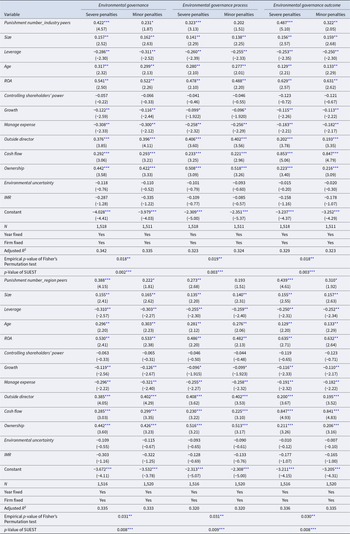
To further test the differences in deterrent effects due to the frequency of penalties and severity of penalties as well as the relationship between them, we divide the sample into four groups according to the level of punishment severity of peer firms in the same industry (or region) and select the first and last quartiles with the harshest and lightest punishments for testing respectively. Table 3 reports the results of the second stage of Heckman’s regression. The coefficients of Punishment number_industry peers and Punishment number_region peers are all positive; however, they are lower and less significant in the minor penalized group than those in the severely punished group and even insignificant when the dependent variable is Environmental governance process, suggesting that increasing penalties can only have a deterrent effect if the penalties are severe and effective. To ensure robustness, both Fisher’s Permutation test and the seemingly unrelated regression test (SUEST) are utilized to examine the statistical significance of coefficient differences between groups. Both methods yield p-values that are all significant at least at the 5% level, indicating that there are statistically meaningful differences in the coefficients of Punishment number_industry peers (or Punishment number_region peers) between samples with varying levels of punishment severity.
Regression results: Relationship between the number and severity of penalties

* Notes: p < 0.1, ** p < 0.05, *** p < 0.01; t statistics in parentheses. The empirical p-value of Fisher’s Permutation test and p-value of SUEST are used to test the significance of the difference in the coefficients of Punishment number_industry peers or Punishment number_region peers between groups and the former is obtained by Bootstrap sampling 1,000 times.
Analysis of Heterogeneity of the Deterrence Effect
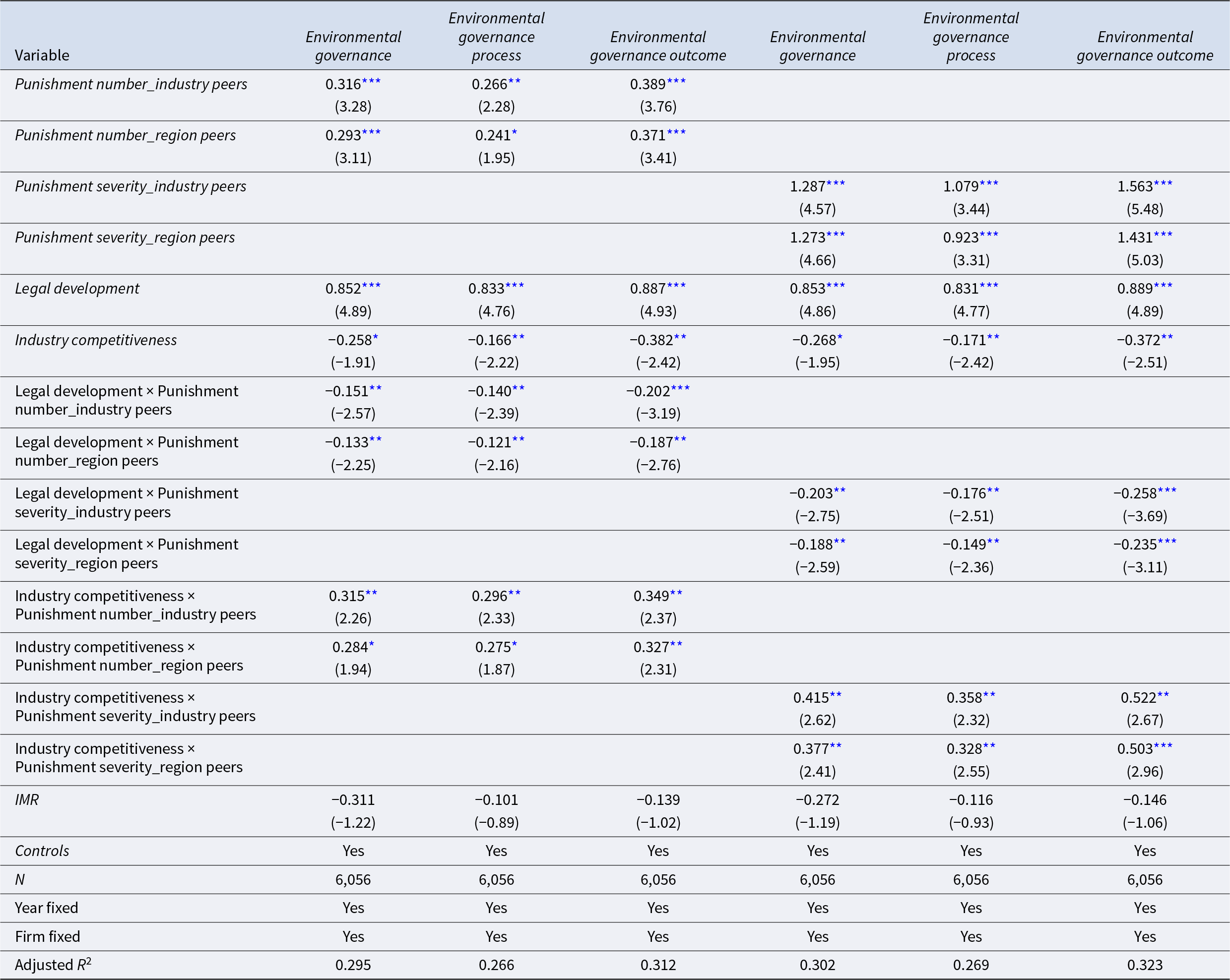
We test H2 and H3 using Models (3)–(6), and Table 4 illustrates the second-stage results of Heckman’s regression. Consistent with the previous results, we also document a positive and significant coefficient (at least at the 10% level) for Punishment number and Punishment severity. Additionally, the coefficients of  $Legal\,development \times Punishment\,number$ and
 $Legal\,development \times Punishment\,intensity$ are all negative and significant at least at the 5% level, while the coefficients of
 $Industry\,competitiveness \times Punishment\,number$ and
 $Industry\,competitiveness \times Punishment\,severity$ are all positive and significant at the 10% level. Figures 1 and 2 provide a graphic depiction of the interaction effect. All the findings in Table 4 and Figures 1 and 2 suggest that the intensification of industry competition will strengthen, but the level of legal development may weaken the general deterrence effect of environmental enforcement. Thus, H2 and H3 are supported.
The moderating effect of legal development

The moderating effect of competition

Regression results: Heterogeneity of deterrence effect

* Notes: p < 0.1, ** p < 0.05, *** p < 0.01; t statistics in parentheses.
Robustness Test
Endogeneity and omitted variables
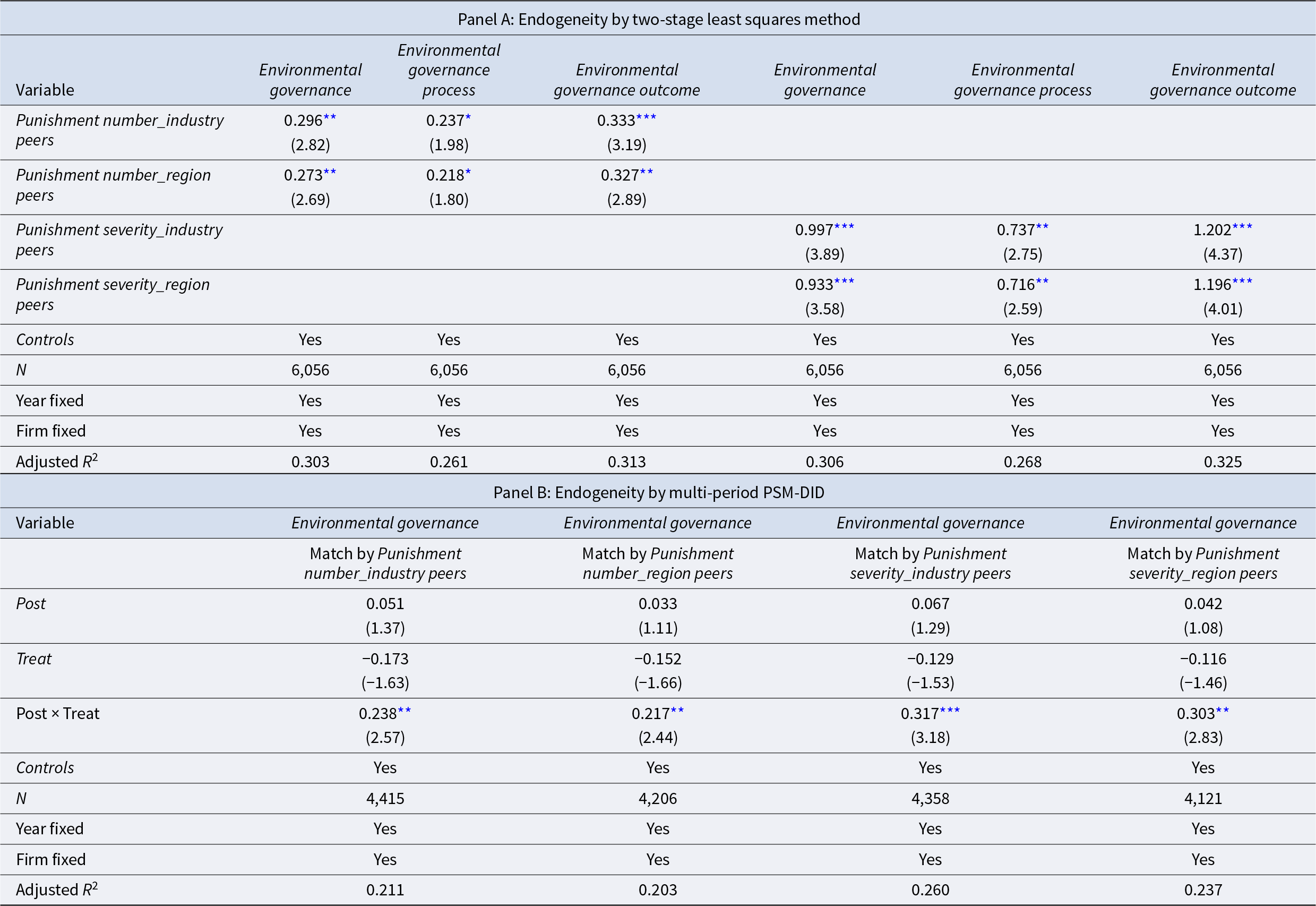
A key challenge in regression analysis is addressing the endogeneity of variables, which can arise from omitted variables and simultaneous causality. Leary and Roberts (Reference Leary and Roberts2014) highlight the empirical difficulties in studying peer effects, as there are two potential explanations for the observed correlation between the behavior of a specific firm and that of its peers. The first explanation posits that firms within the same industry tend to exhibit similar behaviors because they face comparable macroeconomic, technological, and regulatory situations. The second explanation suggests that firms within the same sector adopt similar actions because they sensitively respond to the decisions of their peers. While we have lagged all independent and control variables to mitigate reverse causality, we further apply the two-stage least squares method to ensure the robustness of our results in the face of potential endogeneity.
Referring to Leary and Roberts (Reference Leary and Roberts2014) and Wang, Li, Ma, and Song (Reference Wang, Li, Ma and Song2019), the lagged earnings non-synchronicity of other peer firms (ENS) and the penalties imposed on peer firms in the year t + 1 are used as instrumental variables. Penalization applied to firms is often followed by their inclusion on regulatory blocklists, ensuring ongoing attention from regulators. Thus, the penalties for peer firms in year t are strongly correlated with those in year t + 1. However, for firms’ environmental governance in year t, the penalties for their peers in year t + 1 have not yet occurred and thus cannot influence their environmental governance decisions. Earnings non-synchronicity, which inversely measures the covariance between a firm’s earnings and its peers’ earnings, reflects firm-specific variations in earnings. Notably, a firm’s earnings non-synchronicity captures internal factors that are private and not accessible to outside observers. Therefore, the chosen instrumental variables are highly correlated with the explanatory variable but are uncorrelated with the random error term. The results of the second stage are presented in Panel A of Table 5. The p-values of the Sargan test are all greater than 0.1, and the F-values of the first stage are well above 10, indicating that the two instruments are both valid and strongly correlated with the endogenous variables.
Robust tests: Endogeneity

* Notes: p < 0.1, ** p < 0.05, *** p < 0.01; t statistics in parentheses.
Additionally, we use the multi-period Propensity Score Matching Difference-in-Differences (PSM-DID) approach to conduct endogeneity tests since peer firms are not punished simultaneously. Based on the median of Punishment number_industry peers, Punishment number_region peers, Punishment severity_industry peers, and Punishment severity_region peers, respectively, the sample is divided into a treatment group (peer firms penalized more frequently or severely than the median) and a control group, and then entropy balanced matching is used to match the control group with the treatment group. Where Treat is assigned a value of 1 to indicate the treatment group and 0 to indicate the control group. Post is a time dummy variable assigned a value of 1 for the year following the year in which the peer punishment occurs and after that, considering that punishment exerts a usually time-lagged effect. Regardless of the method, the results reported in Table 5 are consistent with the main findings.
An alternative proxy for variables
Although a textual analysis method is employed to assess environmental governance from both process and outcome dimensions, the measurement of environmental governance largely relies on firm disclosure, which may lack objectivity, making it challenging to determine whether a firm has genuinely complied. Following Wang et al. (Reference Wang, Li, Ma and Song2019), environmental investment – including investments in environmental protection technologies, pollution abatement expenditures, installation of emission-control equipment, and pollution discharge fees – is used as the proxy for environmental governance (Environmental governance_Invest). In total, 3,329 firm-year observations with reported environmental investments were manually selected and processed using a logarithm transformation to mitigate the effects of data variability. Furthermore, in China, CSR scores from Hexun.net, a financial and economic website known for its expertise in financial data analysis, are widely recognized (Xu & Ma, Reference Xu and Ma2022). We also use Hexun’s environmental responsibility score – which includes indicators such as environmental awareness, environmental governance system certification, environmental investment, pollutant emissions, and energy conservation – as an additional proxy for environmental governance (Environmental governance_Hexun).
Furthermore, in line with the studies by Kedia et al. (Reference Kedia, Koh and Rajgopal2015) and Wang et al. (Reference Wang, Li, Ma and Song2019), several variables are constructed as alternative proxies for the penalties incurred by peer firms. First, we define the ratio of penalized firms within a specific industry (or region) to the total number of firms in the same industry (or region) (Punishment number_industry peers1 and Punishment number_region peers1) and the ratio of peer firms with environmental penalty severity scores exceeding the median for respective industry (or region) to the total number of firms in that industry (or region) (Punishment severity_industry peers1 and Punishment severity_region peers1) as the proxies. Second, considering that the previously defined peer firms may include firms that are both in the same industry and the same region, we further exclude penalized peers that belong to both the same industry and region. Instead, we focus on the frequency and severity of peer penalties among firms operating in different areas within the same industry or different sectors within the same region (Punishment number_industry peers2, Punishment number_region peers2, Punishment severity_industry peers2, and Punishment severity_region peers2).
Table 6 reports the regression results after replacing the dependent and independent variables. Confirming the previous results, the coefficients of all variable proxies for environmental punishment of peer enterprises are all positive and significant, at least at the 10% level. Therefore, with another proxy for environmental regulation, our main findings are still robust.
Robust tests: Alternative variables

* Notes: p < 0.1, ** p < 0.05, *** p < 0.01; t statistics in parentheses.
Alternative samples under specific environmental policies
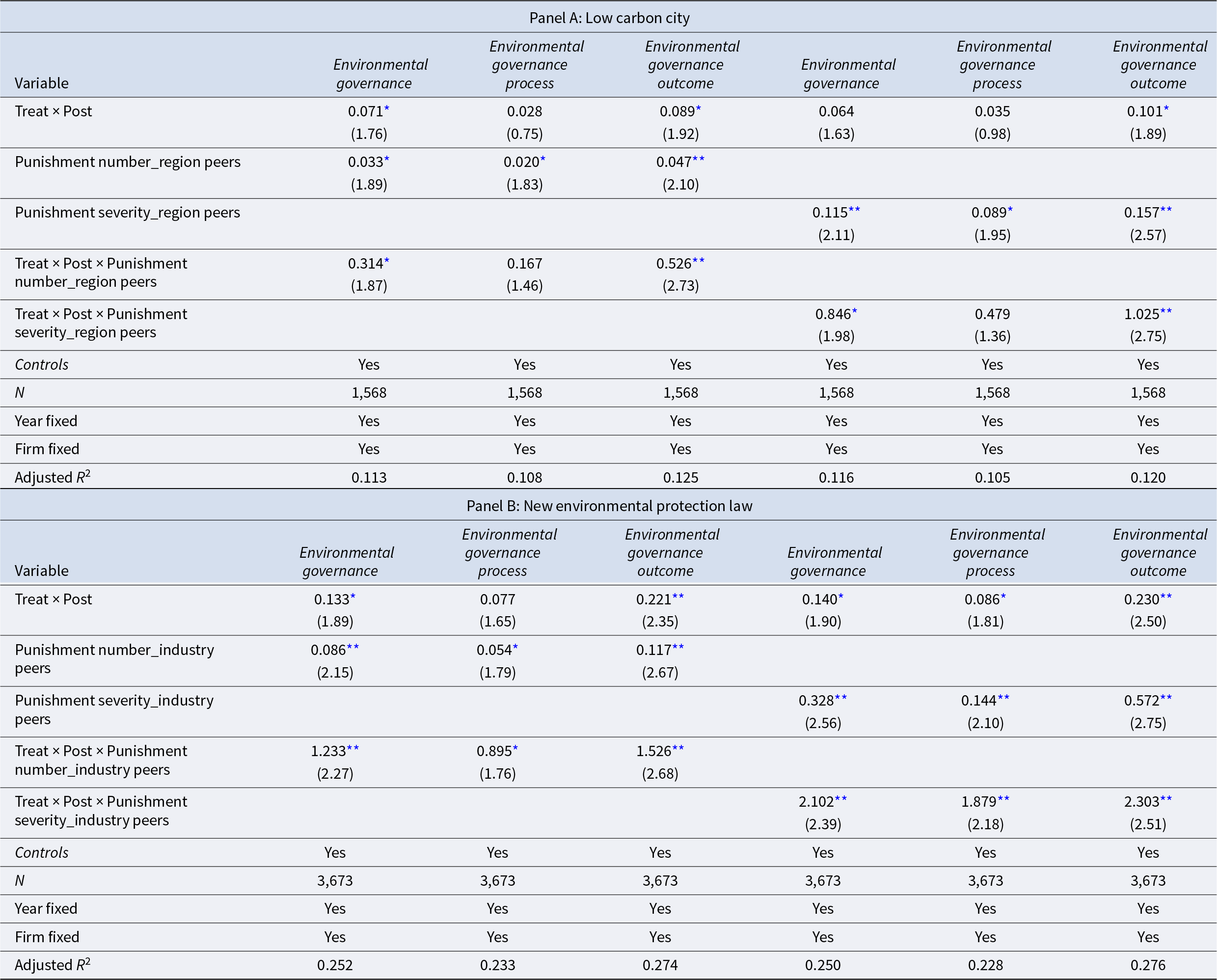
To regulate the behavior of corporate environmental governance, the central government has introduced several key regulations in recent years. Notably, the new Environmental Protection Law passed in 2014 marked a significant step forward. Observing our sample data reveal that penalties for environmental violations have become more stringent since 2015; whether a firm belongs to the targeted industries under a specific policy regime seems to make more sense. In light of this, we focus on two representative environmental policies – the new Environmental Protection Law and the Low-Carbon City Pilot – and employ the PSM-DID approach to test the general deterrence effect under these specific policies.
 \begin{align}Environmental\,governance & = {\beta _0} + {\beta _1}Treat \times Post + {\beta _2}Treat \times Post \times Punishment\_peers \nonumber\\
& \quad + {\beta _3}Punishment\_peers + \mathop \sum \limits_j {\beta _j}Contro{l_{i,t - 1}} + {\varepsilon _{i,t}}\end{align}
The first and second batches of low-carbon city pilot policies were implemented in 2010 and 2012, respectively, with 42 cities selected as pilot locations. Given the formulation of environmental regulations in China has been very intensive in recent years, we chose short-term panel data from 2008 to 2014 to minimize the influence of other policies and re-divided industry peers at the city level. Our experimental group consists of heavy polluters in pilot cities, while the control group includes heavy polluters in ono-pilot cities selected using the radius matching method (radius of 0.0001). The key variables used to match firms include size, growth, profitability, and cash flow. We define Treat as a dummy variable indicating whether a firm’s place of registration is in a pilot city and Post as a dummy variable, set to 1 for the year the city is designated as a pilot city and all subsequent years, and 0 otherwise. In addition, in light of the implementation of the new Environmental Protection Law on January 1, 2015, which targets explicitly heavy-polluting firms, we expand our analysis to the period from 2013 to 2017. In this case, the experimental group comprises heavy-pollution firms, while the control group includes non-heavy-polluting firms matched accordingly. Hence, Treat indicates whether a firm is a heavy polluter, and Post is set to 1 for the year the new law was enacted and for subsequent years and 0 otherwise.
Table 7 presents the results. The coefficients of  $Punishment\_peers$ and
 $Treat \times Post \times Punishment\_peers$ are all positive and primarily statistically significant, regardless of punishment frequency or punishment severity, which not only further validates our main findings, but also confirms that the target of a particular policy is more likely to be subject to the general deterrence effect of peers’ penalties.
Robust tests: Alternative samples under specific environmental regulations

* Notes: p < 0.1, ** p < 0.05, *** p < 0.01; t statistics in parentheses.
Time lag in social learning
Since social learning is a process that involves the accumulation and transfer of experience, it typically requires a relatively long period to observe changes in firms’ behavior. To account for this, we re-ran the regression using the Heckman two-step model, lagging the independent variables by two and three periods, respectively. Table 8 presents the results from the second stage of the Heckman model. The coefficients for two-stage lagged independent variables remain statistically significant, although at a lower significance level compared to the one-stage lagged variables. However, the coefficients for the three-stage lagged variables are no longer significant. These findings suggest that the deterrent effect of environmental punishment is both time-limited and time-lagged, significantly influencing observers’ green behaviors within one to two years of witnessing their peers being penalized.
Robust tests: Time lag in social learning

* Notes: p < 0.1, ** p < 0.05, *** p < 0.01; t statistics in parentheses.
Further Analysis: Direction of the Deterrence Effect
We have examined the existence of a general deterrent effect of environmental penalties in industrial and regional peer groups, as well as the external institutional environment that strengthens this effect. However, even within a shared institutional framework, observers often seek additional information to identify the most suitable model. The deterrent effect of the same punishment can vary significantly, depending on how its informational value is perceived and judged comparatively (Yin et al., Reference Yin, Xu and Wan2014). Given this, we further explore which characteristics of both observing and punished enterprises may influence information judgment in this inhibitory learning process.
Analysis of characteristics of punished firms
An organization’s market position, which reflects its wealth and capabilities, can influence the deterrent impact of environmental sanctions. Leading enterprises, typically prominent and influential, set standards and attract imitation by their peers (Mitchell & Raghuram, Reference Mitchell and Raghuram1994). They frequently benefit from local governmental protections due to local fiscal and tax incentives as well as political tournaments (Luo, Liu, Wu, & Zhong, Reference Luo, Liu, Wu and Zhong2021). Regulatory actions targeting entities with social influence and capability make the enforcement efforts of regulatory authorities salient environmental cues that attract the attention of other firms (Bandura, Reference Bandura1977). This heightened awareness can create anxiety and fear among observers, motivating them to seek further information regarding the credibility of regulatory enforcement. Accordingly, we argue that penalizing leading firms hold substantial informational value to strengthen the deterrence effects of the modeling cue – namely, the punishment of peers. Such actions by regulatory authorities send a strong signal to observing firms that the regulatory and enforcement environment has become more stringent and vigilant in preventing environmental violation behaviors. Observers are also more inclined to use these prominent firms as specific references within the same institutional framework.
Additionally, SOEs serve as pivotal tools in the Chinese government’s strategy for societal and public value creation. Due to their significant contributions to local revenue generation and the protection of state-owned resources, local governments prioritize the development of SOEs (Xu & Liu, Reference Xu and Liu2020). This advantage diminishes the expectation that SOEs will face penalties for violations. The mechanism behind the high penalties imposed on SOEs for deviant behavior is that a given action is perceived as more deviant when the audience holds high expectations for the actor (Florackis, Fu, & Wang, Reference Florackis, Fu and Wang2023). While an adverse signal such as penalties is anticipated from NSOEs, rendering such sanctions less informative, penalties against SOEs are unexpected and serve to recalibrate perceptions of their status. Hence, the imposition of penalties on SOEs for regulatory violations underscores authorities’ commitment to impartial enforcement, while serving to clarify enforcement standards and rules.
Moreover, in organizational studies, the concept of ‘distance’ refers to the degree of closeness between individuals, groups, or entities. It is sometimes referred to as proximity or relationship strength (Tumasjan, Strobel, & Welpe, Reference Tumasjan, Strobel and Welpe2011). Even within the same industry or regional institutional context, there can be variations in distance between firms. Previous research on social distance and knowledge transfer has consistently demonstrated that this distance plays a significant role in how organizations process information about events and, in turn, make decisions (Martin, Lee, & Parmar, Reference Martin, Lee and Parmar2021). Closer social proximity between groups fosters a greater willingness to exchange knowledge, collaborate, and engage in interactive learning (Wang, Rodan, Fruin, & Xu, Reference Wang, Rodan, Fruin and Xu2014). As organizational networks become more embedded, experiences of failure within other organizations offer valuable opportunities for organizational learning. What’s more, an ancient Chinese proverb suggests that the person who truly understands you may not necessarily be a friend but could, in fact, be an adversary. When the distance between a sanctioned organization and an observing organization is minimal, the two are more closely connected and more likely to view each other as a point of reference – whether as competitors or allies.
Therefore, we argue that the social influence and social distance of punished firms may be the two key characteristics influencing whether the general deterrent effect can be effectively exerted. On the one hand, we categorize penalized peers into SOEs and NSOEs. Following Adhikari and Agrawal (Reference Adhikari and Agrawal2018), we further segment the leading firms based on their age, size, profitability, and market share. On the other hand, our study evaluates the social and product market distance between firms. Alumni relationships are prevalent and play a pivotal role in accessing external social capital and resource integration. We manually compile data on the graduation institutions of executives (including the chairman, general manager, deputy general manager, board secretary, and other key managers listed in the annual report). Firms whose executives graduated from the same institution are considered socially close. Social distance is measured by the natural logarithm of 1 plus the number of executives with alumni ties between two firms, with higher values indicating closer social proximity. Additionally, inspired by Hoberg and Phillips (Reference Hoberg and Phillips2016), we assess product market distance by analyzing textual similarities in the product descriptions from firms’ annual reports. Greater similarity indicates closer product relationships and a more direct competitive dynamic between firms. The interaction terms between the proportion of SOEs or leading firms among the penalized companies as well as social or product market distance and each independent variables are introduced in Models (1) and (2). All interactions’ coefficients are positive and most are significant at least at the 10% level, suggesting that penalizing leaders or SOEs or closer firms exert a more substantial deterrence effect on observers.Footnote 7
Analysis of characteristics of observing firms
To investigate which characteristics of observing firms make them more susceptible to peer punishment, we categorize the samples into firms with high or low levels of environmental governance, as well as leading and follower enterprises. Each subsample is then analyzed using regressions based on Models (1) and (2). The coefficients of the independent variable for firms with higher environmental governance levels or leading firms are notably lower and less statistically significant compared to those with lower environmental governance levels or follower firms. To assess the statistical significance of differences between the two subsamples, we conduct both Fisher’s Permutation test and SUEST, yielding p-values that consistently indicate significance at least at the 5% level.Footnote 8 These findings indicate that the deterrence effect of environmental penalties on peer firms is more pronounced among those with lower environmental governance standards or among follower enterprises.
Based on our findings, leading enterprises exhibit a stronger tendency towards independent green decision-making. We interpret this as follows: First, due to their heightened distinctiveness and strong market competitiveness, leading enterprises perceive that the green initiatives or penalties imposed on their peers are unlikely to significantly impact their market position. This resilience makes them less susceptible to similarity-based contagion. Second, the environmental governance frameworks of leading enterprises are typically more robust and standardized than those of their counterparts, reducing the likelihood of facing future regulatory penalties. Finally, local governments tend to protect market leaders in areas such as taxes, economic growth, and stable employment, making it less likely for them to face punishment unless egregious violations occur. Consequently, leading enterprises exhibit weaker deterrence responses and may even avoid legitimacy erosion when their peers face environmental sanctions. In contrast, the following organizations, which lack comparable governmental protection, are more vulnerable to peer influence. They tend to learn and emulate the green decisions of others, both to enhance their legitimacy and mitigate future regulatory risks, as well as to gain competitive advantages in their respective markets.
Additionally, through our comparative analysis of enterprises with varying levels of environmental governance, we find that only those with lower levels of governance are vulnerable to the deterrent effect imposed by their peers. This vulnerability arises because firms with higher levels of governance have already exceeded industry norms in environmental management. As a result, they experience fewer environmental violations and are consequently less likely to face punitive measures from regulatory authorities, public condemnation, or investor disapproval. However, environmental governance entails costs. Enterprises with a low risk of violations may, therefore, choose not to further increase their investments in environmental governance, given the potential inefficiencies. Instead, they may redirect their capital towards improving other aspects of their business operations to strengthen their competitive position.
Further Analysis: The Relationship Between the Environmental Governance Process and Outcome
Considering that the environmental governance outcome is the quantifiable result of the governance process, while the process dimension provides the company with the necessary efforts to improve the governance outcome, the general deterrent effect of environmental penalties on peer firms’ environmental performance or outcomes may be realized through the environmental governance process. We attempt to further test this path concerning the B-Z three-step method proposed by Wen, Zhang, Hou, and Liu (Reference Wen, Zhang, Hou and Liu2004) as follows:
 \begin{align}Environmental\,governance\,outcom{e_{i,t}} & = {\beta _0} + {\beta _1}Punishment\_peer{s_{i,t - 1}} + {\beta _2}IMR \nonumber\\
& \quad + \mathop \sum \limits_j {\beta _j}Contro{l_{i,t - 1}} + {\varepsilon _{i,t}}\end{align}
 \begin{align}Environmental\,governance\,proces{s_{i,t}} & = {\beta _0} + {\beta _1}Punishment\_peer{s_{i,t - 1}} + {\beta _2}IMR \nonumber\\
& \quad + \mathop \sum \limits_j {\beta _j}Contro{l_{i,t - 1}} + {\varepsilon _{i,t}}\end{align}
 \begin{align}Environmental\,governance\,outcom{e_{i,t}} & = {\beta _0} + {\beta _1}Environmental\,governance\,proces{s_{i,t}} \nonumber\\
& \quad + {\beta _2}Punishment\_peer{s_{i,t - 1}} + \mathop \sum \limits_j {\beta _j}Contro{l_{i,t - 1}} + {\varepsilon _{i,t}}\end{align}
The bootstrap method is used to report the significance of the mediating and direct effects. The findings indicate that both direct and mediating effects are significant because the confidence interval does not contain 0, which supports that Environmental governance process plays a partial mediating role in Punishment_peers affecting Environmental governance outcome. Footnote 9 The results validate that peer deterrence can indeed enhance environmental governance outcomes by prompting observing firms to improve their green governance process. However, this mechanism is not exhaustive. Since process-oriented environmental governance measures are often costly and exhibit delayed effectiveness, observing firms, after feeling the deterrence from peers’ environmental penalties, tend to bypass some high-cost initiatives in favor of superficial environmental measures to project compliance.
Discussion
Our investigation explores whether and how environmental penalties imposed on peer firms within industries or regions can deter other firms from facing similar penalties by motivating them to improve environmental governance standards. We propose a theoretical framework centered on vicarious punishment, which explains how observing firms match and identify with punished peers and assess vicarious reinforcement effects by interpreting external environmental cues. Using manually collected micro-level data on environmental penalties and corporate environmental governance, our findings reveal that focusing solely on the immediate impact of environmental penalties on the violators does not fully capture the effectiveness of legal sanctions and that the frequency and severity of environmental penalties also significantly impact the green decisions of peer firms. Through the mechanism of social learning among firms, vicarious punishment plays a crucial role in enhancing the deterrence effect of environmental regulations. Penalties imposed on pioneering firms send clear signals to their industrial and regional peers about which behaviors are acceptable or prohibited, thereby shaping future environmental governance practices. Theoretically, our study confirms how firms learn from the failures of others, contributing to complementing the more extensive studies of ‘learning from success’ and refining social learning theory.
However, our findings also indicate that the effectiveness of environmental enforcement in deterring opportunistic behavior is heavily dependent on the effectiveness of enforcement measures. When punishments are perceived as insufficient severe – what we refer to as ‘failed’ punishment – they often fail to deter observers’ opportunistic behavior. Specifically, when penalties for violating firms are seen as too lenient or disproportionate to the severity of the violation, an increase in the frequency of penalties may only reinforce the perception of weak enforcement, thereby diminishing the incentive for observing firms to invest in more robust environmental governance, especially in time-consuming and costly process-related activities. At best, observers may resort to superficial compliance in the outcome dimension, merely adhering to the basic requirements to avoid inspections. In contrast, stringent and effective enforcement measures can shift the cost-benefit tradeoff, making opportunistic behavior less attractive. Increasing the probability of punishment can only serve as a deterrent if the penalties are sufficiently severe. Our findings challenge Caria’s deterrence theory by demonstrating that deterministic yet mild punishments produce limited deterrence effects (Beccaria, Reference Beccaria2016).
Moreover, this study builds on the characteristics of both process and outcome dimensions to comprehensively assess corporate environmental governance. Using constructed indicators and content analysis, we find that peer-imposed penalties for environmental violations are more likely to deter firms from improving green governance in the outcome dimension while exerting a relatively weaker impact on the process dimension. Observing peer firms facing such penalties motivates quick adjustments in violation metrics to achieve compliance and avoid similar sanctions. Enterprises often resort to short-term strategies, such as production reduction, as effective measures to rapidly enhance environmental governance outcomes (Shen & Zhou, Reference Shen and Zhou2017). In contrast, long-term governance initiatives – such as increased investments in environmental protection, development of innovative green technologies, and participation in environmental compensation projects – are less favored due to their substantial costs and extended timelines (Lee & Xiao, Reference Lee and Xiao2020). Consequently, firms tend to prioritize superficial compliance with regulations to alleviate immediate symptoms, focusing primarily on outcomes while neglecting deeper governance processes. This dimensional distinction not only expands the concept of corporate environmental governance, setting it apart from environmental performance (Asiaei, Bontis, Alizadeh, & Yaghoubi, Reference Asiaei, Bontis, Alizadeh and Yaghoubi2022; Misani & Pogutz, Reference Misani and Pogutz2015) but also clarifies the specific pathway through which environmental penalties exert a general deterrent effect on the green behavior of peer firms.
Additionally, we provide evidence that learning through vicarious punishment can be altered by dynamic institutional external environments. The effects of inhibitory learning effects on peers vary according to local legal development and competitive conditions. These findings broaden our understanding of the contextual factors that shape social learning, illustrating how external conditions can create variations in the demand for learning from others. Importantly, our findings do not imply that informal systems like social learning are superior to modern judicial systems; rather they indicate that these approaches are complementary, each serving a distinct but compatible role within social contexts.
More importantly, our findings further refine the understanding of the social learning process by investigating why observing firms exhibit different response behaviors, which stem from variations in their self-evaluation and regulatory processes. Specifically, we demonstrate that penalties for environmental violations imposed by industry peers have a more significant general deterrent effect on observing firms than those imposed by regional peers. This addresses a key question in institutional theory regarding which peer group organizations are more likely to emulate when operating within diverse institutional contexts. Additionally, regarding the direction in which the deterrent effect works, targeted sanctions against systemically important entities (e.g., leading enterprises and SOEs) and those with close interconnections would generate amplified deterrence signals, particularly influencing follower firms or those exhibiting deficiencies in environmental governance. These differential learning effects are crucial findings, as the self-regulatory processes of observing firms are rarely contextualized and empirically tested within the social learning and vicarious punishment literature. Previous research often assumes that general deterrence or inhibitive learning effects are homogeneous among observers within the same institutional setting. Our findings illustrate that observers continually seek, interpret, and evaluate additional institutional cues to identify the most appropriate targets for learning, even when their peers belong to the same institutional framework. This not only contributes to advancing social learning theory but also enhances scholarship in institutional theory.
Our study provides valuable insights and practical guidance for both regulatory officials and scholars, particularly in emerging economies. First, our research highlights the critical role of penalties in environmental public policy, emphasizing their necessity in deterring violations effectively. This can be achieved by increasing the cost of violations for penalized firms and heightening their perceived risks while simultaneously the potential gains from non-compliance. Governments and media organizations can use this understanding to enhance the visibility of environmental penalties across various platforms, thereby strengthening the perception of threats among businesses and ultimately preventing environmental infractions. Second, an intriguing aspect of using peer punishment as a governance tool lies in its cost-effectiveness. By focusing regulatory efforts on monitoring and penalizing a select group of listed firms, authorities can achieve broader compliance with greater efficiency, significantly reducing monitoring costs. However, our findings suggest that imposed on more prominent firms amplify the effects of vicarious punishment, indicating that regulators can increase the effectiveness of enforcement by ensuring other firms perceive the fairness of this enforcement. As a result, targeting high-profile firms, or ‘big fish’, may yield more effective outcomes in deterring violation behaviors. Finally, by dividing environmental governance into two dimensions – the process and the outcome – we find that when firms observe penalties imposed on their peers, they often adopt superficial measures to improve their environmental governance appearance. Therefore, to encourage more substantive improvements in environmental governance, governments should complement traditional command-and-control environmental regulations, which raise the costs of non-compliance, with market-oriented incentive mechanisms. These include measures such as green tax relief and green financing aimed at amplifying the long-term benefits of environmental governance.
This study has several limitations that suggest directions for further research. First, the deterrence effect on peer firms may not be solely driven by the fear of formal legal penalties. It may also stem from potential declines in market value, damage to corporate reputation or managerial positions, and consumer boycotts. Exploring these factors could enrich the theoretical framework and require empirical testing with relevant mediating variables. Second, this study focuses on China, a country characterized by a highly collective culture and an imperfect market-oriented system, which may make it more susceptible to the influence of social observations and norms. Therefore, comparative research across different national contexts is essential to assess variations in government regulations’ role in corporate environmental governance. Third, the study sample consists exclusively of publicly listed firms in China, overlooking non-listed firms that may also be influenced by or have an impact on their listed counterparts. Given the differing visibility and regulatory scrutiny of listed versus non-listed firms, further investigation is needed into how non-listed firms respond to penalties faced by their publicly listed peers.
Acknowledgements
This study is supported by the National Natural Science Foundation of Guangdong Province (2025A1515011250), the Ministry of Education, Humanities and Social Science Research Projects of China (21YJA630102), Social Science Foundation Project of Guangdong Province (GD23CGL05), Guangzhou Municipal Applied Basic Research Program (2025A04J3939), and Fundamental Research Funds for the Central Universities (QNZD202402).
Appendix
The categories and scoring standards for environmental violations

Notes:
(1) For different environmental violations of laws and regulations of enterprises, environmental administrative punishment measures shall be taken separately, and points shall be scored separately.
(2) If an enterprise takes two or more kinds of environmental administrative punishment measures against the same environmental violations, points shall be given according to the category with the highest score. For example, if the enterprise discharges pollutants that exceed the standard, it will be fined 100,000 yuan and restricted production treatment measures, respectively, and points shall be scored according to the restricted production category.
(3) Where two or more environmental violations co-occur, and two or more environmental administrative punishment measures are taken, points shall be scored according to the category with the highest score for each illegal act, and the cumulative calculation shall be made. For example, an enterprise was fined 300,000 yuan for its excessive air pollutant discharge and 100,000 yuan for its illegal act of moving and changing the automatic monitoring equipment for air pollutant discharge without authorization and was transferred to the public security organ for detention. The former will be deducted 3 points according to a fine of 300,000 yuan, while the latter will be detained for 12 points according to the transfer of detention with the highest demerit score. A total of 15 points will be recorded for the two violations of the enterprise.
Indexes of environmental governance

Variable definitions and data sources

Shan Xu (bmshanxu@scut.edu.cn) is an associate professor at the School of Business Administration, South China University of Technology in China. Her research interests are mainly in the field of CSR and corporate green governance. Her work has been published in journals such as Journal of Business Ethics, Abacus, European Management Review, European Research on Management and Business Economics, Australian Journal of Management, Australian Accounting Review, and so on.
Wei Xie (haze1207@sina.com) recently received her master’s degree from South China University of Technology in China. Her research interests lie at corporate ethical and unethical behaviors. She is currently working at a securities firm.