INTRODUCTION
Languages instantiate many different kinds of dependencies or distributional regularities, some holding between adjacent elements and others holding between non-adjacent elements. During the past decades, many studies have shown that during their first year of life infants become sensitive to frequency, positional, and adjacent phonological properties of their native language (Friederici & Wessels, Reference Friederici and Wessels1993; Jusczyk, Friederici, Wessels, Svenkerud & Jusczyk, Reference Jusczyk, Friederici, Wessels, Svenkerud and Jusczyk1993b; Jusczyk, Luce & Charles-Luce, Reference Jusczyk, Luce and Charles-Luce1994; Sebastián-Gallés & Bosch, Reference Sebastián-Gallés and Bosch2002). In addition, there is growing evidence showing that, before their first birthday, infants become sensitive to non-adjacent phonological regularities (Gonzalez-Gomez, Tsuji, Hayashi, Mazuka & Nazzi, Reference Gonzalez-Gomez, Tsuji, Hayashi, Mazuka and Nazzi2014; Gonzalez-Gomez & Nazzi, Reference Gonzalez-Gomez and Nazzi2012a, 2012b; Nazzi, Bertoncini & Bijeljac-Babic, Reference Nazzi, Bertoncini and Bijeljac-Babic2009a). However, the kinds of non-adjacent regularities infants are able to compute remains for the most part unknown. The present study will explore infants' acquisition of non-adjacent phonological regularities, focusing on vocalic distributional regularities.
Non-adjacent regularities can be found within and between lexical morphemes, the former kind being investigated in the present study. Non-adjacent phonological regularities crossing morpheme boundaries include, for instance, vowel harmony, the fact that vowels in a lexical unit share a given phonetic feature not only within a morpheme but also across morpheme boundaries (cf. front/back harmony in Hungarian, according to which words cannot contain both front and back vowels, and any suffix vowel agrees with the preceding vowel; Rose & Walker, Reference Rose, Walker, Goldsmith, Riggle and Yu2011). Furthermore, in Semitic languages such as Hebrew and Arabic, families of words correspond to consonantal roots, and variations in vowel identity indicate number, gender, lexical class, etc. (Ryding, Reference Ryding2005).
Other examples of non-adjacent regularities across morphemes can be found in the morphosyntactic domain such as subject/verb agreement (Farkas, Reference Farkas2009; Gomez, Reference Gomez2002; Legendre, Barriere, Goyet & Nazzi Reference Legendre, Barriere, Goyet and Nazzi2010; Nazzi, Barriere, Goyet, Kresh & Legendre, Reference Nazzi, Barriere, Goyet, Kresh and Legendre2011; Soderstrom, White, Conwell & Morgan, Reference Soderstrom, White, Conwell and Morgan2007), and agreement between auxiliaries and inflectional morphemes (Höhle, Schmitz, Santelmann & Weissenborn, Reference Höhle, Schmitz, Santelmann and Weissenborn2006; Santelmann & Jusczyk, Reference Santelmann and Jusczyk1998). Within lexical morphemes, different phonological/phonotactic tendencies have been found consistently across languages. For example, languages have been shown to favor syllable sequences where consonants are articulatorily different (e.g. ,/baga/) over reduplications (e.g. /baba/; Rochet-Capellan & Schwartz, Reference Rochet-Capellan and Schwartz2005). In addition, among these variegated forms, sequences starting with a labial consonant followed by a coronal consonant (e.g. /bat/) are privileged over the opposite pattern (e.g. /tap/; Gonzalez-Gomez & Nazzi, Reference Gonzalez-Gomez and Nazzi2012a; MacNeilage & Davis, Reference MacNeilage and Davis2000; Vallée, Rousset & Boë, Reference Vallée, Rousset and Boë2001).
Even though non-adjacent phonological regularities are a very important feature of human languages, infants’ sensitivity to such regularities has only started to be recently explored. Nazzi et al. (Reference Nazzi, Bertoncini and Bijeljac-Babic2009a) and Gonzalez-Gomez and Nazzi (Reference Gonzalez-Gomez and Nazzi2012a) investigated whether and when infants might start learning non-adjacent phonological regularities in their native language. To do so, they used Labial–Coronal (LC) words such as bat (that is, words starting with a labial consonant, such as /p/ or /b/, followed by a coronal consonant, such as /t/ or /d/), and Coronal–Labial (CL) words such as tab (that is, words starting with a coronal consonant, followed by a labial consonant). The difference between the two types of words is usually thought of as a non-adjacent relation between two consonants separated by a vowel at the lexical level. In French, the language of the infants tested, LC words are more frequent than CL words (overall ratio = 1·68; cf. Gonzalez-Gomez & Nazzi, Reference Gonzalez-Gomez and Nazzi2012a, for detailed frequency analyses). To explore whether or not infants were sensitive to such regularities, 6/7- and 10-month-olds were presented with lists of LC and CL sequences, using the head-turn preference procedure (HPP). The authors found that 10- but not 6/7-month-olds showed a preference for the most frequent LC pattern in their language (Gonzalez-Gomez & Nazzi, Reference Gonzalez-Gomez and Nazzi2012a; Nazzi et al., Reference Nazzi, Bertoncini and Bijeljac-Babic2009a), even when, importantly, all adjacent frequencies of the stimuli were fully controlled (Gonzalez-Gomez & Nazzi, Reference Gonzalez-Gomez and Nazzi2012a). Additional control experiments further showed that the LC preference was not due to a positional bias, namely a preference for words starting with a labial consonant or ending with a coronal one (Gonzalez-Gomez & Nazzi, Reference Gonzalez-Gomez and Nazzi2012a). This finding in French was replicated when listening to stimuli recorded in Japanese (Gonzalez-Gomez et al., Reference Gonzalez-Gomez, Tsuji, Hayashi, Mazuka and Nazzi2014), and in pre-term infants (Gonzalez-Gomez & Nazzi, Reference Gonzalez-Gomez and Nazzi2012b), while a CL bias emerged by 13 months in Japanese-learning infants, a language showing a moderate CL bias (Gonzalez-Gomez et al., Reference Gonzalez-Gomez, Tsuji, Hayashi, Mazuka and Nazzi2014).
Taken together, the above studies show that, by 10 months of age, infants are able to compute non-adjacent phonological regularities. However, given that these studies focused on a single phonological dependency (the LC bias), the kinds of non-adjacent regularities infants are able to compute remain for the most part unclear. In particular, are infants able to compute non-adjacent vocalic regularities in addition to consonantal ones? This question is crucial given recent literature showing that consonants and vowels play different roles at different linguistic processing levels (Havy & Nazzi, Reference Havy and Nazzi2009; Nazzi, Reference Nazzi2005; Nazzi, Floccia, Moquet & Butler, Reference Nazzi, Floccia, Moquet and Butler2009b; Nespor, Pena & Mehler, Reference Nespor, Pena and Mehler2003), supporting the existence of a division of labor between consonants and vowels, a hypothesis known as the CV hypothesis (Nespor et al., Reference Nespor, Pena and Mehler2003). The CV hypothesis proposes that vowels have more weight in encoding information about the prosodic and syntactic structures, while consonants have more weight in encoding information about lexical identity. Thus, consonants would play a more important role in word identification and vowels in extracting grammar-like generalizations.
Different evidence has emerged supporting this hypothesis. In French, Spanish, Italian, English, and Dutch adults, many studies found that consonants are privileged over vowels in lexical processing. This was found in tasks measuring lexical access in both the auditory (Cutler, Sebastián-Gallés, Soler-Vilageliu & van Ooijen, Reference Cutler, Sebastián-Gallés, Soler-Vilageliu and van Ooijen2000; Delle Luche, Poltrock, Goslin, New, Floccia & Nazzi, Reference Delle Luche, Poltrock, Goslin, New, Floccia and Nazzi2014) and written modalities (Acha & Perea, Reference Acha and Perea2010; New, Araújo & Nazzi, Reference New, Araújo and Nazzi2008; New & Nazzi, Reference New and Nazzi2014), in tasks measuring detection of word-forms from continuous speech using unknown artificial languages (Bonatti, Pena, Nespor & Mehler, Reference Bonatti, Pena, Nespor and Mehler2005; Toro, Nespor, Mehler & Bonatti, Reference Toro, Nespor, Mehler and Bonatti2008), and in novel word learning tasks (Havy, Serres & Nazzi, Reference Havy, Serres and Nazzi2014). Furthermore, regarding the opposite vowel bias in grammar-like processing, Toro and colleagues (2008) found that adults use vowels, but not consonants, to extract structural generalizations from unknown artificial languages (e.g. an ABA pattern, where the first and last vowels were identical). This consonantal bias in lexical processing has also been found during infancy. Indeed, different studies have shown that infants are better at processing specific consonantal than vocalic information while learning new words (Havy, Bertoncini & Nazzi Reference Havy, Bertoncini and Nazzi2011; Havy & Nazzi, Reference Havy and Nazzi2009; Nazzi, Reference Nazzi2005; Nazzi et al., Reference Nazzi, Floccia, Moquet and Butler2009b). For example, French-learning infants were able to simultaneously learn two words differing only by one consonantal feature (e.g. /pize/ vs. /tize/), but they were not able to do so when the two words differed only by a vocalic feature (e.g. /pize/ vs. /pyze/), at both 16 (Havy & Nazzi, Reference Havy and Nazzi2009) and 20 months (Nazzi, Reference Nazzi2005). By 30 months of age, French-learning infants were able to learn two words differing by a vocalic feature, although at that age they still gave more weight to consonant information under conflicting circumstances in which they had to neglect either a consonantal or a vocalic one-feature change (i.e. match a /pide/ with either a /tide/ or a /pyde/; Nazzi et al., Reference Nazzi, Floccia, Moquet and Butler2009b). In such cases, 30-month-olds preferably chose to neglect the vocalic change rather than the consonantal one. Similar results were found for three-year-olds (Havy et al., Reference Havy, Bertoncini and Nazzi2011, 2014). This consonant bias has also been found in Italian infants (Hochmann, Benavides-Varela, Nespor & Mehler, Reference Hochmann, Benavides-Varela, Nespor and Mehler2011), though evidence in English is weaker, with an apparently later emergence of the bias (Floccia, Nazzi, Delle Luche, Poltrock & Goslin, Reference Floccia, Nazzi, Delle Luche, Poltrock and Goslin2014; Mani & Plunkett, Reference Mani and Plunkett2007; Nazzi et al., Reference Nazzi, Floccia, Moquet and Butler2009b). All these findings support the privileged role of consonants in lexical processes, although some cross-linguistic modulation is observed (a vocalic bias is even found in Danish, a language with a vowel-oriented phonological system; cf. Højen & Nazzi, Reference Højen and Nazziin press). Importantly though, this consonant bias is found early and consistently in French, the language under investigation in the present study.
As far as our knowledge goes, only one study has indirectly shown that infants are sensitive to non-adjacent vocalic regularities. Van Kampen, Parmaksiz, van de Vijver, and Höhle (Reference Van Kampen, Parmaksiz, van De Vijver, Höhle, Gavarró and Freitas2008) investigated whether infants are able to use word stress and vowel harmony to segment words. In this context, they first conducted a control experiment to determine whether or not infants are sensitive to vowel harmony. Using the head-turn preference procedure, infants were presented with a list of four pseudo-words with vowel harmony and a list of four pseudo-words without vowel harmony. Turkish- but not German-learning 6-month-old infants showed a preference for the harmonic stimuli. These results suggest that 6-month-old Turkish-learning infants are already sensitive to vowel harmony, a feature present in their native language. Furthermore, a segmentation experiment showed that by 9 months of age, Turkish-learning infants use vowel harmony to find word boundaries in continuous speech.
The above study establishes early sensitivity to vowel harmony in Turkish-learning infants, which would be compatible with the early acquisition of a non-adjacent dependency instantiated on vowels. However, as mentioned before, the goal of Van Kampen et al. (2008) was not to investigate infants' sensitivity to non-adjacent phonological regularities, but to investigate the use of metrical and statistical cues for word segmentation. For this reason, crucial factors were not controlled in their study, such as the adjacent and positional frequencies of the stimuli used. Furthermore, several other factors make it difficult to compare the Van Kampen et al., study with the studies on non-adjacent phonological consonant regularities (Gonzalez-Gomez & Nazzi, Reference Gonzalez-Gomez and Nazzi2012a, Reference Gonzalez-Gomez and Nazzi2012b; Nazzi et al., Reference Nazzi, Bertoncini and Bijeljac-Babic2009a). First, the fact that infants are sensitive to vowel harmony as early as 6 months of age suggests that this effect might not be based on a phonotactic acquisition, since acquisition of native phonotactic properties has been shown to appear at a later age, around 9/10 months (Friederici & Wessels, Reference Friederici and Wessels1993; Gonzalez-Gomez & Nazzi, Reference Gonzalez-Gomez and Nazzi2012a; Jusczyk et al., Reference Jusczyk, Friederici, Wessels, Svenkerud and Jusczyk1993b; Jusczyk, Luce & Charles-Luce, Reference Jusczyk, Luce and Charles-Luce1994; Nazzi et al., Reference Nazzi, Bertoncini and Bijeljac-Babic2009a; Sebastián-Gallés & Bosch, Reference Sebastián-Gallés and Bosch2002). Second, vocalic harmony in Turkish has a morphosyntactic component, given that it is a phenomenon occurring between vowels of a given morpheme and also between vowels across morpheme boundaries (Rose & Walker, Reference Rose, Walker, Goldsmith, Riggle and Yu2011). According to the CV hypothesis (Nespor et al., Reference Nespor, Pena and Mehler2003), this might make a difference, given that vowels are more important in encoding information about (morpho)syntactic structure, predicting an advantage for vowels over consonants. Third, preference for vocalic harmony could be due to identity ABA rule learning (based on feature repetition), which has been found to be present both in 7-month-olds (Marcus, Vijayan, Rao & Vishton, Reference Marcus, Vijayan, Rao and Vishton1999) and in newborns (Gervain, Berent & Werker, Reference Gervain, Berent and Werker2012; Gervain, Macagno, Cogoi, Pena & Mehler, Reference Gervain, Macagno, Cogoi, Pena and Mehler2008). Lastly, a corpus analysis of a CHILDES database has shown that 90% of words in Turkish are harmonic (Ketrez, Reference Ketrez2014), non-harmonic words thus being the exception. Thus, vowel harmony appears to be a particular bias, given its feature repetition and its very high frequency of occurrence in the Turkish lexicon, that might be acquired through different mechanisms than other phonotactic regularities (and possibly not at the lexical level).
Given the above comments, the question of infant acquisition of non-adjacent phonological vocalic properties is directly re-addressed in the present study. We investigate whether infants are really able to learn non-adjacent phonotactic vocalic regularities, and if so, whether these acquisitions are learned at the same age as equivalent consonantal regularities. To do so, first, we identified a vocalic non-adjacent phonological dependency having a similar overall frequency ratio to the LC bias in French, according to the adult database Lexique 3 (New, Pallier, Ferrand & Matos, Reference New, Pallier, Ferrand and Matos2001). The chosen candidate was what we will call the posterior–anterior bias (PA). The PA bias refers to the fact that non-adjacent sequences having a posterior vowel (e.g. /u/ or /o/) followed by an anterior vowel (e.g. /i/ or /e/), as in the word hotel, are overall 1·79 times more frequent than the opposite AP pattern (PA: 64%; AP: 36%), that is words starting with an anterior vowel followed by a posterior vowel, as in the word ech o (see Table 1). It is important to highlight that even if the PA and LC ratios are similar (LC: 63%; CL: 37%; cf. Gonzalez-Gomez & Nazzi, Reference Gonzalez-Gomez and Nazzi2012a), PA/AP structures are overall almost nine times more frequent than LC/CL structures, which should favor, if anything, the acquisition of the PA bias.
Cumulative frequency of AP and PA French words (all words versus Vow1ConsVow2 words only) according to the adult database Lexique 3 (New et al., Reference New, Pallier, Ferrand and Matos2001). Ratios above 1 indicate a PA bias.

Importantly also, a positional analysis of the corpus revealed that anterior vowels are more frequent in both word-initial and word-final positions (see Table 2). These results further confirm that the PA bias truly reflects a non-adjacent regularity and is not only the result of a conjunction of positional frequency effects.
Overall cumulative frequency of anterior initial, anterior final, posterior initial, and posterior final vowels in French words according to the adult database Lexique 3 (New et al., Reference New, Pallier, Ferrand and Matos2001). Ratios below 1 indicate an anterior bias.

In relation to the CV hypothesis (Nespor et al., Reference Nespor, Pena and Mehler2003), three different hypotheses about infants' preference for PA sequences were explored. A first possibility is that non-adjacent consonantal and vocalic regularities are treated in the same way and thus learned at the same time, a possibility which would contradict the CV hypothesis. According to this possibility, and based on the results of Nazzi et al. (Reference Nazzi, Bertoncini and Bijeljac-Babic2009a) and Gonzalez-Gomez and Nazzi (Reference Gonzalez-Gomez and Nazzi2012a), the PA bias should emerge between 7 and 10 months of age. A second possibility is that these non-adjacent regularities are learned as structural generalizations, that is, as a rule about vowel identity and order, which has been taken as a proxy for syntax-like acquisition in the literature on the CV hypothesis (e.g. Toro et al., Reference Toro, Nespor, Mehler and Bonatti2008). The CV hypothesis would then predict an advantage for the processing and learning of vocalic over consonantal sequences, such that the PA bias should emerge before the consonant bias, hence before 10 months of age. Finally, a third possibility is that sensitivity to these non-adjacent regularities results from distributional computations to extract phonotactic information at the lexical level. The CV hypothesis would thus predict an advantage for consonantal acquisitions, and the PA should emerge later than 10 months of age.
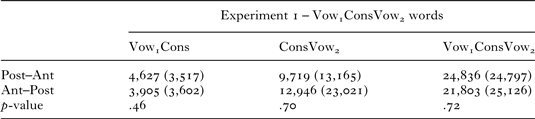
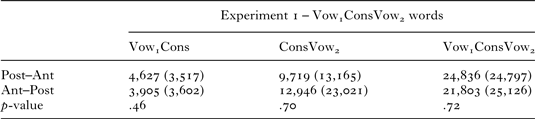
Experiment 1 tested the emergence of a PA bias in French-learning infants. Crucially (and contrary to Van Kampen et al., Reference Van Kampen, Parmaksiz, van De Vijver, Höhle, Gavarró and Freitas2008), all adjacent frequencies of Vow1ConsVow2, Vow1Cons, and ConsVow2 were matched across the PA and AP lists (cf. Table 3) according to the French database Lexique 3 (New et al., Reference New, Pallier, Ferrand and Matos2001), in order to prevent an interpretation in terms of differences in the frequencies of adjacent phonemes.
Diphonic and triphonic mean frequency (and SDs) and p-values associated with the stimuli used in Experiment 1
EXPERIMENT 1
METHOD
Participants
Thirty-two infants from French-speaking families were tested: sixteen 10-month-olds (mean age = 10 months 11 days; range: 10 months 1 day to 25 days; 8 girls, 8 boys) and sixteen 13-month-olds (mean age = 13 months 11 days; range: 13 months 3 days to 23 days; 9 girls, 7 boys). The data of two additional 10-month-olds and three 13-month-olds were not included in the analyses due to fussiness/crying.
Stimuli
The stimuli were composed of vowel–consonant–vowel (Vow1ConsVow2) sequences. This sequence structure was chosen in order to have only one non-adjacent relation within each item (as done in the study on the LC bias; Gonzalez Gomez & Nazzi, Reference Gonzalez-Gomez and Nazzi2012a). Twenty-four bisyllabic Vow1ConsVow2 items were selected, combining five anterior vowels /i/, / /, /œ/, /y/, and /e/, and five posterior vowels /o/, /
 /, /a/, /
 /, and /u/: twelve items with an anterior–posterior structure (/ip/, /ib/, /k/, /ga/, /œku/, /œta/, /yda/, /yd/, /et/, /epo/, /ebu/, /eg/) and twelve items with a posterior–anterior structure (/ote/, /pe/, /ky/, /bi/, /adœ/, /aty/, /ag/, /pi/, /d/, /ge/, /ukœ/, /ube/). Items in both lists were made up of exactly the same vowels and consonants. Consonants were chosen in order to obtain balanced adjacent regularities between the AP and PA lists for the Vow1ConsVow2, Vow1Cons and ConsVow2 sequences of phonemes according to the Lexique 3 database (cf. Table 3). All of these items were pseudo-words legal in French.
The stimuli were recorded in a sound-attenuated booth by a French female native speaker who was naive to the hypotheses of the study. Two tokens of each item were selected. Four lists were created: two lists with the twelve AP items (using different tokens of each item in the two lists, and reversing the order of the items in the two lists) and two lists with the twelve PA items (same manipulation). The duration of all the lists was 18·00 s.
Procedure and apparatus
The experiment was conducted inside a soundproof booth. The booth had a red light and a loudspeaker (SONY xs-F1722) mounted at eye level on each of the side panels and a green light mounted on the center panel. A response box (connected to a Dell Optiplex computer) and a TV screen (connected to a camera inside the booth) were located outside the booth. The observer, who looked at the video of the infant on the TV screen, pressed the buttons of the response box according to the direction of the infant's head, thus starting and stopping the flashing of the lights and the presentation of the sounds, and recording the looking times. The observer and the infant's caregiver wore earplugs and listened to masking music over tight-fitting closed headphones, which prevented them from hearing the stimuli presented. Information about the duration of the head-turn was stored on the computer.
The classic version of the head-turn preference procedure was used (Jusczyk, Cutler & Redanz, Reference Jusczyk, Cutler and Redanz1993a). Each infant was held on a caregiver's lap in the center of the test booth. Each trial began with the green light on the center panel blinking until the infant had oriented to it. Then, the red light on one of the side panels began to flash. When the infant turned in that direction, the stimulus for that trial began to play. The stimuli were delivered by the loudspeakers via an audio amplifier (Marantz PM4000). Each stimulus was played to completion or stopped after the infant failed to maintain the head-turn for 2 consecutive seconds. If the infant turned away from the target by 30° in any direction for less than 2 s and then turned back again, the trial continued, but the time spent looking away (when the experimenter released the buttons of the response box) was automatically subtracted from the orientation time by the program. Thus, the maximum orientation time for a given trial was the duration of the entire speech sample. If a trial lasted less than 1·5 s, the trial was repeated and the original orientation time was discarded.
Each session began with two musical trials, one on each side to give infants an opportunity to practice one head-turn to each side. The test phase consisted of eight trials divided into two blocks (in each of which the two lists of each structure were presented). Order of the different lists within each block was randomized.
RESULTS AND DISCUSSION
Mean orientation times to the AP and PA lists were calculated for each infant. The data for the 10-month-olds (M AP = 8·32 s, SD = 2·57 s; M PA = 8·26 s, SD = 3·28 s), and for the 13-month-olds (M AP = 6·38 s, SD = 2·61 s; M PA = 9·69 s, SD = 2·25 s), are presented in Figure 1. A 2-way ANOVA with the between-subject factor of age (10 versus 13 months) and the within-subject factor of lexical structure (AP versus PA words) was conducted. The effect of lexical structure was significant (F(1,30) = 8·38, p = ·007, ηp 2 = ·22), with infants having longer orientation times to PA than to AP lists. The effect of age was not significant (F(1,30) = 0·11, p = ·75). However, the interaction between age and lexical structure was significant (F(1,30) = 8·94, p = ·005, ηp 2 = ·23), indicating that the effect of lexical structure changed with age. Planned comparisons showed that the lexical structure effect was not significant at 10 months (F(1,30) = 0·005, p = ·95), but was significant at 13 months (F(1,30) = 17·32, p < ·001, d = 1·36). A bias for PA stimuli was found in only 8 of the 16 10-month-olds (p = ·60, binomial test), but in 12 of the 16 13-month-olds (p = ·04, binomial test).
Mean orientation times (and standard error of the mean) to the AP and PA stimuli in Experiments 1 and 2, to the A-initial versus P-initial items in Experiment 3a, and to the P-final versus A-final items of Experiment 3b; ** p ≤ 0.01; *** p ≤ 0.001.

Experiment 1 first establishes the emergence of a perceptual posterior–anterior bias between the ages of 10 and 13 months. Importantly though, given that all adjacent regularities were fully controlled (that is, the Vow1Cons and the ConsVow2 were chosen so that there was no significant difference between the adjacent sequences of the PA and AP lists according to the Lexique 3 database), these results support the interpretation that, by 13 months, infants have learned these non-adjacent vocalic regularities present in the French lexicon. More specifically, they have learned the general predominance of non-adjacent sequences of PA vowels over AP vowels in French words.
Second, these results suggest the existence of a delay in the acquisition of non-adjacent vocalic regularities, compared to similar consonantal regularities which are acquired by 10 months of age (the LC bias; Gonzalez-Gomez & Nazzi, Reference Gonzalez-Gomez and Nazzi2012a). One possibility is that the acquisition of vocalic non-adjacent regularities is delayed in comparison to consonantal non-adjacent regularities. This is predicted by the third hypothesis outlined in the ‘Introduction’, according to which the LC and PA biases are the result of distributional computations at the lexical level, at which there is a processing advantage for consonants over vowels as stated by the CV hypothesis (Nespor et al., Reference Nespor, Pena and Mehler2003). However, an alternative interpretation for the present acquisition delay is that the stimuli in the present experiment were more complex than those on the LC bias used by Gonzalez-Gomez and Nazzi (Reference Gonzalez-Gomez and Nazzi2012a). Indeed, the present study contrasted five anterior vowels to five posterior vowels, while Gonzalez-Gomez and Nazzi only contrasted two labial consonants to two coronal consonants. To investigate this methodological possibility, a second experiment was conducted contrasting only two anterior vowels to two posterior vowels.
EXPERIMENT 2
METHOD
Participants
Thirty-two infants from French-speaking families were tested: sixteen 10-month-olds (mean age = 10 months 13 days; range: 10 months 1 day to 26 days; 7 girls, 9 boys) and sixteen 13-month-olds (mean age = 13 months 17 days; range: 13 months 6 days to 24 days; 7 girls, 9 boys). The data of one additional 10-month-old and two 13-month-olds were not included in the analyses due to fussiness/crying.
Stimuli
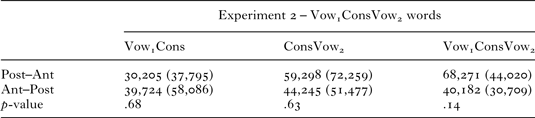
Twenty-four bisyllabic Vow1ConsVow2 items were selected, combining anterior vowels /i/ and /e/, and posterior vowels /o/ and /a/: twelve items with an anterior–posterior structure (3 IcO: /ipo/, /ido/, /ibo/; 3 IcA: /ita/, /ika/, /ipa/; 3 EcO: /eto/, /ego/, /edo/; 3 EcA: /eba/, /ega/, /eka/) and twelve items with a posterior–anterior structure (3 OcI: /opi/, /odi/, /obi/; 3 AcI: /aki/, /agi/, /api/; 3 OcE: /ote/, /oge/, /ode/; 3 AcE: /abe/, /ate/, /ake/). As in Experiment 1, items in both lists were made up of exactly the same vowels and consonants. Consonants were chosen in order to obtain balanced adjacent regularities between the AP and PA lists for the Vow1ConsVow2, Vow1Cons, and ConsVow2 sequences of phonemes according to the Lexique 3 database (cf. Table 4). All of these items were pseudo-words legal in French. The steps in stimulus preparation were the same as in Experiment 1.
Diphonic and triphonic mean frequency (and SDs) and p-values associated with the stimuli used in Experiment 2
Procedure and apparatus
The procedure and apparatus were the same as in Experiment 1.
RESULTS AND DISCUSSION
Mean orientation times to the AP and PA lists were calculated for each infant. The data for the 10-month-olds (M AP = 7·89 s, SD = 2·34 s; M PA = 8·53 s, SD = 2·20 s), and for the 13-month-olds (M AP = 6·39 s, SD = 2·16 s; M PA = 9·11 s, SD = 2·00 s), are presented in Figure 1. As in Experiment 1, a 2-way ANOVA with the between-subject factor of age (10 versus 13 months) and the within-subject factor of lexical structure (AP versus PA words) was conducted. The effect of lexical structure was significant (F(1,30) = 13·39, p < ·001, ηp 2 = ·31), infants having longer orientation times to PA than to AP lists. The effect of age was not significant (F(1,30) = 0·56, p = ·46). However, the interaction between age and lexical structure was significant (F(1,30) = 5·08, p = ·03, ηp 2 = ·15), indicating that the effect of lexical structure changed with age. Planned comparisons showed that the lexical structure effect was not significant at 10 months (F(1,30) = 0·99, p = ·33), but was significant at 13 months (F(1,30) = 17·48, p < ·001, d = 1·31). A bias for PA stimuli was found in only 10 of the 16 10-month-olds (p = ·23, binomial test), but in 12 of the 16 13-month-olds (p = ·04, binomial test).
Experiment 2 replicates the results from Experiment 1, showing that the posterior–anterior bias emerges between the ages of 10 and 13 months, using the same number of contrasted elements as in Gonzalez-Gomez and Nazzi (Reference Gonzalez-Gomez and Nazzi2012a). Therefore, these results show that the delay found for vocalic acquisitions compared to consonantal ones did not result from differences in the number of vowels versus consonants used in the two studies. Importantly, these differences in acquisition timing appear to be related to the existence of functional differences between vowels and consonants, as stipulated by the CV hypothesis (Nespor et al., Reference Nespor, Pena and Mehler2003). Given the advantage for consonants, the comparison of Gonzalez-Gomez and Nazzi, (Reference Gonzalez-Gomez and Nazzi2012a) and the present study suggest that the LC and PA biases are learned at the lexical level.
In Experiments 1 and 2, because there is no frequency database for infant-directed speech, the stimuli were built controlling for adjacent regularities using the Lexique 3 database, with no full guarantee that the frequencies would be similar in both types of input. Moreover, we found a predominance of A-initial words over P-initial words, and a predominance of A-final words over P-final words (cf. Table 2), and at this point it cannot be excluded that infants would be influenced by these frequency/positional effects (e.g. prefer A-final words). In order to differentiate the relative contribution of the non-adjacent relationship between the two vowels and these potentially confounding adjacent and positional factors, two additional control sub-experiments were run at 13 months (following the same logic as Gonzalez-Gomez & Nazzi, Reference Gonzalez-Gomez and Nazzi2012a). For these control experiments, the stimuli of Experiment 1 were re-recorded, removing either the final vowel (leaving P-initial and A-initial Vow1Cons items) or the initial vowel (leaving A-final and P-final ConsVow2 items). This manipulation removed the non-adjacent regularity we were investigating, while adjacent regularities and positional properties between the two lists of stimuli remained identical to those in Experiment 1.
If 13-month-old infants were sensitive to non-adjacent vocalic regularities in Experiments 1 and 2, they should have no preference in either of these two additional conditions. By contrast, if they were reacting to differences in adjacent frequencies (present in the infants' input but not in the adult lexicon), then they should prefer P-initial over A-initial Vow1Cons items in Experiment 3a, or A-final over P-final ConsVow2 items in Experiment 3b, or both. Lastly, if infants were sensitive to the frequency/positional factors, they might prefer A-initial words in Experiment 3a (a frequency bias that would go against the observed preference for AP words), and A-final words in Experiment 3b (a frequency bias that would support a preference for PA words). Note that these frequency/positional predictions differ from the potential adjacent dependency predictions, and only one of them would support the observed PA bias at 13 months. Accordingly, two new groups of 13-month-olds were tested on either P-Cons versus A-Cons stimuli (Experiment 3a), or Cons-A versus Cons-P stimuli (Experiment 3b). Note that both P-Cons and Cons-A stimuli are in line with the posterior–anterior structure (which we will call PA-based structures), while both A-Cons and Cons-P stimuli are in line with the anterior–posterior structure (which we will call AP-based structures).
EXPERIMENTS 3A AND 3B
METHOD
Participants
Sixteen 13-month-old infants from French-speaking families were tested for each experiment (Experiment 3a: mean age = 13 months 13 days; range: 13 months 1 day to 23 days; 7 girls, 9 boys; Experiment 3b: mean age = 13 months 9 days; range: 13 months 1 day to 20 days; 8 girls, 8 boys). The data of three additional infants were not included in the analysis due to fussiness/crying.
Stimuli Experiment 3a
The final vowels of the twenty-four Vow1ConsVow2 words of Experiment 1 were removed in order to obtain twelve A-initial and twelve P-initial Vow1Cons sequences (A-initial: /ip/, /ib/, /k/, /g/, /œk/, /œt/, /œd/, /yd/, /et/, /ep/, /eb/, /eg/) and twelve items with a posterior–anterior (P-initial) structure (/ot/, /p/, /k/, /b/, /ad/, /at/, /ag/, /p/, /d/, /g/, /uk/, /ub/).
Stimuli Experiment 3b
The initial vowels of the twenty-four Vow1ConsVow2 words of Experiment 1 were removed in order to obtain twelve A-final and twelve P-final Vow1Cons sequences (A-final: /te/, /pe/, /ky/, /bi/, /dœ/, /ty/, /g/, /pi/, /d/, /ge/, /kœ/, /be/; P-final: /p/, /b/, /k/, /ga/, /ku/, /ta/, /da/, /d/, /t/, /po/, /bu/, /g/).
In both sub-experiments, consonants were completely balanced. All two-phoneme sequences were recorded in a sound-attenuated booth by the same French female native speaker as Experiment 1, naive to the hypotheses of the study. Two tokens of each sequence were selected. In each sub-experiment, four lists were made up: Experiment 3a: two lists with the twelve A-initial sequences (using different tokens of each item in the two lists, and reversing the order of the items in the two lists) and two lists with the twelve P-initial words (same manipulation); Experiment 3b: two lists with the twelve A-final sequences (same manipulation) and two lists with the twelve P-final words (same manipulation). The duration of all the lists was 14·00 s.
Procedure and apparatus
The procedure and apparatus were the same as in Experiment 1.
RESULTS AND DISCUSSION
Mean orientation times to the A-Cons and P-cons lists of Experiment 3a were calculated for each infant and are presented in Figure 1. Mean orientation times were 7·85 s (SD = 3·29 s) for the A-Cons list and 7·44 s (SD = 3·09) for the P-Cons list. Similarly, mean orientation times to the Cons-A and the Cons-P lists of Experiment 3b were calculated for each infant and are also presented in Figure 1. Mean orientation times were 7·98 s (SD = 2·34 s) for the Cons-A list and 8·17 s (SD = 3·38) for the Cons-P list.
A 2-way ANOVA with the between-subject factor of Experiment (3a versus 3b) and the within-subject factor of lexical structure (AP-based versus PA-based) was conducted. Both main effects were not significant (F(1,30) = 0·37, p = ·55, for lexical structure; F(1,30) = 0·20, p = ·66, for experiment). Additionally, the interaction between experiment and lexical structure was not significant (F(1,30) = 0·05, p = ·83). Planned comparisons showed that the lexical structure effect was not significant in either Experiment 3a (F(1,30) = 0·34, p = ·56; a preference for P-Cons items was found for only 8 of the 16 infants, p = ·60, binomial test) or Experiment 3b (F(1,30) = 0·08, p = ·78; a preference for Cons-A items was found for 10 of the 16 infants, p = ·23, binomial test).
The absence of preference in these control experiments establishes that the 13-month-olds in Experiments 1 and 2 were not responding to adjacent properties (between Vow1Cons or ConsVow2) of the stimuli, since these adjacent properties were also present in Experiments 3a and 3b. Furthermore, the lack of preference also rules out the possibility that the PA preference was due to a positional bias, such as an A-word-final bias. This suggests that the frequency controls we had made on the basis of the adult Lexique 3 database were appropriate for infant testing. More importantly, they establish that, in Experiments 1 and 2, infants were responding to non-adjacent properties, namely the predominance of PA words over AP words in the French lexicon.
GENERAL DISCUSSION
The goals of the present study were to investigate whether infants are sensitive to non-adjacent phonotactic regularities between vowels, and if so, whether these acquisitions are acquired at the same age as equivalent consonantal regularities. Accordingly, we investigated when French-learning infants develop a preference for Vow1ConsVow2 items with a posterior–anterior structure over items with an anterior–posterior structure, the posterior–anterior structures being comparatively more frequent in French than the anterior–posterior ones (cf. Table 1). The results of Experiment 1 showed that this bias emerges between 10 and 13 months of age, that is, three months later than what has been previously found for a consonant bias of similar magnitude (cf. Gonzalez-Gomez & Nazzi, Reference Gonzalez-Gomez and Nazzi2012a). These results were replicated in Experiment 2, using simpler stimuli (stimuli containing 4 instead of the 10 different vowels used in Experiment 1). Taken together, the results of Experiments 1 and 2 showed that, between 10 and 13 months of age, infants become sensitive to non-adjacent phonological regularities between vowels. This interpretation is reinforced by the way the stimuli were constructed, controlling for adjacent regularities using the adult database Lexique 3.
Nevertheless, as discussed earlier, two other effects could have affected the 13-month-olds' preferences. First, the adjacent frequency control could only be calculated on an adult database, since no suitable database is available for very young infants. If these adjacent frequencies were different for the infant input and were responsible for the observed posterior–anterior preference at 13 months, then presenting 13-month-olds with Vow1Cons should result in a preference for posterior-initial items, and/or presenting them with ConsVow2 should result in a preference for anterior-final items. Second, frequency/positional effects might also have contributed to the labial–coronal preference, at least when it comes to final anterior vowels, since anterior vowels are overall more frequent than posterior vowels in French, and this is true both in word-initial and word-final position. If 13-month-olds were reacting to these frequency/positional properties, then presenting them with Vow1Cons should result in a preference for anterior-initial items (an effect that would go against a posterior–anterior preference), and presenting them with ConsVow2 should result in a preference for anterior-final items (an effect that would support a posterior–anterior preference). These effects were evaluated in two additional control experiments presenting infants with either the first two phonemes (Vow1Cons, Experiment 3a) or the last two phonemes (ConsVow2, Experiment 3b) of the original stimuli used in Experiment 1.The results of Experiments 3a–b rule out these alternative interpretations, since no preferences were obtained at 13 months. These latter results further suggest that the adjacent regularities, controlled using the adult database Lexique 3, were appropriate for infant input. The present study thus provides new evidence showing that infants become sensitive to vocalic non-adjacent regularities between 10 and 13 months of age.
At this point, it is important to discuss the age difference in acquisition between the results of Van Kampen and colleagues (2008) and our results. While the results of Van Kampen et al., showed that Turkish-learning 6-month-olds are already sensitive to vowel harmony (a property present in their native language), it is not until seven months later (13 months) that we found evidence of infants' sensitivity to non-adjacent vocalic regularities. As discussed in the ‘Introduction’, several factors could explain this difference. First, crucial factors were not controlled in Van Kampen et al., such as the adjacent and positional frequencies of the stimuli used. Second, the prevalence of vocalic harmony in Turkish (90% of words according to Ketrez, Reference Ketrez2014) is far higher than the prevalence of the PA bias, which makes vowel harmony much more salient than the PA bias in French. Third, vocalic harmony in Turkish has a morphosyntactic component (Rose & Walker, Reference Rose, Walker, Goldsmith, Riggle and Yu2011), and might be learned at the morphosyntactic level rather than the lexical level, as the present PA bias. A related possibility is that vowel harmony is learned as an identity/repetition rule (applying at the level of a given feature), a type of rule that has been found to be learned in laboratory experiments by both 7-month-olds (Marcus et al., Reference Marcus, Vijayan, Rao and Vishton1999) and newborns (Gervain et al., Reference Gervain, Macagno, Cogoi, Pena and Mehler2008, 2012). Both possibilities would predict an advantage for vowels over consonants according to the CV hypothesis, which proposes that vowels play a more important role on extracting (morpho)syntactic-like generalizations (Nespor et al., Reference Nespor, Pena and Mehler2003), which might explain the time lag in the acquisition of both biases.
Given the pending questions regarding the interpretation of vocalic harmony acquisition (which could be further tested with a language in which vowel harmony has lower prevalence, such as Hungarian, which has 77% of harmonic words; Ketrez, Reference Ketrez2014), it is interesting that our results suggest the existence of a delay in the acquisition of vocalic non-adjacent phonological regularities compared to consonantal non-adjacent ones, which have been shown to be acquired between 7 and 10 months of age (cf. Gonzalez-Gomez & Nazzi Reference Gonzalez-Gomez and Nazzi2012a; Nazzi et al., Reference Nazzi, Bertoncini and Bijeljac-Babic2009a). It is important to emphasize that the prevalence of the vocalic (PA) and the consonantal (LC) biases in the French lexicon is similar (PA bias occurrence ratio = 1·79; LC bias occurrence ratio = 1·68). Thus, the asymmetry found in the acquisition of non-adjacent vocalic and consonantal regularities cannot be explained in terms of prevalence of occurrence. Moreover, as noted earlier, PA/AP structures are overall almost nine times more frequent than LC/CL structures, which should have favored, if anything, the acquisition of the PA bias.
The delay of acquisition of the vocalic PA dependency can be explained by the CV hypothesis (Nespor et al., Reference Nespor, Pena and Mehler2003), according to which vowels and consonants play different roles at different linguistic processing levels. More specifically, it has been proposed that vowels are given more weight in the encoding of information about prosodic/syntactic structure, while consonants are given more weight in the encoding of information about lexical identity. The CV hypothesis predicted two possible outcomes about infants' preference for PA sequences. The first possibility, if the PA and LC biases were learned as structural generalizations (i.e. as a rule about vowel or consonant identity and order), predicted an advantage for vocalic over consonantal sequences, thus earlier acquisition of the PA bias. The second possibility, if the biases were learned at the lexical level, predicted an advantage for consonantal acquisitions, hence later acquisition of the PA bias than the LC bias. Our results are in line with the second possibility, suggesting that these non-adjacent phonological regularities are lexically related acquisitions.
The possibility that these non-adjacent regularities would be learned at the lexical level raises the question of whether the acquisition of the PA and LC biases would have implications for lexical learning. Recent studies have found that these kinds of regularities help infants identify possible word-like units and learn new words. First, Gonzalez-Gomez and Nazzi (Reference Gonzalez-Gomez and Nazzi2013) conducted a word segmentation study exploring infants' ability to segment word forms having either a labial–coronal or a coronal–labial structure. Their results show that although infants were able to segment the words with an LC structure at 10 months, they were not able to segment the CL ones until 13 months. In a subsequent study, Gonzalez-Gomez, Poltrock, and Nazzi (Reference Gonzalez-Gomez, Poltrock and Nazzi2013) used animated cartoons in a word learning task to explore whether or not words having an LC structure are easier to learn than words having a CL structure. Their results show that 14-month-olds were able to learn only LC words, while 16-month-olds could learn both LC and CL words. These results are in line with evidence showing that infants use knowledge about native adjacent phonotactic regularities to learn the words of their native language. This has been shown in studies investigating word form segmentation (Mattys & Jusczyk, Reference Mattys and Jusczyk2001) and word learning (Graf Estes, Edwards & Saffran, Reference Graf Estes, Edwards and Saffran2011). All these studies show that words made up of frequent phonotactic sequences are segmented and learned more easily and/or at an earlier age than words made up of infrequent phonotactic sequences. Based on the findings of the present study, similar word segmentation and word learning advantages would be predicted around 13 months of age for words having a PA bias in French, which will have to be tested in the future. Such ‘advantages’ should also be language-specific, that is, based on the specific properties of the lexicon of a given language, as has been found using sequences of plosive consonants (labial /p/, /b/, and coronal /t/, /d/) by comparing French-learning infants (developing an LC bias) and Japanese-learning infants (developing a CL bias).
Importantly, the set of studies described above shows that infants' knowledge of their native language phonotactic patterns influences both their word segmentation and their word learning abilities, providing evidence that early speech perception and later lexical acquisition are closely related. However, the fact that by 9 months Turkish-learning infants use vowel harmony to segment words, and more particularly use non-harmonic sequences as a cue to find word boundaries (Van Kampen et al., Reference Van Kampen, Parmaksiz, van De Vijver, Höhle, Gavarró and Freitas2008), might suggest that whether these patterns are acquired at a lexical level or not may not be directly related to the fact that they would then be used at a lexical level. Further studies will be needed to explore this issue.
The difference in timing found between the acquisition of vocalic and consonantal non-adjacent regularities is in line with previous studies showing an advantage for consonants over vowels in lexically related tasks in both adults (Bonatti et al., Reference Bonatti, Pena, Nespor and Mehler2005; Cutler et al., Reference Cutler, Sebastián-Gallés, Soler-Vilageliu and van Ooijen2000; New et al., Reference New, Araújo and Nazzi2008) and toddlers/children (Havy & Nazzi, Reference Havy and Nazzi2009; Havy et al., Reference Havy, Bertoncini and Nazzi2011; Nazzi, Reference Nazzi2005; Nazzi, et al., Reference Nazzi, Floccia, Moquet and Butler2009b). However, this is the first time that this kind of asymmetry has been found at such a young age. Taken together, these results support the existence of an early privileged role of consonants in lexical processes in French, as proposed by Nespor et al. (Reference Nespor, Pena and Mehler2003). Future research will be needed to continue evaluating infants' acquisition of different non-adjacent consonantal and vocalic regularities in order to determine, on the one hand, the kinds of regularities that infants are sensitive to, and on the other hand, which regularities are treated as lexical acquisitions and which are treated as rule generalizations. At any rate, the present study establishes that infants learning French become sensitive to non-adjacent vocalic regularities in their native language between 10 and 13 months of age, hence later than their acquisition of equivalent consonantal non-adjacent regularities, as predicted by the CV hypothesis if these regularities are learned at the lexical level.