Introduction
Genetically modified (GM) crops with tolerance to nonselective herbicides have been rapidly adopted in the United States due to their higher crop yield and lower pesticide costs as well as the simplicity and flexibility of the technology (Fernandez-Cornejo et al. Reference Fernandez-Cornejo, Hendricks and Mishra2005, Reference Fernandez-Cornejo, Wechsler, Livingston and Mitchell2014). The introduction and adoption of crops resistant to glyphosate in the Roundup Ready® system enabled producers to reduce production costs associated with herbicide purchases, applications, tillage, and hand weeding and are more environmentally benign than the soil tillage and herbicides they have replaced; some researchers consider glyphosate to be a “once in a century herbicide” (Duke and Powles Reference Duke and Powles2008; Gianessi Reference Gianessi2005). The intensive use of glyphosate has contributed to the evolution of glyphosate-resistant (GR) weeds, forcing many producers to use alternative technologies for weed control. The widespread infestation of GR Palmer amaranth (Amaranthus palmeri S. Watson) in soybean [Glycine max (L.) Merr.] is a major contributor to the greater adoption of LibertyLink® (LL) soybean in the midsouthern United States (Riar et al. Reference Riar, Norsworthy, Steckel, Stephenson, Eubank, Bond and Scott2013a, Reference Riar, Norsworthy, Steckel, Stephenson, Eubank, Bond and Scott2013b).
The LL system uses the GM crop resistance to the herbicide glufosinate. Glufosinate is a nonselective, nonresidual POST herbicide used in GM crops, including canola (Brassica napus L.), corn (Zea mays L.), cotton (Gossypium hirsutum L.), and soybeans (Anonymous 2011b; Senseman Reference Senseman2007). Glufosinate controls weeds that are difficult to control with glyphosate, such as Ipomoea spp. and hemp sesbania [Sesbania herbacea (Mill.) McVaugh], and GR weeds, such as horseweed (Erigeron canadensis L.), and Amaranthus spp. (Culpepper et al. Reference Culpepper, York, Batts and Jennings2000; Green and Owen Reference Green and Owen2011; Whitaker et al. Reference Whitaker, York, Jordan and Culpepper2011). Shurley et al. (Reference Shurley, Smith, Culpepper and Roberts2010) reported that in areas of prevalent GR Palmer amaranth, especially in nonirrigated conservation tillage, a glufosinate-based system is the most efficacious and cost-effective tool to manage GR Palmer amaranth. However, grass weed control with glufosinate may be inadequate and may require additional management inputs (Beyers et al. Reference Beyers, Smeda and Johnson2002; Burke et al. Reference Burke, Askew, Corbett and Wilcut2005; Gardner et al. Reference Gardner, York, Jordan and Monks2006; Koger et al. Reference Koger, Burke, Miller, Kendig, Reddy and Wilcut2007; Steckel et al. Reference Steckel, Wax, Simmons and Phillips1997). Culpepper and York (Reference Culpepper and York1999) reported glufosinate (400 g ai ha−1) applied POST only provided 81% to 94% and 64% season-long control of fall panicum (Panicum dichotomiflorum Michx.) and goosegrass [Eleusine indica (L.) Gaertn.], respectively. Culpepper et al. (Reference Culpepper, York, Batts and Jennings2000) reported glufosinate at 400 g ai ha−1 provided 77% and 83% control of broadleaf signalgrass [Urochloa platyphylla R. D. Webster] and goosegrass, and a sequential application of glufosinate at 290 g ai ha−1 improved control by only 13% and 5%, respectively. Stephenson and Scroggs (Reference Stephenson and Scroggs2009) reported that two applications of glufosinate at 880 g ai ha−1 resulted in less than 90% control of barnyardgrass.
Due to limited translocation of glufosinate, plant size at time of application is critical for season-long weed control. Glufosinate applied late POST compared with earlier applications was ineffective on larger goosegrass (Culpepper et al. Reference Culpepper, York, Batts and Jennings2000) and barnyardgrass (Craigmyle et al. Reference Craigmyle, Ellis and Bradley2013) due to plant regrowth and escapes. When treated at 15-cm plant height, giant foxtail (Setaria faberi Herrm.), common lambsquarters (Chenopodium album L.), common cocklebur (Xanthium strumarium L.), and Pennsylvania smartweed [Persicaria pensylvaniva (L.) M. Gomez] control was 45% less than when the weed species were treated at 10-cm plant height with glufosinate applied at 420 g ai ha−1 (Steckel et al. Reference Steckel, Wax, Simmons and Phillips1997).
A recent survey of soybean consultants in the midsouthern United States concluded that 35% of the total scouted LL acres were treated solely with glufosinate (Riar et al. Reference Riar, Norsworthy, Steckel, Stephenson, Eubank, Bond and Scott2013b). Compared with glyphosate, glufosinate applied alone will not likely provide adequate summer annual grass control; thus, producers may choose to mix herbicides to broaden and improve the spectrum of weeds controlled and reduce application cost. (Beyers et al. Reference Beyers, Smeda and Johnson2002; Corkern et al. Reference Corkern, Reynolds, Vidrine, Griffin and Jordan1998; Culpepper et al. Reference Culpepper, York, Batts and Jennings2000; Green Reference Green1989; Kim et al. Reference Kim, Won, Lee, Yu and Lee2005; Vidrine Reference Vidrine1989; Vidrine et al. Reference Vidrine, Reynolds and Blouin1995; Zhang et al. Reference Zhang, Hamill and Weaver1995).
The arloxyphenoxypropionate (FOP) and cyclohexanedione (DIM) herbicide families, commonly known as the graminicide herbicide group, are used for POST annual and perennial grass control without causing injury to dicotyledonous weed or crops (Devine et al. Reference Devine, Duke and Fedtke1993; Senesman Reference Senseman2007). The FOP herbicides fluazifop-P and quizalofop-P and the DIM herbicides clethodim and sethoxydim are labeled for use in soybeans (Anonymous 2010a, 2010b, 2010c, 2011a).
Producers that use the LL soybean cropping system can combine glufosinate, which is a nonselective herbicide, with a graminicide herbicide for enhanced grass weed control. However, there have been conflicting reports of antagonism when graminicide herbicides are applied at normal use rates with glufosinate. Burke et al. (Reference Burke, Askew, Corbett and Wilcut2005) reported decreased goosegrass control when clethodim was applied in mixture with glufosinate. Gardner et al. (Reference Gardner, York, Jordan and Monks2006) reported reduced control of annual grasses when glufosinate was mixed with clethodim, fluazifop-P, quizalofop-P, or sethoxydim. However, Beyers et al. (Reference Beyers, Smeda and Johnson2002) reported adequate control of giant foxtail when quizalofop-P was mixed with glufosinate. GR johnsongrass [Sorghum halepense (L.) Pers.] control was greater when herbicide programs included clethodim compared with glufosinate applied alone (Johnson et al. Reference Johnson, Norsworthy and Scott2014).
The antagonism of graminicides by broadleaf herbicides applied with graminicides may sometimes be reduced or alleviated by sequential herbicide applications (Green Reference Green1989). However, there have been conflicting reports of annual grass control antagonism from graminicides applied before or after glufosinate. Burke et al. (Reference Burke, Askew, Corbett and Wilcut2005) reported antagonized goosegrass control when clethodim was applied 7 or 14 d after glufosinate. However, when glufosinate was applied 7 or 14 d after clethodim, goosegrass control was equivalent to clethodim applied alone. Gardner et al. (Reference Gardner, York, Jordan and Monks2006) reported reduced annual grass control when graminicides were applied 1 d before, mixed with, or applied 1 or 3 d after glufosinate. However, annual grass control was not adversely affected when graminicides were applied 3 or 5 d before glufosinate or 5 or 7 d after glufosinate. Irby et al. (Reference Irby, Reynolds, Huff and Dodds2007) reported poor barnyardgrass control when glufosinate was applied before graminicides. Conflicting reports of antagonism with annual grass control may be due to the size of the grasses at the time of the glufosinate applications or the antagonism being species specific.
Barnyardgrass is one of the most troublesome grasses in soybean production areas of the Midsouth (Van Wychen Reference Van Wychen2016). Barnyardgrass exhibits prolific seed dormancy, prolonged emergence, and rapid growth and flowers in a wide range of photoperiod and environmental conditions (Bagavathiannan et al. Reference Bagavathiannan, Norsworthy, Smith and Burgos2011; Maun and Barrett Reference Maun and Barrett1986; Mitch Reference Mitch1990; Potvin Reference Potvin1986). Barnyardgrass densities of 0 to 500 plants m−1 of row reduced soybean yield 0% to 78%, with an average yield reduction of 0.25% for each barnyardgrass plant per meter of soybean row (Vail and Oliver Reference Vail and Oliver1993). Soybean is a common rotational crop with rice (Oryza sativa L.) in the Midsouth. Barnyardgrass is a major pest of both rice and soybean production systems, so its control is critical to prevent yield loss and to reduce the number of seeds entering the soil seedbank.
Limited data are available on the effect of application timing of mixtures of graminicide and glufosinate on barnyardgrass control. Producers using the LL soybean system would benefit from appropriate management strategies to prevent potential graminicide antagonism. The objectives of this research were to determine the effects of sequential applications of glufosinate either before or after graminicides on barnyardgrass control.
Materials and Methods
Field Experiments
Field studies were conducted in 2013 and 2014 to evaluate the potential interactions of glufosinate and clethodim for barnyardgrass control. Experiments were conducted at the Black Belt Branch Experiment Station in Brooksville, MS (33.2593 N, 88.5655 W), on an Okolona silty clay (fine, smectitic, thermic Oxyaquic Hapluderts) with 8% sand, 51% silt, 41% clay, 2% organic matter, and pH of 6.8, and a Brooksville silty clay (fine, smectitic, thermic Aquic Hapluderts) with 7% sand, 48% silt, 45% clay, 1.8% organic matter, and pH of 6.0 in the respective years. Experiments were conducted in fields naturally infested with populations of barnyardgrass. Barnyardgrass density averaged 1,205 and 269 plants m−2 in 2013 and 2014, respectively. In 2013, the experiment was conducted in a fallowed field not planted to soybean. Plot size in the fallowed area was 2.8 by 9.4 m. ‘Pioneer 95L01’ soybeans (Pioneer Hi-Bred International, P.O. Box 1000, Johnston, IA) were planted May 19, 2014, with a target population of 271,930 plants ha−1, and plots were 3 rows (0.96 m) by 9.4-m long.
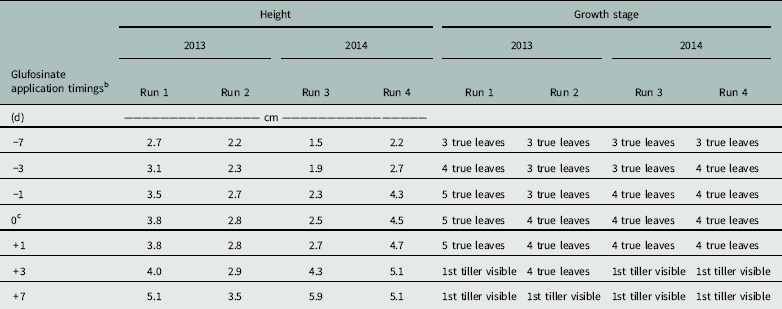
Herbicide treatments consisted of glufosinate (Ignite® 280 SL, 280 g ai L−1, Bayer CropScience, P.O. Box 12014, 2 T.W. Alexander Drive, Research Triangle Park, NC 27709) at 594 g ai ha−1 applied 7, 3, and 1 d before, mixed with, or 1, 3, or 7 d after clethodim (Select Max®, 116 g ai L−1, Valent U.S.A., P.O. Box 8025, Walnut Creek, CA 94596) at 0 or 76 g ai ha−1, and clethodim applied alone at 0 or 76 g ai ha−1 following Corkern et al. (Reference Corkern, Reynolds, Vidrine, Griffin and Jordan1998). Crop oil concentrate (Agri-dex®, Helena Chemical, 225 Schilling Boulevard, Suite 300, Collierville, TN 38017) at 1.0% v/v was included with all clethodim treatments. No adjuvant was included when glufosinate was applied alone. Clethodim was applied on day 0 to eliminate differences in growth stage or environmental conditions. Herbicide treatments were applied with a CO2-pressurized backpack sprayer equipped with XR8002 flat-fan nozzle (TeeJet® Technologies, P.O. Box 7900, Wheaton, IL 60187) at an application volume of 140 L ha−1 and a pressure of 220 kPa. Herbicide treatments were initiated when barnyardgrass plants had 2 to 4 fully expanded leaves. Barnyardgrass height and growth stages for all applications were recorded at the time of application (Table 1). Visual estimates of barnyardgrass control were recorded at 14, 28, and 56 d after the clethodim treatment (DAT), using a scale of 0% to 100%, where 0=no control and 100=complete control. Chlorosis, height reductions, and regrowth were visually evaluated to estimate control. Barnyardgrass biomass was collected at 56 DAT using a 1-m quadrat, and plants were separated to include only the plants present at the time of application. Samples were oven-dried at 65 C for 1 wk to determine aboveground biomass on a dry matter basis. Soybeans were machine harvested, and yields were recorded.
Barnyardgrass height and growth stage at the time of application for field experiments in 2013 and 2014.a

a Average barnyardgrass population was 1,205 plants m−2 in 2013 and 269 plants m−2 in 2014.
b Glufosinate applied relative to graminicide application in days before or after clethodim applied on day 0.
c Glufosinate was mixed with clethodim on day 0.
The experimental design was a randomized complete block with a factorial arrangement of treatments: Factor A was glufosinate application timing relative to clethodim application (ranging from 7 d before to 7 d after) and Factor B was clethodim rate (0 or 76 g ha−1). Four replications for each treatment were used in each experiment. Barnyardgrass control data were pooled across years because experimental replications were considered a random variable. Barnyardgrass control data were subjected to square-root transformation, but interpretations were similar to untransformed data; therefore, untransformed data were used for analysis. Barnyardgrass biomass data were subjected to square-root transformation. Interpretations of results were not similar to untransformed data; therefore, transformed data were used in the analysis with results presented in their original scale. Data were subjected to ANOVA, and means were separated using Fisher’s protected LSD test at P=0.05.
Greenhouse Experiments
Treatments described in the field studies were also evaluated in the greenhouse; however, two additional graminicides were included, fluazifop-P (Fusilade DX®, 240 g ai L−1, Syngenta Crop Protection) and quizalofop-P (Assure II®, 105 g ai L−1, Du Pont de Nemours, 1007 Market Street, Wilmington, DE 19898). Barnyardgrass seeds were planted approximately 2.5-cm deep in 40-cm3 plastic Ray Leach Cone-tainer™ planting tubes (D40 Deepot Cell, Stuewe and Sons, 2290 SE Kiger Island Drive, Corvallis, OR 97333) containing commercial potting soil mix (Metro-Mix® 360, Sun Gro Horticulture, 770 Silver Street, Agawam, MA 01001) and placed into a column module. After planting, each Cone-tainer™ was surface irrigated with tap water and then subirrigated for the duration of the experiment. Plants were thinned to 3 plants per Cone-tainer within 1 wk of emergence, and grown at 35/30 C night/day temperature. Natural light was supplemented with light from sodium-vapor lamps (General Electric Sodium Vapor Lamps, Lucalox LU 400, General Electric Consumer and Industrial Lighting, 1975 Noble Road, Nela Park, Cleveland, OH 44112) to provide a 16-h photoperiod (Dodds et al. Reference Dodds, Reynolds, Massey, Smith and Koger2007).
Approximately 1 wk after thinning, when plants had 3 to 4 fully expanded leaves, herbicide treatments were initiated using a compressed-air spray chamber equipped with a single 80015EVS flat-fan nozzle (TeeJet® Technologies) at an application volume of 140 L ha−1 and a pressure of 240 kPa. Glufosinate at 594 g ai ha−1 was applied 7, 3, and 1 d before, mixed with, or 1, 3, or 7 d after application of fluazifop-P at 210 g ai ha−1, quizalofop-P at 56 g ai ha−1, clethodim at 76 g ai ha−1, or none following Corkern et al. (Reference Corkern, Reynolds, Vidrine, Griffin and Jordan1998). Graminicides were also applied alone. Graminicides were applied on day 0 to eliminate differences in plant height and environmental differences at application. Crop oil concentrate at 1.0% v/v was included with all graminicide treatments. No adjuvant was included when glufosinate was applied alone. Barnyardgrass height and growth stages for all applications were recorded at the time of application (Table 2).
Barnyardgrass height and growth stage at the time of application for greenhouse experiments in 2013 and 2014.a

a Barnyardgrass population of 3 plants per Cone-tainer™.
b Glufosinate (594 g ha−1) applied relative to graminicide application in days before or after graminicides, applied on day 0.
c Glufosinate was mixed with graminicides on day 0.
Barnyardgrass control was visually estimated 14 and 28 d after graminicide treatment (DAT) using a scale of 0% to 100%, where 0=no control and 100=complete control. Chlorosis, height reductions, and regrowth were visually evaluated to estimate control. Barnyardgrass aboveground biomass was collected at 28 DAT, oven-dried at 65 C for 1 wk, and weighed to determine barnyardgrass biomass.
The experimental design was a randomized complete block with a factorial arrangement of treatments: Factor A was graminicide herbicide rate and Factor B was glufosinate application timing relative to the graminicide. Four replications for each treatment were used in each experiment, and the experiment was replicated in time. Experimental replications were considered a random variable; therefore, data were pooled. Untransformed and arcsine square-root-transformed data were subjected to ANOVA, but interpretations were similar to untransformed data; therefore, untransformed data were used for analysis. Data were subjected to ANOVA, and means were separated using Fisher’s protected LSD test at P=0.05.
Results and Discussion
Field Experiments
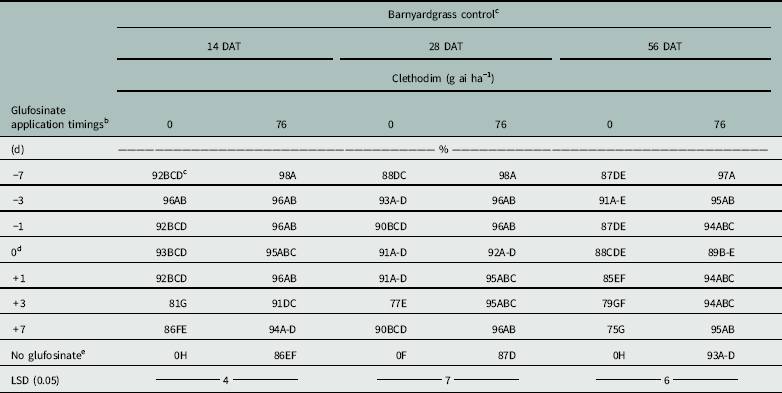
Barnyardgrass as affected by the interaction of clethodim rate by glufosinate application time was significant at all evaluations. When evaluated at 14 DAT, glufosinate applied 7 d before clethodim controlled barnyardgrass 98% compared with 92% control by glufosinate applied 7 d before without clethodim (Table 3). Glufosinate plus clethodim provided greater or equivalent barnyardgrass control compared with clethodim applied alone regardless of glufosinate application timing. Applications of glufosinate applied before or after clethodim provided 91% to 98% barnyardgrass control. Glufosinate control of barnyardgrass was variable across application timings, likely a function of increasing plant heights at later application timings. Similarly, giant foxtail control by glufosinate applications was variable as plant height increased (Steckel et al. Reference Steckel, Wax, Simmons and Phillips1997).
Barnyardgrass control as affected by application timing of glufosinate when applied alone or mixed with clethodim for field experiments in 2013 and 2014.a

a Crop oil concentrate at 1% v/v was included in all clethodim treatments.
b Glufosinate (594 g ha−1) applied relative to graminicide application in days before or after clethodim applied on day 0.
c Means within a DAT column followed by a similar letter are not different according to Fisher’s protected LSD P=0.05. A numerical LSD is given for each column within each DAT rating interval.
d Glufosinate (594 g ha−1) and clethodim were mixed on day 0.
e Applications of clethodim without glufosinate were applied on day 0.
At 28 DAT, clethodim applied alone was not different from glufosinate mixed with clethodim (Table 3). Barnyardgrass control was not affected by application timing of glufosinate when clethodim was applied on day 0, with control ranging from 92% to 98%. The sequential treatment of glufosinate applied 7 d before clethodim improved barnyardgrass control from 88% to 98% compared with glufosinate applied alone at the 7-d-before timing. Similarly, the sequential treatment of glufosinate applied 3 d after clethodim improved control from 77% to 95% compared with glufosinate applied alone at the 3-d-after timing.
By 56 DAT, barnyardgrass regrowth was evident for all treatments, especially treatments that did not include clethodim (Table 3). Barnyardgrass control was not different between glufosinate plus clethodim and clethodim applied alone. Barnyardgrass control ranged from 94% to 97% when glufosinate was applied before or after clethodim. Compared with glufosinate plus clethodim, glufosinate applied 7 d before clethodim improved barnyardgrass control from 87% to 97%.
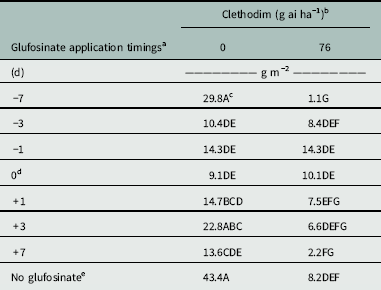
The glufosinate application timing by clethodim rate interaction was significant for barnyardgrass biomass. Barnyardgrass biomass in the untreated check yielded 43.4 g m−2 (Table 4). Applications of glufosinate without clethodim yielded 9.1 to 29.8 g m−2 compared with the untreated check, whereas glufosinate applied before or after clethodim yielded 1.1 to 14.3 g m−2. Glufosinate plus clethodim did not adversely affect barnyardgrass biomass compared with glufosinate and clethodim applied alone. Glufosinate applied 7 d before clethodim significantly reduced barnyardgrass biomass compared with clethodim applied alone. Unlike the barnyardgrass control and biomass data, soybean yield was not affected by application timing or clethodim rate, with yield ranging from 1,748 to 2,733 kg ha−1 (unpublished data).
Barnyardgrass biomass collected 56 DAT as affected by application timing of glufosinate when applied alone or mixed with clethodim for field experiments in 2013 and 2014.

a Glufosinate (594 g ha−1) applied relative to graminicide application in days before or after clethodim applied on day 0.
b Crop oil concentrate at 1% v/v was applied with treatments that included clethodim.
c Means within a DAT column followed by a similar letter are not different according to Fisher’s protected LSD P=0.05.
d Glufosinate (594 g ha−1) and clethodim were mixed on day 0.
e Applications of clethodim without glufosinate were applied on day 0.
Gardner et al. (Reference Gardner, York, Jordan and Monks2006) reported annual grass control was not adversely affected when graminicides were applied 5 or 7 d after glufosinate and when graminicides were applied 3 or 5 d before glufosinate. In contrast to our results, applications of graminicides 1 d before and 1 and 3 d after were antagonistic to annual grass control (Gardner et al. Reference Gardner, York, Jordan and Monks2006). Burke et al. (Reference Burke, Askew, Corbett and Wilcut2005) reported goosegrass antagonism with glufosinate applied before clethodim; however, clethodim applied before glufosinate did not negatively affect control.
Glufosinate applied 7 d before clethodim yielded 29.8 g m−2 of biomass; however, the application of clethodim on day 0 reduced barnyardgrass biomass 96% (Table 4). Previous research has reported that in a glufosinate-based system, sequential applications may be required to achieve adequate season-long control. Although tissue desiccation and reduction in photosynthetic activity occurs soon after glufosinate is applied, photosynthesis may not be completely inhibited. Sellers et al. (Reference Sellers, Smeda and Li2004) reported that glutamine synthetase activity was still detected in velvetleaf (Abutilon theophrasti Medik.) at 72 h after glufosinate was applied at 320 g ai ha−1. In our field experiment, enough new leaf tissue may have been present on day 0 to absorb and translocate clethodim, thus improving barnyardgrass control when glufosinate was applied 7 days prior.
Barnyardgrass control in a glufosinate-based system may require additional management inputs. Previous research has reported annual grass control antagonism with glufosinate mixed with clethodim and sequential applications of glufosinate and clethodim (Burke et al. Reference Burke, Askew, Corbett and Wilcut2005; Gardner et al. Reference Gardner, York, Jordan and Monks2006; Irby et al. Reference Irby, Reynolds, Huff and Dodds2007). However, in the previous research, graminicides were applied either before or after glufosinate, which may have affected control (Burke et al. Reference Burke, Askew, Corbett and Wilcut2005; Gardner et al. Reference Gardner, York, Jordan and Monks2006; Irby et al. Reference Irby, Reynolds, Huff and Dodds2007). To eliminate growth differences of barnyardgrass due to environmental conditions at the time of the clethodim application, these experiments used clethodim applied on a set day. In this experiment, barnyardgrass control was not adversely affected by glufosinate plus clethodim or sequential applications of glufosinate applied before or after clethodim. Applications of glufosinate applied alone provide variable control throughout the growing season. Regardless of clethodim rate or glufosinate timing, soybean yield was not affected.
Greenhouse Experiments
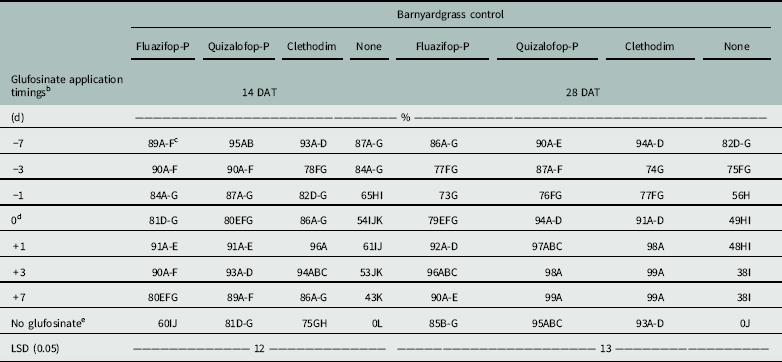
The graminicide by glufosinate application timing interaction was significant for barnyardgrass control at all evaluations. When evaluated at 14 DAT, glufosinate mixed with fluazifop-P or clethodim provided 35% and 14% greater barnyardgrass control, respectively, compared with fluazifop-P and clethodim applied alone (Table 5). Glufosinate plus fluazifop-P and glufosinate applied before or after fluazifop-P improved barnyardgrass control compared with fluazifop-P applied alone. Barnyardgrass was controlled 95% when glufosinate was applied 7 d before quizalofop-P, whereas glufosinate plus quizalofop-P and quizalofop-P alone controlled barnyardgrass 80% and 81%, respectively. Glufosinate applied 7 d before and 1 or 3 d after clethodim provided 93% to 96% barnyardgrass control compared with 75% control with clethodim applied alone. Glufosinate applied alone at −7 and −3 d provided greater control of barnyardgrass compared with the later glufosinate applications.
Barnyardgrass control as affected by application timing of glufosinate when applied alone or mixed with fluazifop-P, quizalofop-P, or clethodim for greenhouse experiments in 2013 and 2014.a

a Fluazifop-P, quizalofop-P, and clethodim applied at 210, 56, and 76 g ai ha−1. Crop oil concentrate at 1% v/v was included with all graminicide herbicide applications.
b Glufosinate (594 g ha−1) applied relative to graminicide application in days before or after graminicides, applied on day 0.
c Means within a DAT column followed by a similar letter are not different according to Fisher’s protected LSD P=0.05. A numerical LSD is given for each column within each DAT rating interval.
d Glufosinate (594 g ha−1) and graminicides were mixed on day 0.
e Applications of graminicides without glufosinate were made on day 0.
At 28 DAT, barnyardgrass control was 73% to 79% with glufosinate plus fluazifop-P and when glufosinate was applied 1 or 3 d before fluazifop-P (Table 5). However, control increased when glufosinate was applied 1, 3, or 7 d after fluazifop-P. Barnyardgrass control was reduced to 76% when glufosinate was applied 1 d before quizalofop-P compared with 95% control with quizalofop-P applied alone. All other quizalofop-P applications provided 87% to 99% control, regardless of glufosinate application timing. Clethodim applied alone controlled barnyardgrass 93%; however, control was reduced to 77% and 74% when glufosinate was applied 1 or 3 d before clethodim. Control improved with clethodim when glufosinate was applied 7 d before, mixed, or applied 1, 3, or 7 d after clethodim compared with glufosinate applied 1 or 3 d before clethodim. Poor barnyardgrass control with glufosinate applied alone occurred when glufosinate was applied after the −3-d timing due to barnyardgrass size at the time of application, with control ranging from 38% to 56%. Burke et al. (Reference Burke, Askew, Corbett and Wilcut2005) reported decreased glufosinate control of goosegrass with increasing growth stage. Steckel et al. (Reference Steckel, Wax, Simmons and Phillips1997) reported glufosinate weed control was sensitive to plant height at the time of application. Burke et al. (Reference Burke, Askew, Corbett and Wilcut2005) reported poor goosegrass control when glufosinate was applied 7 or 14 d before clethodim. Clethodim applied before glufosinate provided similar control as clethodim applied alone (Burke et al. Reference Burke, Askew, Corbett and Wilcut2005).
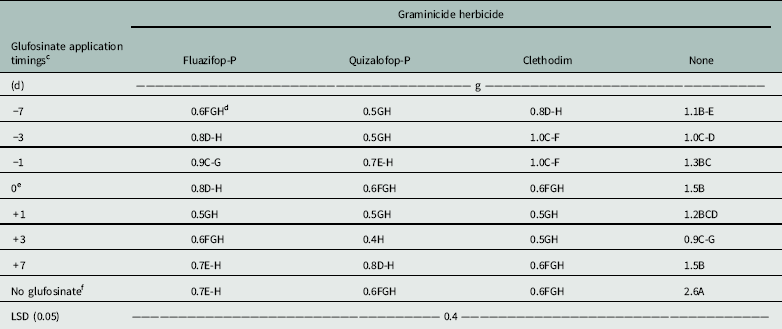
Fluazifop-P and quizalofop-P treatments adequately reduced barnyardgrass biomass compared with the untreated check, regardless of glufosinate application timing (Table 6). Glufosinate applied 1 and 3 d before clethodim resulted in significantly more biomass compared with glufosinate applied 1 and 3 d after clethodim. Barnyardgrass biomass with glufosinate applied alone was variable, with biomass reduction ranging from 42% to 65% compared with the untreated check.
Barnyardgrass biomassa as affected by application timing of glufosinate when applied alone or mixed with fluazifop-P, quizalofop-P, or clethodim.b

a Barnyardgrass biomass 28 DAT was pooled over replications with a population of 3 plants per Cone-tainer™.
b Fluazifop-P, quizalofop-P, and clethodim applied at 210, 56, and 76 g ai ha−1. Crop oil concentrate at 1% v/v was applied with treatments that included graminicides.
c Glufosinate (594 g ha−1) applied relative to graminicide application in days before or after graminicides, applied on day 0.
d Means within a DAT column followed by a similar letter are not different according to Fisher’s protected LSD P=0.05. A numerical LSD is given for each column within each DAT rating interval.
e Glufosinate (594 g ha−1) and graminicides were mixed on day 0.
f Applications of graminicides without glufosinate were applied on day 0.
Barnyardgrass control in glufosinate-based systems may require additional management inputs. Previous research has reported grass antagonism with glufosinate plus clethodim and sequential applications of glufosinate and clethodim (Burke et al. Reference Burke, Askew, Corbett and Wilcut2005; Gardner et al. Reference Gardner, York, Jordan and Monks2006; Irby et al. Reference Irby, Reynolds, Huff and Dodds2007). In this experiment, barnyardgrass control with sequential applications of glufosinate varied with the graminicide. However, glufosinate applied 1 and 3 d before graminicides generally reduced barnyardgrass control. Applications of glufosinate applied alone provided variable control throughout the growing season. Although significant visual barnyardgrass control differences were detected due to application timing of glufosinate, barnyardgrass biomass with fluazifop-P and quizalofop-P did not differ between the application timings of glufosinate. However, significantly greater biomass was produced under glufosinate applied 1 and 3 d before clethodim compared with glufosinate applied 1 and 3 d after clethodim. This research concurs with previous research reporting decreased grass control with clethodim mixed with herbicides used for broadleaf weed control (Vidrine et al. Reference Vidrine, Reynolds and Blouin1995).
Not only were the results of the field experiment different from what has been reported in literature, results were different from the greenhouse experiments. The differences in environmental conditions and growth stages at the time of application may have contributed to barnyardgrass control response differences between the field and greenhouse experiments. Phenotypic and genetic variation among barnyardgrass ecotypes will also have differential responses with soil type and fertility level, thus affecting morphological development (Tasrif et al. Reference Tasrif, Juraimi and Kadir2004). Although barnyardgrass control in the field was not affected by glufosinate application timing, data from the greenhouse indicate that potential exists for reduced control if glufosinate is applied 1 or 3 d before graminicides. Glufosinate applied without a graminicide applied on day 0 had variable control throughout the growing season. Without a graminicide applied on day 0, glufosinate applied before day 0 resulted in reduced control due to plant regrowth; however, reduced control from glufosinate applied after day 0 was due to larger barnyardgrass plants at the time of application. To be incorporated into an effective weed control system with glufosinate, graminicides should be used for enhanced grass weed control. For maximum benefit from incorporating graminicides into a glufosinate weed control system, glufosinate should be applied 7 d before a graminicide application or 1, 3, or 7 d after a graminicide application.
Acknowledgments
Funding for these experiments were provided by the Mississippi Soybean Promotion Board. No conflicts of interest have been declared.