Significant outcomes
About 70.2% of heroin addicts in methadone maintenance treatment had a sleep disorder in our survey.
The severity of sleep disorder in our survey was a mean of Pittsburgh Sleep Quality Index (PSQI) 9.1 ± 5.4.
PSQI scores were correlated significantly with the methadone dosage.
Limitations
Lack of polysomnography to provide objective sleep evaluation.
Limited data on the patients' abuse of hypnotics, alcohol and other substance.
Our samples were from only one site.
The sample size was small.
Introduction
Sleep disturbance is a common phenomenon among opiate addicts. The aetiology of sleep disturbances in the methadone maintenance treatment (MMT) population is often multifactorial and complex. Opiate withdrawal, an irregular life pattern, physical illness, comorbid psychiatric illness or other drug abuse problem might result in sleep disturbance. The mechanisms of mu, delta and kappa receptors with regard to sleep are unclear and controversial. However, it has been noted that mu agonist significantly inhibited rapid eye movement sleep (Reference Cronin, Keifer, Baghdoyan and Lydic1).
Physicians often underestimate the severity and prevalence of sleep disorders in this population. A high prevalence (84%) of sleep disorders in MMT patients was reported by Stein et al. (Reference Stein, Herman and Bishop2). Peles et al. reported a mean PSQI score of 9 ± 4.8 in MMT patients in Israel (Reference Peles, Schreiber and Adelson3). Taiwan began its methadone harm reduction program in December 2005. However, the average dosage of MMT in Taiwan is lower than that in other Western countries. The question is, does a lower methadone dosage lead to better sleep quality? But sleep disturbance and hypnotic abuse were still noted in our clinics in Taiwan. To our knowledge, there are few studies in the world relevant to this issue. The aims of this study are (a) to explore the severity of sleep quality in the MMT population, and (b) to study the relationship between sleep quality and age at opiate exposure, opiate exposure duration, duration in MMT, methadone attendance rate and methadone current dosage.
Methods
The study protocol was approved by the institutional review board of Changhua Christian Hospital. There is no commercial funding in the study. We excluded patients with schizophrenia and bipolar disorder, based on their clinical records. One hundred and twenty-one patients with a heroin addiction, including 105 males and 16 females, were enrolled from MMT clinics at the Lutung branch of Changhua Christian Hospital, which is a mental hospital located in central Taiwan. The mean age of these patients was 39.6 ± 8.6 years. The educational levels were as follows: 2 patients (1.7%) had received no education, 22 (18.2%) graduated from elementary school, 66 (54.5%) from junior high school, 29 (24.0%) from senior high school and 2 (1.7%) had graduated from college. In terms of marital status, 58 patients (47.9%) were single, 35 (28.9%) were married, 25 (20.7%) were divorced and 3 (2.5%) were widowed. Eighty-five patients (70.2%) had a job and 36 (29.8%) did not. Intravenous injection was the mode of heroin use for 113 patients (93.4%). The mean age of first use of heroin was 27.2 ± 7.4 years. The mean duration of opiate abuse was 12.4 ± 5.9 years (range, 1–24 years). The mean duration in MMT program participation was 15.7 ± 11.1 months.
We designed questionnaires, including (Reference Cronin, Keifer, Baghdoyan and Lydic1) demographic variables, (Reference Stein, Herman and Bishop2) medical history and (Reference Peles, Schreiber and Adelson3) MMT-related variables, to identify the presence of insomnia, duration of insomnia, hypnotic history, Visual Analogue Scale-10 (VAS-10) of sleep quality, PSQI, methadone dosage, methadone history and opiate history. Continuous variables were analysed using the t-test and one-way analysis of variance. A post hoc correction was done when needed. Associations between sleep disorder scores and other variables were done using regression analysis. Statistical analyses were performed using the software program SPSS PC 12.0 (SPSS Inc, Chicago, IL, USA).
Chinese version of the PSQI and VAS-10 of sleep quality
The PSQI is a self-administered questionnaire used to evaluate subjective sleep quality during the previous month (Reference Backhaus, Junghanns, Broocks, Riemann and Hohagen4). It contains 19 self-rated questions, yielding both a global score and 7 component sub-scores: subjective sleep quality, sleep latency, sleep duration, sleep efficiency, sleep disturbance, use of sleep medication and daytime dysfunction. Each component is scored from 0 to 3, yielding a global PSQI score between 0 and 21, with higher scores indicating a lower quality of sleep. A PSQI global score greater than 5 indicates ‘poor sleep' with a sensitivity of 89.6–98.7% and specificity of 84.4–86.5% (Reference Backhaus, Junghanns, Broocks, Riemann and Hohagen4,Reference Buysse, Reynolds, Monk, Berman and Kupfer5). Use of the same cut-off score on the Chinese-language version of the PSQI has been shown to have a sensitivity of 98% and specificity of 55% (Reference Tsai, Wang and Wang6), and is a reliable and valid tool for the assessment of sleep quality (Reference Backhaus, Junghanns, Broocks, Riemann and Hohagen4,Reference Tsai, Wang and Wang6). The VAS-10 of sleep quality is a subjective VAS (10 cm) measuring the severity of sleep problems.
Results
Methadone use
The average daily dosage of methadone in this sample was 51.4 ± 24.9 mg. Most of the patients (88.4%) drank methadone regularly. The attendance rate for MMT in a recent month was 87.6 ± 18.9%, on average.
Sleep quality
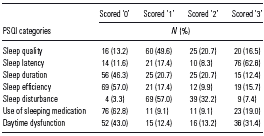
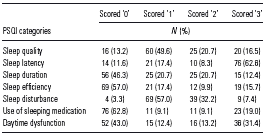
Thirty-seven patients (30.6%) believed that they had sleep problems, including 6 females and 31 males. The mean VAS-10 sleep quality score was 6.8 ± 2.5 and the mean PSQI was 9.1 ± 5.4. The 7 PSQI sleep categories are shown in Table 1.
PSQI categories and score distribution
Management of sleep problems
Eleven patients (9.1%) took hypnotics regularly, 16 (13.2%) took hypnotics occasionally and 94 patients (77.7%) denied taking hypnotics, now; 28 patients (23.1%) would use alcohol to sleep better. Forty-five patients (38.0%) had visited clinicians due to sleep disturbance. Ten patients (8.3%) thought they would use heroin again due to sleep disturbance, and 26 (21.5%) thought they might use heroin again, for the same reason.
PSQI and gender, employment status, marital status, route of heroin use and hypnotics use
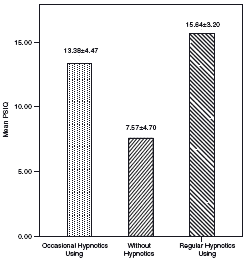
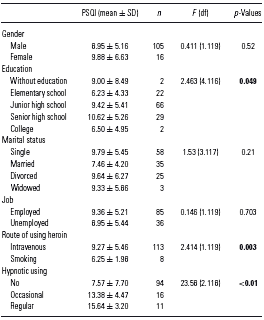
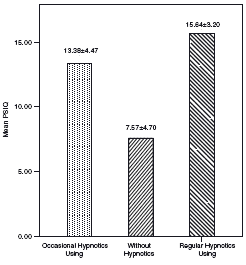
There was no significant difference in PSQI scores between males and females (t (119) = −0.641, p = 0.523), between employed and unemployed (t (119) = 0.382, p = 0.703), and between marital statuses (F (3,117) = 1.53, p = 0.21). However, patients that injected heroin intravenously had higher PSQI scores than those that smoked heroin (t (16.253) = −3.481, p = 0.003). There was a difference between educational levels and PSQI scores. Patients with a senior high school educational level had a higher PSQI score than patients with an elementary school education in the Bonfferoni post hoc analysis. There were also differences between hypnotics use and non-use and PSQI scores (F (2,118) = 23.58, p < 0.01). PSQI scores were significantly higher in patients with regular hypnotics use or occasional hypnotics use than in patients without hypnotics in the Bonfferoni post hoc analysis (Fig. 1). Comparisons between mean PSQI scores and different variables are provided in Table 2.
PSQI scores were significantly higher in patients with regular hypnotics use or occasional hypnotics use than patients without hypnotics in Bonfferoni post hoc analysis (mean difference between regular hypnotic using and without hypnotics = 8.06, p < 0.01; mean difference between occasional hypnotic using and without hypnotics = 5.80, p < 0.01).
Comparison in mean PSQI by different variables
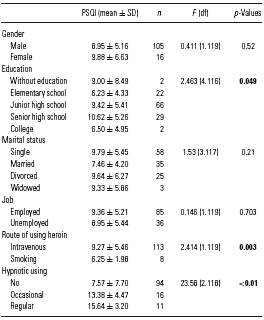
p-Value in bold means significant difference between variables (<0.05).
PSQI and age at opiate exposure, opiate exposure duration, duration in MMT, methadone current dosage and methadone attendance rate
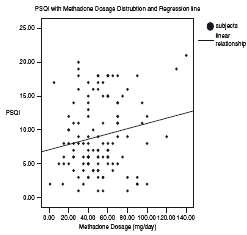
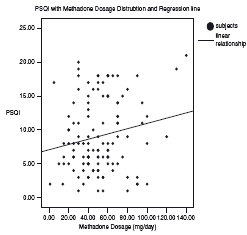
PSQI scores had no correlation with age at opiate exposure, opiate exposure duration, duration in MMT and methadone attendance rate, but PSQI scores were associated significantly with methadone dosage (R = 0.181, p = 0.047). The distribution of methadone dosages and PSQI scores, and the regression line are illustrated in Fig. 2.
Association between PSQI and methadone dosage (R = 0.181, F (1,119 = 4.027, p = 0.047).
‘Poor sleeper' and ‘normal sleeper' groups
Among the study subjects, 70.2% had PSQI scores >5, indicating ‘poor sleepers', and 29.8% had PSQI scores ≤5, indicating ‘normal sleepers'. These two groups were similar in age, gender, age at first exposure to opiates, duration of opiate abuse, dosage of methadone, duration of MMT and MMT attendance rate. There were significant differences in the VAS-10 of sleep quality (t (105.645) = −6.295, p < 0.01).
Discussion
Effect of opioids on sleep
The mechanism of opioid medication and opiates in relation to sleep might be unclear. However, clinical studies have shown the effects of opioid medications and methadone. Dimsdale found that single doses of oral opioid medications can significantly affect sleep architecture in healthy adults; decreased deep sleep and increased stage two sleep were noted (Reference Dimsdale, Norman, DeJardin and Wallace7). In Xiao's study, patients in early MMT had poor sleep quality and abnormal sleep architecture, including lower sleep efficiency, shorter total sleep time, more awakenings and shorter slow wave sleep (Reference Xiao, Tang and Smith8).
Sleep disorders prevalence and severity
In our study, we found that the sleep disorder prevalence rate was high (70.2%) in heroin addicts under MMT. The prevalence of insomnia was 39.4% in the general Chinese population (Reference Wong and Fielding9). The mean PSQI in our subjects was 9.1 ± 5.4. Stein et al. reported 84% of subjects had PSQI scores of 6 or higher, and found a mean PSQI of 10.64 ± 4.9 (Reference Stein, Herman and Bishop2). In Pele's study, 75.2% of subjects had PSQI scores of 6 or higher, and a mean PSQI (9 ± 4.8) was shown (Reference Peles, Schreiber and Adelson3). We found a prevalence and severity of sleep disorder similar to these studies. Sleep disorder is a serious problem in these patients, with at least 70% experiencing it.
Relative factors analyses
We also found that patients injecting heroin intravenously had higher PSQI scores than patients that smoked heroin. Severity of opiate dependence could be a factor related to this phenomenon. However, we did not find a significant difference between poor sleep and normal sleep in terms of age at first exposure to opiates, duration of opiate abuse, dosage of methadone, duration of MMT and MMT attendance rate.
PSQI and methadone dosage
We found a linear correlation between PSQI scores and methadone dosage. Patients with a higher methadone daily dosage had a higher PSQI score. This result correlated with the results of Stein's and Pele's studies (Reference Stein, Herman and Bishop2,Reference Peles, Schreiber and Adelson3). Although the association between PSQI and methadone dosage is significant, the effect size (i.e. R = 0.181) of this study is between small and moderate (Reference Cohen10). The sample size enhanced the statistical power of this study. In other words, the association is not strong, which may imply that the sleep quality is influenced by other potential antecedents as well as methadone dosage in our sample. On the other hand, a large effect size (R = 0.48) of the association between methadone dosage and PQSI was reported by Peles et al. Underlying factors moderating this association remain to be investigated.
Hypnotics prevalence
The current prevalence rate of hypnotics use was 22.3% in our sample. However, several studies reported a high prevalence rate of hypnotics use. Psychiatric comorbidity was associated with a more severe substance use disorder among treatment-seeking opioid abusers (Reference Brooner, King, Kidorf, Schmidt and Bigelow11). In Gelkopf's study, a lifetime and current prevalence of benzodiazepines (BZD) abuse were found in 66.3 and 50.8% patients in MMT (Reference Gelkopf, Bleich, Hayward, Bodner and Adelson12). The prevalence of hypnotics use in our sample was not as high as in Gelkopf's study. The self-report questionnaire on hypnotics use in our study might have resulted in a lower prevalence. Also, we found that 29.8% of our patients might relapse due to sleep disturbance; therefore, sleep disturbance could be a risk factor for heroin relapse. Brands et al. reported ongoing BZD users were more likely to have opioid-positive and cocaine-positive urine screens during MMT (Reference Brands, Blake, Marsh, Sproule, Jeyapalan and Li13). In another recent study, baseline BZD use correlated with lower retention rates, and ongoing BZD use correlated with poorer outcomes in heroin-assisted treatment and MMT (Reference Eiroa-Orosa, Haasen, Verthein, Dilg, Schafer and Reimer14). Concomitant consumption of BZD and opioids is a major problem in patients with opioid dependence. It may have a substantial impact on morbidity, mortality and the clinical course. BZD use by MMT patients is associated with a more complex clinical picture and may negatively influence treatment outcomes (Reference Sharkey, Kurth, Anderson, Corso, Millman and Stein15). Paying more attention to this issue may yield better maintenance outcomes.
Limitations
There are still several limitations to our study. The first was the lack of polysomnography to provide objective sleep evaluation. Sharkey et al. reported objective sleep measures confirmed subjective measures in MMT patients with disturbed sleep. And, both objective and subjective measures are useful in research and clinical settings to assess sleep in opioid-dependent patients (Reference Sharkey, Kurth, Anderson, Corso, Millman and Stein15). The second is the limited data on the patients' abuse of hypnotics, alcohol and other substance. The third is that our samples were from only one site. There might be some differentness in different sites. The fourth is the small sample size. A larger sample would give the analysis of differences between each variable more power.
Clinical implications
Patients with heroin addiction might have sleep problems. The severity of their sleep problem was serious in our survey. Clinicians should routinely assess their sleep and differential diagnosis. Sleep quality questionnaires, sleep diaries, polysomnography and home polysomnography are useful in assessment. In addition, clinicians also should be aware of hypnotics use or abuse in this population. Education on sleep hygiene, lifestyle resetting and the risk of drug interactions might be helpful.
Conclusion
The sleep disturbance prevalence rate in opiate addicts in MMT was high in this survey, and the severity of these sleep problems was underestimated. This study highlighted the serious problem in this population. Further studies with objective sleep examinations are needed. Clinicians should pay more attention to sleep problems in opiate addicts in MMT, especially those receiving a high dosage of methadone.
Acknowledgements
The authors have declared no conflicting interests.