IntroductionFootnote 1
On 13 March 1964, just two years after Uganda’s independence in 1962, Paulo [Paul] Onen, a mission-educated Acholi, wrote to a Catholic priest telling him that his chiefdom had resolved a major succession dispute that was tearing apart the Toro Chiefdom, a small polity in Acholiland.
I greet you in the name of Jesus Christ, Our Lord and Savior. I am writing to tell you that the conflict which has been going on here for over three months about the right successor for our chiefdom has today been resolved successfully. Everyone is happy with the outcome. Yesterday, Lacito Okech came here. He called everyone in the village. He began by telling us the history of our chiefdom and then read from his book what he had written about our chiefdom. Thereafter, he identified the family that should produce the chief and everyone was satisfied with what he said. He left with us two copies of his books, one of which I am sending to you.Footnote 2 (Italics added; translation by author.)
Onen’s brief letter reveals the importance of Lacito Okech, a local intellectual, and his books in Acholiland.Footnote 3 But who was Lacito Okech? What were the circumstances that led him to become the first Acholi to publish a book in the colonial era? What are the contributions and limitations of this book? The answers to these questions can be found in the complex life of Okech, which spanned the precolonial and the colonial periods.
Okech was born in Koch chiefdom in the early 1880s. As a young man, he was identified, groomed, and appointed a La or Pa rwot (La or Bot rwodi).Footnote 4 Although this was an important position in precolonial Acholiland, this title and position has never been subjected to close scrutiny by scholars of Acholiland. To better understand La or Pa rwot, it is worth looking at each of its components in turn. In the Acholi language, the noun prefix la- (plural lu-) is a definite article. Or is a noun that means “message.” Pa is a possessive pronoun, and it means “of.” Thus, Pa rwot, means “of the chief.” Hence, La or Pa rwot means “the messenger of the chief.”Footnote 5 Therefore, Okech was literally a royal messenger. As a La or Pa rwot, Okech performed at least two major functions. First, he was a royal emissary, delivering information orally from his chief to other chiefs in Acholiland and beyond. This explains why Okech reported that, before colonization, he spoke several languages: Acholi, Lango, Alur, Jonam, and Labwor.Footnote 6 Second, whenever his chief traveled, Okech was part of his entourage, and he was often the royal precursor, preceding his chief to make necessary diplomatic and other arrangements.
In 1904, the Church Missionary Society (CMS) established the first mission station in Acholiland, which produced the first group of literate Acholi. Okech, however, was not among them, perhaps because his chief did not release him. In 1908, the CMS temporarily withdrew from Acholiland. Two years later, in 1910, the colonial state established an office in the region, and CMS missionaries began returning in 1911 by making occasional visits to check on the converts and local evangelists they had left behind. Okech enrolled with one of the local evangelists and began receiving instruction. In 1912, Okech was baptized,Footnote 7 and he immediately became a local evangelist before joining the colonial government as a clerk in October 1914.Footnote 8 But before his conversion to Christianity and his recruitment into colonial service, Okech was already an accomplished Acholi – a royal messenger. He possessed different types of knowledge and skills, making him a legitimate leader in his community.
From a clerk, Okech rose successively to the positions of a colonial chief and a native financial assistant, the highest government position an African could attain at the time. After becoming literate, Okech states, he devoted considerable time to writing Acholi history, taking advantage of his own knowledge and his various colonial postings to document the history of many Acholi chiefdoms.Footnote 9 He completed his manuscript in 1947. Six years later, in 1953, Tekwaro ki Ker Lobo Acholi (History and Chieftainship of Acholiland) was published by Eagle Press, then a reputable colonial press in Kampala, the colonial capital of Uganda. Thus, Okech became the first Acholi historian to publish a history of his people.
Shortly after the publication of Tekwaro, other works emerged, apparently inspired by Okech’s book and facilitated by the increasing number of missionary-educated Acholi.Footnote 10 It is surprising, therefore, that scholars working on northern Uganda have almost ignored this generation of Acholi writers; their works have never really been subjected to sustained or critical analysis in modern scholarship. This is largely because transitional figures wrote in the Acholi language, making it impossible for non-Acholi scholars to access their works. Moreover, historians have been relatively less interested in northern Uganda than other regions of the country. To date, most recent works on Acholiland focus almost entirely on the much-publicized war between the Lord’s Resistance Army and the Government of Uganda, ignoring the late precolonial and early colonial eras that the first generation of literate Acholi straddled and wrote about.Footnote 11
This article seeks to shine some light on these neglected periods and their Acholi intellectuals by examining the life, career, and writings of Lacito Okech. Okech spanned three different settings – those of the Acholi, the CMS, and the British colonial regime – and he performed different roles – a precolonial Acholi royal messenger, a Christian convert, and an outstanding colonial servant. Okech was what Nancy Rose Hunt has called a “middle figure”Footnote 12 who, like many other intermediaries elsewhere, “journeyed back and forth across vast political, cultural and personal chasms,” mediating the Acholi with the CMS and with the colonial state, and playing different roles depending on whom he was dealing with.Footnote 13
How did Okech negotiate his life in these three different settings? What were his challenges as a historian? And how much did his position as an intermediary influence his writing of history? I argue that Okech’s adroitness in juggling multiple roles allowed him to thrive in all these settings, and, more important, enabled him to become the first Acholi to write and publish a history of his people. However, his embodiment of different roles also had far-reaching consequences for his production of Acholi history. This article begins with a summary of the history of Acholiland, dating back to the 1850s, to introduce the major events and personalities that will aid the understanding of Okech’s writing. Thereafter, it examines the works of the CMS, focusing on the emergence of literate Acholi; and, finally, it explores Okech’s career trajectory. All these sections are intended to set the stage for understanding Okech’s writing, especially the influence of his triple role on the production of knowledge in colonial Acholiland.
Historical Background: From Egyptians to Europeans
The second half of the nineteenth century was a time of enormous social change in Acholiland. Beginning in the 1850s, the Acholi people came into contact with the first group of foreigners. These foreigners, who became locally known as Kutoria, were Arab traders.Footnote 14 Financed by Egyptian ruling classes, these traders cut through the region in search of slaves and ivory.Footnote 15 They established three stations in the chiefdoms of Pabbo, Padibe, and Patiko, some of the most powerful Acholi chiefdoms at the time. These three stations, as the historian Ronald Atkinson has observed, “became the centers of their activities in northern Uganda and the contiguous southern Sudan.”Footnote 16 Thus, from the late 1850s to 1872, trade between the Kutoria and the Acholi boomed, and the Acholi received firearms and clothes.
But beginning in April 1872, this trade began to decline. Khedive Ismail, the ruler of Egypt, came under pressure from England to stop the slave trade in this region, called Equatoria Province, which was under the Egyptian government. In 1869, Ismail hired Sir Samuel Baker, an Englishman and explorer, who had explored the region between 1863 and 1865, and gave him the rank governor-general.Footnote 17 Ismail gave Baker the mandate to lead “an expedition to take permanent possession of the Equatorial regions in the name of the Egyptian government and (…) stop the slave trade [carried out by the Kutoria].”Footnote 18 Yet, despite Baker’s appointment in 1869, Ismail did not immediately send Baker to the region: instead, he stationed Baker in Cairo.Footnote 19 It was not until March 1872 that Baker arrived in Acholiland with Arab soldiers, who became locally known as the Jadiya. By the end of 1872, Baker had defeated the Kutoria, and he left Acholiland in March 1873, just a month before the end of his contract.
Khedive Ismail, however, did not immediately hire a replacement. As a result of the leadership vacuum, relations between the Acholi and the Jadiya deteriorated, largely because the latter began abusing Baker’s food agreement with local leaders, which required chiefs to donate grains and other foodstuffs to feed his soldiers. The Jadiya began levying excessive amounts of grain tax. Moreover, the grain tax was collected with extreme violence.Footnote 20 In 1874, Baker was succeeded by General Charles Gordon. Like Baker, Gordon did not arrive immediately in Acholiland. When he arrived in 1876, Acholi-Jadiya relations were already hostile, and Gordon did not try to mend them. Shortly after leaving Acholiland, Gordon resigned his job, and he was succeeded by Mehmed Emin. On December 31, 1878, when Emin arrived in Acholiland, skirmishes between the Acholi and the Jadiya had already began, but it was not until 1885 that “a multi-polity Acholi force” begun conducting a relentless guerilla war against the Jadiya.Footnote 21 The guerilla warfare, however, did not defeat the Jadiya. The subsequent defeat of the Jadiya in Acholiland was a result of an external factor: the Mahdi revolt, which broke out in Sudan against the same oppressive Egyptian government. This revolt cut off supplies to the Jadiya in northern Uganda, and with the relentless Acholi guerrilla warfare against them, they were eventually defeated.Footnote 22
By the end of 1888, most of the Jadiya had left Acholiland, but a thriving group of Arabic interpreters had been firmly established in the region. These men were products of the Acholi encounter with Arab traders and soldiers. Besides introducing Arabic to the natives, this encounter also brought “the Arab and Nubian (…) [forms] of dress, [and] greetings,” as well as “Islamic names” to the people.Footnote 23 The presence of the Arabs, however, was not the only episode in Acholi history before the arrival of the Church Missionary Society.
After the collapse of the Egyptian colonial project, Acholiland witnessed a brief interlude without foreign interference. The absence of foreigners did not, however, mean an end to violence. This brief period was still largely characterized by violence. In particular, two influential chiefs fought for supremacy. By 1896, when the British annexed Acholiland to the Uganda protectorate, Chief Abok Awich of Payira Chiefdom had defeated his rival, Chief Ogwok of Padibe Chiefdom, and had established himself as the de facto paramount chief of the region. Yet, after formally annexing Acholiland, the British did not establish an office in the region. This neglect gave Awich the opportunity to entrench his dominance in the region, but not for long.
Beginning in 1897, two “outside events intruded upon Acholiland, and forced [Chief] Awich into a commitment (…) [that led] to the destruction of the delicately balanced paramountcy which he was trying to construct.”Footnote 24 The first event was the Nubian Mutiny in the Buganda Kingdom. The Nubians were former Egyptian government soldiers that had remained in Uganda in the service of the Imperial British East Africa Company. After the collapse of the Egyptian colonial project, these soldiers were recruited by “Captain Fredrick Lugard who was employed by the Imperial British East Africa Company (…) [because the] company needed military protection for a successful colonization.”Footnote 25 These troops became the British fighting force in the Uganda Protectorate. However, in September 1897, they rioted, complaining that “the administration did not sufficiently appreciate or reward them for their services.”Footnote 26 Fearing reprimand, many of the troops fled Buganda Kingdom and moved to Acholiland, which was still relatively outside British control, and sought Chief Awich’s protection.
The second event was King Kabarega’s retreat into Acholiland. In 1897, Kabarega, who had vigorously resisted British occupation of his kingdom, Bunyoro, was defeated. He also fled to Acholiland and sought Chief Awich’s protection. That both the Nubians and Kabarega sought Awich’s protection tells how powerful Awich was at the dawn of colonization. To defeat both the Nubians and Kabarega, the British organized two military expeditions between 1897 and 1901 to “pacify” Acholiland. The “pacification” exercise cowed most Acholi chiefs into signing treaties that placed their chiefdoms under the Uganda Protectorate, but Chief Awich rejected signing any such treaty. As a result, the colonial state arrested and imprisoned Chief Awich in 1901. In 1902, the British released Awich and reinstated him as the chief of Payira. In 1903, Awich invited the CMS to begin their work in Acholiland.Footnote 27
The Arrival of the CMS in Acholiland
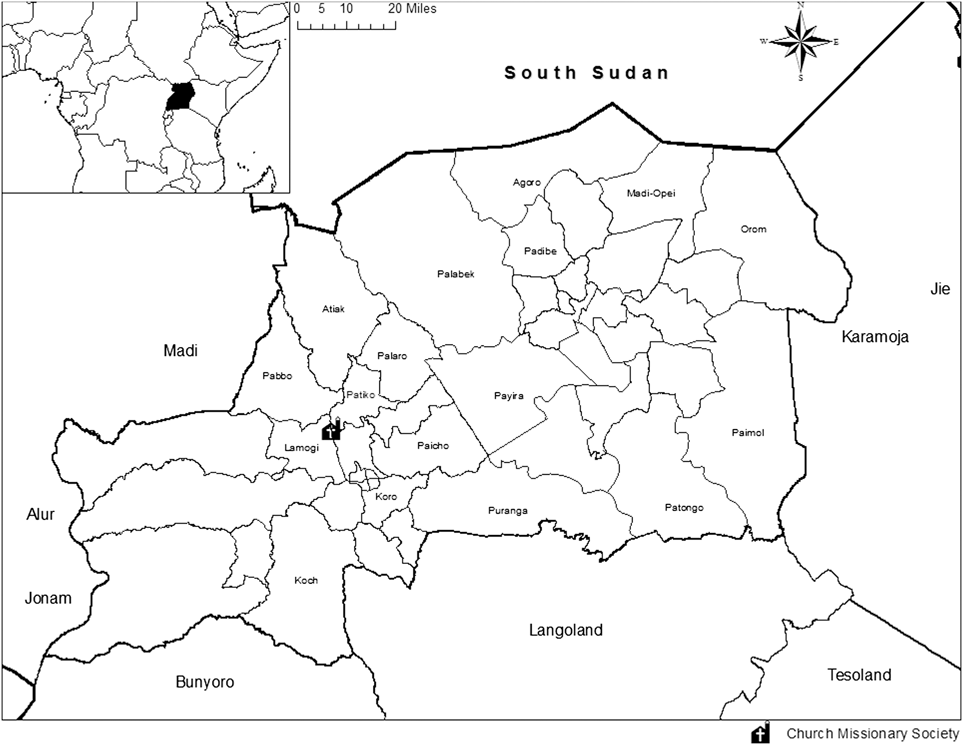
While returning home from imprisonment in Kampala, Awich traveled through Bunyoro Kingdom and was apparently impressed by the works of the CMS. He saw schools and churches that the CMS had built and decided that he wanted similar developments in his chiefdom. In February 1903, at his home in the Bunyoro Kingdom, Rev. A.B. Lloyd received a delegation of five royal messengers from Acholiland. These messengers were sent by Chief Awich to invite the CMS to Acholiland.Footnote 28 In response, two months later, Lloyd arrived in Acholiland for a tour of the region. The report that Lloyd wrote about his journey to Acholiland prompted another tour by the CMS leaders. In 1904, Bishop Tucker, Dr. Albert Cook, Mrs. Cook, and Lloyd toured Acholiland and identified a site for the first CMS church in the region (see Figure 1). After the tour, Tucker asked Lloyd to remain behind and open the first church in Acholiland. Upon his return to Buganda, Tucker relocated Rev. A.L. Kitching to Acholiland to begin translating the Bible into Acholi. After several months, Tucker sent A.E. Pleydell to reinforce the two missionaries.Footnote 29
Map of Acholiland, showing major chiefdoms and location of the first church in 1904. Shauna’h Fuegen, 2017.

Converting the Acholi people effectively began in 1905. In January of the same year, Kitching reported that “Regular reading” was already “proceeding twice a day as at other stations in Uganda,” with “an average attendance of some 40 men on weekdays, while on Sunday our congregation usually reaches about 80.”Footnote 30 This school implemented a three-pronged, one-year curriculum consisting of catechetical courses (mainly rote learning of Christian dogma and prayers), reading (mainly the Bible), and writing.Footnote 31 The language of instruction was Acholi; at first, the missionaries who had not yet learned Acholi relied on three Alur men: Sira Donge, Matayo Adimola, and Lakana Kija, who could speak both Runyoro and Acholi. Whereas Runyoro is a Bantu language, Acholi and Alur are dialects of the Lwo group of languages, and they are mutually intelligible. These Alur men had already learned Runyoro during their stay in Bunyoro, where they had lived as slaves.Footnote 32
Upon completing the set study program, the learners were assessed for mastery of religious dogma and prayers, and their ability to read and write. Each learner who met the CMS’s expectations was baptized and given a Christian name in addition to his Acholi one.Footnote 33 Of the forty people that Kitching reported to have started learning in January 1905, only two were baptized on 26 November 1905. The CMS records do not tell why only two were baptized. It is likely that many of the initial learners abandoned the CMS school because its curriculum did not appeal to them. The first two converts were Muca Ali and Lakobo Ameda. Ali was the son of Ywa Gimoro, a prominent Arabic translator in the 1860s and 1870s, and prior to becoming a convert, he was a healer. Ameda, on the other hand, was a royal messenger in the Patiko Chiefdom.Footnote 34
In 1906, Kitching baptized twelve more men. Of the twelve, two were Alur men, Matayo Adimola and Lakana Kija [Kiiza]. Unlike Donge, who arrived in Acholiland as a convert, Adimola and Kija were initially not converts. They arrived as porters, and were baptized in 1906 with the other Acholi.Footnote 35 The other ten converts, came from various backgrounds: some were sons of chiefs whereas others were sons of prominent Acholi courtiers.Footnote 36 For example, Chief Awich, who had invited the CMS to Acholiland, sent two boys: “Aliker his son, and Obwoya” who “was just a boy living in the household.”Footnote 37 Chief Lagony of Koch Chiefdom did the same thing. He sent Kibwola, his son, “but the second boy he sent, Oyugi, was not.”Footnote 38 The chief of Patiko, Okello, who gave land to the CMS, also sent only one son, Lagara, and another boy.Footnote 39 But who were these other boys that chiefs were sending with their sons to the CMS school?
There is, unfortunately, no way of knowing who they were. But that they were sent by chiefs suggests that they might have been young courtiers or pages. In addition to chiefs, prominent courtiers also sent their sons to the school. For example, Okello Mwoka, a prominent military general of Puranga Chiefdom, sent two sons, Olal and Otuke. Likewise, Obwona Acholi, a royal messenger of Patiko Chiefdom, sent two sons, Dony and Odur. In the same way, Owiny, only recorded as an “elder,” who may have also been a courtier, sent his son, Okelokoko. Only one 1906 convert, Laraa, is of unknown paternity.Footnote 40 The CMS class of 1906, like that of 1905, was exclusively male. That most of these converts were from prominent or elevated sociopolitical backgrounds was a result of the CMS and the colonial regime’s approaches to learner recruitment. The colonial state directed each chief to send at least one of his sons to the school, and instructed the missionaries to educate the chiefs’ sons to create a pool of literate Acholi that would help to implement British indirect rule in Acholiland.Footnote 41
Even though the CMS had a promising start, with two converts in 1905 and twelve in 1906, CMS records show that there was not a single baptism in 1907, and there is no proper explanation for this failure to save even a single soul that year. It was not until 5 February 1908, that the CMS baptized five more people. Again, these converts were prominent courtiers and sons of chiefs or otherwise prominent men. Despite the new baptisms, on 25 February 1908, the CMS withdrew its missionaries from Acholiland, bringing their work to an abrupt end. As already indicated, the CMS returned to Acholiland in 1911, following the establishment of a colonial office in the region in 1910. After a number of occasional visits to check on the converts and local evangelists who had remained in Acholiland, CMS missionaries reopened the church in 1913. It is important to note that the year before the CMS returned to Acholiland, the Catholic Verona Fathers had already arrived there, setting the scene for what was to become a bitter rivalry over the souls of the Acholi.Footnote 42 The men who continued to join the CMS schools were still essentially from the upper echelons of Acholi society. Many of them were from royal families; and some, such as Okech, were already working as courtiers in their chiefdoms.Footnote 43
Overall, it was the CMS who produced the first generation of literate Acholi.Footnote 44 Yet, this was not an elite class of free individuals: they were expected to live by the strict Christian code of conduct. Those who deviated from that code were excommunicated and unlikely to keep their jobs. In his 1978 biography, Lakana Onek, one of the early converts, recounted the difficult situation they found themselves in even as appointed colonial chiefs. “We lived in constant fear of losing our jobs. If you violated any of the church rules, you were liable to losing your job in the government.”Footnote 45 As I shall show below, these conditions had important consequences for the writing of Acholi history by this generation of Acholi. At this juncture, it is appropriate to begin exploring Okech’s life and career trajectory to understand his position.
Family and Career Background
Okech was born in Koch Chiefdom in the early 1880s, a decade characterized by war and famine. His family named him “Okech,” meaning a boy born during famine, instead of “Olweny,” given to a boy born during war.Footnote 46 This implies that famine had a more disastrous impact on his family than the wars of the period. Not much is known about Okech’s family history apart from the fact that his father was called Omara Aryemu. The only information available about Aryemu is that he was a prominent Arabic interpreter in the 1870s and 1880s. Nothing is known about Okech’s mother, except her name – Maliam [Mariam] Lakaraber. This name suggests the influence of Islam on Okech’s family.
Unfortunately, lack of sources makes it difficult to recreate Okech’s early life. As a young man, however, Okech distinguished himself from his peers. In 1969, Petero Odida, the then editor of the revived Acholi Magazine, a publication by the Acholi elite, that began in 1949, wanted to publish a biography of Okech, and he asked him, inter alia, to relate the story of his ascendance to the elevated position of a royal messenger. In response, Okech said, “I could recite the tradition and history of Koch Chiefdom from its founder to the then current chief,” a rare feat for someone of his age. As a result, Okech explained, “elders brought him to the court, and he started living in the court of the chief,” where he was “groomed as a La or Pa rwot.”Footnote 47 The details of the training of royal messengers have been described elsewhere, and it suffices to summarize them here.Footnote 48
Prospective royal messengers were neither “preordained” nor specifically trained for the post from the beginning. Rather, children with special abilities were all nominated to a talent pool, which Onyango Odongo, one of the most prominent Acholi local historians, referred to as lugwok paco (literally, guardians of the society).Footnote 49 Nominees were first identified by their respective parents, who knew the abilities and potential of their children better than anyone else.Footnote 50 The nominated children were sent to their clan council where they were schooled in clan history (tekwaro), and laws and legal precedents (ongon). Clan councils acted as clan courts that resolved disputes within the clan, and they groomed outstanding young men for leadership positions, which enabled the transmission of knowledge and skills from one generation to the next.
Those who excelled at tekwaro and ongon were promoted to their chiefdom council where they were taught their chiefdom history, laws and legal precedents, and mediation. These were, however, not rigid institutions. Their norms and laws were constantly evolving.Footnote 51 It was from the chiefdom council that elders tested and picked outstanding young men to fill court positions. It is impossible to determine the exact correlation between a person’s skills and the court position or responsibilities accorded to him. But once the chiefdom council had earmarked somebody to become a royal messenger, that candidate would be apprenticed to an existing royal messenger for an extended period of time in order to develop the necessary knowledge and skill sets.
In particular, apprentice royal messengers learned non-Acholi languages to be able to mediate between their chiefs and non-Acholi leaders. Apart from languages, prospective royal messengers also learned how to walk and run long distances, prompting early Europeans in the region to call them mere “runners.”Footnote 52 Moreover, they also learned what I call simple divination to interpret omens in order to travel safely in the region.Footnote 53 Finally, as indicated above, royal messengers traversed the region delivering information orally. To deliver information orally, sometimes after many days on the road, required exceptional powers of retention and oral delivery. It meant that they had to understand, internalize, and memorize the message, and then deliver it in the most appropriate diction, and answer questions on behalf of their chief. This was a challenging and delicate role, especially when it involved delivering information relating to hostility between chiefdoms.
In short, before Okech converted to Christianity and joined the colonial service, he was already an accomplished Acholi – a royal messenger. He possessed particular types of knowledge and skills, which made him a legitimate leader in his community. This role introduced Okech to most leaders in the region and beyond before 1910. A turning point in Okech’s career came in 1911. That year, Okech enrolled with Abimereki Lukyalekere, a local CMS evangelist from Bunyoro, and began receiving instruction. In 1912, Okech was baptized by Rev. Arthur Brian Fisher. His baptismal name was Erastus, which his people domesticated as Lacito.Footnote 54 He then joined the CMS church as a catechist and was posted to Langoland.Footnote 55 There is no information on how long he worked as catechist.
In October 1914, Okech joined the colonial service, and was appointed secretary to Chief Olya of Atyak Chiefdom. In August 1915, Okech tells us, he got married. In Tekwaro, Okech mentions only one wife, but documentary and oral sources reveal that by the time Tekwaro was published in 1953, Okech already had eight wives.Footnote 56 It is likely that he did not reveal his aberrant marital status because he feared being excommunicated and losing his privileged status as an Anglican and a colonial servant. This reveals how Acholi leaders negotiated the European bureaucracy: they concealed personal information that was likely to damage their reputation in CMS and colonial government circles.
On 1 December 1915, after fourteen months of service in Atyak, Okech was transferred to Gulu, the headquarters of colonial administration in Acholiland. Colonial records offer no explanation for the relocation, but, at the time, a transfer from an outpost to the headquarters must have been a promotion, suggesting that Okech’s performance in Atyak was commendable. This transfer marked the beginning of a series of promotions in the colonial and CMS services. In 1923, Okech was appointed chief of Lamogi Chiefdom. This was a difficult position for any colonial employee. In 1911, the chiefdom had mounted the first armed resistance against the British. The uprising was occasioned by native opposition to forced labor, taxation, and forced disarmament.Footnote 57 Although the rebellion was crushed, the people of Lamogi remained largely opposed to the colonial state. Okech served as the chief of Lamogi for fourteen years, enough time to suggest that the state was happy with his work.
In 1925, while still serving as a chief, Okech was appointed to the CMS West Acholi Board of Education. His tasks included preparing school financial estimates, and supervising the schools.Footnote 58 That Okech served the CMS and the state concurrently reveals the high esteem in which both institutions held him. In 1937, Okech was appointed native financial assistant, the highest position a native could attain, which he held for nine years. In this position, Okech, together with the district commissioner, managed and dispatched Acholi development funds to the different chiefdoms. Okech retired in 1954, possibly due to old age. However, he remained a respected ex-colonial servant, a prominent Anglican, and a community elder.
Overall, Okech’s diverse career trajectories and experiences, which spanned the precolonial and colonial eras, allowed him to occupy significant positions in different administrative systems. This certainly put him in an ideal position to become the first Acholi to publish a book. But these experiences also had important consequences for his writing of Tekwaro. The book’s preliminaries and conclusion, which I now turn to, will set the stage for understanding the complexity of Okech’s work as a historian, and of the influence of his precolonial, Christian, and colonial service experiences on his writing.
Tekwaro’s Preliminaries and Conclusion
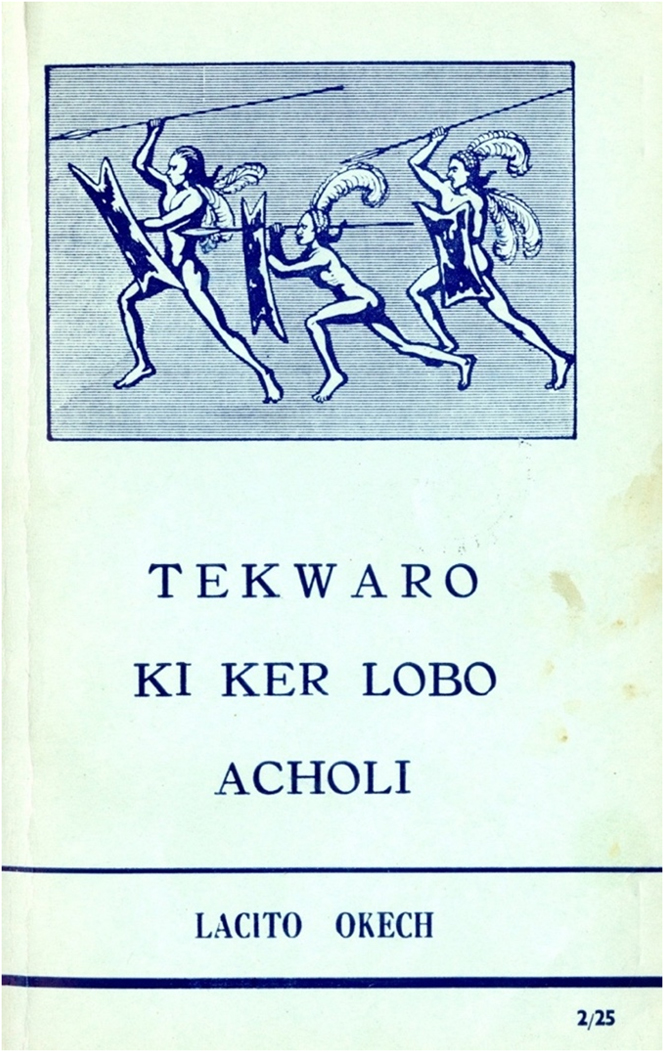
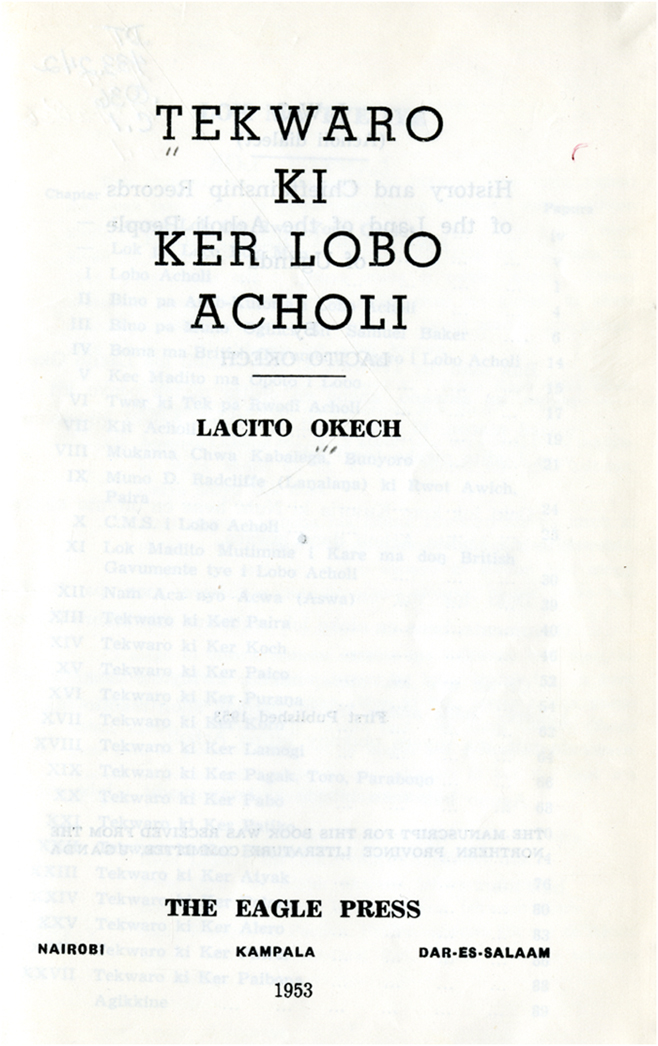
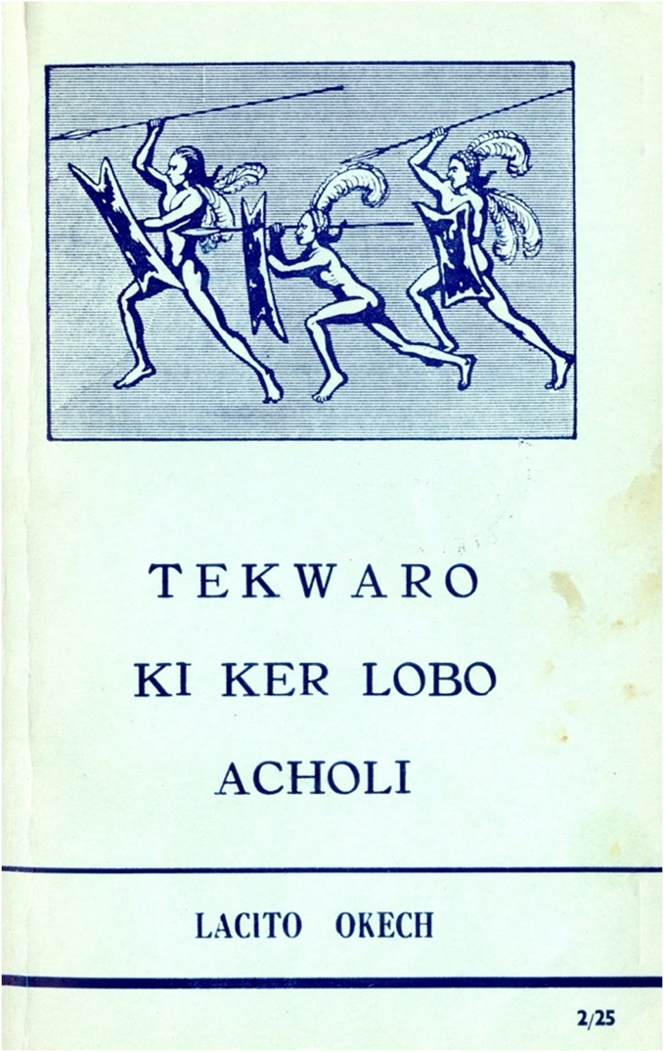
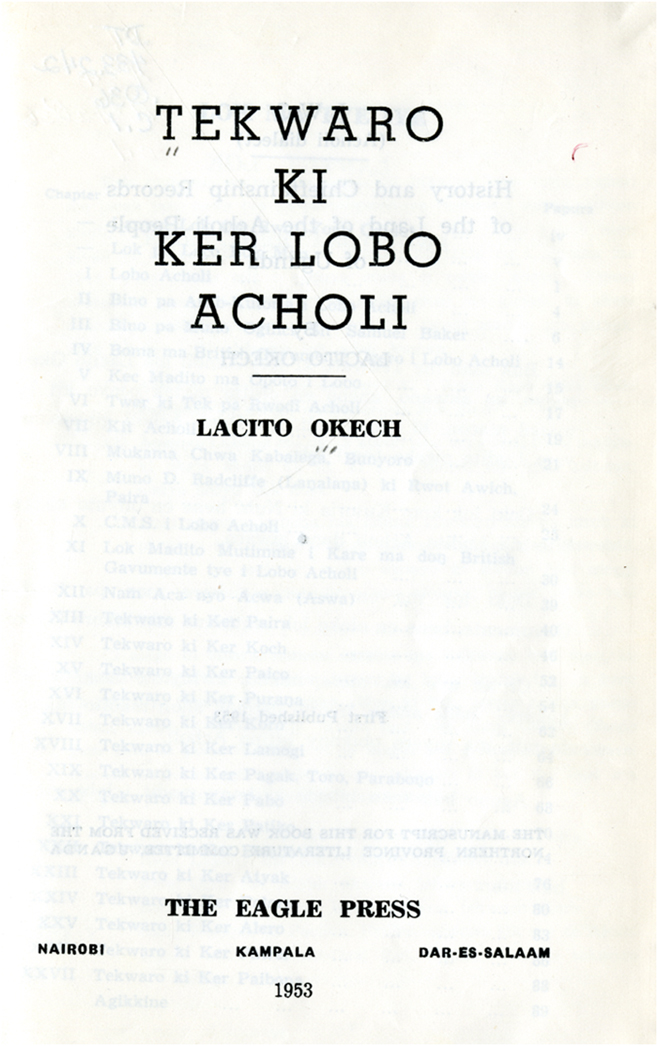
In 1953, Okech published what he called a foundational work in Acholi history and he asked the “better learned” people to build on it.Footnote 59 He titled his book Tekwaro ki Ker Lobo Acholi (History and Chieftainship of Acholiland) (Figure 3). Tekwaro is written in clear and readable Acholi prose. The main body of the book covers ninety pages of text, and is divided into twenty-seven chapters, without pictures or maps. The only illustration is on the cover page, which bears a picture depicting three people performing Otole, the Acholi war dance (see Figure 2). There is no way of knowing whether it was Okech’s decision to use the picture, and if it was, what he intended to communicate.
Cover Page.
Title Page.
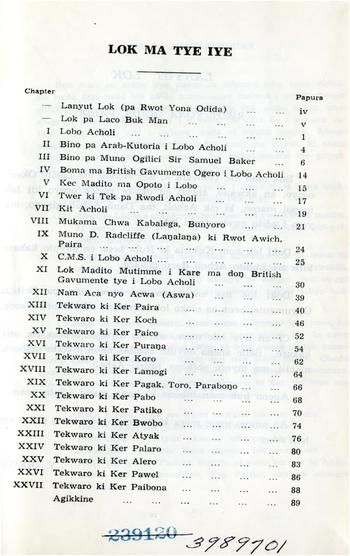
The twenty-seven chapters can be divided into three sections (Figure 4). The first section consists of four chapters spanning precolonial and colonial “Acholiland: Acholiland, Migration and Neighbours,” “Arrival of Arab Traders in Acholiland,” “Arrival of Sir Samuel White Baker,” and “Establishment of British Protectorate in Acholiland.”
Table of Contents.

The first chapter suggests the beginning of Acholi history according to Okech. In this section, Okech bases his account on Acholi migration legends and the travelogues of Sir Samuel Baker, the second English explorer (after John Speke), who traveled extensively throughout Acholiland between 1863 and 1865, and returned to the region as governor of Equatoria from March 1872 to 20 March 1873. The second section consists of eight chapters: “Memorable Famine in Acholiland,” “Roles and Powers of Acholi Chiefs,” “Acholi Culture; Mukama [King] Chwa Kabalega,” “Major D. Radcliff and Chief Awich,” “Church Missionary Society in Acholiland,” “What Happened when the Britsh Settled in Acholiland,” and “River Acwa” [Aswa]. In Chapter 8, Okech cites Sir Apollo Kaggwa’s renowned book, Bassekabaka ba Buganda (Past Kings of Buganda), implying that he was also fluent in Luganda. In the remaining fifteen chapters, Okech documents the histories of fifteen Acholi chiefdoms, based on his personal knowledge and research.
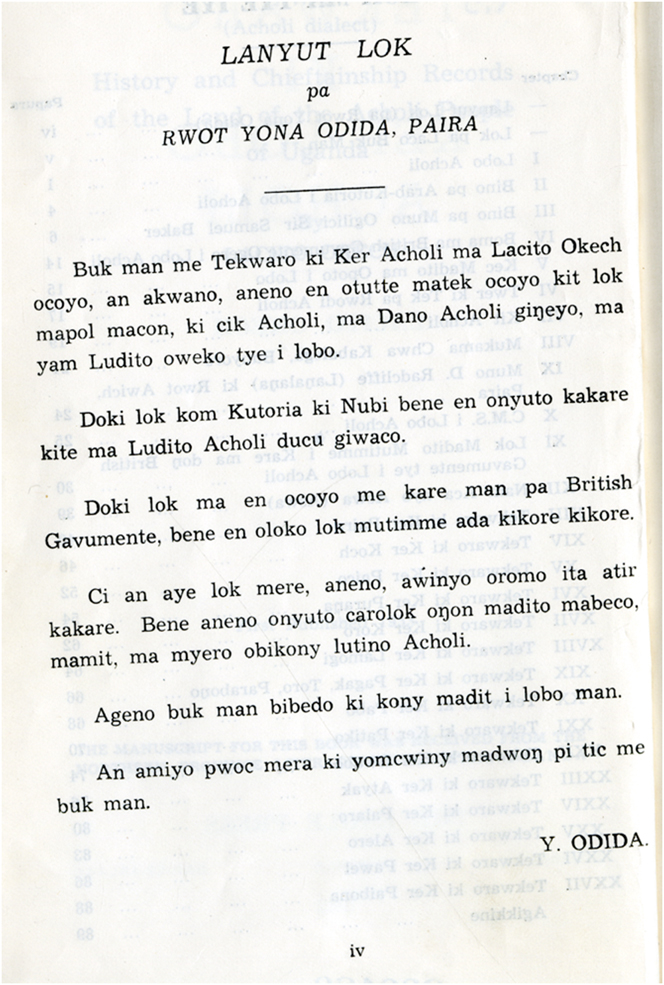
The foreword was written by Chief Yona Odida of Payira Chiefdom – the largest and most influential chiefdom in colonial Acholiland (see Figure 5). Odida, though a prince, was initially a government-appointed chief, but after the death of his father, Chief Awich, in 1946, Odida was installed as successor to his father, thus becoming a traditional chief. Odida ratifies the accuracy of Tekwaro’s accounts: “I have accepted as true what he [Okech] has written.”Footnote 60 Okech’s choice of an influential chief of Odida’s calibre, rather than his own chief of Koch, to write the foreword raises some questions. Why did he choose Odida? What does this choice reveal about the production of history? Did Odida influence Okech’s writing of Acholi history in any way?
The Foreword.

The last question will be anwered in the next section. For now, I argue that the choice of Chief Odida to write the foreword reveals Okech’s intent to exploit Odida’s status in Acholiland to legitimize Tekwaro among the Acholi. Okech’s choice of Odida, instead of any other Acholi, a missionary, or a colonial oficial, highlights two important issues in the production of knowledge in colonial Acholiland. On the one hand, it illustrates the importance of traditional chiefs: knowledge was political and to produce acceptable histories of Acholi chiefdoms, Okech needed the backing of the most influential chief in Acholiland. On the other hand, the choice of Odida suggests that, in spite of Okech’s sterling record in both the precolonial and colonial eras, as a commoner he had limited power and influence in the traditional Acholi setting. For example, even as a native financial assistant, Okech could not produce Acholi royal and cultural history without traditional chiefly sanction: Tekwaro had to be sanctioned by a respectable traditional chief. Okech’s recourse to the premier traditional Acholi chief of the time reveals his adroitness in navigating the cross-currents of his complex personal situation to achieve his objectives in different settings.
In an equally interesting preface, Okech states that he wrote the book to help his people by preserving Acholi history. And, perhaps in an effort to lend credibility to his book, Okech tells the reader that he compiled his book for over thirty years, between 1916 and 1946, and that most of his information came from intelligent chiefs, old men, and himself. In addition, Okech names eight people as his key sources, and I shall examine their likely influence on Okech’s writing below. Finally, and most interesting, Okech thanks the Christian God, Lubanga, to whom he attributes his success. In three sentences, Okech potrays himself as a devout Christian, writing: “I thank Lubanga for taking me away from the forest of Koch and bringing me out to the light, to school; and enabling me to write this book. I thank Lubanga who made me a royal messenger and later put me in many administrative positions. Again I thank Lubanga for making me learn various languages: Lunyoro, Luganda, Kiswahili, English and others.”Footnote 61 In the conclusion, Okech exhorts the reader to “put Lubanga first in everything one does.”Footnote 62 What does all this tell about Okech?
Okech’s effusive evocation of Lubanga could easily be seen as emblematic of his Christian piety. However, Okech’s brand of Christianity did not prevent him from violating a cardinal tenet of his faith: while writing Tekwaro, Okech was already polygamous, a fact he suppressed in the book. So why this effusive display of Christian piety? There are no clear answers to this question, but the context in which Okech was operating is known. First, the colonial state and the Anglican church were bound together. According to Heike Behrend, “Being a Christian, i.e. Protestant or ‘reader’, was a prerequisite of acquiring [and maintaining] a position of a chief.”Footnote 63 Second, beginning in 1946, the Anglican Church accused its members in Acholiland of indulging in “polygamy” and “accumulation of wealth.”Footnote 64 Perhaps because polygamy was more sacrilegious than “accumulation of wealth,” in 1947 the Church passed a resolution to excommunicate all polygamous members. Between 1947 and 1952, seventy-eight members were excommunicated, but Okech was not among them.Footnote 65 He must have escaped excommunication because the CMS authorities were unaware of his aberrant marital status. Thus, his effusive display of Christian piety in the book’s preface can be read as a ruse contrived to portray himself as a devout Christian, and preserve his Anglican and colonial state privileges.
Finally, the conclusion consists of eleven paragraphs. The most striking item in the conclusion is Okech’s stinging opposition to a rumored plan by the colonial state to unite all the Lwo-speaking people under one Lwo dialect to ease colonial administration. According to Okech, this would include such dialects as Joluo, Alur, joPaluo, and other Lwo languages. “I want to point out an important issue here. It is about which dialects must unite all the Lwo people under one family. I don’t support this talk at all – I don’t like it.”Footnote 66 This brief, yet strong, condemnation of a rumored plan at the end of Tekwaro raises an interesting question. Why didn’t Okech highlight this motive in the preface or make his case more elaborately in the conclusion? When Okech completed his book in 1946, he was still a colonial servant. Given his position as a native financial assistant, Okech was aware of the potentially adverse consequences of his statement, which may explain why he did not elaborate his stand on the rumor. As a colonial functionary, he could not afford to expound on an opinion contrary to perceived colonial policy, but as a native Acholi, he had to display solidarity with his people. This brief, yet emphatic, opposition to a rumored plan reveals Okech’s conflicting loyalties, the complexities of his situation at the confluence of his precolonial, missionary, and colonial settings, and the dexterity with which he handled those complexities.
Politics of Production of Knowledge
What kind of sources did Okech rely on? What was their influence on Okech’s writing? Although Tekwaro is largely based on information garnered from many informants, only eight of them are named in the preface. However, at the beginning of most chapters, especially those on chiefdoms, Okech names additional sources. Those named in the preface include Rwot Abok Awich, Rwot Lagony, Rwot Olya, Rwot Abe Arita, Keny Koropil, Odora, Siad Effendi Jubar, and Murjan Effendi Bakit. The first four, identified by the title “Rwot,” which means “chief,” were traditional chiefs of Payira, Koch, Atyak, and Koro, respectively.Footnote 67 The fifth informant, Koropil, had been an Arabic interpreter, and he had also worked as an interpreter for Sir Samuel Baker.Footnote 68 The sixth informant, Odora, was a son of a chief of Patiko Chiefdom.Footnote 69 The last two, Jubar and Bakit, as their names indicate, were descendants of Arab traders and soldiers.
Okech does not tell why he chose these people as sources, or his relationships with them. It appears that he had close relations with all the eight sources, built over his time as a royal messenger and a colonial servant. I focus only on Awich and Olya, the first two chiefs, to illustrate two of the influences on Okech’s writing of Acholi history. It is also important to revisit here the first informant, Rwot Awich, to aid an understanding of the silences in Tekwaro. Rwot Awich was the most powerful Acholi chief in the late precolonial and early colonial Acholiland. Before colonial rule, Awich had established himself as the de facto Acholi paramount chief, but when the British arrived to formalize their annexation of Acholiland by signing treaties with Acholi chiefs, Awich snubbed them. In 1901, the colonial state arrested Awich, and imprisoned him in Kampala, about 200 miles from Acholiland. But after realizing his importance and influence in Acholiland, and the possibility of using him to entrench colonial rule there, the British reinstated Awich in 1902, hoping that, after his imprisonment, Awich would be sifficiently browbeaten to cooperate with the colonial authorities. Awich did not.Footnote 70
It is interesting that in February 1903 Awich invited the CMS to Acholiland. In March 1903, because of his continued spurning of the British, he was rearrested and detained in Nimule. After his release in May 1903, he still refused to cooperate. Between 1908 and 1910, Awich was repeatedly arrested and detained. In late 1911, he was tried for illegal possession of firearms and was again banished to Kampala in 1912. That second banishment “ended the reign of Rwot Awich.”Footnote 71 His chieftaincy was given to Eliya Aliker, one of his sons. But, only a year later, the British deemed the chiefdom too large for Aliker to manage. In 1913, the colonial state divided the chiefdom into two: Eastern and Western Payira. The eastern part remained under Aliker whereas the western part was given to Yona Odida, another son of Awich who would later write the foreword to Tekwaro.Footnote 72 Finally, after dividing Awich’s chiefdom, the colonial state also divided Awich’s wealth to deny him whatever residual power and influence he had. “The cattle of Chief Awich was divided [among his sons],” the colonial state’s 1916 report read.Footnote 73
After dividing his chiefdom, distributing his cattle, and entrenching colonial rule in Acholiland, in 1919, the state released Awich from jail in Kampala, but took him to Kitgum, close to the Uganda-Sudan boundary, where he was confined until 1943, when he was allowed to return to his chiefdom. Awich died in 1946. That same year, R.M. Bere, a colonial official, described Awich as one of the most influential chiefs in Acholiland. “His position (…) at the beginning of the [twentieth] century was almost sufficient to establish the figment that he was the paramount chief; and most of the Europeans with whom he came in contact were under this impression.” Bere, however, concluded that because of his resistance to the state, Awich “misused his power, mistook the omens and missed his opportunity [to achieve even more greatness], so bringing himself to a rather humiliating end,” and, therefore, he “must be counted a failure.”Footnote 74
Because Okech is discreet about his relationship with Awich in his book, it is difficult to assess the influence of that relationship on Okech’s writing. So I will look elsewhere for this relationship. In 1936, a CMS visitor noted that Lacito Okech, “a very close and longtime friend of Owitch [Awich],” led them to Chief Awich because they “wanted to meet the man who had invited the CMS in Acholiland.”Footnote 75 Although this shows a relationship between Awich and Okech, it does not tell anything about the nature of that relationship. Fortunately, Reuben Anywar, the second Acholi to publish a book on Acholi history (in 1954), gives important insights into the precolonial relationship between the two. Anywar states that Chief Awich was often involved in settling conflicts between his chiefdom and others in the first decade of the twentieth century. He even settled a conflict in Okech’s cheifdom, Koch, in 1907.Footnote 76 This event took place during Okech’s tenure as a royal messenger in Koch Chiefdom.
Thus, as a royal messenger, Okech must have interacted with Chief Awich and gotten to know him well, and Okech’s treatment of Awich in Tekwaro attests to this. In Tekwaro, Okech omits details of Awich’s resistance to the British and his consequent humiliation by the British, events that Okech must have been aware of. Even Anywar, who was not a contemporary of Awich, and who, unlike Okech, never interviewed Awich, gives a more detailed account of Awich’s struggles with the British than Okech does. Why are Awich’s anti-British struggles absent in Okech’s work? The answer lies in the ambivalence of Okech’s position as a prominent Acholi, Christian, and colonial servant. As a prominent Acholi and former royal messenger, Okech could not afford to write about one of the most powerful and revered Acholi leaders of his time without lauding Awich’s resistance to the British. But as a Christian and a colonial servant, he could not afford to write about Awich without disparaging the late chief’s anti-colonial stance. Thus, Okech chose to remain silent about Awich’s more controversial attributes and experiences.
Moreover, as stated above, it was Yona Odida, Awich’s son, who wrote the foreword to Tekwaro (see Figure 5). Did Odida influence Okech’s account of his father? In the circumstances, it is logical to imagine that Odida did. It is unlikely that Odida would have sanctioned a version of history that exposed his father’s humiliation by the British, or that portrayed his father as anti-establishment. It is intriguing, however, that Odida endorses Tekwaro with his “imprimatur” when he writes in the foreword, “I have read this book, Tekwaro ki Ker Lobo Acholi, that Lacito Okech has written, and I saw how hard he worked to write it. (…) I have accepted as true what he has written.”Footnote 77 This suggests that Odida saw his role as ratifying what Okech had written, and, as such, it is not impossible that Odida had a say in what Okech could publish about his father.
Okech’s second informant, Rwot Olya, chief of Atyak Chiefdom, was another prominent Acholi chief. The colonial state appointed Okech to work as the clerk to Chief Olya. In particular, the state employed Okech to help the illiterate Olya, who had been coopted to ease the transition to the new order, in compiling tax records, and writing monthly reports. Okech worked with Olya from October 1914 to December 1915. But, as with Awich, Okech is silent on his relationship with Olya. However, Atyak, like Payira, had a close relationship with Okech’s Koch Chiefdom, dating back to the precolonial era. This relationship continued into the colonial era and should have affected Okech’s stance on Olya. The best clue to Okech’s relationship with Olya comes from J.R.P. Postlethwaite, a colonial official in Acholiland. In discussing Atyak’s reception of the colonial state, Postlethwaite noted that Olya was one of the most progovernment traditional chiefs. As a result, he encountered formidable resistance in Atyak for supporting the colonial policies of taxation and forced labor. Postlethwaite states that at the beginning of the First World War, in 1914, his government received “instructions that all trained native askaris [soldiers], whether police or ex-KAR [King’s African Rifles], were to be sent down to the German East Africa Frontier force as soon as possible” to fight alongside the British. According to Postlethwaite, this withdrawal of the colonial army and the police, gave the Acholi “the impression that the [colonial] government were preparing to depart.”Footnote 78
Postlethwaite notes that he received a letter from Atyak Chiefdom, informing him of a threat to kill Olya for being a traitor. This letter, Postlethwaite adds, was written by Olya’s son “who had been to the mission school and knew a little English.”Footnote 79 The letter “stated that the Acholi of Attiak [Atyak] had surrounded their chief,” and they had decided to kill him because “Olia [Olya] had been a man of the white man and that as his masters had fled it was fitting that they should kill him and appoint a new chief in his stead.” Postlethwaite adds, “The note concluded with the news that dancing [to celebrate the exit of the colonial state] would last four days, two of which had since passed, and later (…) Olia would die unless his protector, the District Commisioner, saved him.”Footnote 80 Olya somehow escaped lynching by his subjects.
In his account of Atyak Chiefdom, Okech narrates almost every event up to Olya’s death in 1923 – except this humiliating incident. Because Okech began work (as Olya’s clerk) in Atyak in October 1914, only a few months after the attempt on Olya’s life, he must have learned about this incident before or during his tenure as clerk to Chief Olya, if not during his research for Tekwaro. Moreover, Olya was one of Okech’s key sources. Therefore, although the sources are scanty, I surmise that Okech deliberately omitted this incident in Tekwaro, and for a good reason. His role as a royal messenger, and the relationships he had built with these two chiefs in the precolonial era, shaped his writings in important ways. Although his role placed him in an ideal position to have access to, and interview, these prominent chiefs, Okech could not write as he wished. Put simply, the writings of Okech on Awich and Olya illustrate both the advantages and the constraints that Okech enjoyed and endured respectively as a producer of knowledge.
Okech and Choice of Themes in Tekwaro
I have, in the preceding pages, pointed out how Okech’s position as a royal messenger affected his writing on Acholi chiefs. Now I will examine how Okech’s position as a prominent Anglican convert and a senior colonial functionary influenced his writing. Perhaps the most important missionary influence on Okech is reflected in his omission of the difficult history of the CMS in Acholiland. Okech’s account of the CMS begins in June 1904. That year, Okech writes, Rev. Lloyd, Dr. Albert Cook, Bishop Tucker, the leader of CMS in Uganda, and Sira Donge, their language translator, arrived on a tour of Acholiland. Lloyd had already explored Acholiland alone in 1903.Footnote 81 This second visit was to establish a mission station, and it was duly erected on Keyo Hill in Lamogi Chiefdom. Okech further states that when the CMS mission began operating in 1904, only a few people joined the school. He continues that due to the low voluntary pupil enrolment, Lloyd appealed to Acholi chiefs to send their children to the school. Okech also reports that the CMS baptized only twenty-eight people between 1905 and 1907. Of the twenty-eight, two were Alur who had come with the CMS missionaries from Bunyoro, and nine were children. Baptizing only seventeen adult Acholi and nine children after four years of hard work reveals the Acholi reluctance to join the CMS, a fact that is corroborated by missionary and other sources.Footnote 82 It is revealing that Okech does not comment on the low level of evangelical achievement. He simply states that because people were not interested in converting to Christianity and because natives fled from the vicinity of the CMS mission, the missionaries decided to leave Acholiland. Without any transition, Okech then lists the names of the converts from 1905 to 1908, after which he embarks on a new history of the CMS, beginning in 1911.
Okech is silent on why the Acholi were not interested in converting to Christianity, or why they left the vicinity of the CMS mission. He only states that the Acholi highly disparaged the mission, but he doesn’t explain why. But, some contemporary events offer some persuasive explanations. For example, the CMS introduced and continued to use phonographs and magic lanterns to entertain the Acholi. But these audio-visual machines confused the Acholi and aroused deep misgivings about the powers of the CMS.Footnote 83 Locals saw missionaries as witches who wanted to harm them. After the introduction of the phonograph and the magic lantern in 1904, a sequence of events between 1905 and 1907 appeared to confirm the Acholi’s initial suspicion that the missionaries were dangerous people who should be avoided and driven out of Acholiland. Perhaps one of the first events to tilt the balance of public opinion against the missionaries was the fatal shooting of a woman at Patiko. In 1905, Rev. A.E. Pleydell shot and killed a woman who was working in her garden near the mission station. He shot her because he thought “she was a [sic] wild game in the bush.”Footnote 84 The impact was immediate: Acholi fled the mission.Footnote 85
Second, “Keyo Hill was struck by lightning three times” between March and October in 1906.Footnote 86 In Acholi thought, lightning is an event of momentous proportions. It was (and still is) locally referred to as lut kot, literally “stick/cane of the rain,” but actually cane of the jok (spirit). It is still understood as an expression of a jok’s displeasure and reprisal. If lightning struck a building, or a house, people deserted it; if it struck a domestic animal but did not kill it, the owner had to kill the animal and throw it away; if it struck and killed an edible domestic animal, people would not eat it; and if it struck and killed a person, relatives performed a special burial near a well, not at the home, to avoid further retribution. And if it struck but did not kill a person, the person had to undergo a cleansing ritual.Footnote 87 The fact that lightning struck the mission station three times in the same year must have suggested to the Acholi that their jok was unhappy with the presence of the CMS, and they fled the environs of the mission station. Third, Chief Okello, who gave the CMS land and supported them, died. Shortly, after the death of Chief Okello, his prominent royal messenger, Obwona Acholi, also died.Footnote 88 After the death of these two men, Sira Donge, one of the local assistants that Rev. A.B. Lloyd had brought with him from Bunyoro Kingdom, explained, the chief’s subjects blamed the CMS missionaries for the death of their leaders and “stopped me from going to preach in nearby areas.”Footnote 89 As a result of this sequence of events, “the Acholi who lived near the mission station now left. They politely explained that the land was no longer fertile and moved.”Footnote 90
Even more revealing was the immediate reaction of the Acholi to the departure of the CMS missionaries: “The people refused to provide porters to help with the move,” and porters had to come all the way from Bunyoro Kingdom where the CMS had established a station before moving into Acholiland.Footnote 91 Shortly after the missionaries left, the Acholi destroyed the CMS church building and burned all the reading materials, including the Bibles. Even the remaining converts who wanted to continue the work of the CMS were violently dispersed. As Bishop J.K. Russell reports, people “attacked them, beat them very severely and destroyed all their books (…) because they still wanted to go on reading [teaching Acholi how to read the word of God], although the white men had gone.”Footnote 92
Okech omitted mentioning the struggles, and the violence that ensued, between the Acholi and the CMS. And yet it is inconceivable that Okech could have forgotten all these events. Given his close connection with the CMS (he even served on the Board of Governors of the CMS’s education department), Okech must have had good reasons for omitting these events in the history of the CMS in Acholiland. Here, Okech continues to gloss over failures of institutions he is part of: he did not want to write about the failures of the CMS in Acholiland.
Moreover, Okech ignores the history of Islam in the area. The omissions were not due to lack of Muslim sources or information, or because of a language barrier; two of his listed sources in the preface – Said Effendi Jubar and Murjan Effendi Bakit – were Muslims. In addition, Omara Aryemu, Okech’s father, and Keny Koro, another of his key sources, were interpreters for the Arab (Muslim) traders. Finally, Okech himself spoke Arabic, although he does not list Arabic in his arsenal of languages. Bwangamoi Okot, Okech’s son, suggested, “My father might simply have forgotten to include Arabic, partly because it was no longer in current usage in Acholiland.”Footnote 93 But the best clue to Okech’s silence on his knowledge of Arabic and the omission of history of Islam comes from a report and an autobiography. In 1935, the Anglican church excommunicated five converts for what they call “speaking Arabic” and adding “Islamic names on top of their Christians names.”Footnote 94 In 1978, Petero Ali Obol, one of the five converts excommunicated in 1935, wrote that when he added his father’s name Ali to his name, “it annoyed the Gulu Anglican Church Council,” who “questioned my belief.” But after several months, Obol concluded, “I was informed I was no longer a member of the Anglican church.”Footnote 95 Taken together, these clues suggest that Okech might have omitted the history of Islam and excluded Arabic from his list of languages to avoid questioning by the church council, and possibly excommunication. The work of this church council might also explain why Okech glossed over the failures of the CMS in Acholiland.
Likewise, Okech’s writings on the Verona Fathers, a Roman Catholic order, are questionable. He devotes only half a page to them. This limited coverage is easier to explain. Okech could not have lacked information or sources on the Verona Fathers. Instead, the explanation for his half-page treatment is more likely to be found in the animosity that had existed between the CMS and Verona Fathers since 1912 when the Fathers began competing with the CMS for converts. As Colin Leys reported, as soon as the Verona Fathers began recruiting converts, “both churches spread with vigor, but in a most intense spirit of competition. Where one opened a school and built a church, the other sought to do so.”Footnote 96 This cutthroat competition between the CMS and the Verona Fathers trickled down to their respective converts, even leading to violence between the two denominations.
The climax of this violence was perhaps in 1915, when the state intervened with a law restraining both factions. The new law stipulated that, henceforth, in establishing new mission schools, a “Catholic school must be at a distance of at least two miles from a Protestant one.”Footnote 97 The regulation, however, did not resolve all the problems: each mission used its school as tactical propaganda and indoctrination base.Footnote 98 In the 1960s, Santo Oyet, one of the first generation of literate Acholi, recounted that they were taught in their school to “hate Catholics and never submit to them.”Footnote 99 Lakana Onek, another beneficiary of CMS education, criticized it for “creating hatred among people.”Footnote 100 These testimonies illustrate the kind of education that Okech received, and it is safe to assume that his treatment of the Verona Fathers was partly a continuation of an old feud: he did not consider the works of the Verona Fathers worthy of many pages of his book.
Finally, there is evidence that Okech’s position in the colonial state also influenced his writing of Acholi history. Perhaps the most important clue is Okech’s glossing over the colonial violence against his people. Like in many other places, the imposition of the colonial rule in Acholiland resulted into various forms of resistance. For instance, between 1911 and 1912, the people of Lamogi Chiefdom rose up against the British, in what became known as the Lamogi Rebellion, because of forced labor, taxation, and disarmament. To quell the rebellion, the British responded with excessive police brutality, killing ninety-one people and taking 1,071 prisoners of war.Footnote 101 Shortly after the Lamogi rebellion, in 1914, a similar resistance emerged in the Puranga Chiefdom, where Okello Mwoka, a government-appointed chief and Okech’s acquaintance, was murdered for supporting the colonial state. The state responded by arresting several suspects, “sentencing four to a long term of imprisonment and four to death.”Footnote 102 Those sentenced to death were hanged publicly. On the day of hanging, J.R.P. Postlethwaite, the colonial official in Gulu, forced his local employees and subjects to go to a public ground and witness the hanging of the men “in order to give a lesson that cold blooded murder especially inflicted on one as loyal to the Government as the deceased cannot but meet with the severest punishment.”Footnote 103
Okech glossed over these kinds of colonial violence on his people. Again, this was not a result of lack of information. Indeed, Okech himself may have been in the crowd that witnessed the executions. Moreover, in the case of the Lamogi Rebellion, Okech served as an appointed chief of the Lamogi Chiefdom from 1923 to 1937, long enough for him to learn and document the violence committed against the Lamogi people. The best explanation for Okech’s stance has to do with his senior position in the colonial state. As a chief and then native financial assistant, Okech did not want to write about issues that he thought were likely to make his employer question his allegiance. In general, Tekwaro is not candid on controversial issues or conflicts that pitted the Acholi against the colonial state.
Conclusion
This article has examined the career and writing of Okech. I have argued that Okech’s journey to authoring the first book on Acholi history and chiefdoms was shaped by both precolonial and colonial rule. His positions as a royal messenger, a Christian convert, a colonial servant, and an Anglican School Board member contributed significantly to making him the local intellectual that he became. But after Okech converted to Christianity and joined the colonial service, he had to play three roles: an Acholi, an Anglican convert, and a colonial employee. It is these three roles that influenced his writing of Acholi history. To navigate the choppy waters of his personal life, and maintain his status in each setting, Okech often had to deliberately omit or gloss over important historical issues, and this largely explains why Tekwaro is not candid about controversial issues, personalities in Acholi history, or conflicts that pitted any of the three settings against another. This strategy reveals not only his personal predicament but also the complexity of twentieth-century Acholiland. However, despite Tekwaro’s glaring omissions, and partly because of them, the book remains a landmark in the production of historical knowledge in colonial Acholiland by one of its inhabitants whose life spanned the precolonial and colonial eras.
Patrick W. Otim received his PhD from the University of Wisconsin-Madison in 2016 and is presently an Assistant Professor of History at Bates College. His scholarship focuses on Uganda, with a special emphasis on the precolonial and colonial history of northern Uganda. He is currently revising his doctoral dissertation, “Forgotten Voices of the Transition: Precolonial Intellectuals and the Colonial State in Northern Uganda, 1850–1950,” into a book manuscript. E-mail: potim@bates.edu.