Introduction
Cochlear implantation has become a routine procedure for the management of sensorineural hearing loss.Reference Demir, Binnetoglu, Mammodova and Batman1 Over the past several decades, developments in the field of microelectronics and progress in signal processing techniques have led to an increase in the performance and effectiveness of cochlear implant devices. Innovations in surgery also have contributed to the increased hearing performance of cochlear implant users. Efforts to improve the auditory outcome of cochlear implants have resulted in atraumatic implantation of the cochlear implant electrode and protection of the cochlear anatomy.
Although the round window route and cochleostomy are the two main approaches to implant placement,Reference Demir, Binnetoglu, Mammodova and Batman1 the round window approach is considered to be less traumatic.Reference Adunka, Unkelbach, Mack, Hambek, Gstoettner and Kiefer2,Reference Roland, Wright and Isaacson3 Contradictory results between the two techniques have been reported in the literature. Eshraghi et al.Reference Eshraghi, Ahmed, Krysiak, Ila, Ashman and Telischi4 showed that the round window approach preserved residual hearing, whereas Cheng et al.Reference Cheng, Wang, Liu, Yuan, Shu and Chen5 did not find any significant difference between the two techniques. Skarzynski et al.Reference Skarzynski, Lorens, Piotrowska and Anderson6 demonstrated successful hearing preservation in subjects with residual low-frequency hearing, associated with the atraumatic round window surgical technique. Preservation of low-frequency hearing resulted in excellent pure tone thresholds and speech perception scores, even in children.Reference Meredith, Rubinstein, Sie and Norton7 Moreover, Todt et al.Reference Todt, Basta and Ernst8 suggested using the round window route for electrode insertion to preserve vestibular function. However, a recent study by Korsager et al.Reference Korsager, Schmidt, Faber and Wanscher9 indicated that surgical technique has no effect on vestibular function.
Several studies have shown the benefits of atraumatic techniques; however, most of these studies have been conducted with pure tone audiometric evaluations or speech perception tests with subjects who have some measurable residual hearing.Reference Brown, Hullar, Cadieux and Chole10,Reference Pillsbury, Dillon, Buchman, Staecker, Prentiss and Ruckenstein11 To our knowledge, only the study by Kang and KimReference Kang and Kim12 evaluated subjects without residual hearing; these authors analysed the post-operative speech perception outcomes in 84 cochlear implant users and found no benefit of the round window technique over cochleostomy. The preservation of hair cells and cochlear structures (scala media, scala tympani and scala vestibuli) can also be important for subjects without residual hearing, and may additionally be helpful in regenerative hair cell therapy.Reference Mittal, Nguyen, Patel, Debs, Mittal and Yan13
Spectral ripple resolution is an important ability, which has been proposed as an objective evaluation method for detecting subtle differences in cochlear implant benefit,Reference Drennan, Anderson, Won and Rubinstein14 has a significant relationship with speech and music perception,Reference Won, Drennan and Rubinstein15–Reference Jung, Won, Drennan, Jameyson, Miyasaki and Norton17 is useable in evaluating the benefits of residual hearingReference Golub, Won, Drennan, Worman and Rubinstein18 and matures very early.Reference Jung, Won, Drennan, Jameyson, Miyasaki and Norton17,Reference Horn, Dudley, Dedhia, Nie, Drennan and Won19 Therefore, this study aimed to compare spectral resolution after round window electrode insertion and traditional cochleostomy cochlear implant surgery. We hypothesised that spectral resolution performance will differ between these two techniques.
Materials and methods
Subjects
Twenty-six unilaterally implanted and prelingually deaf individuals aged 12–25 years (average of 18.3 years) participated in this study. Mean age at diagnosis and implantation was 21.6 months and 55.7 months, respectively. Regarding inclusion criteria, all patients had normal cochlear anatomy and at least one year of cochlear implant experience. All subjects had similar free field audiometric thresholds and good word discrimination scores.
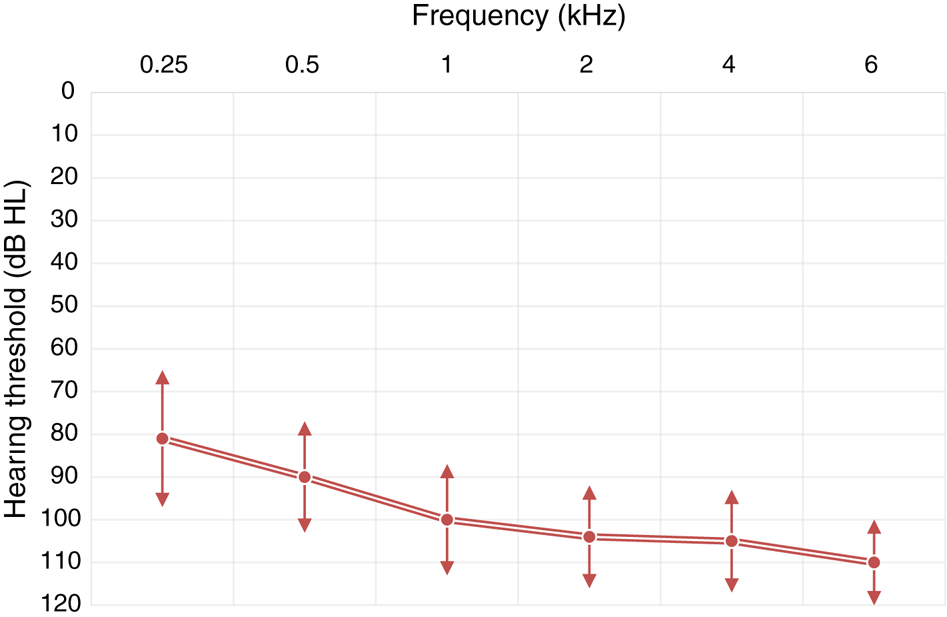
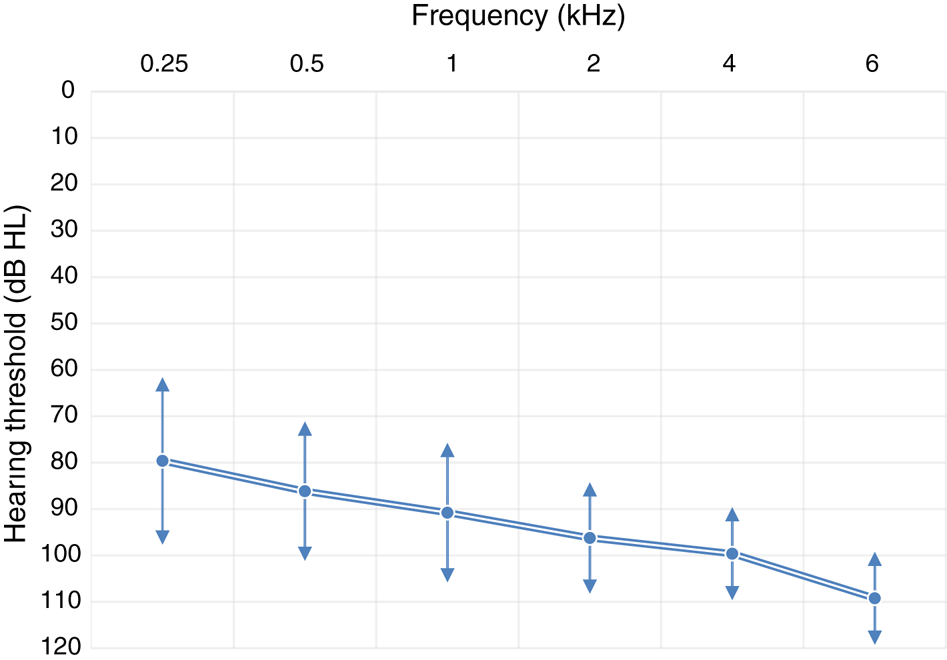
Residual hearing in the ear with the cochlear implant was not measurable pre- or post-implantation in almost all subjects; therefore, no data regarding residual hearing in this ear are presented. However, some subjects had residual hearing capacity in the contralateral ear; therefore, we collected behavioural pure tone thresholds in the contralateral ear, presented in Figures 1 and 2. This decision was based on the benefit of acoustic hearing seen on the spectral resolution tests.Reference Golub, Won, Drennan, Worman and Rubinstein18 Hearing aids in the contralateral ear were removed during testing.
Contralateral residual hearing thresholds of cochleostomy group (n = 13). Vertical lines represent standard deviation.

Contralateral residual hearing thresholds of round window group (n = 13). Vertical lines represent standard deviation.

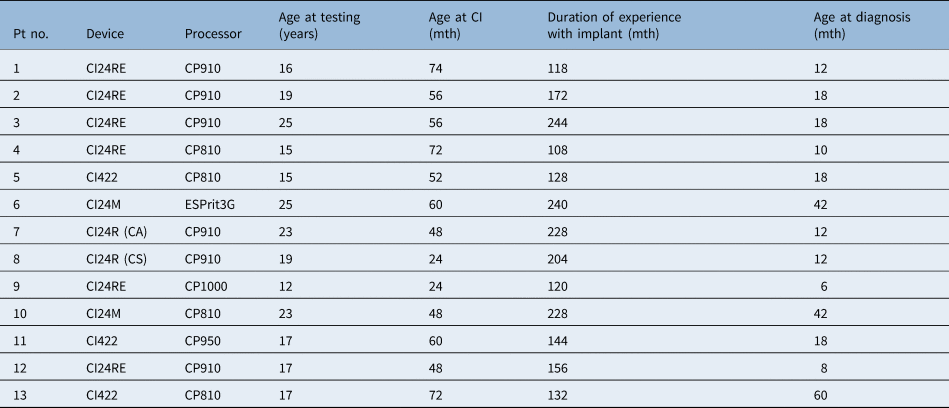
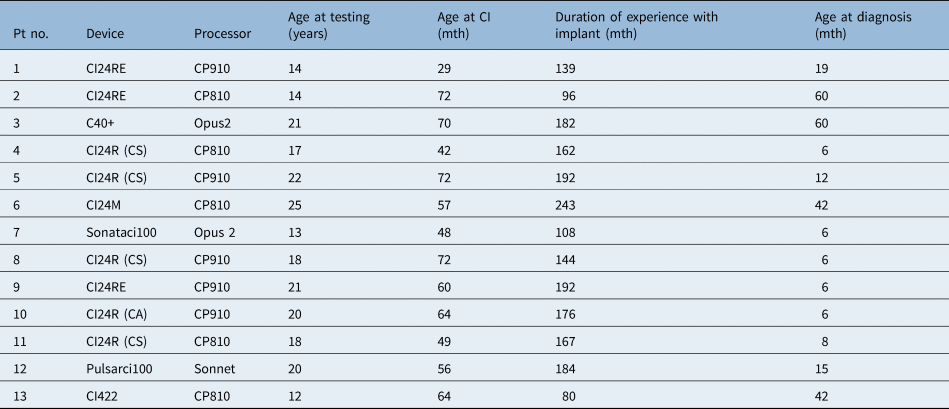
Patients were classified into two groups according to surgical approach: one group (n = 13) underwent cochlear implantation via the round window technique, and the other group (n = 13) underwent surgery via cochleostomy. Age at testing, age at severe-to-profound hearing loss onset and age at implantation are presented in Tables 1 and 2.
Demographics for round window group

Pt no. = patient number; CI = cochlear implantation; mth = months
Demographics for cochleostomy group

Pt no. = patient number; CI = cochlear implantation; mth = months
Spectral ripple discrimination and Turkish matrix sentence test scores for study groups

CI = cochlear implantation; min = minimum; max = maximum; SD = standard deviation
All tests were conducted in a sound-treated, double-walled room (IAC Acoustics, Chandlers Ford, UK) with a sound field presentation level of 65 dB (A-weighted). All stimuli were presented via a loudspeaker that was positioned at 0° azimuth and 0° elevation, at a 1 metre distance from the subjects.
The study protocol was approved by the ethical committee, and all subjects and their parents gave written informed consent to participate. The study procedure was approved by the university ethical committee (15 September 2017; protocol no: 09.2017.556).
Surgical techniques
First, a retroauricular incision was performed, and then the temporal occipital periosteum was elevated. A deep bone groove was created for the implant based on the thickness of the dura mater. After the cortical mastoidectomy and visualisation of the short process of the incus, the facial recess was detected and enlarged in the round window approach. The electrical compound action potential and electrical stapedius reflexes were measured intra-operatively after insertion, to check the functionality of the implant. A Stenvers and transorbital petrous skiagram were acquired during the early post-operative period to assess and record the appropriate placement of the implant.
Speech perception test
Speech perception in noise performance of the study groups was evaluated using the Turkish matrix sentence test.Reference Zokoll, Fidan, Turkyilmaz, Hochmuth, Ergenc and Sennaroglu20 This test is conducted with an adaptive procedure in an open set response format, aiming for the 50 per cent threshold of speech intelligibility. The Turkish matrix sentence test uses syntactically fixed sentences comprising five words: name plus numbers plus adjectives plus objects plus verbs. Background noise was fixed at 65 dB, while the speech signal was changed adaptively starting from 0 dB signal-to-noise ratio. If the subject correctly repeats three of five words, the speech signal in the next presentation is decreased. Otherwise, the speech signal in the next presentation is increased. The subjects listened to 20 sentences in total after the training session.
Spectral ripple discrimination
The spectral ripple discrimination test is an adaptive task, and previously described stimuli and procedures were used.Reference Won, Drennan and Rubinstein15 The stimuli were generated by summing 200 pure tone frequency components with a duration of 500 ms and a rise/fall time of 150 ms. Each stimulus was either a standard (reference) or inverted ripple (ripple phase reversed). The stimuli had a bandwidth of 0.1–5 kHz, and the ripple densities differed by ratios of 1.411. The test paradigm used a two up and one down adaptive forced-choice procedure. Spectral ripple resolution thresholds were determined converging on 70.7 per cent correct.Reference Levitt21 Testing included three adaptive tracks. The mean threshold of a single track was determined by averaging the final 8 of 13 reversals. The final spectral ripple discrimination thresholds were determined by averaging three adaptive tracks.
Statistical method
Statistical analysis was performed using SPSS software, version 21.0 (SPSS, Chicago, Illinois, USA). Differences between the round window and cochleostomy groups were analysed with the Mann–Whitney U test. The 0.05 significance level was employed.
Results
Demographics for the study groups are presented in Tables 1 and 2.
A Mann–Whitney U test was performed to assess the differences in spectral ripple discrimination average and Turkish matrix sentence test score between the round window and cochleostomy groups. Distributions of the spectral ripple discrimination average and Turkish matrix sentence test score for round window and cochleostomy groups were similar as assessed by visual inspection. The difference between the median engagement of the Turkish matrix sentence test score for the round window group (10.00 dB) and the cochleostomy group (7.20 dB) was not statistically significant (U = 143, z = −1.256, p = 0.209). Median engagement of the spectral ripple discrimination average was significantly higher in the round window group, with 1.16 ripples per octave, than in the cochleostomy group, with 0.58 ripples per octave (U = 112, z = −3.256, p = 0.001), using an exact sampling distribution for U.Reference Dinneen and Blakesley22
In order to evaluate the possible benefit of residual hearing, we also examined the behavioural pure tone thresholds of the contralateral non-implanted ear, and compared thresholds in each frequency between the groups. There were no statistically significant differences between the groups in terms of behavioural pure tone thresholds (p > 0.05).
• The round window approach is considered less traumatic than cochleostomy for cochlear implantation, but literature results are contradictory
• This study used objective spectral resolution to evaluate the surgical approaches in cochlear implant users
• Spectral ripple discrimination was used to assess cochlear implantation via the round window technique (n = 13) or cochleostomy (n = 13)
• There was a significant difference in spectral ripple discrimination scores between the round window and cochleostomy groups
• The round window group performed almost two times better than the cochleostomy group
• It is speculated that the health of surviving neurons, influenced by their proximity to implant electrodes in the cochlear apical region, played a role in this outcome
Discussion
The spectral ripple discrimination results of this study support the benefits of the round window approach over cochleostomy in implant surgery. This finding is challenging, because the between-group difference in the speech perception test was not statistically significant, which is a consistent finding in previous research.Reference Kang and Kim12 This can be explained by the relatively complex nature of speech perception development in cochlear implant usersReference Han, Lee, Kang, Oh and Lee23,Reference Pisoni24 compared with spectral ripple discrimination. The spectral ripple discrimination test can measure the frequency resolution without the influences of cognitive development, and can predict many different abilities, such as speech or music perception.Reference Won, Drennan and Rubinstein15–Reference Jung, Won, Drennan, Jameyson, Miyasaki and Norton17 In addition, it is known that spectral ripple discrimination ability matures very early in cochlear implant users,Reference Horn, Dudley, Dedhia, Nie, Drennan and Won19 and there was no difference between paediatric and adult cochlear implant users.Reference Jung, Won, Drennan, Jameyson, Miyasaki and Norton17
The benefit of the round window approach in spectral ripple discrimination might be explained by histopathological studies conducted in cochlear implant users. Previous histopathological studies have shown that the decrease in the total spiral ganglion cell count in implanted ears mainly occurs in the apical segment of the cochlea.Reference Kamakura, O'Malley and Nadol25,Reference Khan, Handzel, Damian, Eddington and Nadol26 As implant technology aims to imitate the tonotopic nature of the inner ear, there might be a contribution of intact inner-ear structures in the apical region of the cochlea to the frequency perception of low frequencies. Considering the positive impact of a wider frequency bandwidth on spectral ripple discrimination performance, our findings might be reflecting the health of surviving neurons and their proximity to the implant electrodes in the apical region of the cochlea.
Previous studies found no difference in word recognition performance in relation to intact spiral ganglion cells after cochlear implantation; moreover, there was an inverse relationship between spiral ganglion count and speech perception scores.Reference Fayad and Linthicum27–Reference Nadol, Shiao, Burgess, Ketten, Eddington and Gantz29 The authors of these studies attributed this observation to the role of central auditory pathways, which is in accordance with our findings.
Factors other than the surgical technique can affect the health and uniformity of surviving neurons, such as electrode length. In a 2016 review paper, it was suggested that no type of electrode could perfectly protect residual hearing.Reference Nguyen, Cloutier, Philippon, Cote, Bussieres and Backous30 In addition, this paper reported that slow, gentle insertion and the utilisation of intra-operative corticosteroids enhanced auditory results post-operatively.Reference Nguyen, Cloutier, Philippon, Cote, Bussieres and Backous30 The duration of follow up is also important when comparing surgical techniques in terms of residual hearing preservation. Wanna et al.Reference Wanna, Noble, Carlson, Gifford, Dietrich and Haynes31 followed patients for at least a year and reported higher rates of long-term hearing preservation in round window or extended round window approaches than in cochleostomy approaches. All patients in our study were long-term cochlear implant users, with 14.24 years and 13.23 years of use in the round window and cochleostomy groups, respectively.
Study limitations
Although differences between the study groups in terms of contralateral hearing thresholds were not statistically significant, the contribution of this difference to the superior performance of the round window group should be considered. Differences in hearing thresholds were around 5–15 dB HL. On the other hand, the spectral ripple discrimination scores of the round window group were almost double those of the cochleostomy group. We believe that the difference in spectral ripple discrimination scores cannot be explained by slightly better contralateral hearing thresholds. Nevertheless, this possibility must also be considered.
Conclusion
This study shows the benefit of the round window approach over cochleostomy in cochlear implantation, with better spectral ripple discrimination scores. Consistent with the literature, there was no difference in speech perception scores between these two groups. We believe that our findings might be reflecting the health of surviving neurons and their proximity to the implant electrodes in the apical region of the cochlea.
Competing interests
None declared