Introduction
The adverse impact of major depressive disorder (MDD) on executive functions (EF) is well documented (for a review see Rock et al. Reference Rock, Roiser, Riedel and Blackwell2014). There is also evidence that dysphoria is associated with impairments on EF in non-clinical samples (Snyder, Reference Snyder2013). A growing literature has also suggested a negative relationship between clinical levels of anxiety and cognition, particularly regarding generalized anxiety disorder (GAD; Andreescu & Varon, Reference Andreescu and Varon2015). The core symptoms of GAD are excessive anxiety and worry which interfere with daily activities. Persistent worry and apprehension may be accompanied by physical and psychological symptoms such as restlessness, feeling on edge or easily fatigued, difficulty concentrating, muscle tension or sleeping problems (American Psychiatric Association, 2013). Factors which were associated with GAD included female sex, living alone, lower levels of educational attainment and cognitive impairment (Wiltink et al. Reference Wiltink, Beutel, Till, Ojeda, Wild, Münzel, Blankenberg and Michal2011; Zhang et al. Reference Zhang, Norton, Carrière, Ritchie, Chaudieu and Ancelin2015). An explanation for the impact of anxiety on cognitive impairment in non-clinical populations is provided by Eysenck and colleagues (Eysenck et al. Reference Eysenck, Derakshan, Santos and Calvo2007). According to their attentional control theory, anxiety impairs efficient functioning of the goal-directed attentional system and increases the extent to which processing is influenced by the stimulus-driven attentional system. This theory is in line with neurobiological findings showing abnormal amygdala, anterior cingulate cortex (ACC) and prefrontal cortex activation in GAD patients along with decreased functional connectivity between these areas (Hilbert et al. Reference Hilbert, Lueken and Beesdo-Baum2014).
Anxiety is negatively associated with age-related cognitive impairment, particularly in older adults (Beaudreau et al. Reference Beaudreau, MacKay-Brandt and Reynolds2013). Accordingly, higher levels of anxiety were associated with poorer memory only in the high age group in a study by Deptula et al. (Reference Deptula, Singh and Pomara1993), which related anxiety ratings (relaxed/tense) to verbal list-learning performance in young and elderly non-clinical subjects.
While studies have addressed cognitive functioning in dimensional anxiety phenotypes only rather recently, there is ample evidence for the negative association between major depression and cognition. For example, Rock et al. (Reference Rock, Roiser, Riedel and Blackwell2014) reported lower planning performance in tower transformation tasks for depressed patients. Planning represents a form of problem solving and denotes the mental conception and evaluation of behavioral sequences and their outcomes prior to their actual execution (Goel, Reference Goel and Nadel2002). Planning is clearly linked to fluid intelligence (Unterrainer et al. Reference Unterrainer, Rahm, Kaller, Leonhart, Quiske, Hoppe-Seyler, Meier, Müller and Halsband2004; D'Antuono et al. Reference D'Antuono, La Torre, Marin, Antonucci, Piccardi and Guariglia2016), depends strongly on prefrontal functioning (Unterrainer & Owen, Reference Unterrainer and Owen2006), and is considerably affected in healthy aging (Kaller et al. Reference Kaller, Debelak, Köstering, Egle, Rahm, Wild, Blettner, Beutel and Unterrainer2016). It is essential to all aspects of life that demand goal-directed control and planning of behavior. Thus, its decline has a pervasive impact on independent living. To our knowledge, planning ability has not been linked to anxiety in a large non-clinical sample covering a broad age range, neither on its own nor in combination with depression.
In the present study, we addressed three questions: (i) Whether cognitive planning is associated with subclinical levels of anxiety, and (ii) whether there is an age-related increase of this association. As anxiety and depression are both negatively related to cognition, and as they are strongly interrelated with each other (Löwe et al. Reference Löwe, Wahl, Rose, Spitzer, Glaesmer, Wingenfeld, Schneider and Brähler2010), we (iii) examined whether anxiety has a significant predictive value for cognitive performance even when analyzed in a combined model with depression. To address these questions, we used the Tower of London (ToL) task (Shallice, Reference Shallice1982), assessed in 4240 consecutive participants of the Gutenberg Health Study (GHS) cohort, to measure planning ability in a non-clinical population-based sample.
Methods
Study sample
We analyzed cross-sectional data of 4240 consecutive participants (48.8% female) aged 40–80 years enrolled in the GHS at the follow-up examination from May 2012 to October 2014. The GHS is a population-based, prospective, observational single-center cohort study in the Rhine-Main region in western Mid-Germany with the primary aim to evaluate and improve cardiovascular risk stratification (Wild et al. Reference Wild, Zeller, Beutel, Blettner, Dugi, Lackner, Pfeiffer, Münzel and Blankenberg2012). Baseline examination started in 2007. Participants underwent a full examination after a follow-up period of 5 years. The study protocol and sampling design were approved by the local ethics committee and by the local and federal data safety commissioners. A detailed description of this cohort with respect to socio-demographic and medical characteristics was published elsewhere (Wiltink et al. Reference Wiltink, Beutel, Till, Ojeda, Wild, Münzel, Blankenberg and Michal2011). In line with other surveys, we identified GAD in 3.4% and depression in 7.2% of the sample.
Measurement of cognitive function
Planning ability was assessed with the ToL – Freiburg Version (Kaller et al. Reference Kaller, Unterrainer, Kaiser, Weisbrod and Aschenbrenner2012a , Reference Kaller, Unterrainer and Stahl b ). In the ToL, planning is required for an efficient transformation of a given start state into a desired goal state within the minimum number of moves.
In the GHS, a touchscreen version was used that has proven feasible even for elderly participants without any computer experience. The ToL problem set consisted of an optimized selection of four-, five- and six-move problems (eight of each) with a monotonic increase of problem difficulty (split-half reliability and internal consistencies: >0.70; Kaller et al. Reference Kaller, Unterrainer, Kaiser, Weisbrod and Aschenbrenner2012a , Reference Kaller, Unterrainer and Stahl b , Reference Kaller, Debelak, Köstering, Egle, Rahm, Wild, Blettner, Beutel and Unterrainer2016). Test duration was limited to 20 min. For analysis of global planning performance, the number of problems that were solved in the minimum number of moves was used. Thus, the scale of the dependent variable ranged from 0 to 24. Data from the ToL task were only available at follow-up.
Questionnaires
Generalized anxiety was assessed using the two-item version of the GAD-7 (Kroenke et al. Reference Kroenke, Spitzer, Williams, Monahan and Löwe2007; Löwe et al. Reference Löwe, Wahl, Rose, Spitzer, Glaesmer, Wingenfeld, Schneider and Brähler2010), which provides proven convergent validity with established anxiety measures (Donker et al. Reference Donker, van Straten, Marks and Cuijpers2011: r = 0.82, p < 0.001 with HADS anxiety scale; see also Kertz et al. Reference Kertz, Bigda-Peyton and Bjorgvinsson2013; Rutter & Brown, Reference Rutter and Brown2017). ‘Feeling nervous, anxious or on edge’ and ‘Not being able to stop or control worrying’ are rated from 0 = ‘not at all’, 1 = ‘several days’, 2 = ‘over half the days’, and 3 = ‘nearly every day’. A cut-off score of three or more detects current Generalized Anxiety Disorder with a sensitivity of 86% and a specificity of 83% (Kroenke et al. Reference Kroenke, Spitzer, Williams, Monahan and Löwe2007). Depression was measured with the German version of the Patient Health Questionnaire according to the DSM-IV criteria for depression (PHQ-9; sensitivity 81%, specificity 82%; Löwe et al. Reference Löwe, Spitzer, Grafe, Kroenke, Quenter, Zipfel, Buchholz, Witte and Herzog2004).
Socioeconomic status (SES) was defined according to Lampert and Kroll's scores of SES (Lampert & Kroll, Reference Lampert, Kroll, Richter and Hurrelmann2006) ranging from 3 to 27 with 3 indicating the lowest SES and 27 the highest SES.
Statistical analysis
We used multiple linear regression analyses with anxiety, depression, age, sex, and SES as predictors and number of correctly solved planning tasks as dependent variable. Sex, age, and SES are known to influence ToL planning performance (Kaller et al. Reference Kaller, Unterrainer, Kaiser, Weisbrod and Aschenbrenner2012a , Reference Kaller, Unterrainer and Stahl b ) and were thus included in all analyses as confounders. Age was analyzed as continuous variable, but for easy interpretability, was scaled so that beta estimates reflected the change in the number of ToL problems that were correctly solved associated with an increase of age by 10 years. Hence, a beta estimate of −1 meant that an increase of age by 10 years resulted in a reduction of the number of solved ToL problems by 1. Spearman coefficient was calculated for single correlational analysis of age and GAD-2.
To identify further confounders of anxiety and EFs, we performed additional analyses, including self-reported alcohol consumption (dichotomized variable: daily intake of <20 g for men and <10 g for women v. ⩾20 g for men and ⩾10 g for women), sleep quality (Jenkins Sleep Scale; Jenkins et al. Reference Jenkins, Stanton, Niemcryk and Rose1988) smoking (dichotomized variable: current smoker/social smoker v. non-smoker/ex-smoker), and overall health status (1 = very good, 2 = good, 3 = acceptable, 4 = bad).
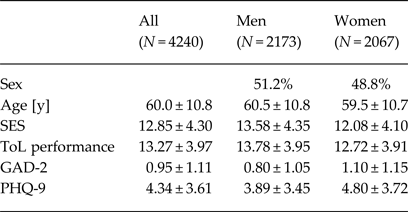
With regard to our second question, a potential age related increase of the association between GAD-2 and ToL scores, we tested the interaction of anxiety and age on planning ability. Descriptive data of the sample are provided in Table 1. p-values corresponding to two-tailed tests are reported and were considered significant at the 0.05 level. Statistical analyses were performed using R version 3.3.1.
Sample characteristics

[y], years; SES, socioeconomic status; ToL, Tower of London; GAD-2, anxiety; PHQ-9, depression.
Continuous variables are described by mean ± s.d.
Results
Cognition, anxiety and age
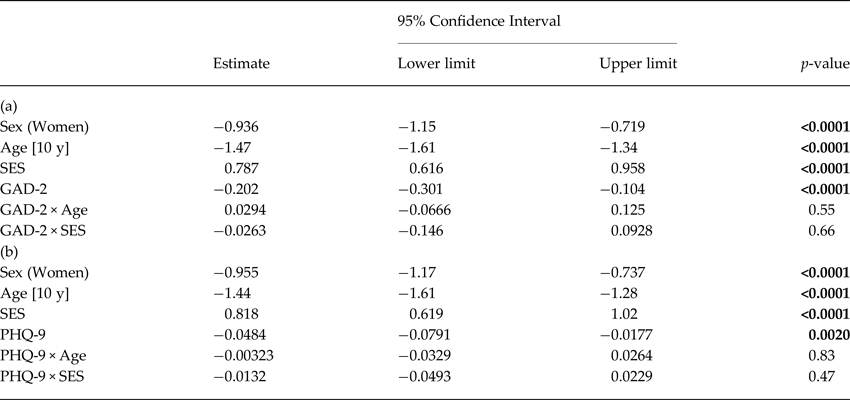
Multiple regression analysis revealed significant associations between planning performance and sex (β = −0.94; p < 0.0001), age (β = −1.47; p < 0.0001), SES (β = 0.79; p < 0.0001) and GAD-2 (β = −0.20; p < 0.0001; see Table 2 a). In line with previous studies (Kaller et al. Reference Kaller, Unterrainer, Kaiser, Weisbrod and Aschenbrenner2012a , Reference Kaller, Unterrainer and Stahl b , Reference Kaller, Debelak, Köstering, Egle, Rahm, Wild, Blettner, Beutel and Unterrainer2016), better planning performance was observed in men, in younger participants and participants with higher levels of educational attainment. Anxiety was significantly associated with cognition: higher anxiety ratings were accompanied by lower planning performance. Contrary to our prediction, however, this negative association did not change with increasing age (β = 0.03; p = 0.55).
Results of linear regression analyses with planning performance as dependent variable. (a) With anxiety and anxiety × age/SES interactions and (b) with depression and depression × age/SES interactions

SES, socioeconomic status; GAD-2, anxiety.
p-values considered significant are highlighted in bold. Effects of age are provided in 10-year units [10 y].
Table 2 b provides the results of the same analysis with depression. Although depression significantly predicted planning performance (β = −0.05; p < 0.0020), its β was notably lower than that of anxiety.
Single correlational analysis of age and GAD-2 yielded a negative coefficient of r = −0.13 (p < 0.0001) indicating lower anxiety levels in older participants.
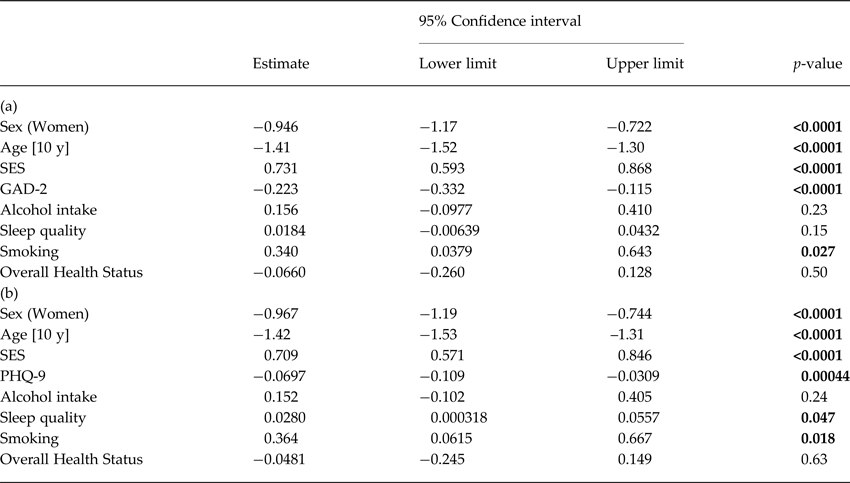
Additional analyses were carried out to control for alcohol intake, sleep quality, smoking and overall health status. None of these confounders significantly impacted upon the association between planning performance and anxiety and planning performance and depression (see Table 3 a and b).
Results of linear regression analyses with planning performance as dependent variable and potential additional confounders with anxiety (a) and (b) depression

p-values considered significant are highlighted in bold.
In summary, anxiety was negatively associated with ToL performance. This relation did, however, not change with age.
Cognition, anxiety and depression
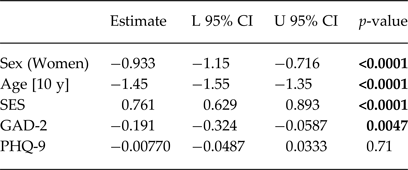
The third question of this study addressed whether anxiety, despite its high comorbidity with depression, has a predictive value for planning ability that goes beyond the association of depression and planning. Consequently, we added both to a combined regression model. Again, sex, age and SES showed significant associations as in the previous analyses (Table 4). Anxiety significantly predicted lower planning performance (β = −0.19; p = 0.0047) in contrast to depression, which had no effect (β = −0.01; p = 0.71). Thus, anxiety appeared to predict planning performance even when analyzed in the same model as depression, at least in a non-clinical sample. In contrast, the low but significant β-value of depression in the above-mentioned single model was not significant in the combined model.
Results of linear regression analysis with sex, age, socioeconomic status (SES), anxiety (GAD-2) and depression (PHQ-9) as predictors and planning performance as dependent variable

p-values considered significant are highlighted in bold. Effects of age are provided in 10-year units [10 y].
Discussion
We found a negative association between subclinical levels of anxiety and complex EFs using planning tasks in a large non-clinical sample, but we did not find an increase of this association with older age. This might imply that participants with relatively poorer planning performance could be more prone to higher anxiety levels, e.g. due to their lower ability to flexibly re-plan their actions in face of unforeseen events. Alternatively, although we cannot draw causal inferences due to the cross-sectional association study design, our findings are in line with the assumptions of the attentional control theory. Eysenck et al. (Reference Eysenck, Derakshan, Santos and Calvo2007) have suggested that the main effects of worry (and, more generally, of anxiety) affect a key function of the central executive, namely attentional control. They conclude that anxious individuals preferentially allocate attentional resources to threat-related stimuli whether internal (e.g. worrisome thoughts) or external (e.g. threatening task-irrelevant distractors). Though we did not assess whether our participants in their test situation allocated their attentional resources internally or externally, worriedness and nervousness as reported by our population-based sample were sufficient to significantly interfere with cognitively demanding tasks.
Our second question, whether the negative association of anxiety and cognition is enhanced with age, was answered negatively. Evidence for this assumption primarily came from clinical studies reporting reductions in cognitive functions in elderly participants with GAD (Beaudreau et al. Reference Beaudreau, MacKay-Brandt and Reynolds2013; Andreescu & Varon, Reference Andreescu and Varon2015; Zhang et al. Reference Zhang, Norton, Carrière, Ritchie, Chaudieu and Ancelin2015). We studied a population-based community-dwelling sample. Bivariate correlation analyses between age and anxiety revealed that participants reported lower anxiety values with increasing age. A similar pattern was also reported by Byers et al. (Reference Byers, Yaffe, Covinsky, Friedman and Bruce2010) who showed that the prevalence of mood and anxiety disorders decreased with age. Deptula et al. (Reference Deptula, Singh and Pomara1993) found significant negative correlations between performance on verbal recall measures and ratings of anxiety in the elderly group, but not in the young age group. On the one hand, the younger group had significantly lower intelligence scores on the vocabulary subtest than the older group. On the other hand, ratings of anxiety were made by individuals by marking a point on a line that corresponded best to their affective state, ranging from 1(relaxed) to 100 (tense). This measurement, thus, put more emphasis on stress perception compared with the assessment of anxiety in our study, which primarily asked for persistent worry and nervousness. Both reasons might explain the discrepancy to our findings. Finally, Wetherell et al. (Reference Wetherell, Reynolds, Gatz and Pedersen2002) reported in cognitively intact individuals that higher levels of neuroticism (trait anxiety) are not generally associated with longitudinal cognitive decline in normal aging. Thus, although there is a significant impact of anxiety on cognition, this association does not necessarily interact with age in healthy participants.
The third question, whether anxiety, despite high comorbidity with depression, would significantly contribute to predicting planning performance even when analyzed in a combined model, was clearly answered positively. We have expected an association between cognition and depression since several systematic reviews have demonstrated cognitive deficits in patients suffering from depression. A meta-analysis based on 16 studies (Rock et al. Reference Rock, Roiser, Riedel and Blackwell2014) demonstrated significantly impaired planning performance in both currently and remitted depressed patients. Moreover, there is preliminary evidence that dysphoria in non-clinical samples is associated with executive dysfunction and differences in associated brain activity (Snyder, Reference Snyder2013). In fact, our results, too, revealed a modest association of depression with planning, which is consistent with the literature. Nevertheless, when taking into account the impact of anxiety, the association between depression and cognition vanished. Recently, Williams et al. (Reference Williams, Kueider, Dmitrieva, Manly, Pieper, Verney and Gibbons2016) investigated the influence of self-reported symptoms of anxiety and depression on memory performance. Supporting our results, they found a higher association between anxiety and memory performance than between depression and memory performance. They therefore recommended routine assessments of anxiety symptoms when cognitive testing is conducted. Based on our findings, we strongly emphasize their recommendation to include anxiety assessment when cognitive functions are tested in non-clinical samples.
Limitations
First, our participants provided self-report of their distress. Subjective evaluation may have distorted our results, e.g. by underestimating true values compared with a clinical interview. The second drawback is the cross-sectional association study design: It would be desirable to replicate the psychometric testing in the upcoming next wave of examinations to better control for cohort effects and to be able to analyze changes in affective state and their relation to changes in cognitive performance. As another consequence of the association study design, participants most likely also differed in variables that were not included in this analysis. It therefore remains possible that the observed associations are due to one or many unobserved variables that causally influence both affective state and cognitive performance.
Conclusions and perspectives
Our results demonstrate that associations observed in clinical groups might differ from those in population-based samples, including a different trajectory across the life span. As we found an association between anxiety and cognition, one of the next research questions to be addressed refers to exploring the causal mechanisms behind this association. This could be approached with experimental designs in which participants are exposed to threatening stimuli/situations and when the allocation of attentional resources (internal v. external) is explicitly tested. In case, anxiety being the causal factor for cognitive impairment, a next step to consider would be behavioral (e.g. relaxation techniques) or pharmacological interventions that aimed at reducing these negative affective states in order to improve executive functioning. These approaches could be informed by studies on the biological, e.g. genetic or neural network mechanisms driving cognitive function in the context of different anxiety phenotypes (e.g. Neufang et al. Reference Neufang, Geiger, Homola, Mahr, Akhrif, Nowak, Reif, Romanos, Solymosi, Deckert and Domschke2015; Geiger et al. Reference Geiger, Domschke, Homola, Schulz, Nowak, Akhrif, Pauli, Romanos, Deckert and Neufang2016a , Reference Geiger, Domschke, Ipser, Hattingh, Baldwin, Lochner and Stein b ). Given converging evidence for anxiety predisposing to an earlier cognitive decline (e.g. Potvin et al. Reference Potvin, Forget, Grenier, Préville and Hudon2011) and a higher conversion of mild cognitive impairment (MCI) to dementia (Mah et al. Reference Mah, Binns and Steffens2015), potentially via a structural degeneration and impaired functioning of the hippocampus and the prefrontal cortex (Mah et al. Reference Mah, Szabuniewicz and Fiocco2016), screening for and treatment of anxiety could serve as a preventive measure regarding subsequent cognitive decline and could prove to be beneficial as an adjunct in early therapeutic interventions regarding MCI.
Acknowledgements
The Gutenberg Health Study (GHS) is funded through the government of Rhineland-Palatinate (‘Stiftung Rheinland-Pfalz für Innovation’, contract AZ 961-386261/733), the research programs ‘Wissen schafft Zukunft’ and ‘Center for Translational Vascular Biology (CTVB)’ of the Johannes Gutenberg-University of Mainz, and its contract with Boehringer Ingelheim and PHILIPS Medical Systems, including an unrestricted grant for the GHS. Philipp S. Wild is funded by the Federal Ministry of Education and Research (BMBF 01EO1503) and he is PI of the German Center for Cardiovascular Research (DZHK). This study was also supported by the intramural grant ‘MAIFOR’ of the University Medical Center of the Johannes Gutenberg University Mainz. We thank all study participants for their willingness to provide data for this research project and we are indebted to all coworkers for their enthusiastic commitment.