

1. Introduction
In insurance markets, ex post moral hazard arises when the cost of a loss is affected by the behaviour that occurs after the insured event has occurred (Zweifel & Breyer, Reference Zweifel and Breyer1997). In the case of automobile insurance, when neither the policyholder nor the smash repairer bears the cost of a road traffic crash (RTC) repair, one or both parties may face incentives to inflate the loss size. Consumers, for instance, may face incentives to bring repairs that are not due to the event covered by the policy, into the scope of repairs. Producers, whose profits may be increasing in the size of the loss, may also be subject to a form of moral hazard: inflating the scope of the necessary repairs, or increasing the prices charged for “insurance jobs”. The parties also no doubt may also face disincentives – including the possibility of legal and financial sanctions – for engaging in such conduct.
In this paper, we propose a series of empirical tests for ex post moral hazard on the Australian auto (property) insurance market. To do this, we use a unique survey of 994 auto crashes that was conducted in Australia. The information that was collected includes not only expenditures on crash repairs, but detailed information about the nature and scope of the repairs that were performed, vehicle and respondent characteristics, and indicators of the latent crash severity. The data collected provide us with a way to measure not just reported repair expenditures, but to create quantitative measures of the scope of repairs. It is this property of the data set that enables us to differentiate between alternative drivers of ex post moral hazard. Our concluding test for ex post moral hazard regresses controls for automobile characteristics, parts replaced, RTC severity, income, gender and a binary measure of insurance status, on the log of repair costs, to derive a compensated price elasticity for comprehensive automobile insurance. Our empirical estimates suggest that ceteris paribus ex post moral hazard added approximately 46.8% to the cost of vehicle repairs during the study period.
The structure of the paper is as follows. In the next section, we present a critical overview of the literature on ex post moral hazard, focusing on conceptual disagreements and a debate about the term. These conceptual differences – especially as between the health insurance and other parts of the insurance literature – are not only persistent sources of intellectual disagreement and debate, they also have implications for measurement. Our purpose of setting out the key tenets of the debate is to clarify the nature of these different conceptions and to make clear how we operationalise the term both conceptually and empirically. While the purpose, in terms of presenting our own empirical results, is “functional”, this literature review arguably makes a contribution more generally, because aspects of this debate – about a central concept in insurance economics – appear not to have been synthesized elsewhere in the literature to date.
Following our synthesis of the literature and our operationalisation of the concept of ex post moral hazard, we set out our empirical model based on our conception of the problem in the context of auto property insurance. In this section, too, we clarify a further conceptual point that is relevant to our empirical approach: we use data on crashes, not on insurance claims, to test for the presence of moral hazard using survey data. Additionally, we explain how we propose to use both the scope of repairs (defined in quantitative terms, by the number of repair items per vehicle) and the value of smash repairs as potential tests for the presence of moral hazard in our data set. The next section of the paper provides a detailed description of the data, followed by the Results section, in which we also test the sensitivity of our results to the assumption of a zero income effect, using the Slutsky equation to produce estimates of the adjusted elasticity and comparing it to the unadjusted elasticity derived from our econometric results. The final section presents the discussion.
2. Literature
Different definitions of, and methods used to estimate moral hazard empirically, can be found throughout the insurance literature. The broader insurance literature has commonly defined ex ante and ex post moral hazard, as the effect that insurance can have on policyholder behaviour before and after the insured event, respectively. For example, in the health insurance literature ex ante moral hazard is defined as the effect that insurance may have on the probability of an individual falling ill and ex post moral hazard the effect that insurance can have on the cost of medical treatment should an individual fall ill. In the case of ex ante moral hazard the individual acts in a sense prior to “nature” and in the case of ex post the individual acts after nature (Zweifel & Breyer, Reference Zweifel and Breyer1997). Analogously, in the auto insurance literature, ex ante moral hazard may be conceived as involving a change in driver “effort” that increases the likelihood of a crash (Dionne et al., Reference Dionne, Michaud and Dahchour2013; Rowell et al., Reference Rowell, Nghiem and Connelly2017; Weisburd, Reference Weisburd2015) and ex post moral hazard as involving changes to behaviour – such as reduced price-sensitivity leading consumers to engage in lower search costs to find competitive repair quotes – following a crash.
Within the automobile insurance literature, however, the term ex post moral hazard has usually been used in two different ways. Firstly, the term ex post moral hazard has often been used to describe fraud (Dionne, Reference Dionne2013; Picard, Reference Picard2013) and empirical analysis has focused on identifying evidence of fraudulent claims (Artís et al., Reference Artís, Ayuso and Guillén1999, Belhadji et al., Reference Belhadji, Dionne and Tarkhani2000; Reference Artís, Ayuso and Guillen2002; Caron & Dionne, Reference Caron and Dionne1999; Subelj et al., Reference Subelj, Furlan and Bajec2011; Tracy & Fox, Reference Tracy and Fox1989). Typically, these studies analyse closed claims, to estimate the prevalence of fraud and/or develop algorithms to identify fraudulent claimants. This can be challenging (Caron & Dionne, Reference Caron and Dionne1999) and while some researchers have relied on the subjective assessment of the claims assessor (Belhadji et al., Reference Belhadji, Dionne and Tarkhani2000) others have sought to identify potentially fraudulent behaviours in policyholders or smash repairers through structured interviews conducted by the insurers or academic researchers (Artís et al., Reference Artís, Ayuso and Guillén1999, Reference Artís, Ayuso and Guillen2002; Macedo et al., Reference Macedo, Cardoso, Neto and da Costa Bras Cunha2020). These approaches may fail to detect some fraudulent claims or policyholder behaviour that does not reach a legal threshold of fraud.
Secondly, many studies that have tested for evidence of ex ante moral hazard in automobile insurance (Chiappori & Salanié, Reference Chiappori and Salanié2000; Abbring et al., Reference Abbring, Chiappori and Pinquet2003; Israel, Reference Israel2004) have analyzed claims data as opposed to road traffic crashes (RTC) data. The policyholder’s ex post decision to lodge a claim following an RTC can generate a bias because high deductibles can discourage small claims thus confounding tests for ex ante moral hazard (Chiappori, Reference Chiappori2000). The effect that the structure of the insurance policy can have on filing a claim has also been described as an ex post moral hazard (Cummins & Tennyson, Reference Cummins and Tennyson1996; Puelz & Snow, Reference Puelz and Snow1997; Abbring et al., Reference Abbring, Chiappori and Zavadil2007; Robinson & Zheng, Reference Robinson and Zheng2010).
Within the health insurance literature, where the term ex post moral hazard has been defined as the effect insurance has on medical treatment expenditure (Zweifel & Breyer, Reference Zweifel and Breyer1997; Einav & Finkelstein, Reference Einav and Finkelstein2018), some methodological disagreement on how to best estimate this effect persists. While Pauly (Reference Pauly1968) defined ex post moral hazard as a rational response to price, Dionne has argued that
[t]he main difficulty in isolating the ex post moral hazard effect in different levels of insurance coverage is separating the effects of price and income variations from the effects of asymmetric information. Contrary to what is often stated in the literature (especially that of health insurance), not every variation in consumption following a variation in insurance coverage can be tied to ex post moral hazard (Dionne, Reference Dionne2013, p. 431).
In response to Arrow’s (Reference Arrow1963) claim that [ex post ] moral hazard was a sufficient condition for the public provision of health insurance, Pauly (Reference Pauly1968) presented a simple numerical example, which assumed that lump-sum payments from the insurer had no significant income effects, to demonstrate that ex post moral hazard could result in welfare losses for some people when public medical insurance was provided. Nyman (Reference Nyman1999) argued that Pauly (Reference Pauly1968) erroneously assumed the income effect to be zero. Using an income elasticity of −0.18 obtained from the RAND Health Insurance Experiment (Manning & Marquis, Reference Manning and Marquis1996; Nyman (Reference Nyman1999) argued that Pauly (Reference Pauly1968) overstated the pure price effect of health insurance by 20%.
This paper aims to evaluate the effect that automobile insurance has on the cost of RTC repairs. These empirical tests will embody the notion that ex post moral hazard is some combination of (a) a rational response to price in the sense of Pauly (Reference Pauly1968) and (b) opportunistic fraud committed by policyholders, RTC repairers, or both, as analysed elsewhere in the automobile insurance literature (see, e.g. Reference DionneDionne, 2013; Picard, Reference Picard2013). The analyses will differentiate the effect that insurance has on the scope and value of smash repairs. The assumption of no significant income effects will be tested as proposed by Nyman (Reference Nyman1999). Empirical tests for ex post moral hazard are presented using econometric estimates to report the responsiveness of repair expenditures as elasticities with respect to holding comprehensive auto property insurance.
3. Empirical Model
Figure 1 provides a simplified representation of the relationship between insurance, RTCs and repairs. From the left, the first node represents the vehicle owner’s decision whether to purchase auto insurance and the second node represents the chance that they experience an RTC. Uninsured RTC repairs must be paid for out-of-pocket. If insured the policyholder must decide whether to lodge a claim. To preserve the no-claim bonus only major RTCs will result in a claim and if accepted will be paid by the insurer, per the terms of the policy. Both ex ante and ex post moral hazard could contribute to a statistical correlation between insurance and the expected cost of RTC repairs. At the first chance node ex ante moral hazard could increase the probability of a RTC, such that ceteris paribus insured motorists have a higher probability of a RTC. At the second chance node ex post moral hazard could increase the overall cost of repairs for insured motorists who have had their claim accepted, through higher prices, more extensive repairs, or both. Therefore, to isolate the effect of ex post moral hazard from ex ante moral hazard we restrict our analysis to RTCs, as follows.
Automobile crash repair decision tree.

In Australia, it is possible to purchase automobile insurance for (i) fire and theft and (ii) fire, theft and third party property damage or (iii) comprehensive automobile insurance. Only comprehensive insurance indemnifies the policyholder for the cost of repairs to their own vehicle in the advent of a RTC. Therefore in equation 1, the explanatory variable of interest is a dichotomous measure of insurance (Ins), (=1 if comprehensively insured and zero if otherwise). The dependent variable is specified as the log of the total market value of RTC repairs (henceforth “cost” (lnC), for brevity). Specifying the dependent variable in logarithms enables the parameter estimate on Ins to be interpreted, conveniently, as an insurance-repair elasticity. In our data, we identified two sets of covariates that may affect the cost of vehicle repairs, post RTC. The first set of covariates (V) includes vehicle characteristics, which are chosen as indicators of the costs of repair for a given level of RTC severity. For example, the cost of repair is likely to be positively correlated with vehicle value as well as a range of other characteristics such as vehicle make, vehicle age, engine size, body type and location. The second set of covariates (S) are chosen as indicators of the latent severity of the RTC (i.e. dichotomous indicators of the attendance of an ambulance, tow-truck, police or vehicle towed away): the greater the damage to the vehicle, the greater are the expected costs of repair. In addition, the specification includes controls for annual income (Y) and a dummy variable (M) equal to one if the respondent is male.
In equation (1), we hypothesize that ex post moral hazard would, ceteris paribus, result in a positive correlation between insurance (Ins) and cost of RTC repairs (lnC), controlling for V, S, Y and M. The underlying assumption for our test is that ex post moral hazard affects behaviour after the advent of an RTC.
 \begin{align} lnC = f(Ins,{\textbf{V}},{\textbf{S}},Y,M)|{\textrm{RTC}} = {\textrm{1}} \end{align}
3.1. Scope of smash repairs
Australian insurers typically underwrite the repair of the vehicle rather pay a monetary transfer to the policyholder.Footnote 1 Following an RTC, the policyholder will, in consultation with the smash repairer, determine the scope of RTC repairs be undertaken. When the presmash condition of the automobile is unknown to the insurer, both the policyholder and the smash repairer have an incentive to engage in a degree of “soft-fraud”. Consumers who are assumed to maximize the value of their vehicle post repair, have an incentive to include vehicle parts which were damaged or worn pre-smash in the quote for repair. The smash repairers also have, ceteris paribus, an incentive to accept additional repairs wherever the expected profits obtained from additional repairs are greater than zero. Equation (2) proposes a test of the scope of ex post moral hazard. The dependent variable P is a nonmonetary measure of the scope of repairs undertaken. As positive relationship between Ins and P would be accepted as evidence of insurance increasing the scope of repairs.
 \begin{align} {\textrm{P}} = {\textrm{f}}({\textrm{Ins}},{\textbf{V}},{\textbf{S}},{\textrm{Y}},{\textrm{M}})|{\textrm{RTC}} = {\textrm{1}} \end{align}
3.2. Value of smash repairs
Following an RTC, ex post moral hazard could also result in an increase the value of RTC repairs, if smash repairers are able to increase the repair expenditures on a vehicle they know to be insured. (In fact, this information is routinely sought and disclosed on the Australian auto repair market when a quote for repairs is requested.) Furthermore, if asymmetry of information exists between the repairer and the insurer, repairers may face incentives to increase the costs of repairs to insured vehicles. Insurers may attempt to counter this incentive by imposing penalties (e.g. revocation of approval to repair vehicles) on repairers who are dishonest. Whether this form of moral hazard is present or of any importance are thus empirical matters. To capture the capacity to inflate the cost of repairs, net of any increase in the scope of repairs undertaken (which would also increase cost), where P a control for the number of parts used to repair the vehicle is substituted into equation (1), to give equation (3) as follows. A positive correlation between Ins and lnC, conditional upon the control set will be accepted as prima facie evidence of ex post moral hazard affecting the value of RTC repairs.
 \begin{align} {\textrm{lnC}} = {\textrm{f}}({\textrm{Ins}},{\textbf{V}},{\textbf{S}},{\textrm{Y}},{\textrm{M}},{\textrm{P}})|{\textrm{RTC}} = {\textrm{1}} \end{align}
4. Data
EKAS Marketing Research Services was commissioned by IMRAS Consulting to conduct a survey of community attitudes to the Australian smash repair market over a six-week period from late October to early December in 1999. They contacted 23,610 rural and metropolitan households in four Australian States (NSW, Victoria, Queensland and WA), of which 4,005 (17%) completed the survey. Apart from the basic quotas on each capital city or regional area, selection of households was random, based upon random number generation from White Pages telephone directories. Selection of the household respondent was anyone responsible for the maintenance and servicing of at least one car and if more than one person met this inclusion criterion the individual with the closest birth date to the date of interview, was selected. If this person was responsible for more than one car, then the vehicle with the registration next due was selected (IMRAS, 2000).
The respondent was then asked a series of questions about their current insurance behaviour which was assumed to reflect the past 12 months (i.e. 1999). Due to the low incidence of RTCs the respondents were asked to recall particulars about any RTC and associated repairs that may have occurred over the last 24 months (i.e. 1998 & 1999). The accuracy of data collection was dependent on respondent recall and there was no requirement that responses be verified with written documentation (IMRAS, 2000).
The resulting data, henceforth referred to as the IMRAS data set, provide a fairly representative sample of the costs of an Australian RTC repair, as detailed below. The IMRAS survey contains data on a range of variables that can be used to estimate ex post moral hazard in the Australian auto property insurance market. First, respondents were asked if they had been involved in at least one auto crash in the preceding two years: 994 (24.8%) respondents indicated that they had. This sub-set of respondents was then asked detailed questions about the nature, extent and costs of repairs. Second, participants were asked if their vehicle was comprehensively insured against the cost of smash repairs in an RTC, of which, 790 (79.5%) of the respondents who had an RTC indicated yes. The IMRAS survey also collected data on vehicle characteristics (e.g. make, vehicle value) and crash characteristics (e.g. repairs undertaken and attendance of RTC services).
While the response rate to the IMRAS household survey was only 17%, this is considered as high for market research (Bednall & Shaw, Reference Bednall and Shaw2002). The data included in Table A1 in the appendix indicate that there is a strong concordance between summary statistics obtained from the IMRAS survey and national means reported in the literature. For example, the IMRAS household survey reports that the annual probability of the respondent being involved in an RTC is 0.124 and the probability of lodging a claim for an RTC is 0.08. Statistics Australia however, reports that the annual probability of lodging a claim for an RTC is 0.129 (see Table A1). Similarly, the cost per claim following an RTC was estimated to be $2,796, which is also slightly less than the $3,173 reported by the (Bureau of Transport Economics, 2000). Likewise, the proportion of the sample that reported to be comprehensively insured was 0.795, which is also slightly less than an estimate of 0.885 reported by Bureau of Transport Economics (2000).
There does appear to be some moderate under reporting of insurance and RTC data (incidence and severity) but the reporting of demographic data and vehicle characterises appears to be consistent with published means. For example, 49% of the respondents were male, which corresponds closely with the national mean of 49.6% (Australian Bureau of Statistics, 2004). Similarly, a reported respondent age of 45.4 years is comparable with a published mean age of 47.2 years for licensed drivers in NSW (RTA Road User Research, 2002). Likewise, the characteristics of the sampled vehicles closely correspond to the Australian fleet. A mean vehicle age of 8.8 years is comparable with 10.5 years reported by the Productivity Commission (2005) and the proportions of the five classifications of vehicle makes (Ford, GM Holden, Toyota, Mitsubishi, Made in Asia and Made in Europe) are almost identical with the proportions of vehicle makes registered in the state of NSW (RTA Road User Research, 2002). Thus, the data collected by the IMRAS survey are broadly consistent with published means for the Australian smash repair market (see Table A.2 in the appendix).
In our sample the average value and age of the repaired vehicle was $12,760 and 8.4 years, respectively. The distribution of RTC repair costs ($ and log$) are reported in Figure 2. The repair category “written off” was not reported. The mean cost of repairs following an RTC was $1,884. The most popular automobiles were the four domestic makes, Toyota (225), General Motors Holden (169), Ford (168) and Mitsubishi (106). RTC severity was reflected by the presence of police, tow-truck or ambulance, which attended 42% of all RTCs. An average of 2.6 parts were repaired or replaced per RTC. Bumpers (front and rear) were the automobile component most frequently repaired. See Appendix A.2 for summary statistics drawn from our data.
Road traffic crash repairs.

5. Results
5.1. Ex post moral hazard
To test for ex post moral hazard, a semi-log regression was estimated as equation (4) a follows:
 \begin{align} lnC = {\alpha _0} + {\alpha _1}Ins + {\alpha _{\textrm{2}}}{\textbf{V}} + {\alpha _{\textrm{3}}}{\textbf{S}} + {\alpha _{\textrm{4}}}Y + {\alpha _{\textrm{5}}}M + \varepsilon_{\textrm{i}} |{\textrm{RTC}} = {\textrm{1}} \end{align}
Repair costs in levels were skewed (see Figure 2(a)). A Shapiro and Wilk (Reference Shapiro and Wilk1965) test confirmed that the residuals from this specification were not normally distributed [W = 0.66, (p < 0.01)], supporting our decision to select log costs (lnC) as the dependent variable. The explanatory variable of interested was a dichotomous measure of insurance (Ins), equal to one if the vehicle was insured. The vector V included the variables to capture the underlying cost of repair (vehicle-make, engine-size, body-type, location, vehicle age and vehicle value). The vector S included four dichotomous variables for RTC service attendance (ambulance, tow-truck, police and towed away), as a proxy for RTC severity. Controls for income (Y), which was reported as seven income categories including “refused” and a dummy variable equal to one if male (M) are also included. The null hypothesis, insurance has no effect on the cost of repairs was rejected if the p value is less than 0.05.
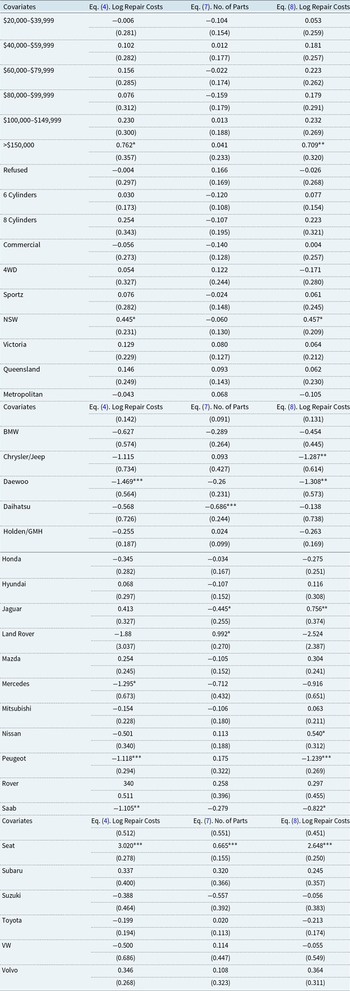
In Table 1, coefficients are reported with robust standard errors in parentheses. F-tests, calculated with uncorrected standard errors, for the joint level of significance are reported for the vehicle make, engine size, body type, location and income. A complete set of coefficients for these covariates are reported in Table A.3 in the appendix. In equation (4), the coefficient for Ins (0.384, p = 0.02) was statistically significant. The marginal effect was estimated to be 0.468 following Halvorsen and Palmquist (Reference Halvorsen and Palmquist1980)Footnote 2 , which implies insurance resulted in a 46.8% increase in the cost of repairs. Covariates, which were statistically significant predictors of the cost of RTC repairs, included the attendance of an ambulance (0.55*), tow truck (0.54* * *) and 23 binary controls for vehicle make (F(22,472) = 11.40; p < 0.01). Income was not a statistically significant predictor of cost in equation (4), however the potential of correlations with vehicle make and vehicle value to confound these results were considered. However, re-specifications of equation (4) without income and without vehicle make and value, continued to generate statistically significant coefficients for insurance of (0.28, p = 0.06) and (0.44, p < 0.01), respectively, although the size of the effect changed.
5.2. Income effect
Assuming zero income effects can overstate the pure price effect of insurance (Nyman, Reference Nyman1999). We test our assumption of zero income effect in equation (4) by substituting an estimate of income elasticity derived from the IMRAS survey data into the Slutsky (Reference Slutsky1915) equation, as follows:
 \begin{align} \zeta = \eta + \alpha \end{align}
Empirical results tests for ex post moral hazard

Notes: Coefficients are reported with robust standard errors in parenthesis. An F-test for joint level of significance, calculated with uncorrected standard errors is reported for vehicle make (BMW, Chrysler-Jeep, Daewoo, Daihatsu, Holden GMH, Honda, Hyundai, Jaguar, Kia, Land Rover, Mazda, Mercedes, Mitsubishi, Nissan, Peugeot, Rover, Saab, Seat, Subaru, Suzuki, Toyota, V.W. & Volvo, Ford omitted), engine size (6-cylinder & 8-cylinder; 4-cylinder omitted), body-type (Commercial, 4WD & Sports; Sedan omitted), location (New South Wales, Queensland & Victoria; Western Australia omitted and Metropolitan; Rural omitted) and income ((i) $20,000–$39,999, (ii) $40,000–$59,999, (iii) $60,000–$79,999, (iv) $80,000–$99,999, (v) $100,000–$149,999, (vi) >$150,000, (vii) “Refused”
 $$\& \; < \$ 20,000$$
omitted). Post-estimation statistics including the Condition index, Akaike Information Criterion (AIC) and Bayesian Information Criterion (BIC) are reported for all models. Levels of statistical significance are *
*
*
p < 0.01, *
*
p < 0.05, p < 0.1.
†The number of observations in equation (7) is higher than equations (4) and (8) because 203 (18.6%) respondents reported damaged parts but zero or a missing cost of repairs. ‡For equation (7) a pseudo R2 is reported.
The dependent variable ζ is the Hicksian (compensated) price elasticity of demand, η is the Marshallian (uncompensated) price elasticity of demand,
 $\lambda$
is the income elasticity of demand and α is the share of household income spent on RTC repairs. An estimate of the uncompensated price elasticity η is obtained from the coefficient for Ins in equation (4). In a log-level regression, the estimated coefficient for a binary variable is an elasticity (Wooldridge, Reference Wooldridge2000). An increase in insurance status from zero to one (i.e. a decrease in effective price to the policyholder) results in a 46.8% increase in the quantity ($) of repairs purchased. Hence our estimate of the uncompensated price elasticity η is equal to
 $-0.468\ ({\rm i.e.,}\ \Delta{Q}/\Delta{P}\,=\,0.468/\!-\!1)$
.
To obtain an estimate of income elasticity (Ε) the mid-points of seven income categories were used to construct “linear” measure of income. Log of income (lny) was then used as an explanatory variable in equation (6) as follows.
 \begin{align} lnC = {\alpha _0} + {\alpha _1}Ins + {\alpha _2}{\textbf{V}} + {\alpha _{\textrm{3}}}{\textbf{S}} + {\alpha _{\textrm{4}}}lny + {\alpha _{\textrm{5}}}M + \varepsilon_{\textrm{i}} |{\textrm{RTC}} = {\textrm{1}} \end{align}
A coefficient of 0.16 (p = 0.12), for lny implies that a 1% increase in household income was associated with a 0.16% increase in the cost of an RTC repairs, albeit with a p value that lies beyond the 10% level of statistical significance. In our data, the proportion of income spent on RTC repairs α is approximated by dividing average premium ($445) by average household income ($59,333). Substituting into equation (5) we obtain an estimate of Ξ equal to −0.467,Footnote 3 demonstrating that in the Australian market for RTC insurance the income effect associated with a claim is very small (0.001) or zero.Footnote 4 The coefficient α4 in equation (6) could underestimate the income effect if income is correlated with elements of V (e.g. vehicle type or vehicle value). A sensitivity analysis that re-estimated equation (6) without the covariates vehicle type and value reports a 25% increase in the coefficient for lny (α4 = 0.2, p = 0.03). Given that RTC repairs are a small proportion of household income, the income effect does not affect the integrity of the empirical analysis that follows.
5.3. Scope of crash repairs
In specifying equation (2), we hypothesised that ex post moral hazard could result, inter alia, in an increase in the scope of repairs. The IMRAS survey provided rich detail on the quantity repairs undertaken for each RTC. These included documentation of major parts (e.g. left side front panel/mudguard) and minor parts (e.g. aerial). Equation (7) tests the effect that Ins has on the quantity of repairs, using Poisson regression.
 \begin{align} P = {\alpha _0} + {\alpha _1}Ins + {\alpha _2}{\textbf{V}} + {\alpha _{\textrm{3}}}{\textbf{S}} + {\alpha _{\textrm{4}}}Y + {\alpha _{\textrm{5}}}M + \varepsilon_{\textrm{i}} |{\textrm{RTC}} = {\textrm{1}} \end{align}
The dependent variable P is a count of the number of parts repaired, where each part, damaged or replaced for the RTC repair, was weighted equally. In equation (7) the coefficient for Ins was 0.17 (p = 0.03).Footnote 5 The marginal effects indicated that insurance was associated with an increase from 1.98 to 2.36 parts per RTC repair.
5.4. Value of crash repairs
Equation (8) estimates the effect that ex post moral hazard on the value of RTC repairs after controlling for the number of vehicle parts (P) repaired. The coefficient for P was statistically significant 0.25 (p < 0.01), indicating that parts replaced had an independent effect on the value of the repairs. The coefficient on Ins was 0.321 ( p = 0.04) and the marginal effect of insurance was estimated to increase the cost of repairs by 37.9 per centFootnote 6 The coefficients for insurance reported in equations (4) and (8) were found to be different at the 99% level of statistical significance using a likelihood-ratio test [(χ2(1) = 82.69) (p < 0.01)], suggesting that the increase in parts replaced accounted for approximately 19 per cent (i.e. (46.8−37.9/46.8) ∗100) of the total increase in the value of repairs.
 \begin{align} lnC = {\alpha _0} + {\alpha _{\textrm{1}}}Ins + {\alpha _{\textrm{2}}}{\textbf{V}} + {\alpha _{\textrm{3}}}{\textbf{S}} + {\alpha _{\textrm{4}}}Y + {\alpha _{\textrm{5}}}M + {\alpha _{\textrm{5}}}P + \varepsilon_{\textrm{i}} |{\textrm{RTC}} = {\textrm{1}} \end{align}
5.5. Sensitivity analyses
The IMRAS survey reported that 18.6% of repairs had parts replaced for zero cost, which is a potential source of bias. To address this concern a dummy variable Nilcost equal to one if parts were reportedly replaced for nil cost and zero if otherwise was added to equations (4), (7) and (8). The dependent variables in equations (4) and (8) were transformed back to $ instead of log$ to prevent the omission of Nilcost from the results. The coefficients for insurance in equations (4) and (8) report the effect of ex post moral hazard denominated in 1999 Australian dollars. Equation (7) was a Poisson regression, as specified above. The sensitivity analysis reported in Table 2 shows that the coefficients for Nilcost in equations (4) and (8) were negative (respondents who reported zero costs for a positive number of parts repaired had lower repairs RTC) and the coefficients for Insured were marginally smaller. No differences were reported in equation (7). Hence, the results reported in Table 2 did not change substantially due to this potential source of non-reporting bias.
Regression coefficients for “Insured” with and without a control for nil cost parts replaced.

Notes: Coefficients for Insured and Nilcost are reported with robust standard errors in parenthesis. All other coefficients were estimated but not reported. Levels of statistical significance are * * * p < 0.01, * * p < 0.05, * p < 0.1.
6. Discussion
This paper estimates the ex post moral hazard effect of insurance in the Australian market for RTC repairs and subsequently attempts to differentiate the effects that ex post moral hazard has on the scope of repairs and the value of repairs. The principal test for ex post moral hazard was equation (4), in which the dependent variable was specified in logarithms, enabling the coefficient on the binary variable Ins to be interpreted as an repair expenditures elasticity with respect to holding comprehensive insurance. The analysis controlled for a range of vehicle characteristics observable to insurers (car make, vehicle value, vehicle age, engine-size, body-type, location) income, gender, as well as a set of proxies for RTC severity (attendance of an ambulance, tow-truck, police or vehicle towed away) not usually observed by insurers. After exponentiation, the coefficient for the binary variable Ins (0.38) in equation (4), ex post moral hazard was found to be associated with a 46.8% increase in the cost of repairs. The separation of price and income effects has been identified in the literature as a relevant consideration when testing for ex post moral hazard (Dionne, Reference Dionne2013) and failure to do so could result in an over estimation of ex post moral hazard (Nyman, Reference Nyman1999). Our analysis indicates that the income effect was small and does not materially affect the interpretation of our results.
The empirical analysis presented in equation (8) then differentiates the effect that ex post moral hazard had on the value of RTC repairs identified in equation (4) from the scope of RTC repairs identified in equation (7). When a count of parts repaired was specified as the dependent variable, the coefficient for insurance was statistically significant (Ins = 0.17; p = 0.03). The marginal effects indicated that insurance increased the scope of RTC repairs from 1.98 to 2.36 parts per RTC repair. Furthermore, when a count of parts repaired was included as an explanatory variable in equation (8) it was found to have a statistically significant effect on the value of repairs (p = 0.25; p < 0.01), but insurance now had smaller effect on the value of repairs compared to equation (4) (i.e. after exponentiation a 37.9% increase in equation (8) versus a 46.8% increase in equation (4)). This suggests that increased parts replaced accounted for approximately a 19% (i.e. (46.8−37.9/46.8) ∗100) of the increase in the value of repairs attributable to ex post moral hazard.
Taken at face value, the residual 81% increase in the value of repairs (100% – 19%) could be explained in two ways. First, while insurers may be able to observe and exert some influence over the number of parts used in insured repairs, they are less able to affect the margins on other cost inputs such as labour. Therefore, smash repairers may increase the price of insured repairs. Second, the observed cost differences might be due to differences in the quality of the RTC repair. Insured repairs might use more costly inputs (e.g. genuine automobile parts, higher quality paints or a higher number of paint coats). The IMRAS data set did not provide a measure of the quality of RTC repairs, and therefore, our analysis is unable to differentiate between these two explanations.
Several comments about our methods can be made. First while the automobile insurance literature has frequently used the term ex post moral hazard to describe fraudulent claiming and fraud (Artís et al., Reference Artís, Ayuso and Guillén1999; Caron & Dionne, Reference Caron and Dionne1999; Belhadji et al., Reference Belhadji, Dionne and Tarkhani2000; Reference Artís, Ayuso and Guillen2002; Subelj et al., Reference Subelj, Furlan and Bajec2011), in this paper, the term ex post moral hazard has been broadened to include the effect that insurance has on the cost of repairs. This approach accepts the argument that ex post moral hazard is, in part, a rational response to price (Pauly, Reference Pauly1968). However, the tests for ex post moral hazard presented in this paper were unable to differentiate fraudulent and non-fraudulent repairs.
Second, our empirical models have assumed that the ex ante and ex post moral hazard effects occur before and after nature, respectively (Zweifel & Breyer, Reference Zweifel and Breyer1997). Hence, our tests for ex post moral hazard were restricted to an analysis of RTC repairs. While, it could be argued that our estimates ex post moral hazard will be biased if insurance not only increased the probability of an RTC but also increased the severity RTCs, there was no statistically significant correlation between that insurance status and our proxies for RTC severity (attendance of, ambulance, tow-truck, police, or vehicle towed away) (see Appendix A.4). Furthermore, analysis of an Israeli claims data set has found that ex ante moral hazard in that sample was restricted to minor RTCs (Weisburd, Reference Weisburd2015), which suggests that auto property insurance seems not to increase the severity of RTCs. Therefore, our estimates of ex post moral hazard would seem unlikely to be confounded by this source of ex ante moral hazard to any substantial degree.
Third, the analysis is focused on insurance status, not claims per se. The explanatory variable of interest was a coarse measure of insurance status. The survey did not report the deductible (excess) or the no claim bonus (bonus malus). The 46.8% increase in the cost of RTC repairs inferred from equation (4) indicates the difference in value of repairs between uninsured vehicles and insured vehicles, conditional upon a rich set of controls for vehicle characteristics, RTC severity, income and gender. The insured group included (i) insured vehicle owners that have a RTC claim accepted, (ii) insured vehicle owners that have the RTC claim rejected and (iii) insured vehicle owners who chose to pay for the repairs out of pocket (see Figure 1).
Finally, our results are subject to the critical assumption that the IMRAS survey data are representative of consumer experiences in the Australian smash repairs industry and not confounded by significant reporting or measurement bias with respect to the cost of repairs and insurance status. While almost all the means reported in Appendix A.1 closely, approximate comparable means reported in the Australian literature, unobserved differences in the reporting of RTC repairs by insured and uninsured owners could affect our result. However, a robustness check, which included a control for a respondent who reported a positive number of parts replaced for nil cost did not materially affect our results (see Table 2).
The results presented in this paper are potentially relevant to both insurers and economists interested in markets for insurance. Insurer’s wishing to expand their market share may wish to consider developing cheaper insurance products aimed at the approximately 20% of Australian vehicle owners who currently choose to self-insure. Insurers could, for example, consider underwriting policies that stipulate the use of non-genuine replacement parts or exclude cosmetic repairs for hail damage to develop insurance policies that would be attractive to vehicle owners who currently chose to self-insure. For insurance economists, this paper provides a succinct overview of the different approaches that have been used to analyse ex post moral hazard in this literature. Future analysis of ex post moral hazard in the market for RTC repairs would benefit from data that included information on repair quality so that the source of this cost difference (more costly repairs or increased repair quality) can be identified.
Acknowledgements
This research received financial support from the Australian Prudential Regulation Authority (APRA) and the Reserve Bank of Australia (RBA) through the Brian Gray Scholarship programme for doctoral thesis “Moral hazard: Empirical evidence in the Australian market for automobile insurance” (Rowell, Reference Rowell2011). Preliminary results were presented as “Empirical tests for consumer-push and producer-pull ex post moral hazard in a market for automobile insurance” to the 22nd International Congress on Insurance: Mathematics and Economics (IME, 2018), University of NSW Kensington Campus Sydney 15–18 July 2018 and the 45th Seminar of the European Group of Risk and Insurance Economists (EGRIE), Nuremberg, 17–19 September, 2018. We thank Dinah Heidinger, for comments that she provided that have helped us to improve the paper.
6. Appendix
IMRAS and other Australian road traffic crash statistics.

*Personal correspondence to first author from Industry Insurance Australia Ltd June 2009.
Road traffic crash characteristics.

Unreported Coefficients for Table 1.

Note: Coefficients are reported with robust standard errors in parenthesis. The reference categories are (i) <$20,000, (ii) 4 cylinder, (iii) Sedan, (iv) Western Australia, (v) Ford Levels of statistical significance are * * * p < .01, * * p < .05, *p < .1.
Correlations, Insurance and proxies for RTC severity.

Level of statistical significance is p < .01.