Introduction
Pear psylla, Cacopsylla pyricola (Förster) (Hemiptera: Psyllidae), is a major pest of commercial pears, Pyrus L. (Rosaceae), in North America and Europe. Cacopsylla pyricola is a multivoltine and dimorphic species with two seasonal morphotypes, i.e., a summerform and a winterform, which were at first thought to be distinct species (Slingerland Reference Slingerland1892). The two morphotypes differ in their seasonal occurrence, color, and morphology. The large and dark overwintering adult winterform first appears in late summer and early autumn in association with shortening photoperiod (Oldfield Reference Oldfield1970). In early- to mid-May, the smaller, lighter colored summer morphotype (or summerform) first appears in orchards, where it can be found over the duration of the spring and summer growing season (Slingerland Reference Slingerland1892; Wong and Madsen Reference Wong and Madsen1967).
This seasonal dimorphism also affects reproductive biology. The winterform morphotype undergoes a photoperiod-controlled reproductive diapause, characterized by a lack of mating and absence of ovarian development (Krysan and Higbee Reference Krysan and Higbee1990). Mating and oviposition begin in late winter as temperatures increase. Conversely, the summerform adult reaches reproductive maturity within a few hours of eclosion for females and after 5days for males (Burts and Fischer Reference Burts and Fischer1967; Wong and Madsen Reference Wong and Madsen1967), and three or four summerform generations are completed per season in the central area of Washington State. These differences between morphotypes could also affect their sex-attraction behavior and the composition of their sex-attractant pheromones (Soroker et al. Reference Soroker, Fefer, Goldinberg, Litovshy, Gitgarts and Reneh2010), although this has yet to be shown for C. pyricola.
Studies on the role of chemical signals in mate location within Psylloidea have shown male attraction to female odorants in two species of pear psylla, Cacopsylla bidens (Šulc) (Soroker et al. Reference Soroker, Talebaev, Harari and Wesley2004) and C. pyricola (Horton and Landolt Reference Horton and Landolt2007; Horton et al. Reference Horton, Guédot and Landolt2007, Reference Horton, Guédot and Landolt2008; Guédot et al. Reference Guédot, Horton and Landolt2009a), in the Asian citrus psyllid, Diaphorina citri Kuwayama (Wenninger et al. Reference Wenninger, Stelinski and Hall2008), and in the potato psyllid, Bactericera cockerelli (Šulc) (Guédot et al. Reference Guédot, Horton and Landolt2010). Chemicals involved in attraction are now partly known for two of these species, the winterform morphotype of C. pyricola (Guédot et al. Reference Guédot, Millar, Horton and Landolt2009b) and C. bidens (Soroker et al. Reference Soroker, Fefer, Goldinberg, Litovshy, Gitgarts and Reneh2010). With C. pyricola, a female-produced sex-attractant pheromone, 13-methylheptacosane, was recently collected and identified from solvent extracts of winterform females and shown to attract winterform males in olfactometer assays and field tests (Guédot et al. Reference Guédot, Horton and Landolt2009a, Reference Guédot, Millar, Horton and Landolt2009b).
Little is known about the possible importance of volatile sex attractants for the summerform morphotype of C. pyricola. Horton et al. Reference Horton, Guédot and Landolt(2008) showed that male summerform C. pyricola are attracted to volatile chemicals from summerform females and foliage infested with summerform females. However, it is not known whether the source of the attractant in summerform C. pyricola, as shown for winterform C. pyricola psylla (Guédot et al. Reference Guédot, Horton and Landolt2009a), can be collected from solvent extractions of females. Here we tested whether or not male summerform C. pyricola are attracted to female-produced volatile chemicals. We used both live summerform females and extracts of summerform females as attractant sources, as was done previously in our studies with the winterform (Guédot et al. Reference Guédot, Horton and Landolt2009a). We also tested extracts of females against live females to determine whether the female extracts were as effective at attracting males.
Our second objective was to examine whether or not male summerforms respond to odorants from live males and extracts of conspecific males. In conspecific interactions, male-produced sex pheromones can act as attractants (Landolt and Heath Reference Landolt and Heath1990; Leal et al. Reference Leal, Kuwahara, Shi, Higuchi, Marino, Ono and Meinwald1998; Kirk and Hamilton Reference Kirk and Hamilton2004) or repellents (Zhang and Aldrich Reference Zhang and Aldrich2003). Olfactometer trials with summerform C. pyricola previously showed that males were slightly repelled by odors from freshly killed conspecific males (Horton et al. Reference Horton, Guédot and Landolt2008), but it is not yet known whether live males or solvent extracts of males also produce this response. In winterform C. pyricola, males were shown to be repelled by odors from freshly killed males, live males, and extracts of males (Guédot et al. Reference Guédot, Horton and Landolt2009a).
Our third objective was to assess female summerform C. pyricola response to male- and female-produced odorants. We tested female response to live females and males and to extracts of females and males. Horton and Landolt (Reference Horton and Landolt2007) suggested that in choice assays, female winterform C. pyricola showed no preference in settling on pear host previously occupied by females versus pear host previously occupied by males. In other laboratory studies with C. pyricola, female response to volatile chemicals from conspecifics was not assayed (Horton et al. Reference Horton, Guédot and Landolt2007, Reference Horton, Guédot and Landolt2008; Guédot et al. Reference Guédot, Horton and Landolt2009a). In field experiments, female C. pyricola did not show a preference for either male- or female-baited traps over unbaited traps (Brown et al. Reference Brown, Landolt, Horton and Zack2009). Studies with other psyllid species have suggested that females did not respond to volatile chemicals from either male or female conspecifics in laboratory bioassays (Soroker et al. Reference Soroker, Talebaev, Harari and Wesley2004; Wenninger et al. Reference Wenninger, Stelinski and Hall2008). Horton et al. (Reference Horton, Guédot and Landolt2008) suggested that the mating status of summerform female C. pyricola did not affect female attractiveness because mated and virgin females were attractive to males. Our final objective was to assess whether the mating status of females would affect female response to female- and male-produced volatile chemicals.
Materials and methods
Source of insects
Unless otherwise stated (see below), all assays were done using field-collected psyllids. Summerform pear psylla were collected, using a beat tray and aspirator, from a pear orchard at the United States Department of Agriculture Experimental Farm near Moxee, Yakima County, Washington, United States of America (46°30′18.60″N, 120°10′6.64″W) during June–July 2010. Adults were separated by sex in the field and placed in groups of 500 on pear seedlings in 10 L ventilated plastic containers. The containers and insects were kept at 25°C in long-day conditions (16L:8D photoperiod) for 2–5days before the insects were assayed.
In one set of assays, we analyzed response of virgin females to male and female psyllids, to ensure that mating status did not affect female response. Because we could not be certain of mating status in field-collected insects, we used laboratory-reared psyllids for these assays. To obtain virgin adults, summerform psylla were collected as described previously, placed in the laboratory on pear seedlings (30–40cm in height) and allowed to oviposit. Egg-laden plants were kept at 25°C in long-day conditions (16L:8D photoperiod). Under these conditions, the eggs develop into adults of the summerform morphotype (Wong and Madsen Reference Wong and Madsen1967). As nymphs matured, plants were examined every 24h and newly eclosed summerform adults (noticeable by their light-green coloration) were aspirated from the plants. Adults were immediately separated by sex to prevent mating and moved onto small pear seedlings (10–12cm in height) in groups of 25–30 individuals of one sex and similar ages. The seedlings and psylla were enclosed in 135mL ventilated plastic cages and stored under long-day conditions for 7–10days until the insects were assayed. After 7days, 10 females were dissected to determine ovarian maturity, and behavioral assays began when females had reached an average ovarian score of 5 or higher (Krysan and Higbee Reference Krysan and Higbee1990), at which stage females are known to be attractive to males in olfactometer assays (Horton et al. Reference Horton, Guédot and Landolt2007). Females used in bioassays were dissected following the olfactometer assays to confirm mating status by presence or absence of spermatophores.
Y-tube olfactometer
The response of male and female pear psylla to olfactory cues was assessed using a Y-tube olfactometer. The glass olfactometer, described in Horton and Landolt (Reference Horton and Landolt2007), consisted of a 2.5cm diameter, 27cm long stem with two 7cm long arms at 135° to one another. The Y-tube was used horizontally and positioned to have an approximately 15° incline. Compressed air (Oxarc, Spokane, Washington) was passed through a charcoal filter, an air humidifier, and paired 1 L glass jars containing odor sources. A 25cm long section of 2mm diameter polytetrafluoroethylene hose (Cole-Parmer Instrument Company, Vernon Hills, Illinois) connected each jar to an arm of the Y-tube. Two cool-white bulbs (F20T12-CW-ECO, Ecolux, General Electric Company) provided a light intensity above the branching point of the Y-tube of about 2100lx. During the assays, air was maintained at 50mL/min through each arm of the olfactometer. Before each bioassay, air was passed through the entire system at 50mL/min in each arm (including the jars containing the odor sources) for 15min.
Psylla extracts
Extractions were performed between 1200 and 1700, at which time male attraction to female-produced odorants peaked in the field (Brown et al. Reference Brown, Landolt, Horton and Zack2009). Each extraction consisted of 25 psylla transferred into a 11mL glass vial containing 300μL pentane for 5min, during which the glass vial was agitated by hand. The solvent was then transferred by Pasteur pipette to another clean glass vial (extract). Simultaneously with each extraction and to act as the control treatment, the same procedure was used to obtain a 300μL pentane solution having no psylla in it. All pentane samples (extracts and controls) were stored at −20°C for 1–7days until assays were conducted. Approximately 1h before the bioassays were to be conducted, the pentane samples were allowed to warm at room temperature. The entire sample of each extract or solvent control was applied with a glass syringe (Hamilton Company, Reno, Nevada) onto filter-paper disks (55mm i.d.; Whatmann No. 1 Catalogue No. 1001 055; Whatmann, Maidstone, United Kingdom) and allowed to evaporate in a fume hood for 1min. Each filter-paper disk was then folded and placed in a 1 L glass jar. Within about 3min, paired glass jars containing either the extract or solvent control were attached to the olfactometer.
Assay methods
Seven experiments were conducted between 1200 and 1800. In each experiment, comparisons were run in random order, with 15 replicates (i.e., 150 insects) per comparison. Each replicate consisted of 10 psylla assayed individually. Psylla to be assayed were placed in a 50mL holding vial approximately 30min prior to an assay. A single psylla was allowed to enter the olfactometer and given 10min to enter an arm of the Y-tube. Choice was defined as a psylla contacting the upwind end of an arm, at the point of insertion for the hose (Horton and Landolt Reference Horton and Landolt2007). Insects that failed to make a choice within the 10min cutoff were removed from the Y-tube and discarded. For each replicate, the first 5 of 10 psylla were assayed, the arms of the olfactometer were rotated 180° horizontally, and then the last 5 of 10 psylla were assayed. Following each replicate of 10 psylla, glassware and hoses were soaked in hot soapy water, serially rinsed with water, acetone, and hexane, and then baked in an oven at 150°C for at least 2h.
Male response to conspecific odors (experiments 1–3)
Experiment 1: Male response to live females and males
Two comparisons were conducted: (a) 25 females versus an empty jar and (b) 25 males versus an empty jar. Psylla were moved into the 1 L glass jars for eventual attachment to the olfactometer 2 h before each assay.
Experiment 2: Male response to extracts of females and males
Two comparisons were made: (a) female extract versus solvent control and (b) male extract versus solvent control. Each extract consisted of 25 psylla equivalents extracted in 300μL pentane and applied to a filter paper.
Experiment 3: Male response to live femalesversusextracts of females and to live malesversusextracts of males
Two comparisons were assayed: (a) live females versus female extract and (b) live males versus male extract. In each treatment, 25 psylla or an extract of 25 psylla equivalents were used. For the live psylla treatments, each jar contained a control filter paper onto which 300μL pentane was applied.
Female response to conspecific odors (experiments 4–7)
Experiment 4: Female response to live females and males
Two comparisons were assayed: (a) 25 females versus an empty jar and (b) 25 males versus an empty jar. Psylla were moved into the 1 L glass jars for eventual attachment to the olfactometer 2 h before each assay.
Experiment 5: Female response to extracts of females and males
Two comparisons were made: (a) female extract versus solvent control and (b) male extract versus solvent control. Each extract consisted of 25 psylla equivalents extracted in 300μL pentane and applied to a filter paper.
Experiment 6: Female response to live femalesversusextracts of females and to live malesversusextracts of males
Two comparisons were conducted: (a) live females versus. female extract and (b) live males versus male extract. In each treatment, 25 psylla or an extract of 25 psylla equivalents were used. Jars containing live psylla each contained a filter-paper disk onto which 300μL pentane had been applied.
Experiment 7: Virgin female response to live virgin females and males
Two comparisons were made: (a) live virgin females versus blank and (b) live virgin males versus blank. Psylla were moved into the 1 L glass jars for eventual attachment to the olfactometer 2 h before each assay.
Data analysis
Statistical analyses were performed using SAS (SAS Institute 2002). Because olfactometer data are usually analyzed with either paired sample t tests or χ2 tests, we conducted both analyses. The mean number of psylla choosing one arm of the olfactometer was compared with the mean number choosing the other arm, using paired-sample t tests in PROC TTEST (Horton et al. Reference Horton, Guédot and Landolt2007, Reference Horton, Guédot and Landolt2008; Guédot et al. Reference Guédot, Millar, Horton and Landolt2009b, Reference Guédot, Horton and Landolt2010). The number of psylla that chose one arm of the olfactometer was compared with the number choosing the other arm using χ2 tests (∞ = 0.05). Significance values obtained with paired t tests and χ2 tests yielded similar results, with the exception of two assays (3a and 5a). For those two assays, the results of both statistical tests are reported; for all other assays, we report the results of paired t tests.
Results
Experiment 1: Male response to live females and males
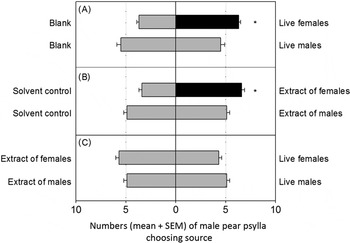
All 300 males entered one arm or the other of the olfactometer within the 10min cutoff time. Significantly more males (63%) chose the jar containing the live females than the empty jar (t = 6.14, df = 14, P < 0.0001; Fig.1A, upper bar). Males' choices did not differ significantly between the jar containing the live males (45%) and an empty jar (t = 1.47, df = 14, P = 0.16; Fig.1A, lower bar).

Experiment 2: Male response to extracts of females and males
All 300 assayed males made a choice within 10min. Significantly more males (66%) selected the jar containing the female extract when it was paired with an empty jar (t = 5.53, df = 14, P < 0.0001; Fig.1B, upper bar). Male choices did not differ significantly between the male extract (51%) and the jar containing the solvent control (t = 0.25, df = 14, P = 0.81; Fig.1B, lower bar).
Experiment 3: Comparison of male response to live females versus extracts of females and to live males versus extracts of males
All 300 assayed males made a choice within the 10min cutoff time. There were no significant differences within either set of comparisons. Fifty-seven percent of males chose the female extract when paired with the live females (t = 2.47, df = 14, P = 0.03; χ2 = 2.67, df = 1, P = 0.1; Fig.1C, upper bar). Fifty-one percent of males chose the live males when paired with the male extract (t = 0.41, df = 14, P = 0.7; Fig.1C, lower bar).
Experiment 4: Female response to live females and males
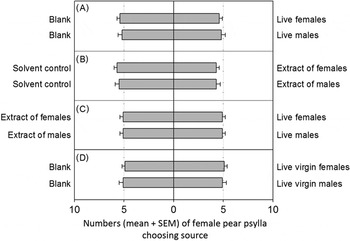
All 300 assayed females made a choice within the 10min cutoff time. Females did not show a preference for the live females (46%) (t = 1.57, df = 14, P = 0.14; Fig.2A, upper bar) or the live males (48%) (t = 0.51, df = 14, P = 0.62; Fig.2A, lower bar) when paired with an empty jar.

Experiment 5: Female response to extracts of females and males
Of the 300 females assayed, 297 made a choice within 10min; 3 females assayed to the male extract exceeded the 10min cutoff time and were discarded. There were no significant differences within either comparison. Fifty-seven percent of females selected the jar containing the solvent control when paired with the female extract (t = 2.44, df = 14, P = 0.03; χ2 = 3.23, df = 1, P = 0.07; Fig.2B, upper bar). Forty-three percent chose the male extract over the solvent control (t = 1.63, df = 14, P = 0.13; Fig.2B, lower bar).
Experiment 6: Comparison of female response to live females versus extracts of females and to live males versus extracts of males
All 300 assayed females made a choice within 10min. Females did not show a significant preference for either the live females (49%; t = 0.40, df = 14, P = 0.7; Fig.2C, upper bar) or the live males (49%; t = 0.43, df = 14, P = 0.67; Fig.2C, lower bar) when paired with the female extract or the male extract, respectively.
Experiment 7: Virgin female response to live virgin females and live virgin males
All 300 assayed females made a choice within the 10min cutoff time. Similar to the results obtained in experiment 4, females did not show a preference for the live virgin females (51%; t = 0.49, df = 14, P = 0.63; Fig.2D, upper bar) or the live virgin males (49%; t = 0.15, df = 14, P = 0.88; Fig.2D, lower bar) when paired with an empty jar. Dissection confirmed that 97.3% of females used in these assays were unmated.
Discussion
Results presented here support previous reports showing that male C. pyricola are attracted to female-produced volatile chemicals (Horton and Landolt Reference Horton and Landolt2007; Horton et al. Reference Horton, Guédot and Landolt2007, Reference Horton, Guédot and Landolt2008; Guédot et al. Reference Guédot, Horton and Landolt2009a). Male attraction to female-produced volatile chemicals occurs in three other species of psyllids: C. bidens, D. citri, and B. cockerelli (Soroker et al. Reference Soroker, Talebaev, Harari and Wesley2004; Wenninger et al. Reference Wenninger, Stelinski and Hall2008; Guédot et al. Reference Guédot, Horton and Landolt2010). In the present study, we determined that summerform male C. pyricola were attracted to live summerform females and to solvent extracts of summerform females, which is consistent with results previously obtained with winterform C. pyricola (Guédot et al. Reference Guédot, Horton and Landolt2009a). Extracts of females were as attractive to males as live females, confirming that the female-produced chemicals responsible for male attraction can be isolated by extracting females with a nonpolar solvent. Insect cuticular hydrocarbons, in addition to preventing desiccation (Nelson Reference Nelson and Treherne1978; Lockey Reference Lockey1988; Howard Reference Howard, Stanley-Samuelson and Nelson1993), are known to be involved in chemical communication and to convey information about sex, species, and physiological state in insects (for reviews see Howard and Blomquist Reference Howard and Blomquist1982, Reference Howard and Blomquist2005; Singer Reference Singer1998). Indeed, solvent extractions were recently used to isolate and identify a female-produced pheromone, 13-methylheptacosane, that attracts winterform male C. pyricola, the first sex-attractant pheromone identified for any psyllid species (Guédot et al. Reference Guédot, Horton and Landolt2009a, Reference Guédot, Millar, Horton and Landolt2009b).
Previous reports indicated that winterform males avoid volatile chemicals from live males, freshly killed males, and extracts of males (Guédot et al. Reference Guédot, Horton and Landolt2009a). In contrast, we found that summerform males are not affected by volatiles from either live males or extracts of males. It is not yet clear why winterform and summerform males differ in their response to male-produced odorants. However, we note that the number of males used as the odor sources differed between studies of winterforms and summerforms. Twice as many males were used as the source of odors in the winterform study than in the current assays with summerform C. pyricola. Thus, it is possible that the male–male repellency reported for winterform C. pyricola is due, at least in part, to the density of males used as odor source. Indeed, in cage assays, high densities of male C. pyricola prompt dispersal of conspecific males from the pear host plant, possibly to avoid competition for access to females (Horton and Lewis Reference Horton and Lewis1995). Previous work with C. bidens (Soroker et al. Reference Soroker, Talebaev, Harari and Wesley2004) and D. citri (Wenninger et al. Reference Wenninger, Stelinski and Hall2008) suggested that males do not respond to conspecific male-produced odorants. On the other hand, male B. cockerelli are attracted by male-produced chemicals (Guédot et al. Reference Guédot, Horton and Landolt2010). Male-produced pheromones could have several intraspecific recognition roles, including female and (or) male attractants (Leal et al. Reference Leal, Kuwahara, Shi, Higuchi, Marino, Ono and Meinwald1998; Kirk and Hamilton Reference Kirk and Hamilton2004), aggregation pheromones (reviewed in Wertheim et al. Reference Wertheim, van Baalen, Dicke and Vet2005), male repellents (Zhang and Aldrich Reference Zhang and Aldrich2003), female aphrodisiacs (Hillier and Vickers Reference Hillier and Vickers2004), and inhibitors of female attractiveness (Andersson et al. Reference Andersson, Borg-Karlson and Wiklund2003; Schulz et al. Reference Schulz, Estrada, Yildizhan, Boppré and Gilbert2008).
Female C. pyricola did not respond to female-produced odors from live females, regardless of their mating status. The lack of response by female C. pyricola to female-produced volatile chemicals was also reported in a field study showing that females were not attracted to traps baited with live females (Brown et al. Reference Brown, Landolt, Horton and Zack2009). Furthermore, winterform females do not respond to 13-methylheptacosane, a recently identified female-produced sex-attractant pheromone for winterform male C. pyricola, in laboratory or field bioassays (Guédot et al. Reference Guédot, Millar, Horton and Landolt2009b). Similarly, female C. bidens and D. citri do not respond to female conspecifics in laboratory bioassays (Soroker et al. Reference Soroker, Talebaev, Harari and Wesley2004; Wenninger et al. Reference Wenninger, Stelinski and Hall2008). Nevertheless, positive antennal responses from female C. bidens to female-infested plants suggest that females can perceive the presence of females (Soroker et al. Reference Soroker, Talebaev, Harari and Wesley2004). Female B. cockerelli avoid female-produced odorants (Guédot et al. Reference Guédot, Horton and Landolt2010). In the present study, although female C. pyricola tend to avoid female-produced volatile chemicals from solvent extracts of females, they do not show a preference for (or avoidance of) live females over an extract of females.
Summerform female C. pyricola also did not respond to odors from live summerform males, regardless of their mating status, or from solvent extracts of summerform males. These results are consistent with a field study that demonstrated that female C. pyricola fail to show a preference for (or avoidance of) male-baited traps when tested against unbaited traps (Brown et al. Reference Brown, Landolt, Horton and Zack2009). Female D. citri did not respond to male-produced volatile chemicals when paired with a blank control (Wenninger et al. Reference Wenninger, Stelinski and Hall2008). Females remain stationary, whereas males are actively searching for females in a number of psyllid species, including C. pyricola (Burts and Fischer Reference Burts and Fischer1967; Krysan Reference Krysan1990; Percy et al. Reference Percy, Taylor and Kennedy2006; Tishechkin Reference Tishechkin, Drosopoulos and Claridge.2006; Brown Reference Brown2008), suggesting that mating success for female C. pyricola does not require females to actively search for and locate conspecific males. Soroker et al. (Reference Soroker, Talebaev, Harari and Wesley2004), however, suggested that female C. bidens tend to avoid males, and Guédot et al. (Reference Guédot, Horton and Landolt2010) have shown that female B. cockerelli avoid volatile chemicals from males.
In conclusion, our study confirms that male summerform C. pyricola are attracted to odors emitted by females, and that these volatile chemicals can be isolated by solvent extractions of females. We have also shown that female C. pyricola do not respond to female- or male-produced volatile chemicals. Thus, the chemical produced by females and shown to attract males (but not other females) is indeed a sex pheromone and not a general attractant for C. pyricola. Further study will identify the specific female-associated chemicals that attract summerform male C. pyricola, for eventual comparison with the identified attractant for male winterform C. pyricola (Guédot et al. Reference Guédot, Millar, Horton and Landolt2009b).
Acknowledgments
Assistance from Merilee Bayer and Deb Broers in collecting and maintaining insects and conducting the olfactometer trials was greatly appreciated. We thank Karolynn Tom and Bonnie Ohler for their help in collecting insects. This research was supported by Research Grant Award No. US-4048-07 from the United States − Israel Binational Agricultural Research and Development Fund, the United States Department of Agriculture's Cooperative State Research, Education, and Extension Service (National Research Initiative 2006-35302-17475), and the Washington Tree Fruit Research Commission (PR-05-504).