Studies examining Gene × Environment (G × E) interactions in psychological research have proliferated in the past decade. This is largely due to the understanding that most multifaceted behaviors, including mental disorders, are products of both genetic and environmental factors (Rutter, Moffitt, & Caspi, Reference Rutter, Moffitt and Caspi2006). Social sciences research has tended to focus on the identification of novel G × E relationships across various candidate genes, social environments, and outcomes, rather than on which associations withstand the test of replication (Risch et al., Reference Risch, Herrell, Lehner, Liang, Eaves and Hoh2009). The interplay of genes and the environment is complex. Therefore, before we can think further about translating new knowledge into clinical practice, it is critical that findings are consistent across samples. Given preliminary evidence for the role of GABA receptor subunit alpha-2 (GABRA2) variants as both risk (Dick et al., Reference Dick, Latendresse, Lansford, Budde, Goate and Dodge2009) as well as plasticity factors (i.e., the differential susceptibility hypothesis; Brody, Chen, & Beach, Reference Brody, Chen and Beach2013; Simons & Lei, Reference Simons, Lei, Gibson and Krohn2013), this study tests whether parental monitoring interactions with GABRA2 conform to a diathesis–stress or differential susceptibility model. Understanding G × E interactions outside of risk conceptualizations may have utility in identifying not only individuals who are most at risk for developing psychopathology but also those who are most likely to benefit from adaptive social contexts including interventions.
Externalizing Behavior
The development of externalizing behavior has been of longstanding interest given the difficulty in treating delinquent youth coupled with its direct cost to the larger society. Adolescent externalizing behavior has been associated with a variety of negative sequelae in adulthood, including criminal activity, antisocial personality disorder, and alcohol and drug dependence (Odgers et al., Reference Odgers, Moffitt, Broadbent, Dickson, Hancox and Harrington2008; Shaw, Hyde, & Brennan, Reference Shaw, Hyde and Brennan2012). Researchers have come to understand engagement in externalizing behavior as being characterized by heterogeneous pathways, whereby different trajectories are associated with specific etiological pathways and outcomes (Fairchild, van Goozen, Calder, & Goodyer, Reference Fairchild, van Goozen, Calder and Goodyer2013; Lacourse, Nagin, Tremblay, Vitaro, & Claes, Reference Lacourse, Nagin, Tremblay, Vitaro and Claes2003; Moffitt, Reference Moffitt1993; Odgers et al., Reference Odgers, Moffitt, Broadbent, Dickson, Hancox and Harrington2008; Shaw et al., Reference Shaw, Hyde and Brennan2012; Weisner & Windle, Reference Weisner and Windle2004). The work of Moffitt (Reference Moffitt1993) is perhaps the most widely recognized theoretical model of adolescent externalizing taxonomies. She posits that for some individuals problem behavior develops early and is stable (i.e., life-course persistent), whereas for others it develops later and is limited to adolescence (i.e., adolescent limited). Externalizing behavior within the adolescent-limited trajectory typically desists in adulthood. In contrast, those continuing to engage in more persistent externalizing behavior are more likely to develop psychopathology in adulthood, such as alcohol dependence (Moffitt, Reference Moffitt1993).
Recent refinements have been made to Moffitt's (Reference Moffitt1993) model to expand this typology to include five clusters: normative experimentation, childhood limited, childhood-onset persistent, adolescent limited, and adolescent-onset persistent (Fairchild et al., Reference Fairchild, van Goozen, Calder and Goodyer2013). Based on a comprehensive literature review, the authors found that a majority of individuals with high rates of externalizing behavior in childhood tend to reduce these behaviors in early adolescence. In addition, a majority of individuals who begin engaging in externalizing behavior in adolescence tend not to remit in adulthood; rather, they usually extend these behaviors into their mid-20s (Fairchild et al., Reference Fairchild, van Goozen, Calder and Goodyer2013). Empirical studies largely support these theoretical models. That is, usually three to five groups are identified, with the typical pattern reflecting stable low and stable high groups, a moderate group, a declining group, and a late-starting high group or increasing group (Odgers et al., Reference Odgers, Moffitt, Broadbent, Dickson, Hancox and Harrington2008; Shaw et al., Reference Shaw, Hyde and Brennan2012; Weisner & Windle, Reference Weisner and Windle2004). Understanding predictors differentiating these trajectories is of practical importance as it may identify adolescents most at risk for developing psychopathology.
Parental Monitoring and Knowledge
Parenting, a primary social context for adolescents, has garnered increasing support for its role in impacting adolescent adjustment. In particular, parental monitoring has been consistently supported as a robust predictor of externalizing behavior (e.g., Barnes, Hoffman, Welte, Farrell, & Dintcheff, Reference Barnes, Hoffman, Welte, Farrell and Dintcheff2006). Earlier work conceptualized parental monitoring as “parenting behaviors involving attention to and tracking of child whereabouts, activities, and associations” (Dishion & McMahon, Reference Dishion and McMahon1998, p. 61). However, in their seminal work, Stattin and Kerr (Reference Stattin and Kerr2000) demonstrate that there is a significant gap in how parental monitoring is conceptualized and how it is typically measured. That is, most measures of parental monitoring reflect knowledge rather than direct tracking and surveillance. In more recent work, researchers have determined that this knowledge is acquired primarily in the context of an open and trusting parent–child relationship through frequent child disclosure and of the parent's ability to actively monitor the child (Kerr, Stattin, & Burk, Reference Kerr, Stattin and Burk2010). Consistent with these findings, longitudinal studies demonstrate that a key component of parental monitoring, parental knowledge, predicts youth delinquent behavior as well as unique trajectories of delinquent behavior across adolescence (Laird, Pettit, Bates, & Dodge, Reference Laird, Pettit, Bates and Dodge2003; Shaw et al., Reference Shaw, Hyde and Brennan2012). Given strong support for the role of parental knowledge on externalizing behavior, the current study focuses on this important component of monitoring.
Ecological perspectives (e.g., Bronfenbrenner & Morris, Reference Bronfenbrenner, Morris and Lerner1998) suggest that the degree to which social contexts exert an influence on adolescents' behaviors varies greatly. Therefore, research focusing on interactions between environmental variation and a child's individual characteristics may provide a more accurate description of the complexity of child development and its processes (Nigg, Reference Nigg2006). Conditional models encompassing parental monitoring and biology may be important for understanding unique etiological factors predicting different externalizing pathways.
G × E Effects
One of the most prominent examples of child characteristics moderating social environments has come from research on G × E interactions, which demonstrates that adolescents differ in vulnerability to parenting based on genotype (Dick et al., Reference Dick, Latendresse, Lansford, Budde, Goate and Dodge2009; Kochanska, Kim, Barry, & Philibert, Reference Kochanska, Kim, Barry and Philibert2011). One example is the GABRA2 gene, located on chromosome 4, which codes for the alpha-2 subunit of the receptor of the neurotransmitter GABA-A. Dick and colleagues (Reference Dick, Latendresse, Lansford, Budde, Goate and Dodge2009) found evidence for a GABRA2 × Parental Monitoring interaction predicting externalizing trajectories, suggesting that those with the GABRA2 minor allele were more likely to demonstrate persistently elevated externalizing behaviors. This effect was strong among adolescents reporting low parental monitoring, consistent with diathesis–stress models whereby some individuals may be more vulnerable to environmental stressors due to their genes and at greatest risk for developing psychopathology (Zuckerman, Reference Zuckerman1999). However, in a later erratum (Dick et al., Reference Dick, Latendresse, Lansford, Budde, Goate and Dodge2011), the authors state that it was those with the major allele who were most at risk for developing externalizing problems. These associations warrant clarification in two specific areas given the potential impact that these findings have on understanding the role of GABRA2 and parental monitoring on the development of externalizing behavior.
First, the reported direction of GABRA2 associations are mixed. The single nucleotide polymorphisms (SNPs) in the GABRA2 gene that are reported in most studies are in linkage disequilibrium with two common genetic forms or haplotypes, the major haplotype (~50.4%) and the minor (~44.0%) haplotype in Whites, with more than 10 SNPs that consistently differ between these two forms (International HapMap Consortium, 2003). Although a majority of studies report that the minor allele is associated with alcohol dependence and impulsivity (Bauer et al., Reference Bauer, Covault, Harel, Das, Gelernter and Anton2007; Covault, Gelernter, Hesselbrock, Nellissery, & Kranzler, Reference Covault, Gelernter, Hesselbrock, Nellissery and Kranzler2004; Edenberg et al., Reference Edenberg, Dick, Xuei, Tian, Almasy and Bauer2004; Enoch, Schwartz, Albaugh, Virkkunen, & Goldman, Reference Enoch, Schwartz, Albaugh, Virkkunen and Goldman2006; Pierucci-Lagha et al., Reference Pierucci-Lagha, Covault, Feinn, Nellissery, Hernandez-Avila and Oncken2005; Villafuerte, Strumba, Stoltenberg, Zucker, & Burmeister, Reference Villafuerte, Strumba, Stoltenberg, Zucker and Burmeister2013), some studies report that the major allele increases risk for alcohol dependence, conduct disorder, and externalizing behavior (Agrawal et al., Reference Agrawal, Edenberg, Foroud, Bierut, Dunne and Hinrichs2006; Dick et al., Reference Dick, Bierut, Hinrichs, Fox, Bucholz and Kramer2006, Reference Dick, Latendresse, Lansford, Budde, Goate and Dodge2009). This illustrates recent critiques that question the burgeoning interest in G × E research because of inconsistencies across studies (Risch, et al., Reference Risch, Herrell, Lehner, Liang, Eaves and Hoh2009).
Second, recent work, including a Special Issue in Development and Psychopathology in 2011, suggests that traditional diathesis–stress models may be limited by their negative focus on contextual adversity and therefore fail to fully capture all processes relevant to environmental influences on behavior (Belsky, Bakermans-Kranenburg, & van IJzendoorn, Reference Belsky, Bakermans-Kranenburg and van IJzendoorn2007; Belsky & Pluess, Reference Belsky and Pluess2009). The differential susceptibility hypothesis suggests that individuals with genotypes traditionally conferring risk may also be more affected by adverse as well as adaptive environments (Belsky et al., Reference Belsky, Bakermans-Kranenburg and van IJzendoorn2007). Research has largely supported differential susceptibility in the serotonergic and dopaminergic systems (e.g., Belsky & Pluess, Reference Belsky and Pluess2009; Kochanska et al., Reference Kochanska, Kim, Barry and Philibert2011). There is preliminary evidence suggesting that GABRA2 variants may also reflect susceptibility factors. For example, Brody and colleagues (Reference Brody, Chen and Beach2013) examined differential effects of prevention trials on subsequent alcohol use based on genetic factors. Findings demonstrated that youth with genetic variants, including those in GABRA2, reported more alcohol use in the control condition but also reaped the most benefit from the prevention program, resulting in a greater reduction in alcohol use over time consistent with the differential susceptibility hypothesis (Brody et al., Reference Brody, Chen and Beach2013).
Alpha-2 GABA-A receptors are expressed primarily in the amygdala and areas receiving innervation from the striatum, such as the substantia nigra (Brody et al., Reference Brody, Chen and Beach2013; Schwarzer et al., Reference Schwarzer, Berresheim, Pirker, Wieselthaler, Fuchs and Sieghart2001). GABRA2 variants are associated with increased activity in these brain areas, thereby likely increasing emotional responsiveness and sensitivity to social contexts (Brody et al., Reference Brody, Chen and Beach2013; Simons & Lei, Reference Simons, Lei, Gibson and Krohn2013). GABRA2 may reflect a susceptibility factor, with heightened sensitivity to a variety of social contexts, not just risk. This is a notable distinction from risk conceptualizations, as individuals with variants traditionally conferring risk may actually be more affected by adverse and adaptive environments alike (Belsky & Pluess, Reference Belsky and Pluess2009). The current study examines whether there is evidence for GABRA2 as a susceptibility factor consistent with the differential susceptibility hypothesis. This is the first study to our knowledge to empirically test the differential susceptibility hypothesis in GABRA2.
Current Study
The primary aim of this study was to test whether the differential susceptibility hypothesis is supported in GABRA2 × Parental Monitoring interactions in the prediction of externalizing trajectories. This study is based on a sample of adolescents from the Michigan Longitudinal Study (MLS), which is an ongoing multiwave prospective study (Zucker, Ellis, Fitzgerald, Bingham, & Sanford, Reference Zucker, Ellis, Fitzgerald, Bingham and Sanford1996; Zucker et al., Reference Zucker, Fitzgerald, Refior, Puttler, Pallas, Ellis, Fitzgerald, Lester and Zuckerman2000). The MLS is community sample enriched with high-risk families including fathers convicted of drunk driving, meeting criteria for alcohol use disorder (AUD). Given prior work (e.g., Fairchild et al., Reference Fairchild, van Goozen, Calder and Goodyer2013; Lacourse et al., Reference Lacourse, Nagin, Tremblay, Vitaro and Claes2003; Odgers et al., Reference Odgers, Moffitt, Broadbent, Dickson, Hancox and Harrington2008; Shaw et al., Reference Shaw, Hyde and Brennan2012), we hypothesized that three to five trajectory classes would be identified. We also hypothesized weak effects of GABRA2 on externalizing behavior given small effect sizes of SNPs (Ioannidis, Trikalinos, & Khoury, Reference Ioannidis, Trikalinos and Khoury2006), but direct effects of parental knowledge, a component of parental monitoring, on externalizing behavior consistent with prior work (Barnes et al., Reference Barnes, Hoffman, Welte, Farrell and Dintcheff2006; Laird et al., Reference Laird, Pettit, Bates and Dodge2003; Shaw et al., Reference Shaw, Hyde and Brennan2012). We expected that a comparative analysis of diathesis–stress versus differential-susceptibility models following recommended steps (Belsky et al., Reference Belsky, Bakermans-Kranenburg and van IJzendoorn2007) would help decipher if the minor allele is best characterized as a risk or susceptibility factor. Consistent with the majority of the literature reporting that the minor allele is associated with genetic risk (Agrawal et al., Reference Agrawal, Edenberg, Foroud, Bierut, Dunne and Hinrichs2006; Bauer et al., Reference Bauer, Covault, Harel, Das, Gelernter and Anton2007; Covault et al., Reference Covault, Gelernter, Hesselbrock, Nellissery and Kranzler2004; Edenberg et al., Reference Edenberg, Dick, Xuei, Tian, Almasy and Bauer2004), we expected a significant GABRA2 × Parental Monitoring interaction, whereby monitoring would have a greater effect on externalizing trajectories among those homozygous for the minor allele (GG genotype) compared to A-carriers (AA or AG genotypes) across SNPs (rs279827, rs279826 and rs279858). Genotype data was dichotomized (A-carriers = 0, GG genotype = 1) given that those with one or two major alleles (A) had comparable levels of externalizing behavior.
Method
Participants
The MLS is an ongoing prospective study that utilizes population-based recruitment procedures to access a nonclinical sample of alcoholic families as well as ecologically comparable non-substance-abusing control families, resulting in three different risk categories (Zucker et al., Reference Zucker, Ellis, Fitzgerald, Bingham and Sanford1996, Reference Zucker, Fitzgerald, Refior, Puttler, Pallas, Ellis, Fitzgerald, Lester and Zuckerman2000). The first represents a high-risk family including fathers convicted of drunk driving, meeting criteria for AUD. Families from the same neighborhoods were also recruited to represent two other risk categories: fathers with no history of AUD (low risk) or fathers identified as having AUD (moderate risk). Mothers' AUD was free to vary in the high and moderate risk category but was an exclusion criterion for the low-risk category. Families were eligible for the study if they had a son between the ages of 3 and 5 at the time of recruitment. This study included 504 adolescents from the following AUD risk categories: low risk (39.3%, n = 198), moderate risk (28.6%, n = 144), and high risk (32.1%, n = 162). Full biological siblings were also included. A majority of adolescents are male (71.2%, n = 359) and primarily White (96.8%, n = 488) because female siblings and non-White families were included after the early waves of the study were initiated. For a full description of MLS methods and demographic characteristics see Zucker et al. (Reference Zucker, Ellis, Fitzgerald, Bingham and Sanford1996, Reference Zucker, Fitzgerald, Refior, Puttler, Pallas, Ellis, Fitzgerald, Lester and Zuckerman2000).
Procedure
Parents and children completed extensive assessments in their homes following initial recruitment (Wave 1, ages 3 to 5) with subsequent assessments occurring every 3 years (e.g., Wave 2, ages 6 to 8, Wave 3 ages 9 to 11, up through ages 15 to 17). Children were assessed annually when the target child turned 11 years old. Given that externalizing behavior is dynamic in adolescence and likely to change in short spans of time compared to other developmental periods (Weisner & Windle, Reference Weisner and Windle2004), available annual data were used instead of wave data to capture important nuances.
Adolescents completed self-report measures reflecting their own behavior (e.g., externalizing behavior) and their parent's behavior (e.g., monitoring). In addition, a subset of families (both parent and child) provided blood or saliva for genotyping. Given potential evocative effects of GABRA2 on parental monitoring, gene–environment correlation (rGE; Belsky & Beaver, Reference Belsky and Beaver2011) tests between adolescents' and parents' genotype and parental monitoring were conducted because rGE may confound G × E effects (Belsky & Beaver, Reference Belsky and Beaver2011). This refers to a nonrandom distribution of environments across different genotypes (see Kendler, Reference Kendler, Kendler, Jaffee and Romer2011, for a review of rGE). Otherwise, data for the present study are based on adolescent reports for those with at least two annual assessments. This study examines 504 children from 253 families. Eighty-one (32.0%) families had 1 child, 107 (42.3%) had 2 children, 52 (20.6%) had 3 children, and 13 (5.1%) had 4 or 5 children participate in the study.
Measures
Externalizing behavior
Adolescents tend to report more problem behaviors compared to reports from fathers, mothers, and teachers (Stanger & Lewis, Reference Stanger and Lewis1993). As such, problem behavior was assessed using the Youth Self-Report (YSR) from the Achenbach System of Empirical Behavioral Assessment (Achenbach & Rescorla, Reference Achenbach and Rescorla2001). Items from the aggressive and delinquency subscales were used to calculate raw scores of externalizing behavior. Items on the YSR are rated on a 3-point Likert scale (0 = not true, 2 = very true or often true). For this study, externalizing behavior specific to the adolescent's age (i.e., externalizing at ages 12 to 17) was calculated based on the adolescent's date of birth and date of assessment. The YSR has been used extensively and has demonstrated strong reliability and validity (Achenbach & Rescorla, Reference Achenbach and Rescorla2001). Internal consistency across assessments in this study was good (Cronbach α = 0.88).
Parental monitoring
Consistent with the larger literature, parental monitoring reflects a dual process involving “parents' knowledge of the child's whereabouts, activities, and associations” (Kerr & Stattin, Reference Kerr and Stattin2000, p. 368), as well as child-driven processes such as disclosure of information to parents. Thus, parental monitoring is viewed as ongoing bidirectional Person × Environment interactions that reflect a proxy for the family environment (DiClemente et al., Reference DiClemente, Wingood, Crosby, Sionen, Cobb and Harrington2001; Kerr & Stattin, Reference Kerr, Stattin, Crouter and Booth2003). Research suggests that parenting practices as reported by the adolescent have a stronger impact on future psychosocial development and may be less biased than parent-report (Kuppens, Grietens, Onghena, & Michiels, Reference Kuppens, Grietens, Onghena and Michiels2009). Therefore, the Parental Monitoring—Youth Form (Chilcoat & Anthony, Reference Chilcoat and Anthony1996) was used to assess parental knowledge and disclosure processes, as reported by the adolescent. This seven-item measure reflects adolescent perceptions of parents' knowledge about their peer group, their whereabouts, and expectations about time spent away from the home. A maximum value reflecting parental monitoring across ages 11 and 12 was created. Internal consistency was adequate (Cronbach α = 0.71).
Background variables
A strong relationship has been demonstrated between family adversity characteristics (e.g., income, marital status) and race on adolescent externalizing behavior (Chung, Hill, Hawkins, Gilchrist, & Nagin, Reference Chung, Hill, Hawkins, Gilchrist and Nagin2002). Growth factors were regressed on the following demographic characteristics: adolescent's race and parent's marital status, average years of education, and family income. Two additional covariates, biological sex and family risk group status (i.e., low vs. moderate or high risk), were included to control for potential differences in class trajectories.
Genotyping
Three GABRA2 SNPs were selected for this study (rs279827, rs279826, and rs279858) to correspond to previous work (e.g., Dick et al., Reference Dick, Latendresse, Lansford, Budde, Goate and Dodge2009). For simplicity and clarity, findings focus on SNP rs279827 given previous haplotype analyses conducted on this sample demonstrates high linkage disequilibrium across these SNPs (r 2 = .80–.92; Villafuerte et al., Reference Villafuerte, Strumba, Stoltenberg, Zucker and Burmeister2013). As expected when SNPs are highly correlated, findings were largely consistent across SNPs. SNP rs279827 was chosen for its potential as a functional SNP. It is located next to an acceptor splice site (Tian, Chen, Cross, & Edenberg, Reference Tian, Chen, Cross and Edenberg2005). SNP rs279827 was included in the Illumina Addiction biology SNP array designed by Hodgkinson and colleagues (Reference Hodgkinson, Yuan, Xu, Shen, Heinz and Lobos2008), a panel genotyped in the MLS sample using the Illumina GoldenGate platform (Illumina Inc., San Diego, CA). SNPs rs279826 (intron 4) and rs279858 (exon 5, K132K) were genotyped by Taqman (Villafuerte et al., Reference Villafuerte, Heitzeg, Foley, Yau, Majczenko and Zubieta2012). We included duplicates (78 for the array and 12 for the Taqman assay) and no discrepancies were observed. All SNPs were in Hardy–Weinberg equilibrium.
Data analytic plan
Trajectory analyses proceeded in two separate steps according to recommended guidelines (e.g., Jung & Wickrama, Reference Jung and Wickrama2008). First, growth mixture modeling (GMM) in MPlus, version 7.1 (Muthén & Muthén, Reference Muthén and Muthén1998–2012), was used to identify relatively homogenous subgroups of adolescents based on shared growth trajectories of self-reported externalizing problems across adolescence (i.e., ages 12 to 17). These GMM models assume an underlying continuous growth process conceptualized as latent growth factors (i.e., intercept and slope coefficients). The intercept represents the mean elevation at the origin of the time scale (i.e., age 12 in this study). The linear slope represents the rate of change per unit of time (i.e., per year in this study). These growth factors represent average trajectories in the sample, while the variance around these means represent heterogeneity (i.e., individual differences) in growth. Growth mixture modeling is more flexible compared to traditional growth curve models since it allows for identification of unique growth factors and individual variability around the mean intercepts, slopes, and rates of change across two or more subgroups (Muthén & Muthén, Reference Muthén and Muthén2000). Given that the identification of within-group differences was not a primary research question in this study, variances for each growth factor were constrained to be equal across trajectory classes to avoid nonconvergence in the estimation of model parameters. According to Muthén (Reference Muthén and Kaplan2004), exclusion of covariates from GMM may lead to model misspecification, resulting in distorted model results. Therefore, demographic characteristics (race, parents' marital status and education, and family income) were included as covariates and regressed on growth factors.
Growth mixture models were run with an increasing number of latent classes. Standard indices were used to determine the optimal number of latent classes. One criterion, entropy ranges from 0.00 to 1.00 based on individual class probabilities with higher values reflecting clear classification (Jung & Wickrama, Reference Jung and Wickrama2008). The Akaike information criterion (AIC) and Bayesian information criterion (BIC) were also examined. Smaller AIC and BIC values reflect better model fit. Research suggests that there may be limitations to the AIC and BIC (i.e., they may be sensitive to sample size and BIC may favor low parsimony; Jung & Wickrama, Reference Jung and Wickrama2008). The bootstrap likelihood ratio test (BLRT) was also estimated, given evidence that it may be a better indicator for determining number of classes (Nylund, Asparouhov, & Muthén, Reference Nylund, Asparouhov and Muthén2007). The BLRT provides a p value comparing the k and k – 1 class model (i.e., comparing the current model to the model with one fewer class). A p value of less than .05 indicates that the model tested fits the data better when compared to a model with one fewer class. The number of classes was determined by a combination of factors, including fit indices, parsimony, theoretical justification, and interpretability (Jung & Wickrama, Reference Jung and Wickrama2008).
A majority (74.4%; n = 375) of adolescents included in these trajectory models had at least half of the repeated assessments available and did not differ significantly from those adolescents who were not assessed annually or did not have at least two annual assessments on externalizing behaviors in the year immediately prior to the present study's initial assessment (i.e., age 11), F (1) = 0.38, p = .54, or parental monitoring, F (1) = 0.94, p = .33.
Each adolescent was assigned to the class with the highest posterior probability. These class labels were regressed using multinomial logistic regression via GMM on genes and parenting for adolescents with genetic data (38.6%, n = 195). Standardized values of child's biological sex and family AUD risk (low versus moderate or high risk) were included as covariates. Analyses were extended to include interactions between GABRA2 (0 = A-carriers, 1 = GG) and parental monitoring, which was standardized around the sample grand mean, before forming the cross-product interaction terms to eliminate nonessential multicollinearity (Aiken & West, Reference Aiken and West1991). Three two-way interactions (e.g., Rs279827 × Parental Monitoring) were tested to examine the role of GABRA2 as a moderator in the association between parental monitoring and externalizing trajectories. Using the fitted models, conditional odds ratios were calculated and reflected pairwise comparisons of class trajectory status. Adolescents with available genetic data did not differ significantly from those who did not have available genetic data on either trajectory class membership, F (1) = 1.19, p = .28, or parental monitoring, F (1) = 0.34, p = .56. Missing genotype was assumed to be missing at random and likely had minimal impact on the results. Furthermore, in order to avoid deleting cases, analyses utilized maximum-likelihood estimation with all available data.
Sensitivity analysis
Given that our sample included siblings, we performed a sensitivity analysis. The goal of this sensitivity analysis was to assess the impact of other sources of within-family dependence, specifically shared genes unlinked to GABRA2 and shared environment, that were not explicitly included in the analysis model. To do this, we constructed a data-generating model incorporating various forms of within-family dependence. We then ran the multinomial logistic regression on data simulated from this model. We varied the degree of within-family dependence from no dependence to complete dependence and considered how the empirical standard errors of the parameter estimates increased as the degree of within-family dependence increased.
Within family dependence can be viewed as arising from three sources: genetic similarity between siblings, similarity in parental behavior toward their different children, and the net effect of all other forms of common environment within a family. Since the GABRA2 genotype and the parental monitoring level are measured directly and are included in the analysis, these two sources of dependence are already accounted for. The goal of this sensitivity analysis was therefore to assess the impact of other sources of within-family dependence, specifically shared genes unlinked to GABRA2 and shared environment, that were not explicitly included in the analysis model.
For data simulation, we first specified a log-linear random effects model that matched the observed features of the data as captured through our modeling. Sibling genotypes were simulated using Mendelian inheritance, based on genetically independent parents, with genotype frequencies matching those found in our data. Parental monitoring for siblings within a family was simulated to have a .80 intraclass correlation. Additional correlation between siblings (reflecting unmeasured common environment and genetics) was simulated using a Gaussian copula to produce positively dependent exchangeable Bernoulli trials. Standard errors were calculated using 1,000 replications.
Results
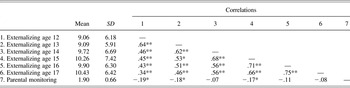
Overall, findings indicate an increase in externalizing behaviors but a relatively stable level of variability across age. Externalizing behavior was significantly correlated across all ages. High levels of externalizing behaviors were associated with low levels of parental monitoring at three different ages (12, 13, and 15). See Table 1 for the means, standard deviations, and Pearson's correlations for age-specific externalizing behavior and parental monitoring scores. It is important to note that, although our sample was enriched for families with alcoholism, externalizing scores were largely comparable to previous work examining these relationships in community samples (Dick et al., Reference Dick, Latendresse, Lansford, Budde, Goate and Dodge2009), as well as those reported by Achenbach and Rescorla (Reference Achenbach and Rescorla2001) for their nonreferred sample. That is, average T scores for 11- to 18-year-old males and females are approximately 54 for rule-breaking and aggressive behavior scales (Achenbach & Rescorla, Reference Achenbach and Rescorla2001). The T scores in the current sample ranged from 51 to 55.
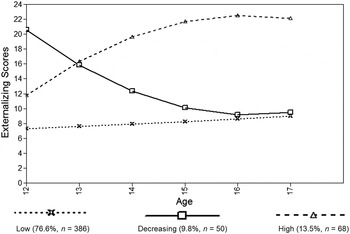
Externalizing trajectories for the total sample.

Means, standard deviations, and correlations between parental monitoring and externalizing across ages 12 to 17

*p < .01. **p < .001.
Prior to determining the number of classes to extract, linear and quadratic growth factors were compared in an unconditional traditional growth model to assess whether subsequent trajectory models should include a nonlinear growth factor. Model fit indices determined whether a linear or nonlinear model fit the data better. Higher values on the comparative fit index (CFI) and the Tucker–Lewis index (TLI), and lower values on the root mean square error of approximation (RMSEA) represent the best fitting model. The model accounting for nonlinear growth (CFI = 0.987, TLI = 0.981, RMSEA = 0.04) was more representative of the data than a linear model (CFI = 0.957, TLI = 0.960, RMSEA = 0.07). A formal likelihood ratio test, χ2Δ (4) = 27.67, p < .0001, also supports the quadratic model. As such, subsequent models include a quadratic growth factor. Given that additional growth factors add computational burden and possible convergence problems, the variance of the linear term was fixed to zero.Footnote 1
Identification of externalizing behavior trajectories
Exploratory conditional growth mixture models were estimated to determine the most probable class formation by sequentially increasing the number of estimated latent classes and evaluating standard indices when accounting for demographic covariates. In all, one-class, two-class, three-class, and four-class models were tested. When comparing the one- and two-class solutions, there was a decrease in AIC (11091.09 vs. 11010.60) and BIC (11192.42 vs. 11128.83). The BLRT favored the two-class solution (p < .001). The three-class solution resulted in a decrease in AIC (10969.57) and BIC (11104.69) but a decrement in entropy (from 0.81 to 0.75). The BLRT favored the three-class solution (p < .001). Although the BLRT suggested an improvement in the four-class solution, AIC and BIC did not improve and entropy decreased (0.65). Furthermore, the four-class solution resulted in convergence issues due to low counts (~2% of the sample in one class). Upon consideration of the model fit information, prior research, and interpretability, the three-class solution was selected as the best fitting model.
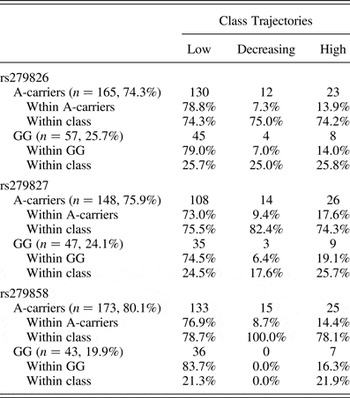
Figure 1 shows the three trajectory groups. A majority of adolescents (76.6%, n = 386) exhibited a low trajectory. A small subset (9.8%, n = 50) demonstrated elevated levels of initial externalizing behavior (intercept = 20.48, p < .001), peaking at or before age 12 and displaying a steady nonlinear decline (linear = –5.43, p < .001; quadratic = 0.65, p < .05), with comparable levels of externalizing at age 16 and 17 as the low-externalizing class. The third group (13.5%, n = 68) demonstrated a moderate level of initial externalizing behavior at age 12 (intercept = 11.73, p < .001) that increased in a nonlinear fashion (linear slope = 5.19, p < .001; quadratic slope = –0.62, p < .05). We designated these groups low, decreasing, and high, respectively (see Figure 1). Of the covariates, only family income was related to growth factors (–0.66, p < .05), suggesting that income is related to lower levels of initial externalizing behavior. Table 2 presents genotype frequencies across classes.
Genotype frequencies across single nucleotide polymorphisms per trajectory classes

Parental monitoring and GABRA2
As expected, multinomial logistic regressions estimated using conditional GMMFootnote 2 supported a main effect of parental monitoring. The odds of being in the decreasing versus the low class almost double when adolescents reported lower parental monitoring (odds ratio [OR] = 2.10, 95% confidence interval [CI] = 1.00–4.45). These effects were marginal when comparing the high to the low-externalizing class (OR = 1.96, 95% CI = 0.93–4.15). The odds of being in the high versus the low class almost double if adolescents came from a high AUD risk family (OR = 1.71, 95% CI = 1.00–2.93). Biological sex and GABRA2 were not significant predictors.
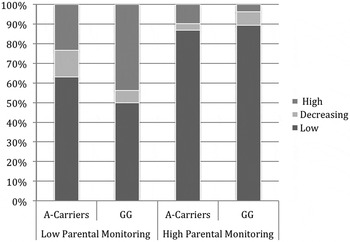
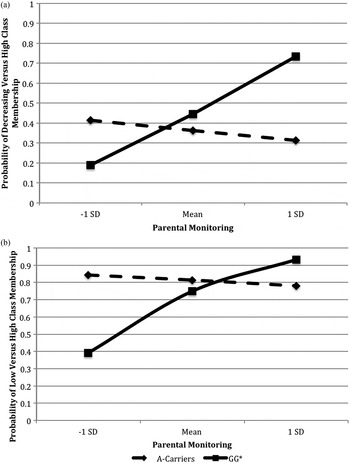
The GABRA2 × Parental Monitoring interaction was significant, providing evidence for moderation when comparing the decreasing (OR = 4.28, 95% CI = 1.24–14.76) and low classes (OR = 5.73, 95% CI = 1.17–38.47) to the high class. Figure 2 presents class trajectory membership as a function of GABRA2 by levels of parental monitoring. For illustrative purposes, a median split of parental monitoring was created, although it was modeled as a continuous variable. As depicted in the figure, among those reporting high parental monitoring, those with the GG genotype had (a) a greater proportion in the decreasing class, (b) a lesser proportion in the high class, and (c) an equal proportion in the low class compared to A-carriers. At low monitoring, those with the GG genotype had (a) a greater proportion in the high class and (b) a lesser proportion in both the decreasing and low classes compared to A-carriers. These results indicate that those with the GG genotype showed heightened susceptibility to parental monitoring.
Externalizing trajectory class by GABRA2 genotype (rs279827) and parental monitoring.

Figure 3 offers another depiction of the GABRA2 × Parental Monitoring interaction when comparing the decreasing and the high class at different values of parental monitoring (1 SD above and below the mean). When comparing the decreasing and high classes (Fig. 3a) at low levels of parental monitoring, those with the GG genotype had a lower probability of being in the decreasing compared to the high-externalizing class. At high levels of parental monitoring, they had a higher probability of being in the decreasing compared to the high-externalizing class. The simple slope of parental monitoring was statistically significant (1.11, p < .05) for the GG genotype but not significant for A-carriers (–0.35, p = .31). When comparing the low and high classes (Fig. 3b), at low levels of parental monitoring those with the GG genotype had a lower probability of being in the low compared to the high-externalizing class. At high levels of parental monitoring they had a higher probability of being in the low compared to the high-externalizing class. The simple slope of parental monitoring was statistically significant (2.12, p < .05) for the GG genotype but not significant for A-carriers (–0.37, p = .22). This indicates that those with the GG genotype may have heightened susceptibility to parental monitoring in a “for-better-and-for-worse” manner (Belsky & Pluess, Reference Belsky and Pluess2009). In adverse environments (low monitoring) those with the GG genotype were more likely to belong to high-risk externalizing trajectories and less likely to belong in low-risk trajectories; in adaptive environments (high monitoring) the opposite was true.
The GABRA2 genotype (SNP rs279827) and predicted probabilities of externalizing trajectories by levels of parental monitoring. *p < .05.

rGE
Correlation analyses demonstrated no significant bivariate relationships (rs = –.09 to –.05 across SNPs) between adolescent and parent genotypes and parental monitoring. An absence of rGE effects indicates that identified G × E interactions do not simply reflect an evocative effect of GABRA2 genes on parenting (Belsky & Beaver, Reference Belsky and Beaver2011).
Sensitivity analyses
As expected, the standard errors increase as the dependence in data increases; the standard error for zero dependence is almost identical to the standard error found in our analysis (e.g., OR = 4.3, 95% CI = 1.2–14.8, corresponding to SE = 0.62 for the interaction term). That is, this odds ratio will remain significantly different from 1 as long as the standard error remains below 0.73. We thus can have an excess sib/sib concordance as high as 0.9. This indicates that within-family dependence had a minimal impact on results.
Discussion
Externalizing behavior is a significant component of childhood maladjustment. Some degree of externalizing behavior is expected and not always predictive of later psychopathology (Moffitt, Reference Moffitt1993). However, some adolescents continue engaging in externalizing behavior as they move into adulthood, and at that point what was dismissed or forgiven earlier becomes behavior with significant negative consequences. Therefore, developmental models distinguishing between normative and persistent problem behavior have significant utility. Parental monitoring and genetic make-up are likely to impact developmental patterns of externalizing behavior. This study systematically tests the form of GABRA2 by parental monitoring interactions on externalizing trajectories given preliminary evidence for differential susceptibility in this genetic system (Brody et al., Reference Brody, Chen and Beach2013; Simons & Lei, Reference Simons, Lei, Gibson and Krohn2013). Moreover, this study clarifies the association between these relationships given mixed findings in the GABRA2 literature on problem behavior. There was evidence for a significant GABRA2 × Parental Monitoring effect: Adolescents with the minor allele are greatly susceptible to both adverse and adaptive parenting consistent with the differential susceptibility hypothesis.
In line with the problem behavior literature (Lacourse et al., Reference Lacourse, Nagin, Tremblay, Vitaro and Claes2003; Odgers et al., Reference Odgers, Moffitt, Broadbent, Dickson, Hancox and Harrington2008; Shaw et al., Reference Shaw, Hyde and Brennan2012), three empirically differentiated externalizing classes were estimated. We identified a low-externalizing class that is consistent with a persistently low (e.g., Lacourse et al., Reference Lacourse, Nagin, Tremblay, Vitaro and Claes2003; Odgers et al., Reference Odgers, Moffitt, Broadbent, Dickson, Hancox and Harrington2008; Shaw et al., Reference Shaw, Hyde and Brennan2012) or a normative experimentation class (Fairchild et al., Reference Fairchild, van Goozen, Calder and Goodyer2013). We also identified a group that demonstrated moderate levels of initial externalizing behavior that increased in severity across middle to late adolescence. This most closely maps on to a persistently high (e.g., Shaw et al., Reference Shaw, Hyde and Brennan2012) or an adolescence-onset persistent class (Fairchild et al., Reference Fairchild, van Goozen, Calder and Goodyer2013; Lacourse et al., Reference Lacourse, Nagin, Tremblay, Vitaro and Claes2003; Odgers et al., Reference Odgers, Moffitt, Broadbent, Dickson, Hancox and Harrington2008). Finally, we identified a decreasing class that demonstrated elevated levels of externalizing behavior peaking at or before early adolescence and gradually decreasing to low levels of externalizing behavior in late adolescence. This is consistent with a high-decreasing class (Shaw et al., Reference Shaw, Hyde and Brennan2012), or a childhood-limited class (Fairchild et al., Reference Fairchild, van Goozen, Calder and Goodyer2013; Lacourse et al., Reference Lacourse, Nagin, Tremblay, Vitaro and Claes2003; Odgers et al., Reference Odgers, Moffitt, Broadbent, Dickson, Hancox and Harrington2008). Given that some degree of externalizing behavior is normative in adolescence, identifying factors that discriminate between adolescents who will mature out of these behaviors and successfully transition to healthy adulthood and those experiencing sustained problems leading to psychopathology are critical.
Consistent with previous research, there was evidence for a main effect of parental monitoring on externalizing trajectories (Barnes et al., Reference Barnes, Hoffman, Welte, Farrell and Dintcheff2006; Laird et al., Reference Laird, Pettit, Bates and Dodge2003; Shaw et al., Reference Shaw, Hyde and Brennan2012). That is, parents who are informed about key aspects of their child's behavior and environment in real-time have adolescents who are less likely to exhibit high-risk externalizing trajectories. Moreover, our findings indicate that adolescents' genotype did not have a main effect on externalizing trajectories; rather, GABRA2 moderated the effects of parental monitoring on externalizing trajectories, uniquely differentiating the lower risk classes (low and decreasing) and the high-risk class in a cross-over interaction pattern. Typically, main effects of genotype are not detected in cross-over patterns, perhaps due to vulnerability and protective effects within the same genotype balancing each other out (Uher & McGuffin, Reference Uher and McGuffin2008). This highlights the critical need to move beyond bivariate associations and consider the role of both context and genetic information to gain a more precise understanding in the development of youth problem behavior.
In our study, A-carriers were largely unaffected by parental monitoring, whereas at high parental monitoring GG genotype adolescents were more likely to belong to lower risk externalizing classes but less likely to belong to lower risk externalizing classes at low parental monitoring. Although previous work demonstrated that adolescents with the major allele were more likely to develop high-risk externalizing trajectories, especially in the context of low parental monitoring (Dick et al., Reference Dick, Latendresse, Lansford, Budde, Goate and Dodge2009), our findings are consistent with the larger literature on GABRA2, which frames the minor allele as being a potential susceptibility factor (Agrawal et al., Reference Agrawal, Edenberg, Foroud, Bierut, Dunne and Hinrichs2006; Bauer et al., Reference Bauer, Covault, Harel, Das, Gelernter and Anton2007; Covault et al., Reference Covault, Gelernter, Hesselbrock, Nellissery and Kranzler2004; Edenberg et al., Reference Edenberg, Dick, Xuei, Tian, Almasy and Bauer2004; Villafuerte et al., Reference Villafuerte, Heitzeg, Foley, Yau, Majczenko and Zubieta2012). Differences across studies may be attributable in part to our extension of prior work to include quadratic effects as well as assessing trajectories and conditional effects in the same model. Including a quadratic growth factor likely provided a more nuanced conceptualization of externalizing trajectories not captured by previous work. It is possible that prior work (Dick et al., Reference Dick, Latendresse, Lansford, Budde, Goate and Dodge2009) collapsed across two putatively distinct groups (low and adolescent-limited classes), perhaps because of lower variance in externalizing behavior in a community sample compared to our sample enriched for alcoholism. Factors discriminating between adolescents who will successfully transition to adulthood and those who will experience sustained problems leading to psychopathology is critical.
When examining the form of the interaction (i.e., whether it is consistent with the diathesis–stress or differential susceptibility) we employed a series of proposed empirical steps for establishing genetic susceptibility to environmental influence (Belsky et al., Reference Belsky, Bakermans-Kranenburg and van IJzendoorn2007). There is evidence for (a) a cross-over interaction between GABRA2 and parental monitoring, (b) independence of genotype and parental monitoring, (c) no association between genotype and externalizing trajectories, and (d) a significant slope for the susceptibility group (i.e., GG genotype) compared to a nonsignificant slope for the nonsusceptible group (A-carriers). Unfortunately, we were unable to examine regions of significance for these slopes (Preacher, Curran, & Bauer, Reference Preacher, Curran and Bauer2006) because this approach is currently unavailable for multinomial outcomes. Nevertheless, findings are consistent with other studies demonstrating that, in some contexts, genetic effects may convey greater susceptibility rather than risk (Kochanska et al., Reference Kochanska, Kim, Barry and Philibert2011). Moreover, findings are consistent with preliminary studies suggesting that GABRA2 variants may reflect susceptibility rather than risk (Brody et al., Reference Brody, Chen and Beach2013; Simons & Lei, Reference Simons, Lei, Gibson and Krohn2013).
Limitations and future directions
While this study provided an important advancement to the literature on the interaction between genes and parenting, there are a number of limitations. First, the heterotypic nature of externalizing behavior poses methodological challenges when examining developmental change (Leve, Kim, & Pears, Reference Leve, Kim and Pears2005). One must weigh the pros and cons of assessing behaviors across a broad age range while keeping measurement constant. When multiple measures are used, it is difficult to discern whether change reflects differences in methodology. In an effort to assess true change, we chose to include only one measure (the YSR), limiting our findings to adolescence and one reporter. Although previous work (Dick et al., Reference Dick, Latendresse, Lansford, Budde, Goate and Dodge2009) examined a broader age range, it is unclear whether different assessments added measurement variance to trajectories. In addition, although adolescent report of parenting practices and externalizing behavior may be more direct and accurate (Stanger & Lewis, Reference Stanger and Lewis1993), this may have inflated shared-method variance. Future research encompassing other informants as well as a broader range of ages is necessary.
Though our sample size is comparable to other studies (Dick et al., Reference Dick, Latendresse, Lansford, Budde, Goate and Dodge2009; Kochanska et al., Reference Kochanska, Kim, Barry and Philibert2011), a larger sample would allow for an examination of each genotype. Given the nature of large longitudinal datasets, data collected through the MLS goes through an extensive quality assurance process including screening and crosschecking. For this reason, some of the collected data was not yet available for this study. Although our rate of adolescents characterized by the high-externalizing class (13.5%) was comparable to rates reported in previous work (rates = 3%–16%; Walters, Reference Walters2011), the use of growth mixture modeling led to several small cell sizes when examining conditional effects. Until findings are replicated with a larger sample, caution is warranted when drawing inferences.
It was also necessary to make an analytical tradeoff between conducting growth mixture modeling and estimating regions of significance, since testing regions of significance was not possible given the multinomial structure of the outcome variable. At the same time, the ability to examine heterogeneous trajectories of externalizing behavior consistent with developmental theory is a significant strength that outweighs the potential limitation of not being able to test regions of significance. This is especially true given other statistical procedures (e.g., probing simple slopes; Aiken & West, Reference Aiken and West1991). However, it will be important for future work to examine regions of significance and test other confirmatory models, such as reparameterized regression models (Widaman et al., Reference Widaman, Helm, Castro-Schilo, Pluess, Stallings and Belsky2012), in order to further substantiate the form of this interaction.
Our findings may not generalize to samples with different demographics. Our sample was largely White, and parenting practices may operate differently across race (Smith & Krohn, Reference Smith and Krohn1995). Our sample was also enriched with alcoholic fathers, potentially limiting its generalizability to nonproblem populations. However, the T scores were similar to community and nonreferred samples (Achenbach & Rescorla, Reference Achenbach and Rescorla2001; Dick et al., Reference Dick, Latendresse, Lansford, Budde, Goate and Dodge2009).
Despite these limitations, the current study demonstrates that those with the GABRA2 minor allele (GG) are most susceptible to parental monitoring, which is consistent with the larger GABRA2 literature (Bauer et al., Reference Bauer, Covault, Harel, Das, Gelernter and Anton2007; Covault et al., Reference Covault, Gelernter, Hesselbrock, Nellissery and Kranzler2004; Edenberg et al., Reference Edenberg, Dick, Xuei, Tian, Almasy and Bauer2004; Enoch et al., Reference Enoch, Schwartz, Albaugh, Virkkunen and Goldman2006; Pierucci-Lagha et al., Reference Pierucci-Lagha, Covault, Feinn, Nellissery, Hernandez-Avila and Oncken2005). This is the first study to systematically examine the role of GABRA2 variants as susceptibility factors. Sole focus on diathesis–stress models likely increase the risk of misunderstanding the true nature of adolescent growth and the role that genes play in shaping behavior. Traditional conceptualizations of GABRA2 variants as risk factors may be misguided, as individuals with the GG genotype may also be more susceptible to adaptive environments. That is, adolescents traditionally categorized as at risk for later psychopathology may also be particularly sensitive to the degree to which parents are invested in creating a nurturing environment fostering trust, openness, and communication.