Geographical and historical background
The island of Rhodes is seventy-seven kilometres in length and thirty-five kilometres in width, covering about 1400 square kilometres, with a range of hills rising from either end to culminate in the highest point, west of centre, at Mt. Ataviros, 1215 metres above sea level. Despite some rainfall in winter, nearly all the many streams are often dry in the summer. Forests, despite frequent fires, are still numerous, particularly on the western slopes of the hills. The lowland areas are fertile and cultivated in plantations of vines, olives and fruit trees. The nearest point of the Anatolian coast is only 11 kilometres distant. There are few harbours apart from those at the town of Rhodes and at Lindos.
When the Hospitallers acquired Rhodes in 1309, they took over a territory which had suffered a turbulent past under the Byzantines. There had been multiple incursions by Arabs, particularly in the seventh, eighth and ninth centuries.Footnote 1 The island, or at least the town of Rhodes, was occupied by Seljuk Turks at the end of the eleventh century,Footnote 2 while the Venetians attacked the island in 1124,Footnote 3 followed by Genoese and Pisan pirates in 1192.Footnote 4 After the Fourth Crusade in 1204, the island, under its governor Leo Gabalas, broke away from the Nicaean empire and an attempt by the Nicaean Greeks to recover the island in 1233 was unsuccessful.Footnote 5 The Nicaeans did not fully acquire the island until 1250, when they joined forces with John Gabalas, Leo's brother and quasi-independent successor, to conquer the town of Rhodes which had been seized opportunistically by the Genoese in 1248.Footnote 6 Turkish attacks from the mainland began in approximately 1278 and continued until the beginning of the fourteenth century.Footnote 7
Very little is known about the ownership of land on Rhodes prior to its occupation by the Hospitallers. Whatever the reality, and whatever changes occurred after 1250, it is known that Michael VIII Palaiologos gave the island to his brother, the despot John Palaiologos, in approximately 1260. The exact nature of this grant remains obscure, but Mark Bartusis has concluded that John would have received the properties, as well as the administrative rights over the islands [Mytilene and Rhodes], for as long as the emperor wanted him to have them.Footnote 8 In any event, in 1272, Michael ‘took away the great part of [John's] oikonomia; all the islands [mentioned] earlier, I speak of Mytilene and Rhodes'.Footnote 9
My primary objectives in examining these documents were to identify medieval place-names mentioned in the documents, to determine the extent of the definable boundaries of the grants and to prepare a gazetteer. The results of this investigation will appear in a forthcoming study, but it is necessary to preface that by analysing the nature of the land grants, as will be done below.
Documents concerning the Rhodian countryside
Very little documentary evidence exists for the period 1306–1423, apart from that in the Hospitaller archives in Malta. Most pre-1424 travellers to Rhodes did not visit the countryside except in order to view the church and icon of ‘Our Lady of Filerimos'.Footnote 10 Cristoforo Buondelmonti was an exception. He was based on Rhodes from 1414 to 1422; he returned there by June 1430 and may have died there.Footnote 11 In his Liber Insularum Archipelagi, he describes, inter alia, the countryside of Rhodes and certain contemporary issues.Footnote 12
Although hardly any archival documents survive from Rhodes for the period prior to 1346,Footnote 13 there are in total 200 extant, which refer to the countryside of Rhodes in the period under review.Footnote 14 Appendix A lists the 151 documents which refer specifically to land grants made to both Latins and Greeks, together with a few other documents which illustrate additional features regarding the landscape.Footnote 15 The majority of these grants were issued in Rhodes, but others were granted from near Limassol [1], Avignon [3, 4, 99–105, 107–122] and Paris [143]. The document issued in Cyprus on 27 May 1306 was a record of the pact agreed between the Hospitallers and the Genoese, Vignolo de Vignoli, on how to administer their planned Dodecanese conquests, while the other documents were issued in France because the Master of the Hospitallers resided there at the time.
The grantees
The documents listed in Appendix A give the names of the grantees and their possible ethnicity, as surmised by me.Footnote 16 Fifty-six of the documents, or 37%, involve Hospitallers, all of them with names of Latin origin. Some of them received more than one grant, namely Fr. Domenico de Alamania (6); Fr. Bertrand de Gagnac (3); Fr. Raymond de l'Escure (3); Fr. Hugo Raymundi (2) and Fr. Mathieu de Saint George (2). Two grants [113, 124] were joint grants to two Hospitallers. A noticeable trend is that more grants were awarded proportionately to Hospitallers in the latter part of the period, (more than half in 1366–1392 and nearly half in 1392–1423), than in the earlier periods, (less than a quarter between 1347 and 1351 and just over a quarter between 1351 and 1366). The reason for this trend is not known, but it may relate to an increasing need to attract more Hospitallers to the island in the later periods in order to bolster defences.Footnote 17 It is not entirely clear how many Hospitaller grantees actually took up residence on the island, as many of them held positions in the West.Footnote 18
Of the remaining ninety-five documents, some forty-six or 31% of the total, concern other Latins. However, it should be noted that it is not always clear from the names given in the documents whether a grantee was Latin or Greek, since the names are reproduced in Latin; therefore, the ethnicities ascribed in Appendix A are a first approximation. The pact of 1306, referred to earlier [1],Footnote 19 conferred the casale of Lardos and one other unidentified casaleFootnote 20 upon Vignolo de Vignoli, and his family continued to hold at least part of Lardos until 1402 [3, 4, 5, 71, 107, 132, 133, 134]. Nevertheless, more Latin settlers were needed if the Order was to reinforce its hold on the island and to increase agricultural production. Consequently, in 1313 [2], the Order issued an appeal for settlers to come to Rhodes where they would be offered land. It is not known how many people responded to this invitation, but it is likely that there were few takers.Footnote 21
The Latin settlers who are identified can be divided into several groups. One group consisted of the Master's familiares, such as his interpreter [48], doctor [49, 59], squires [58, 111], barber [109, 115, 120, 122] and farrier [114]. The members of a second group were identified as serviens [11] and clerics [42, 46]. Another group included individuals apparently without specific functions, whose place of origin is attached to their name, such as Florence [81], Aragon [87] and Naples [101]. Two of the grants were for miles [136, 151].
Thirty-five awards or 23% are to Greeks; their numerical share of such grants that have survived declines progressively over the period. Eight such awards are to Greek priests [9, 15, 55, 88, 98, 103, 144, 145], two of which [98 and 103], were given to the same individual, a priest named Ligotetos, while one endowment [145] was a joint grant to three priests. Other awards were to Greeks with stated positions such as protos [12, 150], the leading man of a village; serviens [10, 14, 24, 33], and three individuals who worked for the Master, namely a cook [18], an interpreter [19] and a squire [75] The birthplace or origin of other Greeks given awards is unknown, except for one person from Cyprus [33].
There is a final group of thirteen grantees, or 9% of the total, whose ethnic origins are unknown, apart from two Syrians. One of these thirteen grantees, Nicolaus Beluca, was given two separate grants [104, 148]. Awards were given to Nayme the Syrian in 1348 [32] and to Johannes Beg in 1358 [51]; several Syrians had accompanied the Hospitallers when they moved to Cyprus in 1291, but it is not apparent whether this particular individual was a descendant or someone who had left Syria later.
Any portrait of the island's landowners based on the grantees mentioned in the 151 documents is necessarily incomplete. Quite apart from missing documents, particularly in the period up to 1347, the grants do not make direct reference to land owned by the Hospital. The situation immediately after the conquest of the island in 1309 is unclear, but one of the notable features of the extant grants is the absence of any reference to Greek archontes. These were the Byzantine land-owning class who are found throughout the Byzantine Empire at the time of the Fourth Crusade and are specifically alluded to, for instance, in the Peloponnese, on Crete and on Cyprus. They were surely present on Rhodes, but may have left the island following the Hospitaller conquest, possibly for other properties owned by them in territory still controlled by the empire.Footnote 22 It is clear from the 1313 call for settlers [2] that the Hospital controlled lands on the island, partly because, perhaps, they were deserted, having been abandoned by their owners, or confiscated, which was the case in the Peloponnese and Crete. In November 1314, it is known from the unidentified casale document referred to earlierFootnote 23 that the Chapter General of the Order ascribed a specific amount of funding, 30,000 bezants, from the revenues of two casalia and their appurtenances owned by the Hospital to the Conventual hospital.
The extant documents included in this survey do refer indirectly to lands owned by the Hospital and Latin or Greek settlers. The documents include in 122 or 81% of cases, specific names of the owners of properties adjacent to the area or feature being awarded. Thus, for instance, document [72] describes how an award of two modiate of land in the contrata of Stanbrotio in the casale of Apolakkia was bordered on one side by the road to the mills and to Siana, on another side, by the vines of papas Costas, another by those of the deacon Changari and on another by lands of the Hospital. This supplementary information provides a more comprehensive picture of landholdings on the island. It is also clear from this information that the Hospitallers possessed some type of land registry for the island, the records of which have unfortunately not survived.Footnote 24
The location of the grants
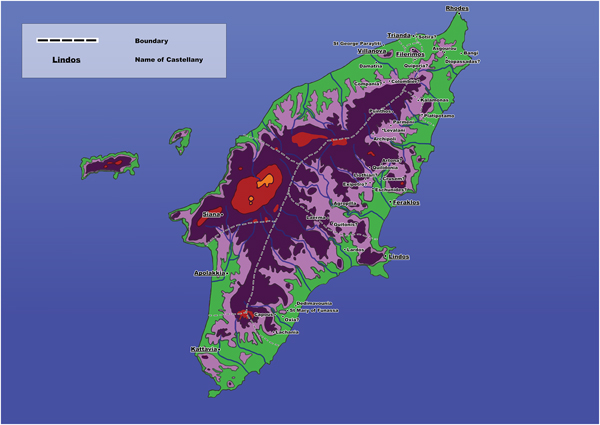
Appendix B summarizes the location of each known award and notes whether it is explicitly or implicitly situated within a specific castellany. Other geographic terms used include a territorium, contrata or casale, as well as a simple locus. A castellany was a territorial unit administered by a castellan and containing at least one castle that served as a base for the castellan and presumably a garrison. However, the territorial limits of the castellany in Rhodes did not remain constant; modifications occurred as a result of rearranging or subdividing castellanies into smaller units from time to time. Fig. 1 shows the conjectural boundaries of late-fourteenth-century castellanies, based upon evidence regarding identified locations. Both a territorium and a contrata were smaller geographic areas, but it is not known which was the larger, as occasionally an area was described as a territorium or contrata in the same document,Footnote 25 which presumably means that the terms were inter-changeable, at least in some circumstances.Footnote 26 The casale, in contrast, was an economic or agrarian unit circumscribing a village, including serfs and their services, slaves, animals and any rights attached to the property.Footnote 27 Some locations in the documents had differing descriptions; for example, Afandou was called both a casale [34] and a locus [110], while the name Apolakkia appeared as both a contrata [9] and a casale [72]. Asgourou was named a territorium [121], contrata [27, 45] and locus [112].
Map of Conjectural Boundaries of Castellanies ca. 1380

Other awards do not refer to a specific geographic area, but instead to other features, such as unidentified lands, in fifteen cases, churches in nine examples, including Ag. Theodori near Archangelos three monasteries, one orchard and nineteen places not further described. As noted above,Footnote 28 most grants mention adjoining geographic areas or features; this characteristic is dealt with below.Footnote 29
The subject of the grants
Appendix C tabulates some other characteristics of the grants awarded in the 151 documents in the survey. The first column describes the geographic unit or feature which was the subject of the grant. The geographic units included the casale or sometimes several casalia; the modiata, which was a specific area of land,Footnote 30 the cafizata which equalled, as noted in one of the documents [50], one eighth of the modiata; and the charruata [21] which was a measure of the area of land capable of being ploughed within a year. In one case [149], an entire territorium was granted.Footnote 31
Properties are frequently mentioned with the features they include, such as vineyards; orchards and/or market gardens;Footnote 32 monasteries, churches, chapels, cells and chaplaincies; watermills and windmills, houses, buildings, baths, an inn and a hospice; an enclosure; unspecified lands; fig and unstated types of trees; a platea,Footnote 33 springs and a sheepfold. Sometimes the awards would combine multiple items, such as a geographic area and a feature: [52], for instance, mentioned nine modiate and a vineyard. Other grants covered several different components, which were not necessarily contiguous, such as [28] which comprised three separate elements, namely a mill with an adjacent vineyard and jardinum; four modiate with figs and trees; and another mill with another jardinum, together with a vineyard.
The tenure of the grants and rental arrangements
Appendix C also lists the tenure arrangements for each grantee. As already stated, it is not known who owned land on the island at the time of the conquest by the Hospitallers in 1309, or under what terms. If a substantial portion had been held by archontes, it would seem that they had left the island or that their land had been confiscated. In any case, the Hospital would have regarded all land as its own by right of conquest and subsequent papal decree – hence the appeal [2] for settlers in 1313, whereby they were offered lands of varying value dependent upon their status. The lands would be offered in perpetual fief, with accompanying military responsibilities, but the complete absence of any reference to this type of grant in extant early documents suggests that there were very few, if indeed any, settlers who came to Rhodes in the immediate post-conquest period.
Fifty-five of the grants recorded in the 151 documents instead refer to lands or features leased to Latins and Greeks in perpetual emphyteusis. This was a practice founded in the late Roman period and maintained by the Byzantines, whereby the grantor retained his dominium or superior lordship, but allowed the lessees, and usually their heirs, to have full use of the land in return for an annual rent. The Hospitallers clearly inherited the practice, for the Chapter General of 1335 permitted the Master to lease out lands in Rhodes under such arrangements.Footnote 34 Thus, both the early two grants, dating from 1338 and 1339 [6 and 7], the only ones surviving from before 1347, illustrate the practice of granting land in perpetual emphyteusis. Two additional features are of interest. Firstly, the major portion of the 1338 grant was for uncultivated land that the Hospital stated it could not easily cultivate itself; this indicates that the Hospital aimed to retain the Byzantine strategy of land amelioration. Secondly, both grants specifically mentioned that the grant was to the lessee/s and their heirs. It is highly likely that the majority of the grants, where tenure is not mentioned in the document, were given in perpetual emphyteusis.Footnote 35
The second most common form of grant revealed in these documents is the thirty-one grants to individual brethren. As shown in the fourth column of Appendix C, these awards were usually for life, but occasionally for a specific number of years [34, 53, 76, 94 and 137]. Importantly, whatever the length of the grant, the inability to pass on land and other features to heirs meant that there was no entrenched class of Hospitaller landholders on Rhodes. Quite apart from this, as noted earlier, it is not clear how many property-owning Hospitallers lived on the island.
Similarly, the effective absence of any class of hereditary Latin feudatories facilitated the development of a multicultural mix of Latin and Greek landholders. It has already been observed that Vignolo de Vignoli had been given the casale of Lardos in hereditary, unlimited by time, feudum nobile and that his family maintained partial ownership until 1402.Footnote 36 There are only two other examples of a fief being awarded in the period up to 1423. In 1374, the Master granted the casale of Dyascoros in feudum to Giovanni Corsini of Florence and his children [81]. The document mentions that Corsini held adjoining lands, including the casale of Fanes, but does not state how these lands were held. The next example dates from 1422 [151], when Antonio Cattaneo, a Genoan miles, was enfeoffed with the casale of Salakos and other lands. The grant was for twenty-nine years and could be renewed twice, but was to lapse after eighty-seven years.
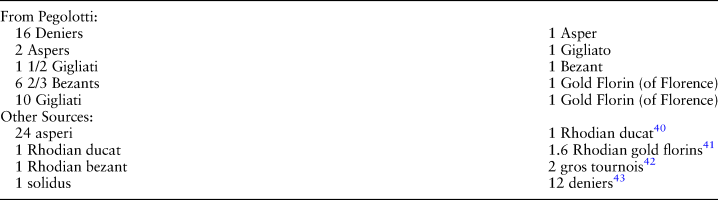
Shown in the fourth column of Appendix C are the annual rent arrangements for each of the grants. Of the 103 awards which mention rent, 91 specify rent money, while 10 have payments in kind.Footnote 37 Two [9, 28] combine both forms of payment. The most common form of currency used was the asper: others included florins of different geographical origin (for example, Rhodes, Florence and Naples); the bezant; the denarius or denier; the gros; the ducat; the gigliato and the solidus.Footnote 38 Table I below illustrates what is known from Pegolotti and other sources about the comparative value of each of these coins:Footnote 39
Value Equivalents of Currencies used for Rental Obligations on Rhodes

The florins and ducats from Rhodes were apparently less valuable than those from Florence or Venice, but care needs to be taken when establishing exchange rates as currencies fluctuated. Some 17 grants, however, one from as early as 1350 [38], do not specify an amount but merely refer to an accustomed census. Most of these incidents refer to vineyards, but some involve other features as well, such as an unquantifiable piece of land, houses and orchards. None, however, refer to a specific area of land, such as a modiata or casale, and it is thus impossible to form any view of what was meant by the term ‘accustomed census’.
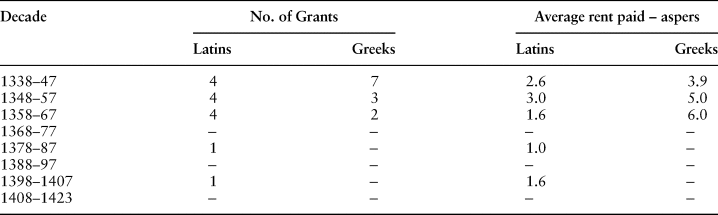
What can be deduced, however, from analyzing the various rental amounts charged? One way to assess rental trends throughout the period is to compare grants involving modiate with no additional feature and to equate, where a different coinage is used, payments to the asper equivalent. Table II below shows the payments made by Latins and Greeks over various periods of time:
Rents paid by Latins and Greeks for a modiata of land

Thus, average rents paid by Latins remained remarkably consistent over the period, while rents paid by Greeks appear to be higher. Two of the decades, however, ranging from 1348 to 1357 and 1358 to 1367, are distorted by one particular grant; once these are excluded [33 and 79], the average rent falls to 3.5 and 2.0 aspers respectively, bringing the payments by Greeks more into line with those paid by Latins.Footnote 44
Two other trends are noteworthy. The average price paid by Latins for a casale amounted to nearly 63 gold florins between 1358 and 1366. In contrast, the first two grants of a casale [34 and 63] were priced very inexpensively, while the last two grants in 1382 [94] and 1404 [137] were abnormally high, being 570 florins of Naples and 450 florins of Rhodes respectively. Grants involving mills were comparatively costly as the person owning the mill had the right to charge other inhabitants to mill their grain. Thus, one Greek paid 100 aspers for a water mill and one modiata of land [15], while subsequently two further Greeks paid 55 [21] and 60 aspers [69] for the site for a water mill, together with two modiate, and a mill respectively. Latins were also granted mills but with no discernible pattern of payment.Footnote 45
Conclusions
Not much evidence exists to indicate what the Rhodian Greeks may have thought of the Hospitallers. Nevertheless, an episode in Gregoras' History is interesting.Footnote 46 The historian recounts how a friend of his, Manuel Angelos, had visited Rhodes in 1342 and met some elderly Rhodians who remembered life before the Hospitaller conquest. Angelos was told that the loss of their liberty was a blow, but that they appreciated the military qualities of the Knights in defending them against attacks from overseas. The Rhodian Greeks went on to say that they did not feel exploited and had benefited from a justice system that was fair, and all the while that they had enjoyed material advantages derived from the provision of ample food supplies.
Hospitaller policy towards the Rhodian Greeks was undoubtedly influenced in a positive way by their experiences in Cyprus, where they held numerous estates populated largely by Greeks. It is unclear whether the Hospitaller leaders made a conscious decision to promote a harmonious relationship with their Greek subjects on Rhodes from the very start of their occupation, but they would have been encouraged to do so by the knowledge that they, the Greeks, represented a significant majority of the population and were, therefore, best treated with respect. The Hospitallers would also have been aware of the ongoing difficulties suffered by the Venetians in confronting a partly hostile Greek population in Crete.
Whatever their ideological or political views, the Hospitallers behaved in such a way as to create what appears to have been an economically successful island and lived with their Greek subjects in relative political and social peace. Their approach had several aspects, the major one, resulting from the Order's system of governance, being the policy of restricting the number of Latins awarded grants in feudum nobile and of regulating that Hospitallers be granted at most awards for their lifetime. With virtually no entrenched class of hereditary landowners, therefore, the Hospitallers treated the Greeks, again because of the Order's system of governance, in virtually the same way as Latin settlers as far as grants of perpetual emphyteusis were concerned. The grants to Latins may have been bigger in size, but the information contained in the documents about adjacent properties and their landholders indicates there were probably many more Greek landholders than there were Latin ones. The admittedly scant evidence suggests that Greeks were not charged much higher rents than Latins.
The exact terms of the peace treaty between the Rhodians and the Hospitallers when Rhodes was surrendered in 1309 have not survived. We do know that the Greeks were allowed to maintain their religious freedom and that the small landholders appear to have retained their properties. At any rate, the Greeks on the island did not rebel and, therefore, kept their side of the bargain. This allowed the Knights to concentrate their resources on defending the island against external enemies. Towards the end of the period under review, a Byzantine emperor, Manuel II, could write that ‘above all, the Hospitallers possessed more enthusiasm in defending Christians than some who might be more powerful’ and furthermore stated that ‘they had the reputation of not breaking their oaths’.Footnote 47 Consequently, the countryside of Rhodes enjoyed one of the more harmonious relationships between Latins and Greeks to be found in the post-1204 Byzantine world.
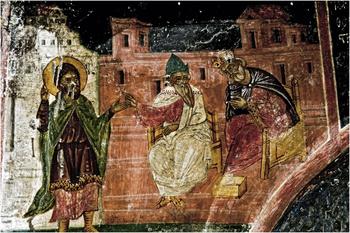
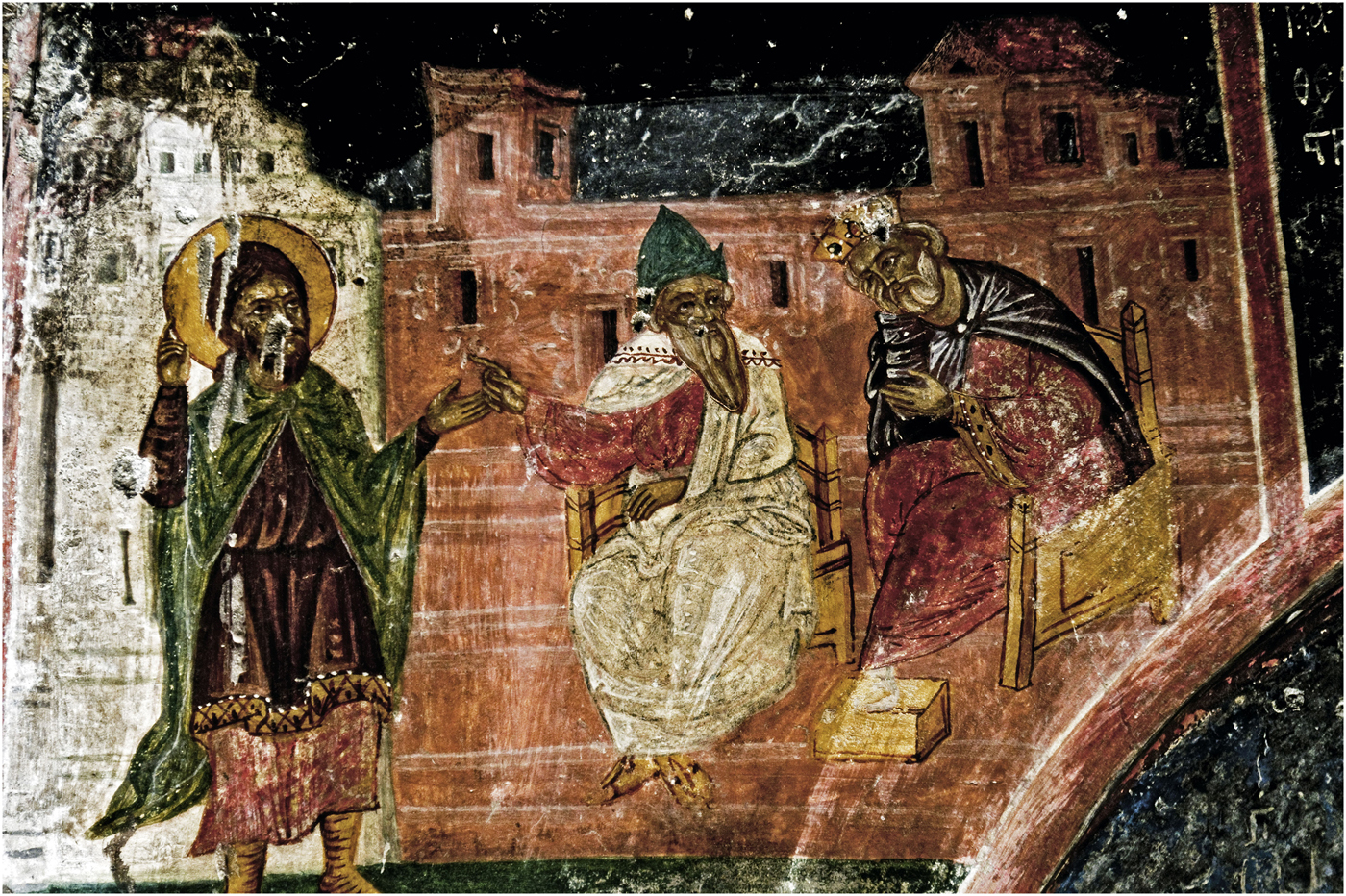
Fresco on the North Wall of the Church of Ag. Theodori near Archangelos
LIST OF MALTA DOCUMENTS: APPENDIX A (DATE, CODE, ETHNICITY AND RECIPIENT)
Appendix

*Archivo Histórico Nacional, Madrid, Sección de Ordenes Militares–San Juan de Jerusalén; Llengua de Aragón, Legajo 718
**Archivo Secreto Vaticano, Reg. Vat. 291, f.147v-148
LIST OF MALTA DOCUMENTS: APPENDIX B (LOCATION AND CASTELLANY)
Appendix

LIST OF MALTA DOCUMENTS: APPENDIX C (NATURE OF GRANT, TENURE, RENT AND LENGTH OF TERM)
Abbreviations: mon = Monastery, mod = modiate, jard = jardinum, vyd = vineyard, perp = perpetual, emph = emphyteusis, asp = asper, bez = bezant, fl = florin