INTRODUCTION
The gas test (Hohenheim Futterwert test: Menke et al. Reference Menke, Raab, Salewski, Steingass, Fritz and Schneider1979) is used routinely to evaluate and rank the nutritive value of fodders for ruminants (Nsahlai et al. Reference Nsahlai, Deka Siaw and Osuji1994; Bustan et al. Reference Bustan, Pasternak, Pirogova, Durikov, Devries, El-Meccawi and Degen2005). In this test, gas production (GP; CO2 and CH4) due to rumen fermentation of substrate to volatile fatty acids is measured when incubated with rumen liquor and the volume produced is used to estimate the organic matter digestibility and metabolizable energy yield (Menke & Steingass Reference Menke and Steingass1988). The gas test is a convenient method in that a large number of samples can be measured simultaneously over a relatively short period.
In most studies, cow liquor from rumen-fistulated cows is used. However, some ruminants such as sheep and cows are classified as grazers and consume mainly grasses and roughage, that is, fibrous forage rich in structural carbohydrates; others such as moose and kudu are browsers and consume predominantly woody and non-woody dicotyledonous plants, while others, such as goats and deer, are intermediate feeders and consume a mixture of the two (Hofmann Reference Hofmann1989; Gordon Reference Gordon2003). This would suggest that there could be differences in digestibility of a common feed among ruminant species depending on the classification of the ruminant. There are several reports that indicate that this may be the case.
Several in vivo studies reported that goats used low-quality, high fibrous feeds more efficiently than sheep (Gihad et al. Reference Gihad, El Bedawy and Mehrez1980; Domingue et al. Reference Domingue, Dellow and Barry1991 a, Reference Domingue, Dellow, Wilson and Barryb) and that red deer (Cervus elaphus) used feeds with high soluble carbohydrate and protein contents more efficiently than sheep and goats (Domingue et al. Reference Domingue, Dellow and Barry1991 a). Furthermore, it was reported that goats can consume and digest tannin-rich feeds to a greater extent than sheep (Bohra Reference Bohra1980; Degen et al. Reference Degen, Becker, Makkar and Borowy1995, Reference Degen, Blanke, Becker, Kam, Benjamin and Makkar1997).
In vitro studies using rumen liquor showed that dry and organic matter digestibilities across five substrates for cattle, goats and nilgai antelope (Boselaphus tragocamelus) were similar, but were substantially higher than those for white-tailed deer (Odocoileus virginianus) (Priebe et al. Reference Priebe, Brown and Swakon1987). These authors concluded that donor ruminant species may influence in vitro digestion. In a study comparing dromedaries (Camelus dromedarius) and sheep, acid detergent fibre (ADF) was utilized to a greater extent by dromedaries than by sheep and this was partly due to higher cellulytic activity of rumen micro-organisms in dromedaries (Kayouli et al. Reference Kayouli, Jouany, Demeyer, Ali-Ali, Taoueb and Dardillat1993). Ammar et al. (Reference Ammar, Lopez, Andres, Ranilla, Bodas and Gonzalez2008) compared sheep and goat rumen liquor for studies on dry matter (DM) digestibility and GP kinetics on leaves, flowers and fruits of five browse plant species; the authors found significant differences between ruminant species liquors, but these differences were not consistent among or within plant species. In spite of these differences, the authors concluded that when animals are fed the same diet, differences between sheep and goat rumen fluid used as source of inoculum can be considered of little nutritional significance.
In the current study, GP of leaves from seven fodder trees and shrubs from Nepal, incubated with rumen liquor from two grazer species (cows and sheep) and one intermediate feeder species (goats), was measured. It was hypothesized that there would be a difference among ruminant species and, as the feeds were browses, it was predicted that the GP from the leaves incubated with goat rumen liquor would be greater than those incubated with the liquors of the two grazers. One of the goals of the current study was to determine whether the rankings of GP, or quality index (QI), among plant species were similar among ruminant species, even though the absolute gas volumes produced may be different. To do this, a Mantel test was employed to determine whether the Euclidean distances between the QI of plant species were similar among ruminant species.
MATERIALS AND METHODS
Plant species and site of collection
Leaves from seven common fodder trees and shrubs, namely Kutmiro (Litsea monoplotela), Tanki (Bauhinia purpurea), Harro (Termialia chebula), Ginderi (Premma integrifolia), Bahadar (Artocarpus lakoocha), Koiralo (Bauhinia variegata) and Titepati (Artemesia vulgaris), were collected in January 2005, at the village of Katteldanda. January is a winter (October–March) month when there is a shortage of fodder leaves and green forage in the mid-hills of Nepal. Katteldanda, about mid-way between Kathmandu and Pokhara, is situated in the Ghorkas District (28°00′N; 84°37′E) in the mid-hills of Nepal. It is about 1097 m asl, receives an average annual rainfall of 1537 mm, usually between July and August, and has a minimum air temperature of about 8°C in winter (December–February) and a maximum air temperature of about 32°C in summer (April–August). Most families raise some five to six goats for meat and one to two water buffalo for milk. The livestock are tethered near the household and are fed mainly leaves collected from fodder trees and shrubs in a communal forest.
Composition of leaves
All measurements for each plant were undertaken in duplicate. DM composition of the samples was determined by drying in an oven at 50°C until constant mass. Higher temperatures are not recommended because phenolics can be inactivated directly and/or can bind with fibre. In addition, drying samples at 50°C and 80–90°C were compared and no difference in DM content was found. Samples were analysed for nitrogen (N) content by the Kjeldahl method and for ash by burning at 550°C (AOAC 1990). Crude protein was calculated as 6·25×N. Neutral detergent fibre (NDF), ADF and acid detergent lignin (ADL) were determined as described by Van Soest et al. (Reference Van Soest, Robertson and Lewis1991), applying a Fibertec System M6 (Tecator, Haganas, Sweden). Hemicellulose was calculated as the difference between NDF and ADF; cellulose as the difference between ADF and ADL. Condensed tannins (CTs) were determined using the butanol-HCl iron reagent and results were expressed as leucocyanidin equivalent (Porter et al. Reference Porter, Hrstich and Chan1986).
In vitro GP
In vitro GP measurements, using the Hohenheim Gas method (Menke et al. Reference Menke, Raab, Salewski, Steingass, Fritz and Schneider1979), can be used to estimate organic matter digestibility and metabolizable energy yield of feed samples; in this method, the gas produced in anaerobic fermentation of substrate is used to predict the nutritive value. Rumen liquor and particulate matter were collected via rumen fistulae before morning feeding from two cows, two sheep and two goats fed on a roughage diet of mainly poor quality wheat straw and some lucerne hay; the liquor was homogenized, strained and filtered through glass wool. Incubation medium was prepared as described by Menke et al. (Reference Menke, Raab, Salewski, Steingass, Fritz and Schneider1979). Samples, each of 200 mg DM, were incubated in triplicate in 100 ml calibrated glass syringes in which 30 ml of the incubation medium was added. The glassware was kept at 39°C and flushed with CO2 before use and the mixture was continually stirred under CO2 at 39°C. GP, as determined by piston movement, was measured over 24 h after correcting for GP due to rumen fluid alone.
To rank the browse samples, the method described by Conklin et al. (Reference Conklin, McDowell and Van Soest1991) was used. For each ruminant species, the GP of each browse sample was subtracted from the mean value of all browse samples and was divided by the standard deviation (s.d.) of the mean to produce a QI.
Statistical methods
To compare the QI of browses between sheep and goats, sheep and cows and goats and cows, Euclidean distances of the variables for each group were calculated, and a Mantel test (Mantel & Valand Reference Mantel and Valand1970) was used with 9999 iterations to calculate the probability of this comparison (GenAlex software package version 6 for Excel). A significant congruence between standardized Euclidian distances of QI between ruminant donor species would indicate similar rankings of the browse species when using rumen liquor from either of the ruminant species. This method has been used widely in many areas of biological research and is particularly well suited for nutritional studies. It is a non-parametric test that is appropriate for comparisons when sample sizes are small (Luo & Fox Reference Luo and Fox1996) and has been proven to be superior to Pearson's correlation statistic (Dutilleul et al. Reference Dutilleul, Stockwell, Frigon and Legendre2000).
A paired t test was used to test for differences in GP between each pair of ruminant species.
RESULTS
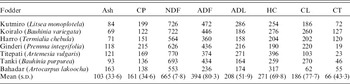
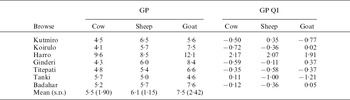
Mean crude protein of the seven browse species was 161±32 g DM/kg (range between 120 and 220 g/kg DM) and mean CTs was 661±40 g/kg DM content and ranged between 20 and 130 g/kg DM (Table 1). Mean 24 h GP of the browses (Table 2) incubated with goat liquor (7±2·4 ml per 200 mg substrate) was significantly (P=0·02) higher than the GP incubated with cow liquor (5±1·9 ml), while GP with sheep liquor (6±1·1 ml) was intermediate, not significantly different from cow liquor (P=0·20), but approached significant difference from goat liquor (P=0·06).
Ash, crude protein (CP), NDF, ADF, hemicellulose (HC), cellulose (CL) (all in g/kg) and CTs(expressed as leucocyanidin equivalent) of seven fodder trees and shrubs

The 24 h GP (ml/200 g DM) for seven browse species incubated with rumen liquors from cows, sheep and goats and the QI of the browse species

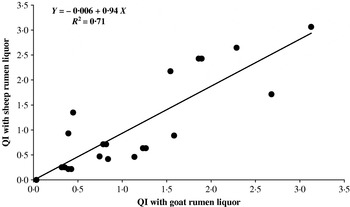
According to the QI, Harro ranked first among browses for all three ruminants (Table 2). However, there were some differences in the ranking order for the various browses among the ruminant species. For example, Ginderi ranked lowest with cow liquor, but Titepati was lowest with sheep liquor and Kutmiro with goat liquor. A Mantel test with 9999 permutations indicated a significant correlation between goat and sheep (P=0·01) browse rankings, but approached significance between both cow and sheep (P=0·10) and cow and goat (P=0·09) rankings. The regression of Euclidian distances of QI of browse species incubated with sheep rumen liquor and with goat rumen liquor took the form (Fig. 1):

Regression of Euclidian distances of QI of browse species incubated with sheep rumen liquor and with goat rumen liquor (Y=−0·006+0·94X; R 2=0·71). See text for explanation.

DISCUSSION
Goats are intermediate feeders and consume both grasses and browse, whereas sheep and cows are grazers and consume mainly grasses. This led to the hypothesis that there are differences among ruminant species in their ability to utilize forages and to predict that browsers use browse more efficiently than grazers. Consequently, it was predicted that the GP from browse incubated with goat rumen liquor would produce more gas than browse incubated with cow or sheep liquor. The prediction was partly supported in that the GP of browse incubated with goat liquor rumen was significantly higher than browse incubated with cow rumen liquor and approached significance when compared with GP of browse incubated with sheep rumen liquor.
Other studies have been equivocal as to whether rumen liquor donors affect in vitro evaluation of feeds. Priebe et al. (Reference Priebe, Brown and Swakon1987) concluded that donor rumen liquor affects digestion following their findings that organic matter digestibility using rumen liquors from cattle, goats and nilgai antelope were similar but were substantially higher than from white-tailed deer. In contrast, Ammar et al. (Reference Ammar, Lopez, Andres, Ranilla, Bodas and Gonzalez2008) concluded that the use of sheep or goat rumen liquor does not affect nutritional studies although some significant differences were found between the two small ruminant species. Calabrò et al. (Reference Calabrò, López, Piccolo, Dijkstra, Dhanoa and France2005) found that feeds were digested more extensively with sheep than buffalo (Bubalus bubalis) rumen liquor and differences between ruminant species increased with more fibrous feeds, while Salem (Reference Salem2005) reported that rumen fluid of buffalo produced more gas than rumen fluids of cattle and sheep fed the same diet and suggested that it may reflect differences in fermentation capacity. In the assessments of a number of feeds, Bueno et al. (Reference Bueno, Cabral Filho, Gobbo, Louvandini, Vitti and Abdalla2005) reported no difference in asymptotic GP and organic matter digestibility between sheep and cow rumen liquor but that the rate of fermentation was higher with cow than sheep rumen liquor.
In the current study, browse incubated with sheep liquor produced an intermediate volume of gas between that of goat and cow liquors. Although both sheep and cows are classified as grazers, there are differences in the amount of browse they consume. In a study of grazing sheep (West African Djallonké breed), goats (West African Maradi breed) and cattle (crossbreeds of Soudanais Peul zebu, Bos indicus, and the Bambara or Mere breed, Bos taurus), in southwestern Burkina Faso, goats browsed significantly more than sheep and cattle during the cool season. Sheep browsed significantly more than cattle in the rainy season, when the goats were not allowed to graze (Ouédraogo-Koné et al. Reference Ouédraogo-Koné, Kaboré-Zoungrana and Ledin2006). The trend of GP of the browse in this latter study was similar to the grazing behaviour of the three ruminants in that goats browsed most, followed by sheep and then by cows.
Differences in in vivo digestibility between ruminant species may also be related to body size, morphology of the digestive tract and physiological characteristics such as retention time of digesta. A prominent example is the increase in salivary gland size, in particular, the parotids, from grazers to intermediate feeders to browsers (Hofmann Reference Hofmann, Dobson and Dobson1988). Salivary glands contain proline, which binds with and neutralizes the negative effects of tannins. However, when comparing 28 species of artiodactyls that differed in dietary intake (grazers, mixed feeders and browsers), Pérez-Barberia et al. (Reference Pérez-Barberia, Gordon and Illius2001) concluded that there is no consistent evidence to support a significant adaptive effect of stomach morphology to different diets and, in another report, Gordon (Reference Gordon2003) concluded that there is little substantive evidence for differences in morphology and physiology between the feeding categories once body mass and phylogenetic relationships have been taken into account. However, body size is an important adaptive characteristic (Schmidt-Nielsen Reference Schmidt-Nielsen1984) of animals and, consequently, its effect should not be removed from analyses (Smith Reference Smith1980).
The seven browse species in the current study were of low quality and generally of high tannin content. Goats appear to defend against tannins better than sheep by being able to detoxify tannins or their degraded products (Distel & Provenza Reference Distel and Provenza1991). This difference between species may be due, at least in part to tannase, which has been identified in the rumen mucosa of goats (Begovic et al. Reference Begovic, Dusic, Sacirbegovic and Tatro1978). Goats, sheep and cows do not produce proline-rich salivary proteins as a mechanism for neutralizing tannins (Austin et al. Reference Austin, Suchar, Robbins and Hagerman1989; Distel & Provenza Reference Distel and Provenza1991). However, presence of salivary proteins, other than proline-rich proteins, having high affinity for tannins cannot be discounted (Austin et al. Reference Austin, Suchar, Robbins and Hagerman1989; Makkar & Becker Reference Makkar and Becker1993).
The in vitro differences in GP in the present study among rumen fluid liquors would indicate that there were differences in rumen microflora among species, although their diets were similar. Similarly, reports are equivocal. Jones et al. (Reference Jones, Meyer, Bechaz, Stolts, Palmer and van der Merwe2001) compared rumen fluid from a number of South African browsers, intermediate feeders and a grazer (sheep) and concluded that rumen microbial populations from browsers are not able to ferment tanniniferous forages better than rumen microbial populations from grazers. It seems likely that these browsers do not have rumen bacteria capable of degrading the CTs in these shrub legumes. In contrast, Odenyo et al. (Reference Odenyo, McSweeney, Palmer, Negassa and Osuji1999), who compared the capabilities of rumen liquor from a number of African ruminants, concluded that rumen fluid from goat, Grant's gazelle (Gazella granti), Gunther's dik-dik (Madoqua guentheri) and impala (Aepyceros melampus) effectively fermented tannin-rich fodders, and therefore may harbour tannin tolerant or degrading micro-organisms. Gordon (Reference Gordon2003) argued that the findings of Odenyo et al. (Reference Odenyo, McSweeney, Palmer, Negassa and Osuji1999) were dietary-specific and not species-specific as each of the ruminant species consumed different diets. However, a tannin–protein complex degrading bacteria (streptococci; Enterococci faecalis) was isolated in the faeces of goats, which never consumed tannin-rich diets previously (Goel et al. Reference Goel, Puniya and Singh2007). This would suggest that there are species-specific, in addition to dietary-specific, microflora in ruminants. Furthermore, in a study comparing dromedaries and sheep (Kayouli et al. Reference Kayouli, Jouany, Demeyer, Ali-Ali, Taoueb and Dardillat1993), both species contained similar microflora, but due to higher cellulytic activity of micro-organisms in dromedaries, ADF was utilized to a greater extent by dromedaries than by sheep.
GP is a consequence mainly of two processes: fermentation of carbohydrates to acetate and butyrate and fermentation to proprionate which produces gas only from buffering of the acid. Feeds that produce high levels of propionate would, therefore, yield lower volumes of gas. While, for closely matched feeds fermentation stoichiometry is likely to be similar, that is, the feeds will produce the same molar proportions of acetate:butyrate:propionate, and therefore the same volumes of fermentation gas for each unit of digested feed, this is unlikely to occur for dissimilar feeds, as was the case in the current study. This would imply that comparisons of similar forages among ruminants, as was the case in the current study, is more reliable than comparisons among forages within a ruminant species. However, in a comparative study of sheep and red deer rumen fluids, Hervás et al. (Reference Hervás, Ranilla, Mantecón, Tejido and Frutos2005) found significant differences in the molar proportions of volatile fatty acids and suggested a divergence in fermentation pathways and that fermentation might have been more efficient in deer than in sheep. This suggests that inclusion of volatile fatty acid molar proportions to GP would improve the assessment of forage quality.
The Mantel test showed a significant correlation between goat and sheep browse rankings, but approached significance between both cow and sheep and cow and goat rankings. It was concluded that the dietary habits of ruminant species donors may affect in vitro nutritional studies when using rumen liquor, which was also suggested by Mould et al. (Reference Mould, Kliem, Morgan and Mauricio2005) who proposed that wherever possible the inoculum should be obtained from an appropriate host animal fed similar feedstuffs.
We thank an anonymous referee for very helpful suggestions, Nhuchhe Lal Tamraker for help with all aspects of the research, Raj Kumar Jha for fodder sample analyses, Basanta Shrestha, Sanjeev Panday and Prajwal Regmi for sample collection, Bishnu Rana Magar and the late Roger W. Benjamin for helpful discussions. We also thank Abdullah Abou-Rachbah and Sammy Abou-Rachbah for taking care of the animals. Special thanks to the farmers who helped us collect samples and for their warm hospitality. We also thank Eli Gefen for suggestions on statistical methods. The research was funded by the US–Israel Cooperative Development Research Program, Office of the Science Advisor, United States Agency for International Development (USAID), under Grant Number TA-MOU-00-C17-014 and the Israeli Ministry of Science.