Introduction
Laryngopharyngeal reflux refers to the retrograde flow of gastric contents into the laryngopharynx, whereby gastric material comes into contact with upper aerodigestive tract tissue and consequently damages it. Koufman was the first to recognise laryngopharyngeal reflux as an entity distinct from classical gastroesophageal reflux.Reference Koufman1 Although the two conditions are similar, laryngopharyngeal reflux has a more significant impact on the patient's social functioning and general vitality.Reference Carrau, Khidr, Crawley, Hillson, Davis and Pashos2
Laryngopharyngeal reflux has been shown to be either the prime aetiological factor or a significant aggravating factor in more than 50 per cent of patients with hoarseness.Reference Fraser3 Despite being an established causative or contributing factor to numerous otorhinolaryngological diseases, laryngopharyngeal reflux remains a subjective entity in view of the absence of definite diagnostic criteria. There is no pathognomonic symptom or sign for laryngopharyngeal reflux. However, this clinical problem is now beginning to be addressed, with the development and validation of various assessment instruments.
The Reflux Symptom Index was introduced by Belafsky et al. Reference Belafsky, Postma and Koufman4 It is widely used to analyse patients' perceptions of possible laryngopharyngeal reflux. Besides being useful in establishing an initial diagnosis of laryngopharyngeal reflux, the Reflux Symptom Index can also be utilised to assess disease severity and to monitor treatment efficacy. However, it has been criticised for not including throat pain, which other authors have found in 40 per cent of laryngopharyngeal reflux patients.Reference Qadeer, Swoger, Milstein, Hicks, Ponsky and Richter5
The Reflux Finding Score was also developed by Belafsky et al. in an effort to standardise the reporting of laryngoscopic findings for patients with laryngopharyngeal reflux, in order to improve diagnosis, evaluation of clinical improvement and assessment of therapeutic efficacy.Reference Belafsky, Postma and Koufman6 Of the signs assessed by the Reflux Finding Score, laryngeal pseudosulcus has been found to be an accurate predictor of laryngopharyngeal reflux, with an observed sensitivity and specificity of 70 to 77 per cent.Reference Hickson, Simpson and Falcon7 The main criticism of the Reflux Finding Score is that it is subjective, as it depends upon the experience of the laryngologist performing the grading.
A more objective and widely practised method used to diagnose laryngopharyngeal reflux is ambulatory, 24-hour, double-probe pH monitoring. When utilising this method, the most common parameters used to evaluate laryngopharyngeal reflux are the number of reflux episodes with a drop to pH 4 in 24 hours, and the percentage of time the pH is below 4 (i.e. the reflux index). However, the normal pH of the hypopharynx is not well defined. Some authors have proposed that, for the hypopharynx, a drop in pH to less than 5 is a more reliable indicator of proximal reflux. This is due to pH neutralising factors such as saliva (which neutralises acid primarily due to its bicarbonate content) and airway secretions.Reference Dobhan and Castell8 This alteration in pH drop threshold has also been proposed by Panetti et al., based on assessment of the mean pH at the upper oesophageal sphincter in asymptomatic controls.Reference Panetti, Pearson, Dettmar and Koufman9
The proton pump inhibitor test comprises a short course of high-dose proton pump inhibitor, and is used to diagnose gastroesophageal reflux disease and non-cardiac chest pain.Reference Locke, Talley, Fett, Zinsmeister and Melton10 It has been used widely in the Western world for more than a decade. However, to date only a few studies have examined the utility of proton pump inhibitors in patients with extra-oesophageal reflux. In 1997, Metz et al. undertook a pilot study of proton pump inhibitor testing in 10 patients with laryngeal reflux symptoms, using omeprazole 20 mg twice daily for a month, and reported a sensitivity of 62.5 per cent.Reference Metz, Childs, Ruiz and Weinstein11 The current recommendation for conducting an empirical trial of aggressive acid suppression with proton pump inhibitors suggests twice daily treatment for at least four months.Reference Habermann, Kiesler, Eherer and Friedrich12
In Malaysia, 24-hour, double-probe pH monitoring is the most sensitive tool available for the diagnosis of laryngopharyngeal reflux. However, it is invasive, painful, complicated and expensive, and is only available in two state-run hospitals nationwide. In addition, its sensitivity and specificity are affected by many external factors.Reference Belafsky and Rees13 In contrast, the proton pump inhibitor test is simple, readily available in both urban or rural areas, and can be performed by primary care physicians with no specific training. It is also non-invasive, painless, and does not affect the patient's appearance or cause absence from work.
In this study, we aimed to determine the sensitivity and specificity of intensive empirical treatment with pantoprazole (a proton pump inhibitor) in diagnosing laryngopharyngeal reflux in adults. Pantoprazole was used in this study because it is the commonest proton pump inhibitor used in our otorhinolaryngology clinic at Universiti Kebangsaan Malaysia Medical Centre. Studies have shown that it is as effective as any other proton pump inhibitor in elevating gastric pH and reducing intra-oesophageal acid exposure.Reference Brett14, Reference Goh, Benamouzig, Sander and Schwan15 We hoped that our findings would aid rural and primary care physicians to diagnose and treat patients with laryngopharyngeal reflux.
Materials and methods
Subjects
Between September 2007 and December 2008, we enrolled in the study 55 consecutive patients from our otorhinolaryngology clinic at Universiti Kebangsaan Malaysia Medical Centre. All patients were aged between 18 and 60 years old, and had a Reflux Symptom Index of more than 13 or a Reflux Finding Score of more than 7.
We excluded from the study patients with: a history of throat trauma; neurological causes of dysphonia or dysphagia; any oesophageal or hypopharyngeal cancer; concomitant proton pump inhibitor treatment; or adverse reactions secondary to proton pump inhibitor treatment.
The study proposal was reviewed and approved by the Universiti Kebangsaan Malaysia research and ethics committee (project code FF-233-2007).
Data collection
Initially, all patients were asked to complete a personal data questionnaire and a Reflux Symptom Index table.
Patients then had their height and weight measured and their body mass index calculated. A general physical examination was performed.
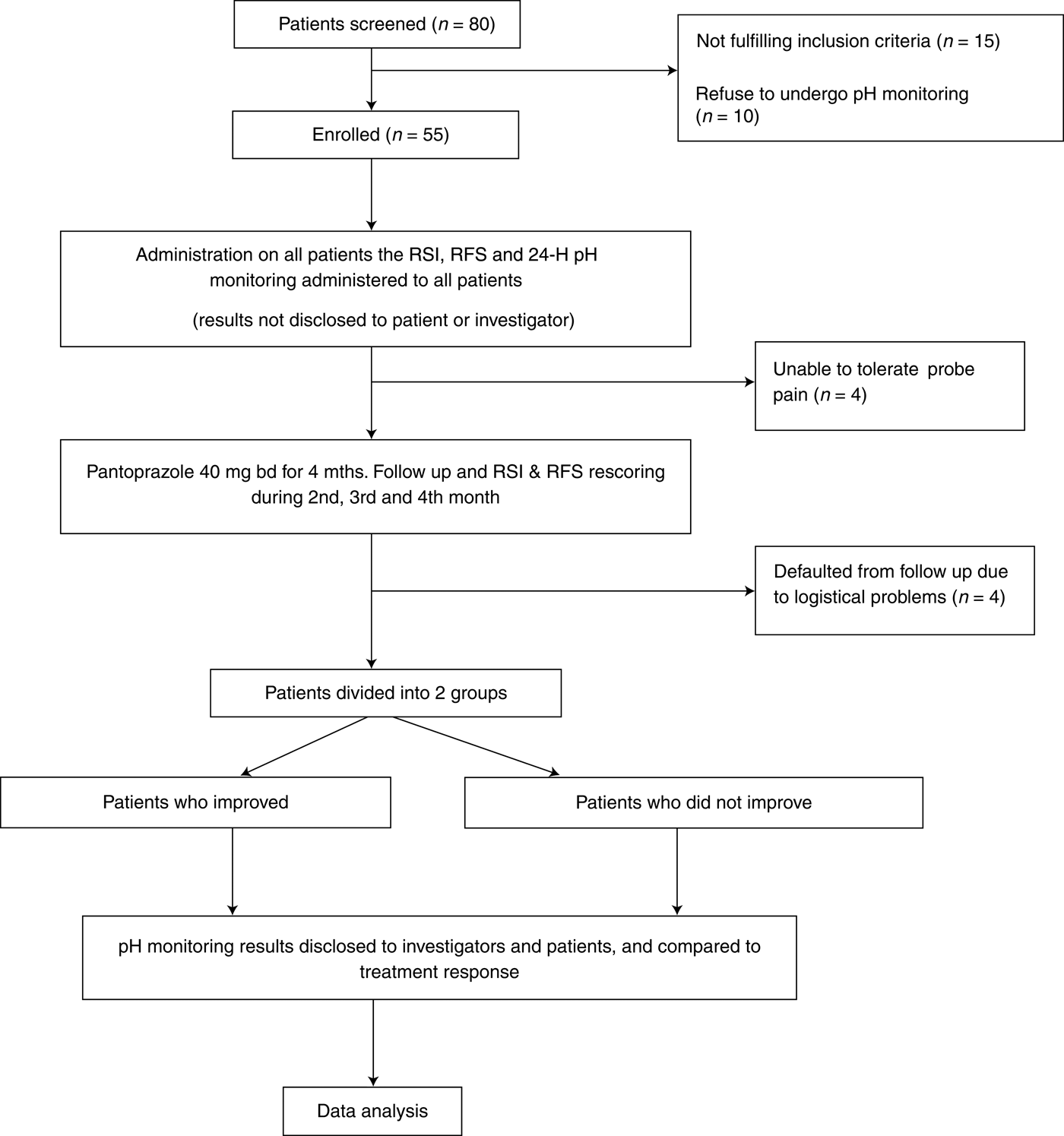
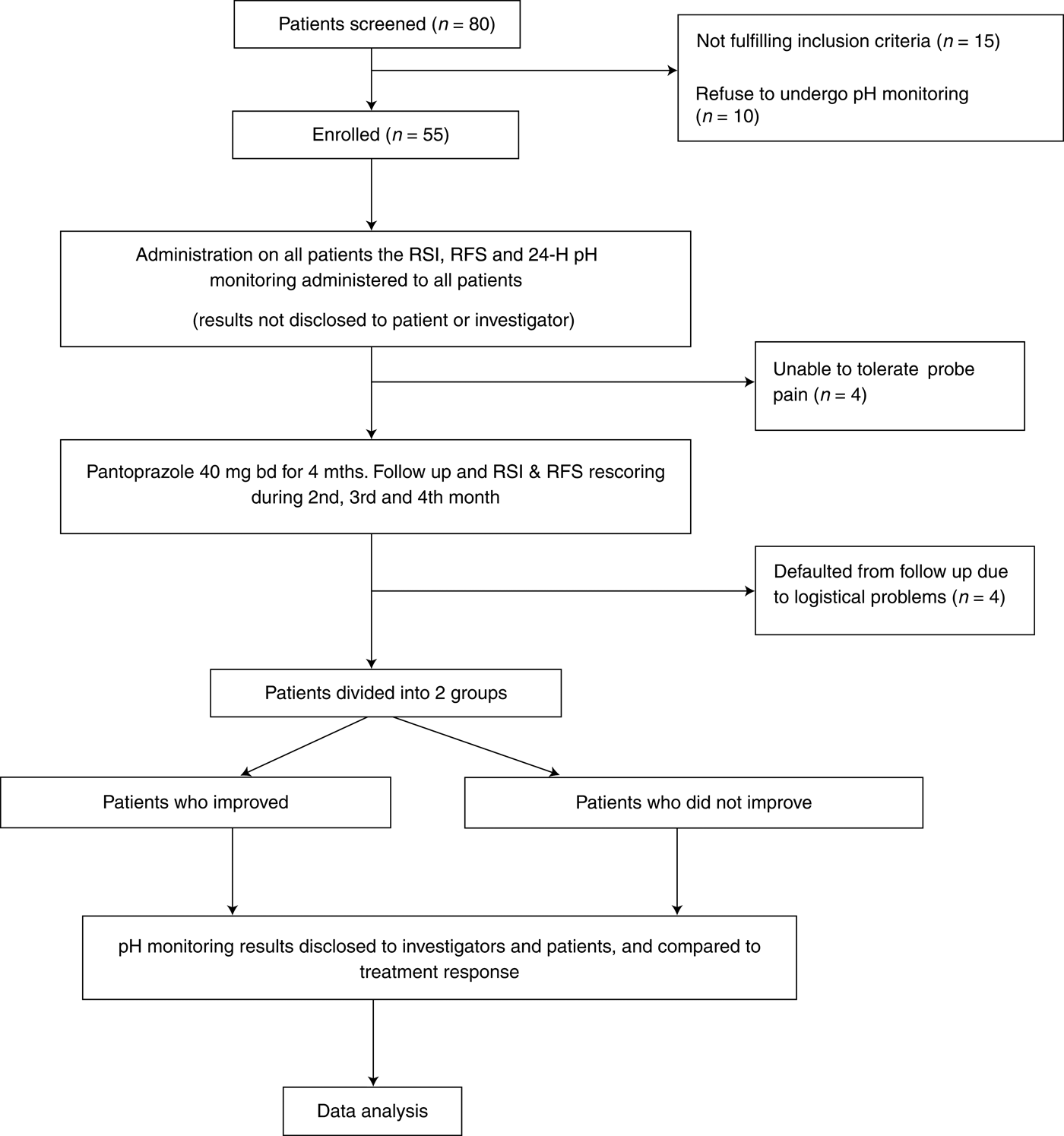
A laryngeal examination was performed using a 4 mm, 70° rigid endoscope (Karl Storz, Tuttlingen, Germany). Endoscopic images were recorded, and the Reflux Finding Score calculated and documented (Figure 1).
Summary of study progress.
Flexible fibre-optic laryngoscopy was then performed on each patient. The distance between the tip of the nasal alar and the area just above the pyriform fossa was measured and marked on the flexible scope tubing.
All patients then underwent 24-hour, double-probe pH monitoring. The catheter was inserted such that the upper probe was located just above the cricopharyngeus muscle, so that the catheter insertion length corresponded to the measurement documented earlier during flexible laryngoscopy. The lower probe was placed 15 cm distal to the upper probe. Patients were then permitted to return home, but were instructed to avoid carbonated drinks. After the 24-hour monitoring period, patients returned to the clinic for removal of the probe. The level of discomfort experienced by each patient during probe placement was documented using a visual analogue scale score.Reference Ho, Spence and Murphy16
The results of 24-hour pH monitoring were not disclosed to either the investigator or the patient until the patient had completed four months of empirical pantoprazole treatment. The test was considered positive if the proximal probe recorded any abrupt pH drops to less than 5, with an accompanying or preceding pH drop to less than 4 recorded at the distal probe. Only 1 event of simultaneous pH change in both the proximal and distal probes is required to objectively diagnose laryngopharyngeal reflux.
All patients were treated empirically with pantoprazole 40 mg twice daily for four months. The Reflux Symptom Index and Reflux Finding Score were reassessed during follow-up appointments in the second, third and fourth month of treatment. After four months' treatment, patients with a Reflux Symptom Index improvement of 10 or more, or a Reflux Finding Score improvement of 5 or more, were considered to be positive for laryngopharyngeal reflux. The presence or absence of improvement with empirical treatment was then compared to the patient's pH monitoring result.
Any patients showing no symptomatic improvement after two months of compliant treatment were referred to the surgical department for further endoscopic assessment.
Statistical analysis
In order to calculate our sample size, we assumed that 20 per cent of the Asian population have laryngopharyngeal reflux.Reference Lam, Wei, Hui and How17 Our sample size calculation formula used a β value of 0.8 (i.e. a power of 80 per cent) and an α value of 0.05, and was based on the estimate that there would be at least a 10 per cent difference. Collected data were analysed using the Statistical Package for the Social Sciences version 13 software program (SPSS Inc, Chicago, Illinois, USA), following consultation with a statistician. Data analyses were performed using the non-parametric Kruskal–Wallis, Friedman and Mann–Whitney tests. A p value of less than 0.05 was considered statistically significant. The Friedman test was used to assess improvement in the Reflux Symptom Index and Reflux Finding Score. The Spearman correlation test was used to assess correlation between laryngopharyngeal reflux and body mass index.
Results
Fifty-five patients were initially enrolled in the study. The drop-out rate was 14.5 per cent; this was mainly due to inability to tolerate the probe within the upper aerodigestive tract, and also to logistical problems.
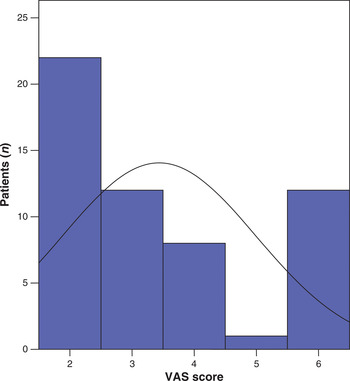
All of the 55 patients enrolled in the study reported discomfort or pain during pH monitoring. Although the majority (40 per cent) complained of only mild pain, nearly a quarter (23.6 per cent) experienced pain so severe that they had to drastically reduce or even cease their normal daily activities. Figure 2 shows patients' reported level of discomfort during pH probe insertion.
Level of discomfort or pain reported by patients following pH probe insertion, assessed by visual analogue scale (VAS) scoring. Mean score = 3.44; standard deviation = 1.56. 2 = mild pain, but able to do daily activities; 3 = uncomfortable, nagging pain, able to do daily activities but need to rest in between; 4 = miserable and distressed, some activities limited; 5 = horrible, intense pain, most daily activities limited

In our patients, the most common presenting laryngopharyngeal reflux symptom was foreign body sensation (40.43 per cent), followed by hoarseness (23.4 per cent), cough (14.89 per cent) and excess mucus in the throat (10.64 per cent). Choking was the main presenting symptom in only 6.38 per cent of patients, and dysphagia in 4.26 per cent.
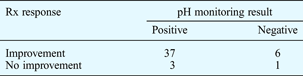
Of the 47 patients who completed the study, 37 had both an improvement in reflux scores and a positive pH monitoring result. Six patients had a negative pH monitoring result but still showed improvement in either their Reflux Finding Score or Reflux Symptom Index, and were satisfied with their treatment.
Three patients showed no improvement in reflux scores but had a positive pH monitoring result. Two of these three complained of worsening dyspepsia and flatulence, with one having mild nausea but no vomiting. These three patients were further evaluated endoscopically by the surgical team, but no abnormality was found.
Only one patient had neither improvement of reflux scores nor a positive pH monitoring result. This patient also underwent endoscopic evaluation via gastroesophagoduodenoscopy, which revealed no abnormalities.
The sensitivity of empirical pantoprazole treatment in the diagnosis of laryngopharyngeal reflux was found to be 92.5 per cent. The specificity, however, was 14.2 per cent. The positive predictive value was 86 per cent and the negative predictive value 25 per cent. Table I shows the results table used to calculate the above values.
Summary of study results
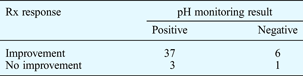
Data represent patients numbers. Rx = empirical pantoprazole treatment
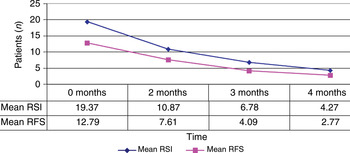
Patients' total Reflux Symptom Index and Reflux Finding Score results were significantly reduced after empirical pantoprazole treatment, compared with baseline measurements (Figure 3). A larger improvement in these scores was seen between the baseline and second month measurement points, compared with the third and fourth month measurement points. The overall mean Reflux Symptom Index ± standard deviation (SD) at baseline was 19.87 ± 7.196. After two months of treatment, this improved significantly, to 10.87 ± 7.331 (p < 0.001). Further significant improvements were noted at three months (6.78 ± 6.037) and at four months (4.27 ± 4.294) (p < 0.001 for both improvements). The overall mean baseline Reflux Finding Score ± SD was 12.79 ± 3.827. Significant improvements in this parameter were noted at two months (7.61 ± 4.522), three months (4.09 ± 3.292) and four months (2.77 ± 2.631) (p < 0.001 for the improvement noted during all consequent assessments done after the second, third and fourth month of Pantoprazole treatment).
Patients' Reflux Symptom Index (RSI) and Reflux Finding Score (RFS) results with empirical pantoprazole treatment.

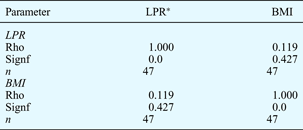
There was no significant correlation between body mass index and laryngopharyngeal reflux (diagnosed based on pH monitoring) (Spearman's correlation coefficient = 0.119, p = 0.427) (Table II).
Correlation between BMI and LPR*
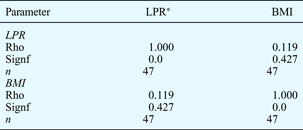
* As diagnosed by positive results on 24-hour, double-probe pH monitoring. BMI = body mass index; rho = Spearman's correlation coefficient; signf = significance (two-tailed)
Pantoprazole has various undesirable side effects which can involve multiple organ systems. These side effects were explained to each patient prior to enrolment in the study. Over the four-month treatment period, two patients complained of mild gastrointestinal disturbance after pantoprazole administration. No other adverse effects of pantoprazole were reported.
Discussion
Laryngopharyngeal reflux is a relatively newly diagnosed condition in Malaysia. In the Western world, however, there is a high incidence of this disease: approximately 10–30 per cent of patients visiting the otolaryngologist, and more than half of all patients with voice and laryngeal problems, have conditions related to laryngopharyngeal reflux.Reference Belafsky, Postma and Koufman4, Reference Koufman, Amin and Panetti18 However, to our knowledge the prevalence of laryngopharyngeal reflux in the Malaysian population has not previously been documented. It is possible that the Malaysian prevalence of this condition varies greatly from that in Western countries, owing to Malaysia's multiracial population and differences in diet and lifestyle.
In the case of gastroesophageal reflux disease, the prevalence in Asia is 2–5 per cent, very much lower than that in Western countries (29–44 per cent).Reference Pan, Xu, Ke, Han, Guo and Li19–Reference Shaker, Castell, Schoenfeld and Spechler21 The cause of this reduced prevalence is unknown, but genetics and environmental factors may have a protective effect, and under-reporting may also play a role.Reference Goh, Chang, Fock, Ke, Park and Lam20, Reference Ho, Lee and Wong22
Although the proton pump inhibitor test is commonly used as a diagnostic tool in cases of gastroesophageal reflux disease, the reported sensitivity and specificity vary widely, being respectively 27 to 89 per cent and 35 to 73 per cent.Reference Gasiorowska and Fass23 At present, there is no agreed ‘gold standard’ for gastroesophageal reflux disease diagnosis. The best diagnostic investigation is currently considered to be a combination of gastroesophageal endoscopy and 24-hour oesophageal pH monitoring. However, neither of these tests is able to detect functional gastroesophageal reflux (‘heartburn’). It has been estimated that 50 per cent of patients with functional heartburn improve after proton pump inhibitor treatment.Reference Lind, Havelund, Carlsson, Anker-Hansen, Glise and Hernqvist24 Therefore, it is postulated that the proton pump inhibitor test may be more sensitive and specific than alternative diagnostic options, since this test can also detect those patients with functional heartburn responsive to anti-reflux treatment.
In our study, the sensitivity of the proton pump inhibitor test for laryngopharyngeal reflux diagnosis was 92.5 per cent. This high sensitivity indicates that the proton pump inhibitor test is a good identifier of laryngopharyngeal reflux. However, the specificity of the test was only 14.2 per cent, suggesting that the test is a poor identifier of patients without laryngopharyngeal reflux. As stated above, there is no currently agreed gold standard for laryngopharyngeal reflux diagnosis. Twenty-four-hour, double-probe pH monitoring has a reported sensitivity of 17.5 to 80 per cent for laryngopharyngeal reflux diagnosis.Reference Belafsky and Rees13 Despite this wide variance in reported sensitivity, we used 24-hour, double-probe pH monitoring as it was the most sensitive tool available for laryngopharyngeal reflux diagnosis in Malaysia. Currently, the best method for laryngopharyngeal reflux diagnosis may be a combination of double-probe pH monitoring, patient symptom assessment and laryngoscopy.Reference Park, Hicks, Khandala, Richter, Abelson and Milstein25
Our study findings indicate that the proton pump inhibitor test had a positive predictive value of 86 per cent for the diagnosis of laryngopharyngeal reflux. This value estimates the likelihood that a person who improves with proton pump inhibitors actually has laryngopharyngeal reflux. Our study findings indicated that the proton pump inhibitor test had a negative predictive value of 25 per cent. This value reflects the likelihood that a person who does not improve with proton pump inhibitors is disease-free.
Belafsky et al. investigated patients with uncomplicated laryngopharyngeal reflux, defined as a pharyngeal reflux event of pH less than or equal to 4, without any evidence of glottic or subglottic stenosis, carcinoma, leukoplakia, paradoxical vocal fold motion, or granuloma formation.Reference Belafsky, Postma and Koufman26 These authors found that laryngopharyngeal reflux symptoms improved over two months of therapy (proton pump inhibitor), with no significant additional improvement thereafter. In addition, they found that the Reflux Symptom Index improved before any significant improvement was noted in the Reflux Finding Score. In contrast, our study found that significant improvement in the Reflux Symptom Index occurred simultaneously with significant improvement in the Reflux Finding Score, beginning from the second month of treatment. Improvements in both scoring systems were most significant after the second month of treatment, but continued to be significant even after the third and fourth month. The difference between these two study findings may be due to the fact that our study included patients with vocal process granuloma and paradoxical vocal fold motion.
• Laryngopharyngeal reflux is a common disease with a significant negative impact on patients' quality of life
• There is no pathognomonic sign or symptom, or any ‘gold standard’ diagnostic method
• The most sensitive test, 24-hour, double-probe pH monitoring, is commonly used but is expensive, uncomfortable and not widely available, with a broad range of sensitivity and specificity
• The proton pump inhibitor test is a simple, painless, inexpensive, non-invasive and easily accessible tool for laryngopharyngeal reflux diagnosis, which can be used both as a first-line diagnostic strategy and an empirical treatment for laryngopharyngeal reflux
There is a strong association between gastroesophageal reflux disease and obesity. An increased body mass index has been shown to correlate with an increased risk of gastroesophageal reflux disease related hospitalisation.Reference Ruhl and Everhart27 Halum et al. reported that gastroesophageal reflux disease was associated with increased body mass index and obesity; however, they also found that laryngopharyngeal reflux was not associated with increased body mass index or obesity.Reference Halum, Postma, Johnston, Belafsky and Koufman28 We too found no significant correlation between laryngopharyngeal reflux and body mass index, further supporting the premise that elevated body mass index and obesity have no relationship to pharyngeal reflux events. However, laryngopharyngeal reflux usually coexists with gastroesophageal reflux disease. Thus, it would be reasonable to recommend weight reduction in overweight patients with both gastroesophageal and laryngopharyngeal reflux. For patients with isolated laryngopharyngeal reflux, however, weight reduction counselling may not be helpful in reducing reflux symptoms.
Throughout our study, we assessed patients' level of discomfort experienced during 24-hour, double-probe pH monitoring. All of the 55 patients enrolled in the study reported some discomfort or pain. Although the majority (40 per cent) complained of only mild pain, nearly a quarter (23.6 per cent) reported pain so severe that they had to drastically reduce or even cease their daily activities. These results did not include the many patients who declined to join the study after hearing that they would be required to wear the pH monitoring device for 24 hours. In Malaysia, the use of 24-hour, double-probe pH monitoring is limited to only two hospitals nationwide. In addition, patients are required to pay a minimum of RM200 (approximately £42) to purchase the disposable probe (which must be imported and is not always available). Furthermore, insertion of the catheter containing the probe requires special training in order to properly locate the proximal probe just above the upper oesophageal sphincter. Therefore, in order to confirm the diagnosis of laryngopharyngeal reflux in Malaysia, we are currently forced to ask patients to undergo 24-hour, double-probe pH monitoring, a test which is invasive, painful, complicated, expensive and not easily available, and which has a sensitivity and specificity which may be high or low depending upon many external factors.
Conclusion
The proton pump inhibitor test not only has a high sensitivity in diagnosing laryngopharyngeal reflux but also is an uncomplicated, economical form of investigation for this pathology.
Acknowledgement
The authors wish to advise that Nycomed GmbH, suppliers of the pantoprazole used in the study, had no involvement in study design, data collection, data analysis, data interpretation, report writing or the manuscript submission process.