Introduction
Problematic memory functioning in older adults can be classified into one of three clinical categories: (a) memory loss as a consequence of normal aging; (b) memory loss in the absence of disease, but that is more severe than expected for the person's age, or (c) memory loss due to disease or pathological brain functioning. An early and accurate assessment of later life memory loss is crucial for appropriate diagnosis and treatment planning. One of the oldest and most frequently used measures for this purpose is the Rey Auditory Verbal Learning Test (RAVLT; Schmidt, Reference Schmidt1996).
The RAVLT is a brief (10–15 minutes), commonly used, and extensively researched measure of short-term auditory–verbal memory that assesses a range of different memory functions, including learning rate and strategies, susceptibility to interference, and confabulation or confusion in the memory processes (Lezak et al., Reference Lezak, Howieson and Loring2004). Various studies support the clinical utility of the RAVLT in differentiating normal age-related memory decline from memory decline due to common late-life pathologies such as posterior stroke, cardiovascular disease, depression, and dementia (e.g. Fichman et al., Reference Fichman, Dias, Fernandes, Lourenço, Caramelli and Nitrini2010). The RAVLT has also been found to successfully differentiate between older patients at low and high risk of continued cognitive decline (Andersson et al., Reference Andersson, Lindau, Almkvist, Engfeldt, Johansson and Eriksdotter Jonhagen2003).
Normative studies for both clinical and non-clinical samples have repeatedly demonstrated a marked age-related decline in performance in cognitively healthy adults, particularly free recall on the various trials of the test (Strauss et al., Reference Strauss, Sherman and Spreen2006). There is also some evidence of a gender effect on RAVLT performance, with women outperforming men, although this has not been consistently replicated (Schmidt, Reference Schmidt1996).
Recent research suggests that some higher order cognitive functions, including memory, may be modulated by circadian arousal (Schmidt et al., Reference Schmidt, Collette, Cajochen and Peigneux2007). Importantly, this research suggests that performance on some assessment tasks may be sensitive to the time of day that the test is administered, so that performance is better at an individual's optimal or preferred time of day than his or her non-optimal or non-preferred time. There is also some evidence that this effect may be particularly strong for older adults, as aging has a significant impact on the circadian arousal system (Schmidt et al., Reference Schmidt, Collette, Cajochen and Peigneux2007). Therefore, differences between the performance of older and younger adults on a variety of cognitive tasks such as the RAVLT may be overestimated in studies that fail to account for time-of-day effects on testing.
Borbély (Reference Borbély1982) proposed a model of arousal regulation to explain the sleep–wake cycle that includes a circadian “pacemaker” or internal clock. There is considerable individual variation in the timing of this circadian pacemaker, most of which is expressed as differences in the timing of sleep–wake phases. This means that some people (“morning types”) tend to reach their optimum arousal level earlier in the day and have a preference for engaging in everyday activities, including more taxing physical and cognitive tasks, in the morning, while others (“evening types”) follow an opposite pattern (Rowe et al., Reference Rowe, Hasher and Turcotte2009). These differences in timing preference reflect an individual's morningness–eveningness “chronotype.” Others are neither distinct morning nor evening types, with self-directed sleep and everyday activities influenced more by external environmental cues such as work or school schedules, or social demands (Schmidt et al., Reference Schmidt, Collette, Cajochen and Peigneux2007). The Morningness-Eveningness Questionnaire (MEQ; Horne and Östberg, Reference Horne and Östberg1976) was developed to assess individual morningness–evening chronotype and has been used extensively in recent chronotype-based research (see Schmidt et al., Reference Schmidt, Collette, Cajochen and Peigneux2007, for a review). Individual differences in chronotype are determined to a large extent by endogenous factors such as age. Using the MEQ, a range of studies has confirmed that young adults (18–25 years old) and older adults (50 years and older) differ in their preferred time of day (e.g. Intons-Peterson et al., Reference Intons-Peterson, Rocchi, West, McLellan and Hackney1998; Hasher et al., Reference Hasher, Goldstein, May, Izawa and Ohta2005).
MEQ normative studies have confirmed that, on average, young adults report arousal peaks around mid to late afternoon. However, peak arousal periods begin to shift toward morning at around age 50 years and continue to move earlier into the day during the elderly years (May and Hasher, Reference May and Hasher1998). These studies have found that approximately 40% of younger adults in their late teens and mid-20s identify as moderate or definite evening types, and as few as 5% as morning types. In comparison, approximately 75% of adults aged in their 60s and 70s identify as morning types, and only 2% as evening types (e.g. May and Hasher, Reference May and Hasher1998; May, Reference May1999). Objective measures of physiological arousal support this trend toward morningness in older adults (Buschkens et al., Reference Buschkens, Graham and Cottrell2009), and these MEQ norms are also in line with evidence showing that younger adults tend to report later preferred waking times than middle-aged and older adults (e.g. Monk et al., Reference Monk, Kupfer, Frank and Ritenour1991). These age-related changes in chronotype need to be considered in the assessment of cognitive aging, as there is increasing evidence that both age and chronotype have an important influence on performance on certain types of cognitive assessment.
Chronotype-based studies have consistently found that individuals perform better on some cognitive tasks when tested at their preferred rather than their non-preferred time of day. This effect has been found on visuospatial tasks (Rowe et al., Reference Rowe, Hasher and Turcotte2009), verbal and visual memory tasks (Intons-Peterson et al., Reference Intons-Peterson, Rocchi, West, McLellan and Hackney1999), analytic thinking, and recall and recognition of prose (May et al., Reference May, Hasher and Stoltzfus1993). In each of these studies, optimal performance was achieved when subjects were tested at their preferred time of day. May and Hasher (Reference May and Hasher1998) have named this phenomenon the synchrony effect.
Synchrony effects have been seen in a range of studies assessing time-of-day effects in memory functioning, such as false memory, prose recall and recognition, span measures, and negative priming tasks (May et al., Reference May, Hasher and Stoltzfus1993; May and Hasher, Reference May and Hasher1998; Intons-Peterson et al., Reference Intons-Peterson, Rocchi, West, McLellan and Hackney1999; May, Reference May1999). Research has also found that age-related differences on some memory tasks are more likely to appear when older adults are tested in the afternoon, which is the non-optimal time of day for the majority of individuals older than 50 years (May and Hasher, Reference May and Hasher1998). For example, Rowe et al. (Reference Rowe, Hasher and Turcotte2009) administered a visuospatial working memory span task to younger and older adults at either their peak or off-peak time of day. While both age groups performed better at their peak time, this advantage was far greater for the older group, suggesting that time of testing contributes significantly to age differences in performance on measures of visuospatial working memory span.
Importantly, there is increasing evidence showing that while younger adults’ performance on some memory tasks tends to improve over the day, performance by older adults tends to decline (Schmidt et al., Reference Schmidt, Collette, Cajochen and Peigneux2007). This means that age differences are minimized when older and younger adults are tested in the morning but appear to be exacerbated during afternoon or evening testing times, suggesting that time of testing might be an important variable in determining age differences in memory functioning (May et al., Reference May, Hasher and Stoltzfus1993). For example, Intons-Peterson et al. (Reference Intons-Peterson, Rocchi, West, McLellan and Hackney1999) found that cognitively normal older adults showed less susceptibility to false memory when tested at their optimal time of day. Younger adults performed consistently better than older adults on three false memory tasks (two verbal and one visual), but older participants showed a greater increase in susceptibility to false memory when tested in the afternoon (their non-optimal time) than the younger participants. May et al. (Reference May, Hasher and Stoltzfus1993) also found a significant synchrony effect when testing older and younger adults on a memory recognition task. No age differences in recognition were observed in the morning test sessions. However, older adults performed significantly worse than the younger adults when tested in the late afternoon, the non-optimal time of day for the older group.
Although there have been no studies directly investigating time of day or synchrony effects on the RAVLT, there is some evidence of synchrony effects in some similar tasks, including word and digit span tasks and explicit memory tasks (e.g. Intons-Peterson et al., Reference Intons-Peterson, Rocchi, West, McLellan and Hackney1999). Time-of-day or synchrony effects have also been observed in inhibitory attention functions that contribute to several RAVLT scores (e.g. Lezak et al., Reference Lezak, Howieson and Loring2004). Synchrony effects are stronger for older adults, and research has found robust age and synchrony effects on memory performance (see Schmidt et al., Reference Schmidt, Collette, Cajochen and Peigneux2007, for a review). Whereas testing in the morning (preferred time for most older subjects, but non-preferred for younger subjects) generally yields age differences in performance on memory tasks, greater differences are seen when testing occurs in the afternoon and evening, with older subjects performing significantly worse compared with younger subjects (Schmidt et al., Reference Schmidt, Collette, Cajochen and Peigneux2007).
The purpose of the current study was to investigate the contribution of synchrony effects to RAVLT performance by manipulating whether or not testing occurred at participants’ peak circadian arousal period. Younger evening types and older morning types were tested on the RAVLT at either their optimal or non-optimal time. The critical issue was whether there was a synchrony effect on RAVLT performance for younger and older adults. In terms of hypotheses, both younger and older adults were predicted to perform at their best at their optimal compared with non-optimal time of testing. On the basis of existing evidence, it was also anticipated that younger adults would perform consistently better than older adults on all RAVLT measures, regardless of time of testing.
Methods
Participants
Participants were 42 younger adults aged 18 to 33 years (M = 24.2, SD = 4.38) and 42 older adults aged 55 to 71 years (M = 63.1, SD = 4.65). To reflect the established life span trends in morningness–eveningness, both groups were selected on the basis of their score on the Horne–Östberg MEQ. Younger adults were moderate or definite evening types (MEQ score <41, M = 36.14, SD = 5.10), and older adults were moderate or definite morning types (MEQ score >59, M = 65.48, SD = 5.12). Participants whose MEQ scores fell outside these criteria (9 older and 13 younger) were excluded from the study.
The younger adult group included 42 (12 men, 30 women) university students from a regional university in New South Wales, Australia. Of these, 34 participants were undergraduate students who received course credit for participation. The remaining eight younger adults were postgraduate students, who did not receive course credit. Older participants were community-dwelling adults (26 men, 16 women) recruited from community service groups in a large regional center in New South Wales. Apart from the course credit mentioned earlier, participants did not receive any incentives for participating in the study. All participants reported ten or more years of formal education, normal or corrected-to-normal hearing and vision, and having slept and eaten their average amount before testing. All participants reported no history of formal assessment of memory or cognitive functioning.
Measures
Chronotype
The MEQ (Horne and Östberg, Reference Horne and Östberg1976) consists of 19 questions related to sleep–wake behaviors, has high test–retest reliability, and has been found to correlate with variations in sleep–wake cycles, body temperature, and changes in perceived alertness (e.g. Tankova et al., Reference Tankova, Adan and Buela-Casal1994). Scores classify individuals from definitely morning type to definitely evening type. MEQ scores range from 16 to 86, with higher scores indicating earlier peak subjective arousal period, or morningness. Smith et al. (Reference Smith, Reilly and Midkiff1989) reported a full-scale Cronbach's α of 0.82 for the MEQ. The MEQ showed good internal consistency for the current sample, with a Cronbach's α of 0.80.
Cognitive status
The Standardized Mini-Mental State Examination (SMMSE; Molloy and Standish, Reference Molloy and Standish1997) is a commonly used adaptation of the Mini-Mental State Examination (MMSE; Folstein et al., Reference Folstein, Folstein and McHugh1975) consisting of 20 items requiring either verbal or written/drawn responses assessing orientation, memory, language, and visuospatial construction skills. It has high test–retest reliability and correlates highly with the original MMSE and other measures of cognitive functioning such as the Orientation-Memory-Concentration test (Katzman et al., Reference Katzman, Brown, Fuld, Peck, Schechter and Schimmel1983; Pangman et al., Reference Pangman, Sloan and Guse2000). SMMSE scores range from 0 to 30, with lower scores indicating greater cognitive impairment. SMMSE scores between 26 and 30 are considered within the normal range in the general population (Vertesi et al., Reference Vertesi2001). Participants were included on the basis of a score of at least 26.
Subjective arousal
The General Activation (GA) scale of the Thayer Activation-Deactivation Checklist (AD-ACL; Thayer, Reference Thayer1967) was adapted for this study as a measure of self-reported tonic alertness/arousal. The GA scale uses a set of five adjectives rated by participants on a ten-point Likert scale to indicate current subjective feelings of arousal. Lower scores indicate higher subjective feelings of arousal. Thayer (Reference Thayer1967) has shown that scores on the GA scale vary diurnally along with a range of objective indicators of physiological arousal and have been used as an index of arousal in published chronobiological studies (e.g. Clodoré et al., Reference Clodoré, Foret and Benoit1986). The GA scale of the AD-ACL has shown excellent internal consistency (Thayer, Reference Thayer1967). In the present study, subjective arousal was included as a manipulation check to establish whether participants tested at their age-appropriate optimal time of day (morning for the older group, afternoon for the younger group) also reported higher subjective arousal at the testing session than their age peers tested at their non-optimal time of day. The GA scale showed excellent internal consistency for the current sample, with a Cronbach's α of 0.98.
Rey Auditory Verbal Learning Test
The RAVLT is a brief (10–15 minutes) verbally administered test used both to assess verbal learning and memory and to provide information about a range of important memory functions including word span under overload, acquisition, proactive and retroactive interference, recall, and recognition (Lezak et al., Reference Lezak, Howieson and Loring2004). The test included eight trials: five trials of repeated presentation and immediate recall of a 15-word list, followed by the presentation and recall of a new list of 15 words (Trial B), another trial assessing immediate post-interference recall of list A (Trial 6), an additional recall trial after a 20-minute delay (Trial 7), and a final recognition trial of the original list (Trial 8). There are several ways to calculate the RAVLT scores (Schmidt, Reference Schmidt1996). However, the most commonly used RAVLT scores, and formulae for their calculation, are defined by Lezak et al. (Reference Lezak, Howieson and Loring2004). These formulae include total learning (the sum of scores for Trials 1–5), delayed recall (Trial 7 score), recognition (Trial 8 score), proactive interference (Trial 1 score minus Trial B score), and retroactive interference (Trial 5 score minus Trial 6 score). The RAVLT is normed for use with individuals aged 7 to 88 years and has good one month and one-year test–retest reliability (Snow et al., Reference Snow, Tierney, Zorzitto, Fisher and Reid1988).
Procedure
Participants were initially administered the MEQ and then randomly assigned to one of two testing times: morning (between 9.00 am and 11.00 am) or afternoon (between 3.00 pm and 5.00 pm). Test sessions were administered individually by the first author (C.A.L.) and were completed in approximately 45 minutes. Each test session comprised a series of demographic questions, followed by administration of the RAVLT, the SMMSE, and the GA scale of the AD-ACL. For the RAVLT, all participants received the verbatim instructions outlined in Lezak et al. (Reference Lezak, Howieson and Loring2004).
Results
Preliminary analyses and manipulation check
Analysis of SMMSE results showed that all participants scored within the normal range (26–30) and showed no evidence of cognitive impairment. A two-way analysis of variance (ANOVA) showed that there was no significant difference in SMMSE scores between older and younger adults, or between those tested in the morning and those tested in the evening sessions (Fs < 1, ns). Similarly, there was no significant difference in years of education between older and younger groups or between those tested in the morning and those tested in the evening (Fs < 2.49, p > 0.11).
Subjective arousal scores, as measured by the GA scale of the AD-ACL (Thayer, Reference Thayer1967) were used both to validate the group allocation based on MEQ scores and to test whether or not participants were indeed functioning at optimal or non-optimal times as planned. A two-way ANOVA showed that there was no reliable difference in arousal scores between the younger and older adults, or between morning and afternoon sessions. However, as expected, there was a reliable two-way interaction between age and time of testing, F(1,80) = 58.26, p < 0.001, partial η2 = 0.42. Analysis of the simple main effects revealed a synchrony effect for both age groups on arousal. Note that lower scores on the AD-ACL are indicative of greater arousal. Older adults reported significantly higher subjective arousal in the morning (M = 14.38, SD = 6.41) than in the afternoon (M = 28.86, SD = 9.15), F(1,40) = 35.24, p < 0.001, whereas younger adults reported significantly higher arousal in the afternoon (M = 16.62, SD = 9.78) than in the morning (M = 29.19, SD = 6.58), F(1,40) = 23.91, p < 0.001.
Main analyses
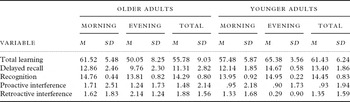
Means and standard deviations for all dependent variables are presented in Table 1.
Descriptive statistics for RAVLT performance for both groups at morning and evening testing times

A series of 2 × 2 between-group ANOVAs were used to compare the RAVLT scores of the two age groups (older and younger adults) across two time-of-test conditions (morning or evening). The dependent measures in these analyses were five RAVLT scores (total learning, delayed recall, recognition, proactive interference, and retroactive interference).
RAVLT: Total Learning
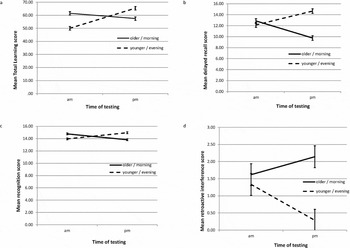
For total learning, there was a reliable two-way interaction between age and time of testing, F(1,80) = 54.31, p < 0.001, partial η2 = 0.40, see Figure 1a. Post hoc analyses with one-way ANOVAs revealed the predicted synchrony effect for both age groups on total learning. Older adults performed significantly better in the morning (their optimal time of day) than in the afternoon (non-optimal time), F(1,40) = 28.19, p < 0.001, whereas younger adults performed significantly better in the afternoon (their optimal time of day) than in the morning (non-optimal time), F(1,40) = 27.85, p < 0.001. Overall, there was no reliable difference in total learning scores between morning and afternoon sessions. However, as predicted, the younger adults achieved significantly higher scores on total learning than the older adults, F(1,80) = 18.42, p < 0.001, partial η2 = 0.19. In addition, a comparison of both age groups at their optimal times showed that younger adults tested in the afternoon scored significantly higher than older adults tested in the morning, t(40) = 2.71, p = 0.01.
Two-way interactions between age group and time of testing for RAVLT scores: (a) Total Learning; (b) Delayed Recall; (c) Recognition; and (d) Retroactive Interference. Error bars represent standard errors.

RAVLT: Delayed Recall
For delayed recall, there was a reliable two-way interaction between age and time of testing, F(1,80) = 43.97, p < 0.001, partial η2 = 0.36, see Figure 1b. Post hoc analyses with one-way ANOVAs revealed the predicted synchrony effect for both age groups on delayed recall. Older adults performed significantly better in the morning than in the afternoon, F(1,40) = 17.75, p < 0.001, whereas younger adults performed significantly better in the afternoon than in the morning, F (1,40) = 35.56, p < 0.001. There was no reliable difference in delayed recall scores between morning and afternoon sessions. However, as predicted, the younger adults achieved significantly higher scores on delayed recall than the older adults, F(1,80) = 24.45, p < 0.001, partial η2 = 0.23. In addition, a comparison of both age groups at their optimal times showed that younger adults tested in the afternoon scored significantly higher than older adults tested in the morning, t(40) = 3.29, p = 0.002.
RAVLT: Recognition
In recognition, there was a reliable two-way interaction between age and time of testing, F(1,80) = 45.80, p < 0.001, partial η2 = 0.36, see Figure 1c. Post hoc analyses with one-way ANOVAs revealed the predicted synchrony effect for both age groups on recognition. Older adults performed significantly better in the morning (their optimal time of day) than in the afternoon (non-optimal time), F(1,40) = 22.35, p < 0.001, whereas younger adults performed significantly better in the afternoon (their optimal time of day) than in the morning (non-optimal time), F(1,40) = 23.46, p < 0.001. There was no reliable difference in recognition scores between morning and afternoon sessions or between the younger and older adults. However, a comparison of both age groups at their optimal times revealed no significant difference between groups in Recognition performance.
RAVLT: Proactive Interference
There was no reliable difference in proactive interference scores between morning and afternoon sessions or between the younger and older adults, nor was there a significant interaction in proactive interference between age and time of testing (all Fs < 1.48, ns).
RAVLT: Retroactive Interference
For retroactive interference, there was a reliable two-way interaction between age and time of testing, F(1,80) = 6.08, p < 0.05, partial η2 = 0.07, see Figure 1d. Post hoc analyses with one-way ANOVAs revealed the predicted synchrony effect for younger adults but not for older adults. The retroactive interference scores for older adults tested in the morning did not differ significantly from those tested in the evening, F(1,40) = 1.18, ns. On the contrary, younger adults tested in the morning experienced significantly more interference than those tested in the afternoon, F(1,40) = 6.32, p < 0.05. There was no reliable difference in retroactive interference scores between morning and afternoon sessions. However, the younger adults showed significantly lower levels of retroactive interference than the older adults, F(1,80) = 11.31, p < 0.001, partial η2 = 0.12. In addition, a comparison of both age groups at their optimal times showed that younger adults tested in the afternoon scored significantly higher than older adults tested in the morning, t(40) = 3.00, p = 0.006.
Gender differences
In view of the gender disparity between groups, all statistical analyses were re-computed, controlling for gender as a covariate. The pattern of significant main effects and interactions remained identical for all outcome variables after controlling for gender effects.
Discussion
Evidence of synchrony effects in memory functioning, coupled with an established shift from evening to morning preference during the adult life span, suggests that age effects on some memory measures may be overestimated when time of testing is ignored. The current study investigated whether synchrony effects could explain some of the well-documented age-related decline on the RAVLT.
On the basis of previous normative studies, younger participants were expected to perform better than older participants on all RAVLT measures, regardless of time of testing. However, participants were expected to perform better when tested at their optimal than their non-optimal time of day, as they would be more physiologically aroused at their optimal time of day. A manipulation check using AD-ACL (GA) arousal scores confirmed the appropriateness of the morning and afternoon session format. Younger evening types felt more alert and aroused during the afternoon testing sessions and older morning types felt more alert in the morning sessions. Together, time of testing and age accounted for approximately half of the variance in arousal.
The results of the main analyses partially support the first hypothesis. There were small to moderate significant main effects for age on three of the five RAVLT measures, with the younger group achieving higher mean scores than the older group on the total learning and delayed recall measures and lower scores on retroactive interference. However, most importantly, for these three outcome measures, younger adults tested at their optimal time (afternoon) outperformed older adults tested at their optimal time (morning). This confirms that synchrony effects do not fully explain the reported age-related decline.
These results support existing evidence of age-related decline on these RAVLT measures and similar word list learning tasks (e.g. Vakil and Blachstein, Reference Vakil and Blachstein1997). However, there were no observed age differences on the mean scores for recognition or proactive interference. There are several possible reasons for this result, including equivocal evidence for age differences on these two scores and a large number of high-functioning older individuals in the current older sample. Many studies have found significant age differences on word recognition (e.g. Geffen et al., Reference Geffen, Moar, O'Hanlon, Clark and Geffen1990), while others have not (e.g. Bleecker et al., Reference Bleecker, Bolla-Wilson, Agnew and Meyers1988). Many of the current older sample participants also routinely performed above their age-based norms and therefore could have been less likely to show age-related deficits in some RAVLT scores.
The results also partially support the second hypothesis, with both age groups showing moderate synchrony effects on most RAVLT scores except proactive interference. All participants performed significantly better at their optimal time of day than their non-optimal time on all RAVLT measures except proactive interference, for which no synchrony effects were observed. It is unclear why proactive interference alone should be immune to synchrony effects. There is a range of evidence showing that older adults are more susceptible to proactive interference on a range of tasks and that this disadvantage is exacerbated when older adults are tested at non-optimal times of day (i.e. afternoon or evening; Lustig et al., Reference Lustig, Hasher and May2001). One variable that may account for this finding is the high level of functioning shown by the current older sample. According to the norms provided in the RAVLT handbook (Schmidt, Reference Schmidt1996), most of the older sample participants performed better than their age peers on the two trials used to calculate this score. However, given that high levels of functioning should influence all RAVLT scores, it is unlikely that this fully explains the current lack of synchrony effect on proactive interference alone.
Another explanation for this finding may lie in individual differences in the ability to inhibit or delete irrelevant or obsolete information from working memory, which is an inherent feature of proactive interference. According to Hasher et al. (Reference Hasher, Chung, May and Foong2002), individuals with impaired deletion of obsolete material generally choose between two strategies when recalling target items: either only reporting items that they are sure belong to the target list or reporting all items in working memory. Both of these strategies can mask impaired deletion. Hasher and colleagues found that older adults, particularly those tested at non-optimal times, tend to use the second strategy, effectively improving their performance and reducing any group differences. Importantly, for the current study, this strategy effectively masks any group differences in proactive interference (Hasher et al., Reference Hasher, Chung, May and Foong2002).
There are several limitations to the current study. Participants were selected on the basis of age and MEQ score, with only morning-type older adults and evening-type younger adults included in the study. This reduces the generalizability of the current findings because conclusions are necessarily limited to synchrony effects for morning-type older adults and evening-type younger adults. We are not able to make general claims about synchrony effects for older and younger adults. This is a common problem in studies investigating time-of-day and age effects because the vast majority of older adults are moderate or definite morning types. While younger adults are spread more evenly across the MEQ categories, the majority are either neutral or evening types and very few are definite morning types. This natural confound precludes any conclusions about the direct relationship between time of testing and age on RAVLT performance.
The current study also used a between-subject design and randomly assigned participants to morning or afternoon testing sessions. Another option would have been to use a within-subject design and test each participant both in the morning and in the evening. This would have allowed a more direct comparison between each participant's performance at his or her optimal and non-optimal times and would have eliminated the risk of confounding effects related to the different testing times. However, the RAVLT has significant practice effects and incomplete norms for the alternate word lists (Schmidt, Reference Schmidt1996) and is therefore not well suited to a repeated-measures approach.
The current study makes an important contribution to the psychogerontological, RAVLT, and chronobiological literature. The RAVLT manual already acknowledges a range of known RAVLT moderators, including age, education, intelligence, gender, ethnicity, and clinical status (Schmidt, Reference Schmidt1996). The current findings now suggest that preferred time of day and time of testing may also act as potential moderators of the relationship between age and RAVLT performance. As this is the first evidence of such a relationship, there is a need for future research to replicate and validate these findings and to develop age-based RAVLT norms using study designs that account for time-of-day preference and time of testing.
The present results also serve to inform clinical practice on the use of the RAVLT to assess verbal memory function. Clinicians should consider possible synchrony effects when planning assessment sessions and take these effects into account when interpreting the RAVLT performance of older adults tested later in the afternoon.
The current findings provide the first evidence of a moderate synchrony effect on the RAVLT. If these results can be validated and replicated, they will have important implications for clinicians who use the RAVLT in assessing memory loss in older adults. These results suggest that clinicians should consider their client's self-reported preferred time of day when planning RAVLT assessments and take synchrony effects into account when interpreting RAVLT performance.
Conflicts of interest
None.
Description of authors’ roles
Claire A. Lehmann designed the study, performed the assessments, collected the data, and contributed to writing the manuscript. Anthony D. G. Marks supervised the research and data analysis and contributed to writing the manuscript. Tanya L. Hanstock provided advice in relation to clinical assessment and contributed to writing the manuscript.