Antimicrobials are commonly overprescribed, accounting for significant healthcare expenditures, wasted resources, preventable adverse drug events, and selection of more resistant pathogens.Reference Maki and Schuna 1 – Reference Dellit, Owens and McGowan 5 Antimicrobial stewardship programs (ASPs), seek to optimize use of these agents with the goals of improving clinical outcomes and minimizing unintended consequences.Reference Dellit, Owens and McGowan 5 Strategies proven effective in accomplishing these goals include formulary restriction with prior authorization requirements and prospective audit with intervention and feedback.Reference Dellit, Owens and McGowan 5 Prior authorization allows for tight control on initiation of antimicrobials, while prospective audit allows for longitudinal follow-up to optimize therapy as cultures and other information become available.
Each of these ASP interventions have been associated with improved outcomes compared to preintervention periods.Reference Chung, Wu, Yeo, Chan and Hsu 6 – Reference White, Atmar, Wilson, Cate, Stager and Greenberg 9 However, data directly comparing ASP methods are limited because ASP interventions are frequently implemented simultaneously.Reference Dellit, Owens and McGowan 5 , Reference John and Fishman 10 – Reference Barlam, Cosgrove and Abbo 13 Prior authorization has potential limitations including delays in administration of appropriate therapy and missed opportunities for de-escalation and optimization of drug, dose, and duration.Reference Reed, Stevenson, West, Bauer and Goff 7 Using the results of microbiologic cultures and susceptibility testing, prospective audit can address some of these limitations but requires substantial time and resources. ASPs can employ elements of both strategies by developing criteria for certain drugs or syndromes. However, to maximize ASP resources, a better understanding of the advantages of prospective audit is necessary to prioritize activities.
At the Hospital of the University of Pennsylvania (HUP), these stewardship strategies were sequentially implemented allowing a unique opportunity for a direct comparison of their impact. In 1993, broad-spectrum and costly antimicrobials were restricted, requiring approval by a doctor of pharmacy (PharmD) trained in infectious diseases or a medical fellow. In 2009, the policies of the ASP were revised so that many antibiotics no longer required prior authorization, including piperacillin-tazobactam, cefepime, and vancomycin. At this time, prospective audit with intervention and feedback was also implemented to monitor utilization and to promote appropriate streamlining of derestricted agents. Details of the ASP during both time periods have been previously described.Reference Gross, Morgan, Kinky, Weinder, Gibson and Fishman 12 , Reference Mehta, Haynes and Wileyto 14
To evaluate the change in stewardship methods at HUP, Mehta et alReference Mehta, Haynes and Wileyto 14 compared antimicrobial consumption in days of therapy (DOT) per patient days (PD) during the 2 time periods and found significant increases in both total antimicrobial use (+9.65 DOT/1,000 PD per month; P<.001) and broad-spectrum Gram-negative antimicrobial use (+4.80 DOT/1,000 PD per month; P<.001) after the stewardship method shifted to prospective audit. However, the impacts of the intervention on a patient level, on clinical management, and on outcomes were not assessed. The objective of this study was to determine whether prospective audit increases the likelihood of streamlining antimicrobial therapy in patients with bacteremia compared to prior authorization.
PATIENTS AND METHODS
Setting and Study Population
We conducted a retrospective cohort study at HUP, a 774-bed tertiary academic medical center. Records were reviewed of patients ≥18 years old who were admitted to HUP between May 1, 2008, and June 30, 2011, with a case of bacteremia secondary to Staphylococcus aureus, Enterococcus spp., or any Gram-negative aerobic organism, and who received antimicrobial therapy for at least 24 hours after receipt of antimicrobial susceptibility results. Exclusion criteria included polymicrobial bacteremia, pregnancy, admission during the washout period (June 2009), patients switched to therapy that was deemed a priori as inappropriate or not routinely recommended by the study investigators, and cases in which the isolate was resistant to all tested agents. Only the first admission for each patient in the study period was included. However, multiple bacteremia cases for the same patient were included if they occurred during the index admission.
The cohort of patients was previously definedReference Mehta, Haynes and Wileyto 14 and divided into 2 groups. The first group comprised patients admitted May 1, 2008, through May 31, 2009, and these patients were included in the “restriction period.” The second group comprised patients admitted July 1, 2009, through June 30, 2011, and these patients were included in the “audit period.” A single reviewer (J.L.B.) assessed a de-identified data set for outcome measures. Demographics of the study population, including history of β-lactam allergy, were assessed separately and were not included in the de-identified data set.
Definitions and Outcome Measures
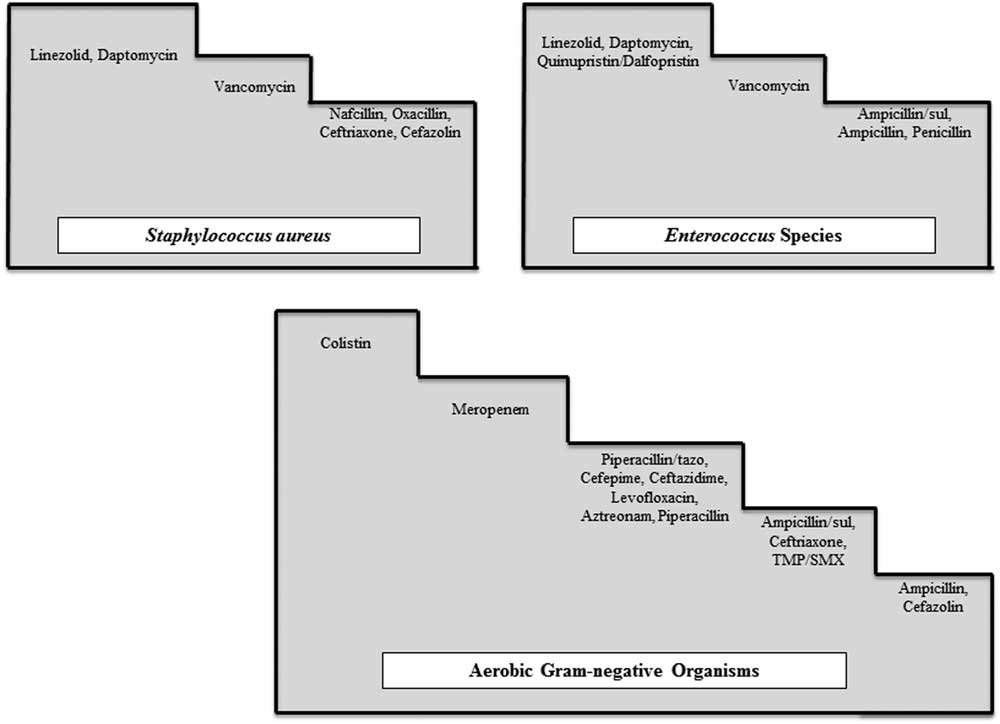
A case of bacteremia was defined as at least 1 blood culture positive for S. aureus, Enterococcus spp., or any aerobic Gram-negative organism. We developed antimicrobial algorithms to define the relative spectrum of activity of formulary antimicrobials against S. aureus, Enterococcus spp., and aerobic Gram-negative organisms (Figure 1), taking into account the hospital antibiogram and expected susceptibility pattern of these organisms.
Antimicrobial step-down charts

Broth microdilution susceptibility testing was performed utilizing the VITEK2 system. Etest or Kirby-Bauer test were used to confirm selected results. Standardized break points for the institution were determined utilizing a combination of Clinical and Laboratory Standards Institute and European Committee on Antimicrobial Susceptibility Testing recommendations. 15 – 18 Results were reported in the medical record as susceptible (S), intermediate (I), or resistant (R).
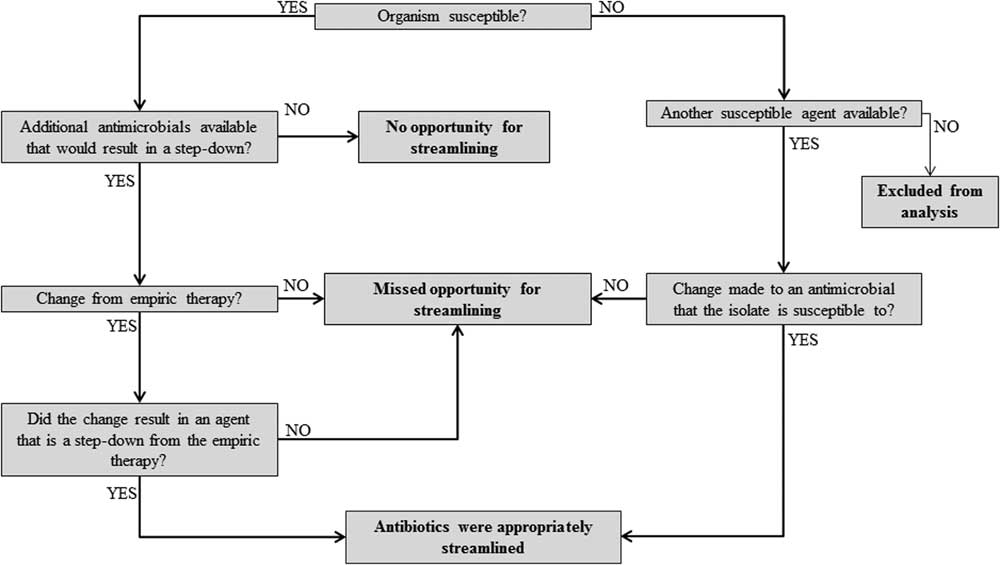
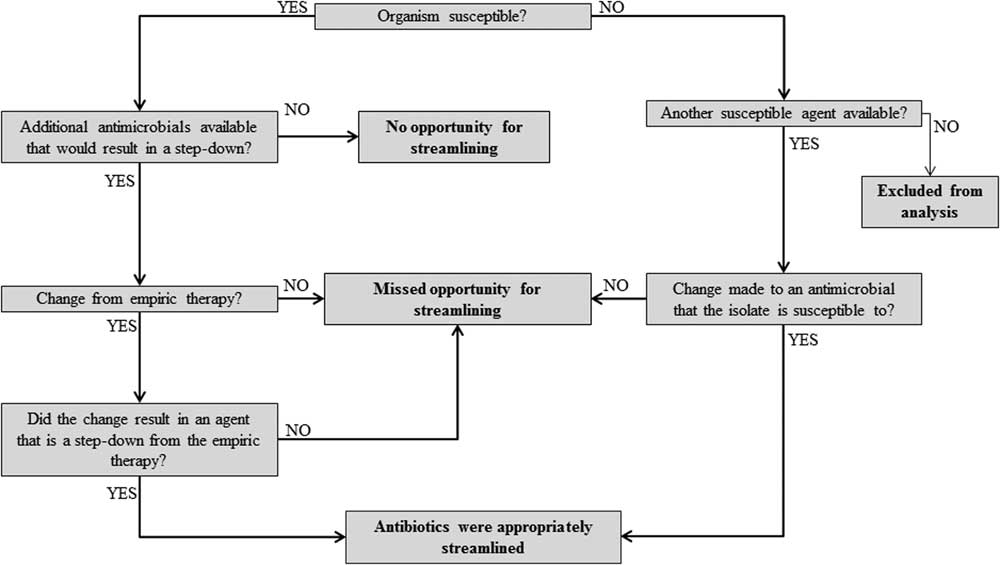
Empiric therapy was defined as the last antimicrobial administered in the interval between the release of the blood-culture Gram-stain result and the release of susceptibility results that had presumptive activity against the pathogen seen on Gram stain (ie, Gram-positive coccus or Gram-negative rod active agent). Antimicrobial therapy changes after the release of the susceptibility results were recorded. Definitive therapy was defined as the narrowest spectrum agent to which the isolate was determined to be susceptible, which was administered within 72 hours after release of the susceptibility results. Opportunity for streamlining was determined based on the antimicrobial susceptibility of the isolate (Figure 2). Streamlining was determined to have occurred if 1 of the following events happened within 72 hours after release of the susceptibility results: (1) therapy was switched to a definitive agent that was at least 1 step narrower in spectrum of activity than the empiric agent, or (2) the isolate was resistant to the empiric agent and therapy was switched to a definitive agent to which the organism was susceptible. Allergy information was not available in the de-identified data set, so history of antibiotic allergies was not taken into account when determining the opportunity for streamlining. Cases were not included in the streamlining analysis if there were no opportunities for streamlining (ie, all drugs were resistant or the empiric drug was the most narrow agent that could be used).
Determination of opportunity to streamline
Time to streamlining was defined as the difference in hours between the electronic time stamp when antimicrobial susceptibility results were released and the time stamp when the definitive agent was ordered. For the purposes of this analysis, if the definitive agent was considered to be an appropriate agent for that pathogen but was not included on the susceptibility report, it was assumed to be susceptible. The most common example was the use of daptomycin for enterococcal bacteremia because daptomycin was not included on the standard susceptibility panel.
The primary outcome was the frequency of streamlined antimicrobial regimens in each period, defined as the number of cases in which antimicrobials were streamlined divided by the total number with an opportunity for streamlining. The secondary outcome was time to streamlining. Because the time to streamlining may be affected by time of day (eg, overnight or during weekend shifts), the outcome was assessed by comparing both the median time to streamlining as well as by categorical time frames: <24 hours, 24 to <48 hours, and 48 to 72 hours. The probability of streamlining was compared using select patient and organism characteristics and between the 2 periods.
Statistical Analysis
Demographic data were compared using the χ2 or Fisher’s exact test for categorical variables and Wilcoxon rank sum test for continuous variables. Both the primary endpoint of frequency of streamlining and the secondary categorical endpoint of time to streamline were compared using the χ2 test. Associations between patient characteristics and the probability of streamlining were assessed on univariate analysis using χ2 or Wilcoxon rank sum where appropriate. Characteristics with a P<.20 were included in a stratified analysis using the Mantel-Haenszel test. All analyses were performed with STATA statistical software version 12.1 (StataCorp, College Station, TX).
RESULTS
Patient Characteristics
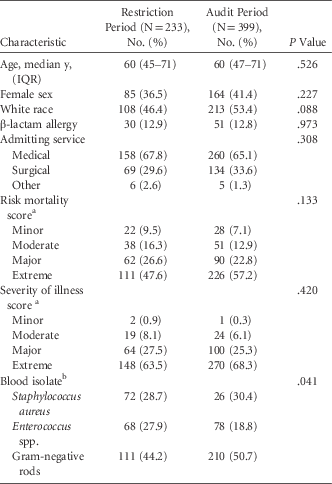
We reviewed the records of 868 patients with bacteremia. Among these patients, 236 (27.2%) were excluded for the following reasons: antibiotics discontinued within 24 hours after release of susceptibility results (n=153), polymicrobial bacteremia (n=47), empiric drug not targeted to the isolate identified by Gram staining (n=21), definitive drug not targeted to the isolate identified (n=12), no drugs reported susceptible for the isolate (n=3). After exclusions, 632 patients with 665 cases of bacteremia were included. Overall, 29.8% of bacteremia isolates were S. aureus, 22.0% were Enterococcus spp., and 48.3% were Gram-negative species (Table 1). Baseline characteristics were similar between periods including age, gender, β-lactam allergy, and severity of illness. A greater proportion of cases were associated with Enterococcus spp. during the restriction period and Gram-negative organisms during the audit period.
Comparison of Patient Characteristics during the Restriction and Audit Periods.

a Risk Mortality Score and Severity of Illness ScoreReference Shen 19 , 20 are determined on admission based on the All Patient Refined Diagnosis Related Groups (APR-DRGs) system, which uses a clinical algorithm and evaluates multiple comorbidities, age, procedures, and principal diagnosis.
b Based on 665 cases of bacteremia: n=251 during the restriction period and n=414 during the audit period.
Of 665 cases of bacteremia, 448 (67.4%) were eligible for streamlining, including 158 (62.9%) in the restriction period and 290 (70.0%) in the audit period. The opportunity for streamlining by organism type was 55.6%, 48.0%, and 83.5% for S. aureus, Enterococcus spp., and Gram-negative organisms, respectively, with no differences between periods.
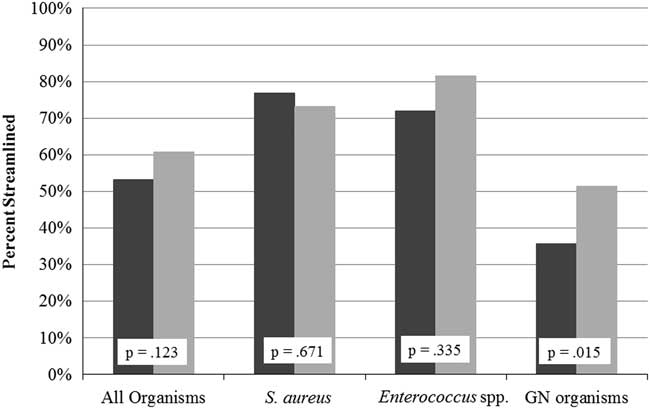
Of 448 cases of bacteremia eligible for streamlining, antimicrobial therapy was streamlined for 260 cases (58.0%), including 176 cases during the audit period and 84 cases during the restriction period. The overall frequency of streamlining was not significantly different between periods for all cases of bacteremia (audit vs restriction: 60.7% vs 53.2%; P=.123). The frequency of streamlining was similar for S. aureus and Enterococcus spp. bacteremia for the 2 periods, but cases of Gram-negative bacteremia were more likely to be streamlined during the audit period than during the restriction period (51.4% vs 35.6%; P=.015) (Figure 3).
Cases streamlined by organism type Legend:
 Restriction period,
 Audit period

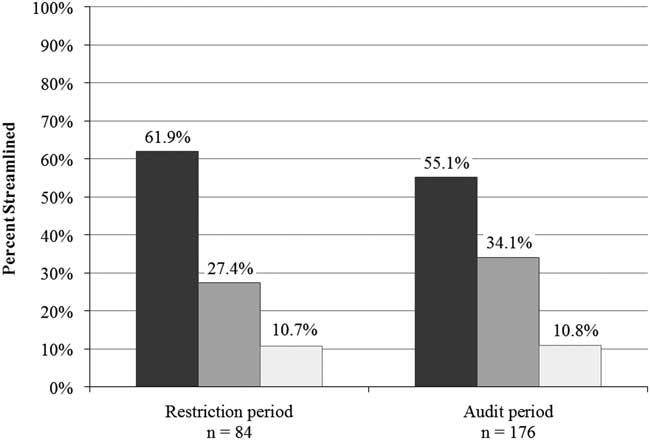
Time to streamlining was similar between periods, with the majority of cases streamlined <24 hours after receipt of susceptibility results (audit vs restriction: 55.1% vs 61.9%; P=.48) (Figure 4). Median time to streamlining was similar between periods (audit vs restriction: 22.80 hours [IQR, 15.5–32.0 hours] vs 22.45 hours [IQR, 16.8–28.5 hours]; P>.05) and did not vary by organism type.
Time to streamlining Legend:
<24 hours,
24 - <48 hours,
 48 - 72 hours

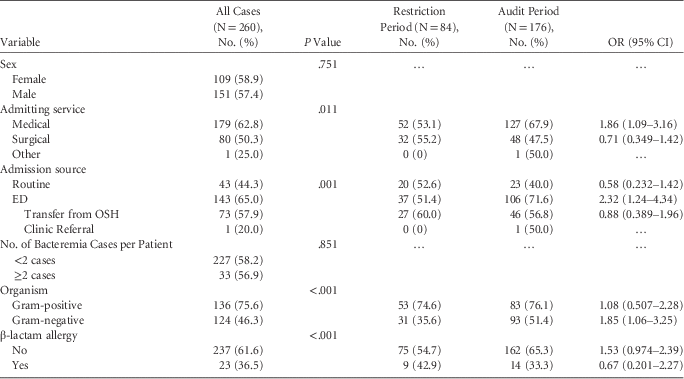
Among the 260 cases studied, streamlining was significantly more likely to occur for patients admitted to a medical versus surgical service, admission through the emergency department, Gram-positive versus Gram-negative bacteremia, and when there was no β-lactam allergy (Table 2). There was no difference in the probability of streamlining by sex and number of cases of bacteremia.
Univariate and Stratified Analyses Characterizing Frequency of Antimicrobial Streamlining by Select Patient Characteristics in All Patients and During Each Period

NOTE. OR, odds ratio; CI, confidence interval; ED, emergency department; OSH, outside hospital.
Compared to the restriction period, the audit period was associated with a significantly increased likelihood of streamlining among patients who were admitted to a medical service, admission through the emergency department, and those with Gram-negative bacteremia. Other factors such as being admitted to the surgical service, presence or lack of β-lactam allergy, and Gram-positive bacteremia were not associated with a difference in frequency of streamlining between periods (Table 2).
DISCUSSION
We found that the ASP method utilizing prospective audit with intervention and feedback was associated with a similar probability and time to streamlining therapy in patients with bacteremia compared to formulary restriction alone. However, auditing was associated with increased streamlining for cases of Gram-negative bacteremia, patients admitted through the emergency department and those on a medical service. These findings suggest that efforts dedicated to prospective audit should focus preferentially on patients with Gram-negative bloodstream infections and those admitted through the emergency department, where empirical therapy may be overly broad.
We observed a lower percentage of patients with an opportunity to streamline in the restriction period (62.9% vs 70.0%), which may be the result of more frequent initiation of broad-spectrum therapy in the audit period because prior authorization was not required. To account for this difference, proportions and percentages were utilized to describe streamlining outcomes rather than raw numbers, which would have given an advantage to the group with more opportunities.
Although patient characteristics were similar between groups, a greater proportion of bacteremias were associated with Gram-negative bacteremia during the audit period. This finding is consistent with reports of the changing epidemiology of bacteremia in which rates of Gram-positive bacteremia are on the decline.Reference Aung, Skinner, Lee and Cheng 21 , Reference Guidry, Rosenberger and Petroze 22 The decrease in the proportion of Gram-positive bacteremia may reflect the impact of evidence-based practices to reduce central-line–associated infections and healthcare-onset MRSA bacteremia.Reference Dantes, Mu and Belflower 23 – Reference Siegel, Rhinehard, Jackson and Chiarello 26
We did not observe an increased probability of streamlining for Gram-positive infections during the audit period. Notably, during the baseline restriction period, cases of S. aureus and enterococcal bacteremia were more than twice as likely to be streamlined than were Gram-negative bacteremia (74.4% vs 35.6%), with correspondingly fewer opportunities for improvement with audit and feedback. Linezolid and daptomycin were restricted during both periods, and vancomycin was the drug of choice for suspected Gram-positive bacteremia in patients without a history of resistance or intolerance throughout this evaluation. A potential explanation for these results could be the complex pharmacokinetic monitoring and toxicity profile of vancomycin, in which ordering providers favored stepping down to β-lactam agents for the treatment of susceptible Gram-positive infections without the need for ASP audit and feedback.
The audit period was associated with almost 2-fold higher odds of streamlining Gram-negative bacteremia than antimicrobial restriction. Concurrent with the audit intervention, cefepime and piperacillin-tazobactam were de-restricted, and the hospital-wide use of broad-spectrum anti–Gram-negative therapy increased significantly.Reference Mehta, Haynes and Wileyto 14 It is well established that inadequate empiric therapy for bloodstream infections is associated with increased morbidity and risk of death.Reference Kumar, Roberts and Wood 27 , Reference Kuti, Patel and Coleman 28 Broad-spectrum empiric therapy may decrease the risk of inadequate treatment, however, and corresponds with increased opportunities for streamlining therapy when susceptibility results return. At our institution, audit interventions focused on piperacillin-tazobactam and cefepime. Because Enterobacteriaceae retained favorable susceptibility to ceftriaxone (>85%) during this evaluation, ceftriaxone remained a convenient, cost-effective option for step-down therapy for most cases of Gram-negative bacteremia. These results indicate that daily review by PharmDs trained in infectious diseases may be an effective mechanism to enhance antimicrobial streamlining especially for Gram-negative infections.
During the audit period, we also observed an increased frequency of streamlining among patients admitted through the emergency department but not for other locations. emergency department providers administer empiric antimicrobial therapy for a broad range of serious infectious syndromes and often do so without formal ASP oversight.Reference May, Cosgrove and L’Archeveque 29 Our findings suggest that patients admitted through the emergency department with serious infections may be a priority target for prospective audit and feedback. During this period, the frequency of streamlining was 20% higher on a medical compared to surgical service. This finding may represent differences in the sources of bacteremia in surgical compared to medical patients and/or may indicate that medical providers are more receptive to antimicrobial stewardship recommendations by a PharmD.
Overall, likelihood of streamlining in the total population was lower than expected (53%–61%). This finding is driven by the low numbers of Gram-negative cases streamlined in both periods. The exact reason for the low proportion streamlined is unknown; however, it could be related to factors that were not able to be accounted for in this study, such as drug intolerance, source of primary infection, disregard of ASP recommendations, or lack of knowledge of the importance of narrowing therapy among providers.
Our study has several important limitations. First, we used the antimicrobial susceptibility results to determine whether there was an opportunity to streamline. We did not consider the impact of patient-specific factors such as allergies, intolerances, or renal function. As a result, we may have misclassified cases of bacteremia as eligible for streamlining when there were appropriate contraindications to modifying therapy, as discussed above. Because severity of illness and frequency of β-lactam allergies were similar between periods, misclassifications for these reasons likely did not result in differences in outcome measures. Second, we were unable to assess the primary cause of bacteremia and whether broad-spectrum antimicrobial therapy was appropriate for that source of infection. Third, the low number of cases assessed in this study prevented the ability to do more granular analyses, in particular, to assess trends between Gram-negative species. Future studies designed and powered to assess such outcomes are warranted to determine whether the prevalence of streamlining varies by organism type. Fourth, we did not assess the impact of the ASP interventions on treatment outcomes. Finally, this study was a single-center study conducted at a large academic institution with resources dedicated to ASP, including infectious diseases pharmacists, physicians, and fellows, and these results may not be generalizable to other hospitals with limited resources or different ASP models.
In a previous comparison of ASP methods at our hospital, overall antimicrobial use decreased during the prior authorization period and increased during the audit period, including significant increased use of both cefepime and piperacillin-tazobactam following de-restriction.Reference Mehta, Haynes and Wileyto 14 This study adds to those results by identifying situations in which prospective audit with intervention and feedback may be more impactful than restriction in streamlining antimicrobial therapy for bacteremia. A coordinated approach using both antimicrobial restriction and prospective audit with intervention and feedback can further the goal of ASP to achieve optimal clinical outcomes related to antimicrobial use.
ACKNOWLEDGMENTS
We thank the staff of the Penn Data Store for their assistance in assembling the medication and laboratory data used in this study.
Financial support. No financial support was provided relevant to this article.
Potential conflicts of interest: All other authors report no conflicts of interest relevant to this article. J.M.M. is a member of Teqqa, LLC. Teqqa did not participate in the study design, analysis, or preparation of this manuscript.