




No CrossRef data available.
Article contents
How are parent–child conflict and childhood externalizing symptoms related over time? Results from a genetically informative cross-lagged study
Published online by Cambridge University Press: 07 April 2005
Abstract
The present study attempted to determine the direction and etiology of the robust relationship between childhood externalizing (EXT) symptoms and parent–child conflict using a genetically informative longitudinal model and data from the ongoing Minnesota Twin Family Study. Participants consisted of 1,506 same-sex twins assessed at ages 11 and 14, and their parents. The relationship between EXT and parent–child conflict from ages 11 to 14 was examined within a biometrical cross-lagged design. The results revealed three primary findings: first, the stability of conflict and externalizing over time is largely, although not solely, a result of genetic factors. Second, there appears to be a bidirectional relationship between conflict and EXT over time, such that both conflict and EXT at 11 independently predict the other 3 years later. Finally, the results are consistent with the notion that parent–child conflict partially results from parental responses to their child's heritable externalizing behavior, while simultaneously contributing to child externalizing via environmental mechanisms. These results suggest a “downward spiral” of interplay between parent–child conflict and EXT, and offer confirmation of a (partially) environmentally mediated effect of parenting on child behavior.
This research was funded in part by USPHS grants (DA05147, DA13240, AA09367, AA00175, MH 65137), a National Institutes of Mental Health training grant (MH17069 to S.A.B.), and a Doctoral Dissertation Fellowship (S.A.B.). We also thank Hennepin County Medical Center in Minneapolis for the research time that enabled the primary author to conduct this study.
Information
- Type
- Research Article
- Information
- Copyright
- © 2005 Cambridge University Press
Recent research (e.g., Rothbaum & Weisz, 1994; Waschbusch, 2002) has converged in suggesting a robust association, both concurrent and longitudinal, between conflictive/negative parent–child relationships and child and adolescent externalizing disorders, namely attention-deficit/hyperactivity disorder (ADHD), conduct disorder (CD), and oppositional defiant disorder (ODD). A “parent effects model,” in which a conflictual/negative parenting style causes and/or exacerbates child externalizing behavior, has traditionally been cited as responsible for this association (Collins, Maccoby, Steinberg, Hetherington, & Bornstein, 2000; Maccoby, 2000). Supporting this interpretation is the large body of experimental treatment research that has found that improving parents' discipline strategies leads to a reduction in children's externalizing problems (Dishion, Andrews, Kavanagh, & Soberman, 1996; Dishion & Kavanagh, 2000; Forgatch & DeGarmo, 1999; Patterson, 1974; Patterson, Dishion, & Chamberlain, 1993). Furthermore, numerous correlational studies (Campbell, Pierce, Moore, Marakovitz, & Newby, 1996; Gardner, Sonuga–Barke, & Sayal, 1999; Loukas, Fitzgerald, Zucker, & von Eye, 2001; Wasserman, Miller, Pinner, & Jaramillo, 1996) have also found evidence of significant effects of poor parenting/negative parent–child relationships on later child externalizing, even when controlling for earlier externalizing.
However, some researchers have argued that the association between parent–child conflict and externalizing is not solely parent driven, but may also be instigated by the child, such that the child's oppositional, irritable behavior elicits conflictive reactions from his or her parents. Supportive evidence for this “child effects model” comes from a seminal study by Anderson, Lytton, and Romney (1986), in which CD and nonproblem boys, and their respective mothers, interacted in unrelated pairs during play and structured tasks. When interacting with nonproblem children, the mothers of CD children did not differ from the mothers of nonproblem children in commands, positive behaviors, or negative behaviors. However, all mothers responded more negatively to and gave more commands to children with CD than to nonproblem children, suggesting that the maladaptive interactions between CD boys and their mothers were driven mainly by the child. Similarly, Kerr and Stattin (2000) found that low parental knowledge of their child's daily activities was related to increased delinquency. However, children's spontaneous disclosures of information explained more of this association than did parents' surveillance efforts, suggesting that the association between parental monitoring and child adjustment may be partially child driven. Child effects have also been demonstrated in drug treatment experiments. Barkley and Cunningham (1979) found that when children's nonattentive and noncompliant behavior is improved by the administration of stimulant drugs, their mothers become less controlling and mother–child interactions are nearly normalized. This improvement in mothers' directive reactions has been found to be consistent across different doses of Ritalin (Barkley, Karlsson, Pollard, & Murphy, 1985).
Thus, both child-driven and parent-driven mechanisms have been identified. How might we account for these seemingly incompatible results between studies that support child effects and those that support parent effects? This most likely explanation is a bidirectional or reciprocal model, in which parent–child conflict and child externalizing behavior both influence, and are influenced by, each other. For example, it may be that the previously mentioned Kerr and Stattin (2000) results, which have generally been interpreted as supportive of child effects, are in fact bidirectional in nature. Specifically, adolescents who spontaneously disclose more information to their parents may do so because of parental expectations that were established earlier in life. Thus, both processes may be important but are not revealed because of the restricted age range of the sample (participants were 14 years old).
Recent research has attempted to explicitly test this sort of bidirectional model, with mixed results. Bates, Petit, Dodge, and Ridge (1998) evaluated child temperament and parental control as interacting predictors of behavioral outcomes independently in two longitudinal samples. In both samples, they found that children's early unmanageability predicted later externalizing behavior more accurately when the mother had been observed to be low in restrictive control, implicating both child- and parent-driven processes as important for later child externalizing behavior. Similarly, O'Connor, Deater–Deckard, Fulker, Rutter, and Plomin (1998) used a longitudinal adoption sample to examine possible reciprocity. Analyses revealed that children at genetic risk were more likely to receive negative parenting than those not at genetic risk. However, the results also showed that much of the association between negative parenting and children's externalizing was not a function of the child's genetic risk, thereby allowing for the possibility of reciprocal effects. Similar results were obtained in another, although cross-sectional, adoption study, that by Ge, Conger, Cadoret, Neiderhiser, Yates, Troughton, and Stewart (1996). In addition, there is research suggesting that children with CD respond more aversively to punishment than do non-CD children (Lytton, 1990; Patterson, 1976), results that have generally been interpreted in support of a bidirectional perspective. Other studies, however, have not found evidence of reciprocal effects between poor parenting and child externalizing over time (Campbell et al., 1996; Vuchinich, Bank, & Patterson, 1992), although their results have suggested concurrent reciprocal relationships.
Thus, although there is increasing evidence that both parent-driven and child-driven effects may operate in a mutual and reciprocal fashion, the direction of the relationship between conflictual relationships with one's child and child externalizing behavior has yet to be conclusively resolved. Perhaps as a consequence of this lingering uncertainty, there have been very few studies of the etiology of this relationship (i.e., genetic or environmental). The association may reflect genes that are shared by parents and their children, or it may reflect a direct influence of parents or children on each other (i.e., environmental mediation), or some combination of the two. In the present study, we sought to clarify and unravel both the direction and the etiology of the relationship between conflict and child externalizing over time using a genetically informative twin sample. We specifically sought to answer two questions: Do conflict and externalizing at age 11 independently impact conflict and externalizing at age 14? What is the etiology (i.e., genetic and/or environmental) of these relationships over time?
To answer these questions, however, we did not simply examine the similarity of genetic influences over time. Instead, we employed a biometric cross-lagged design that, that, to our knowledge, has not been fit in any previous study (although it is similar to that employed by Neiderhiser, Reiss, Hetherington, & Plomin, 1999). This design is advantageous because it constrains all cross-age associations to take the form of phenotypic partial regression coefficients, thereby controlling for the association between conflict and externalizing at age 11 when examining their effects on each other at age 14. In other words, the use of partial regression coefficients ensures that the relationship between, for example, conflict at 11 and externalizing at 14 is not actually being driven by conflict's “preexisting” relationship with externalizing at age 11. In addition, because the study is genetically informative, we were able to decompose the cross-lagged coefficients into their genetic and environmental components.
However, the most salient feature of this design is that it enables us to examine not only the proportions of genetic and environmental influences on the cross-lags, but also the processes by which parent–child relations and child misbehavior impact each other over time. As put forth by Turkheimer and Waldron (2000), parents do not respond directly to their children's genes, but instead do so indirectly, via their children's phenotypes. (The children's phenotypes, or observed characteristics, are thought to result from their genetic predispositions, prenatal, and postnatal environmental experiences.) They challenged the behavioral genetics field to incorporate these psychological processes, happening at the level of the phenotype, into their studies. Along these lines, we attempted to answer questions about the etiology of the longitudinal relationship between parenting and externalizing by modeling the impact of the phenotypic cross-lags on the genetic and environmental expression of conflict and externalizing (EXT) symptoms at age 14. Such modeling would enable us to address the challenge laid out by Turkheimer and Waldron (2000), and determine how (i.e., via genetic and environmental influences) conflict and EXT at age 14 were influenced by the observed characteristics of conflict and EXT present at age 11 (via the cross-lags). In this way, it was possible to address previously unanswered questions. Is conflict at 14 heritable because it is a response to the child's observed EXT symptoms at age 11? Does conflict at age 11 account for environmental variance in EXT at 14? If so, we could then conclude that the observed conflict between parents and children exerts an environmentally mediated impact on child EXT behavior.
As indicated, Neiderhiser et al. (1999) conducted a similar study, in which they examined 395 families with adolescent siblings who participated in the Nonshared Environment and Adolescent Development study at two points of assessment, 3 years apart (also presented in Reiss, Neiderhiser, Hetherington, & Plomin, 2000). The adolescents ranged in age from 10 to 18 during their intake assessment. Similarly to the present analyses, they examined the cross-lagged associations between parental conflict–negativity and adolescent antisocial behavior, although they did so in two independent models rather than in a single, nested model. They found that much of the etiology of the cross-lagged coefficients was genetic in nature. However, the Neiderhiser et al. (1999) study centered on the decomposition of the phenotypic cross-lagged correlations into their genetic and environmental components, and did not examine the phenotypic-driven processes by which parent–child relations and child misbehavior impact each other over time (i.e., what is the impact of the phenotypic cross-lags on the genetic and environmental expression of the age 14 phenotypes?). This is an important distinction, because although useful, decomposing the cross-lagged coefficients does not reveal how the cross-lags impacted conflict and EXT at age 14. Thus, the present study seeks to expand upon the pioneering work of Neiderhiser et al. (1999) by examining the phenotypic-driven contributions of the cross-lagged coefficients to the genetic and environmental components composing conflict and EXT at age 14.
Consistent with both the child effects and parent effects models, we hypothesized that we would find evidence of a bidirectional relationship between conflict and child EXT. Furthermore, we hypothesized that the phenotypic cross-lags will impact both the genetic and environmental components of conflict and EXT at age 14. Specifically, the results of Anderson et al. (1986) indicated that parents may be responding to their child's oppositional/delinquent behavior. Consistent with this notion is the finding that parenting variables have been found to be moderately heritable (Burt, Krueger, McGue, & Iacono, 2003; Neiderhiser et al., 1999). Thus, we suspected that parenting variables were heritable because parents were, to some extent, responding to their child's externalizing behaviors, which were themselves genetically influenced (see Burt, Krueger, McGue, & Iacono, 2001). Given this, we proposed that the heritability of conflict at 14 owed in part to the observed effects of externalizing at age 11 (i.e., the child effects path).
However, there is a large body of treatment literature that finds that improving parenting styles results in a decrease in child externalizing (Dishion et al., 1996; Dishion & Kavanagh, 2000; Patterson, 1974; Patterson et al., 1993). Thus, we further suspected that a conflictive relationship with one's child independently exacerbated and/or maintained the child's oppositional/delinquent behavior, even when controlling for genetic influences on that behavior. Given this, we proposed that the environmental variance in EXT at 14 owes in part to contributions from observed conflict between parents and children at age 11 (i.e., the parent effects path). We did not have any specific hypotheses regarding whether the environmental variance accounted for in EXT would be shared environmental (i.e., family-wide and similarly impacting all children in the family) or nonshared environmental (i.e., child-specific and unique to each child; also includes measurement error).
Method
Sample
The sample was drawn from participants in the ongoing Minnesota Twin Family Study (MTFS). The MTFS is a population-based, longitudinal study of same-sex adolescent twins born in the state of Minnesota and their parents. More than 90% of twin births between 1971 and 1985 were located using public databases. Among twins who met study eligibility criteria (i.e., neither of the twins had a cognitive or physical handicap that would preclude completing the MTFS day-long, in-person assessment and the family lived less than one day's drive from our Minneapolis laboratory), 83% agreed to participate. The participating families were broadly representative of the Minnesota population at the time the twins were born; approximately 98% are Caucasian. Analysis of more than 80% of the nonparticipating families via a brief mail or telephone survey revealed that parents in participating families had slightly, albeit significantly more, education (0.25 years) than parents in nonparticipating families. In socioeconomic status (SES) and self-reported mental health problems, however, there were no significant differences between participating and nonparticipating families. Further information regarding the design, recruitment procedures, and participation rates of the MTFS can be obtained elsewhere (Iacono, Carlson, Taylor, Elkins, & McGue, 1999).
The participants in the current research ranged in age from 10 to 12 (average age = 11), at the time of their intake visit. The sample consisted of 753 (N = 1506) same-sex, reared-together twin pairs: 373 male pairs (253 monozygotic [MZ], 120 dizygotic [DZ], ntotal = 746) and 380 female pairs (233 MZ, 147 DZ, ntotal = 760). Of these, 691 (93%) of the boys and 706 (93%) of the girls completed the first follow-up assessment approximately 3 years later. Those who did not complete the follow-up assessment (55 boys, 54 girls) did not have more mental health problems than those who did complete follow-up (McGue, Elkins, Walden, & Iacono, in press).
MZ (identical) twins are slightly more common than DZ (fraternal) in the population from which our sample was drawn (Hur, McGue, & Iacono, 1995). From 1971 to 1984, there were 4.09 MZ and 2.60 like-sex DZ twin pairs born per 1,000 births for an MZ/DZ ratio of 1.57:1. The preponderance of MZ twin pairs in our sample reflects this, as well as a slight bias in recruitment, with an MZ/DZ ratio of 1.82:1.
Zygosity determination
Zygosity of the twins was determined by the agreement of several separate estimates: (a) ponderal and cephalic indices and fingerprint ridge counts were measured; (b) MTFS staff evaluated visage, hair color, and face and ear shape for physical similarity; and (c) parents completed a standard zygosity questionnaire. When these estimates did not agree, a serological analysis was performed to determine zygosity. A previous validation study (n = 50 pairs) found that when the three estimates agreed, the indicated zygosity was uniformly confirmed by the serological analysis. This finding suggests that our method of zygosity determination is accurate.
Assessment of mental disorders
During their intake and follow-up visits, all participants and their parents were assessed in-person by trained bachelor and masters-level interviewers for DSM-III-R mental disorders (DSM-III-R was current at the onset of the study). CD and ODD were assessed using the Diagnostic Interview for Children and Adolescents–Revised (DICA-R; Reich & Welner, 1988). The MTFS version of this instrument contained supplementary probes and questions, which were added after consultation with one of the DICA-R's authors to ensure complete coverage of each symptom. Mothers reported on symptom presence in both twins, while twins reported only on themselves. Mothers and each twin were all interviewed by separate interviewers. At intake, the reporting period was the twin's lifetime. At follow-up, the reporting period consisted of only the last 3 years.
Two DSM-III-R “symptom count” variables were used in the present study. These variables corresponded to the number of the following symptoms assigned: (a) the nine criterion A symptoms of ODD (argues with adults, frequently loses temper, refuses to comply with adult requests, deliberately annoys others, often angry and resentful, touchy and easily annoyed by others, spiteful and vindictive, swears, blames others for own mistakes) and (b) 12 of the 13 criterion A symptoms of CD (often truant, stolen without confrontation more than once, often lies, deliberately engages in fire setting, has run away from home overnight, often initiates physical fights, physically cruel to people, has used a weapon in more than one fight, has stolen with confrontation of victim, has been physically cruel to animals, vandalism, trouble with the law, has broken into other's property). The exception was symptom 9, “has forced someone into sexual activity with him or her,” which was not assessed to avoid potential mandated reporting.
Following the interview, a clinical case conference was held in which the evidence for every symptom was discussed by at least two advanced clinical psychology doctoral students. Mother and child interviews were not discussed during the same clinical case conference, so as to avoid potential bias. Only symptoms that were judged to be clinically significant in both severity and frequency were considered present. The reliability of the consensus process was good, with κs of .79 and .67 for diagnoses of CD and ODD at age 11, respectively.
After clinically significant symptoms were assigned, computer algorithms were used to sum the number of assigned symptoms using a combined informant approach. Specifically, a symptom was considered present if it was endorsed by either the mother or the child. Symptoms endorsed by both mother and child were counted as only one symptom. The use of this combined informant approach allowed for a more complete assessment of symptomatology than would the use of either informant alone, as previous studies have indicated that each type of informant contributes a considerable amount of valid information not contributed by other informants (Achenbach, McConaughy, & Howell, 1987; Burt et al., 2001). As actual diagnoses were not used, duration rules were excluded for both disorders. In this way, we created a “symptom count” corresponding to the criteria for each DSM-III-R disorder. The CD and ODD symptom counts were then averaged to create an overall measure of EXT symptoms.
Assessment of the family environment
The Parental Environment Questionnaire (PEQ) was administered to tap perceptions of the parent–child relationship. Mothers and twins rated 50 items assessing aspects of their relationships on a 4-point scale (1 = definitely true to 4 = definitely false). The mothers rated their own relationships with each twin, while twins each rated their relationship with their mothers. Items were essentially the same for both mothers and twins, with alterations in wording appropriate for particular raters. This scale, which was developed for use by the MTFS, has been factor analyzed and has been shown to reliably assess five dimensions of parent–child relationships (Elkins, McGue, & Iacono, 1997): Parent–child conflict, Parental involvement with child, Child regard for parent, Parent regard for child, and Structure provided by parent. The so-called “Parent–child conflict scale” (referred to as conflict from here on out) comprised 12 items (see Table 1 for a list of the items comprising this scale). The internal consistencies for this scale at age 11 in the current sample (and at age 17 in the other cohort of the MTFS, which is not used in the present study) ranged between .81 and .88 for twin and parent informants. Age 14 alphas were not computed, although the consistency of the alphas across ages and independent samples strongly suggests that parent–child conflict is a consistently reliable construct. If one item on a scale was missing, that item was prorated (i.e., other item scores were averaged, and this average was used as the missing item's score) and added to the scale score. If more than two items on a scale were missing, the scale score was coded as missing. (For more information on the development of the PEQ, please refer to Elkins et al., 1997.)
Items comprising the PEQ Parent–Child Conflict Scale

PEQ's were mailed to families prior to their on-site assessments. Participants were asked to bring their completed PEQ with them to their in-person visit. If a completed PEQ was not obtained by the end of the assessment, participants were asked to complete it at home and return it by mail. One telephone prompt was made if a completed PEQ was still not received. Of the 760 female participants at intake, there were useable twin PEQ reports for 724 participants and useable mother PEQ reports for 645 participants. Of the 746 male participants at intake, there were useable twin and mother PEQ reports for 651 and 623 participants, respectively. Of the 706 female participants at follow-up, there were useable twin and mother PEQ reports for 683 and 664 participants, respectively. Of the 691 male participants at follow-up, there were useable twin PEQ reports for 623 participants and useable mother PEQ reports for 617 participants.
Informant reports of the conflict scales, as assessed by mother and twin, were moderately and significantly correlated at both intake (r = .28, p < .001) and follow-up (r = .41, p < .001). We averaged mother and twin informant-reports (i.e., mother report of twin and twin report of mother).1
Although a thorough analysis of informant effects is beyond the scope of the current investigation, we thought it worthwhile to examine empirically whether the use of information from both mother and child was likely to enhance the validity of our conceptualization of mother–child conflict. We did so by comparing child and maternal reports of the predictor (i.e., conflict) to criterion information independently obtained from teachers. At both their intake and follow-up visits, each child was asked to nominate up to four teachers whom we could contact to complete a 49-item questionnaire about him or her (see Sherman, McGue, & Iacono, 1997, for a more detailed description of this instrument). At least one teacher report was obtained from 88% of the twins at age 11 and 85% of the twins at age 14. When multiple reports were available, responses were averaged over teachers. Items were adapted from child behavior rating scales and DSM criteria to cover externalizing behaviors. Teachers also reported information about delinquency/substance use in the child's peer group. We performed multiple regression analyses using teachers' reports of deviant peer group affiliation and behavior problems at age 11 (with items grouped into scales tapping oppositionality, hyperactivity, inattentiveness, and total externalizing problems) as dependent, criterion variables. We entered mothers' reports of conflict at age 11, followed by children's reports, and then repeated these analyses reversing the order of entry. Regardless of order of entry, the addition of the second reporter consistently resulted in a significant increase in R2 (all p ≤ 0.03). These analyses were repeated using age 14 variables. Once again, regardless of order of entry, the addition of the second reporter resulted in a significant increase in R2 (all p ≤ 0.01). Such results indicate that, at ages 11 and 14, both twin and mother informant reports were providing unique and predictive information that was not provided by the other informant reports, bolstering our decision to combine informants. However, it should be noted that teacher reports were not used in model-fitting analyses because, unlike symptom reports from the twins and their mothers, teacher reports do not correspond directly to DSM-III-R CD and ODD symptoms.
Statistical analyses
As is typically found in population-based samples, the symptom count distributions were positively skewed for each disorder. To better approximate normality, the externalizing symptom count variable was log transformed prior to model fitting. Conflict scores were largely normally distributed, and were therefore not transformed.
Structural equation modeling of twin data is based on the difference in the proportion of genes shared between MZ twins, who share 100% of their genetic material, and DZ twins, who share an average of 50% of their segregating genetic material. MZ and DZ twin correlations are compared to estimate the relative contributions of additive genetic effects (a2), shared environmental effects (c2), and nonshared environmental effects plus measurement error (e2) to both variance within and covariance among observed behaviors or characteristics (i.e., phenotypes). Crucial to this methodology is the equal environments assumption (EEA), which assumes that MZ twin pairs are no more likely to share the environmental factors that are etiologically relevant to the phenotype under study than are DZ twin pairs. Under this assumption, any differences in the MZ and DZ correlations are due to differences in their genetic similarity. The EEA has been repeatedly tested and supported for numerous phenotypes, including many mental disorders (Hettema, Neale, & Kendler, 1995; Kendler, Neale, Kessler, Heath, & Eaves, 1993; Morris–Yates, Andrews, Howie, & Henderson, 1990; Scarr & Carter–Saltzman, 1979), but it remains an assumption for any particular phenotype until subjected to empirical testing. Using this model, higher MZ than DZ twin correlations implicate genetic influences, while equivalent MZ and DZ twin correlations implicate shared environmental influences.
The additive genetic component (a2) is the effect of individual genes summed over loci. Additive genetic effects, if acting alone, would create MZ correlations that are double those of DZ correlations. The shared environment (c2) is that part of the environment that is common to both members of a twin pair, and acts to make the twins within a pair (both MZ and DZ) similar to each other. In keeping with the EEA, shared effects do not differ by zygosity, and if acting alone, would make MZ and DZ twin correlations similar in magnitude. Several factors appear to contribute at least partially to the shared environment, including parent–child conflict (Burt et al., 2003) and neighborhood effects (Caspi, Taylor, Moffitt, & Plomin, 2000). The nonshared environment (e2) encompasses environmental factors unique to each twin within a pair. The nonshared environment, which also does not differ by zygosity, differentiates each twin within a pair, making them less similar. Parent–child conflict (Burt et al., 2003) and peer groups (Manke, McGuire, Reiss, Hetherington, & Plomin, 1995) both appear to function at least partially in this capacity, impacting each child within the family in a unique manner. Measurement error, which similarly acts to reduce both MZ and DZ similarity, is also contained within e2. More information on twin studies is provided elsewhere (Plomin, DeFries, McClearn, & McGuffin, 2001).
Although we were only missing a relatively small amount of data, we made use of full-information maximum-likelihood (FIML) raw data techniques, which produce less biased and more efficient and consistent estimates than other techniques, such as pairwise or listwise deletion, in the face of missing data (Little & Rubin, 1987). The structural-equation modeling program (Neale, 1997) Mx was used to fit models to the transformed raw data. When fitting models to raw data, variances, covariances, and means of those data are freely estimated by minimizing minus twice the log likelihood (−2lnL). The minimized value of −2lnL of the data under the unrestricted baseline model can then be compared with −2lnL under the more restrictive biometric models. This comparison provides a likelihood-ratio chi-square test of goodness of fit of the more restrictive model relative to the baseline model. These chi-square values are then converted to the Bayesian information criterion (BIC; BIC = χ2 − Δdf (lnN); N = 753 pairs). The BIC, which measures model fit relative to parsimony, was used to determine the best-fitting model among a set of fitted models. Better fitting models have more negative values. The difference between two models in BIC relates to the posterior odds (i.e., the odds ratio formed by taking the probability that the second model is correct given the data, over the probability that the first model is correct given the data). When comparing models, a difference in BIC of 10 corresponds to the odds being 150:1 that the model with the more negative value is the better fitting model, and is considered very strong evidence in favor of the model with the more negative BIC value (Raftery, 1995).
Fitting a cross-lagged model (see Figure 1) with Mx allowed us to examine genetic and environmental contributions to the relationship between conflict and child externalizing symptoms from age 11 to age 14. The model requires all cross-age associations to function as partial regression coefficients (i.e., b11, b12, b21, b22). The cross-age regression coefficients (i.e., b11, b22) index the stability of conflict and EXT over time, controlling for the effects of the other trait. The cross-lagged regression coefficients (i.e., b12, b21) allowed us to determine whether conflict and EXT at age 11 independently impacted each other at age 14 (e.g., did conflict at age 11 impact externalizing at age 14 over and above its relationship with externalizing at age 11?). Moreover, as this was a genetically informative sample, we were also able to examine the etiology of this relationship. We made use of two separate, yet related analyses. First, we decomposed the phenotypic cross-lagged coefficients into their genetic and environmental components, enabling us to determine how genes and environmental factors influenced the actual cross-lags. Second, we examined the impact of conflict and EXT at age 11 (acting via the cross-lagged regression coefficients) on the genetic and environmental expression of conflict and EXT at age 14. In other words, we investigated both the cross-lags themselves and the impact of the cross-lags on the age 14 phenotypes, determining whether they contributed genetic or environmental variance to conflict and EXT at age 14. In this way, the cross-lagged model enabled us to better understand the process by which conflict and EXT impact each other over time.

A path diagram of the cross-lagged model. The variance within and across phenotypes is parsed into that due to additive genetic effects (A), shared environmental effects (C), and nonshared environmental effects (E). Variance paths, which must be squared to estimate the proportion of variance accounted for, are represented by lowercase letters followed by one numeral (e.g., a1, a2). Genetic and environmental correlations are represented by lowercase letters followed by two numerals (e.g., a11, a22). Phenotypic partial regression coefficients are represented by a lowercase letters followed by two subscripted numerals (e.g., b11).
The moderating effects of gender were also examined in these analyses, as it is well known that male children generally display a higher frequency of externalizing behaviors than do female children (Hewitt et al., 1997). Our previous analyses of CD and ODD at age 11, however, did not reveal evidence of sex differences in estimates of genetic and environmental contributions to the variance in these disorders (Burt et al., 2001), and hence, we expected that we would find little evidence for gender differences in the genetic and environmental architecture of externalizing symptoms at age 14.
Results
Correlations among maternal and child symptom count variables were obtained to assess whether both mother and child were contributing unique information to the combined symptom count. At age 11, maternal and child reports were correlated .27 for CD and .25 for ODD. At age 14, maternal and child reports were correlated .53 for CD and .43 for ODD. Given these correlations, it appears that both mother and child are contributing unique variance to the combined symptom count variables.
To index the severity of externalizing symptomatology, mean combined symptom counts were computed separately by gender and age (see Table 2). For each disorder at each age, an independent-samples t test indicated that the mean follow-up symptom counts differed significantly by sex (p < .001, two tailed), with males having higher symptom counts than females. Symptom counts increased from age 11 to 14 for both girls and boys (p < .001, two tailed). These statistics of central tendency and range collectively indicate that the boys in this sample are more symptomatic than are the girls. In addition, they suggest that there is a great deal of growth in externalizing symptomatology in early adolescence.
Number of conduct disorder and oppositional defiant disorder symptoms by age and gender

Independent-samples t tests also indicated that mean conflict scores differed across sex at both ages. At intake, they were 21.44 (SD = 4.98) for boys and 18.72 (SD = 4.34) for girls (p < .001, two tailed). At follow-up, they were 21.22 (SD = 5.38) for boys and 20.55 (SD = 5.40) for girls (p < .05, two tailed). Intake conflict scores ranged from 12 to 40 for males, and 12 to 34 for females. Follow-up conflict scores ranged from 12 to 45 for males, and 12 to 40 for females. Conflict scores increased from age 11 to 14 for females (p < .001, two tailed), but did not differ across assessment for males.
The interclass correlations between conflict, ODD, and CD at ages 11 and 14 are presented separately by sex in Table 3. These correlations indicate that, for both males and females, there are moderate correlations between conflict and CD at age 11 (r = .19 and .33, respectively) and age 14 (r = .29 and .36, respectively), and between conflict and ODD at age 11 (r = .37 and .39, respectively) and age 14 (r = .47 and .50, respectively). Furthermore, CD and ODD are moderately correlated at both 11 (r = .39 and .53, respectively) and 14 (r = .57 and .58, respectively). Because of the somewhat higher correlations between ODD and conflict than between CD and conflict, and the moderate correlations between CD and ODD, we elected to ensure that the relationship between EXT and conflict over time was not driven solely by ODD. We therefore calculated partial correlations between conflict and CD over time, controlling for the overlap between CD and ODD. Conflict at 11 continued to predict CD at 14, even when controlling for the substantial overlap with ODD (r = .102, p < .001). Likewise, CD at 11 continued to predict conflict at 14, even when controlling for overlap with ODD (r = .091, p < .001). These results indicate that the relationship between conflict and the disorders was not solely a function of the relationship between conflict and ODD.
Interclass correlations among parent–child conflict, oppositional defiant disorder, and conduct disorder at ages 11 and 14

Multivariate modeling
We initially estimated variances, covariances, and means for the raw data to get a baseline index of fit (−2lnL = 20,003.34, df = 5498). This baseline index of fit is necessary to compare fit indices when determining the best-fitting biometric model. We tested an ACE cross-lagged model, in which the variance attributable to genetic (A), shared environmental (C), and unique environmental plus measurement error (E) factors were all estimated. The model was fit both allowing for gender differences in variance parameter estimates (−2lnL = 20,220.56, df = 5614, BIC = −550.70) and constraining the parameter estimates to be equal across gender (−2lnL = 20,257.97, df = 5636, BIC = −658.93). The best-fitting model (i.e., the one that resulted in the most negative BIC value) was the no-sex differences model. This result suggests that, although boys are more symptomatic than girls, the genetic and environmental architecture underlying the relationship between conflict and EXT is the same across gender.
Individual genetic and environmental contributions
Figure 2 presents the standardized path diagram. All genetic and environmental variance estimates are statistically significant (p < .05). Parameter estimates can be obtained by squaring their genetic and environmental path coefficients. They indicate that both conflict and EXT at age 11 are similarly influenced by genetic, shared, and nonshared environmental factors (conflict at 11: a2 = 37.6%, c2 = 35.4%, e2 = 27.0%; EXT at 11: a2 = 38.2%, c2 = 32.7%, e2 = 29.1%). The genetic and environmental variance component estimates of the age 14 phenotypes index the genetic and environmental variance unique to that age (conflict at 14: a2 = 17.0%, c2 = 33.6%, e2 = 30.3%; EXT at 14: a2 = 24.1%, c2 = 24.3%, e2 = 35.8%). In other words, the age 14 estimates obtained by squaring the path coefficients reveal the variance in conflict and EXT at age 14 that is not held in common with the age 11 phenotypes. As some of the variance in the age 14 phenotypes is contributed by their counterparts at age 11, these unique age 14 variance estimates do not sum to 100%. Specifically, roughly 19.1% of the variance in conflict at age 14 and 15.8% of the variance in EXT at 14 is explained by the age 11 phenotypes. Thus, the variance estimates obtained by squaring the age 14 genetic and environmental path coefficients sum to 80.9% for conflict at 14 and 84.2% for EXT at 14 (also presented in Residual factors in Table 4). Accordingly, the total amount of genetic and environmental variance in the age 14 phenotypes can be obtained by adding in that which is contributed by the age 11 phenotypes (these total A, C, and E estimates are presented in italics in Table 4; conflict at 14: a2 = 24.1%, c2 = 40.9%, e2 = 34.9%; EXT at 14: a2 = 30.0%, c2 = 30.3%, e2 = 39.6%)
Squared, standardized path coefficients and corresponding percentages of variance accounted for in conflict and EXT at age 14


Standardized path estimates of the cross-lagged model with genetic, shared, and nonshared environmental contributions to the variance within and across phenotypes are illustrated. All paths are statistically significant at p < 0.05.
Genetic and environmental correlations
The genetic and environmental correlations are located on the outer sides of the diagram in Figure 2. Genetic and environmental correlations report the extent to which the genetic and environmental factors impacting one phenotype are the same as those impacting the other phenotype. A shared environmental correlation of 1.0, for example, indicates that the same common environmental factors are impacting both conflict and EXT, while a shared environmental correlation of .0 indicates that these environmental effects are unique to each phenotype. Of note, these correlations are reported only within age, as the etiology of the cross-age relationships are assessed via the cross-lagged regression coefficients. The correlations at age 14 are again residuals, indexing the relationship between conflict and EXT at 14 that is not a result of their relationship at age 11. Thus, the shared environmental correlations between conflict and EXT (.601 at age 11 and .451 at age 14) indicate that conflict and EXT, at both ages 11 and 14, shared many of the same shared environmental influences. The genetic correlations (.365 at age 11 and .277 at age 14) indicate that they also held some genetic effects in common, although many of the genetic effects were unique to each phenotype. Finally, while conflict and externalizing do have some nonshared environmental effects in common, most are unique to each phenotype.
Partial regression coefficients
Partial regression coefficients are located in the center of the diagram presented in Figure 2, and report the association between the two connected variables controlling for the preexisting relationship between conflict and EXT at age 11. The cross-lagged paths (i.e., b21 and b12) are both significant at p < .001. Specifically, removing each of the cross-lagged regression coefficients by fixing it to be zero resulted in highly significant decreases in fit (b21 = 0, Δχ2 = 33.50, on 1 df; b12 = 0, Δχ2 = 15.20, on 1 df). Such results suggest that there is a bidirectional relationship between conflict and externalizing over time.2
Because we assess father report of twin only at age 11, we could not use this informant in our analyses. As a consequence, we elected to focus the current paper on mother–child conflict. However, to assess whether these findings held using a more inclusive measure of parent–child conflict, the analyses were also conducted incorporating twin report of father into the conflict composite. The model fit statistics and results were found to be virtually identical to those reported herein, further increasing our confidence in these findings and suggesting that they may also apply to the father–child relationship.
The cross-age stability paths (i.e., b11 and b22) independently accounted for 14.9 and 9% of the variance in conflict and EXT at age 14 (also presented under Age 14 phenotypic variance in Table 4). Of note, as these are partial regression paths, the cross-age stability paths do not directly index the correlations over time. Instead, as with all path analysis, the correlation between two variables is expressed as the sum of the admissible paths (Loehlin, 1998). An individual path is admissible when it travels only once through the same variable, it does not travel forwards and then backwards along the same path, and it does not have more than one curved arrow between the two variables (see Loehlin, 1998, for more information). Thus, because conflict and EXT at age 11 are correlated .385, the admissible paths between conflict at ages 11 and 14, .386 + (.385 × .104), sum to the correlation for conflict over time (r = .43). Similarly, the correlation between externalizing at age 11 and 14 is .37.
Genetic and environmental contributions to the phenotypic cross-lagged coefficients
The phenotypic regression coefficients (i.e., b11, b12, b21, b22) that connect the variables have been broken down into their genetic and environmental components (see Table 5). The proportions of genetic and environmental variance in each cross-lagged coefficient are presented. The results indicate that the cross-lags are uniformly, and roughly equally, influenced by both genetic and environmental factors. Specifically, genetic factors account for 36–38% of the variance, shared environmental factors contribute 32–36% of the variance, and nonshared environmental factors contribute 27–29% of the variance within a given phenotypic cross-lagged regression coefficient.
Proportions of genetic and environmental contributions to the phenotypic partial regression coefficients

Genetic and environmental contributions over time: Interpretation of the results
Because the cross-lagged regression coefficients (i.e., b11, b12, b21, b22) have been broken down into their genetic and environmental components, we were also able to compute the contributions of the cross-lags (and thus, conflict and EXT at age 11) to the genetic and environmental expression of conflict and EXT at age 14 (see Table 4). This is, in many ways, the analysis most central to the topic at hand, as it enables us to determine how conflict and EXT, as observed at age 11, impacted the future genetic and environmental manifestations of conflict and EXT at age 14 (i.e., is conflict at 14 heritable because it is a function of EXT at age 11? Does conflict at 11 exert an environmentally mediated effect on EXT at 14, thereby providing evidence of an environmental impact of parenting on externalizing?). As a result, it is worthwhile to briefly describe Table 4. Of note, the presented coefficients were standardized and squared to facilitate interpretation. The total A, C, and E (genetic, shared, and nonshared environmental, respectively) variance contributions to conflict and EXT at age 14 are presented in italics. As indicated previously, these reveal the total proportions of the genetic and environmental contributions to conflict and EXT at age 14. Importantly, these A, C, and E totals at age 14 are used to calculate the percentages of A, C, and E variance contributed by the age 11 variables and residual factors (accordingly, the percentages for each column sum to 100%). For example, .056/.241 = 23.2%; thus, conflict at 11 uniquely accounts for 23.2% of the heritability of conflict at 14. As labeled in the table, the effects of conflict and EXT at age 11 were broken down into those unique to each and those common to both. These common effects are not directly of interest to the goals of this study, but are computed primarily to assess (and thereby remove) the effects of the preexisting association between conflict and EXT at age 11 (r = .385), and in this way, allow for the explicit examination of the unique impact of conflict and EXT over time. In contrast, the “residual factors” include all remaining variance. Specifically, residual factors include effects not present at age 11, other variables impacting the age 14 phenotypes that not assessed in the present study, and measurement error.
Genetic and environmental contributions to conflict at 14
The stability of conflict from age 11 to age 14 was largely a result of genetic factors. Specifically, conflict at 11 contributed 23.2% of the heritability of conflict at 14, and somewhat less of the shared and nonshared environmental variance in conflict at 14, 12.9, and 11.5%, respectively. Thus, when looking at the continuity of conflict over time, genetic factors appear to be primarily responsible, although environmental factors are also implicated. In addition, externalizing at age 11 independently contributed 1.1% of the total variance in conflict 3 years later, and did so via both genetic and environmental mechanisms. However, whereas 1.7% of the heritability of conflict at age 14 was contributed by EXT at age 11, only 0.9 and 0.9% of the shared and nonshared environmental variance in conflict at 14 was contributed by EXT at 11.
Genetic and environmental contributions to EXT at 14
The stability of externalizing from age 11 to age 14 was a function of both genetic and environmental mechanisms. Specifically, EXT at 11 contributed 6.6–11.4% of the genetic and environmental variance in EXT at 14. Conflict at age 11 also independently contributed 2.9% of the total variance in EXT at 14. Moreover, it did so via genetic, common, and unique environmental factors, accounting for 2.0–3.6% of the genetic, shared, and nonshared environmental variance to EXT at 14.
Discussion
The primary aim of the present study was to elucidate both the direction and the etiology of the association between conflictive relationships with one's child and childhood externalizing disorders from age 11 to 14. Specifically, we sought to determine whether the relationship between conflict and EXT symptoms over time was child driven, parent driven, or bidirectional, and the extent to which genetic and environmental factors contributed to this association. We speculated that the bidirectional model would best characterize the association between parenting and externalizing. Furthermore, we hypothesized that EXT at age 11 would impact the heritability of conflict at age 14, while conflict at age 11 would impact the environmental components of EXT at age 14. We were also interested in the moderation of those influences by gender, but speculated that the etiology would not vary across gender. As reviewed below in more detail, these hypotheses were largely supported.
The optimal fit of the no-sex-differences model indicates that the variance component estimates do not differ significantly by gender. Thus, although boys are more symptomatic than girls, it appears that the genetic and environmental architecture underlying the relationship between conflict and EXT does not differ between males and females. This result is consistent with those of other studies (Burt et al., 2001, 2003; Rhee & Waldman, 2002). Under the best-fitting no-sex-differences model, all of the phenotypes were similarly influenced by genetic, shared, and nonshared environmental factors. The parameter estimates for conflict at both 11 and 14 are consistent with those reported in other studies that have examined parent–child conflict or parental negativity (Burt et al., 2003; Pike, McGuire, Hetherington, Reiss, & Plomin, 1996). As EXT represents a combination of CD and ODD symptoms, the parameter estimates for EXT at ages 11 and 14 are not directly comparable with any other known studies. However, the parameter estimates are generally consistent with other twin studies that have examined CD and ODD individually (Burt et al., 2001; Eaves et al., 1997).
The genetic, shared environmental, and nonshared environmental correlations were reported only within, and not across, each age range (i.e., the cross-age correlations were constrained to act as phenotypic regression coefficients; see Figures 1 and 2). The shared environmental correlations between conflict and EXT at both ages 11 and 14 indicated that many of the shared environmental influences are common to conflict and EXT, although some are unique to each phenotype. In contrast, the genetic and nonshared environmental correlations, which were uniformly smaller than .5, suggested that, although some of the genetic and nonshared environmental factors are common to conflict and EXT at each age, many are specific to each phenotype. Overall, these results indicate that both genetic and environmental factors, but particularly shared environmental factors, are important to the concurrent association between conflict and EXT symptoms at both ages 11 and 14. Of note, at age 11, these results suggest somewhat more shared environmental and somewhat less genetic mediation of the relationship between conflict and EXT than those indicated in Burt et al. (2003). This difference likely results from the alternate operationalizations of EXT (i.e., combined CD and ODD symptom counts versus a latent factor that accounts for the covariation among CD, ODD, and ADHD).
The stability paths (i.e., b11 and b22) index the magnitude of the cross-age but within-trait relationships over time, controlling for the contributions of the other trait. These “stability coefficients” are moderate for both conflict (b11 = .386) and EXT (b22 = .300), accounting for 14.9 and 9% of the variance, respectively. The cross-lagged paths (i.e., b21 and b12) index the magnitude of the cross-age, cross-trait relationships controlling for the effects of any preexisting relationship between conflict and EXT at age 11. Thus, the cross-lagged paths indicate that conflict at 11 independently contributed to externalizing at 14 (b21 = .170) over and above its relationship with externalizing at 11. Similarly, externalizing at 11 independently contributed to conflict at 14 (b12 = .104) over and above the contributions of conflict at 11. Such results suggest that there is a bidirectional relationship between conflict and externalizing over time, and are consistent with the interpretation that parenting both impacts, and is impacted by, child behavior. Moreover, we presented evidence that the association with conflict is not driven solely by ODD, but is a function of both CD and ODD, further bolstering our interpretation.
The phenotypic regression coefficients (i.e., b11, b12, b21, b22) that connect the variables were then broken down into their genetic and environmental components. These results indicated that the cross-lags were uniformly, and roughly equally, influenced by both genetic and environmental factors. Specifically, genetic factors accounted for 36–38% of the variance, shared environmental factors contributed 32–36% of the variance, and nonshared environmental factors contributed 27–29% of the variance within a given phenotypic, cross-lagged regression coefficient. When these genetic and environmental contributions to the cross-lag coefficients are compared to those obtained by Neiderhiser et al. (1999), the results reveal only moderate consistency across studies. Specifically, Neiderhiser et al. (1999) found that genetic factors were largely responsible for both of the cross-lagged phenotypic correlations between child externalizing and parental conflict/negativity, accounting for 38–100% of the cross-lagged correlations. In contrast, the cross-lags presented within the current model were influenced by both environmental and genetic factors, although as genetic influences were moderate for both cross-lags (36–38% of the variance), the present findings do not necessarily represent an extreme departure from the findings of Neiderhiser et al. (1999). However, to the extent that the results of Neiderhiser and colleagues vary from those presented herein, the differences are likely attributable to the very different age ranges assessed in the two studies. Specifically, the current study examined participants at age 11, and then again at age 14, with only minimal spread around these ages. In contrast, the sample of Neiderhiser et al. (1999) ranged in age from 10 to 18 at intake and 13 to 21 at follow-up. This is an important distinction, as there is a robust finding within the behavioral genetics literature that estimates of genetic influence on multiple phenotypes appear to increase from adolescence to adulthood (Lyons, True, Eisen, Goldberg, Meyer, Faraone, Eaves, & Tsuang, 1995; McGue, Bouchard, Iacono, & Lykken, 1993), a phenomenon that may arise because individuals have an increasingly greater impact on the environments they experience (for a more detailed explanation, see Scarr & McCartney, 1983). As a result, the somewhat higher genetic loadings reported within the Neiderhiser et al. (1999) study likely reflect that phenomenon to some extent.
Interpretation of cross-lagged effects
There are three primary findings obtained from an examination of the genetic and environmental contributions of the cross-lagged coefficients to conflict and EXT at age 14. First, genetic factors appear to be particularly salient to the stability of conflict over time. Specifically, roughly a quarter of the genetic variance (23.2%) in conflict at age 14 was contributed by conflict 3 years earlier. Shared and nonshared factors were also important, although less so, to the continuity of conflict from age 11 to 14, contributing 12.9 and 11.5% of the variance, respectively. In contrast, genetic and environmental factors contributed more equally to the stability of EXT over time. Specifically, 11.4% of the genetic variance in EXT at age 14 was contributed by EXT 3 years earlier. Similarly, EXT at 11 contributed 9.7% of the shared environmental variance and 6.6% of the nonshared environmental variance in EXT at 14. Such findings suggest that although the stability of conflict over time is largely a function of genetic factors, the stability of EXT is a function of both genetic and environmental factors.
Second, for conflict at age 14, externalizing at 11 independently contributed over and above the effects of conflict at 11. This unique association was largely a function of genetic factors. Specifically, 1.7% of the heritability of conflict at age 14 was a result of externalizing behaviors observed 3 years previously. These results suggest that conflictive mother–child relationships are heritable (O'Connor, Hetherington, Reiss, & Plomin, 1995; Rowe, 1981) partially because they are a function of the child's externalizing behavior, which is itself partially genetically influenced. Such findings are consistent with those of O'Connor et al. (1998) and Ge et al. (1996). Somewhat less (0.9 and 0.9%, respectively) of the shared and nonshared environmental variance in conflict at 14 was accounted for by EXT at 11.
Third, the unique association between conflict at 11 and externalizing at 14 was a function of both genetic and environmental factors. Conflict at 11 accounted for 3.7% of the heritability of EXT at 14. In addition, once genetic factors were controlled, 3.4% of the shared environmental and 2.0% of the nonshared environmental variance of externalizing at age 14 was a result of conflict observed 3 years previously. These results lend support to the notion that, irrespective of the child's genes, conflictive relationships with one's child exacerbate or maintain the child's externalizing behaviors. Moreover, these conflictive relationships appear to contribute to externalizing at both the family-wide (shared environmental effects that are common to siblings and increase their similarity) and child-specific (nonshared environmental effects that are unique to each child) levels. Thus, although parent–child conflict appears to affect family functioning as a whole, it also appears to impact each individual child uniquely. Furthermore, when viewed together, the above cross-lagged results are collectively consistent with the interpretation of a “downward spiral” of reciprocal interplay between parent–child conflict and child externalizing behavior. Although we cannot be certain what initiated this cycle, it may be that conflictive parenting acted as “the key in the ignition,” activating the child's genetic predisposition toward oppositional/delinquent behavior, which then more elicited negative and conflictual reactions from his or her parents, reactions that then exacerbated the child's oppositional/delinquent behavior, and so on.
Limitations
Several limitations of our study also must be considered. First, the magnitude of the cross-lag contributions is relatively small. EXT at age 11 contributes only 1.1% of the total variance in conflict at age 14, and conflict at 11 contributes just 2.9% of the total variance in EXT at 14. However, given the 3-year span between assessments, phenotypes which account for 1–3% of the variance are not trivial. Nor are they unusual, as several methodologically rigorous longitudinal studies have reported similarly small (1–6%) percentages of variance explained (Campbell et al., 1996; Loukas, Fitzgerald, Zucker, & von Eye, 2001; Reiss et al., 2000; Wasserman et al., 1996). For example, the overall effect sizes of the current study are essentially identical to the estimated cross-lagged correlations, calculated after stability and contemporaneous associations have been accounted for, presented in the Neiderhiser et al. (1999) study, and thus account for a similarly small proportion of variance (1–3%).
More importantly, however, there is evidence to suggest that, in much the way that multiple genes are likely to impact a given mental disorder, environmental risks may involve a combination of several psychosocial risk factors (Cadoret, Yates, Troughton, Woodworth, & Stewart, 1995; Deater–Deckard, Dodge, Bates, & Pettit, 1998; Forehand, Biggar, & Kotchick, 1998), and thus individually account for only a small proportion of the variance in that disorder (McGue, 2001; Rutter, Silberg, O'Connor, & Simonoff, 1999). This point is particularly salient in the case of parent–child conflict, as our previous work (Burt et al., 2003) has indicated that there is a largely direct relationship between parent–child conflict and the disorders. Specifically, our results indicated that their relationship is not mediated by parental involvement with the child, parent regard for child, child regard for parent, structure (as indexed by the PEQ), cohesion, and adaptability (as indexed by the Family Adaptability and Cohesion Scale—3rd edition), martial discord (as measured by the Spanier Dyadic Adjustment Scale), divorce of parents, or parental income, and thus appears to be directly tied to the disorders. Accordingly, other psychosocial variables (i.e., low SES) would likely account for additional variance over and above the effects of parent–child conflict. Given this, the finding of a measured risk variable in the child's environment that accounts for 1–3% of the variance in clinically relevant externalizing symptoms 3 years later, and do so (at least partially) via environmental mechanisms, is an important step toward identifying psychosocial variables that have a lasting influence on the disorders.
Second, although this study relies on the EEA for interpretation of the results, the EEA was not directly evaluated herein, as such analyses are beyond the scope of the present study. Numerous studies of various psychiatric phenotypes support the EEA (Hettema et al., 1995; Kendler et al., 1993; Morris–Yates et al., 1990; Scarr & Carter–Saltzman, 1979). However, it has been suggested (Rutter, Pickles, Murray, & Eaves, 2001) that if truly relevant environmental effects involve a gene–environment correlation, and they likely do, then these environmental effects will be wrongly attributed to genes, thereby violating the EEA. As the present study does find evidence of substantial environmental effects, however, it remains unclear to what extent this may have biased the estimates reported herein.
Third, the relative magnitude of the stability coefficients for both conflict (b11 = .386) and EXT (b22 = .300), accounting for 15 and 9% of the variance, respectively, may appear somewhat smaller than might be expected. As mentioned previously, however, because these are partial regression coefficients, one must also take into account, for example, the relationship between EXT at 11 and conflict at 14, as well as the preexisting relationship between conflict and EXT at age 11. As a result, the correlation between conflict at 11 and 14 is .43. For EXT, the correlation over time is .37, which is not an unusually low correlation for externalizing over a 3-year interval (Campbell et al., 1996). This is particularly true in samples of this age range, as early adolescence marks the onset of a significant increase in externalizing behaviors (Moffitt, 1993). Consistent with this, the descriptive data in the present study (see Table 2) suggests substantial growth in externalizing symptoms from age 11 to 14. Accordingly, there is only a moderate interclass correlation and large effects of residual factors (effects not present at 14, other variables not assessed in the model, and measurement error) on externalizing at 14.
Fourth, although we are able to obtain the genetic and environmental contributions to the cross-lags and their contributions to the age 14 phenotypes, we are not able to determine the significance of these contributions. More specifically, because the cross-lagged effects are constrained to take the form of phenotypic regression coefficients in the model, we are only able to evaluate the significance of these regression coefficients, and not the significance of their decomposed genetic and environmental components. However, as noted previously, both regression coefficients are highly significant. In addition, the utility of this model is thought to outweigh our inability to determine statistical significance.
Fifth, the relevance of parent–child conflict as a psychosocial indicator may vary with many characteristics of the sample. For example, because the data collection for the present study commenced when the participants were roughly 11 years old, we cannot determine the mechanisms involved in early and middle childhood. Alternately, it may be that other psychosocial variables become more salient as the children transition through adolescence. Also, as mentioned above, heritability estimates are thought to increase over the course of adolescence. Thus, these results apply only to individuals in late childhood and early adolescence, and should not be applied to younger or older populations.
A sixth and final limitation relates to the use of family-reported parent–child conflict, as opposed to observer ratings. Observer ratings are potentially advantageous in that they remove the dispositional characteristics of the reporter(s). However, observer ratings are generally based on only 1–2 hr of observation, while family reporters have direct and long-term knowledge of their within-family relationships. Regardless, it is unclear what effect observer reports may have on the estimates reported in the present study.
Implications
The findings presented herein have two important, interrelated implications. First, these findings suggest that although the relationship between parent–child conflict and child externalizing is partially a function of the child's predisposition toward externalizing, it is also partially a result of the parent's conflictive relationship with the child. In particular, these results offer confirmation that, once genetic effects are statistically controlled, parents continue to exert an environmentally mediated influence (both family-wide and child specific) on child behavior. Results such as these help to bridge the ideological chasm between those who focus on genetic influences on mental illness and those whose attention is focused on environmental influences.
Second, the results of the present study have implications for our understanding of gene–environment interplay over time. The results presented herein are consistent with the interpretation that genes and environments work together in a dynamic fashion, such that both environmental triggers and genetic influences are necessary for the expression of the behaviors referred to as the disorders of disruptive and antisocial behavior. Such findings build on the concepts of evocative gene–environment correlations, in which children's genetically influenced traits elicit from others the very environmental circumstances needed to further activate those traits, and gene–environment interactions, which posit differential responses to the environment as a result of having different genes (Plomin, DeFries, & Loehlin, 1977; Scarr & McCartney, 1983). Specifically, the results of the current paper are consistent with the idea that environmental triggers, which are to some extent elicited by the child's behavior, are in turn responsible for maintaining and even exacerbating the child's oppositional and delinquent behavior. It may be that environments and genes ultimately express themselves via this type of mutual, dynamic mechanism. Future genetically informative longitudinal research, perhaps initiated during infancy, and gene–environment interaction studies conducted at the level of the gene, may ultimately yield a more definitive conclusion.
References
REFERENCES
Achenbach, T. M.,
McConaughy, S. H., &
Howell, C. T.
(1987).
Child/adolescent behavioral and emotional problems: Implications
of cross-informant correlations for situational specificity.
Psychological Bulletin
101,
213–232.Google Scholar
Anderson, K. E.,
Lytton, H., &
Romney, D. M.
(1986).
Mothers' interactions with normal and conduct-disordered boys:
Who affects whom?
Developmental Psychology
22,
604–609.Google Scholar
Barkley, R. A., &
Cunningham, C. E.
(1979).
The effects of methylphenidate on the mother–child
interactions of hyperactive children.
Archives of General Psychiatry
36,
201–208.Google Scholar
Barkley, R. A.,
Karlsson, J.,
Pollard, S., &
Murphy, J. V.
(1985).
Developmental changes in the mother–child interactions of
hyperactive boys: Effects of two dose levels of Ritalin.
Journal of Child Psychology and Psychiatry
26,
705–715.Google Scholar
Bates, J. E.,
Petit, G. S.,
Dodge, K. A., &
Ridge, B.
(1998).
Interaction of temperamental resistance to control and restrictive
parenting on the development of externalizing behavior.
Developmental Psychology
34,
982–995.Google Scholar
Burt, S. A.,
Krueger, R. F.,
McGue, M., &
Iacono, W. G.
(2001).
Sources of covariation among
attention–deficit/hyperactivity disorder, oppositional defiant
disorder, and conduct disorder: The importance of shared
environment.
Journal of Abnormal Psychology
110,
516–525.Google Scholar
Burt, S. A.,
Krueger, R.,
McGue, M., &
Iacono, W.
(2003).
Parent–child conflict and the comorbidity among childhood
eternalizing disorders.
Archives of General Psychiatry
60,
505–513.Google Scholar
Cadoret, R. J.,
Yates, W. R.,
Troughton, E.,
Woodworth, G., &
Stewart, M. A.
(1995).
Genetic–environmental interaction in the genesis of
aggressivity and conduct disorders.
Archives of General Psychiatry,
52,
916–924.Google Scholar
Campbell, S. B.,
Pierce, E. W.,
Moore, G.,
Marakovitz, S., &
Newby, K.
(1996).
Boys' externalizing problems at elementary school age: Pathways
from early behavior problems, maternal control, and family stress.
Development and Psychopathology
8,
701–719.Google Scholar
Caspi, A.,
Taylor, A.,
Moffitt, T. E., &
Plomin, R.
(2000).
Neighborhood deprivation affects children's mental health:
Environmental risks identified in a genetic design.
Psychological Science
11,
338–342.Google Scholar
Collins, W. A.,
Maccoby, E. E.,
Steinberg, L.,
Hetherington, E. M., &
Bornstein, M. H.
(2000).
Contemporary research on parenting: The case for nature and
nurture.
American Psychologist
55,
218–232.Google Scholar
Deater–Deckard, K.,
Dodge, K. A.,
Bates, J. E., &
Pettit, G. S.
(1998).
Multiple risk factors in the development of externalizing behavior
problems: Group and individual differences.
Development and Psychopathology
10,
469–493.Google Scholar
Dishion, T. J.,
Andrews, D. W.,
Kavanagh, K., &
Soberman, L. H.
(1996).
Preventive interventions for high-risk youth: The Adolescent
Transitions Program.
In
R. D. Peters &
R. J. McMahon (Eds.),
Preventing childhood disorders, substance use, and delinquency
(pp.
184–214).
Thousand Oaks, CA:
Sage.
Dishion, T. J., &
Kavanagh, K.
(2000).
A multilevel approach to family-centered prevention in schools:
Process and outcome.
Addictive Behaviors
25,
899–911.Google Scholar
Eaves, L. J.,
Silberg, J. L.,
Meyers, J. M.,
Maes, H. H.,
Simonoff, E.,
Pickles, A.,
Rutter, M.,
Neale, M. C.,
Reynolds, C. A.,
Erikson, M. T.,
Heath, A. C.,
Loeber, R.,
Truett, K. R., &
Hewitt, J. K.
(1997).
Genetics and developmental psychopathology: 2. The main effects of
genes and environment on behavioral problems in the Virginia twin study of
adolescent development.
Journal of Child Psychology and Psychiatry
38,
965–980.Google Scholar
Elkins, I. J.,
McGue, M., &
Iacono, W. G.
(1997).
Genetic and environmental influences on parent–son
relationships: Evidence for increasing genetic influence during
adolescence.
Developmental Psychology
33,
351–363.Google Scholar
Forehand, R.,
Biggar, H., &
Kotchick, B. A.
(1998).
Cumulative risk across family stressors: Short- and long-term
effects for adolescents.
Journal of Abnormal Child Psychology
26,
119–128.Google Scholar
Forgatch, M. S., &
DeGarmo, D. S.
(1999).
Parenting thought change: An effective prevention program for single
mothers.
Journal of Consulting and Clinical Psychology
67,
711–724.Google Scholar
Gardner, F. E. M.,
Sonuga–Barke, E. J. S., &
Sayal, K.
(1999).
Parents anticipating misbehaviour: An observational study of
strategies parents use to prevent conflict with behaviour problem
children.
Journal of Child Psychology and Psychiatry
40,
1185–1196.Google Scholar
Ge, X.,
Conger, R. D.,
Cadoret, R. J.,
Neiderhiser, J. M.,
Yates, W.,
Troughton, E., &
Stewart, M. A.
(1996).
The developmental interface between nature and nurture: A mutual
influence model of child antisocial behavior and parent behaviors.
Developmental Psychology
32,
574–589.Google Scholar
Hettema, J. M.,
Neale, M. C., &
Kendler, K. S.
(1995).
Physical similarity and the equal environments assumption in twin
studies of psychiatric disorders.
Behavior Genetics
25,
327–335.Google Scholar
Hewitt, J. K.,
Silberg, J. L.,
Rutter, M.,
Simonoff, E.,
Meyer, J. M.,
Maes, H.,
Pickles, A.,
Neale, M. C.,
Loeber, R.,
Erickson, M. T.,
Kendler, K. S.,
Heath, A. C.,
Truett, K. R.,
Reynolds, C. A., &
Eaves, L. J.
(1997).
Genetics and developmental psychopathology: 1. Phenotypic assessment
in the Virginia twin study of adolescent behavioral development.
Journal of Child Psychology and Psychiatry
38,
943–963.Google Scholar
Hur, Y.-M.,
McGue, M., &
Iacono, W. G.
(1995).
Unequal rate of monozygotic and like-sex dizygotic twin births:
Evidence from the Minnesota Twin Family Study. Behavior,
Genetics
25,
337–340.Google Scholar
Iacono, W. G.,
Carlson, S. R.,
Taylor, J.,
Elkins, I. J., &
McGue, M.
(1999).
Behavioral disinhibition and the development of substance use
disorders: Findings from the Minnesota Twin Family Study.
Development and Psychopathology
11,
869–900.Google Scholar
Kendler, K. S.,
Neale, M. C.,
Kessler, R. C.,
Heath, A. C., &
Eaves, L. J.
(1993).
The test of the equal-environment assumption in twin studies pf
psychiatric illness.
Behavior Genetics
23,
21–27.Google Scholar
Kerr, M., &
Stattin, H.
(2000).
What parents know, how they know it, and several forms of adolescent
adjustment: Further support for a reinterpretation of monitoring.
Developmental Psychology
36,
366–380.Google Scholar
Little, R. J. A., &
Rubin, D. B.
(1987).
Statistical analyses with missing data.
New York:
Wiley.
Loehlin, J. C.
(1998).
Latent variable models: An introduction to factor, path, and
structural analysis.
Mahwah, NJ:
Erlbaum.
Loukas, A.,
Fitzgerald, H. E.,
Zucker, R. A., &
von Eye, A.
(2001).
Parental alcoholism and co-occurring antisocial behavior:
Prospective relationships to externalizing behavior problems in their
young sons.
Journal of Abnormal Child Psychology
29,
91–106.Google Scholar
Lyons, M. J.,
True, W. R.,
Eisen, S. A.,
Goldberg, J.,
Meyer, J. M.,
Faraone, S. V.,
Eaves, L. J., &
Tsuang, M. T.
(1995).
Differential heritability of adult and juvenile antisocial
traits.
Archives of General Psychiatry
52,
906–915.Google Scholar
Lytton, H.
(1990).
Child and parent effects in boys' conduct disorder: A
reinterpretation.
Developmental Psychology
26,
683–697.Google Scholar
Maccoby, E. E.
(2000).
Parenting and its effects on children: On reading and misreading
behavior genetics.
Annual Review of Psychology
51,
1–27.Google Scholar
Manke, B.,
McGuire, S.,
Reiss, D.,
Hetherington, E. M., &
Plomin, R.
(1995).
Genetic contributions to adolescents' extrafamilial social
interactions: Teachers, best friends, and peers.
Social Development
4,
238–256.Google Scholar
McGue, M.
(2001).
The genetics of personality. In
D. L. Rimoin,
J. M. Connor,
R. E. Pyeritz, &
B. R. Korf (Eds.),
Emery and Rimoin's principles and practice of medical
genetics
(4th ed., pp.
2791–2800).
London:
Churchill Livingston.
McGue, M.,
Bouchard, T. J., Jr.,
Iacono, W. G., &
Lykken, D. T.
(1993).
Behavior genetics of cognitive ability: A life-span
perspective.
In
R. Plomin &
G. E. McClearn (Eds.),
Nature, nuture, and psychology.
Washington, DC:
American Psychological Association.
McGue, M.,
Elkins, I.,
Walden, S., &
Iacono, W.
(in press).
Perceptions of the parent–adolescent relationship: A
longitudinal study.
Developmental Psychology.
Moffitt, T. E.
(1993).
Adolescence-limited and life-course-persistent antisocial behavior:
A developmental taxonomy.
Psychological Review
100,
674–701.Google Scholar
Morris–Yates, A.,
Andrews, G.,
Howie, P., &
Henderson, S.
(1990).
Twins: A test of the equal environments assumption.
Acta Psychiatrica Scandinavica
81,
322–326.Google Scholar
Neale, M. C.
(1997).
Mx: Statistical modeling
(4th ed.).
Richmond, VA:
University of Virginia, Department of Psychiatry.
Neiderhiser, J. M.,
Reiss, D.,
Hetherington, E. M., &
Plomin, R.
(1999).
Relationships between parenting and adolescent adjustment over time:
Genetic and environmental contributions.
Developmental Psychology
35,
680–692.Google Scholar
O'Connor, T. G.,
Deater–Deckard, K.,
Fulker, D.,
Rutter, M., &
Plomin, R.
(1998).
Genotype–environment correlations in late childhood and early
adolescence: Antisocial behavioral problems and coercive parenting.
Developmental Psychology
34,
970–981.Google Scholar
O'Connor, T. G.,
Hetherington, E. M.,
Reiss, D., &
Plomin, R.
(1995).
A twin-sibling study of observed parent–adolescent
interactions.
Child Development
66,
812–829.Google Scholar
Patterson, G. R.
(1974).
Interventions for boys with conduct problems: Multiple settings,
treatments, and criteria.
Journal of Consulting and Clinical Psychology
42,
471–481.Google Scholar
Patterson, G. R.
(1976).
The aggressive child: Victim and architect of a coercive
system.
In
E. J. Mash,
L. Hamerlynck, &
L. Handy (Eds.),
Behavior modification and families (pp.
267–316).
New York:
Brunner/Mazel.
Patterson, G. R,
Dishion, T. J., &
Chamberlain, P.
(1993).
Outcomes and methodological issues relating to treatment of
antisocial children.
In
T. R. Giles (Ed.),
Effective psychotherapy: A handbook of comparative research
(pp.
43–88).
New York:
Plenum Press.
Pike, A.,
McGuire, S.,
Hetherington, E. M.,
Reiss, D., &
Plomin, R.
(1996).
Family environment and adolescent depressive symptoms and antisocial
behavior: A multivariate genetic analysis.
Developmental Psychology
32,
590–603.Google Scholar
Plomin, R.,
DeFries, J. C., &
Loehlin, J. C.
(1977).
Genotype–environment interaction and correlation in the
analysis of human behavior.
Psychological Bulletin
84,
309–322.Google Scholar
Plomin, R.,
DeFries, J. C.,
McClearn, G. E., &
McGuffin, P.
(2001).
Behavioral genetics
(4th ed., rev.).
New York:
Worth Publishers/W. H. Freeman.
Raftery, A. E.
(1995).
Bayesian model selection in social research.
Sociological Methodology
25,
111–163.Google Scholar
Reich, W., &
Welner, Z.
(1988).
Diagnostic Interview for Children and Adolescents—Revised:
DSM-III-R version (DICA-R).
St. Louis, MO:
Washington University.
Reiss, D.,
Neiderhiser, J. M.,
Hetherington, E. M., &
Plomin, R.
(2000).
The relationship code: Deciphering genetic and social influences on
adolescent development.
Cambridge, MA:
Harvard University Press.
Rhee, S., &
Waldman, I. D.
(2002).
Genetic and environmental influences on antisocial behavior: A
meta-analysis of twin and adoption studies.
Psychological Bulletin
128,
490–529.Google Scholar
Rothbaum, F., &
Weisz, J. R.
(1994).
Parental caregiving and child externalizing behavior in nonclinical
samples: A meta-analysis.
Psychological Bulletin
116,
55–74.Google Scholar
Rowe, D. C.
(1981).
Environmental and genetic influences on dimensions of perceived
parenting: A twin study.
Developmental Psychology
17,
203–208.Google Scholar
Rutter, M.,
Pickles, A.,
Murray, R., &
Eaves, L.
(2001).
Testing hypotheses on specific environmental causal effects on
behavior.
Psychological Bulletin
127,
291–324.Google Scholar
Rutter, M.,
Silberg, J.,
O'Connor, T., &
Simonoff, E.
(1999).
Genetics and child psychiatry: I Advances in quantitative and
molecular genetics.
Journal of Child Psychology and Psychiatry
40,
3–18.Google Scholar
Scarr, S., &
Carter–Saltzman, L.
(1979).
Twin method: Defense of a critical assumption.
Behavior Genetics
9,
527–542.Google Scholar
Scarr, S., &
McCartney, K.
(1983).
How people make their own environments: A theory of
genotype–environment effects.
Child Development
54,
424–435.Google Scholar
Sherman, D. K.,
McGue, M. K., &
Iacono, W. G.
(1997).
Twin concordance for attention deficit hyperactivity disorder: A
comparison of teachers' and mothers' reports.
American Journal of Psychiatry
154,
532–535.Google Scholar
Turkheimer, E., &
Waldron, M.
(2000).
Nonshared environment: A theoretical, methodological, and
quantitative review.
Psychological Bulletin
126,
78–108.Google Scholar
Vuchinich, S.,
Bank, L., &
Patterson, G. R.
(1992).
Parenting, peers, and the stability of antisocial behavior in
preadolescent boys.
Developmental Psychology
28,
510–521.Google Scholar
Waschbusch, D. A.
(2002).
A meta-analytic examination of comorbid
hyperactive–impulsive–attention problems and conduct
problems.
Psychological Bulletin
128,
118–150.Google Scholar
Wasserman, G. A.,
Miller, L. S.,
Pinner, E., &
Jaramillo, B.
(1996).
Parenting predictors of early conduct problems in urban, high-risk
boys.
Journal of the American Academy of Child and Adolescent
Psychiatry
35,
1227–1236.Google Scholar
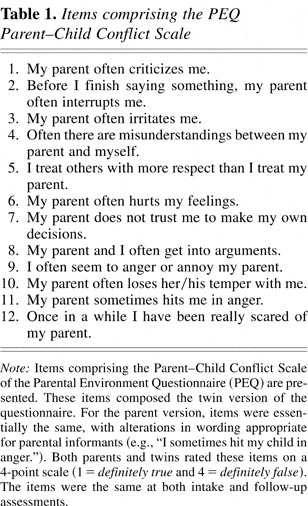
Items comprising the PEQ Parent–Child Conflict Scale
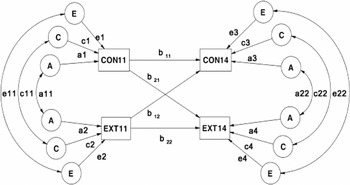
A path diagram of the cross-lagged model. The variance within and across phenotypes is parsed into that due to additive genetic effects (A), shared environmental effects (C), and nonshared environmental effects (E). Variance paths, which must be squared to estimate the proportion of variance accounted for, are represented by lowercase letters followed by one numeral (e.g., a1, a2). Genetic and environmental correlations are represented by lowercase letters followed by two numerals (e.g., a11, a22). Phenotypic partial regression coefficients are represented by a lowercase letters followed by two subscripted numerals (e.g., b11).
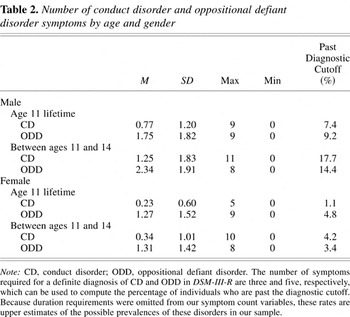
Number of conduct disorder and oppositional defiant disorder symptoms by age and gender
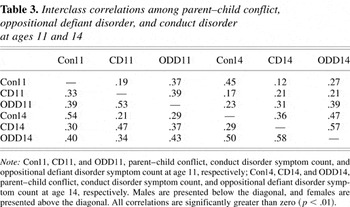
Interclass correlations among parent–child conflict, oppositional defiant disorder, and conduct disorder at ages 11 and 14
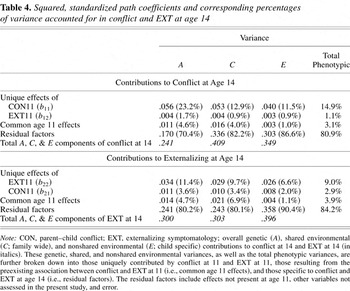
Squared, standardized path coefficients and corresponding percentages of variance accounted for in conflict and EXT at age 14
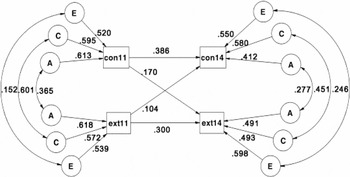
Standardized path estimates of the cross-lagged model with genetic, shared, and nonshared environmental contributions to the variance within and across phenotypes are illustrated. All paths are statistically significant at p < 0.05.
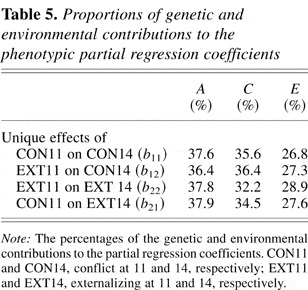
Proportions of genetic and environmental contributions to the phenotypic partial regression coefficients
 You have
Access
- 154
- Cited by