China's increasing presence in Latin America in recent years and the interactive dynamics this generates have caught the attention of scholars and policy makers. However, the role that public opinion in China plays in shaping relations has received little attention, especially when compared with the strong public interest in Sino-American, Sino-Japanese, Sino-Indian or even Sino-African affairs, despite its potential influence on Beijing. While official Chinese policy towards Latin America stresses the apolitical, economic nature of the relationship, the perceptions of ordinary Chinese about the region, which originate partly from misinformation and stereotype, are very different. In an authoritarian nation where public opinions still cannot be widely and freely expressed, the internet is increasingly studied as a meaningful primary source in understanding Chinese public attitude, especially towards foreign policies. Using online Chinese communities as primary sources, this article examines public perceptions in China of Latin America, especially in terms of how the region is seen as part of the Third World while also offering China a convenient backyard by which to access the First World United States. Since these perceptions are substantially different from official reality, the reasons why they differ may have implications for future Sino-American relations.
The article first reviews previous studies on Chinese understanding of Latin America and the official perception offered by Beijing after the end of the Cold War. This provides the basis of comparison with current public perception. A methodological section follows illustrating how online public opinion in China can be scientifically studied and why that matters. Codified online public opinion on four different Latin American topics is then analysed and compared with official opinion: how “Latin Americanization” becomes China's nightmare, how the Latin Americans should learn from the “China model,” how the Latin Americans were being discriminated in the H1N1 epidemic, and how the “Latin American card” to balance the US is emphasized. Finally, the conclusion examines the possible impact of the “disconnect” between the two views, which suggests that only when the stereotypes discussed in this article are dismissed will the true value of Latin America gradually obtain any standing in the eyes of ordinary Chinese and will the Latin American mission of the Chinese government be fully understood by its subjects.
Literature Review of China's Perception of Latin America
Referencing official and academic literature, this section discusses why ordinary Chinese perceive Latin America as a mix of Third and First World, while the government projects it as something else.
Chinese perception of Latin America: Third World or First World?
The Chinese perception of Latin America in the 20th century was rather ambiguous, if not contradictory. Latin America was a key strategic partner during the early days of the People's Republic of China in the so-called YaFeiLa (亚非拉, Asia-Africa-Latin America) group, which embodied the solidarity of developing countries in their struggle against the imperialist, developed Western world. Although since the Cultural Revolution Beijing has gradually dismissed anti-imperialist rhetoric, ordinary Chinese still largely perceive Latin America as part of the developing world; the most recent articles revealing such Chinese perceptions can be found in the volume edited by Hearn and Leon-Manriquez.Footnote 1 A number of scholars see the enormous different perceptions between China and Latin America as preventing the two sides from becoming close.Footnote 2
The Chinese have, however, sometimes placed Latin America in the developed world by grouping Latin American countries with those of the West (xifang guojia 西方国家). This perception is particularly prominent when Latin America's cultural origins are discussed, starting with the early contact between China and Latin America in the late 19th century. The Chinese see many cultural similarities between Hispanic-dominated Latin America and countries of the West, and recall certain Latin American countries, such as Peru, as bullying Chinese coolies in the past. This complicated dual identity given to Latin America has been noted by Chinese scholars such as Shihao Wang 王士皓; he found that while the Chinese government traditionally put the region in the Third World, especially in the Maoist era, it frequently concurrently described Latin America as part of “the West” in its official mouthpiece, the People's Daily.Footnote 3
Projection of Latin America by the Chinese government
While a Third World image of Latin America is common among ordinary Chinese citizens, a study of the current official Chinese policy towards the region shows a greater emphasis on its First World or quasi-First World identity in recent decades. Since the end of the Cold War, China has entered the region on an unprecedented scale, as the establishment of strategic partnerships between China and all the important Latin American countries reflects. In 2008, Beijing launched its first policy paper on Latin America and the Caribbean region, indicating Beijing's acknowledgment of growing interests there. The government is the key driver behind the change: various scholars see the authoritarian, “proactive” nature of the Chinese party-state as facilitating the rapid advances China has made on the continent.Footnote 4 Different views of Latin America can be found in official sources, namely: Latin America is a rising economy in the semi-developed world; Sino-Latin American comradeship derived from earlier revolutionary ideology is downplayed; Latin America should develop independently from China; and Latin America is generally friendly to China.Footnote 5 Interestingly, our research shows how online perceptions dismiss these one by one.
Methodology: Internet as a Source of Public Opinions in China
Most methodologies used to study Sino-Latin American relations have focused on the data which represent the government line. Many articles draw meticulously on official papers and represent official Chinese opinion.Footnote 6 The topic has also been studied by assessing public opinion through polling. The most comprehensive research conducted to date is from the Institute of Latin American Studies at the Chinese Academy of Social Sciences from early 2007 to May 2008; based on a nationwide survey it found that the Chinese public knows little about the continent and that the vast majority are satisfied with the current pace at which China's relations with Latin America are being developed.Footnote 7 However, this method places limitations on obtaining a true picture. A better result is obtained by a systematic analysis of online opinion.
Importance of online public opinion in China
As Andrew Chadwick comments in Internet Politics, “the issue is no longer whether politics is online, but in what form and with what consequences.”Footnote 8 The launch of Web 2.0 has enabled evolution from static web pages to multimedia and interactive websites and furthered politics on the internet in China. In their Handbook of Internet Politics, Chadwick and Philip Howard list the new features of internet politics in the developed world, modified versions of which are certainly also applicable to China.Footnote 9 First, the internet serves as a platform for political discourse in China, although the party-state has attempted to disseminate information online in a top-down manner. The party-state's strong control results in more pro-government messages being found online, making it difficult for researchers to differentiate state-sponsored online messages from voluntarily patriotic ones. A feature of internet politics relevant to our topic is the idea of collective intelligence. By gathering information from a critical mass, a widespread network of amateurs can potentially outperform the official discourse prepared by the authorities. This is of considerable significance in authoritarian regimes like China, as citizen access to high politics is normally largely blocked. In fact, the internet has become the only platform for alternative messages to be circulated and reconstructed in China in a bottom-up manner, albeit that they are often disguised in patriotic colours to pass official censorship. This feature is a key difference between Chinese cyberspace and the West's.
When Guobin Yang gave his preliminary assessment of the relationship between Chinese civil society and the internet, he characterized the virtual community in China by the Habermasian concept of a “public sphere.”Footnote 10 The “public sphere,” as suggested by Jürgen Habermas, has several characteristics: a platform for rational debate among autonomous and rational individuals; space where the public are free to engage and disengage themselves from the debate; and a medium of communication which, like newspapers and books, is necessary for deliberation.Footnote 11 While Habermas describes the public space as comparable to the café salon of the French Revolution period, its creation in China encourages the involvement of laymen, making it a truly public sphere. One key issue of cyber-politics in China, identified by Yongnian Zheng and Xiaoling Zhang, is whether civil society (still a nascent entity in undemocratic China) could be empowered in its relation to the state, or could become a “digital civil society.”Footnote 12 Following Muthiah Alagappa's traditional definition, Guobin Yang sees a “digital civil society” as encompassing “the large numbers of online communities, web-based social networks and loose organizations, as well as the active online presence of offline civic associations.”Footnote 13
Little attempt has been made at the governmental level to analyse the role of public opinion in the official policy-making process for Sino-Latin American relations, despite an increase in public participation on both sides. The official background of the Chinese researchers means that the quantitative studies undertaken have made no attempt to distinguish the differences between official and popular opinions, even less trace the origins behind such differences or discuss their impact. Most revealing when trying to understand Sino-Latin American relations is how the Chinese distort and misperceive the region's stereotypical image. This information is best obtained by systematic qualitative study to illustrate the various constructed myths circulated in China on the region.
Sino-Latin American relations are not currently a hot topic in China's virtual community, meaning the most direct channel of expression in China is under-explored. The rapid development of the online Chinese community has not only boosted the information flow among citizens across the territory but also created a new form of social interaction between the state, the media, various professionals and intellectuals, as well as China's ordinary citizens, with foreign policy serving as an arena of interaction.Footnote 14 As free expression remains constrained, the Chinese find online forums a useful platform from which to influence Chinese diplomacy. Three areas of influence on foreign policy are noted by scholars: changing the authority's mindset; injecting online opinions into the decision-making process; and shaping foreign policy directly by launching actual movements.Footnote 15 Although users may not exert a direct influence, their role in shaping the perception of the Chinese towards foreign countries is significant and has an indirect impact on the policy-making process.
Selection of sample internet forums
To be selected as primary research sources, online discussion forums in China had to fulfil two requirements: popularity as judged by hit rates, and attention to international relations as judged by the designated topics of discussion. The research was designed to ensure a mix of forums with inclinations towards different viewpoints, particularly the liberals and their opposition, the dominating dichotomized schools of interpretation in China. Forums targeting both veteran international observers and more casual viewers are also covered. By adopting and modifying the framework of Arvaja and his colleagues for group-level perspectives, three categories of postings are classified from our samples: personal (those mainly expressing personal emotions without much sophistication), judgemental (those including detailed analyses to express opinionated agreement or disagreement) and informative (those primarily presenting information in a relatively opinion-free and academic manner).Footnote 16 Generally, the more the forum inclines towards the “personal” category, the more radical it is; and the more the forum inclines towards the “informative” type, the more rational it is. Four forums from ten of the most popular in China on which the author has previously conducted research were selected for sampling as being the most representative (two pro-new leftists and two pro-liberal; two personal-inclined and two informative-inclined) as well as having a longitudinal record consistent with the author's other research for cross-region comparison.Footnote 17 Summarized details of the selected forums are as follows:
(1) Strong Nation Forum (Qiangguo luntan 强国论坛, SNF): set up in 1999 in response to the Belgrade Embassy Bombing, it is arguably the earliest and most famous meeting point of online Chinese nationalists. It is run by the state-owned People's Daily (Renmin ribao 人民日报) and can gather over 1,300,000 visitors at any one time.Footnote 18
(2) Community of Iron and Blood (Tiexue luntan 铁血论坛, CIB): a forum run by amateurish military fans which focuses extensively on military affairs, it is also famous for nationalist expressions.Footnote 19
(3) Tianya Community (Tianya xiequ 天涯协区, TYC): established at roughly the same time as the SNF, the Hainan Island-based TYC is privately-run and is seen as a keen competitor of SNF. Famous for featuring liberal ideas originally, new leftist and nationalist sentiments have also been notably present in TYC in recent years.Footnote 20
(4) Phoenix Net Forum (Fenghuangwang luntan 凤凰网论坛, PNF): run by the privately-owned Phoenix Satellite Television Company Limited (Fenghuang weixing dianshi 凤凰卫星电视), it is a popular online base of the Chinese liberals. A single topic can have over 12,000 hit rates over a night.Footnote 21
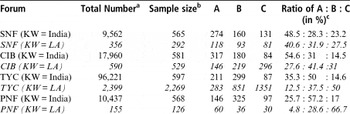
Although Latin America is frequently discussed on internet forums in China, the number of posts relating to the keyword “Latin America” (LaMei 拉美) is almost 100 times fewer than for other geographical keywords such as “India” (Yindu 印度). This may make conclusions drawn from the Latin American posts statistically inconclusive. However, as the author has previously conducted research on the online Chinese community and its view of India, using a much larger sample size from comparable forums, analysis of these can be referred to in identifying the nature of our selected forums (Table 1).Footnote 22 As seen from the table, CIB and SNF are generally regarded as more fanatical than TYC and PNF. Despite this, when Latin America was being discussed the views obtained from netizens were fairly homogenous. In other words, no matter what type of forum the postings came from, the comments tended to be similar.
Empirical Ratio of Rational/Radical Level of the Selected Forums

Notes:
aThis number includes the responses to original posts. Sometimes there can be hundreds of responses to a single post; sometimes there are none. The number is counted manually after using a keyword search as restricted by the time frame.
bSince the research using “India” as the keyword threw up a huge number of postings, we took a confidence level of 95% to select and study roughly 400 to 600 postings from each forum. These were classified into one of the three categories to obtain a ratio of the three for each forum's related messages (Confidence Level: 95%; Confidence Interval: 4). When the keyword search for “India” was replaced with “Latin America,” the total number of posts was greatly reduced. After deleting any irrelevant posts (such as using the same Chinese characters to talk about other issues), all remaining posts were used for our sample.
cA: personal; B: judgmental; C: informative.
Sources:
The data on India are derived from Simon Shen, “Exploring the neglected constraints on Chindia: analysing the online Chinese perception of India and its interaction with China's Indian policy,” The China Quarterly, No. 207 (2011), pp. 541–60. The data on Latin America are sourced by the author.
Time frame
The time frame chosen for the research was 1 November 2008, immediately before Hu Jintao revisited Latin America, to 31 October 2009, when another Chinese leader, Wu Bangguo, Chairman of the Standing Committee of the National People's Congress of China, went to the region. Several historic events involving China and Latin America took place during this period, including the global financial crisis and the outbreak of the H1N1 epidemic, seen in China as having originated in Latin America. All postings relevant to Sino-Latin American relations and Latin America were studied and downloaded as primary data. The threads created, the posts replied to, and the language and tone used enabled us to use discourse analysis to develop an understanding of the general perceptions of the Chinese towards Latin America and how these vary from the official policy.
Limited attention to Latin America: small absolute number of posts
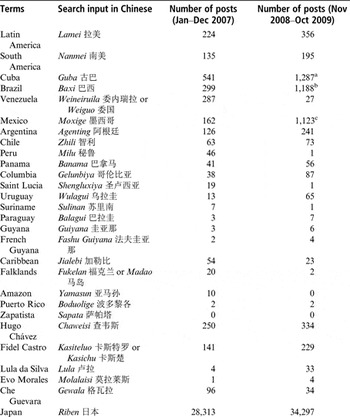
An inherent constraint has to be acknowledged here. The small absolute number of relevant online posts suggests a general lack of interest in Latin America. A bigger picture can, however, be obtained by conducting another quantitative search. In a project for publication led by the author, a participating scholar, Kai-chi Leung 梁啟智, conducted a search on 27 Latin America-related keywords on the countries, people and culture mentioned by Strong Nation Forum in 2007. Using the same keywords as the basis of comparison, the author conducted further research for posts during our chosen time frame and observed a similar result (Table 2). This shows that the attention given by Chinese online to Latin America is almost 100 times less than that given to Japan. Indeed, the number of Latin America-related posts in China is substantially fewer than made towards India or even Africa. The figures observed in 2007 and 2009 are basically consistent, while some obvious differences can be explained by certain ad hoc incidents (see below).
Comparative Frequency of Latin America-related Terms Mentioned in Strong Nation Forum from January 2007 to December 2007 and from November 2008 to October 2009

Notes:
aApril 2009: US President Barack Obama implemented new policy towards Cuba.
bJuly 2009: Clodoaldo Hhgueney, Brazilian Ambassador to China, served as a guest in the online chat programme at Strong Nation Forum. October 2009: Brazil's Rio de Janeiro won the bid for 2016 summer Olympics.
cApril 2009: the outbreak of H1N1 in Mexico.
Sources:
The data from January 2007 to December 2007 are quoted from Kai-chi Leung, “Discussions on Sino-Latin American relations in Qiangguo (or the lack thereof),” in Simon Shen and Shaun Breslin (eds.), Online Nationalism and China's Bilateral Relations (New York: Lexington, 2010), p. 249. The data during our time frame were sourced by the author. Note that Leung's original table included a figure on the USA as well, which is not included here because the author regards Leung's selected keywords Meiguo or Meilijian might have missed out the major keyword on the topic Zhongmei (Sino-US).
Sampling and codification
The general political inclination of the Chinese posts on Latin America, theoretically, can be studied in a paradigm featuring the new leftists on one side and the liberals on the other. The new leftists are those who support a strong central government, redistribution of resources and often a tendency towards patriotism, whereas the liberals generally support a market economy, Western democratic ideals and heavy criticism of state-sponsored nationalism. However, both the 3,500 posts using “Latin America” as keyword in Table 1 and the 5,379 posts relating to a range of topics on Latin America in SNF as identified in Table 2 show an overwhelming dominance by the new leftists. More than 90 per cent of the data incline towards them; as a result, liberal voices – such as those calling for appreciation of Latin America's democratic achievements – are little represented. The study mechanism used to select the quoted samples was first to go through all the posts and confirm that there was more than 90 per cent new leftist representation (therefore, unless mentioned otherwise, the posts do not reflect the under-represented liberal views online); second, to identify the posts relevant to the four major areas of official perception outlined above; and third, to select two threads randomly from each forum relevant to the four areas for further analysis. The findings can be summarized as below.
Online Chinese Perceptions of Latin America
Although Chinese netizens have generally paid little attention to Latin America, their stereotyping of the region is no less distorted than for countries to which they show more concern. The online Chinese opinion reveals sharp differences with the official Chinese view.
“Latin Americanization” as China's nightmare versus Latin America as a booming economy
Although Sino-Latin American economic contact was minimal before the end of the Cold War, China now officially sees the region as having huge economic potential. From previous negligible bilateral trade, generic Sino-Latin American trade reached almost US$150 billion in 2008, a more than tenfold increase since 2000.Footnote 23 Besides bilateral trade and direct investment, the rich natural resources in Latin America – oil in particular – are another prime focus of China's state-owned companies.Footnote 24 It is worth noting here that while unilateral subsidy is often stressed by Beijing in regard to Sino-African relations, Sino-Latin American relations are more associated with mutual benefit as the living standard and GDP per capita in Latin America are at least as good as in China.
If the Chinese government sees Latin America as a better developed part of the Third World, most Chinese netizens do not. They see it as almost as poor and backward as Africa, despite the fact that the Latin Americas once performed relatively well economically and sided with other imperialists against China. In this constructed image, the economic performance of the region is viewed as generally poor, with problems like the massive amount of foreign debt, budget deficits and uncontrollable inflation well noted by the Chinese.Footnote 25 The region is seen as very corrupt, its wealth concentrated in the hands of a small group of people, thus preventing “ordinary citizens from moving up the social upper ladder because of limited opportunities.”Footnote 26 Security is perceived to be bad; Rio de Janeiro is known as the “most terrible city” in the world.Footnote 27 Even the standard of hygiene is jeered at. The following taken from an online posting entitled “why Latin America has to be mentioned” is most representative:
In our mainstream vision, Latin America never has a place. In our concept, the term “Latin America” is not even above that of “Africa.” We are always shameful in mentioning Latin America, where breed all sorts of tumours caused by capitalism, wealth polarity, social instability, political dictatorship and distorted economic development. Since the Latin Americans gained independence, they have remained in the Third World having wasted two centuries. How can we compare ourselves with Latin America?Footnote 28
Perhaps seeing value in making a comparison with China, more inspirational are the reasons suggested in this discussion which led to such desperation in Latin America. The netizens' dominating theme is the responsibility of the liberal model, whose recipe of privatization and capital-intensive marketization led to Latin America's easy exploitation by the US.Footnote 29 Globalization and open market policy share the blame, exacerbating the inherent difficulties of Latin America's modernization such as lack of social and class cohesion.Footnote 30 The few liberals who can still be identified online suggested what they labelled “incompetent dictatorships,” such as that of Hugo Chávez, have triggered further income polarity and inequality.Footnote 31 In contrast, plenty of posts link Latin America's “failure” with the overall demerits of the Western democratic system.Footnote 32 Put simply, most believe Latin America to lack the ability for sustainable development.Footnote 33 Although these views are not always consistent, what does seem to find consensus among netizens is that Latin America has not found a successful way to develop; therefore it is not capable of resisting US capitalist exploitation and subsequent financial crises. This vicious cycle is summed up as “Latin Americanization” (LaMeihua), an increasingly negative label heavily exploited by the online Chinese community. In nationalist-driven forums like SNF in particular, Latin Americanization is a convenient “strawman” when China is discussed. The direst warning for China offered by netizens, notably during the financial crisis in 2008, was “China is facing a more tragically doomed fate than being Latin Americanized.”Footnote 34
These ideas are in line with the recent academic discussion of Latin Americanization. China Review News, which generally takes a new leftist line, said the unsuccessful “Latin American model” resulted from the inept adoption of the US system in Latin America.Footnote 35 Christina Sue suggests that anxiety about preventing Latin Americanization in China indicates that the Chinese regime remains pre-emptive, flexible, pragmatic and responsive to threats, and will head off dangers to the regime.Footnote 36 Scholars such as Daojiong Zha 查道炯 also see the root of Latin Americanization (despite many Latin American states having an open economy) in a political structure which remains militarily authoritarian, leading to severe transfer of interest, corruption and instability.Footnote 37 According to Zha, if democratic reform is not carried out in time, China will become “‘Latin Americanized’ just like Venezuela or Mexico”; but this liberal line is less taken online.Footnote 38
Latin America should learn from the “China model” versus Latin America should walk its own way
In an attempt to pre-empt Western intervention after the Cold War, China gradually acknowledged that every country in the world has a different national situation (guoqing) and nothing can be easily transplanted from one to another. It also officially renounced the right to guide the development of other countries. In 2011, in response to the turmoil in the Arab world, Premier Wen Jiabao emphasized that China had no intention of preaching elsewhere its own successful experience of economic development and disregarded the existence of the “China model.”Footnote 39 Where Latin America is concerned, Beijing understands that directly exporting the “model” is not an option.
However, the fact that China keeps reminding fellow developing countries to avoid following the US model is inevitably seen as an indirect promotion of China's own system. After the financial crisis in 2008, several Chinese scholars formally proposed theorizing the “China model” to encapsulate the reasons for China's economic success. According to Pan Wei, the model consists of four sub-systems: a unique way of social organization, a unique way of developing its economy, a unique way of government and a unique outlook on the world.Footnote 40 Most advocates see the model as an elaborate version of the Beijing Consensus, which basically features everything other than the Washington Consensus. In the view of some Chinese scholars, Latin American countries currently governed by left or centre-left governments are already voluntarily or involuntarily referencing the model.Footnote 41 Recently, several Latin American scholars have proposed applying the “China model” to their region, but their interpretation of it can be very different from the Chinese understanding. For instance, Mexican economist Enrique Dussel Peters said the development model of China “should be a role model for Mexico and Latin America,” and the fact that China refuses to follow the Latin American precedent and rely on foreign capital and cheap labour in the production line – his version of the “China model” – is particularly creditable.Footnote 42
In the online community, few have doubted the applicability of the “China model” in Latin America or questioned the morality and practicality of exporting it. But when the comments of Dussel Peters, one of the most famous Latin American scholars in China, were shared in the online community there was much disagreement; most Chinese netizens viewed his “model” as wrong and not representative of the truth behind China's development. They see a strong, authoritarian government, such as outlined by Wei Pan, being at the core of the “China model”:
The China model is a way to control the foreign exchange rate so we can develop a labour-intensive industry by using our cheap labour and eliminate competitors.Footnote 43
Our ability to export our products is because we can manipulate foreign exchange rates so foreign investors can make profits.Footnote 44
The netizens thought that Dussel Peters' suggestion would simply lead Latin America into further chaos from excessive liberalization, and that by following it China would be led down the same fatal Latin Americanization path.Footnote 45 In other words, although they favour the “China model,” they doubt Latin Americans are able to learn from the model because of their governments' inability to implement the same macro control over mechanisms like the exchange rate as China has done.
“Mexican flu” discrimination versus Sino-Latin American historic friendship
Official Chinese documents now rarely mention unfriendly gestures shown by Latin Americans towards China, but history plays a strong role in the online Chinese community in reconstructing the image of foreign countries. Much attention was given to posts about history not mentioned in traditional textbooks where Latin Americans appeared as China's oppressors. For example, the story most circulated about Peru among the online Chinese community is that thousands of former soldiers who took part in the Taiping Rebellion (1850–63) were sold to Peru in the late 19th century where they were badly mistreated; they faced a tragic fate, but ultimately changed this by joining Chilean forces to fight against “Peruvian colonialists” in the War of the Pacific (1879–84).Footnote 46 The accuracy of the story is doubtful, although historic accounts exist of some Chinese coolies being exploited in Peru and joining forces with Chile in the war.Footnote 47 As another example, netizens paid much attention to the massacre of some 300 Chinese immigrants and destruction of their homes and businesses in Torreon, Mexico in 1911 (note that “massacre” is an abused emotional term in China as the contemporary nationalist movement was developed surrounding the memory of the Nanjing Massacre in 1937). As Robert Chao Romero says, among the tide of discrimination against Chinese in the entire American region, this was the worst act of violence committed against any Chinese diasporic community of the Americas during the 20th century.Footnote 48 Yet from the netizens' perspective, the highlight of the story was when the Qing court sent a “gunboat” to the Mexican coast to pressure the Mexican politicians into capitulating.Footnote 49
These stories get attention because of their relevance to Chinese history: one was linked to the legendary Taiping Rebellion and the other happened when China's Qing dynasty (1644–1911) was still in power. But the discussion mainly serves one purpose: to exaggerate the effort made by Chinese ancestors in safeguarding Chinese interests and by doing so highlight the weakness of today's government. As a by-product, the stories inevitably helped shape the image of Latin America and differentiated it from Third World countries in Asia or Africa. While discrimination against Chinese in Asia or Africa – which is not uncommon – is often associated with the superior positions held by Chinese businessmen in the indigenous communities, Latin American discrimination of Chinese in history was more like that of the Europeans and North Americans, who saw themselves as superior. In other words, Latin America is seen by the Chinese as part of the past imperialist camp.
With history in mind, it was no surprise that the current affairs topic in our time frame which received the greatest feedback was the Mexican reaction to the H1N1 virus epidemic. Originally labelled “Mexican flu” in China, H1N1 had been interpreted as a Latin American disease and resulted in the eruption of anti-Mexican sentiments online describing Mexico as an “irresponsible country.”Footnote 50 The Mexican government counterattacked by saying that H1N1 originated in an Asian tourist, and temporarily advised its citizens not to go to China and not to participate in a food exhibition scheduled to be held in Shanghai. Interpreting this response as an intentional boycott by Mexico, most Chinese netizens responded vigorously by asking Beijing to take tough measures to punish Mexico.Footnote 51 Mexico was then called a “shameful” country, a “mad dog” which rewarded China's subsidies with revenge (enjiang choubao 恩将仇报), and “a wolf that cannot be satisfied with feeding.”Footnote 52 Half jokingly, some even borrowed the revolutionary rhetoric usually reserved for Western imperialists and said that “a small portion of mean Mexican civilians are still dreaming of seeing the demise of China.”Footnote 53 Although some users pointed to China's double standards, as tourists from the US – another suspected source of H1N1 – were not similarly checked, the general reaction suggests that most Chinese resented being discriminated against by a Latin American country which they see as having oppressed their ancestors. This response was, of course, not contained to the internet community. By quarantining all Mexicans, Beijing was accused of discrimination by media and scholars, such as Yanzhong Huang who followed the case, while the government of Mexico also voiced its discontent.Footnote 54 As Zha noted, China shifted its stance later in the outbreak; some believed Beijing was attempting to resolve the bilateral tension by changing its view of Mexico and supportively offering financial assistance to combat the pandemic.Footnote 55
Playing the Latin American card against the US versus peaceful development
Engaging Latin America in the Cold War is framed as a strategy to contain the United States, but the current Chinese leadership has tried to dismiss the China threat theory by emphasizing economics in Sino-Latin American relations. This is guided by China's new official diplomatic ethos of “peaceful development” (heping fazhan 和平发展). Beijing's unwillingness to challenge the US by entering Latin America is endorsed by some scholars, and some even expressed positive views about the prospects for building a “Latin America–China–USA triangle” that would benefit all three parties.Footnote 56 However, another school tends to distrust the whole assumption of peaceful development, seeing the growing relationship between China and Latin America as a cause of future conflict in Sino-US relations.Footnote 57 Proponents of this view believe China has carefully crafted a Latin America policy to counterbalance its relations with the United States, and that the effectiveness of the policy stems from both Washington's missteps and Beijing's low profile.Footnote 58
The online community sees Latin America as remote from China and its level of “Latin Americanization,” leaving the region with no alternative but to align with great powers. This is often discussed under a more macro framework that catches public attention, that is, Sino-US relations. Latin America's importance is generally rationalized by suggesting that China and the United States are engaged in a new Cold War, so that China must unite with Latin America and the Middle East – the “strategic zones” – to isolate Washington.Footnote 59 Getting energy resources from Latin America is seen as a significant step in enhancing China's national security at the expense of the US.Footnote 60 Noticing the recent tense relations between the United States and the left-leaning Latin American countries, some suggest China should use the opportunity to engage the Latin Americans and “light a fire” in the US's backyard.Footnote 61 And it is not uncommon to frame China's increasing presence in Latin America as revenge on the US for increasing its presence in the Asia-Pacific region and Taiwan, regarded as China's backyard: “US arms sales to Taiwan were done with no prior consultation with the Chinese, too.”Footnote 62 When the presence of China in Latin America is compared with the US presence in Asia, it is generally viewed as lacking and more aggressive policies are proposed.Footnote 63 Since Latin Americanization is viewed by most online as a result of US conspiracy, it is widely believed that the Latin Americans would welcome the Chinese presence (when topics such as H1N1 are not triggered). This interpretation is close to the realist warning that “China [is becoming] a political rival of the US in its own backyard.”Footnote 64
Obviously, the mainstream online analysis of this China–US–Latin American triangle is realist oriented. It sharply differs from official policy which stresses collective development and avoids challenging the United States; and it is in complete opposition to the projected harmonious relationship between the three by scholars like Stallings. Besides its direct impact on Sino-US relations, this online perception has also contributed to the degradation of the image of Latin America. Its attempt to emerge as one of the independent poles in global economics and politics is ignored. Instead, it is sometimes juxtaposed with North Korea as a tool with which China can pressure the US, hinting that the huge differences between Latin America and North Korea are not the interests of the realist-driven Chinese netizens. To some extent, Beijing's emphasis on offering unconditional support to Latin America with no strings attached seems shared by its internet citizens. They see the US as a power “which cares about its self-interests only,” whereas China is pursuing a harmonious foreign policy “which would lead to common prosperity with Latin America.”Footnote 65 However, the ultimate concern of the netizens is still the absolute power of China; penetrating Latin America, even with no advantages at all, is perceived as an assessment mechanism of China's rising national capability.Footnote 66
If China is not strong enough to tap into Latin America alone, working with Russia against the Americans was one acceptable suggestion.Footnote 67 But many netizens regarded a solo China effort as sufficient. When a report in the Los Angeles Times about increasing Sino-Venezuelan military and economic co-operation said China is “becoming bolder in handling Latin America,” most Chinese netizens – including the generally liberal-oriented PNF followers – responded with excitement.Footnote 68 Some even suggested China send its navy to Latin America.Footnote 69 Ironically, no matter how unrealistic and exaggerated these suggestions are, the rise of China alone is sufficient impetus for many Chinese netizens to pursue an aggressive “policy” towards Latin America.
One might ask where Chinese users get these ideas. Besides old ideas from the revolutionary era, contemporary Chinese and Western scholars also suggest this line. For example, Hongying Wu, who heads a centre of Latin American studies, said in 2009, “China has engaged in a patient, comprehensive diplomacy strategy toward Latin America”; “the PLA's new charm offensive is slowly but steadily winning a foothold,” whereas “initiatives beyond arms sales are incrementally allowing the PLA to create a foundation for long-term military co-operation in the not so distant future.”Footnote 70 Leading Sinologist David Shambaugh also noted that “perhaps one of China's most symbolic moves was the consolidation of relations with Venezuela's President Chávez, a Castro protégé who was the focus of America's anger in recent years”; “China's stature as a responsible multilateralist has been recently illustrated by its participation in the United Nations peacekeeping operation in Haiti, the first time that force is being deployed in America's ‘backyard’ by China.” Hence an “increased Chinese activity in the ‘backyard’ has begun to be seen in a different way by some American interest groups, such as the neoconservatives,” such that “some Latin American countries and many textile and shoe producers (particularly in Central America) are already demanding better access to the US market, comparing it with China's.”Footnote 71 It suggests that although Beijing tries hard to dismiss the China threat theory, many scholars already view China's entrance into Latin America from the realist angle, and given the dominance of realism in the online Chinese community, reading Chinese involvement in Latin America as targeting the US, rather than targeting the Latin American market, is thus popularly recorded.
Implications for Sino-Latin American Relations
Although China's official Latin American policy has been greatly transformed since the end of the Cold War, most Chinese internet users are unaware of this. Their general impressions are still largely shaped by old memories. Online public opinion thus cannot be regarded as the most accurate representation of public opinion in China. However, because of China's authoritarian nature and the peculiar role of the internet in expressing public sentiment in the country, the online perceptions and comments on Sino-Latin American relations, and on Latin America's dual identity, may offer valuable indicators of the impact on its citizens of both China's domestic and its foreign policies.
Online Chinese perception of Latin America versus other regions
The author's earlier research on online Chinese nationalism and Chinese perceptions of other regions provides an interesting comparison with Latin America. Although their knowledge of Latin America is very limited, Chinese views on the region are no more distorted than those on Africa or India. However, the content of the distortion is quite different. First, however, the view towards the US, Japan, India or even Africa is equally realist dominated and is consistent with the popular assumption that the future global order will be dominated by a conflict between China and the United States. Second, although most Chinese users are equally dismissive of Latin America, India and Africa, the “failure” of Latin America is interpreted less in racist or cultural terms and more to the ill-fated liberal systems introduced by the US. Third, Chinese netizens are more likely to treat Latin Americans as equal partners as they were previously seen as part of the developed world. Fourth, there is little online enthusiasm for Sino-Indian or Sino-African co-operation, but many users suggest that Latin America borrows the “China model” to divest itself of “Latin Americanization.” This is because most users see Latin America as having the potential to be a useful partner to China in counterbalancing the US. Africa is not regarded as a strong ally and the chance of India siding with China is minimal.
Flexibilities in policy making at normal times
The lack of online Chinese public attention to Latin America, especially in terms of trade and economy, could mean less populist pressure put on China's Latin American policy and more room for Beijing to manoeuvre in the region – provided no crises arise. It is notable that despite the nationalist online atmosphere, few posts complained that China was too weak in its handling of Latin America. Any slight change in China's policy towards the US, Japan or India would readily arouse public attention and criticism of the government for lack of patriotism. Changes in China's Latin America policy are likely to be given a freer hand.
Obsolete stereotypes and expectation mismanagement
Online understanding of Latin America relies largely on outdated, nostalgic memory from the revolutionary era and this could pose a potential danger for Beijing because the public is using imaginary criteria to evaluate the effectiveness of contemporary policy. Trade is an extremely important area of Sino-Latin American relations, but gets no attention from Chinese netizens, largely because it has no historical significance. In contrast, ideology and anti-Americanism, two important areas in the past, are believed also to be of future importance. As a result, an expectation mismatch is likely to occur because the foci of Beijing's attention will not receive due credit, while the strategic results the netizens expect will not be forthcoming. Given the general lack of interest in Latin America, this is unlikely to be a serious problem in times of normality. However, this indifference is largely due to the absence of anything newsworthy taking place between China and the region in recent years. If anti-Chinese riots suddenly broke out in Latin America, for instance, it might be a different story.
Sino-US competition in Latin America: a self-fulfilling prophecy
Similarly, the overwhelmingly realist online interpretation of Sino-Latin American relations, which deviates greatly from reality, is not currently a problem. Although some netizens suggest going into Latin America to prove China's rise, it is debatable whether this is an option, even in the minds of the online community. But an increasing number of Chinese see China as a real future global power, and once its rise is confirmed their expectations will be different. This may not be an official Beijing aim, but the existence of such public opinion would certainly be used by conservatives in the US to support the China threat theory. Searching for evidence to prove the inevitability of conflict as the “tragedy of great powers,” the offensive realists in the US like John Mearsheimer are likely to take these comments seriously.Footnote 72 While Beijing tries to avoid provoking the United States in Latin America, interpreting China's arrival there as an intentional challenge against the US may become a self-fulfilling prophecy created from internet opinion.
“Latin Americanization”: a dialectical strawman for the “China model”
Online perceptions also have important implications for China's domestic policies. Poor understanding of the real Latin America and the negative labelling effect of “Latin Americanization” means that following the Latin American model – whatever that is interpreted as – is seen by most Chinese people as doomed to failure, a view shared by both the nationalist/new leftists and the more Western-sympathetic liberals. Expecting China to abandon its comparative advantage of a cheap labour force or to use high technology to define its market share is not immediately realistic; and avoiding “Latin Americanization” almost automatically means taking firm control of the exchange rate, influx of foreign capital and currency valuation, as well as maintaining social harmony and stability by authoritarian means. These beliefs are not only framed in the “China model” but are guiding principles for Chinese corporations when competing internationally. In a popular book published by Tsinghua University, Changing the Game Setting of Competition between Chinese and Foreign Corporates, a whole chapter is dedicated to addressing the “nightmare of Latin Americanization.”Footnote 73 In other words, “Latin Americanization” and “China model” have become conjoined twins in the popular Chinese context: the former is a convenient strawman to illustrate the consequences of not embracing the latter. Internet users see the relationship between the two as totally logical, if not dialectical. Of course, if Chinese understanding of Latin America were to improve, the strawman might be debunked. Sadly, this is unlikely to happen in the foreseeable future.
Final Words: Deconstructing the Myth? Reconstructing a New Myth?
Although the impact of online public opinion should not be overestimated, it should not be underestimated either. The Chinese government would be well advised to engage itself in expectation management of its citizens to pre-empt potential trouble. Short-term measures are useful, but success lies in consistent public education to redress the stereotype of Latin America. Only when the old-fashioned and inadequate lump-sum terminologies which group Latin America, Asia and Africa together in this era of globalization are abandoned, particularly from textbooks and the mass media, will Latin America gradually obtain any standing in the eyes of ordinary Chinese. And only when the independent values of Latin America, other than serving as the US's backyard, are properly conveyed can the importance of multilateral Sino-Latin American trade be understood. One platform which Beijing could use to construct a new image for Latin America is BRICS in a first attempt at linking China with a Latin American giant directly in economic terms. Sufficient opportunities or media attention arising out of BRICS might give the Chinese an incentive to understand how Latin America has moved on since the early years of Castro and Che Guevara. As constructivist scholars always emphasize, perception makes reality. The current Chinese perception of Latin America is formed from that constructed 50 years ago, and a realistic image needs to be reconstructed as soon and as quickly as possible – not only for today but also for the future.