INTRODUCTION
Atypical universal quantification by preschool children
Children's computation of the meanings of sentences involving the universal quantifier (e.g. every in English) has been a subject of debate. Initially, children were claimed to exhibit atypical universal quantification (Inhelder & Piaget, Reference Inhelder and Piaget1964). Following this original observation, later studies specifically showed that if children are asked ‘Is every boy riding an elephant?’ along with a picture showing some boys each riding an elephant and an extra elephant nobody is riding (this is typically called the Extra Object Condition), three-, four- and five-year-old children would answer ‘No’, pointing to the extra elephant as the reason, even though its presence does not falsify the premise every boy is riding an elephant (e.g. Philip, Reference Philip1995). This atypical semantic interpretation involving the universal quantifier is called the Symmetrical Response (henceforth SR); it seems that children reject these sentences by reasoning that the falsifier is the presence of the extra object which ruins the symmetrical one-to-one relation between boys and elephants in the picture. As opposed to SR discussed as children's atypical response, we will call the typical adult-like interpretation the ‘logical reading’ (henceforth LG, i.e. a ‘True’ response to pictures in which, for example, every boy is riding an elephant irrespective of the presence of extra elephants).
Some linguists have attempted to provide linguistic theory-based explanations for SRs. These approaches attribute the origin of children's SRs to their non-adult-like semantic representation of every (e.g. Drozd, Reference Drozd, Bowerman and Levinson2001; Geurts, Reference Geurts2003; Philip, Reference Philip1995). Other researchers have provided evidence suggesting that throughout their development, children's semantic knowledge and representation of the universal quantifier is not different from adults, but that SRs reflect the effect of some extralinguistic factor which blocks children's use of their adult-like semantic knowledge (e.g. Crain, Thornton, Boster, Conway, Lillo-Martin & Woodams, Reference Crain, Thornton, Boster, Conway, Lillo-Martin and Woodams1996; Gualmini, Reference Gualmini2004; Minai, Reference Minai2006). In particular, Sugisaki and Isobe (Reference Sugisaki, Isobe, Kim and Werle2001) reported that modified extra-object pictures, in which multiple numbers of extra objects were depicted, elicited nearly perfect rates of LG responses from four- and five-year-old children. Gouro, Norita, Nakajima and Ariji (Reference Gouro, Norita, Nakajima, Ariji and Otsu2001) also elicited higher rates of LG responses from children around the same age, by utilizing revised extra-object pictures in which different subtypes of agents within the same supertype are associated with the same objects in different colors (e.g. each of three different kinds of Pokémon is riding on a red pony, a blue pony and a yellow pony respectively, while there is a green pony nobody is riding, i.e. the extra pony). Taken together, these studies suggest that children interpret the universal quantifier the same way as adults under certain circumstances, and that extralinguistic factors play a role in modulating children's level of success in universal quantification.
In search of the basis for symmetrical responses: language development and cognitive control
The fact that children do exhibit LG interpretation of the universal quantifier under certain circumstances shows that it is not a lack of semantic knowledge of universal quantification that causes them to show SRs in contexts such as the Extra Object Condition described above. This explanation per se, however, does not account for why there are domains in which children still exhibit SRs, nor does it offer an explanation of what allows them to grow out of it. The present article investigates what elicits the SR in child language from the perspective of cognitive development. Sugisaki and Isobe (Reference Sugisaki, Isobe, Kim and Werle2001) and Gouro et al. (Reference Gouro, Norita, Nakajima, Ariji and Otsu2001) argued that the successful use of adult-like semantic knowledge by three-, four- and five-year-olds is easily hindered by an extralinguistic factor; they demonstrated that children's interpretation of the universal quantifier improved when the pictures were changed. Gouro et al. (Reference Gouro, Norita, Nakajima, Ariji and Otsu2001) pointed out the visual salience of the extra object in the picture, defining it as an exceptionality in which the extra object uniquely lacks the property shared by the other objects, i.e. being paired with an agent, and argued that the salience of the extra object affects children's responses to sentences with the universal quantifier.
This raises the question of why salience matters for children. We propose that some cognitive factors may contribute significantly to children's SR for universal quantification. Specifically, we argue that a key factor is children's ability to flexibly switch between different perspectives, which is required in computing universal quantification in extra-object contexts, without being hindered by the undue focus on the salient but irrelevant information provided in the extra object.
Let us spell out the relevant issues regarding children's flexible perspective switch. Since Piaget's early observation (e.g. Piaget, Reference Piaget1954), children's cognitive skills have been assumed to be inflexible in various aspects, such as focusing on one dimension of stimuli (e.g. the height of water in a narrow glass) while unable to simultaneously consider another dimension (e.g. the shape of the glass). Recent research has examined such phenomena in light of their development of Cognitive Control, the cognitive system that controls a set of skills required for a variety of cognitive processes such as planning, decision-making, abstract thinking, reasoning, rule acquisition and error correction or troubleshooting (e.g. Conboy, Sommerville & Kuhl, Reference Conboy, Sommerville and Kuhl2008; Davidson, Amso, Anderson & Diamond, Reference Davidson, Amso, Anderson and Diamond2006; among many others). We focus on one of the cognitive aspects characterized in terms of cognitive control, i.e. the ability to flexibly switch perspectives. This cognitive aspect is commonly assessed in preschool children, whose age ranges from three to five, using cognitive tasks such as the Dimensional Change Card Sort (DCCS) (e.g. Frye, Zelazo & Palfai, Reference Frye, Zelazo and Palfai1995; Zelazo, Reference Zelazo2006; Zelazo, Frye & Rapus, Reference Zelazo, Frye and Rapus1996; Zelazo, Müller, Frye & Marcovitch, Reference Zelazo, Müller, Frye and Marcovitch2003). Children are asked to sort cards which can be classed according to two competing dimensions (color and shape), first according to one dimension (e.g. shape) and then according to the other (e.g. color). The decrease of the rates of successful card sorting over the dimension-switch offers a measurement of how flexibly children switch perspectives. Previous research has demonstrated that three-, four- and five-year-olds can successfully sort the cards with respect to the first dimension; however, with respect to the second dimension, many three- and four-year-olds fail, whereas five-year-olds succeed approximately 75% of the time (Frye et al., Reference Frye, Zelazo and Palfai1995). Some researchers attribute such DCCS performance patterns to children's difficulty in controlling their attention, which is called Attentional Inertia (e.g. Diamond, Carlson & Beck, Reference Diamond, Carlson and Beck2005; Kirkham, Cruess & Diamond, Reference Kirkham, Cruess and Diamond2003; cf. Frye et al., Reference Frye, Zelazo and Palfai1995; Zelazo et al., Reference Zelazo, Müller, Frye and Marcovitch2003; Reference Zelazo, Frye and Rapus1996; among others). According to this approach, children in this age range have a difficulty in perceiving an object from multiple perspectives, and thus are not able to flexibly switch perspectives. For example, if children perceive a white cat, they first focus on one aspect of it, e.g. color (its white-ness), but experience difficulty re-perceiving it while focusing on another aspect, e.g. shape (its cat-ness), failing to disengage from the first perspective (i.e. color).
The development of cognitive control has been discussed in light of its link with child language. These studies have been searching for the potential link among cognitive development and overall language development. Bialystok and her colleagues examined the relationship between child bilingualism and cognitive development (e.g. Bialystok, Reference Bialystok1999; Reference Bialystok2001). Whereas bilingual children typically show disadvantaged development in their verbal ability, compared with their monolingual peers (e.g. Macnamara, Reference Macnamara1966; Myers & Goldstein, Reference Myers and Goldstein1979), they outperform the monolinguals on a number of cognitive tasks including the DCCS (e.g. Bialystok, Reference Bialystok1999; Bialystok & Martin, Reference Bialystok and Martin2004).
Examining the relationship between language development and development of cognitive control from another perspective, Mazuka, Jincho and Oishi (Reference Mazuka, Jincho and Oishi2009) proposed that children's developing cognitive control may contribute to children's parsing and interpretation of individual sentences. They note that research points out children's tendency to perseverate in sentence processing, in which once children were led to a wrong path in sentence processing, they exhibit difficulty recovering from it (e.g. Trueswell, Sekerina, Hill & Logrip, Reference Trueswell, Sekerina, Hill and Logrip1999). They claim that children's tendency to perseverate in interpreting individual sentences shares many characteristics with cognitive inflexibilities related to their still-developing cognitive functions. They further imply that children's tendency to exhibit non-adult-like universal quantification might be linked to their still-developing cognitive control.
Universal quantification, visual salience and cognitive control
Recall that preschool children, who exhibit still-developing cognitive control, also exhibit the tendency to commit atypical universal quantification in extra-object contexts. This raises the question of whether there indeed is a link between these two domains. Our speculation that the extra object, as salient but irrelevant information, hinders children's successful universal quantification is consistent with the Attentional Inertia argument (e.g. Kirkham et al., Reference Kirkham, Cruess and Diamond2003). As shown by Sugisaki and Isobe (Reference Sugisaki, Isobe, Kim and Werle2001) and Gouro et al. (Reference Gouro, Norita, Nakajima, Ariji and Otsu2001), children's judgments with universal quantification are non-adult-like when the extra object (which should be ignored) is salient in the visual scene. In order to evaluate the truth of the sentence with the universal quantifier, children must examine the contents of the picture as a truth condition. If their attention is captured by the extra object initially, they have to suppress the perspective from which they initially perceived the picture (i.e. the depiction ‘about’ a saliently remnant object) and re-evaluate it regarding whether or not all the agents have an object. Here the focus must shift from the presence of the extra object to the relation between the agents and the objects. Children who have difficulty in shifting perspectives in such a way may fail in suppressing their initial attention to the salient extra object, resulting in committing atypical universal quantification (i.e. the SR). On the other hand, children with more developed cognitive control would be able to suppress the extra object in interpreting the universal quantifier in the sentence. The present study aims at examining this hypothesis.
The support for our hypothesis provides converging evidence for recent claims regarding children's semantic computation. Our hypothesis, attributing children's non-adult-like universal quantification to their cognitive development, is consistent with Rakhlin's (Reference Rakhlin2007) claim that children's atypical universal quantification may reflect their still-developing theory of mind (ToM). Assuming that one needs to appropriately restrict the domain over which quantification by every should range, in order to correctly understand sentences with every, Rakhlin argues that children's still-developing ToM poses a difficulty for incorporating others' perspectives into establishing an appropriate domain. Our hypothesis also converges with the Question–Answer Requirement (QAR) model, proposed by Gualmini, Husley, Hacquard and Fox (Reference Gualmini, Husley, Hacquard and Fox2008), which claims that sentences are interpreted as answers to a particular question. Since the question is determined by contextual cues, how children interpret sentences depends on what cues children use to establish the questions they are answering. Salient information, such as an extra object in the visual scene, would attract children's attention, perhaps causing them to think that the question they should be answering is about the extra object.
Present study
Based on previous studies of both child universal quantification and the development of cognitive control, we selected four- and five-year-old children as our target age. Since they are at a transitional developmental stage in which their semantic interpretation of universal quantification can easily be hindered by extralinguistic factors, we can examine the link between the development of cognitive control and their interpretation of the universal quantifier. The experiment was conducted in Japan, and our subjects were Japanese-acquiring children.
The previous studies investigating children's interpretation of universal quantification utilized the Truth Value Judgment (TVJ) Task (e.g. Crain & Thornton, Reference Crain and Thornton1998). In this task, children's semantic interpretation is measured by their response to questions regarding the contents of visually presented truth conditions. Note that children's online processing of the sentence is not assessed, because children's semantic judgments are reflected in the resultant output of their semantic computation. Thus, in order to investigate the online aspects of their computation of universal quantification, we monitored children's eye-movements during the TVJ task. Sentence comprehension studies utilizing the visual-world paradigm have demonstrated that, given a visual stimulus depicting the content of an auditorily presented sentence, the listener's eye-movements are closely linked with the online comprehension of the sentence (e.g. Cooper, Reference Cooper1974; Tanenhaus, Spivey-Knowlton, Eberhard & Sedivy, Reference Tanenhaus, Spivey-Knowlton, Eberhard and Sedivy1995; Trueswell & Gleitman, Reference Trueswell, Gleitman, Henderson and Ferreira2004). In our study, children were asked to judge the truth of universally quantified sentences based on the visual presentation of pictures containing extra objects, as in previous TVJ studies. Examining when and how often children look at various parts of the picture during the TVJ task could provide useful information about what children are paying attention to when they reach the SR, and how it may differ from those when they arrive at an LG interpretation.
In the present study, the same children also perform the DCCS, which, as we have discussed above, has been widely adopted to measure preschoolers' ability to switch perspectives between two competing dimensions that both serve as different standards for card sorting. Combining these two tasks allows us to examine whether there is a link between children's ability to interpret the universal quantifier and the flexibility in their switch of perspective over the dimensional change in card sorting.
Our hypothesis leads us to predict that there is a link between children's TVJ responses and DCCS performance; we expect children who show the SR in the TVJ task for the universal quantifier to exhibit poor performance in the DCCS, while children who do not show the SR to exhibit higher performance in the DCCS. We also predict that when children show the SR in the TVJ task, they look more frequently at the extra object, reflecting that the salience of the extra object drew more attention. In contrast, children would show fewer looks at the extra object in the picture when they were able to avoid the SR and show adult-like universal quantification.
METHOD
Participants
Seventy-four Japanese-acquiring four- and five-year-olds (4 ; 00–5 ; 11, Mean 5 ; 01) participated in the experiment. We included data only from those who completed both TVJ and DCCS tasks and whose eye-movements were successfully recorded. Consequently, twenty-two additional children were tested but their data were not included in the analysis for the following reasons: (i) they could not complete both TVJ and DCCS tasks (6); (ii) they could not follow the instructions, e.g. they made responses before the sentence was completed in the TVJ task, or were unable to choose one of the boxes for sorting in the DCCS (5); (iii) they gave uninterpretable responses in TVJ, e.g. saying ‘Right’ or ‘Wrong’ to all items including the fillers (5); or (iv) there were technical problems with the eye-tracker, or coding errors occurred (6). As controls, we also analyzed the data collected from forty-eight adult native speakers of Japanese. An additional five adults participated, but their data were excluded from the analysis due to technical difficulties with the eye-tracker. Twenty of the adults also performed the DCCS as controls, though the task was clearly too easy for them. The study was approved by the RIKEN Ethics Review Board and Duke University Institutional Review Board. All the children participated in the experiment with their parental consent, and the adults participated in the experiment with their agreement based on informed consent. They were tested individually in a quiet experiment room.
Stimuli
TVJ task
The stimuli sentences were spoken naturally by a female native speaker of Japanese and digitally recorded. Seventeen stimulus sentences were prepared: eight target sentences, two warm-up sentences, and seven filler sentences. All sentences contain a universally quantified subject (including three negative sentences serving as fillers, which correspond to English sentences containing nobody; all the stimulus sentences are listed in ‘Appendix 1’). A sample target sentence is given in (1).
(1) Dono-kame-mo kasa-o sashi-teruyo.
which-turtle-also umbrella-acc hold-ing
‘Every turtle is holding an umbrella.’
The Japanese translation for every-NP in English is represented as a morphological combination of the WH-operator (traditionally called ‘indeterminate words’, e.g. Kuroda, Reference Kuroda1965) dono (‘which’) and the particle mo (‘also’), with the NP in between. A recent theoretical issue is the association between dono and mo, regarding whether it is implemented via a movement (e.g. Nishigauchi, Reference Nishigauchi and Tsujimura1999; Takahashi, Reference Takahashi2002; cf. Shimoyama, Reference Shimoyama2006). Crucially for the current article, the sentences with dono-NP-mo, as in (1), were used as the stimulus sentences in previous experiments on Japanese children's universal quantification (Sugisaki & Isobe, Reference Sugisaki, Isobe, Kim and Werle2001; Gouro et al., Reference Gouro, Norita, Nakajima, Ariji and Otsu2001); as we focus on children's logical interpretation of universal quantification, following these studies, the theoretical discussion on the representation of dono-NP-mo is beyond our scope.
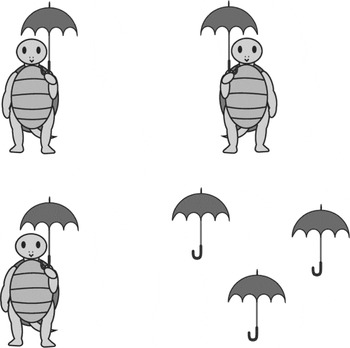
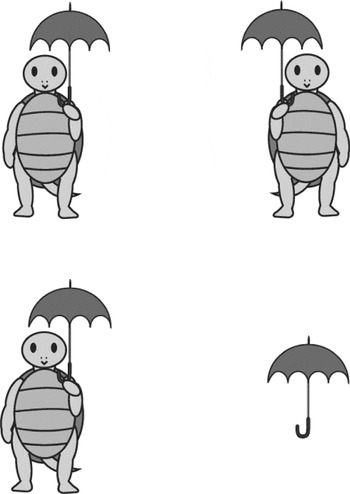
Pictures whose depictions correspond to each of the stimulus sentences were generated. For each of the eight target items, two types of picture sets were created. The first type depicted three animals holding one object apiece and three remaining objects that no animals were holding (i.e. the extra objects); we call this set the ‘Multiple Object’ pictures (see Figure 1). The second set of pictures depicted only one extra object, but was otherwise identical to the Multiple Object pictures; we call this set the ‘Single Object’ pictures (see Figure 2). Thus, a total of twenty-five pictures were created, i.e. two corresponding pictures each (the Multiple Object version and the Single Object version) for the eight targets and one corresponding picture each for the seven fillers and two warm-ups. The displays were divided into two-by-two rectangular lattices (but no visible border lines). Three lattices contained the pairing of an agent and an object respectively, and the remaining one contained the extra object(s). The area of interest (AOI) for gaze-tracking was assigned to the grid containing the extra object(s). The position of the AOI lattice was counterbalanced across items.
Sample ‘Multiple Object’ picture for the sentence Dono-kame-mo kasa-o sashi-teruyo (‘Every turtle is holding an umbrella’).

Sample ‘Single Object’ picture for the sentence Dono-kame-mo kasa-o sashi-teruyo (‘Every turtle is holding an umbrella’).

The expected responses in the TVJ for each item were determined by match or mismatch between the sentence meaning and the depiction of the corresponding picture: matched sentence–picture pairs to elicit ‘True’ responses and non-matched sentence–picture pairs to elicit ‘False’ responses. For all the target items, the adult-like (LG) interpretation of the universal quantifier would yield a ‘True’ response, as the sentence and picture matched. Half of the filler items provided mismatched pictures in order to elicit ‘False’ responses, while the other half of the fillers provided matched pictures.
In Sugisaki and Isobe (Reference Sugisaki, Isobe, Kim and Werle2001), the number of extra objects was much larger, six or seven, resulting in almost perfect LG performance by four- and five-year-old Japanese children. In the present study, we presented three extra objects, aiming to elicit both SRs and LG reponses from within the same group of children. As a control, we also tested another group of children with pictures that contained a single extra object, in order to (i) confirm that the children we were testing were at a stage in which they would provide an overwhelming proportion of SRs if they were given a single extra object, and (ii) compare children's responses and eye-movement patterns across two groups of children.
DCCS
DCCS was administered on a computer screen, instead of using actual cards with pictures. Two sets of materials were prepared in terms of the category of the items depicted in the cards, i.e. animal and vehicle. The ‘animal’ set features two types of animal illustrations, a cat and a monkey, serving as the sorting standard in terms of shape. Each animal picture is painted in one of two colors, green or black, serving as the sorting standard in terms of color. The model pictures on the sorting boxes depicted a green cat and a black monkey respectively, and the sorting cards contained either a green monkey or a black cat each. The ‘vehicle’ set features a bus and an airplane. Each vehicle picture is painted in either blue or white. Two model pictures depicted a white bus and a blue airplane respectively, and the sorting cards each contained a white airplane or a blue bus. The two sets were created so each child could participate in the card sorting session twice, first in one order of rule-switch (e.g. color to shape) using one of the sets of materials, and then in the reverse (e.g. shape to color) using the other set of materials. This also allows each subject to participate in the task twice to counterbalance the order of the rule presentation across subjects.
Design
For the TVJ task, Single Object pictures and Multiple Object pictures were presented in two blocks. One group of participants (TARGET Group) was given Multiple Object pictures in the first block (Block 1) and Single Object pictures in the second block (Block 2). Another group (CONTROL Group) was given Single Object pictures in Block 1 and Multiple Object pictures in Block 2. Both adult and child participants were divided into the two groups described above. Based on a pilot study, we expect that children at this age will fall into two distinct groups when they receive the Multiple Object pictures first, while children's responses are largely uniform when they receive the Single Object pictures first. As discussed above, our main interest is children's responses to Multiple Object pictures. Forty-five children were tested with Multiple Object pictures first, then with Single Object pictures (TARGET group; 4 ; 00–5 ; 11, mean age 5 ; 00). As a control, twenty-nine children were tested with the Single Object pictures first, and then with Multiple Object pictures (CONTROL group; 4 ; 00–5 ; 11, mean age 5 ; 01). Among forty-eight adults who participated as a control, twenty-four were assigned to the TARGET group and the other twenty-four to the CONTROL group.
The experiment was designed this way to examine whether the preceding experience of watching different patterns of pictures would influence the TVJ response patterns in the latter half of the trials, allowing us to investigate whether children exhibit the tendency to perseverate in their responses across blocks (e.g. Snedeker & Yuan, Reference Snedeker and Yuan2008). Each Block contained four target items in a Latin-square design; each child saw half of the test sentences with Multiple Object pictures, and the other sentences with Single Object pictures, but they never heard the same sentence twice. Note, however, our main data were obtained from children's responses in Block 1, as we anticipate children's responses in Block 1 to influence their responses in Block 2.
Procedure
TVJ/eye-tracking paradigm
Participants judged whether or not the sentence they heard and the picture on the display matched: if they thought the picture and the sentence matched, they were asked to say Atari (‘Right’) or Atteru (‘Matched’); if they thought the picture and the sentence did not match, they were asked to say Hazure (‘Wrong’) or Attenai (‘Not matched’). If a participant said Hazure (‘Wrong’), the experimenter asked them why they said so, and recorded their answer.
Participants' eye-movements were monitored with a TOBII 1750 eye-tracking system (Tobii Technology AB) during the TVJ task, controlled by the experiment software E-Prime (Psychology Software Tools, Inc.). First, the subject's eye-movements were calibrated using the ClearView analysis software (TOBII Technology AB), with the 5-point calibration option. Each TVJ trial started with the presentation of a fixation point (‘ + ’) appearing in the center of the display, and the subject was asked to gaze at the fixation point. When the participant's gaze was fixated on the cross for 2 seconds, the cross disappeared and the stimulus picture appeared. The picture was presented for 2500 milliseconds before the onset of the sentence. The eye-tracking continued until the participant responded to the TVJ task by saying ‘Right’ or ‘Wrong’.
DCCS
All children who completed both blocks of the TVJ task, along with twenty of the adult controls, performed the DCCS. Participants were asked to sort testing cards that could be classified in terms of two competing dimensions, color and shape, first according to one dimension and then according to the other. The present study adopted the DCCS in the Standard Version, following Zelazo (Reference Zelazo2006). A session consisted of: (i) the training phase; (ii) the ‘Pre-switch’ Phase, in which children sorted cards based on the first sorting dimension; and (iii) the ‘Post-switch’ Phase, in which children sorted cards based on the second sorting dimension. The training phase with two warm-up trials immediately followed instructions telling the children to sort cards according to the first dimension. The experimenter corrected the children's mistakes during the training phrase; no correction was made thereafter. The Pre-switch Phase followed the training phase. When a test card appeared, the child pointed to the sorting box he/she thought was correct. The Pre-switch Phase consisted of six sorting trials. The Post-switch Phase started immediately after a brief instruction telling children to sort cards now according to the second dimension. Children completed another six trials in this phase. Each child participated in two Sets (i.e. sorting sessions), in order to counterbalance the effect of the order of the two sorting dimensions. In Set 1, the first set of materials (e.g. ‘animal’ set) was used, and the other set of materials (e.g. ‘vehicle’ set) was used in Set 2. In Set 1, they first sorted cards according to one dimension and then according to the other; in Set 2, the order of the dimensions according to which they sorted cards was switched. The position of the two sorting boxes in each Set (e.g. the box with a black monkey on the right and the one with a green cat on the left, or vice versa) and the order of the sets (e.g. Set 1 with the ‘animal’ set and Set 2 with the ‘vehicle’ set, or vice versa) were counterbalanced across subjects.
Results and analyses
We first report the overall results of the TVJ, mainly focusing on the comparison between children and adults. Then we provide a detailed report of analyses in which the participants were further divided into subgroups depending on their overall TVJ response patterns, searching for any link among children's TVJ, DCCS performance and eye-movements.
TVJ
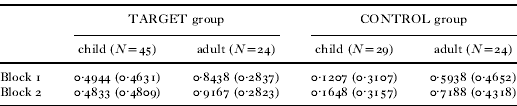
Table 1 shows the mean proportions of LG responses for children and adults in each block. The results replicated previous findings for children's universal quantification: (i) four- and five-year-old children exhibited a strong tendency to commit SRs in both Single Object and Multiple Object conditions, compared to adults; (ii) children's tendency to exhibit the SR was lower in the Multiple Object condition.
Mean proportions (and standard deviations) of LG responses in the TVJ
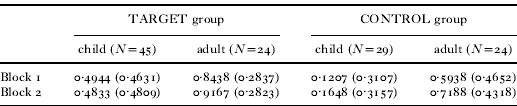
The average LG answer rate for each participant was carried forward to a (2) age × (2) group × (2) block ANOVA, in which age (child vs. adult) and group (TARGET vs. CONTROL) were between-subject factors, while block (Block 1 vs. Block 2) was a within-subject factor. It revealed a significant main effect of group (F(1, 118) = 17·209, p < 0·001, ηp2 = 0·127), age (F(1, 118) = 37·959, p < 0·001, ηp2 = 0·243) and block (F(1, 118) = 6·463, p = 0·012, ηp2 = 0·052). A significant interaction was reported only between block and age (F(1, 118) = 5·062, p = 0·026, ηp2 = 0·041), and no other interactions were significant (F(1, 118) = 2·226, p > 0·1, ηp2 = 0·019 between block and group; F(1, 118) = 0·703, p > 0·4, ηp2 = 0·006 between group and age; F(1, 118) = 0·002, p > 0·9, ηp2 < 0·001 between block and group and age). The post-hoc comparison of means (with Bonferroni adjustment) revealed that adults' performance was significantly better in Block 2 than in Block 1 (p = 0·001), while no effect of block was found in children (p > 0·4).
Looking at the children's data from another perspective, the lack of interaction between group and block demonstrates that TARGET children performed better in both blocks than CONTROL children. This suggests that the Multiple Object pictures presented in Block 1 (i.e. without providing children any prior experience) elicited significantly higher rates of LG responses than the Single Object pictures presented in Block 1. In addition, what children received in Block 1 significantly changed how children responded in Block 2; children's LG response rate was only 12% when Single Object pictures were given in Block 1, but it was 48% when Single Object pictures were given in Block 2. Likewise, children's LG response rate was 49% for Multiple Object pictures given in Block 1, but their LG responses decreased to 16% if Multiple Object pictures were given in Block 2. This is in contrast to adults, who gave more LG responses in Block 2, irrespective of the order of conditions. The tendency of children to perseverate in their responses across blocks will be discussed further in the ‘Discussion’ section. Note further that the Single Object pictures presented in Block 1 elicited higher percentages of SRs even from adults, suggesting that the impact of salience in the extra object is robust enough to distract adults as well. We will also return to this issue in the ‘Discussion’ section.
Clustering based on TVJ responses
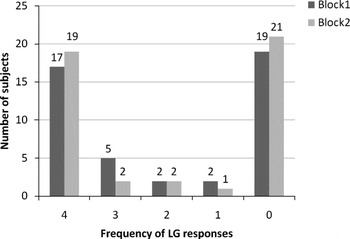
As reported above, the TARGET children as a group exhibited chance-level LG responses on average. This motivated us to further investigate whether every child uniformly gave LG responses at chance level, or whether their response patterns were distributed from child to child. Analysis of individual children's responses revealed a wide range of distribution in their response patterns; there is a clear distinction between children who almost always gave SRs and those who almost always gave LG responses (see Figure 3).
Distribution of the TARGET children (N = 45) based on the frequency of LG responses.

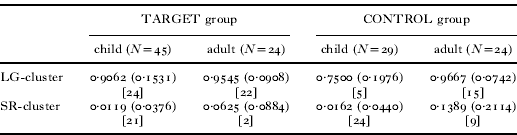
We thus conducted a hierarchical cluster analysis grouping by the Ward method, where the averaged rates of the LG responses for each Block were carried forward as the clustering parameters. There was a clear division between the two clusters of children, one that showed a high percentage of LG responses (we label this the LG-cluster), and one that showed a high percentage of SRs (SR-cluster, henceforth). Nearly half of the children in the TARGET group fell into the LG-cluster (N = 24), while the other half fell into the SR-cluster (N = 21). Note that, similar to the TARGET children, the CONTROL adults also exhibited chance level average rates of LG responses. Thus we conducted the same cluster analysis, which revealed a relatively well-balanced SR-cluster (N = 9) and LG-cluster (N = 15). We also attempted the same cluster analysis for the remaining groups of participants (i.e. TARGET adults, CONTROL children). Unlike the TARGET children and the CONTROL adults, the resultant division in these groups revealed a large imbalance in the number of subjects in each cluster. The majority of the CONTROL children fell into the SR-cluster (24 out of 29), and only five were in the LG-cluster. As for the TARGET adults, almost all the participants fell into the LG-cluster (22 out of 24), with only two exceptions falling into the SR-cluster. The mean proportions of LG responses in each cluster are illustrated in Table 2.
Mean proportions (and standard deviations) of LG responses in the TVJ (block collapsed): TVJ-based cluster comparison
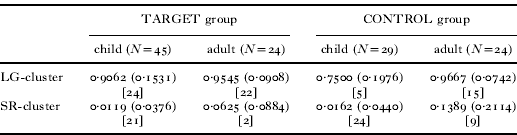
note: Number of participants falling into each cluster is given in square brackets.
DCCS
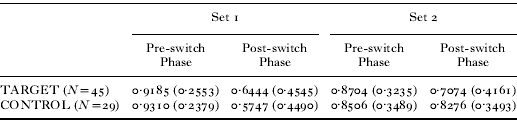
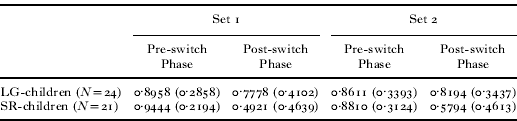
An average accuracy of card sorting for each participant was calculated for the Pre- and Post-switch Phases. While adult controls (N = 20) showed virtually perfect performance in card sorting throughout the entire task, children overall showed a noticeable decrease in the successful card sorting rate over the rule-switch, as shown in Table 3.
Children's mean proportions (and standard deviations) of correct card sorting in the DCCS
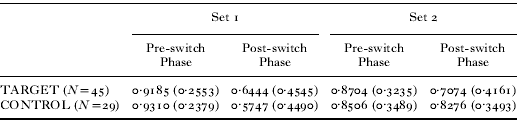
Children's data were carried forward to a (2) groups × (2) sets × (2) phases ANOVA, with group (TARGET vs. CONTROL) as a between-subject variable and set (Set 1 vs. Set 2) and phase (Pre-switch vs. Post-switch) as within-subject variables. The results revealed a significant main effect of phase (F(1, 72) = 31·007, p < 0·001, ηp2 = 0·301), but no significant main effect of set (F(1, 72) = 1·879, p > 0·1, ηp2 = 0·025) or group (F(1, 72) = 0·054, p > 0·8, ηp2 = 0·001). The interaction between set and phase was not significant (F(1, 72) = 3·331, p = 0·072, ηp2 = 0·044). The post-hoc comparison of means (with Bonferroni adjustment) revealed that the Phase effect was significant in Set 1 (p < 0·001) but not in Set 2 (p > 0·1), suggesting that children's card sorting performance over the phase switch improved through sets. No other interactions were significant (F(1, 72) = 1·897, p > 0·1, ηp2 = 0·026 between group and set; F(1, 72) = 0·143, p > 0·7, ηp2 = 0·002 between group and phase; F(1,72) = 0·998, p > 0·3, ηp2 = 0·014 among set and phase and group). The results thus showed that children in the TARGET group did not significantly differ from those in the CONTROL group in their performance in DCCS; in both groups, children's performance was higher in the Pre-switch Phase than the Post-switch Phase in Set 1. Thus we can conclude that the difference in TVJ accuracy between TARGET children and CONTROL children reflects a genuine effect of salience (i.e. the number of extra objects in the pictures), confirming that children in either group were not biased in terms of their DCCS performance.
Across-task cluster comparison: relation between TVJ performance and DCCS performance
Recall that the TARGET children exhibited chance-level TVJ rates as a group, but yielded a well-balanced number of participants falling into two separate clusters with respect to their TVJ responses (24 in LG-cluster vs. 21 in SR-cluster). We conducted the same cluster analysis with the Ward method on their DCCS dataset, in particular, on the averaged rates of the correct card sorting both in Pre- and Post-switch Phases. Once again, there was a well-balanced division in participants in a HIGH-cluster (20 out of 45) who performed successfully both in Pre- and Post-switch Phases, and a LOW-cluster (25 out of 45) whose performance was poorer. The mean proportions of correct card sorting in each cluster are illustrated in Table 4.
TARGET children's mean proportions (and standard deviations) of correct card sorting in the DCCS (set collapsed): DCCS-based cluster comparison

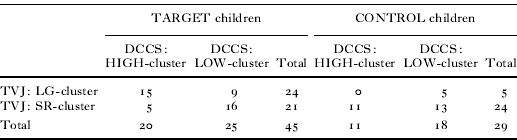
In order to examine whether there is an across-task association in the children's performance in TVJ and DCCS, a chi-square test was conducted on the two-by-two clustering distribution (see Table 5), i.e. LG vs. SR based on TVJ performance during Block 1 and HIGH vs. LOW based on DCCS performance.
Number of children in each cluster in the TVJ-based (LG vs. SR) × DCCS-based (HIGH vs. LOW): results of clustering of the TARGET children and CONTROL children
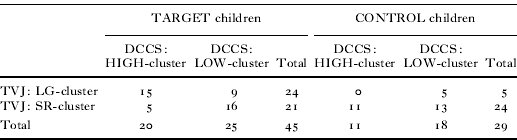
It revealed a significant association between their TVJ performance and their DCCS performance (χ2(1, N = 45) = 6·79, p = 0·016). Having these results as a baseline implying that there is an across-task link in the performance measured in the two datasets, we further examined these cluster comparisons in more detail with respect to: (i) comparison of TVJ performance between DCCS-based HIGH/LOW clusters; and (ii) comparison of DCCS performance between TVJ-based LG/SR clusters.
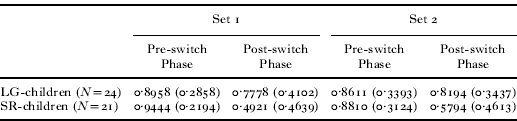
Table 6 shows the comparison of the mean proportions of correct card sorting based on the TVJ clustering (LG vs. SR). We conducted a (2) sets × (2) phases × (2) clusters ANOVA, involving set (Set 1 vs. Set 2) and phase (Pre-switch vs. Post-switch) as within-subject variables and cluster (LG vs. SR) as a between-subject variable. It yielded a significant main effect of phase (F(1, 43) = 22·544, p < 0·001, ηp2 = 0·344). The main effect of cluster was not significant (F(1, 43) = 3·935, p = 0·054, ηp2 = 0·084), but the interaction between phase and cluster was significant (F(1, 43) = 10·373, p = 0·002, ηp2 = 0·194). The post-hoc pair-wise comparisons of means (with Bonferroni adjustment) revealed a significant difference between LG- and SR-clusters in the Post-switch Phase (p = 0·004) but not in the Pre-switch Phase (p > 0·5). These results suggest that SR-children did worse in the rule-switch than LG-children. The main effect of set was not significant (F(1, 43) = 0·045, p > 0·8, ηp2 = 0·001), and no interaction involving set was significant (F(1, 43) = 0·014, p > 0·9, ηp2 < 0·001 between set and cluster; F(1,43) = 0·614, p > 0·4, ηp2 = 0·014 between set and phase; F(1, 43) = 0·069, p > 0·7, ηp2 = 0·002 among set and phase and cluster).
TVJ-based cluster comparison of the TARGET children's mean proportions (and standard deviations) of correct card sorting in the DCCS
We now turn to the comparison of the same children's TVJ responses based on the DCCS-based clusters. Whereas the mean rate of LG responses for HIGH-cluster was 0·6500 (standard deviation = 0·4148), those for LOW-cluster were 0·3600 (standard deviation = 0·4709). According to a one-way ANOVA with cluster as a between-subject variable, this difference between HIGH-cluster and LOW-cluster was significant (F(1, 43) = 4·677, p = 0·036, ηp2 = 0·098), indicating that children who performed better in the DCCS exhibited higher rates of LG responses in the TVJ, and those who performed worse in the DCCS showed lower rates.
Taken together, the cluster comparisons across tasks conducted on the dataset from the TARGET children revealed a link between the success/failure of the logically correct TVJ in universal quantification with respect to extra-object pictures, and the success/failure of the flexible rule-switch in the DCCS.
We also attempted the same two-way clustering on the data from the CONTROL children, whose results are illustrated in Table 5. All 5 LG-children fell into the LOW-cluster, which does not apparently support the correlation between these two tasks, unlike the results from the TARGET children; but, due to the small size of the dataset, the interpretation of the result is not straightforward.
Eye-movements during TVJ
Let us now turn to the eye-movement data
The eye-tracking measurement was the participants' eye fixations to the AOI, i.e. the quadrant that contains the extra object(s). As was discussed above, it has been established that the participants' eye-movements are closely associated with the real-time comprehension of the sentence (e.g. Cooper, Reference Cooper1974; Tanenhaus et al., Reference Tanenhaus, Spivey-Knowlton, Eberhard and Sedivy1995; Trueswell & Gleitman, Reference Trueswell, Gleitman, Henderson and Ferreira2004). Given this, measuring when and how often children look at the extra object(s) in the picture reflects how much attention children paid to the presence of the extra object(s) while computing the truth of the universally-quantified sentences.
Overall results: children vs. adults
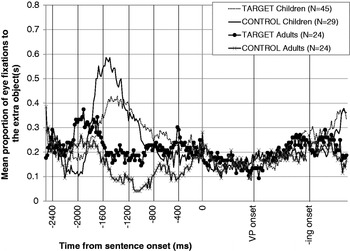
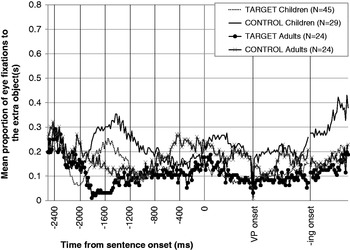
We will first compare children's eye fixations with adults, in order to examine whether the eye-movement patterns between children and adults are similar or different during the TVJ. Figures 4 and 5 plot the trial-based mean proportions of the participants' eye fixations to the AOI both before and while they were hearing the target sentences presented along with the extra-object pictures.
Mean proportions of the eye fixations to the extra object(s) during Block 1.

Mean proportions of the eye fixations to the extra object(s) during Block 2.

The major difference in fixation pattern between children and adults was observed during the 2500 millisecond period before the sentence was auditorily presented in both groups; while children showed a large increase in fixations to the extra object(s), peaking around 1500 ms prior to the sentence onset, adults' increase was shallower and appeared slightly earlier. This tendency in the gaze patterns was robustly observed in Block 1 and was reduced in Block 2, but a similar pattern still held; the CONTROL adults were the exception, who exhibited an increase over the blocks. A (2) groups × (2) ages × (2) blocks ANOVA, with group (TARGET vs. CONTROL) and age (child vs. adult) as between-subject variables and block (Block 1 vs. Block 2) as a within-subject variable was conducted on participant-based mean proportions of fixation frequency to the extra object(s) during the 2500 ms pre-sentence period. It yielded a significant main effect of age (F(1, 118) = 24·884, p < 0·001, ηp2 = 0·174) and of block (F(1, 118) = 97·443, p < 0·001, ηp2 = 0·452). The interaction between age and block was also significant (F(1, 118) = 8·11, p = 0·005, ηp2 = 0·064), and the post-hoc pair-wise comparison (with Bonferroni adjustment) suggested that: (i) children's fixation frequency was significantly higher than that of adults in both blocks (p < 0·001 for Block 1, p = 0·013 for Block 2); and (ii) the difference in fixation frequency both children and adults exhibited across the two blocks was significant (p < 0·001 for children, p = 0·001 for adults). The main effect of group was not significant (F(1, 118) = 2·415, p > 0·1, ηp2 = 0·02), but the interaction between group and block was significant (F(1, 118) = 40·762, p < 0·001, ηp2 = 0·257). The post-hoc pair-wise comparison between group and block (with Bonferroni adjustment) suggested that the effect of block was significant in the TARGET group (p < 0·001) but not in the CONTROL group (p > 0·2). The interaction between group and age was not significant (F(1, 118) = 2·657, p > 0·1, ηp2 = 0·022). Finally, the interaction among group, age and block was significant (F(1, 118) = 7·066, p = 0·009, ηp2 = 0·056). The post-hoc multiple comparisons of means (with Bonferroni adjustment) revealed that: (i) the increase that the CONTROL adults exhibited over the blocks was not significant (p = 0·06), whereas the decrease that the other subject groups exhibited over the blocks was significant (p < 0·001 for all the other groups); (ii) the significant difference between children and adults within each group was observed in Block 1 (p = 0·023 for the TARGET group; p < 0·001 for the CONTROL group), but in Block 2, the difference was not significant for the TARGET group (p = 0·051) and for the CONTROL group (p > 0·1); and (iii) the difference between the TARGET adults and the CONTROL adults was significant in both blocks (p < 0·001 for Block 1; p = 0·002 for Block 2), whereas the difference between the TARGET children and the CONTROL children was significant in Block 2 (p < 0·001) but not in Block 1 (p > 0·9).
Let us now sum up the findings. First, children exhibited a robust peak in fixation frequency around 1500 ms prior to the sentence, while adults' increase was much shallower. Second, participants generally showed a significant decrease in fixation frequency in Block 2 compared with Block 1, except for the CONTROL adults, who showed an increase in fixation in Block 2. Finally, whereas gaze patterns of the TARGET adults and the CONTROL adults significantly differed both in Block 1 and Block 2, the TARGET children and the CONTROL children exhibited the significant difference only in Block 2. Given the divergent TVJ response patterns between the TARGET children and the CONTROL children, this raises a question as to whether there is a link between the TVJ pattern and the eye-movement pattern. Recall that the TARGET children yielded numerically well-balanced clusters based on their TVJ response patterns (21 fell into SR-cluster while 24 fell into LG-cluster); as will be shown below, a closer look at the gaze data based on cluster comparison within group will reveal that the LG-children and the SR-children in the TARGET group distinguished themselves from each other in terms of eye-movement patterns, suggesting a link between TVJ performance and eye-movements.
TARGET group
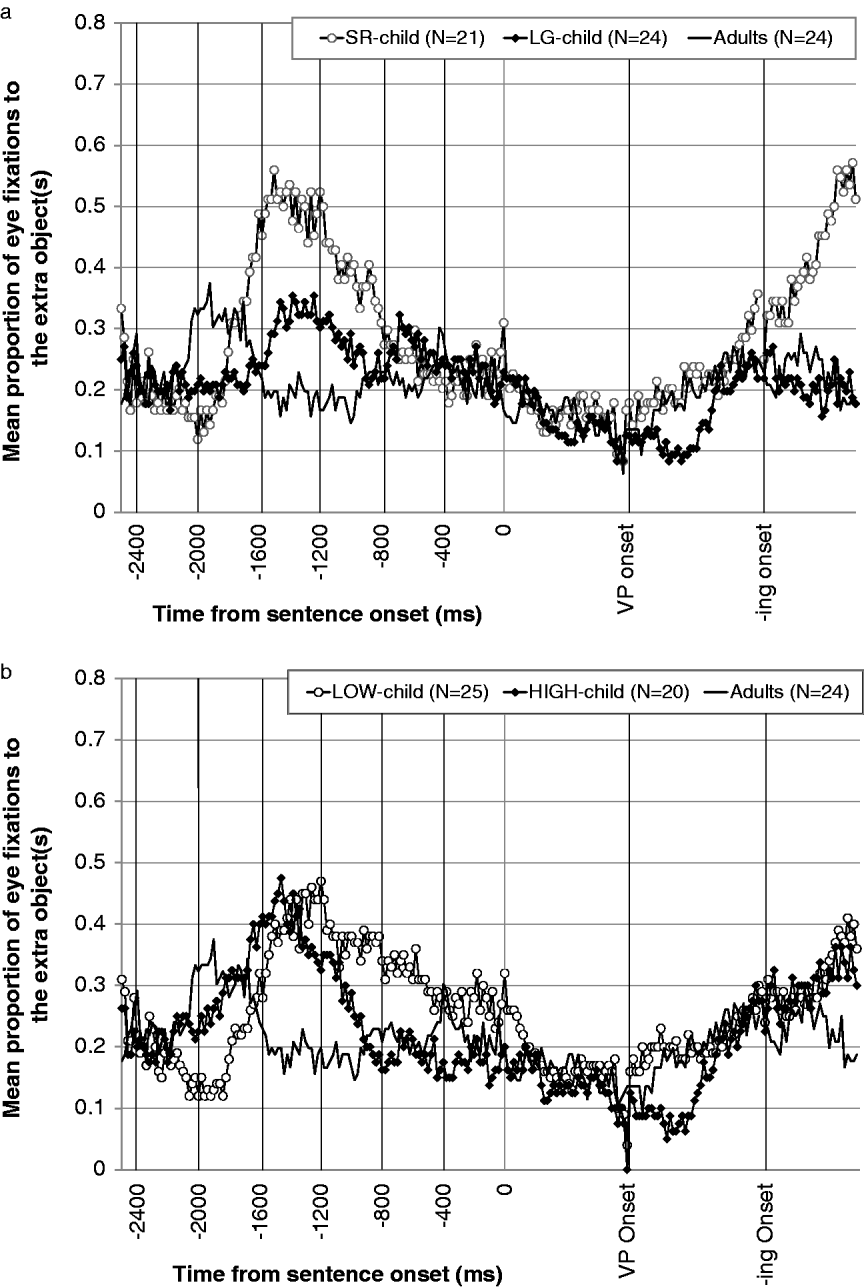
We will now examine the data collected from the children and adults in the TARGET group, focusing first on the relation between TVJ response patterns and gaze patterns, in order to determine whether the age difference was observed within the same condition.Footnote 1 In order to investigate the genuine effect of each TVJ condition on participants' eye-movements without any preceding experience, we primarily focus on the eye-movement data from both groups during Block 1. Figure 6a plots the trial-based mean proportion of the participants' eye fixations to the AOI both before and while they were hearing the target sentences presented along with the extra-object pictures. Note that the data show a notable divergence in the eye-movement patterns among children depending on their TVJ response pattern during the pre-sentence period. The salient increase in the gaze at the extra object(s) around 1500 ms prior to the sentence onset was observed in SR-children; however, LG-children's increase around the same time point is much shallower.
a: Mean proportions of the eye fixations to the extra objects during Block 1 for the TARGET group: TVJ-based clustering. b: Mean proportions of the eye fixations to the extra objects during Block 1 for the TARGET group: DCCS-based clustering.
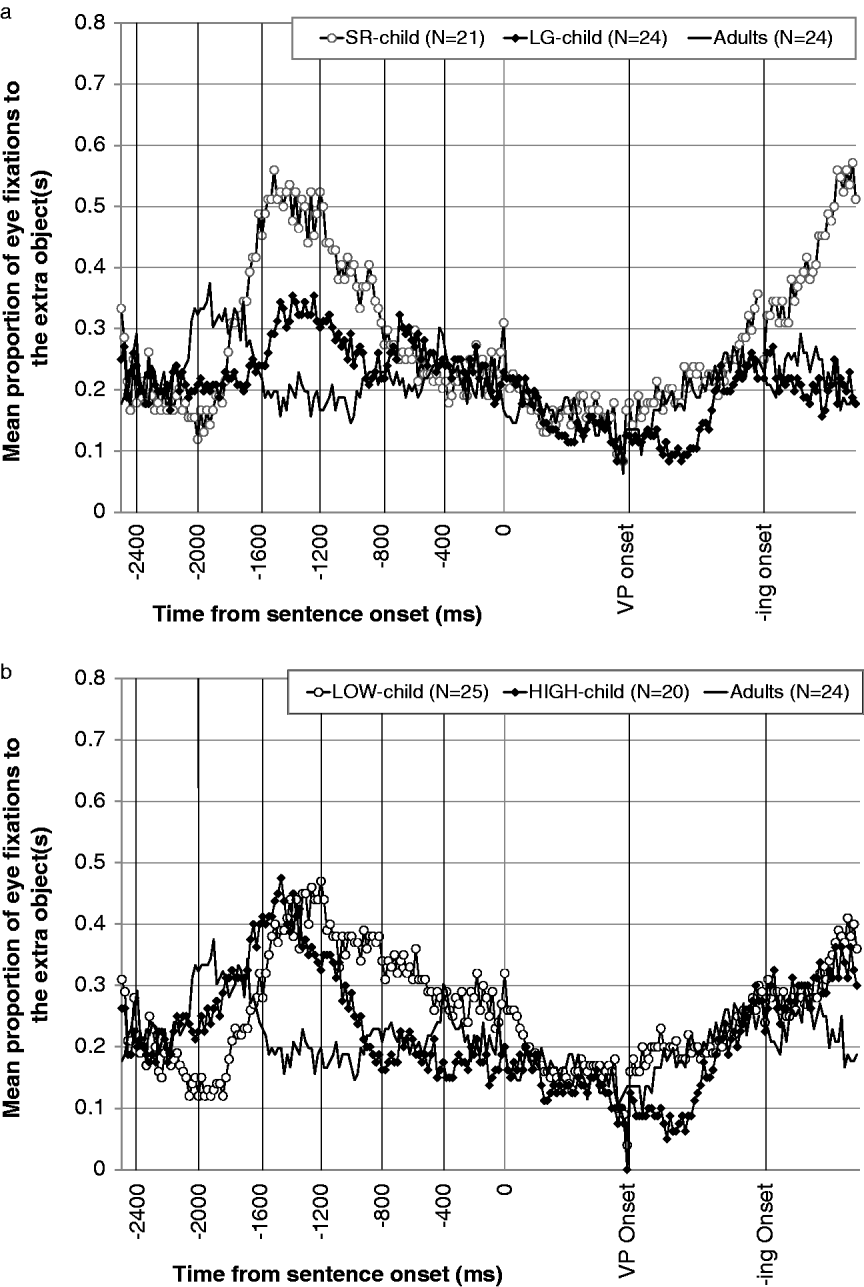
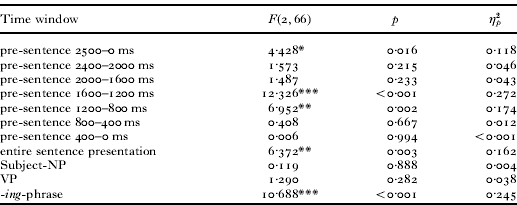
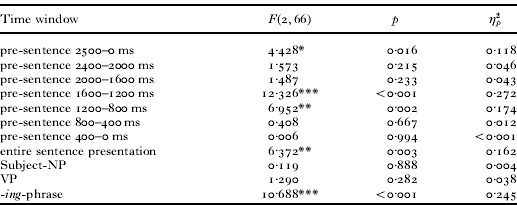
A one-way ANOVA involving cluster (SR-child vs. LG-child vs. adults) as a between-subject variable was conducted on the participant mean proportions of the eye fixations to the extra object(s) (i) during the 2500 ms pre-sentence period, (ii) on the successive 400 ms time windows (TWs, henceforth) starting from 2400 ms to the sentence onset, (iii) during the whole sentence presentation, and (iv) on the successive phrase-by-phrase TWs (Subject-NP, VP, -ing-phrase). The mean proportions of the fixation frequencies and the results of the ANOVAs are illustrated in Appendices 2a and 2b. It should be noted that the main effect of cluster became significant at the 1600–1200 TW and the 1200–800 TW. These time windows correspond to the point showing the divergence in the gaze plot, where the SR-children exhibited a robust peak in their fixation frequency. Note further that the post-hoc pair-wise comparison of means (with Bonferroni adjustment) revealed that, at the 1600–1200 TW, where SR-children exhibited a peak, there was a significant difference between the fixation frequency of SR-children on the one hand and LG-children and adults on the other (p = 0·008 for SR-children vs. LG-children; p > 0·001 for SR-children vs. adults). It should also be noted that the eye fixations of SR- and LG-children greatly diverged again during the sentence presentation, at around the -ing-phrase onset; while the fixation frequency of SR-children continued to increase largely, that of LG-children started to decrease. This may reflect the approximate point at which their decision-making in the TVJ was completed. We will turn to this divergence later in the ‘Discussion’ section.
Recall that, as was reported above, the TARGET children and the CONTROL children did not exhibit a significant difference in the frequency of their eye fixations to the extra object(s) during Block 1, even though their TVJ response patterns were significantly different. Interestingly, TVJ-based clustering of the TARGET children revealed that the divergent eye-movement patterns depended on their TVJ response patterns. The direct comparison of gaze data based on their TVJ responses thus demonstrated an across-task link, confirming the baseline interpretation that the increase in the eye fixations to the extra object(s) which indicates an increase in attention allocated to the extra object(s), i.e. the salient information in the pictures, results in more frequent SRs in the TVJ.
In sum, it was revealed that the eye-movement patterns of the TARGET children significantly diverged depending on their TVJ response patterns; while SR-children showed a significantly robust increase in fixation frequency to the extra object(s) during the pre-sentence period, at around 1500 ms prior to the sentence presentation, the LG-children's increase was much shallower.
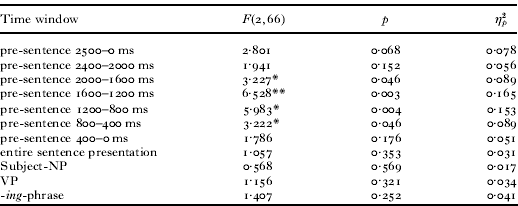
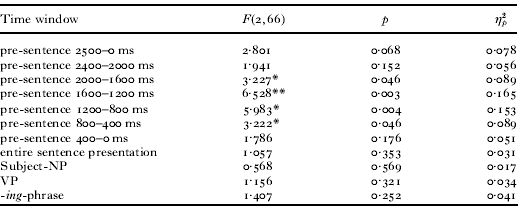
In order to determine whether there is a difference in eye-movement patterns between the HIGH-children (N = 20) and the LOW-children (N = 25) within the TARGET group, we compared their eye fixations based on the DCCS-clustering conducted on the TARGET children (see Figure 6b). Although the plotted divergence in the fixation frequency is shallower than the divergence observed in the TVJ-based cluster comparison (see Figure 6a), a one-way ANOVA involving cluster (LOW-child vs. HIGH-child vs. adults) as a between-subject variable revealed significant differences at the 2000–1600 TW, 1600–1200 TW, 1200–800 TW and 800–400 TW during the 2500 ms pre-sentence period; the difference was also significant during the entire sentence presentation and the -ing-phrase. The mean proportions of the fixation frequencies and the results of the ANOVAs are illustrated in Appendices 3a and 3b.
In sum, the eye-movement patterns of the TARGET children diverged depending on their DCCS response patterns, as well as their TVJ response patterns. The LOW-children exhibited a significantly bigger increase in fixation frequency to the extra object during the pre-sentence period.
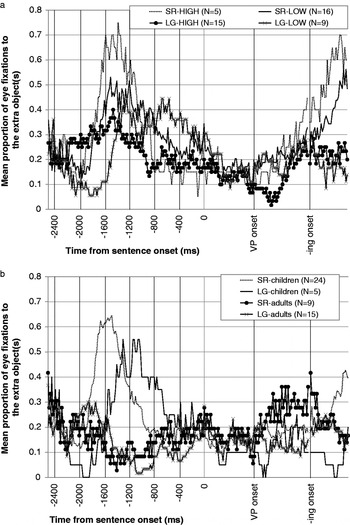
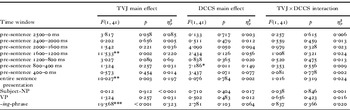
Recall that the TARGET children fell into four clusters according to the two-by-two clustering (TVJ-based and DCCS-based): SR-LOW cluster (N = 16), SR-HIGH cluster (N = 5), LG-LOW cluster (N = 9) and LG-HIGH cluster (N = 15), as is summarized in Table 5. In order to examine the eye-movement patterns across these clusters within TARGET children, we will now compare the TARGET children's eye fixations using the across-task clustering. As can be seen in Figure 7a, among the four clusters, SR-HIGH children exhibited the highest frequency of fixations to the extra objects during the pre-sentence period and during the sentence presentation; see Appendices 4a and 4b for the mean proportions of the fixation frequencies and the results of the ANOVAs. This finding apparently runs counter to our interpretation of the relationship among TVJ and DCCS, i.e. that SRs correlate with low performance in the DCCS. With the limited size of each resultant clustering, it is not straightforward to determine what is happening with the children who exhibited these response patterns. One possible speculation is that these children were not able to shift from the initial, extra-object-oriented perspective to the required, event-oriented perspective, because their relatively strong shifting abilities could not even override the initial perspective. We will turn to this issue in the ‘Discussion’ section.
a: Mean proportions of the eye fixations to the extra objects during Block 1 for the TARGET children: TVJ-based clustering × DCCS-based clustering. b: Mean proportions of the eye fixations to the extra object during Block 1 for the CONTROL group.

CONTROL group
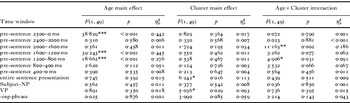
Finally, we will compare the eye-movement patterns of the children and adults in the CONTROL group, focusing on the data collected in Block 1, in order to determine whether the age difference was observed in the condition where Single Object pictures were presented. Figure 7b plots the trial-based mean proportions of the eye fixations to the extra object(s). It should be noted that, unlike the TARGET children, the CONTROL children in both clusters exhibited a similar gaze pattern during the pre-sentence period, with their fixation frequency increased in a similar pattern in terms of magnitude but peaking at slightly different timings. However, considering the small number of LG-cluster CONTROL children (i.e. 5 out of 29), interpretation of the difference across clusters is not straightforward. A (2) ages × (2) clusters ANOVA, with age (child vs. adult) and cluster (SR vs. LG) as between-subject variables, was conducted on the participant mean percentage of fixation frequency (i) during the 2500 ms pre-sentence period, (ii) on successive 400 ms TWs starting from 2400 ms to the sentence onset, (iii) during the whole sentence presentation, and (iv) on successive phrase-by-phrase TWs (Subject-NP, VP, -ing-phrase). The mean proportions of the fixation frequencies and the results of the ANOVAs are illustrated in Appendices 5a and 5b. The results suggest that the overall gaze pattern of children and adults diverged depending on their TVJ response patterns. However, during the 2500 ms pre-sentence period, their gaze patterns differed depending on age; the across-age divergence in the gaze pattern was robust, and the TVJ-based cluster subdivision in each age group did not reveal any significant difference by cluster. As we have noted above, however, the small size of the LG-cluster (5 out of 24) complicates the interpretation of this difference.
In addition, adults in both clusters in the CONTROL group showed similar gaze patterns, but unlike the TARGET adults, the CONTROL adults showed an increase in fixation frequency over the blocks. This may be associated with the improvements they exhibited in the TVJ response patterns over the blocks. These results may further imply that the relation between looks and correct TVJ is different for children and adults; children's looks might reflect their distraction by the extra object(s) leading to SR TVJ, while adults' looks might reflect a process of recovering from SR to LG TVJ patterns.
DISCUSSION
The major findings in the present study are summarized below: (i) in the TVJ Task, children showed the tendency to perseverate across blocks, whereas adults exhibited a significant increase in the rates of their LG responses in Block 2; (ii) children as a group exhibited chance level LG-responses when Multiple Object pictures were presented first, but the analysis of individual response patterns revealed a distinction between some children who uniformly exhibited the SRs and others who exhibited the LG responses most of the time; (iii) across-task cluster comparison within group revealed that children who mostly exhibited the SRs did significantly worse on the rule-switch measured by the DCCS than those who exhibited the LG responses; (iv) according to the analysis of the data from TARGET children, who exhibited the split TVJ response patterns, children who gave the SRs exhibited a remarkable increase in eye fixations to the extra object(s) before the sentence was presented, whereas those who exhibited the LG responses did not show this tendency robustly; and (v) the impact of the single extra object in triggering SRs was robust even for some adults. Below we will discuss these findings from the perspective of the relation between semantic representations involved in universal quantification and the cognitive mechanisms required to construct and evaluate them in real time. In particular, we claim that the development of cognitive control is one of the factors that notably contribute to children's ability to perform adult-like universal quantification.Footnote 2
Before proceeding to a detailed discussion of our hypothesis, let us first confirm two assumptions based on the findings: (i) children in our study show evidence of still-developing cognitive control; and (ii) they are at a stage in which they tend to make SRs in the universal quantifier interpretation in the extra-object context. Children in our study showed evidence of still-developing cognitive control in two ways. First, across-block comparison of the TVJ response patterns demonstrated that children showed a strong tendency to perseverate in their responses across the two blocks; that is, children who showed SRs in the first block continued to show SRs in the second block irrespective of the picture type, while those who showed LG responses in the first block continued to show LG responses in the second block. In contrast, adults exhibited a significant increase in the rate of LG responses over the blocks, irrespective of the order of the type of pictures (Multiple Object vs. Single Object) presented in both blocks. These findings are consistent with findings in previous research reporting children's tendency to perseverate in their responses across blocks (e.g. Snedeker & Yuan, Reference Snedeker and Yuan2008). Second, consistent with previous studies, children's performance in the DCCS on average was significantly lower than that of adults, and there are some children whose post rule-switch performance was at chance level. In addition, the results of the single-extra-object condition confirmed that children in our study are at the stage in which they show a strong tendency to show SRs in interpreting the universal quantifier when there is only one extra object.
Let us now discuss the relationship between the two tasks. The comparisons of the TARGET children's performance based on two-by-two clustering revealed an association between the success/failure in the TVJ and in the DCCS; those who showed SRs consistently in the TVJ exhibited worse performance in the rule-switch measured in the DCCS than those who showed LG responses. Furthermore, a robust divergence between SR-children and LG-children was also observed in their eye-movement patterns; SR-children showed a significantly higher rate of fixations to extra object(s) prior to sentence presentation, whereas LG-children did not exhibit this tendency robustly. Taken together, our findings show that four- and five-year-old children are at a developmental stage in which their semantic interpretation involving universal quantification is easily blocked by extralinguistic factors; due to their still-developing cognitive control, children's access to their knowledge about the universal quantifier tends to be hindered by the salience of the extra object(s) in the picture which is irrelevant information truth-conditionally.
Let us interpret our findings in terms of our hypothesis based on the Attentional Inertia account (e.g. Kirkham et al., Reference Kirkham, Cruess and Diamond2003). We hypothesized that attention is still developing. Such children tend to focus on the saliently remnant objects and have difficulty suppressing this initial perspective. The fact that children produced much fewer SRs when the extra objects were less salient in the Multiple Object condition shows that the salience of the remnant objects was an important factor affecting children's responses. Furthermore, the Multiple Object condition captured the transitional nature of children's ability to interpret the universal quantifier. We found that the TARGET children showed a divergent pattern of responses that can be captured by two distinct clusters, SR or LG, correlating with their performance in rule-switch in the DCCS. The implication is that the SR-cluster represent a subset of children whose cognitive control is less developed, who perceived the extra-object picture with a primary focus on the salient extra object, while the LG-cluster represents the other subset of children, whose cognitive control is more developed (though it is perhaps still developing).
Take sentence (1) and Figure 1 as a sample case. When the picture was presented in the beginning, SR-children's attention was highly attracted by the presence of the extra umbrellas in the picture. This was reflected in their gaze data, which revealed that they fixated to the extra objects significantly more frequently than the LG-children until the sentence started to play. Based on the presence of the extra objects, they established a perspective from which they perceived the picture as one about the saliently remnant umbrellas. In contrast, LG-children were not as strongly influenced by the presence of extra objects; consequently, they did not establish the same perspective.
When the sentence was provided as a description of the picture, and the children were asked to evaluate the match/mismatch of the sentence and the picture, focus had to be made on whether or not all the turtles in the picture were each holding an umbrella, in which the presence of the extra umbrellas was irrelevant information. Recall now that around the VP offset in the sentence presentation, the eye-movement pattern of SR- and LG-children diverged again; while SR-children exhibited a continuing increase in fixation frequency to the extra objects, LG-children's fixation frequency did not show such an increase. The response patterns exhibited by SR-children are consistent with the Attentional Inertia account. The SR-children's initial perception of the picture was drawn by the salient extra objects, and they were unable to suppress the no-longer-relevant information about the extra umbrellas. Therefore, they held to their initial perspective, failing to recover and reorient to the new perspective of the picture perception as a depiction of an event of all the turtles holding an umbrella (which is required for the truth-value judgment of the sentence they are hearing). As a result, they evaluated the sentence ‘incorrectly’ on the basis of the presence of the extra objects in the picture. The increase of fixation frequency to the extra objects at the end of the sentence is also consistent with this account. The LG-children, in contrast, did not fixate disproportionately on the extra object either during the initial inspection of the picture or when they made their responses. This suggests that they were not unduly influenced by the remnant objects in interpreting the universal quantifier. The LG-children thus represent a subset of four- and five-year-old children whose performance in semantic computation involving universal quantification is on its way to becoming adult-like.
Let us turn to the question regarding why SRs take place. Philip (Reference Philip1995) attributed SRs to children's non-adult-like semantic representation of every-sentences, in which ‘every turtle is holding a balloon’ is semantically represented as ‘all minimal events in which either a turtle or a balloon (or both) is a participant are events in which a turtle is holding a balloon’. Whereas his claim straightforwardly explains why children said ‘No’ in SRs, there could be other reasons for children to say ‘No’ in SRs; children might indeed have the adult-like semantic representation of the every-sentence, but they perceive the picture as a depiction of the extra object (based on their initial perspective, from which they could not disengage), resulting in ‘No’ responses on the basis of the mismatch between their adult-like semantic interpretation of theevery.sentence (which does not refer to the extra objects) and their initial perception of the scene (which they take to be ‘about’ the extra objects).Footnote 3 Our findings, revealing the across-cluster divergence in the gaze pattern according to children's TVJ response pattern, might provide support for the second possibility. Namely, children might have said ‘No’ based on the mismatch between the adult-like semantic representation of the every-sentence and the perception of the scene as ‘about’ the extra objects, exhibiting the robust increase in eye fixations to the extra objects. Additionally, note that Philip's claim would predict that children say ‘No’ in the Extra Object Condition, regardless of the salience of the extra object, e.g. the number of the extra object(s). However, as Sugisaki and Isobe (Reference Sugisaki, Isobe, Kim and Werle2001) and Gouro et al. (Reference Gouro, Norita, Nakajima, Ariji and Otsu2001) discussed, children do not say ‘No’ when the salience of the extra object is modified in the pictures; our findings serve as converging evidence, showing that children's ‘No’ responses are linked to how much attention they paid to the presence of extra object(s). These two pieces of evidence together suggest that children's SR reflects the degree to which children commit to take the visual scene as ‘about’ the extra object(s).
Recall that a detailed analysis of our eye-movement data based on the two-by-two clustering of the TARGET children (TVJ-based and DCCS-based clustering) reveals that, among the four clusters (i.e. SR-HIGH, SR-LOW, LG-HIGH and LG-LOW), the SR-HIGH cluster exhibited the most eye fixations to the extra object(s). Given that the SR-HIGH group exhibited the response patterns which appear to run counter to our claim that children commit SRs due to their poor ability to shift perspectives, reflected in their low DCCS performance, this finding complicates the interpretation of our results, bringing up another possibility, i.e. that some children who pay more attention to the extra object(s) commit more SRs for reasons other than their limited flexibility in perspective switching. On the basis of the limited size of the resultant four sub-clusters in the current study, we leave this issue as an open question. Further research is needed in order to examine how the two possibilities are related.
Finally, note that a substantial number of adult participants (9 out of 24) exhibited SRs when they saw the Single Object pictures first. Given that adults presumably possess an appropriate linguistic knowledge of universal quantifier and fully developed cognitive control, this demonstrates that the impact of the salience of the single extra object was robust enough to occasionally affect even adults' judgments of universal quantifier interpretation. Even for adults, the judgment of the truth value of a universal quantifier requires the ‘performance’ of evaluating the visual stimuli in light of their universal quantifier knowledge; it is not enough to possess the knowledge of the universal quantifier. It is consistent with our findings that children whose performance is hindered by their still-developing cognitive control are more likely to show SRs.
CONCLUSION
The results revealed a link between children's successful universal quantification with respect to extra-object pictures and a shallower decrease in card sorting accuracy over the rule-switch in the DCCS. Furthermore, the eye-tracking data acquired during the TVJ task revealed that children committing SRs exhibited significantly increased eye fixations to the extra object(s) prior to the auditory presentation of the sentence; such a tendency was not robustly observed when children made LG interpretations. Taken together, the present findings suggest that children's non-adult-like universal quantification with respect to extra-object pictures is considerably affected by their extralinguistic difficulty in switching perspectives using successful cognitive control in picture recognition. On the basis of these findings, we conclude that cognitive control is a factor that influences semantic processing involving universal quantification, and in children aged four to five, this is still developing. Our findings underscore the need to fully examine the relation between language acquisition and cognitive development for the ultimate understanding of the nature of children's linguistic representations and the process of child language development.
APPENDIX 1:
COMPLETE LIST OF STIMULUS SENTENCES
Test sentences
1. Dono-kame-mo kasa-o sashi-teruyo.
which-turtle-also umbrella-acc hold-ing
‘Every turtle is holding an umbrella.’
2. Dono-kuma-mo terebi-o hakon-deruyo.
which-bear-also TV-acc carry-ing
‘Every bear is carrying a TV.’
3. Dono-risu-mo botan-o mot-teruyo.
which-chipmunk-also button-acc hold-ing
‘Every chipmunk is holding a button.’
4. Dono-panda-mo keeki-o tabe-teruyo.
which-panda bear-also cake-acc eat-ing
‘Every panda bear is eating a piece of cake.’
5. Dono-saru-mo kyabetsu-o kajit-teruyo.
which-monkey-also cabbage-acc nibble-ing
‘Every monkey is nibbling a cabbage.’
6. Dono-zou-mo kan-o ket-teruyo.
which-elephant-also can-acc kick-ing
‘Every elephant is kicking a can.’
7. Dono-tanuki-mo hon-o yon-deruyo.
which-raccoon-also book-acc read-ing
‘Every raccoon is reading a book.’
8. Dono-neko-mo jyuusu-o non-deruyo.
which-cat-also juice-acc drink-ing
‘Every cat is drinking juice.’
Warm-up sentences
9. Dono-buta-mo ne-teruyo.
which-pig-also sleep-ing
‘Every pig is sleeping.’
10. Dono-kitsune-mo hashit-teruyo.
which-fox-also run-ing
‘Every fox is running.’
Filler sentences
11. Dono-niwatori-mo nai-teruyo.
which-chicken-also cry-ing
‘Every chicken is crying.’
12. Dono-ushi-mo nabagutsu-o hai-teruyo.
which-cow-also boots-acc wear-ing
‘Every cow is wearing a pair of boots.’
13. Dono-raion-mo aoi taiko-o tatai-teruyo.
which-lion-also blue drum-acc hit-ing
‘Every lion is hitting a blue drum.’
14. Dono-usagi-mo pinku-no ame-o name-teruyo.
which-rabbit-also pink lollipop-acc lick-ing
‘Every rabbit is licking a pink lollipop.’
15. Dare-mo booshi-o kabut-te-naiyo.
who-also cap-acc wear-ing-neg
‘Nobody is wearing a cap.’
16. Dare-mo hane-te-naiyo.
who-also jump-ing-neg
‘Nobody is jumping.’
17. Dare-mo hana-o kuwae-te-naiyo.
who-also flower-acc hold in mouth-ing-neg
‘Nobody is holding a flower in his mouth.’
APPENDIX 2A
Mean proportions (and standard deviations) of eye fixations during the TVJ for the TARGET group: TVJ-based clustering

APPENDIX 2B
Results of the one-way ANOVAs on the mean proportions of eye fixations during the TVJ for the TARGET Group: TVJ-clustering
APPENDIX 3A
Mean proportions (and standard deviations) of eye fixations during the TVJ for the TARGET Group: DCCS-based clustering

APPENDIX 3B
Results of the one-way ANOVAs on the mean proportions of eye fixations during the TVJ for the TARGET Group: DCCS-clustering
APPENDIX 4A
Mean proportions (and standard deviations) of eye fixations during the TVJ for the TARGET children: TVJ-clustering × DCCS-clustering

APPENDIX 4B
Results of the 2 × 2 ANOVAs on the mean proportions of eye fixations during the TVJ for the TARGET children: TVJ-clustering × DCCS-clustering

APPENDIX 5A
Mean proportions (and standard deviations) of eye fixations during the TVJ for the CONTROL Group

APPENDIX 5B
Results of the 2 × 2 ANOVAs on the mean proportions of eye fixations during the TVJ for the CONTROL Group