Introduction
It is estimated that there will be 100 million people worldwide with dementia by 2050 (World Health Organization, 2012). The majority of people with dementia live in the community, with care provided by an estimated 670,000 family and friends in the UK alone. Previous research into family caregivers of people with dementia has often been weighted towards constructs such as burden, depression, and stress (Crespo et al., Reference Crespo, Lopez and Zarit2005; Cooper et al., Reference Cooper, Balamurali, Selwood and Livingston2007; Dickinson et al., Reference Dickinson, Dow, Gibson, Hayes, Robalino and Robinson2016). Positive and negative states can coexist in caregiving (Lawton et al., Reference Lawton, Moss, Kleban, Glicksman and Rovine1991; Tremont, Reference Tremont2011), yet while caregivers report positive aspects of caring, the role of these positive aspects in well-being has been largely overlooked (Roff et al., Reference Roff, Burgio, Gitlin, Nichols, Chaplin and Hardin2004; Tarlow et al., Reference Tarlow, Wisniewski, Belle, Rubert, Ory and Gallagher-Thompson2004), and has only received attention more recently (Carbonneau et al., Reference Carbonneau, Caron and Desrosiers2010; Orgeta and Leung, Reference Orgeta and Leung2015). These positive aspects of caregiving can serve as a protective factor for the burden of caregiving (Koerner et al., Reference Koerner, Kenyon and Shirai2009).
The positive psychology framework uses the study of strengths, virtues, and positive emotions that enable people to thrive (Seligman et al., Reference Seligman, Steen, Park and Peterson2005) to achieve a greater understanding of well-being, even in the face of difficult circumstances (Keyes and Lopez, Reference Keyes, Lopez, Snyder and Lopez2005; Clarke and Wolverson, Reference Clarke and Wolverson2016). The majority of research in this field has focused on the general population, but there has been recent interest in mental health (Macaskill, Reference Macaskill2016) and in outcomes for people with dementia (Clarke and Wolverson, Reference Clarke and Wolverson2016). Despite the increasing attention to the role of positive psychology in the well-being of caregivers, interventional studies continue to assess caregiver's well-being in the framework of a loss-deficit model, often measuring well-being by the absence of negative factors such as stress and depression. The stress-coping model (Lazarus and Folkman, Reference Lazarus and Folkman1984) and subsequent adaptions (Pearlin et al., Reference Pearlin, Mullan, Semple and Skaff1990; Aneshensel et al., Reference Aneshensel, Pearlin, Mullan, Zarit and Whitlatch1995) have been criticized for the lack of inclusion of positive concepts, which aid the understanding of well-being and experiences of this population (Tarlow et al., Reference Tarlow, Wisniewski, Belle, Rubert, Ory and Gallagher-Thompson2004; Dickenson et al., Reference Dickinson, Dow, Gibson, Hayes, Robalino and Robinson2016).
Studies exploring how families can have positive experiences despite the stress in dementia caregiving have most commonly noted the importance of self-efficacy, resilience, and sense of coherence. Aside from these popular constructs, there is historically a scarcity of relevant positive psychology outcome measures used in interventional research with this population (Tarlow et al., Reference Tarlow, Wisniewski, Belle, Rubert, Ory and Gallagher-Thompson2004; Wilks et al., Reference Wilks, Little, Gough and Spurlock2011; Crellin et al., Reference Crellin, Orrell, McDermott and Charlesworth2014). Recently, existing measures of positive psychology validated within the general population have begun to be applied within caregiver research. However, researchers often pay little attention to the psychometric implications of adopting measures developed for other populations.
The aim of this review was to identify positive psychology measures for family caregivers of people living with dementia, with good psychometric properties. It also aimed to undertake a quality assessment to establish the potential utility of identified outcome measures in research and practice and to recommend which may be most appropriate.
Method
Design
A systematic search was conducted to identify positive psychology outcome measures developed for or validated with family caregivers of people living with dementia in the community. Systematic principles outlined by the PRISMA group were followed for searching and screening results (Moher et al., Reference Moher, Liberati, Tetzlaff and Altman2009). A psychometric property appraisal of the measures identified was conducted using published quality criteria for assessing the measurement characteristics of outcome measures (Terwee et al., Reference Terwee2007).
Search strategy
The following electronic databases were searched: PsychINFO, CINHAL, MEDLINE, EMBASE, and PubMed. In addition to this, hand searching of references and prior citations were performed. Positive psychology search terms were derived from scoping existing literature using Seligman's definition of positive psychology, “the study of strengths, virtues, and positive emotions that enable people to thrive” (Seligman et al., Reference Seligman, Steen, Park and Peterson2005) and the Values in Action (VIA) framework as a guide (Peterson and Seligman, Reference Peterson and Seligman2003). The VIA framework proposes character strengths grouped within six sets of “virtues”: transcendence, temperance, justice, humanity, courage, and wisdom. An additional check for other potential search terms was performed by comparing identified terms from the literature with a related review of positive psychology measures for chronic illness, traumatic brain injury, and older adults (Stoner et al., Reference Stoner, Orrell and Spector2015).
Search terms were as follows: measure AND positive psychology AND family caregiver AND dementia. The variants on terms used were as follows:
Search terms for measure included the following: “measure” OR “outcome” OR “instrument” OR “questionnaire” OR “quiz” OR “test” OR “psychometric” OR “analysis” OR “validation” OR “reliability” OR “validity” OR “scale.” Search terms for positive psychology were as follows: “self-efficacy” OR “hope” OR “gain” OR “resilience,” “wisdom” OR “growth” OR “sense of coherence” OR “belief in a just world” OR “control” OR “autonomy,” “pleasure” OR “self-realization” OR “positivity” OR “optimism” OR “agency” OR “gratitude” OR “satisfaction” OR “outlook” OR “uplift” OR “meaning” OR “happiness” OR “transcendence” OR “self-concept” OR “humor” OR “creativity” OR “spirituality” OR “love” OR “compassion” OR “mindfulness” OR “affability.”
Search terms for family caregiver included the following: “family carer” OR “caregiver” OR “care” OR “relative” OR “friend” OR “spouse.”
Search terms for dementia were as follows: “cognitive impairment” OR “Alzheimer” OR “senile” OR “dementia” OR “demented.”
Truncations of search terms were used where appropriate. All titles and abstracts were screened against the inclusion and exclusion criteria and specifically for the inclusion of a positive psychology measure developed for or validated with family caregivers of people living with dementia in the community. When an outcome measure was identified, a search for the relevant psychometric and/or development study was conducted.
Inclusion criteria
-
• Publication language: Studies published in English only, unless a translation is available.
-
• Publication year: Studies published between 1980 (to include the point from which positive psychology ideas, such as “flow” emerged in the literature) and October 2015 (date of the search).
-
• Outcome measures developed for or validated with a population of family caregivers of people living with dementia in the community (i.e., not those living in a care home).
-
• Outcome measures with psychometric properties published in a peer-reviewed journal.
-
• Outcome measures related to a positive psychology construct or positive psychology traits.
Exclusion criteria
-
• Outcome measures only measuring external or situational contributors to well-being such as social support and external locus of control. These are excluded in order to restrict the breadth of the review to internal sources of well-being such as positive traits, strengths, and virtues detailed in the VIA framework (Peterson and Seligman, Reference Peterson and Seligman2003).
Data extraction
Papers were exported to Mendeley Referencing Software, where the titles were screened against the eligibility criteria. Abstracts were then screened and for those identified as relevant or in ambiguous cases, the full text was screened. The final eligibility decision was made by two reviewers (JS & CS) reading the full text. In three cases, a final agreement was reached with the involvement of third nominated author (MO).
After the full text had been exported, data relating to the sample, design, development, evaluation, and feasibility of each outcome measure was extracted onto pre-prepared data extraction forms by two reviewers. The process of this systematic review is outlined in Figure 1.
Process of the systematic review search.

Psychometric properties
Identified positive outcome measures were grouped by construct and a quality assessment was conducted using guidance formulated by Terwee et al. (Reference Terwee2007), which has been employed in reviews of a similar nature (Windle et al., Reference Windle, Bennett and Noyes2011; Stoner et al., Reference Stoner, Orrell and Spector2015). Two authors (JS & CS) undertook the quality assessment independently and a consensus meeting was held to discuss any disagreements in the scoring.
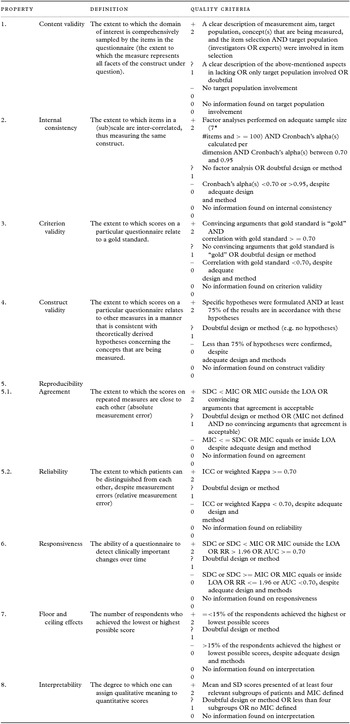
The criterion scores the development of outcome measures based on the reporting of reliability and validity in the development paper. These reported aspects are as follows: (a) content validity, (b) internal consistency, (c) construct validity, (d) reproducibility, (e) responsiveness, (f) floor and ceiling effects, and (g) interpretability, as demonstrated in Table 1. A score of 2 for each criterion was awarded for a study that was well designed and reported. A score of 1 was given if there were methodological flaws in the study design, methods, or if this information was not well reported. A score of 0 was awarded if the study produced poor results despite good methods, or if there was no information found for the given criteria. The individual scores were then added together to assess the overall quality of the development process for the scale with a possible score range of 0–18, with 18 being the highest available score. For the purposes of this review, the authors have assigned labels to total scores to increase interpretability. Scores 0–4 were assigned a label of “poor,” 5–9 were assigned a label of “moderate,” scores 10–14 were assigned a label of “good,” and scores 15–18 were assigned a label of “very good.”
Terwee quality assessment criteria

In order to calculate a total score + = 2; ? = 1; – = 0; 0 = 0 (scale of 0–18). SDC – smallest detectable difference (this is the smallest within person change, above measurement error. A positive rating is given when the SDC or the limits of agreement are smaller than the MIC). MIC – minimal important change (this is the smallest difference in score in the domain of interest which patients perceive as beneficial and would agree to, in the absence of side effects and excessive costs). SEM – standard error of measurement. AUC – area under the curve. RR – responsiveness ratio.
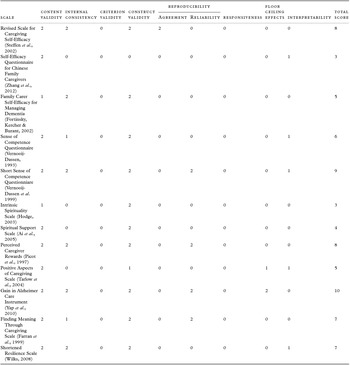
The appraisal of the scale development papers was conducted to identify scales that had been rigorously developed and well reported, and would therefore be suitable for inclusion in interventional or cross-sectional research. Scores for each individual aspect relating to psychometric properties are presented in Table 2.
Quality criteria scores for the identified outcome measures

A score of 2 was awarded for a study that was well designed and reported. An intermediate score of 1 was given if there were methodological flaws in the study design, methods, or if the study was not well defined. A score of 0 was awarded if the study produced inadequate results despite good methods, or if there was no information found for the given criteria. The individual scores were then added together to assess the overall quality of the development process for the scale with a possible score range of 0–18, with 18 indicating a high-quality outcome measure.
Results
The initial search identified 6,677 papers, of which 48 potential scale development or validation papers were identified through screening abstracts. After screening the full articles, 18 papers met the inclusion criteria. These comprised 12 scale development and 6 validation papers. A scale development paper was defined as a manuscript that describes the process of developing a measure, whereas a validation paper was defined as one that tests and describes the psychometric properties of a particular measure, sometimes in a specific population.
The main reasons for exclusion of papers was that the scales did not measure a positive psychology construct (9 excluded), or the population was not family caregivers of people with dementia living in the community (13 excluded).
The outcome measures were grouped by construct to allow ease of comparison across the measures identified and appraised. The scale that scored the highest was the Gain in Alzheimer Care Instrument (GAIN; Yap et al., Reference Yap, Luo, Ng, Chionh, Lim and Goh2010), which scored 10/18, indicating good validity and reliability.
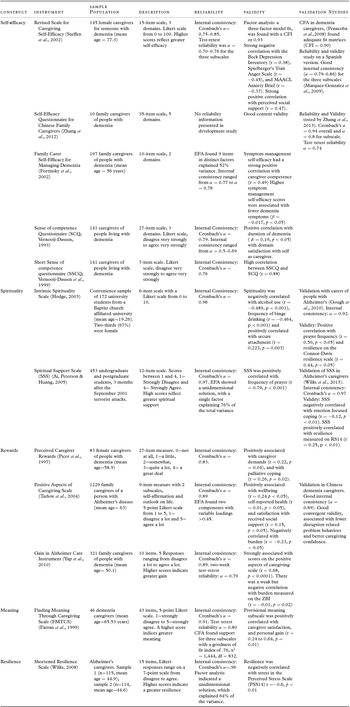
The constructs identified and number of measures included for each were as follows: self-efficacy (5), spirituality (2), rewards (3), meaning (1), and resilience (1), as shown in Table 3.
Description of included outcome measures

Self-efficacy
Five outcome measures were identified for the construct of self-efficacy: The Revised Scale for Caregiving Self-Efficacy (RSSE; Steffen et al., Reference Steffen, McKibbin, Zeiss, Gallagher-Thompson and Bandura2002), the Self-Efficacy Questionnaire for Chinese Family Caregivers (Zhang et al., Reference Zhang, Edwards, Yates, Ruth and Guo2012), Family Caregivers’ Self-Efficacy for Managing Dementia Scale (Fortinsky et al., Reference Fortinsky, Kercher and Burant2002), the Sense of Competence Questionnaire (SCQ; Vernooij-Dassen, Reference Vernooij-Dassen1993; Vernooij-Dassen et al., Reference Vernooij-Dassen, Persoon and Felling1996), and its short version, the Short Sense of Competence Questionnaire (SSCQ: Vernooij-Dassen et al., Reference Vernooij-Dassen, Felling, Brummelkamp, Dauzenberg, Bos and Grol1999).
The RSSE (Steffen et al., Reference Steffen, McKibbin, Zeiss, Gallagher-Thompson and Bandura2002) scored moderately in the quality assessment (8/18). However, the development paper for this scale lacked information on responsiveness, floor and ceiling effects, and interpretability. Adequate internal consistency was found for the subscales, ranging from α = 0.70 to α = 0.76. Self-efficacy on the RSSE was found to have strong negative correlations with depression, measured with the Beck Depression Inventory (Beck, Steer and Brown, Reference Beck, Steer and Brown1996; r = 0.38, p < 0.01) and with anger on the Spielberg's Trait Anger Scale (Spielberger et al., Reference Spielberger, Jacobs, Russell and Crane1983; r = 0.45, p < 0.01). Self-efficacy also had a strong positive correlation with perceived social support (r = 0.47, p < 0.01). This indicates that, in line with expectations, higher self-efficacy was linked with lower depression and anger scores, and higher perceived social support scores, indicating good construct validity.
The Chinese Self-Efficacy Scale (Zhang et al., Reference Zhang, Edwards, Yates, Ruth and Guo2012) scored poorly (3/18) on the quality assessment criteria, mainly due to lack of data in reproducibility, responsiveness, and interpretability. No reliability and limited validity information was given from the development authors. In a subsequent validation study (Zhang et al., Reference Zhang, Edwards, Yates, Ruth and Guo2013), internal consistency was considered too high α = 0.94 for the overall scale, which may indicate multicollinearty (overlapping of items). Nevertheless, internal consistency was good for each subscale (α = 0.8) and test-retest reliability was good (α = 0.74).
The Self-Efficacy Scale for Managing Dementia (Fortinsky et al., Reference Fortinsky, Kercher and Burant2002) scored moderately on the quality assessment criteria (5/18), also due to lack of data in the development paper. This measure demonstrated good internal consistency (α = 0.77 to 0.78). The subscale of symptom management self-efficacy strongly and positively correlated with sense of competence (r = 0.49). Higher symptom management self-efficacy scores were associated with fewer dementia symptoms (β = −0.017, p < 0.05), indicating good construct validity.
The SCQ (Vernooij-Dassen, Reference Vernooij-Dassen1993) scored moderately on the quality assessment criteria (6/18). The SCQ had good internal consistency overall (α = 0.79) but the subscales did not show good Cronbach's alpha scores, ranging from α = 0.5 to α = 0.63. Good construct validity was found, as sense of competence was negatively correlated with apathy of the person with dementia (r = −0.31, p < 0.01) and duration of dementia was positively associated with the domain of satisfaction with ones own performance as a caregiver (β = −0.18, p < 0.05).
The short version of this outcome measure, the SSCQ (Vernooij-Dassen et al., Reference Vernooij-Dassen, Felling, Brummelkamp, Dauzenberg, Bos and Grol1999) scored the highest in the construct of self-efficacy (9/18). The SSCQ was developed from the 27-item SCQ and was intended for use in clinical practice. There was a good correlation between scores on the SCQ and SSCQ, and the SSCQ was found to have good internal consistency (α = 0.76).
Spirituality
Two outcome measures were identified for the construct of spirituality: The Intrinsic Spirituality Scale (ISS; Hodge, Reference Hodge2003) and Spiritual Support Scale (SSS; Ai et al., Reference Ai, Tice, Peterson and Huang2005).
The ISS (Hodge, Reference Hodge2003) was developed using a convenience sample of university students from a Baptist affiliated University. It scored poorly on the quality assessment criteria (3/18). The internal consistency score was found to be too high (α = 0.96), indicating multicollinearity. Concurrent validity was good, with spirituality negatively correlating with alcohol use, (r = −0.489, p < 0.001) and frequency of binge drinking (r = −0.464, p < 0.001). Spirituality also positively correlated with secure attachment (r = 0.223, p = 0.003), indicating good construct validity. A subsequent validation study with caregivers of people with dementia (Gough et al., 2010) found a high Cronbach's alpha (α = 0.92) and positive correlations with amount of prayer (r = 0.50, p < 0.05) and resilience (r = 0.44, p < 0.05).
The SSS (Ai et al., Reference Ai, Tice, Peterson and Huang2005) was developed in America with 453 students, three months after the September 2001 terrorist attacks. It scored 4/18 in the quality assessment criteria. Cronbach's alpha was too high (α = 0.97), which was also found in a subsequent psychometric evaluation of the SSS in a sample of Alzheimer's caregivers (Wilks et al., Reference Wilks, Ketchum, Chen and Bowman2013). Spiritual support was found to positively correlate with resilience measured by the Resilience Scale-14 (RS-14; r = 0.25, p < 0.01), indicating good construct validity.
Rewards
The GAIN (Yap et al., Reference Yap, Luo, Ng, Chionh, Lim and Goh2010), Positive Aspects of Caregiving Scale (PAC; Tarlow et al., Reference Tarlow, Wisniewski, Belle, Rubert, Ory and Gallagher-Thompson2004), and Perceived Carer Rewards Scale (Picot et al., Reference Picot, Youngblut and Zeller1997) were identified for the construct of rewards.
The GAIN outcome measure and developed for use with caregivers of people with dementia. It scored the highest on the quality assessment criteria of all the scales identified in this review (10/18). The measure demonstrated good internal consistency (α = 0.89) and test-retest reliability (α = 0.79). In terms of validity, the authors hypothesized that scores on this measure would negatively correlate with burden, as measured on the Zarit Burden Interview, which was reported in the development paper (r = −0.01, p = 0.02). Scores on the GAIN measure strongly and positively correlated with scores on the PAC scale (r = 0.68, p < 0.0001), which was also developed for caregivers of people with dementia.
The PAC (Tarlow et al., Reference Tarlow, Wisniewski, Belle, Rubert, Ory and Gallagher-Thompson2004) scored moderately on the quality assessment criteria (8/18) and demonstrated good internal consistency (α = 0.89) and adequate validity. It was positively correlated with well-being (r = 0.24, p < 0.05), and negatively associated with burden (r = 0.23, p < 0.05), though the correlations were weak. A validation of this study for the Chinese version of the measure produced similar results in terms of reliability (α = 0.89).
The Perceived Carer Rewards Scale (Picot et al., Reference Picot, Youngblut and Zeller1997) was developed with female caregivers of people with dementia. It scored moderately (5/18) in the quality assessment criteria. It had good internal consistency (α = 0.83) and construct validity, as perceived rewards was negatively correlated with caregiver burden (r = −0.35, p < 0.0001), depression (r = −0.30, p <0.0001), and caregiver demands (r = −0.22, p = 0.04), as expected. The authors (Picot et al., Reference Picot, Youngblut and Zeller1997) recommended further psychometric testing of this measure.
Meaning
The Finding Meaning Through Caregiving Scale (FMTCS; Farran et al., Reference Farran, Miller, Kaufman, Donner and Fogg1999) was the only outcome measure to be identified for the construct of meaning. This measure had a moderate score (7/18) on the quality assessment criteria, mostly due to a lack of information on responsiveness, interpretability, and floor and ceiling effects. Internal consistency was high (α = 0.91) and test-retest reliability was good (α = 0.80). The “Provisional Meaning” subscale was positively correlated with marital satisfaction, caregiver satisfaction, and personal gain (r = 0.24 to 0.64, p = 0.01). Divergent validity was supported by the finding of inverse relationships between the loss/powerless subscale and marital satisfaction, caregiver satisfaction and personal gain (r = −0.38 to −0.53, p = 0.01).
Resilience
The only measure identified for resilience that had been developed for or validated with the dementia caregiver population was the Shortened Resilience Scale (Wilks, Reference Wilks2008), which scored moderately (7/18) for scale development. It lacked evidence on reproducibility, responsiveness, and floor and ceiling effects. Internal consistency was too high (α = 0.96) suggesting significant overlapping of items. Construct validity was good, with resilience negatively correlating with stress (r = −0.6, p < 0.01).
Discussion
This review is the first to systematically identify and evaluate positive psychology outcome measures for family caregivers of people with dementia, using clear and comprehensive criteria. Twelve outcome measures were identified that had been developed for or validated with this population for the constructs of self-efficacy, resilience, rewards, meaning, and spirituality. The majority of scales scored poorly to moderately on the quality criteria, with a lack of information on reproducibility, floor and ceiling effects and responsiveness for most scales. Despite this, the majority of scales reported information for content validity, which would be considered the most important aspect of reporting during development of a measure. Investigators wishing to employ a positive psychology measure with this population may chose a measure based on its underlying theory and relevance to the study rather than total quality score.
Despite the rising recognition of the importance of positive psychology in measuring and understanding well-being (Keyes and Lopez, Reference Keyes, Lopez, Snyder and Lopez2005), there are currently a small number of high-quality positive psychology scales for these family caregivers. This may be due to the concepts underlying the development of current measures, which are often aligned to the stress-coping model to explain and understand the caregiving experience (Pearlin et al., Reference Pearlin, Mullan, Semple and Skaff1990; Lawton et al., Reference Lawton, Moss, Kleban, Glicksman and Rovine1991; Tarlow et al., Reference Tarlow, Wisniewski, Belle, Rubert, Ory and Gallagher-Thompson2004). While there is a comprehensive understanding of how positive aspects of caring can act as protective factors against burden and stress, there is still scope for the development of new measures that draw on models which are more closely aligned to the discipline of positive psychology (Clarke and Wolverson, Reference Clarke and Wolverson2016). It is clear that there is an urgent need to develop a theoretical framework that applies positive psychology to dementia caregiving research.
Methodological limitations
Seligman's definition of positive psychology was chosen due to its inclusive and accessible nature, however, there are a number of alternative theories of positive psychology that may not have been captured in this review, such as Ryff's (Reference Ryff1989) scales of psychological well-being. Therefore, there is the potential that some scales may have been missed, despite a thorough review process including hand searching of references and prior citations.
Although the scales included in this review relate to concepts that reflect positive psychology literature, an in-depth review of the items in each measure revealed a majority of negative wording in the self-efficacy scales in particular, e.g. in the RSSE, “how confident are you that you can control thinking about unpleasant aspects of taking care of [person with dementia]?” This created ambiguity over whether these measures are truly positive psychology in nature and if they really measure a positive construct. Although these scales were included due to the importance of self-efficacy as a stress-adaption mechanism, it is recommended that negative phrasing should be used in combination with positive wording in order to give a balanced perspective that reflects the co-existence of both positive and negative emotions as indicators of wellbeing. This, in turn, would more comprehensively represent the co-valence and interplay of positive and negative experiences in caregiving (Clarke and Wolverson, Reference Clarke and Wolverson2016).
Future research
The quality criteria to assess the development process of the identified scales were used in a related review of positive psychology measures in chronic illness, traumatic brain injury, and older adults (Stoner et al., Reference Stoner, Orrell and Spector2015). In both reviews, and an additional previous review of resilience scales (Windle et al., Reference Windle, Bennett and Noyes2011), conclusions were limited due to the under reporting of many of the criteria such as responsiveness and reproducibility. In order to conduct a comprehensive assessment of the quality of a measure, we hope that future authors will report this information in more detail.
This review did not extend to extrinsic factors that may influence well-being and only searched for intrinsic positive psychology factors, in order to contain the breadth of the review. Therefore, future authors may wish to conduct a review on positive psychology outcome measures related to extrinsic factors such as social support and external locus of control to explore how far these aspects contribute to well-being.
It is recognized that some of the measures discussed in this review have already been used within interventional research in this population, e.g. the SCQ, SSCQ, RSSE, and PAC, with variable results. While it is beyond the scope of this review to examine this, future researchers may wish to review the results of such studies from a psychometric viewpoint in order to further assess validity.
There were positive psychology scales frequently in use with family caregivers of people with dementia that were not able to be included in this review because they were developed for the general population and have not been validated for family caregivers of people with dementia. Using measures that were developed for a different population and assuming the content validity remains the same is potentially problematic and may limit the conclusions that can be drawn from the studies. Therefore, future authors may wish to conduct an in-depth psychometric analyses of scales frequently used with family caregivers of people with dementia that have not yet been validated with this population. Such scales include, but are not limited to the Sense of Coherence scale (Antonovsky, Reference Antonovsky1993) and the Connor-Davidson Resilience Scale (Connor and Davidson, Reference Connor and Davidson2003).
Conclusion
This review shows that there are some robust measures in existence for family caregivers of people with dementia. These should be incorporated into interventional studies. The most psychometrically sound measure in this review was the GAIN instrument (Yap et al., Reference Yap, Luo, Ng, Chionh, Lim and Goh2010). It is recommended that this scale be evaluated in an interventional setting, as the development authors were not able to provide evidence of responsiveness.
Although 12 positive outcome measures for family caregivers of people with dementia were identified in this review, there is still work to be done to develop more high-quality positive psychology scales for this population. The self-efficacy scales identified within this review contained negative wording and therefore the development of a more positive psychology centered, domain-specific self-efficacy scale is warranted. Development of these scales with a firm theoretical grounding would facilitate a better understanding of the positive aspects of caring and how these contribute to well-being. This would ultimately aid in the development of relevant positive psychology interventions.
Conflict of interest
None.
Description of authors’ roles
J. Stansfeld designed the review, conducted the searches, screening, quality appraisal, and drafted the manuscript. C. Stoner was the second reviewer, screened the full texts for inclusion/exclusion, and conducted a secondary quality appraisal. J. Wenborn, M. Vernooij-Dassen, E. Moniz-Cook, and M. Orrell supervised and oversaw the review and contributed to the manuscript. All authors agreed to the final version prior to submission.
Acknowledgments
This systematic review was conducted as part of the Valuing Active Life in Dementia (VALID) research programme funded by the National Institute for Health Research (NIHR) under its Programme Grants for Applied Research scheme (RP-PG-0610-10108). The VALID research team acknowledges the support of the National Institute for Health Research Clinical Research Network. The views expressed are those of the author(s) and not necessarily those of the NHS, the NIHR, or the Department of Health.