

A methodological preface
Because this article inter-articulates social science scholarship with work on artistic texts – an amalgam of fiction and non-fiction, or in Jacques Rancière's terms an ‘abutment of dissimilars’,Footnote 1 – I want to provide a rationale for the (interconnected) methodological and compositional strategies of the article. One key aspect of my approach adheres to a method that Michel Foucault describes in his lectures under the title of The Birth of Biopolitics. Beginning with some remarks in which he describes his method as a radical break with traditional analyses of political concepts, he says, ‘instead of deducing concrete phenomena from universals, or instead of starting with universals as an obligatory grid of intelligibility for certain concrete practices, I would like to start with the concrete practices and, as it were, pass these universals through the grid of these practices.’Footnote 2
In the case of this investigation, the ‘concrete practices’ are sedimented in built environments, specifically in the architectural materialisation of practices of security. What must be added for purposes of explicating the way my text develops is the choice of venues in which architecture is in focus and the media genres through which those venues are represented. I turn primarily to the arts for both aspects, in part because in seeking to provide a critical political sensibility, I am presuming that ‘the political’ operates at two crucial levels. One is the macropolitical level at which one treats security as a matter of governmental policy. In contrast, a grasp of the micropolitical level requires inquiry into the way in which individuals and groups manage (or exploit) precarious environments and situations.
Two methodological perspectives inspire my turn to the arts (primarily fictional media genres) as sources of epistemological support for my investigation. One is expressed by Gayatri Spivak, who while admitting that ‘literature is not verifiable’ (because it will not offer definitive judgements about what should be known), suggests nevertheless that ‘the protocols of fiction give us a practical simulacrum of the graver discontinuities inhabiting (and operating?) the ethico-epistemic and ethico-political … an experience of the discontinuities that remain in place in “real life”’.Footnote 3 Fiction, is an ‘event – an indeterminate ‘sharing’ between the writer and reader’.Footnote 4 The most significant implication of Spivak's remarks is that artistic media genres (regarded as ‘fiction’) can introduce radical contingency into normalised knowledge domains by providing innovative angles of vision that provoke critical thinking rather than offering definitive knowledge judgements.
Jacques Rancière provides a similar, more elaborate perspective in an essay that blurs the boundary between fiction and non-fiction. Commenting on the epistemological force of fiction (which he designates as ‘avowed fiction’). He writes,
[A]vowed fiction in general – is not so much the object that social science has to analyze as it is the laboratory where fictional forms are experimented as such and which, for that reason, helps us understand the functioning of the forms of unavowed fiction at work in politics, social science or other theoretical discourses. It does so because it is obliged to construct what is at the heart of any fictional rationality but easily can be presupposed in the forms of unavowed fiction: time, which means the form of coexistence of facts that defines a situation and the mode of connection between events that defines a story.Footnote 5
Rancière’s term ‘construct’ reflects another crucial aspect of how my analysis (best understood as a theoretical intervention articulated through a compositional strategy) proceeds. I have explicated that strategy elsewhere, comparing my approach to texts to the way Neil Hertz characterises the textual selections of the (legendary) Longinus. Addressing himself to Longinus's writing, and noting that a critic has assailed Longinus's ‘“sliding” from one theoretical distinction to another (in a treatise on “Homer's Battle of the Gods”), a slide “which seems to harbor a certain duplicity and invalidity”’,Footnote 6 Hertz endeavours to rescue Longinus's compositional style. He admits that although ‘a “slide” is observable again and again in the treatise, and not merely from one theoretical distinction to another [so that one finds] oneself attending to a quotation, a fragment of analysis, a metaphor – some interestingly resonant bit of language that draws one into quite another system of relationships’,Footnote 7 Longinus's sliding nonetheless has a methodological justification. While the ‘movement’ of a Longinus's treatise ‘is clearly not linear; it does not run in tandem with the progress of rhetorical argument from topic to topic …, [it] is in some ways cumulative – that is, at certain points one becomes aware of a thickening of texture’.Footnote 8
Shaping my compositional strategy in accord with Hertz's account of Longinus's style, I went on to note – borrowing from an approach described by Walter Benjamin about his mode of analysis, ‘literary montage’Footnote 9 – that Longinus ‘shows’ rather than tells and that similarly my method consists largely in the way my writing assembles and analyses a variety of texts and concepts. Minimising meta statements about what I am doing, I attempt to let the trajectory of textual selections make the case for the epistemological warrants of my analysis. In this inquiry, I survey a variety of artistic and explanatory texts that address the built environment, with the order of the various illustrations being similarly designed so as to ‘thicken’ the analysis as it proceeds. The literary montage I undertake is designed to treat levels of securitisation confronted both by those who seek to defeat them and the coping responses by those in precarious situations (in some cases observable through minor gestures and in others through elaborate practices of resistance in sites at various levels of the built environment). The inquiry is composed by moving from the level of household assemblages (individual homes and apartment buildings) to enterprises (hotels, commercial buildings, and banks), proceeding to governmental security buildings, and ending with geopolitical barriers that punctuate border areas and articulate inter-state antagonisms.
At every level, however, (and this is where the arts make a special contribution) my main subjects are not policy decision-makers or individuals with beliefs and attitudes about policies, but are what I have termed in prior investigations, ‘aesthetic subjects’, which I contrast with the psychological subjects familiar in social science's more explanation-oriented inquiries. Aesthetic subjects are characters or protagonists in artistic texts whose movements and actions, both purposive and non-purposive, map and often alter experiential, politically relevant terrains.Footnote 10 The analysis I offer is a story told with a textual hopscotch. It begins with an episode through which I introduce the main concepts with which I treat the politics of architecture before moving on to the illustrations at the multiple levels I have mentioned.
Fred Hampton's apartment
London, 18 July 2017: As I walked through the Tate Modern museum's ‘Soul of a Nation’ exhibition (devoted to the way the arts have represented the mid-1960s Black Power movement) my attention was riveted by one display. It was Dana C. Chandler Jr's facsimile of the bullet-ridden door to Fred Hampton's Chicago apartment, testifying to his assassination (along with Mark Clark's) by the FBI and Chicago police in a pre-dawn raid on 4 December 1969.Footnote 11 Hampton and Clark had been targeted as part of the FBI's notorious attack on American left wing activists. Subsequent forensic investigation showed that the door, along with the rest of the apartment was punctuated with over ninety bullet holes, all but one of which resulted from ‘law enforcement’ guns. To situate what I observed at the museum, I turn here to the architectural theorist Bernard Tschumi's dictum, ‘There is no architecture without action, no architecture without events, no architecture without program … [and] By extension … no architecture without violence.’Footnote 12 Although Tschumi had less dramatic interventions in mind when he issued that dictum (he used ‘violence’ as a ‘metaphor for the intensity of a relationship between individuals and their surrounding spaces’),Footnote 13 the cast of characters and venue of the assault on Hampton and Clark fits his view of the relationship between architecture and events: ‘Architecture's violence is fundamental and unavoidable, for architecture is linked to events in the same way that the guard is linked to the prisoner, the police to the criminal, the doctor to the patient, order to chaos [thus] … actions quality spaces as much as spaces qualify actions …’.Footnote 14
There are more recent, ready-to-hand exemplars of Tschumi's remark about architectural violence, for example the prisons at Abu Ghraib and Guantánamo Bay, used in the ‘war on terror’ by the administration of President George W. Bush after 9/11. As Richard Ross points out, they have a ‘certain familiarity’ in that they mimic other coercive institutions designed for intimidation:
Both are environments with infinite architectural nuances. Cells, interview rooms, interrogation rooms have a certain familiarity around the globe, and every prison has its segregation cells, isolation areas, ‘the pit’ and ‘the hole.’ Architecture is not necessarily an innocent act of creativity. A confessional in a Catholic church and an interview room at Los Angeles Police Department headquarters share the same intimate dimensions. They are both uncomfortably tight spaces constructed to force people together, to extract a confession in exchange for some form of redemption.Footnote 15
Another ready-to-hand exemplar indicates the way the architecture-violence relationship is reciprocal. The political economy of drug use, specifically the crack cocaine epidemic, has been shown to produce an architectural violence. Beginning with the remark, ‘Within the space of violence is crack’, Michael Hays goes on to describe its impact on architecture:
In my hometown in Alabama, in what used to be downtown, there are seven pawnshops where once there were hardware stores, diners, and pool halls. Downtown is flanked on either side by shopping malls, whose parking lots provide turnarounds for the nightly circuit of cruising cars. The monetary economy of crack cocaine produces as part of its spatialization these nodes of exchange where my grandfather's pistol and my brother's wife's new television set are traded for nightlong highs.Footnote 16
Crucial throughout the analysis that follows is Tschumi's perspective that buildings are not to be understood merely structurally but as ‘event spaces’ that result from practices of human intrusion. As he insists, ‘Any relationship between a building and its users is one of violence, for any use means the intrusion of a human body into a given space, the intrusion of one order into another.’Footnote 17 Thus, in the case of Hampton's apartment the initial intrusion involved habitation while the second involved homicide. Subsequent to that second intrusion were contending forensic investigations emerging out of alternative interpretive assemblages. The FBI and police, backed to some extend by mainstream media, interpreted the killings and inflected the forensic evidence to point to a just war, a shootout between law enforcement and terrorists. Hampton's colleagues in the Black Panther movement saw it as an assassination (supported ultimately by other forensic work). As a Chicago Tribune report put it, ‘the police maintained they were justified in opening fire, but the Panthers saw the raid as a pretext for killing Hampton’. Supporting the Panther's interpretation, ‘outraged black voters’ ended the ‘career of Cook County State's Atty. Edward V. Hanrahan who [authorised the raid and] was indicted but cleared with 13 other law-enforcement agents on charges of obstructing justice.’Footnote 18
If we heed Eyal Weizman's perspective on ‘forensic architecture … a critical field of practice [whose aim is] to disseminate evidence of war crimes in urban context[s]’, Hampton's apartment, like other buildings, ‘continuously record[ed] [its] environment so that one can read political force’ in it.Footnote 19 For Weizman, as for Tschumi, ‘buildings are not static entities … they continually undergo dynamic transformations’.Footnote 20 Accordingly, after experiencing a violent intrusion, the Hampton apartment's silent testimony yielded the details of the event (virtually all the bullet holes coming from FBI and police weapons); the evidence of its transformation from a mere living space to a space of violent encounter supported the Panther's version of the event; it suggested assassination rather than ‘just war’. The FBI's firearms examiner reached the conclusion to which the apartment testified.Footnote 21 Contrary to the police description of a shootout, evidence showed that ‘Hampton was murdered in his bed while unconscious.’Footnote 22 It's a conclusion that the exhibition, ‘Soul of a Nation’, did not want us to forget.
I give Weizman's approach to forensic architecture more attention as I pick up the architecture-violence relationship applied to inter-state antagonisms later in the analysis. In what follows I throttle back for the moment and pursue the architecture of security (and insecurity) in the variety of venues I have suggested as I implement Tschumi's approach to buildings as event spaces and explore the diverse ways that materially sedimented events and the practices that animate them have security-relevant political resonances. To locate the architecture-politics connection I am developing, I draw here from a statement of the relationship that effectively summarises my argument about architecture's political significance: ‘architecture plays an active role in ‘doing politics’ [not as] a procedural attempt to reach a good decision or to achieve the perfect “consensus” [but] … rather [as] a substantive move to “materially refigure” and transfigure the practices, reshape the connections and redistribute … agency’.Footnote 23 In particular, the ‘practices’ with which I am concerned in the analysis to follow involve practices of securitisation (and in some cases practices designed to resist or defeat security structures) at the various levels I have noted above, beginning with a cinematic episode that situates a family in a precarious frontier zone.
A telling cinematic moment
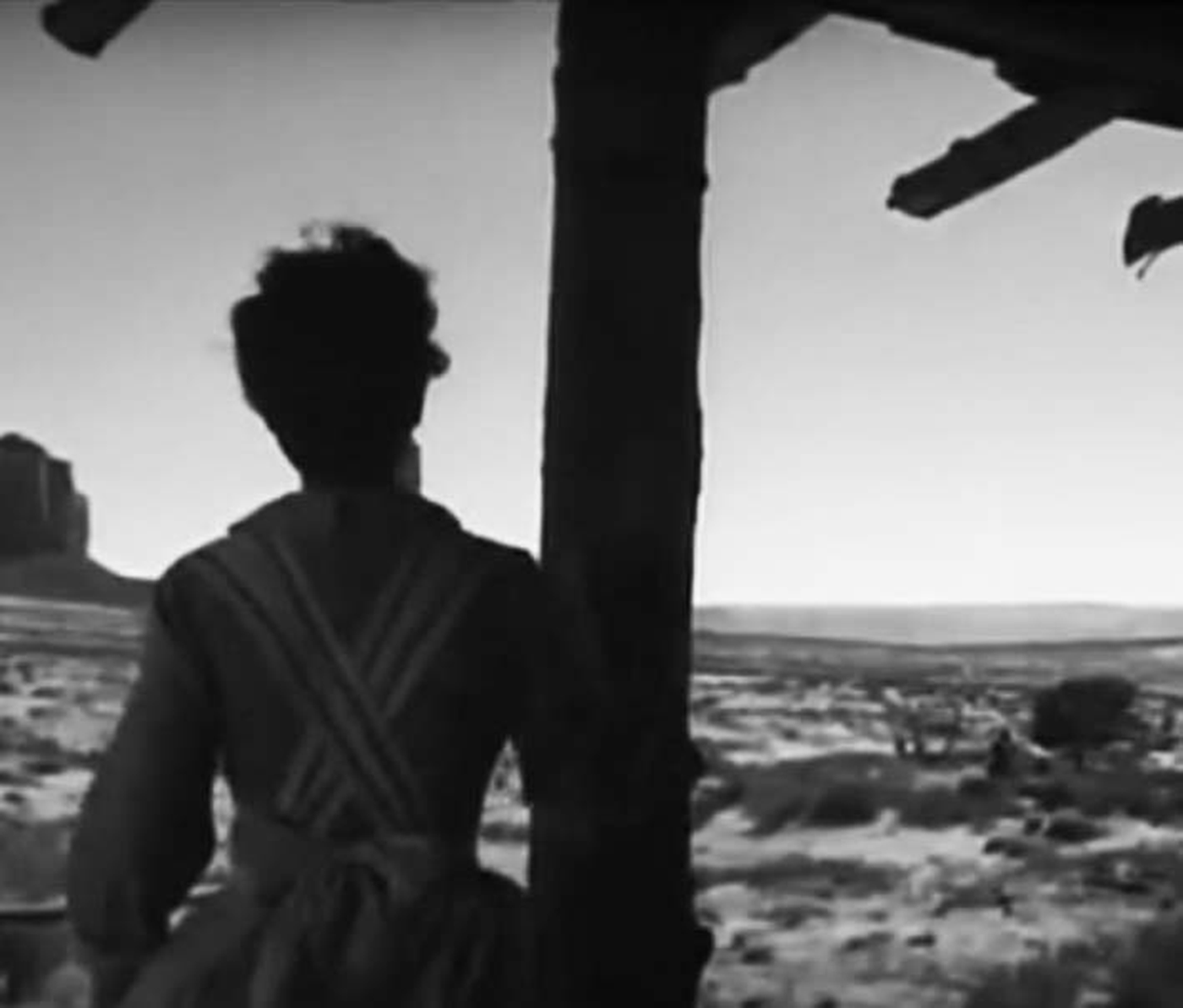
The uncanny appeal of the opening scene of John Ford's The Searchers (1956), which begins with a framing shot aimed at the prairie from inside the dark interior of the Edwards’ family home, has provoked considerable commentary,Footnote 24 in part because interiors have both architectural and security-related psychological resonances and in part because such shots are the ‘archetypes’ that ‘provoke in the addressee a sort of intense emotion accompanied by a vague feeling of déjà vu that everyone yearns to see again’.Footnote 25 It's the first of the film's three inside out shots taken from dark interiors towards the dangerous landscape outsideFootnote 26 – this one from behind Aaron Edwards's wife, Martha (Dorothy Jordan), who looks out towards the prairie watching her brother-in-law, John Wayne, approaching on horseback (Figure 1). The way the scene is shot makes ‘the house itself … a camera pointed at nature’.Footnote 27 Describing that scene elsewhere, I wrote:
The opening scene of The Searchers … is both cinematically powerful and narratively expansive. It is shot from inside the cabin of Ethan Edwards’ (John Wayne) brother's cabin, providing a view a vast expansive of prairie, from which Edwards is approaching … observed by his sister-in-law from her front porch, which, architecturally, plays a role in designating the house as a refuge from outer threats.Footnote 28
Martha (Dorothy Jordan) looking out on the prairie, The Searchers (1956).

I went on to reflect on the kind of architectural statement made by such front porches, quoting a lyrical passage in a novel by Alessandro Baricco, who describes the porch as being:
inside and outside at the same time … it represents an extended threshold … It's a no man‘s land … the idea of protected place – where every house, by is very existence, bears witness to … One could even say that the porch ceases to be a frail echo of the house it is attached to and becomes the confirmation of what the house just hints at: the ultimate sanction of the protected place, the solution to the theorem that the house merely states.Footnote 29
While the porch serves as a security-oriented threshold in individual dwellings, collective living structures involve more extensive security-relevant design elements and afford more complex material features that express the conditions of possibility for association or withdrawal within them and between them and the outside environment.
Security in collective living structures: Apartment buildings
To illustrate the issue of security as it bears on collective domestic structures, I turn next from the opening to John Ford's film The Searchers, which focuses on a single domestic dwelling unit to two crime stories (in a novel and film), both of which have architecture as a major protagonist in the plot. First, in Qui Xiaolong's contemporary Shanghai-situated crime story, When Red is Black (2004), along with the detectives, the murderer, the victim, and some informants, a main protagonist is a shikumen apartment complex in which the crime occurs.Footnote 30 Evolving since 1949, shikumen (literally ‘stone gate’) multiple-unit buildings are two- to three-storey structures featuring straight alleyways surmounted by stone arches, and a front yard situated behind a high brick wall. Among the conditions making the design of the buildings possible was the development of iron and concrete construction – famously analysed in detail by the architectural historian Sigfried GiedionFootnote 31 – which resulted in an ‘industrial standardization’ of dwellings and thus the ‘materialization of new forms of [collective] life’.Footnote 32
However, collective life is often precarious. In the case of exposure to violent crime, a building's material structure is implicated by aspects of its accessibility, necessitated by the comings and goings of its inhabitants and commercial visitors. That accessibility creates a perpetrator's opportunity for committing murder by becoming familiar with the building's spatio-temporal rhythms, its access points (for example, its front versus back door entrances) and the timing of bodies moving within and without the structure. In the novel, the shikumen building and the murder victim are figured as similar, history-worn protagonists. The novel's victim, Yin a disgraced writer, suffered because of the strictures on writers imposed during the Cultural Revolution. She is described along with the other residents as one ‘covered by the dust of the past, just like the shikumen building’, which is part of Shanghai's long-term architectural history.Footnote 33
Once the building is positioned as a main protagonist whose features simulate those of the victim, it emerges as a complex event space whose architectural features shape the repetitive comings and goings (inside and outside) that are the conditions of possibility for both committing the murder and for finding witnesses to help solve it. For example, as Detective Yu, who has the primary responsibility for solving the crime, watches the building, he sees ‘an elderly woman … pushing open the black-painted door … with one hand, carrying a chamber pot in the other … [a] familiar sight’.Footnote 34 And the comings and goings of street merchants – a ‘shrimp lady’ at the front entrance (‘an important witness … [who is] familiar with the shikumen building and with the habits of the other residents)Footnote 35 – and a ‘green-onion-cake peddler at a rear entrance’Footnote 36 – are spatio-temporal architectural features that yield the witnessing relevant to solving the crime. The way the building's openings and partitioning shape the moments and interactions of residents and non-resident suppliers ultimately constitutes the way the drama emerges in the shikumen as event space – for example, when entrances and exits are accessible: ‘Both the front and back doors of Yin's building were locked during the night. The front door, latched from inside, did not open until around seven, and then at around nine thirty in the evening, it was closed again. As for the back door, people who went in and out through it, either early in the morning or late in the evening were supposed to lock it behind them.’Footnote 37 Also important are common spaces and the rhythms of their use – for example the tingzijian room near to the murder victim's apartment. As it turns out, the murderer (although ultimately apprehended) displayed the requisite architectural sagacity needed to defeat the building's security. He knew how to take advantage of the spatio-temporal dynamics of the apartment complex.
Historically that sagacity has been a feature of burglars as well as murderers. As Geoff Manaugh points out in his Burglar's Guide to the City, the thief sees the city as a ‘world where criminal opportunities [are] hidden in the very architecture of the metropolis’.Footnote 38 Referring to one the most (in)famous burglars, Leonidas Leslie (operating in the nineteenth century), he writes, Leslie recognized that ‘the best way to commune with architectural space was breaking into it’.Footnote 39 Although the buildings he hit were designed for legitimate activities, Leslie's architectural acumen rendered them as designs for the illicit user (the events of theft) as much as for the licit ones. The concept of event space thus bears on burglary as much as it does on licit activities because a thief's ability to defeat a building's security requires her/him to assess its temporal rhythms as well as its spatial layout. Accordingly, the master jewel thief (and former building manager) Bill Mason, ‘wrote in his memoir Confessions of a Master Jewel Thief (2003)’ that he found it easy to ‘bypass a lot of security’ by being attentive to less used spaces – the ‘service corridors … the internal hinterlands’ and marginal rooms such as maintenance areas that residents rarely visit – and to heed the temporal rhythms of the building: ‘Every building had its rhythms [moments with] fewer guards on patrol or residents taking out garbage.’Footnote 40
The second apartment-related security drama I analyse is in the Wachowski brothers’ feature film Bound (1996) in which a closet and a wall between adjoining apartments are main protagonists in a story that treats both architectural and identity barriers. The film effectively queers the building by focusing on the way the building's architectural features facilitate encounters that enable a developing lesbian relationship between two women. To clarify my expression about queering the building, I want to note that ‘queer theory’ is not only about politicising sexual orientation but also about resistance to institutionalised norms in general. With respect to that latter focus, ‘queer’ tends to be used ‘as a verb, as action within … networks of norms [and thus] … to name queer as an action implicates us in a search for oral and political agency that resistance is supposed to name’.Footnote 41 That understood, the Wachowski brothers’ film queers the film noir genre (and the building in which the action takes place) by having its main female protagonists refigure the space of an apartment building, enacting a ‘queering of architecture’ and at the same time disclosing of the ‘fluidity of various layers of identity’ that tend to be repressed.Footnote 42 Like traditional film noir crime stories, Bound features a femme fatale whose body and habitus are objects of camera scrutiny. And also like the traditional femme fatale, the protagonist Violet's (Jennifer Tilly) heterosexual moments are not about erotic investment but are a cover for a temporal investment, a deferral to fool a gullible male, in this case Caesar (Joe Pantoliano), a mafia money launderer with whom she shares an apartment where she exchanges sexual favours for room and board with him and his associates, while hatching an escape plan. In this respect she bears comparison with the traditional film noir femme fatale, who is an ‘unabashedly independent and ruthlessly ambitious [woman] using her seductive charms and her intelligence to liberate herself from the imprisonment of an unfulfilling marriage, gaining power over the noir hero by nourishing his sexual fantasies [while] her own interest is only superficially erotic’.Footnote 43
The film's drama begins when a lesbian ex-con, Corky (Gina Gershon) moves into the apartment next door as a temporary hire to refurbish the apartment. Violet, who first spies her when they share a brief moment of public space (the apartment buildings elevator), is immediately attracted to her and conspires to initiate erotic encounters, which begin in Violet's apartment and are later repeated in Corky's. Their erotic connection begins when Violet invites Corky to her apartment to help find a ring, which she has (purposely) lost down a sink drain. As the two begin touching and then erotically groping, with Corky in control in this instance (Violet become the aggressor later in Corky's apartment), a telling event takes place. They abruptly separate as Caesar enters the apartment. On seeing Corky, who looks very masculine (in leather and jeans, in contrast with the very feminine and [hetero-]sexily attired Violet), he shouts, ‘What's this; what the fuck is this?’ After a closer look, he recognises Corky as a lesbian rather than a male paramour and excuses his outburst, saying, ‘It's fuckin’ dark in here.’ Caesar's remark has a double resonance; in addition to referring to ‘the film noir genre, it reflects the blindness in his perception of Violet. He is unable to imagine a woman who dresses in outfits with heterosexual appeal and acts seductively towards men as one who is actually attracted to women’. With respect to Violet's persona, Caesar is always in the dark.
A similar perceptual issue afflicts Corky's view of Violet. Shortly after their erotic connection begins, Corky expresses contempt and jealousy about Violet ‘having sex with men’. Violet responds that she isn't having sex with men, to which Corky responds, ‘I hear you, thin walls, remember?’ Violet replies. ‘That wasn't sex.’ ‘What the fuck was it?’ asks Corky. ‘Work’, replies Violet. Apart from what Violet's response reveals about the film's pedagogy about the boundary-challenging plasticities of identity (especially Violet's mobile subjectivity), the role of the wall, evoked in the conversation, is central to how the film thinks. From the very outset, architectural features create the conditions of possibility for the way the characters affect (and connect with) each other. A closet is the focus in the very first scene, as well as in a late one. It is a place where a bound Corky is thrown late in the film, when Caesar overpowers her after discovering the women's plot to rob the mafia and get Caesar blamed for the missing money. However, like the wall that separates Violet and Corky's apartments, the closet does double duty. It represents the initial sequestering of Violet's lesbian identity.
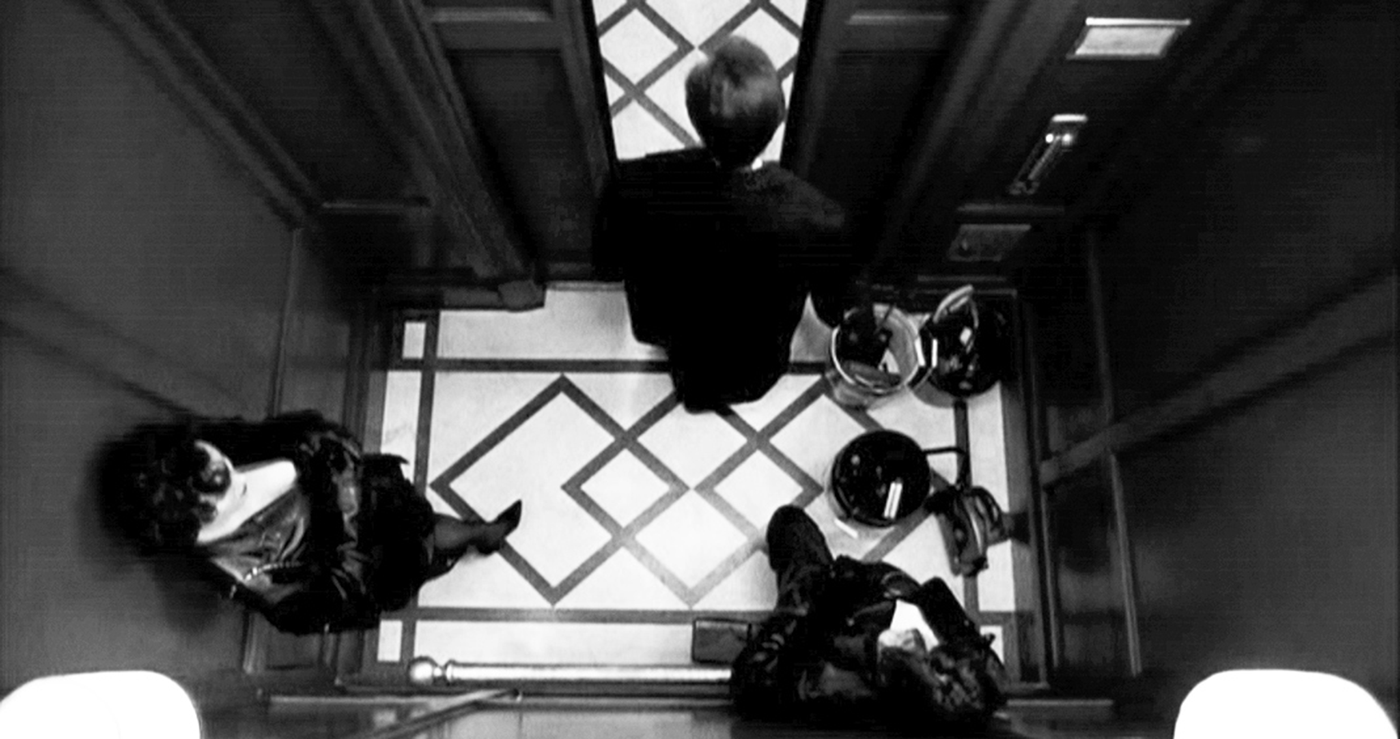
The other important architectural scene is shot in the apartment elevator, where Corky rides up with Caesar and Violet and the women exchange their first glances (a seductive look from Violet and a curious one from Corky). That scene initiates the complexities of the triad because it is clear that the elevator plays its role as a public access space that has created the possibility for the first encounter. And significantly, included in that scene is an overhead shot of the three bodies, showing the structural triad as a preview for the dramatic interpersonal perceptions and actions to follow (Figure 2).
The elevator scene, Bound (1996).

However, the dramatic narrative in which Violet ultimately grabs Caesar's gun and shoots him, freeing the women to escape with the money, doesn't capture what I have suggested as ‘the film's most significant, micropolitical aspects’,Footnote 44 the primary one being the wall separating the two apartments. The film's camera work brings the role of the building's partitions into focus on many occasions with many long takes of the wall (shown from Corky's side). Moreover, there are many panning shots of the technologies that make the wall permeable enough to enable the plot – shots of plumbing pipes and phone lines that along with the walls’ thinness and thus permeability to voices carrying through it. Henri Lefebvre has captured the significance of the technologies that make buildings permeable:
One might almost see it [the building] as the epitome of immovability, with its concrete and rigid outlines … Now a critical analysis would doubtless destroy the appearance of solidity … stripping it as it were of its concrete slabs and its thin non-load bearing walls, which are really glorified screens … [the building] would emerge as permeated in every direction by stream of energy which run in and out of it by every imaginable route: water, gas, electricity, telephone lines.Footnote 45
Certainly the camera is telling us that the apartment building has shaped the events that take place within it. Beyond that, however, is the way the women's plot unfolds. Violet and Corky take advantage of the wall's permeability to refigure the use of the buildings domesticity. Queering the building, they transfigure its event space from one of money laundering (disguised as a form of domesticity) to one of liberation, as Violet's amorous-life-as-business becomes amorous-life-as-mutual trust, that is, to an affective and action-enabled way of being in common (at one point, Corky explains that such dangerous plotting requires even more trust than does an erotic relationship).
Hotels
A consideration of hotels as event spaces adds an important dimension to architecture-influenced security politics. It affords insights into both macro and micropolitical implications of architected living accommodations. The macro level is best understood as ‘hotel geopolitics’, which includes the symbolic and material effects of the spread of US-based as well as other hotel chains worldwide. For example, the development of the Hilton Hotel franchise was conceived in part as a Cold War project, an anti-communist statement, which was made explicit in remarks by Conrad Hilton: ‘we feel that what we are saying about liberty, about communism, about happiness, that we as a nation … we mean these hotels as a challenge … to the way of life prescribed by the communist world’.Footnote 46 In addition to their power-projecting discursive participation in geopolitical contention, international hotels have been sites for housing diplomatic delegations, which have attracted high levels of surveillance by intelligence agencies (for example, ‘a system of surveillance codenamed “Royal Concierge’” by the British secret service’)Footnote 47 and of warfare (for example when Beirut's Holiday Inn ‘became a strategic base for armed militia's to target the city below’).
In contrast with the way ‘hotel geopolitics’ is associated with national conflict strategies is the micropolitics of hotel architecture, which references a different kind of geopolitics. That politics becomes apprehensible when one heeds the disparate flows of bodies into and around hotel space – the surrounding public, the tourists booking rooms, and the hotel's service personnel. The way hotels spatially manage those flows is summarised well by Sara Fregonese and Adam Ramadan:
The conditional relation of hospitality is manifested within and without the hotel, and represents the defining characteristic of hotel space … guests are screened, controlled and charged and welcomed into certain spaces: public areas like the entrance hall, reception corridors, elevators, restaurants, and private areas like guest rooms and function rooms. At the same time guests are restricted from accessing other spaces such as service areas [and] the hotel must … maintain a controlled openness to the outside – to the potential customer – while being able to screen, monitor and subtly control those who enter [because] The open door allows the outside inside.Footnote 48
The details of that spatial management is a major feature of the dramatic narrative in Stephen Frears's feature film Dirty Pretty Things (2002), which turns its primary architectural protagonist, London's fictive Baltic Hotel, into a complex event space in which, as the film narrative proceeds, it is transfigured from a space of control and coercion to one of empowerment. Because the camera lingers on London's buildings while following the fates of its characters, the film is among other things a story of bodies and buildings. The film drama opens and closes at one of London's Heathrow International Airport's terminals where at the outset, Okwe (Chiwetel Ejiofor) a Nigerian refugee and medical doctor (working illegally without a valid passport or visa) is soliciting passengers for the cab he drives during the day, and in the conclusion is there to see his friend Senay (Audrey Tautou), a Turkish refugee, off as she departs for the US.
The other important buildings in the film – aside from the Baltic Hotel where Okwe works as a night clerk and Senay (early in the film) works as a maid – are the cab company for which Okwe works (run by a Caribbean immigrant); a morgue where Okwe's friend Guo (Benedict Wong) works; an apartment that Okwe shares with Senay (they use it in separate shifts); a sewing sweatshop where Senay is sexually exploited later in the film; and a hospital where Okwe sneaks in disguised as a janitor in order to steal medicines. He does this first to help refugees without access to health care, and later to use them for an operation at the end of the film (in order to participate in the hotel manager Señor Juan's (Sergi López) AKA Sneaky's illegal organ harvesting business, which he runs in the hotel at night).
The film's drama's begins when Okwe discovers a human heart clogging one of the hotel toilets. Because of his illegal status he cannot report his discovery (as his friend Guo explains: ‘Okwe, you are nothing, you have nothing … just help the people you can’). Once Okwe's medical background is discovered by Señor Juan, he and Senay are offered illegal passports (one of Señor Juan's side businesses) in exchange for Okwe's medical service as an organ harvester. Although Okwe initially refuses, he changes his mind when he discovers that his friend Senay intends to exchange a kidney for a passport. However, instead of harvesting Senay's kidney, he drugs and extracts Señor Juan's, delivers it to a waiting driver in the hotel basement, collects the fee, and along with Senay is driven to Heathrow Airport by Guo, where after he sees Senay off to the US with her illegal passport he calls Nigeria to tell his young daughter he is coming home.
As a drama the film examines a significant political event, one in which two disempowered refuges (with the help of a group of marginal people: a prostitute who works in the hotel at night, a doorman from somewhere in Eastern Europe, and a Chinese immigrant who works in a morgue) are transfigured from victims into political subjects, forging a temporary oppositional community that acts effectively to overcome a precarious situation. However, I want to focus on the way the Baltic Hotel, as the primary event space in the film, becomes a major protagonist, affording the opportunity for the power transfiguration featured in the film drama. Although the camera follows the characters during their fraught exchanges with Señor Juan and the desperate tactics through which they barely avoid two immigration agents who continually threaten them, it also foregrounds the Baltic hotel. There are many framing shots of it from the outside and many framing and tracking shots within that explore its internal partitions, which separate its guest and service areas. Throughout the film, the footage of the hotel emphasises the way it (like hotels in general) manages the boundaries between open hospitality and security. Recalling Fregonese and Ramadan's above noted description about the separation between guest and service areas, in the film the difference between the guest and service areas is colour-coded. The guest areas appear in bright red and gold colours while the service areas, the basement where the workers lockers are and the garage where deliveries are made, are seen through more subdued blue and green filtering.
As for how the (largely immigrant hotel staff) appear: ‘Hotel workers are treated as unseen objects of the multiple desires and fantasies of managers, clients, and co-workers.’Footnote 49 However, the way they are ‘unseen’ is owed in part to the hotel's social positioning. In contrast with the hotel's guests, whose invisibility (as Siegfried Kracauer famously puts it) is a matter of controlled impression – ‘The … hotel lobby … allows the individual to disappear behind the peripheral equality of social masks’Footnote 50 – the invisibility of the hotel's immigrant workers is a matter of both their inability to rise above the normative standards of social recognition and the spatio-temporal partitioning of the hotel's spaces.
What goes on in the Baltic Hotel is dramatically different at night versus during the day. One aspect of the difference is a common aspect of hotel experiences; a sex worker, Juliette (Sophie Okonedo) meets her clients at night and, as she puts it, ‘doesn't exist’ (because she is not officially present). More dramatically different with respect to the hotel as event space is Señor Juan's organ harvesting business, which goes on in otherwise vacant rooms at night. After Okwe and his team turn the tables and harvest Señor Juan's kidney, a telling follow-up scene takes place. Okwe, accompanied by his operating team descend to the dark, underground parking garage, where they hand over the kidney, packed in ice in a box. The well-dressed, white, assumedly British man accepts it and wonders aloud who they are. Having expected Señor Juan to make the delivery he asks, ‘How come I've never seen you people before?’ Okwe responds, ‘Because we are the people you do not see. We are the ones who drive your cabs, clean your rooms, and suck your cocks.’
As it has turned out their invisibility has been a primary resource, along with the solidarity they have forged. Using their lack of social recognition and the ways in which the built environment has afforded ‘transitory spatial zones’ throughout the city and hidden-from-view areas within the hotel to meet and plan, they are able to evade Señor Juan's coercive power. Ultimately, their transfiguration of a space of hospitality, which the Baltic Hotel features during the day, is a micropolitical event in which the hotel as event space is reconfigured. As I have put it in an earlier reading of the film:
By reorienting the room [where Okwe operates on Señor Juan] along with other spaces throughout the ‘Baltic’ … in order to mount a political challenge to the hotel's dirty business … Okwe and friends repartition the hotel, turning it from a place of business (whether welcoming touristic bodies or exploiting those of refugee/immigrants) into a space of political engagement … [a] repartitioning [that encourages] … a rethinking of the presupposed organisation of political space.Footnote 51
The next two textual analyses to which I turn add important dimensions to the above-noted invisibility issue noted in the reading of Dirty Pretty Things. One that I treat briefly, is a crime novel, Joe Gores's 32 Cadillacs, whose action sites involve tensions similar to the transparency versus security issue apparent in hotels that try to appear hospitable while at the same time maintaining security. The other is a feature film, for which I provide more extended analysis, Tomas Alfredson's film version of the John le Carré novel Tinker Tailor Soldier Spy (2011), in which architecture plays a major role in a global espionage drama.
32 Cadillacs
Joe Gores's crime drama novel stages a series of encounters between a Roma collective who endeavour to steal 32 Cadillacs (to be used for their deceased Gypsy king's funeral cortège) and a group of repo men who, along with a police detective, try to recover them. There are a variety of venues throughout the story whose temporalities and transparencies enable the Cadillac thefts by the Roma. For example, one theft is enabled by the time it takes a parking valet to write a customer's ticket before turning back to the car. However, the most telling moment involves a scam at a bank. It is a point at which one of the Roma on a car-buying mission is planning to pass a bad cheque at a bank to acquire sufficient liquidity. To do so he takes advantage of the bank's visual accessibility and temporal rhythms: ‘Rudolph Marino enters the main branch of “California Citizen's Bank at One Embarcadero (Now Open Nine to Five Every Wednesday to Serve You Better)” and is able to see all his relevant opportunities.’Footnote 52
Marino scanned the bank officers behind the metal and Formica railing. He chose a pretty early-40s round faced woman with pouty lips, She wore floral perfume and pink-tinted glasses that magnified her eyes into a slightly surprise expression, She did not wear a wedding band, Her nameplate said Helen Wooding.Footnote 53
As I have noted elsewhere, ‘The bank laden with signs and spaces organized to seduce a clientele and governed by a rigid temporal structure (fixed opening and closing hours and consistent durations for cheque clearing), turns out [despite is security features (video scanning and an armed guard] to be an easy mark for someone prepared to be the seducer rather than the seduced.’Footnote 54 Gores's theft drama also exposes an aspect of architectural punctuation that exceeds the visibility-opacity binary; he treats accessibility versus impenetrability that many of the Roma involved in the thefts exploit to hide behind what appear to be legitimate enterprises (for example, fortune telling). While Gores's crime drama reveals much about the dilemmas associated with architectures of security in a city setting, the film drama to which I now turn has much more complexity because the architecture of security tends to be relatively ineffectual in preventing moles to insinuate themselves within security apparatuses and has a more extensive cartographic plot (operating within an inter-city and inter-nation network).
Tomas Alfredson's Tinker Tailor Soldier Spy
To recognise the way architecture functions within the film, we can heed the Russian director Sergei Eisenstein's cinematic practice in which he endeavoured to ‘find practical answers to the problem of how to film a building, how to transform it from a passive setting of the action, into a major agent of the plot’.Footnote 55 Among the answers Eisenstein found (after reading – ‘with the eye of a filmmaker’Footnote 56 – the way August Choisy described the Parthenon in his Histoire d'Architecture from the point of view of someone walking around it) was the need for a ‘montage effect’, which requires an emphasis on ‘the sequence.”Footnote 57 So instructed, Eisenstein made architecture one of his major cinematic protagonists by filming its role in narrative sequences. Tomas Alfredson does so as well in his Tinker Tailor Soldier Spy. His camera lingers with long takes focused on many aspects of the MI6 building housing Britain's secret service (aka ‘the Circus’).
For a description of the drama of le Carré’s spy story, David Denby's brief synopsis is adequate:
In ‘Tinker’, le Carré tells us very little about how treason begins, but he creates a fictional account of how it might be shut down. As all the world knows, the meek-mannered cuckold George Smiley, roused from retirement and disgrace, uncovers a mole in M.I.6. (the Circus) by setting traps so intricate that only a spy could fall into them (funny, in its way).Footnote 58
Alfredson's film narrative manages that aspect of the plot well. However, quite apart from the specifics of the narrative drama is the way buildings, especially MI6's headquarters, serve as protagonists. They are among the most significant event spaces in the film, which not surprisingly accords well with Tschumi's concept of event space because Tschumi's perspective on architecture as event space was inspired by his attention to cinema.Footnote 59
Several buildings play key roles in the film. While the MI6 building is the main architectural protagonist, several others also participate in the plot: two homes (the head of MI6, Control's, and Smiley's), a safe house, a sequestered space of brutal interrogation, and a hotel room. In le Carré’s novel, the MI6 building, which houses the Circus, is described as being located in London's West End above a nondescript shop near the corner of Shaftesbury Avenue and Charing Cross Road. Thereafter the story is dominated by its character-operatives, whose action trajectories are delivered in non-linear sets of flashbacks, with the story beginning well after Control, the head of the Circus has died, leaving Smiley with the task of finding the mole spying on behalf of Russia.
In contrast, Alfredson's film version, with its camera continually recording images of buildings and their interior details and moments of use, has architecture functioning as protagonists along with the operatives (with the MI6 building subject to the most elaborate coverage). Openings and closings dominate the building shots in the Circus headquarters. However, the very first opening is a door to Control's home as the operative Jim Prideaux (Mark Strong) is ushered into the study of Control (John Hurt), whose home sits ambiguously between a residence and work place. It is used in this moment as a space outside of MI6 headquarters to keep the meeting and conversation secret from other operatives because the summons to Prideaux (who is being sent to Budapest) is connected with Control's attempt to find the mole that is allegedly located at a high level within the Circus.
During this encounter, as in the rest of the filming of interpersonal moments, the camera pays at least as much attention to buildings as is does to persons. Moreover the bodies-buildings relationship is edited with a dual rhythm, making use of what Noel Burch refers to as two kinds of cinematic space: ‘To understand cinematic space, it may prove useful to consider it as in fact consisting of two different kinds of space: that included within the frame and that outside the frame … [where] screen space can be defined very simply as including everything perceived on the screen by the eye.’Footnote 60 Offscreen space is registered when, for example, ‘a character reaches it by going out a door, going around a street corner, disappearing behind a pillar or behind another person, or performing some similar act. The outer limit of this … segment of space is just beyond the horizon.’Footnote 61
The onscreen-offscreen dynamic to which Burch refers is enacted within the film's buildings, often when characters pair off and take leave of other colleagues to have private conversations. At the MI6 building those seeking privacy tend to move to the roof, a venue that contrasts with the building's conference room, where the entire collection of high-level operatives meet. To convey the way the different rooms work the shots of collective and paired conversation are taken from distances that reveal the structural partitioning that enables the different conversational events. Ultimately, if we heed the rhythms of the cinematic montage, we are apprised of the connections among the important events spaces: Control's and Smiley's (Gary Oldman) homes, the safe house in which the conspirators belonging to a group known as ‘Witchcraft’ meet, the sequestered space of incarceration and torture where Prideaux is interrogated after being captured by Soviet operatives, the hotel room that Smiley and his associate Peter Giulam set up to work on finding the mole, and the parliamentary office of Oliver Lacon (Simon McBurney), the vice-minister in charge of intelligence, whom Smiley keeps apprised of the investigation.
The other and doubtless more significant architectural exploration involves lingering long takes of the opening and closing of portals in the MI6 building and tracking shots of the movements of personnel and files, which as a whole testify to the interactions of bodies, buildings, and intelligence materials that constitute the structures and dynamics of interaction among them, shaped by the building's partitions and moving parts. As a whole those shots display the role of the architecture of everyday intelligence work (the roles of structure and temporal punctuations in the event space of the MI6 building). That the aim is to show an architecture of hyper security is in evidence early in the film. While the credits are being run, the camera lingers on a metal fence topped by sharp spikes around it along with barbed wire on top as Smiley and Control leave the building, are seen through a metal grating, and are then shown passing through a turnstile. To show the parallel security attached to intelligence materials, there is a cut back to the building as the camera follows a brief case bulging with papers being placed in a dumb waiter, which is shown closing, descending, and then reopening in the basement where the papers are to be secured. Ultimately, the film version of Tinker Tailor Soldier Spy, with its image commentary, discloses what the novel version, with its emphasis on human protagonists, neglects – the architectural agency of the event spaces involved in the macro- and micropolitics of the British intelligence operations during the Cold War. With the Cold War now a distant past, the standoff between allied Western nations and the old Soviet Union has given way to a war that is considerably hot, comprising the ongoing, frequently violent encounters between Palestinians and Israelis, an antagonistic relationship in which architecture plays a major role.
A violent event space: the architectures of occupation and resistance
The controversies surrounding architecture in the longstanding Israeli-Palestinian conflict have asserted themselves within clashing cartographic histories, geopolitical and sacred. The crux of that clash became apparent in September 1996, when a violent conflict ensued after the Israeli Prime Minister Benyamin Netanyahu opened a new gate to the ancient tunnel that connected the Israeli sector by the Western Wall, passing under the al-Aqsa Mosque into the Muslims sector of the city. Reviewing that episode and looking into the interpretive practices through which architecture has been presumed to present itself as political reality, Daniel B. Monk analyses what he refers to as ‘the career of architecture in the prehistory of the present conflict’ (while at the same time questioning the ‘normative presentations of architecture's political self-certainty’).Footnote 62 Certainly monumental architecture is central to the conflicting allegiances in the region, prompting Monk to characterise the Israeli occupation as aesthetic and to investigate the (interpretation-mediated) career of architecture that has been continually featured in accounts of the conflict (even though a reliance on such concrete appearances is misleading).
Although architecture remains an active force in the conflict, it now has a different modality and an undeniable effectivity. The architectural history that post dates the ‘career’ to which Monk refers involves a dialect of violence featuring encounters between the forces of occupation and securitisation mounted by the Israeli military (the IDF) and Palestinian resistance. Quite apart from the loosely integrated violent tactics of various Palestinian commando forces, a resistance involving spatio-temporal ingenuity has been underway since the period of Israel's Separation Wall, whose construction was completed in 2006. The wall and a series of checkpoints radically partition Palestinian territories structurally and temporally, imposing difficult travel restrictions within Palestinian territories as well as between them and Israel. That violent architectural imposition has had the effect of rigidifying what had for decades been a ‘frontier’ with a more ‘elastic morphology’.Footnote 63
Israel's passive geometry of separation – the wall and checkpoints – has been supplemented with a more active geometry, a set of search and destroy tactics, which Eyal Weizman describes elaborately (after a set of ethnographic interviews with Israeli forces). For example, examining the 2002 Israeli attack on the West Bank City of Nablus, he learns from the Israeli Commander Aviv Kochavi that the army's tactics involved an ‘inverse geometry … defined as the reorganization of the urban syntax by means of a series of micro-tactical actions [in which] Soldiers avoided the streets, roads, alleys and courtyards that define the logic of movement through the city, as well as the external doors, internal stairwells and windows that constitute the order of buildings; rather they were punching holes through party walls, ceilings and floors, and moving across them through 2100 meter pathways of domestic interior hollowed out of the dense and contiguous city fabric.’Footnote 64 Given the overwhelmingly destructive capacity of the Israeli air force, along with the destructive tactics of the military on the ground, the armed Palestinian resistance has been forced underground, so much so that much of the economy of Gaza has resulted from tunnel building by private contractors.Footnote 65
An encounter of cartographies characterises the way Palestinians regain mobility to make life livable in response to the architectural violence they face. One map, drawn up and used by the Israeli military (IDF), is the one that has ordered the Israeli strategies of isolation incursion, and destruction on the ground and from the air. The Palestinian cartographic response is both structural and temporal. Structurally it has sought to restore some of the elasticity that the wall and system of checkpoints has effaced. As the Palestinian architect Yara Sharif puts it, the design problem involves the creation of a more ‘elastic space born from the will to connect – a space of resistance that keeps on changing with the … interventions [that] respond to [an imposed] instability through the tactics of an emergent architecture, which in its nature, might seem ephemeral, yet is quick in its effects’.Footnote 66
Employing Henri Lefebvre's concept of ‘counter spaces’, Sharif refers to the need to ‘step above and underneath the exhausted surface of Palestine … [to evade the way Israel is] … eating away slowly and quietly at the Palestinian landscape’.Footnote 67 She points out that as the occupation's set of checkpoints divide Palestinians from each other, the Palestinians refigure the spaces around them; they are ‘transformed by the everyday behaviour to try to create spaces of possibility … Playing with lines on the map has created new lines. Palestine is no longer the city and the village – it is also the in-between, the dead spaces and the margins, in which people perform wait, remember and resist. It's the new route that its people create, the tunnels we dig under the wall and the sewage pipes we walk through every day …’.Footnote 68
Through such countermapping and refiguring, Palestine becomes a resistant event space as (in Sharif's terms) ‘“non-places” [are] being made in everyday life into real places’.Footnote 69 Sharif thus effectively conveys the way Palestinians have met the architecture of occupation with a counter architecture, which involves (among other things) redesigns that create possibilities of mobility that the Separation Wall and checkpoints stymie. The countering of the Israeli controlled opening and closing of border gates – open at 7.00 a.m. and closed at 7.00 p.m.Footnote 70 – requires temporal design strategies. For example, unable to move effectively within the ‘complicated lines’ that define of spatio-temporal rhythms of the occupation, young Palestinians looking for job opportunities within Israel have to use the darkness and various ‘hidden spaces’, which they refer to as ‘rabbit holes’. Meeting ‘usually at two or three o'clock in the morning [groups of young men] gather at agreed points and sneak through together … to reach the other side of the wall.’Footnote 71 Ultimately, through such tactics (which as Michel de Certeau famously points out, involve the use of time by people who cannot control space),Footnote 72 Palestinians activate ‘micro-space events’ to transform the border areas into an alternative event space:
Playing with Israel's imposed borderlines has thus created further lines on the map. By putting together … micro-scale events, Palestine is reshaping the dead spaces and urban voids in which people wait, remember and resist. The intensification of the borderlines does not leave any alternative but to occupy the margins, which in turn creates a new spatial quality and intensity to the ‘dark points’ on the map.Footnote 73
Animating the ‘micro-events of resistance’: Hany Abu-Assad's Omar
Film is the barricade … the one where somebody stands and tells the truth.Footnote 74
Don DeLilloRecalling Eisenstein's remark that cinema can turn a passive setting into a major agent of the plot, I turn to Hany Abu-Assad's film Omar (2013) in which the Separation Wall is one of the film's primary agent/protagonists. Moreover, through way the film inter-articulates action and setting – as it mobilises an aesthetic subject involved in the micro-events to which Sharif refers – we can better appreciate her descriptions of the dynamics of architectural resistance (which are enacted by Abu-Assad's eponymous protagonist, Omar). His Omar (Adam Bakri) is part of the uprooted world that the Occupation has created, a subject effectively exiled in his own homeland, living in a space of space-punctuating barriers – mainly the Separation Wall and a series of checkpoints – that impede his relationships with his fiancée Nadia, his friends, and his political activist associates.
The film drama is connected at several moments by its paradigmatic scenes, Omar's repeated scaling of the Separation Wall. Those moments, along with one in which he is harassed and brutalised by Israeli soldiers at a checkpoint, reflect the general Palestinian collective experience of the architecture of occupation: The Wall, as Ana Cristina Mendes points out, ‘is presented in Omar, as the ultimate visual expression of domination, a dynamic that plays itself out continually in a context of asymmetric power dynamics of an unequal access to visual rights … a site of a continuing coloniality of power [but also … on of a playful vacillation between revealing and concealing and hence the site of adaptive ambivalence and radical potentiality …’.Footnote 75 Mobilising its primary aesthetic subject, who must cope with the barriers to movement, Omar (which is part of a developing politically oriented ‘Palestinian national cinema’), discloses a ‘structure of feeling … a collective ontology of Palestinians which is one of constant negotiation of the tension(s) between mobility and immobility’.Footnote 76
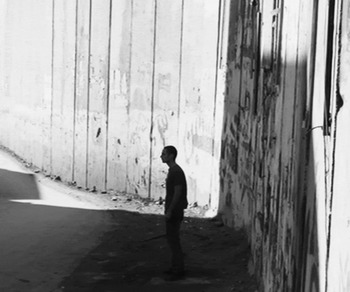
The opening scene suggests the radical potentiality. While the first image shows Omar in shadow (Figure 3), seemingly dwarfed by the immense wall, he is then shown rapidly scaling it, hand over hand as he uses a rope to pull himself over with impressive athleticism. As he is seen over the top, a siren goes off and shots are fired as he descends on the other side and runs through alleys and crooked streets towards the house of his fiancée. However, by the end of the film an exhausted Omar, who has been imprisoned, turned into an informant by the tactics of the Israeli military, separated from his fiancée, and spurned by his former friends, is barely able to climb the wall. Only after an elderly citizen shouts encouragement is he able slowly to make the ascent. That moment of Palestinian solidarity is what seems to remain of collective cohesion, given the way the architecture of occupation has sundered the Palestinian life world.
Omar and the wall, Omar (2013).

To return to Weizman's critical practice of forensic architecture, aimed at disseminating evidence of war crimes in urban contexts, it is clear that what the diminution of Omar's efficacy (the shift that the film shows of his transformation from a healthy, exhilarated, and hopeful body to an exhausted one) is a result of the occupation, which constitutes a continuing war crime, ‘produced’, as Weizman puts it, ‘by a multiplicity of military agents using a network of different technologies and apparatuses, run by political, institutional and administrative logics’.Footnote 77 Although the architecture of resistance that Sharif describes shows how Palestinians manage a degree of mobility in the face of the territorial rigidities and separations that the occupation imposes, critical investigations and testimony from outside the culture of the occupation is an essential political response. That is the critical move involved in Weizman's practice of forensic architecture. In response to the technologies of the occupation, which sequester and immobilise people and impede the sharing of information and access, are the techniques of forensics, which ‘make objects reveal information by subjecting them to additional force. To be analyzed, structures often have to be cut apart … [forensics is thus] the art of object-interrogation the inquisitions of things and buildings.’Footnote 78 Like Abu-Assad's film, forensic architecture turns what appears to be impenetrable into a dynamic and dialectic of force relations. Like the film it helps to construct an oppositional (global) community of sense by providing some of the resources necessary for witnessing and judging. To summarise the relationship between architecture as event space and forensic architecture: what constitutes an ‘event’ is subject to durational contestation. The forensic interventions in Weizman et al.’s forensic architecture practice extend the scope of event space with counter-investigations, involving ‘counter-forensics’Footnote 79 that challenge official accounts. The ‘events’ in those event spaces are continually susceptible to forensic inventions that turn what political and policing officials portray as routine legal interventions into human rights violations. Although the current Israel-Palestine encounter involves a force of arms, an architectural dialectic is very much at the centre of the conflict. It's a conflict in which the architectures of security and resistance are in full view.
Michael J. Shapiro is Professor of Political Science at the University of Hawai'i, Manoa. His research is in the areas of political theory and philosophy, critical social theory, politics of aesthetics, cultural studies, politics of media, indigenous politics, and critical international studies. Among his recent publications are War Crimes, Atrocity, and Justice (Polity, 2015); Politics and Time (Polity, 2016); and The Political Sublime (Duke University Press, 2018). Forthcoming publications include: Punctuations: How the Arts Think the Political (Duke University Press, 2019) and The Cinematic Political: Film Composition as Political Theory (Routledge, 2019). His current research is on the phenomenology of religious life with a focus on artistic media genres.