Introduction
Zearalenone (ZEN) is a mycotoxin with estrogenic effects produced by Fusarium, which is ubiquitous in corn, wheat, sorghum, and other grains and their by-products (Fu et al. Reference Fu, Liu, Xu, Wang, Liao and Chen2020; Xu et al. Reference Xu, Ma, Chen, Yu, Ye, Sun and Zhang2021). ZEN has strong reproductive toxicity, immune toxicity, genetic toxicity, estrogenic effects, carcinogenicity, and teratogenicity, which seriously endanger animal and human health (Gruber-Dorninger et al. Reference Gruber-Dorninger, Faas, Doupovec, Aleschko, Stoiber, Hobartner-Gussl, Schondorfer, Killinger, Zebeli and Schatzmayr2021; Wang et al. Reference Wang, Zhou, Jiang, Wu, Liu, Jiang, Wang, Kuang, Tang and Feng2019; Wu et al. Reference Wu, Cui, Yang, Liu, Han and Chen2021a). Finding a safe and effective method to remove ZEN from animal feeds, therefore, is crucial (Chang et al. Reference Chang, Liu, Sun, Wang, Zhao, Zhang, Zhang and Sun2020; Fu et al. Reference Fu, Liu, Xu, Wang, Liao and Chen2020). Various methods have been developed for the removal of ZEN, including adsorption, solvent extraction, ozonation, enzymatic degradation, microorganism degradation, etc. (Wu et al. Reference Wu, Ou, Zhang, Wang, Xu and Huang2021b). Among them, the adsorption method is considered to be the most feasible and economical due to the advantages of low cost and high efficiency (Li et al. Reference Li, Tian, Dong, Bai, Han, Liang, Meng and Zhang2018; Sprynskyy et al. Reference Sprynskyy, Gadzala-Kopciuch, Nowak and Buszewski2012; Sun et al. Reference Sun, He, Xue, Li, Xu and Qian2014; Sun et al. Reference Sun, Song, Wang, Wang and Zheng2018, Sun et al. Reference Sun, Lian, Li and Zheng2020, Zhang et al. Reference Zhang, Zhang, Jiang, Liu, Li and Zhang2020a). Bai et al. (Reference Bai, Sun, Xu, Liu, Han, Wu and Luo2017) prepared a functionalized graphene oxide composite modified with amphiphilic molecules, didodecyldimethylammonium bromide, for removal of ZEN from corn oil. Kalagatur et al. (Reference Kalagatur, Karthick, Allen, Nirmal Ghosh, Chandranayaka, Gupta and Mudili2017) developed a type of activated carbon derived from seed shells of Jatropha curcas for adsorption of ZEN, and it exhibited an excellent binding to ZEN with a maximum adsorption capacity of 23.14 μg/mg in vitro. Surface-imprinted polymers supported by hydroxylapatite were synthesized by a molecular imprinting technique for adsorption of ZEN, and the composites displayed high sensitivity to ZEN with a maximum adsorption capacity of 6.77 μg mg–1 at an initial concentration of 20 μg mL–1 (Zhang et al. Reference Zhang, He, Song, Wang, Huang, Sun and Zhang2020b). However, the cost of these synthetic adsorbents was high, which seriously impeded their wide application in practice.
Compared with these synthesized adsorbents, natural clay minerals including montmorillonite, kaolinite, halloysite, rectorite, and other non-metallic minerals were also used as low-cost adsorbents for removal of mycotoxins because of their rich reserves and low price (Gan et al. Reference Gan, Hang, Huang and Deng2019; Sadia et al. Reference Sadia, Dykes and Deng2016; Spasojevic et al. Reference Spasojevic, Dakovic, Rottinghaus, Obradovic, Krajisnik, Markovic and Krstic2021). Due to the good hydrophilic performance of these natural clays and clay minerals, achieving efficient removal of nonpolar and hydrophobic ZEN molecules is difficult. Therefore, long-chain quaternary ammonium surfactants, such as cetyltrimethyl ammonium bromide (Feng et al. Reference Feng, Mei, Du, Han and Xu2008), dodecyltrimethylammonium bromide and cetylpyridinium chloride (Markovic et al. Reference Markovic, Dakovic, Rottinghaus, Petkovic, Kragovic, Krajisnik and Milic2017; Sun et al. Reference Sun, Song, Wang, Wang and Zheng2018; Zhang et al. Reference Zhang, Zhang, Wang, Dong, Cheng, Xu and Shan2019), octadecyldimethylbenzyl ammonium (Spasojevic et al. Reference Spasojevic, Dakovic, Rottinghaus, Obradovic, Krajisnik, Markovic and Krstic2021), and stearyldimethylbenzylammonium chloride (Zhang et al. Reference Zhang, Gao, Liu, Shi, Shan and Cheng2015) were employed to modify natural clays and clay minerals to improve the surface/interfacial compatibility between adsorbents and ZEN, which could obviously enhance the adsorption performance of clays and clay minerals with respect to ZEN. However, these long-chain surfactants presented large surface activity, medium/high toxicity, and poor biodegradability, which significantly affected the migration and bioavailability of the other coexisting pollutants even at relatively low concentration (Sandbacka et al. Reference Sandbacka, Christianson and Isomaa2000; Teresa Garcia et al. Reference Teresa Garcia, Kaczerewska, Ribosa, Brycki, Materna and Drgas2016). Therefore, increasing attention has been paid to the environmental problems caused by these surfactants in many countries, and finding eco-friendly and non-toxic modifiers for the preparation of safe and efficient adsorbents for mycotoxin ZEN based on clays and clay minerals is essential.
Polyhexamethylene bisguanide (PHMB) is a new type of eco-friendly multi-functional cationic polymer (Sowlati-Hashjin et al. Reference Sowlati-Hashjin, Carbone and Karttunen2020) with the advantages of good stability, safety, and non-toxicity compared to traditional surfactants. At the same time, PHMB exhibits broad-spectrum antibacterial properties, which could effectively inhibit the growth of gram-positive bacteria, gram-negative bacteria, fungi, and yeasts (Asadi et al. Reference Asadi, Mokhtari and Abbasi2021; Peng et al. Reference Peng, Liu, Peng, Sun, Dong, Ma, Gan, Liu and Shen2021). The guanidine group was easily protonated to be positively charged, so PHMB could be adsorbed on the negatively charged bacterial cell membranes, and then destroy the cell membranes and ultimately kill bacteria (Leitgeb et al. Reference Leitgeb, Schuster, Eng, Yee, Teh, Dosch and Assadian2013; Shi et al. Reference Shi, Zhang, Yang, Shi, Li, Liu, Ji and Chu2015). Palygorskite (Plg) is a 2:1 type chain-layered hydrated magnesium-rich aluminosilicate clay mineral with nanorod-like morphology and regular nanochannel structure, and thus Plg has been widely employed as an adsorbent for adsorption and removal of cationic molecules and ions (Tian et al. Reference Tian, Wang, Zong, Kang and Wang2016; Yang et al. Reference Yang, Li, Li and Yang2018; Youcef et al. Reference Youcef, Belaroui and López-Galindo2019). The objective of this study was, therefore, to develop novel dual-functional Plg-based adsorbents of polyhexamethylene biguanide/palygorskite (PHMB/Plg) composites possessing significant adsorption capacity for and antibacterial activity toward ZEN. The structures and surface properties of the composites were characterized using X-ray diffraction (XRD), Fourier-transform infrared spectroscopy (FTIR), field emission scanning electron microscopy (FE-SEM), zeta potential, and contact angle (CA) measurements. Batch adsorption experiments were conducted systematically to evaluate the adsorption properties of composites toward ZEN over various contact times, pH values, and initial concentrations. The antibacterial performances of the composites relative to Staphylococcus aureus (S. aureus) and Escherichia coli (E. coli) were also studied.
Materials and Methods
Chemicals and Materials
Plg was obtained from Huangnishan (Xuyi County, China) and acidified with 2 wt.% sulfuric acid (Xilong Chemical Factory Co., Ltd., Guangzhou, China.) at room temperature before use. The acidified Plg was composed of 2.04% CaO, 11.95% Al2O3, 6.67% MgO, 56.68% SiO2, 1.77% K2O, and 8.77% Fe2O3 as determined by X-ray fluorescence (XRF, PANalytical, Almelo, The Netherlands). Polyhexamethylene biguanidine hydrochloride (PHMB) with a concentration of 20 wt.% aqueous solution was purchased from Shanghai Yuanye Biotechnology Co., Ltd. (Shanghai, China). ZEN (98%) was supplied by J&K Scientific Ltd. (Beijing, China). Acetonitrile was purchased from Lian Longbohua Pharmaceutical and Chemical Co., Ltd. (Tianjin, China). S. aureus (ATCC25912) and E. coli (ATCC25922) were provided by Lanzhou University Second Hospital (Lanzhou, China) as representative gram-negative and gram-positive bacteria. Luria-Bertani (LB) broth and Nutrient Agar (NA) medium were obtained from Qingdao Hope Bi-Technology Co., Ltd. (Qingdao, China). The solutions used in the experiment were prepared with ultrapure water.
Preparation of PHMB/Plg Composites
Plg (10.00 g) was weighed in a beaker and stirred with 50 mL of distilled water, and then 1.25, 2.50, 3.75, 5.00, or 7.50 g of PHMB aqueous solution was added, giving a PHMB content of 2.5, 5.0, 7.5, 10.0, or 15.0% of the mass of Plg, respectively. The mixtures of PHMB and Plg were heated to 60°C for 4 h, and then the solid products were centrifuged, washed with water, dried at 85°C, and finally ground and passed through a 200-mesh sieve to obtain the PHMB/Plg composites. The samples obtained were recorded as PHMB/Plg-1, PHMB/Plg-2, PHMB/Plg-3, PHMB/Plg-4, and PHMB/Plg-5 based on the amounts of PHMB added.
Characterization
FTIR spectra of the samples were recorded on a Thermo Nicolet NEXUS TM 6700 spectrophotometer (Waltham, Massachusetts, USA) in the wavenumber range 400–4000 cm–1 using KBr pellets. FE-SEM (JSM-6701F, JEOL, Japan) was used to study the morphology of the pure Plg and modified Plg, in which the samples were coated with a layer of gold before testing. XRD patterns were collected using an X'pert PRO X-ray power diffractometer equipped with a CuKα radiation source (40 kV, 30 mA) (PANalytical Co., Almelo, The Netherlands) at a scanning rate of 2.00°2θ/min and a step interval of about 0.167°2θ between 3 and 80°2θ. Zeta potentials of Plg samples were measured by phase analysis light scattering (Malvern Zetasizer Nano ZS, Malvern Panalytical Ltd, Malvern, UK), using disposable cuvettes. Nitrogen adsorption-desorption isotherms were studied by a Micromeritics ASAP 2020 (Norcross, Georgia, USA) specific surface area and porosity analyzer at −196°C. Before the samples were measured, they were dried at 90°C for 10 h under N2 protection to remove the water contained in the samples. Thermogravimetric analysis (TGA) was performed on a STA8000 simultaneous thermal analyzer (PerkinElmer, Waltham, Massachusetts, USA) at a heating rate of 10°C/min under a N2 atmosphere, the initial mass of all samples was 0.005 g. The elemental contents of C and N were determined using an organic elemental analyzer of vario EL CUBE (Elementar Analysensysteme GmbH, Langenselbold, Germany) with a gas pressure of 1100 mbar and gas flow rate of 15 mL/min.
Evaluation of Adsorption Performance
Five mg of ZEN was dissolved in 50 mL of methanol solution to prepare 100 mg/L ZEN solution. Adsorption experiments were all batch experiments. Firstly, 50 μL of ZEN solution was diluted to 10 mL, then 0.02 g of the composite was added and shaken at 37°C for 60 min in a thermostatic oscillator (THZ-98A, Shanghai Yiheng Technology Co., Ltd, Shanghai, China) with a rotating speed of 120 rpm. The solid was centrifuged for 10 min at 1001×g to obtain a clear liquid. Finally, the supernatant was diluted with an equal volume of methanol and filtered through a 0.22 μm membrane for high performance liquid chromatography (HPLC) analysis. The adsorbed amounts (q e) and removal ratio (R) of ZEN were calculated according to the following formulae:


where q e is the amount of ZEN adsorbed by the sample at time t or equilibrium state (μg/mg), C 0 is the initial concentration of ZEN in the solution (μg/mL), C e is the concentration of ZEN in the solution after adsorption (μg/mL), m is the quality of the adsorbent used (g), and V is the volume of ZEN solution (mL). HPLC analysis was performed on an Agilent 1260 Infinity II, which was equipped with a quaternary pump and G7219 autosampler and C18 column (250 mm×4.6 mm×5 μm, Agilent, Santa Clara, California, USA). The mobile phase acetonitrile and water (v/v = 60/40) was pumped at a flow rate 0.6 mL/min and a G7114A VWD detector was used for the ZEN detection (UV wavelength = 238 nm).
The effect of the added amounts of PHMB (2.5, 5, 7.5, 10, and 15%), dosage of adsorbents (5, 10, 15, 20, 30, and 40 mg), pH (2, 3, 4, 5, 6, 7, and 8), contact time (5, 10, 15, 30, 60, and 90 min), and initial concentration of ZEN (0.3, 0.5, 1.0, 2.0, 5.0, 10.0, and 20.0 μg/mL) on the adsorption of ZEN were studied systematically. The pH of ZEN solutions was adjusted with 0.5 mol/L HCl and NaOH solutions. The concentrations of ZEN before and after adsorption of ZEN were measured by HPLC according to the procedures above, while all adsorption experiments were repeated three times.
Antibacterial Performance Evaluation
The antibacterial activities of various PHMB/Plg samples against E. coli and S. aureus were evaluated by determining the minimum inhibitory concentration (MIC) according to the two-fold dilution method (Zhong et al. Reference Zhong, Mu, Zhang, Hui, Kang and Wang2020). Typically, all the samples were weighed and placed in Petri dishes under a UV lamp for 30 min to sterilize them. NA solutions (20 mL) were sterilized at high pressure of 103.4 kPa and cooled to 60°C, and then poured into the Petri dishes with sterilized samples. After that, 1 μL of the bacterium solution with a concentration of 104 CFU/mL was inoculated in the Petri dishes in spots, the ultimate concentrations of PHMB/Plg samples were 5, 2.5, 1.25, and 0.625 mg/mL, respectively. Each Petri dish was inoculated with 3 spots. All Petri dishes with samples were placed in a carbon dioxide incubator for 20 h at 35°C. The minimum concentration needed to inhibit colony growth completely was the MIC value of the sample.
Evaluation of Moisture Adsorption Performance
The moisture adsorption ratio (MAR) of composite adsorbents was determined by gravimetric analysis. The adsorbent samples with various PHMB loadings were dried in an oven at 80°C for 6 h, and the initial mass m 0 was recorded. Next, the samples were stored in a dryer with a saturated NaCl salt solution (75% humidity) at the bottom for 72 h. The sample mass m 1 was recorded. Five specimens at least were repeated to determine the average values in order to obtain reproducible results. The MAR value of the sample was calculated by the following equation:

Water Contact Angles of Adsorbent
The surface modification effect of PHMB for Plg with various contents was evaluated using the water contact angles (CA) via a KRŰSS contact angle meter (DSA100S, Hamburg, Germany) at ambient temperature. The powder samples were pressed into tablets (Press manufactured by ZHY-40, Beijing Zhonghe Venture Technology Development Co., Ltd, Beijing, China) under a pressure of 35 MPa, and then 5 μL of water was dropped onto the tablet surface.
Results and Discussion
FESEM Analysis
The microstructures of the samples were examined by FE-SEM (Fig. 1) and revealed obvious agglomerations in the raw Plg. After modification with PHMB, the disaggregation of crystal bundles or aggregates of Plg was improved and the dispersion of Plg crystal bundles increased with increase in the PHMB content. This phenomenon was attributed to the adsorption of PHMB from the surfaces of the rod-shaped crystals, which effectively weakened the interactions (electrostatic, hydrogen-bonding, and Van der Waals forces) among the Plg crystals due to spatial steric hindrance and electrostatic interaction (Desai et al. Reference Desai, Biswal and Paria2010). This result was also consistent with Plg modified by acrylamide (Zuo et al. Reference Zuo, Meng, Guan, Wang, Yang and Lin2019).
SEM images of a Plg, b PHMB/Plg-2, and c PHMB/Plg-4 composites

FTIR Analysis
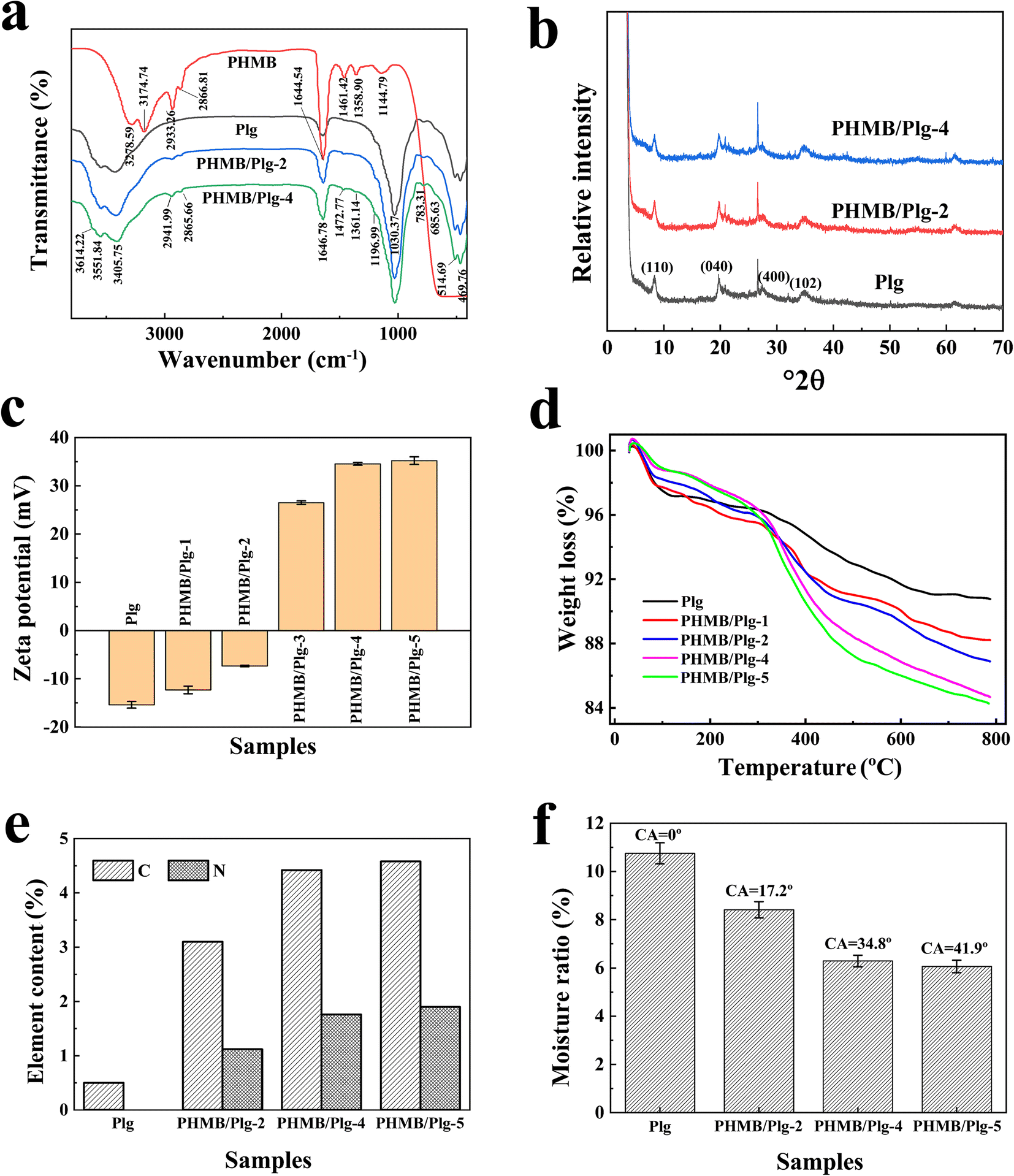
C=N stretching vibrations of guanidine groups were observed at 1644 cm–1, and the C–N stretching vibrations appeared at 1461 and 1358 cm–1, while the stretching vibration peaks of N–H were located at 3278 and 3180 cm–1 (Fig. 2a). The absorption bands at 2934 and 2850 cm–1 were attributed to the symmetric and asymmetric stretching vibration peaks of the C–H bond (–CH2 and –CH3). The main characteristic absorption bands of Plg did not change significantly before and after modification with PHMB, such as stretching vibrations of Al(Mg)–O–H at 3614 cm−1, of octahedral edge crystal water at 3551 cm−1, the antisymmetric stretching vibrations of Si–O–Si at 1196 and 1030 cm−1, the symmetric stretching vibration peak of Si–O–Si at 783 cm−1, the superposition of peaks from Si–O–Mg and Si–O–Al groups at 685 cm−1, the bending vibration of Si–O–Si at 514 cm−1, and the bending vibration peak of O–Si–O at 469 cm−1 (Mu et al. Reference Mu, Kang and Wang2013; de Brito Buriti et al. Reference de Brito Buriti, Barsosa, da Silva Buriti, de Melo Cartaxo, Ferreira and de Araujo Neves Cartaxo2022). However, several new bands from the PHMB/Plg composites appeared, including the C–H bond (−CH2, −CH3) and C–N bond at 2941 and 2865 cm−1, 1472 and 1361 cm−1, respectively (Wang et al. Reference Wang, Liu, Tang and Ma2015; Wang et al. Reference Wang, Chen, Ma, Jin, Chai, Xia, Zhang and Zhang2018). In addition, the absorption peak of the N–H group in PHMB overlapped with the stretching vibration of zeolite water and surface adsorbed water at 3405 cm−1 in Plg, while the stretching vibration of C=N in PHMB overlapped with the bending vibration peak of zeolitic water and surface adsorbed water at 1646 cm−1. With the increase in the PHMB content, the relative intensities of these peaks increased gradually. These results suggested that PHMB was anchored successfully on the surface of Plg through hydrogen bond and electrostatic interaction (Buriti et al. 2021; Zhuang et al. Reference Zhuang, Zhang, Jaber, Gao and Peng2017).
a FTIR spectra of PHMB, Plg, and PHMB/Plg composites. b XRD patterns of Plg and PHMB/Plg composites. c Zeta potential of Plg and PHMB/Plg composites. d TGA curves of Plg and PHMB/Plg composites. e C and N contents of PHMB/Plg composites with amounts of PHMB added. f Moisture adsorption ratio and CAs of Plg and PHMB/Plg composites

XRD Analysis
The XRD patterns revealed peaks at 8.50, 19.90, 27.58, and 34.52°2θ (Fig. 2b) corresponding to the (110), (040), (400), and (102) crystal planes of Plg. The diffraction peaks at 20.83 and 26.59°2θ were characteristic of quartz (Dong et al. Reference Dong, Lu, Wang, Zong, Zhu, Kang and Wang2019). The diffraction peaks of the PHMB/Plg composites were almost the same as for the raw Plg, suggesting that the crystal structure of Plg was largely unchanged by the PHMB modification.
Pore Structural Parameters
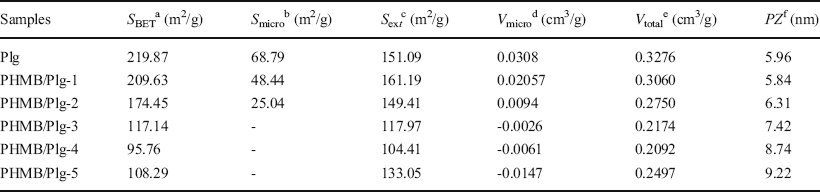
Measurements of the specific surface area and pore-structure parameters of Plg and PHMB/Plg composites (Table 1) found an overall decreasing trend in S BET after treatment with various concentrations of PHMB, especially S micro and V micro. When the ammount of PHMB added was >7.5%, the micropore specific surface area derived from a t-plot disappeared, and it might be ascribed to the coverage of the long alkyl chain, which reduced the adsorption of N2. The pore size increased with added amounts of PHMB, however, which might be due to the long distance between each PHMB molecule on the surface of Plg (Dong et al. Reference Dong, Liu, Wang and Huang2011).
Pore-structure parameters of Plg and PHMB/Plg composites

a BET (Brunauer-Emmett-Teller) surface area
b Mesopore surface area, calculated using BJH method from desorption curve
c Micropore surface area, derived from t-plot method
d Micropore volume
e Total pore volume, measured at P/P 0 = 0.995
f Average pore diameter, calculated according to BET
Zeta Potential Analysis
The zeta potentials (Fig. 2c) of the PHMB/Plg changed from negative to positive values with increasing PHMB dosage. Plg is well known to be negatively charged and thus the cationic PHMB molecules with guanidine groups are adsorbed easily through hydrogen bonding and electrostatic forces, thus reducing the negative charge and even changing the zeta potential from negative to positive as the PHMB loading increased. When the PHMB loading exceeded 10%, the zeta potential remained unchanged, indicating that the PHMB loading on Plg reaches a saturation point or maximum level.
Thermogravimetry (TG) and Elemental Analysis
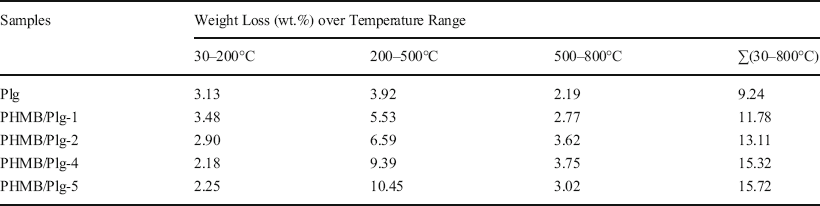
Thermal gravimetric analysis (Fig. 2d) revealed an initial weight loss in Plg between 30 and 200°C due to removal of physically adsorbed water and zeolitic water confined within the nanochannels of Plg. A similar phenomenon was also observed in the PHMB/Plg composites, but the weight loss in this region was much smaller than in the raw Plg (Table 2), suggesting that the Plg surface was covered with PHMB and that the surface changed from hydrophilic to hydrophobic after modification. The weight loss between 200 and 500°C was attributed mainly to the removal of the bound water and coordinated water, and the thermal decomposition of the loaded PHMB. Compared with Plg, the increased weight losses of the PHMB/Plg composites in this region was further evidence for increased PHMB loading. The weight loss from 500 to 800°C was due to the dehydroxylation of structural OH in the Plg and the further decomposition of residual organic matter in PHMB/Plg composites. As expected, the weight loss from the PHMB/Plg composites increased with increasing loading of PHMB.
Weight loss of Plg and the PHMB/Plg composites over various temperature ranges

The increased loading of PHMB was further confirmed by the elemental analysis (Fig. 2e), revealing increases in the C and N contents from 3.1to 4.58% and 1.12 to 1.90%, respectively, as the amount of PHMB increased from 5 to 15%. When the PHMB content was >10 wt.%, the C and N contents increased very slowly, indicating that the loading of PHMB on Plg gradually reached a saturation point.
Surface Hydrophobicity Analysis
Many studies have confirmed that organically modified clays or clay minerals could improve the adsorption capacity for ZEN because the organic modification increased the surface hydrophobicity (Spasojevic et al. Reference Spasojevic, Dakovic, Rottinghaus, Obradovic, Krajisnik, Markovic and Krstic2021; Sun et al. Reference Sun, Lian, Li and Zheng2020). The change in MAR values of PHMB/Plg (Fig. 2f) with increasing PHMB resulted in less moisture adsorption, indicating that the hydrophobicity of Plg was enhanced. The less polar surface was beneficial for capturing non-polar ZEN molecules through hydrophobic interactions, thereby enhancing the adsorption capacity toward ZEN (Zhang et al. Reference Zhang, Zhang, Wang, Dong, Cheng, Xu and Shan2019). The hydrophobicity of the modified samples was also confirmed by contact-angle measurements. Water droplets were adsorbed immediately after being dripped on pure Plg due to the high hydrophilicity. The CA values of PHMB/Plg composites increased with increasing PHMB content, which indicated that the wettability of Plg with water decreased and the surface hydrophobicity increased after PHMB modification. However, the CA values of PHMB/Plg composites were still lower than 50°. This phenomenon was ascribed to the strong hydrophilicity of PHMB; part of hydrophilic groups with positive charge took part in the interaction with the Si–OH of Plg in the modification process, but the remainder was still exposed to the outside.
Adsorption Properties of PHMB/Plg Composites
Effect of PHMB Content
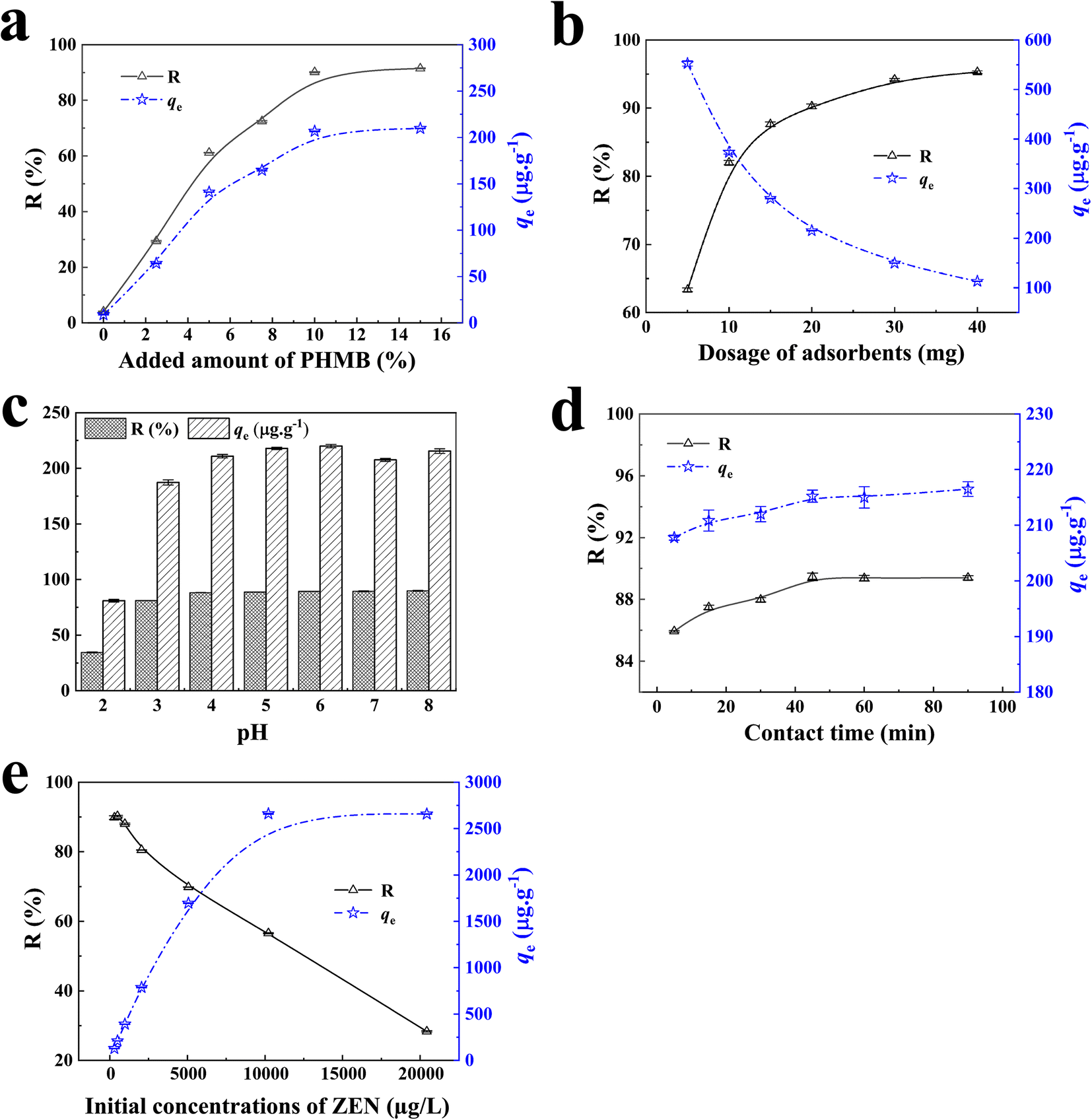
The amount of PHMB loaded was an important factor affecting the adsorption capacity of the composite adsorbents toward ZEN, which was directly related to the amount of PHMB added (Fig. 3a) and is probably attributable to the increase in surface hydrophobicity as the amount of PHMB increased. The sequestration of hydrophobic ZEN was enhanced due to the principle of polar similar solubility. When the amount of PHMB added surpassed 10%, however, the removal capacity scarcely changed. Sample PHMB/Plg-4 was chosen, therefore, as the sample with which to study the relevant adsorption conditions.
a Effect of PHMB content on the amount of ZEN adsorbed (C 0 = 467.82 μg/L, V = 10 mL, m = 20 mg, t = 60 min, T = 37°C, pH = 6 ). b Effect of adsorbent dosage on the adsorption of ZEN (C 0 = 482.52 μg/L, V = 10 mL, t = 60 min, T = 37°C, pH = 6). c Effect of pH on the adsorption of ZEN (C 0 = 497.48 μg/L, m = 20 mg, V = 10 mL, T = 37°C, t = 60 min). d Effect of contact time on the adsorption of ZEN on PHMB/Plg-4 (C 0 = 489.20 μg/L, m = 20 mg, V = 10 mL, T = 37°C, pH = 6). e Effect of various initial concentrations of ZEN on the adsorption of ZEN on PHMB/Plg-4 (m = 20 mg, V = 10 mL, T = 37°C, t = 60 min, pH = 6)

Effect of Adsorbent Dosage
The removal ratio (R) of PHMB/Plg composites toward ZEN increased gradually with increase in the dosage of composite used (Fig. 3b). This was due to the increase in the number of active adsorption sites for ZEN with the amount of composite added. When the dosage of the composite increased from 5 to 40 mg, the value of R increased from 63.36 to 95.28%; when the dosage exceeded 20 mg, the removal ratio increased slightly. It indicated that the adsorbed amount of ZEN on the surface of the composite reached a dynamic equilibrium with the concentration of ZEN in the solution, adsorption equilibrium was achieved, and thus the optimal dosage of composite was 20 mg.
Effect of pH
In order to simulate the acid-base environment of an animal’s gastrointestinal tract, a pH of ~2–8 was selected for the adsorption experiment. As illustrated in Fig. 3c, the removal ratio of composite adsorbents to ZEN increased rapidly when the pH increased from 2 to 4, and then the removal ratio of ZEN hardly changed as the pH exceeded 5, indicating that the hydrophobic effect of PHMB modification might be more important than the charge change (Fig. 2c). This behavior was also consistent with the results of a previous study (Feng et al. Reference Feng, Mei, Du, Han and Xu2008); the hydrophobic property of composite adsorbents was mainly responsible for the specific adsorption of ZEN..
Effect of Contact Time and Adsorption Kinetics
The effect of contact time on the adsorption capacity of the composites for ZEN (Fig. 3d) revealed that when the contact time was <5 min the removal ratio reached 85.94%, then it increased to 89.37% as the contact time increased to 45 min, and finally almost no obvious change occurred by 90 min. From these observations, one may infer that a large adsorption affinity existed between the composite and the ZEN, and thus the composite could quickly interact with ZEN molecules in a short time to achieve the adsorption equilibrium (Hachemaoui et al. Reference Hachemaoui, Boukoussa, Mokhtar, Me Kki, Beldjilali, Benaissa, Zaoui, Hakiki, Chaibi, Sassi and Hamacha2020).
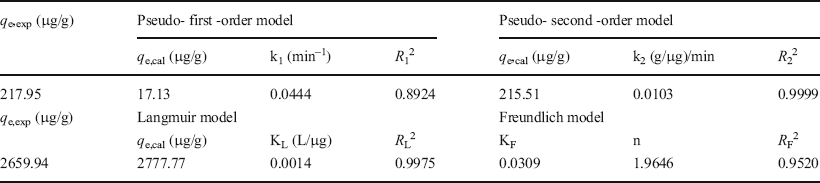
In addition, the experimental data were fitted using pseudo-first order (Eq. 4) and pseudo-second order (Eq. 5) kinetics, to see if these could provide a mechanism for the adsorption of ZEN on PHMB/Plg composites.


where q e (μg/g) and q t (μg/g) denote the amounts of ZEN adsorbed on the PHMB/Plg composites at equilibrium and time t (min), respectively; k1 (min–1) and k2 ((g/μg)/min) are the rate constants for the pseudo-first order and pseudo-second order adsorption equations, respectively. The correlation coefficients (R) and the rate constants (k1 and k2) obtained from the plot of experiment data are listed in Table 3.
Parameters from adsorption kinetics, Langmuir and Freundlich constants, and correlation coefficients associated with adsorption isotherms of Plg and PHMB/Plg composites

The R 2 2 value of the pseudo-second order kinetics model was 0.9999, and the calculated values for q e (denoted q e,cal) were closer to the experimental values (denoted q e,exp) than they were in the pseudo-first order kinetics model, indicating that the pseudo-second order model could well describe the removal of ZEN by PHMB/Plg composites, and thus the major adsorption mechanism would appear to be chemisorption (Zhang et al. Reference Zhang, Zhang, Wang, Dong, Cheng, Xu and Shan2019).
Effect of Initial Concentration and Adsorption Isotherms
Generally, the adsorption performance of the adsorbent depends on the initial concentration of the adsorbed substance solution. Figure 3e exhibits the effect of different initial concentrations on the adsorption capacity of PHMB/Plg composites for ZEN. The initial concentration of ZEN solution played an important role in the adsorption process. With the increase in solution concentration, the adsorption capacity of PHMB/Plg composites for ZEN increased gradually. This was due to the fact that a greater concentration of the solution produces a greater driving force for adsorption. Furthermore, the adsorption gradually tended to equilibrium as the adsorption sites were occupied by ZEN molecules.
Langmuir (Eq. 6) and Freundlich (Eq. 7) adsorption models were used to fit the equilibrium adsorption experimental data. The Langmuir model assumed that the adsorbent presented a homogeneous structure, where all adsorption sites are equivalent.

where q e represents the equilibrium adsorption capacity of ZEN on PHMG/Plg composites (μg/g), C e denotes the equilibrium ZEN concentration (μg/L), q max and b are the monolayer adsorption capacity of the adsorbent and Langmuir adsorption constant (L/μg), respectively.
The Freundlich empirical model removes the homogeneity of sites constraint, thus allowing for heterogeneous systems to be described by a factor of 1/n under reversible adsorption conditions.

where q e represents the amount of ZEN adsorbed at equilibrium (μg/g), C e is the final ZEN concentration at equilibrium (μg/L), K is the Freundlich isotherm constant (L/μg), and 1/n is the heterogeneity factor. The Langmuir and Freundlich parameters obtained from the plot of the experimental data are listed in Table 3. The correlation coefficient R 2 obtained from the Langmuir model was greater than that of Freundlich, and the theoretical maximum adsorption capacity closely followed the actual experimental value. These observations indicate that the removal of ZEN by PHMB/Plg composites was more in line with the Langmuir than the Freundlich model, and thus a monoloayer of ZEN may have formed on the PHMB/Plg composites, and the maximum adsorption capacity was 2777 μg/g. This conclusion was consistent with the conclusions of Sun et al. (Reference Sun, Song, Wang, Wang and Zheng2018) and Li et al. (Reference Li, Zeng, Zhou, Wang and Zhang2014).
The adsorption performance of the adsorbents in the present study was compared with the relevant clay mineral-based adsorbents described in the literature (Table S1). PHMB/Plg composites exhibited a much better performance than polyvinylpyrrolidone, cholestyramine, and raw silicate minerals, but the adsorption capacity was less than that of silicate minerals modified by traditional surfactants. This may be due to the relatively small cation exchange capacity (CEC) of Plg (10.49 meq/100 g) compared with rectorite and montmorillonite at 46.36 and ~68.29–104 meq/100 g, respectively. The smaller adsorption capacity may also be due, in part, to the small amount of organic matter naturally present in Plg.
Antibacterial Performance of PHMB/Plg Composites
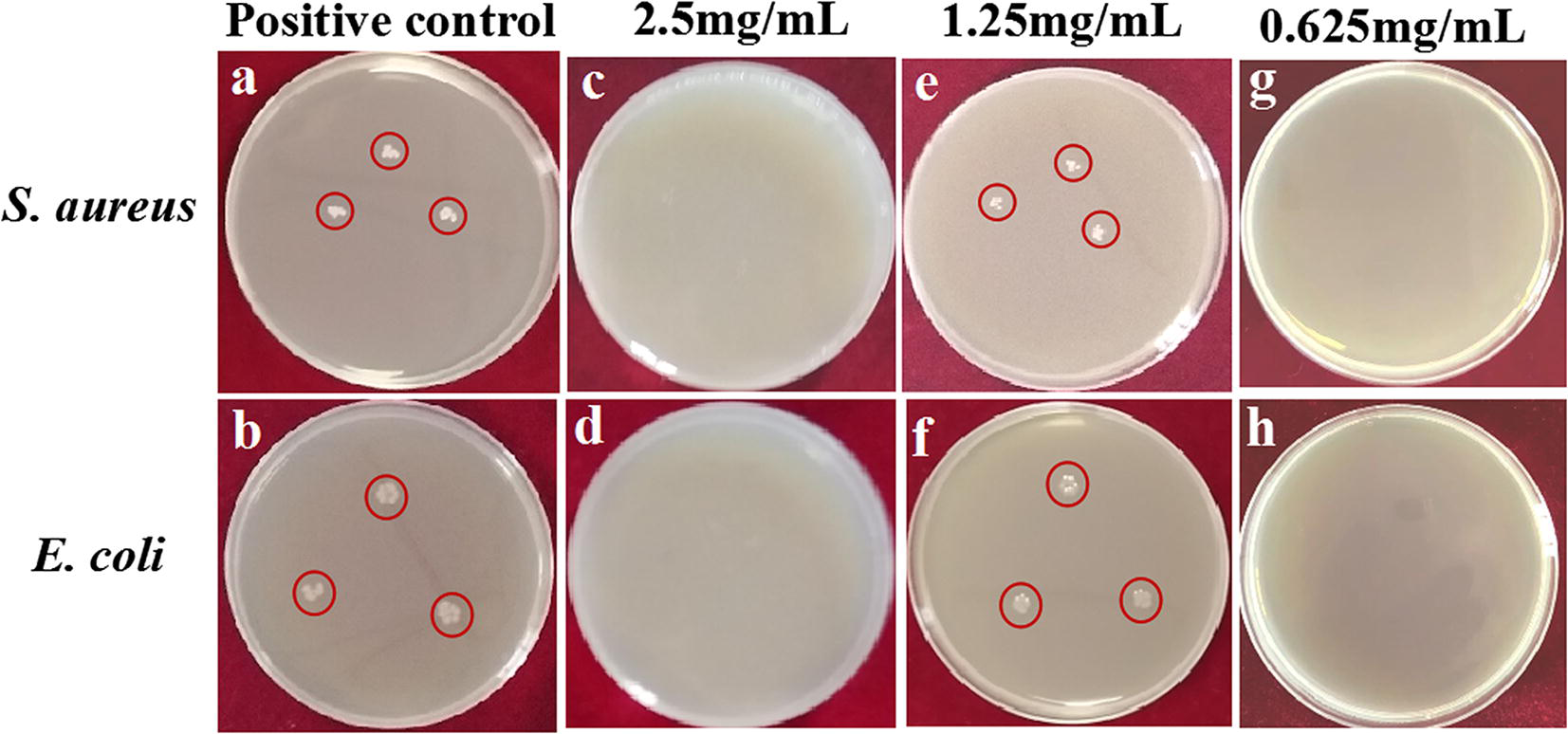
PHMB was a kind of cationic antibacterial polymer containing guanidine groups in the main chain. It could be adsorbed on the negatively charged microbial cell membrane, leading to the leakage of K+ and other components within the cytoplasmic fluid, and then destroyed the cell membrane (Dilamian et al. Reference Dilamian, Montazer and Masoumi2013). In order to evaluate the antibacterial properties of PHMB/Plg composites, E. coli and S. aureus were selected as model strains for detection. The MIC values of Plg, PHMB, and PHMB/Plg composites are listed in Table S2 and Fig. 4. Plg had no obvious antibacterial activity against E. coli or S. aureus in a previous study (Hui et al. Reference Hui, Dong, Kang, Zhou and Wang2019), and the MIC values of Plg against E. coli and S. aureus were >50 mg/mL. On the contrary, PHMB displayed excellent antibacterial properties, and the MIC values of PHMB against E. coli and S. aureus were <0.625 mg/mL. The surfaces of both E. coli and S. aureus were negatively charged, which could be adsorbed onto the antibacterial materials with positively charged surfaces through electrostatic interaction (Hui et al. Reference Hui, Yan, Wang, Wang and Wang2020). The antibacterial activity of the PHMB/Plg composites clearly depended heavily on the loading amount of PHMB on Plg. When the amount of PHMB added was >15%, the composite exhibited good antibacterial properties, and the MIC values of E. coli and S. aureus were both at 2.5 mg/mL. The possible antibacterial mechanism of the composites was ascribed mainly to the contact between bacteria and modified Plg (Hui et al. Reference Hui, Yan, Wang, Wang and Wang2020). When the amount of PHMB added was small, the guanidine group on the PHMB bonded with hydroxyl groups on the surface of Plg through hydrogen bonding and electrostatic action. As the amount of PHMB added increased gradually, some of the guanidine groups on the PHMB could be free, allowing the PHMB/Plg composites with high PHMB loading to display a high positive charge. The bacteria could then be adsorbed on the surface of PHMB/Plg composites via electrostatic interaction, thus restricting the bacterial motion. The PHMB/Plg adsorbents, therefore, may be promising candidates as feed additives for animal breeding due to the good adsorption properties for ZEN and antibacterial activity against E. coli and S. aureus.
a and b Positive control of S. aureus and E. coli; c and e S. aureus treated with PHMB/Plg-5 at the concentrations of 2.5 mg/mL and 1.25 mg/mL, respectively; d and f E. coli treated with PHMB/Plg-5 at the concentrations of 2.5 mg/mL and 1.25 mg/mL, respectively; g and h S. aureus and E. coli treated with PHMB at the concentrations of 0.625 mg/mL, respectively.

Conclusions
Novel ZEN adsorbents of PHMB/Plg composites with antibacterial properties were prepared successfully with PHMB as the non-toxic organic modifier. After PHMB modification, the dispersion of Plg crystal bundles and the hydrophobicity of Plg were improved. These improvements enhanced the adsorption capacity of PHMB/Plg composites for ZEN. With the increase in loading content of PHMB and pH, the adsorption capacity of composites for ZEN increased, and the adsorption could reach equilibrium within 45 min. The adsorption process was modeled best by pseudo-second order kinetics and by the Langmuir adsorption model. The maximum adsorption capacity was ~2777 μg/g. Furthermore, the PHMB/Plg composites exhibited a certain antibacterial effect when the amount of PHMB added increased to 15%, and the MIC value against S. aureus and E. coli was 2.5 mg/mL.
Supplementary Information
The online version contains supplementary material available at https://doi.org/10.1007/s42860-022-00175-8.
Acknowledgments
This work was supported by the Regional Key Project of the Science and Technology Service of the Chinese Academy of Sciences (KFJ-STS-QYZX-086) and the Major Projects of the Natural Science Foundation of Gansu, China (18JR4RA001).
Funding
Funding sources are as stated in the Acknowledgments.
Declarations
Conflict of Interest
The authors declare that they have no conflict of interest.