1. Introduction
The Himalayan–Tibetan orogen is the largest and highest continental collisional orogenic belt on Earth (Yin & Harrison, Reference Yin and Harrison2000), with the thickest continental crust (60–80 km) (Zhao et al. Reference Zhao, Mechie, Brown, Guo, Haines, Hearn, Klemperer, Ma, Meissner, Nelson, Ni, Pananont, Rapine, Ross and Saul2001; Kind et al. Reference Kind, Yuan, Saul, Nelson, Sobolev, Mechie, Zhao, Kosarev, Ni, Achauer and Jiang2002). It has a profound influence on Asian monsoon development and global climate change (Harris, Reference Harris2006; Dupont-Nivet et al. Reference Dupont-Nivet, Krijgsman, Langereis, Abels, Dai and Fang2007). The timing of crustal thickening and plateau uplift, however, is still controversial, with estimates ranging from the Late Cretaceous to the Miocene (e.g. Volkmer et al. Reference Volkmer, Kapp, Guynn and Lai2007; Chung et al. Reference Chung, Chu, Ji, O’Reilly, Pearson, Liu, Lee and Lo2009; Ji et al. Reference Ji, Wu, Liu and Chung2012a ; Li et al. Reference Li, Wang, Dai, Xu, Hou and Li2015; Ding et al. Reference Ding, Spicer, Yang, Xu, Cai, Li, Lai, Wang, Spicer, Yue, Shukla, Srivastava, Khan, Bera and Mehrotra2017; Zhu et al. Reference Zhu, Wang, Cawood, Zhao and Mo2017). Additionally, two main thickening mechanisms, namely tectonic shortening and magmatic underplating, have been proposed, but their relative contributions remain debated (e.g. Kapp et al. Reference Kapp, DeCelles, Leier, Fabijanic, He, Pullen, Gehrels and Ding2007; Mo et al. Reference Mo, Hou, Niu, Dong, Qu, Zhao and Yang2007; Volkmer et al. Reference Volkmer, Kapp, Guynn and Lai2007; Ji et al. Reference Ji, Wu, Liu and Chung2012a ; Wang et al. Reference Wang, Dai, Zhao, Li, Graham, He, Ran and Meng2014; Li et al. Reference Li, Wang, Dai, Xu, Hou and Li2015; Zhu et al. Reference Zhu, Wang, Cawood, Zhao and Mo2017; Zhou et al. Reference Zhou, Wang, Hou, Li, Zhao, Li and Qu2018).
Adakites, characterized by high La/Yb and Sr/Y ratios, were originally defined as the products of partial melting of young subducted oceanic slab (Defant & Drummond Reference Defant and Drummond1990). However, subsequent researches proposed that adakitic rocks can also be generated both in magmatic arcs and collisional orogens where the crust is thickened (Atherton & Petford Reference Atherton and Petford1993; Chung et al. Reference Chung, Liu, Ji, Chu, Lee, Wen, Lo, Lee, Qian and Zhang2003; Hou et al. Reference Hou, Gao, Qu, Rui and Mo2004). Since the La/Yb and Sr/Y ratios of young intermediate-felsic rocks correlate well with the modern crustal thickness at regional to global scales, they are widely used to quantify crustal thickness changes over geological time (Chapman et al. Reference Chapman, Ducea, DeCelles and Profeta2015; Chiaradia Reference Chiaradia2015; Hu et al. Reference Hu, Ducea, Liu and Chapman2017).
The Gangdese belt is located in the southern part of the Himalayan–Tibetan orogen. As the convergent zone of Indian and Asian plates, it is an ideal place to study the crustal thickening process related to continental collision. The La/Yb ratios of magmatic rocks suggest that the Gangdese belt experienced significant crustal thickening in the Eocene, which is generally attributed to the underplating of juvenile mantle-derived magmas (Mo et al. Reference Mo, Hou, Niu, Dong, Qu, Zhao and Yang2007; Guan et al. Reference Guan, Zhu, Zhao, Dong, Zhang, Li, Liu, Mo, Liu and Yuan2012; Ji et al. Reference Ji, Wu, Liu and Chung2012a ; Zhu et al. Reference Zhu, Wang, Cawood, Zhao and Mo2017; Zhou et al. Reference Zhou, Wang, Hou, Li, Zhao, Li and Qu2018). However, previous studies have mostly focused on the magmatic records in the eastern Gangdese belt (east of 87° E), but rarely on the western segment (west of 87° E). Zircon Hf isotope mapping revealed a disparity in crustal composition between the eastern and western segments (Hou et al. Reference Hou, Duan, Lu, Zheng, Zhu, Yang, Yang, Wang, Pei and Zhao2015a), which implies that the two regions underwent diverse tectonic–magmatic evolutionary histories. Therefore, it is necessary to carry out a further investigation on the timing and mechanism of crustal thickening of the western Gangdese belt.
In this study, we present whole-rock elemental and Sr–Nd isotopic data, zircon U–Pb ages and Hf isotopic data for the Eocene Wangdui adakitic pluton in the western Gangdese belt. These, combined with previously published data, provide new constraints on the petrogenesis and source nature of Eocene adakitic rocks in the Gangdese belt. Ultimately, these data are conducive to gaining a better understanding of the crustal thickening process associated with the India–Asia continental collision.
2. Geological background and sample descriptions
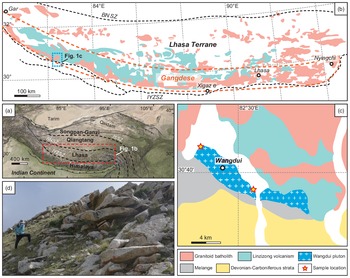
The Tibetan Plateau is composed of four east–west-trending terranes: from north to south, they are Songpan–Ganzi, Qiangtang, Lhasa and Himalaya (Fig. 1a). These terranes are separated by the Jinsha, Bangong–Nujiang and Indus–Yarlung Zangbo suture zones, respectively, all of which represent the remnants of the Tethyan ocean (Yin & Harrison Reference Yin and Harrison2000). The Lhasa terrane, the southernmost tectonic unit of the Asian continent, was detached from Gondwana prior to the Triassic and then drifted northward across the Tethyan ocean until its collision with the Qiangtang terrane in the Early Cretaceous (Yin & Harrison Reference Yin and Harrison2000; Zhu et al. Reference Zhu, Zhao, Niu, Mo, Chung, Hou, Wang and Wu2011; Wang et al. Reference Wang, Ding, Zhang, Kapp, Pullen and Yue2016).
(a) Tectonic framework of the Tibetan Plateau (modified from Li et al. Reference Li, Wang, Dai, Xu, Hou and Li2015; the topographic base is from https://www.gebco.net). (b) Simplified geological map of Lhasa terrane, showing the location of the Gangdese belt (modified from Zheng et al. Reference Zheng, Liu, Wu, Griffin, Li, Xu, Yang, Hou and O’Reilly2019). (c) Geological sketch map of the Wangdui pluton at the southern margin of the Lhasa terrane. (d) Field photograph of the Wangdui pluton. Abbreviations: BNSZ = Bangong–Nujiang suture zones; IYZSZ = Indus–Yarlung Zangbo suture zones; JSSZ = Jinsha suture zones.

The Gangdese belt is a huge tectonic–magmatic unit, which extends nearly east–west for more than 2000 km at the southern margin of the Lhasa terrane (Fig. 1b). Attributed to the subduction of Neo-Tethyan oceanic slab during the Triassic–Cretaceous and the subsequent continental collision between the Indian and Asian plates since c. 55–50 Ma, extensive Mesozoic–Cenozoic magmatism developed along the Gangdese belt, manifested as widespread volcanic rocks and the voluminous Gangdese batholith (Ji et al. Reference Ji, Wu, Chung, Li and Liu2009; Zhu et al. Reference Zhu, Zhao, Niu, Mo, Chung, Hou, Wang and Wu2011, Reference Zhu, Wang, Zhao, Chung, Cawood, Niu, Liu, Wu and Mo2015, Reference Zhu, Wang, Chung, Cawood and Zhao2018; Hou et al. Reference Hou, Duan, Lu, Zheng, Zhu, Yang, Yang, Wang, Pei and Zhao2015a ; Wang et al. Reference Wang, Ding, Zhang, Kapp, Pullen and Yue2016). The volcanic rocks are dominated by the Paleocene–Eocene Linzizong volcanic succession, with minor Triassic–Cretaceous volcano-sedimentary rocks and Oligocene–Miocene potassic–ultrapotassic volcanic rocks (e.g. Mo et al. Reference Mo, Niu, Dong, Zhao, Hou, Zhou and Ke2008; Zhao et al. Reference Zhao, Mo, Dilek, Niu, DePaolo, Robinson, Zhu, Sun, Dong, Zhou, Luo and Hou2009; Kang et al. Reference Kang, Xu, Wilde, Feng, Chen, Wang, Fu and Pan2014; Wang et al. Reference Wang, Ding, Zhang, Kapp, Pullen and Yue2016; Wei et al. Reference Wei, Zhao, Niu, Zhu, Liu, Wang, Hou, Mo and Wei2017). The Gangdese batholith was developed between the Triassic and Miocene (c. 210–10 Ma), with four activity peaks at 205–152 Ma, 109–80 Ma, 65–41 Ma and 33–13 Ma (e.g. Ji et al. Reference Ji, Wu, Chung, Li and Liu2009; Hou et al. Reference Hou, Duan, Lu, Zheng, Zhu, Yang, Yang, Wang, Pei and Zhao2015a ; Zhu et al. Reference Zhu, Wang, Chung, Cawood and Zhao2018). The Mesozoic pre-collisional volcanic rocks and intrusions are mainly located in the eastern part of the Gangdese belt (e.g. Zheng et al. Reference Zheng, Hou, Gong, Liang, Sun, Zhang, Fu, Huang, Li and Li2014; Xu et al. Reference Xu, Zhang, Luo, Guo and Yang2015; Wang et al. Reference Wang, Ding, Zhang, Kapp, Pullen and Yue2016; Wei et al. Reference Wei, Zhao, Niu, Zhu, Liu, Wang, Hou, Mo and Wei2017; Wu et al. Reference Wu, Zheng, Xu and Hou2018), while the Cenozoic syn- to post-collisional magmatism is widely distributed along the entire belt extending from Nyingchi in the east to Gar in the west (e.g. Mo et al. Reference Mo, Niu, Dong, Zhao, Hou, Zhou and Ke2008; Zhao et al. Reference Zhao, Mo, Dilek, Niu, DePaolo, Robinson, Zhu, Sun, Dong, Zhou, Luo and Hou2009; Hou et al. Reference Hou, Zheng, Yang, Rui, Zhao, Jiang, Qu and Sun2013; Q Wang et al. Reference Wang, Zhu, Cawood, Zhao, Liu, Chung, Zhang, Liu, Zheng and Dai2015; R Wang et al. Reference Wang, Richards, Hou, An and Creaser2015; Zheng et al. Reference Zheng, Wu, Tian, Hou, Fu and Zhu2020).
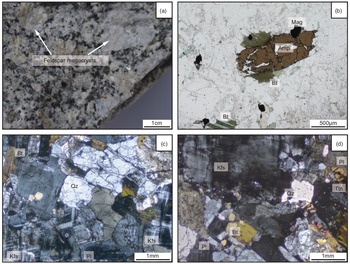
The Wangdui pluton is located in the western part of the Gangdese batholith (c. 85 km east of Hor) and intruded into the Linzizong Formation (Fig. 1c, d). This pluton consists of medium- to coarse-grained monzogranites, which show porphyritic textures and contain megacrysts of plagioclase and K-feldspar. Mafic enclaves associated with pluton were not observed during the field studies. The minerals in the porphyritic monzogranites include K-feldspar (30–35 %), plagioclase (25–30 %), quartz (15–20 %), biotite (10–15 %), amphibole (c. 5 %) and minor accessory phases (zircon, apatite, titanite and magnetite) (Fig. 2). K-feldspar generally is subhedral, with locally developed cross-hatched twinning. Plagioclase commonly exhibits oscillatory zoning and Carlsbad-albite compound twinning. Sub- to anhedral biotite shows strong pleochroism and occasionally appears as mineral aggregates. Amphibole is dark green to brown in colour and prismatic in shape.
(a) Hand specimen photo, and (b–d) photomicrographs of the Wangdui porphyritic monzogranites, southern Tibet. Abbreviations: Amp = amphibole; Bt = biotite; Kfs = K-feldspar; Mag = magnetite; Pl = plagioclase; Qz = quartz; Ttn = titanite.

3. Analytical methods
The analytical methods are presented in Supplementary Text S1 (available online at https://doi.org/10.1017/S0016756822000206), and more detailed descriptions can be found in Andersen (Reference Andersen2002), Ludwig (Reference Ludwig2003), Griffin et al. (Reference Griffin, Powell, Pearson and O’Reilly2008) and Song et al. (Reference Song, Niu, Wei, Ji and Su2010) for U–Pb dating; in Blichert-Toft & Albarède (Reference Blichert-Toft and Albarède1997), Söderlund et al. (Reference Söderlund, Patchett, Vervoort and Isachsen2004) and Wu et al. (Reference Wu, Yang, Xie, Yang and Xu2006) for zircon Hf isotopes; and in Chen et al. (Reference Chen, Hua, Zhang, Lu and Fan2002) and Gou et al. (Reference Gou, Zhang, Tao and Du2012) for whole-rock geochemical analyses.
4. Results
4.a. Zircon U–Pb ages and Hf isotopes
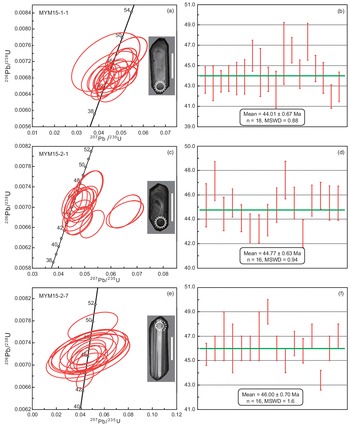
Zircons from three porphyritic monzogranite samples (MYM15-1-1, MYM15-2-1, MYM15-2-7) were selected for U–Pb dating and Hf isotopic analyses. All the results of zircon U–Pb dating are provided in Table S1 (in the Supplementary Material available online at https://doi.org/10.1017/S0016756822000206) and are presented in concordia diagrams with 1σ errors in Fig. 3. The zircon Hf isotopic data and detailed calculation formulas are listed in Table 1.
CL images for representative zircon grains and U–Pb concordia diagrams for the Wangdui pluton, southern Tibet. Solid and dashed circles indicate the locations of laser ablation interactively coupled plasma mass spectrometry (LA-ICP-MS) U–Pb dating analyses and multi-collector LA-MC-ICP-MS Hf isotopic analyses, respectively. The scale bar length in the CL image is 100 μm.

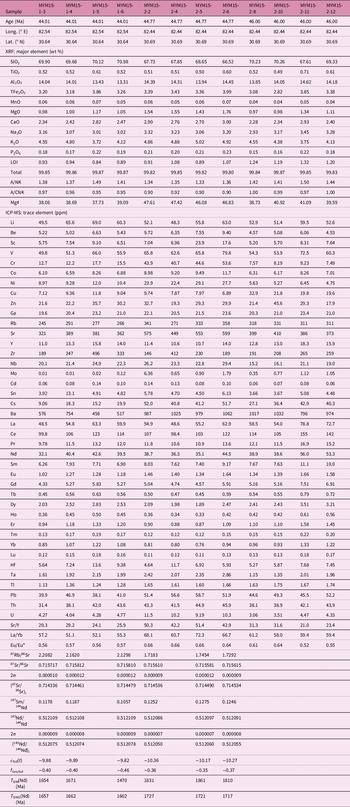
Zircon Hf isotopic data for the Wangdui pluton, southern Tibet

Notes: ϵ Hf(t) = 10000 × {[(176Hf/177Hf)S – (176Lu/177Hf)S × (eλt – 1)]/[(176Hf/177Hf)CHUR,0 – (176Lu/177Hf)CHUR × (eλt – 1)] – 1}.
T DM(Hf) = 1/λ × ln{1 + [(176Hf/177Hf)S – (176Hf/177Hf)DM]/[(176Lu/177Hf)S – (176Lu/177Hf)DM]}.
T DM C(Hf) = 1/λ × ln{1 + [(176Hf/177Hf)S, t – (176Hf/177Hf)DM, t ]/[(176Lu/177Hf)C – (176Lu/177Hf)DM]} + t.
f Lu/Hf = (176Lu/177Hf)S/(176Lu/177Hf)CHUR – 1.
(176Lu/177Hf)CHUR = 0.0332 and (176Hf/177Hf)CHUR,0 = 0.282772 (Blichert-Toft & Albarède, Reference Blichert-Toft and Albarède1997); (176Lu/177Hf)DM = 0.0384 and (176Hf/177Hf)DM = 0.28325 (Griffin et al. Reference Griffin, Pearson, Belousova, Jackson, van Achterbergh, O’Reilly and Shee2000); λ = 1.867 × 10⁻¹¹ year−1 (Söderlund et al. Reference Söderlund, Patchett, Vervoort and Isachsen2004); (176Lu/177Hf)C = 0.015, t = crystallization age of zircon.
The zircons from studied samples are mostly euhedral to subhedral, with crystal lengths of c. 80–350 μm, exhibiting oscillatory or planar zoning in cathodoluminescence (CL) images (Fig. 3). In addition, they have variable contents of Th (148–2377 ppm) and U (205–2028 ppm), with Th/U varying from 0.19 to 1.84. These features indicate that the analysed zircons are all of magmatic origin (Hoskin & Schaltegger, Reference Hoskin and Schaltegger2003). Thus, the measured zircon U–Pb ages represent the timing of zircon crystallization and thus the emplacement age of the host granitoids. Eighteen analyses of zircons from sample MYM15-1-1 yield 206Pb/238U ages ranging from 47.3 to 42.0 Ma, with a weighted mean 206Pb/238U age of 44.01 ± 0.67 Ma (MSWD = 0.88). Zircons from sample MYM15-2-1 yield 206Pb/238U ages ranging from 47.2 to 42.8 Ma for 16 analyses, which have a weighted mean 206Pb/238U age of 44.77 ± 0.63 Ma (MSWD = 0.94). The analyses of 16 zircons from sample MYM15-2-7 yield 206Pb/238U ages ranging from 49.0 to 43.4 Ma, with a weighted mean 206Pb/238U age of 46.00 ± 0.70 Ma (MSWD = 1.60).
A total of 45 zircons from three samples were analysed for 176Hf/177Hf isotopic ratios. Except for one zircon grain yielding a positive zircon ϵ Hf(t) value (+0.4), the remaining 15 analyses from sample MYM15-1-1 yield 176Hf/177Hf ratios of 0.282350 to 0.282420 and ϵ Hf(t) values of −14.0 to −11.5, with model ages calculated relative to the depleted mantle (T DM(Hf)) ranging from 1.26 to 1.16 Ga and the crustal model ages (T DM C(Hf)) ranging from 2.01 to 1.85 Ga. Fourteen Hf analyses from sample MYM15-2-1 have 176Hf/177Hf ratios of 0.282370 to 0.282515, with negative ϵ Hf(t) values ranging from −13.2 to −8.1. Their T DM(Hf) ages and T DM C(Hf) ages range from 1.22 to 1.04 Ga and 1.96 to 1.64 Ga, respectively. Fifteen analyses of zircons from sample MYM15-2-7 show 176Hf/177Hf ratios ranging from 0.282244 to 0.282509, corresponding to ϵ Hf(t) values of −17.7 to −8.3. They have T DM(Hf) ages of 1.43 to 1.07 Ga and T DM C(Hf) ages of 2.24 to 1.65 Ga.
4.b. Whole-rock geochemistry
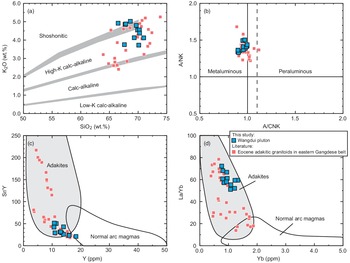
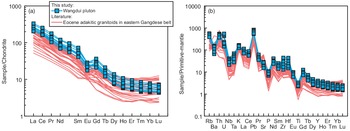
Whole-rock elemental and isotopic data are presented in Table 2. The Wangdui porphyritic monzogranites exhibit relatively limited variation in elemental composition (Figs 4–7). They belong to high-K calc-alkaline to shoshonitic series, with high SiO2 contents of 66.52 to 70.98 wt % and K2O contents of 3.72 to 5.02 wt % (Fig. 4a). The aluminium saturation index (A/CNK = Al2O3/(CaO + Na2O + K2O), molar ratios) values range from 0.90 to 1.00, showing a metaluminous feature (Fig. 4b). In particular, they are characterized by low MgO contents of 0.97 to 1.76 wt % and Mg# values of 38 to 48, with low compatible elements contents (e.g. Cr, 7.49–53.6 ppm; Ni, 4.75–29.1 ppm). In the chondrite-normalized rare earth element (REE) patterns, the porphyritic monzogranites show negative Eu anomalies (Eu/Eu* = 0.52–0.66) and fractionated REE patterns with enrichment of light REEs (LREEs) (Fig. 5a). The high La/Yb ratios of 51.1 to 72.3, low heavy REEs (HREEs) contents (e.g. Yb, 0.76–1.33 ppm) and Y contents of 10.6 to 18.3 ppm, together with high Sr contents of 321 to 599 ppm and Sr/Y ratios of 21.0 to 51.4, indicate that the samples have geochemical affinities with adakites (Fig. 4c, d). In addition, these samples show enrichments in large-ion lithophile elements (LILEs; e.g. Rb, K and Pb) and depletions in high-field-strength elements (HFSEs; e.g. Nb, Ta and Ti) in the primitive-mantle-normalized incompatible element patterns (Fig. 5b).
Whole-rock major, trace element and Sr–Nd isotopic data for the Wangdui pluton

Notes: TFe2O3 = Total iron measured as Fe2O3.
LOI = loss on ignition.
A/NK = Al2O3/(Na2O + K2O) (molar ratio).
A/CNK = Al2O3/(CaO + Na2O + K2O) (molar ratio).
Mg# = 100 × Mg2+/(Mg2+ + Fe2+).
Eu/Eu* = 2 × Eun/(Smn + Gdn).
(87Sr/86Sr)i = (87Sr/86Sr)s – (87Rb/86Sr) × (eλT – 1), λRb-Sr = 1.42 × 10⁻¹¹ year−1, 87Rb/86Sr = (Rb/Sr) × 2.8956.
ϵ Nd(t) = [(143Nd/144Nd)i/(143Nd/144Nd)CHUR(t) – 1] × 10000, (143Nd/144Nd)i = (143Nd/144Nd)s – (147Sm/144Nd) × (eλT – 1), (143Nd/144Nd)CHUR(t) = 0.512638 – 0.1967 × (eλT – 1), λSm-Nd = 6.54 × 10⁻¹² year−1, 147Sm/144Nd = (Sm/Nd) × 0.60456.
T DM = 1/λSm–Nd × ln{1 + [((143Nd/144Nd)s – 0.51315)/((147Sm/144Nd)s – 0.21357)]}.
T DM2 is the two-stage Nd depleted-mantle model age calculated using the same assumption formulation as Keto and Jacobsen (Reference Keto and Jacobsen1987).
(a) K2O vs SiO2 (Peccerillo & Taylor, Reference Peccerillo and Taylor1976), (b) A/NK [Al2O3/(Na2O + K2O)] vs A/CNK [Al2O3/(CaO + Na2O + K2O)], (c) Sr/Y vs Y and (d) La/Yb vs Yb plots for the Wangdui pluton. The fields of adakites and normal arc magmas are from Defant & Drummond (Reference Defant and Drummond1990) and Sun et al. (Reference Sun, Ling, Chung, Ding, Yang, Liang, Fan, Goldfarb and Yin2012). Data for Eocene adakitic granitoids in the eastern Gangdese belt are from Guan et al. (Reference Guan, Zhu, Zhao, Dong, Zhang, Li, Liu, Mo, Liu and Yuan2012), Ji et al. (Reference Ji, Wu, Liu and Chung2012a), Ma et al. (Reference Ma, Wang, Jiang, Wang, Li, Wyman, Zhao, Yang, Gou and Guo2014) and our unpublished data.

(a) Chondrite-normalized REE patterns, and (b) primitive-mantle-normalized trace element patterns for the Wangdui pluton. Chondrite and primitive-mantle-normalizing values are from Sun & McDonough (Reference Sun and McDonough1989). Data for Eocene adakitic granitoids in the eastern Gangdese belt are from the same source as Figure 4.

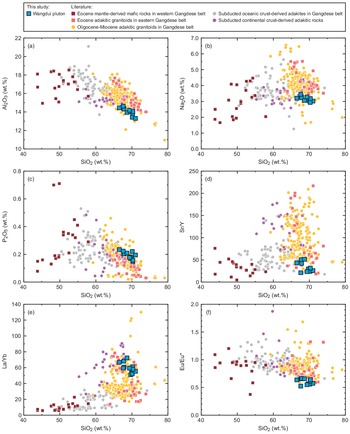
(a) Al2O3, (b) Na2O, (c) P2O5, (d) Sr/Y, (e) La/Yb and (f) Eu/Eu* [2 × Eun/(Smn + Gdn)] vs SiO2 plots for the Wangdui pluton. Data for Eocene mantle-derived mafic rocks in the western Gangdese belt are from Dong et al. (Reference Dong, Mo, Zhao, Zhu, Xie and Dong2011), Zhu et al. (Reference Zhu, Zhao, Niu, Mo, Chung, Hou, Wang and Wu2011), R Wang et al. (Reference Wang, Richards, Hou, An and Creaser2015), Yu (Reference Yu2015) and Xia et al. (Reference Xia, Yang, Guan and Zhang2020). Data for Oligocene–Miocene adakitic granitoids in the Gangdese belt are from Hou et al. (Reference Hou, Gao, Qu, Rui and Mo2004, Reference Hou, Zheng, Yang, Rui, Zhao, Jiang, Qu and Sun2013), Guo et al. Reference Guo, Wilson and Liu(2007b ), Yang (Reference Yang2008), Chen et al. (Reference Chen, Xu, Zhao, Dong, Wang and Kang2011), Zheng et al. Reference Zheng, Hou, Li, Sun, Liang, Fu, Li and Huang(2012a , Reference Zheng, Hou, Li, Liang, Huang, Li, Sun, Fu and Zhang2012b , Reference Zheng, Wu, Tian, Hou, Fu and Zhu2020), Hu et al. (Reference Hu, Liu, Ling, Ding, Liu, Zartman, Ma, Liu, Zhang, Sun, Zhang, Wu and Sun2015), Yu (Reference Yu2015), Zhao et al. (Reference Zhao, Yang, Zheng, Liu, Tian and Fu2015), Li et al. (Reference Li, Li, Wang, Wei, Chen, He, Xu and Hou2017) and Sun et al. (Reference Sun, Lu, McCuaig, Zheng, Chang, Guo and Xu2018). Data for subducted oceanic crust-derived adakites in the Gangdese belt are from Zhu et al. (Reference Zhu, Zhao, Pan, Lee, Kang, Liao, Wang, Li, Dong and Liu2009), Zhang et al. (Reference Zhang, Zhao, Santosh, Wang, Dong and Shen2010), Jiang et al. (Reference Jiang, Wang, Li, Wyman, Tang, Jia and Yang2012, Reference Jiang, Wang, Wyman, Li, Yang, Shi, Ma, Tang, Gou, Jia and Guo2014), Ma et al. (Reference Ma, Wang, Wyman, Li, Jiang, Yang, Gou and Guo2013), Zheng et al. (Reference Zheng, Hou, Gong, Liang, Sun, Zhang, Fu, Huang, Li and Li2014), L Chen et al. (Reference Chen, Qin, Li, Li, Xiao, Zhao and Fan2015), YH Chen et al. (Reference Chen, Yang, Xiong, Zhang, Lai and Chen2015) and Wu et al. (Reference Wu, Zheng, Xu and Hou2018). Data for subducted continental-crust-derived adakitic rocks are from Wang et al. (Reference Wang, Wyman, Xu, Dong, Vasconcelos, Pearson, Wan, Dong, Li, Yu, Zhu, Feng, Zhang, Zi and Chu2008). Data for Eocene adakitic granitoids in the eastern Gangdese belt are from the same source as Figure 4.

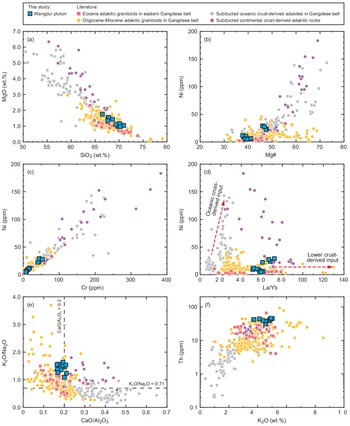
(a) MgO vs SiO2, (b) Ni vs Mg#, (c) Ni vs Cr, (d) Ni vs La/Yb, (e) K2O/Na2O vs CaO/Al2O3 and (f) Th vs K2O plots for the Wangdui pluton. Data sources are the same as Figure 6.

Six samples of Wangdui porphyritic monzogranites were analysed for whole-rock Sr–Nd isotopes. The initial isotopic ratios were calculated based on the measured zircon U–Pb ages. All these samples show homogeneous Sr–Nd isotopic features, with high 87Sr/86Sr(i) ratios of 0.7143 to 0.7145 and low negative ϵ Nd(t) values of −10.4 to −9.8. Their T DM(Nd) and T DM2(Nd) ages are 1.86–1.47 Ga and 1.73–1.60 Ga, respectively.
5. Discussion
5.a. Origin of the Wangdui porphyritic monzogranites
The Wangdui porphyritic monzogranites share geochemical affinities with adakites, characterized by high Sr contents, low HREEs and Y contents, and high La/Yb and Sr/Y ratios (Fig. 4c, d). In the past three decades, a variety of petrogenetic models for adakites (or adakitic rocks) have been proposed: (1) partial melting of subducted oceanic crust (Defant & Drummond Reference Defant and Drummond1990; Rapp et al. Reference Rapp, Shimizu, Norman and Applegate1999; Zhu et al. Reference Zhu, Zhao, Pan, Lee, Kang, Liao, Wang, Li, Dong and Liu2009; Wu et al. Reference Wu, Zheng, Xu and Hou2018); (2) partial melting of subducted continental crust (Wang et al. Reference Wang, Wyman, Xu, Dong, Vasconcelos, Pearson, Wan, Dong, Li, Yu, Zhu, Feng, Zhang, Zi and Chu2008); (3) partial melting of delaminated lower continental crust (Xu et al. Reference Xu, Shinjo, Defant, Wang and Rapp2002; Wang et al. Reference Wang, Xu, Jian, Bao, Zhao, Li, Xiong and Ma2006); (4) partial melting of thickened lower crust (Atherton & Petford Reference Atherton and Petford1993; Chung et al. Reference Chung, Liu, Ji, Chu, Lee, Wen, Lo, Lee, Qian and Zhang2003; Hou et al. Reference Hou, Gao, Qu, Rui and Mo2004, Reference Hou, Zheng, Yang, Rui, Zhao, Jiang, Qu and Sun2013; Zheng et al. Reference Zheng, Hou, Li, Sun, Liang, Fu, Li and Huang2012a , Reference Zheng, Hou, Li, Liang, Huang, Li, Sun, Fu and Zhang b ); (5) crustal assimilation and fractional crystallization process of parental mafic magmas (Castillo et al. Reference Castillo, Janney and Solidum1999; Macpherson et al. Reference Macpherson, Dreher and Thirlwall2006); and (6) magma mixing between felsic and mafic magmas (Guo et al. Reference Guo, Wilson and Liu2007a ; Streck et al. Reference Streck, Leeman and Chesley2007). In this study, the following lines of evidence indicate that the Wangdui porphyritic monzogranites were most likely generated by partial melting of the thickened lower crust.
Adakitic rocks formed by fractional crystallization of parental mafic magmas typically show wide and continuous variations in geochemical compositions, and require the abundant presence of coeval mafic rocks (Castillo et al. Reference Castillo, Janney and Solidum1999; Macpherson et al. Reference Macpherson, Dreher and Thirlwall2006). However, the Wangdui pluton is exclusively felsic, with limited major element variations and uniform trace element patterns (Figs 5, 6a–c). Although some small volumes of coeval mantle-derived mafic magmas have been discovered in the western Gangdese belt (Dong et al. Reference Dong, Mo, Zhao, Zhu, Xie and Dong2011; Q Wang et al. Reference Wang, Zhu, Cawood, Zhao, Liu, Chung, Zhang, Liu, Zheng and Dai2015; R Wang et al. Reference Wang, Richards, Hou, An and Creaser2015; Yu, Reference Yu2015; Xia et al. Reference Xia, Yang, Guan and Zhang2020), they are more than 60 km away from the Wangdui and have significantly more depleted Sr–Nd–Hf isotopic compositions (Fig. 8a, b). Thus, the possibility that coeval mantle-derived mafic rocks were the parental magmas of the Wangdui pluton can be ruled out. In addition, a crucial geochemical feature of the fractional crystallization model (including high-pressure garnet fractionation and low-pressure amphibole fractionation) is that Sr/Y and La/Yb ratios should increase with increasing SiO2 contents (Castillo et al. Reference Castillo, Janney and Solidum1999; Macpherson et al. Reference Macpherson, Dreher and Thirlwall2006), but Wangdui adakitic rocks do not display such evolutionary trends (Fig. 6d, e). Moreover, as shown in Figure 9, the positive correlation between Zr/Sm ratios and Zr contents is inconsistent with the fractional crystallization trend. Collectively, it is unlikely that the Wangdui adakitic rocks were generated by fractional crystallization of parental mafic magmas.
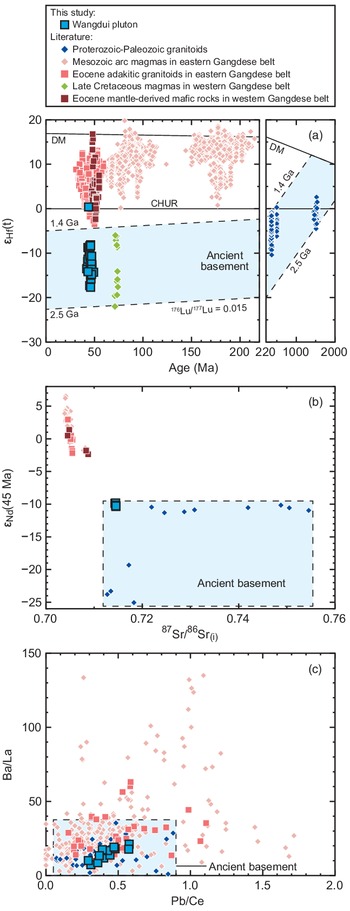
(a) Zircon ϵ Hf(t) vs U–Pb ages, (b) ϵ Nd(t) vs 87Sr/86Sr(i) and (c) Ba/La vs Pb/Ce plots for the Wangdui pluton. Data for Proterozoic–Palaeozoic granitoids are from Ji et al. Reference Ji, Wu, Chung and Liu(2012b ), Dong et al. (Reference Dong, Zhang, Liu, He and Lin2014, Reference Dong, Zhang, Niu, Tian and Zhang2020), Dong & Zhang (Reference Dong and Zhang2015) and Ma et al. (Reference Ma, Kerr, Wang, Jiang, Tang, Yang, Xia, Hu, Yang and Sun2019). Data for Mesozoic arc magmas in the eastern Gangdese belt are from Xu et al. (Reference Xu, Zhang, Luo, Guo and Yang2015), Wang et al. (Reference Wang, Tafti, Hou, Shen, Guo, Evans, Jeon, Li and Li2017) and references therein. Data for Late Cretaceous magmas in the western Gangdese belt are from Jiang et al. (Reference Jiang, Zheng, Gao, Zhang, Huang, Liu, Wu, Xu and Huang2018). Data for Eocene adakitic granitoids in the eastern Gangdese belt and mantle-derived mafic rocks in the western Gangdese belt are from the same source as Figures 4 and 6, respectively.

Zr/Sm vs Zr plot (Lai et al. Reference Lai, Liu and Yi2003) for the Wangdui pluton. Data for Eocene mantle-derived mafic rocks in the western Gangdese belt are from the same source as Figure 6.

In general, adakitic rocks resulting from magma mixing between felsic and mafic magmas are andesitic in composition (Guo et al. Reference Guo, Nakamuru, Fan, Kobayoshi and Li2007a ; Streck et al. Reference Streck, Leeman and Chesley2007), which is not the case for Wangdui porphyritic monzogranites. Additionally, mafic–felsic magma mixing would produce linear trends in element–element binary diagrams (Keller et al. Reference Keller, Schoene, Barboni, Samperton and Husson2015). However, the Wangdui adakitic rocks and the coeval mafic rocks in western Gangdese do not show linear correlations of Al2O3, Na2O and P2O5 with SiO2 (Fig. 6a–c). Besides, no mafic enclaves have been discovered in the Wangdui area during field investigations, which further implies that the effect of magma mixing was negligible.
Previous studies have shown that Neo-Tethyan ocean closure and India–Asia continental collision occurred at c. 55–50 Ma (van Hinsbergen et al. Reference van Hinsbergen, Steinberger, Doubrovine and Gassmöller2011; Zhu et al. Reference Zhu, Wang, Zhao, Chung, Cawood, Niu, Liu, Wu and Mo2015; Ding et al. Reference Ding, Zhang, Dong, Tian, Xiang, Mu, Gou, Shui, Li and Mao2016), so the Wangdui porphyritic monzogranites were formed in an intra-continental setting, which is inconsistent with the tectonic settings for partial melting of subducted oceanic crust. In the Gangdese belt, typical adakites derived from oceanic slab melting were mostly emplaced during the Mesozoic (e.g. Zhu et al. Reference Zhu, Zhao, Pan, Lee, Kang, Liao, Wang, Li, Dong and Liu2009; Zhang et al. Reference Zhang, Zhao, Santosh, Wang, Dong and Shen2010; Ma et al. Reference Ma, Wang, Wyman, Li, Jiang, Yang, Gou and Guo2013; Wu et al. Reference Wu, Zheng, Xu and Hou2018), and are characterized by high MgO, Cr, Ni contents and Mg# values (Fig. 7a–d). By contrast, Wangdui adakitic samples show low contents of MgO and compatible elements, as well as low Mg# values. In addition, oceanic slab-derived adakites are generally expected to have low K2O/Na2O (<0.71) and high CaO/Al2O3 (>0.2) ratios (e.g. Stern & Kilian Reference Stern and Kilian1996; Li et al. Reference Li, Zhu, Wang, Zhao, Zhang, Liu, Chang, Lu, Dai and Zheng2016). The high K2O/Na2O (1.09–1.64) and low CaO/Al2O3 (0.16–0.21) ratios of Wangdui pluton (Fig. 7e), therefore, also argue against an oceanic slab origin. This is further supported by isotopic evidence, wherein Wangdui adakitic rocks have low whole-rock ϵ Nd(t) (−10.4 to −9.8) and zircon ϵ Hf(t) (−17.7 to 0.4) values, distinct from the isotopic characteristics of oceanic crust. Consequently, the Wangdui porphyritic monzogranites were also unlikely to be generated by partial melting of subducted oceanic crust.
The presence of the Eocene mantle-derived gabbros in the western Gangdese batholith (Dong et al. Reference Dong, Mo, Zhao, Zhu, Xie and Dong2011; Q Wang et al. Reference Wang, Zhu, Cawood, Zhao, Liu, Chung, Zhang, Liu, Zheng and Dai2015; Yu, Reference Yu2015; Xia et al. Reference Xia, Yang, Guan and Zhang2020) indicates that the mantle beneath this region was well preserved rather than being squeezed out by subducted Indian plate. In this case, the ascending melts derived from subducted continental crust would inevitably react with the overlying mantle wedge, causing the increase in MgO and compatible elements contents (Fig. 7a–d) (Rapp et al. Reference Rapp, Shimizu, Norman and Applegate1999; Wang et al. Reference Wang, Wyman, Xu, Dong, Vasconcelos, Pearson, Wan, Dong, Li, Yu, Zhu, Feng, Zhang, Zi and Chu2008). However, as mentioned above, this is in contrast to the geochemical compositions of Wangdui porphyritic monzogranites. Moreover, according to the deep seismic reflection studies, most of the Indian continental crust was scraped off to form the accretionary wedge by crustal-scale duplexing, and thus only a thin layer of Indian crust was underthrust beneath the Lhasa terrane (Nábělek et al. Reference Nábělek, Hetényi, Vergne, Sapkota, Kafle, Jiang, Su, Chen and Huang2009; Gao et al. Reference Gao, Lu, Klemperer, Wang, Dong, Li and Li2016). This also implies a low possibility of the subducted continental crust melting model.
Partial melting of delaminated lower continental crust commonly occurs in intra-continental extensional settings (Xu et al. Reference Xu, Shinjo, Defant, Wang and Rapp2002; Wang et al. Reference Wang, Xu, Jian, Bao, Zhao, Li, Xiong and Ma2006). However, the relatively high India–Asia convergence rate (c. 80–100 mm year−1) during 51–45 Ma (van Hinsbergen et al. Reference van Hinsbergen, Steinberger, Doubrovine and Gassmöller2011), together with the development of east–west-trending thrust systems in the region (Hou & Cook, Reference Hou and Cook2009; Li et al. Reference Li, Wang, Dai, Xu, Hou and Li2015), indicates that the Wangdui pluton was emplaced in a compressional environment. Additionally, adakitic rocks derived from delaminated lower crust also typically have high MgO and compatible elements contents due to the interaction with the overlying mantle (Xu et al. Reference Xu, Shinjo, Defant, Wang and Rapp2002; Wang et al. Reference Wang, Xu, Jian, Bao, Zhao, Li, Xiong and Ma2006), which is not observed in Wangdui adakitic rocks. Besides, considering the relatively depleted isotopic compositions of coeval mantle-derived rocks (Fig. 8a, b), melt–mantle interaction would cause the increase in ϵ Nd(t) and ϵ Hf(t) values of the resulting adakitic magmas (Wang et al. Reference Wang, Xu, Jian, Bao, Zhao, Li, Xiong and Ma2006). In contrast, the Wangdui porphyritic monzogranites show highly enriched isotopic signatures, which are similar to those of the ancient Gangdese basement (see Section 5.b). Thus, the delaminated model is unsuitable for the formation of the Wangdui porphyritic monzogranites.
The only remaining candidate is the thickened lower crust, which could serve as the source region for the Wangdui adakitic rocks. This inference is supported by the observation that the low MgO and compatible elements contents of Wangdui samples are comparable to those of the previously reported Eocene–Miocene adakitic intrusions in the Gangdese belt (Fig. 7a–d), which have been interpreted as the products of partial melting of the thickened lower crust (e.g. Hou et al. Reference Hou, Gao, Qu, Rui and Mo2004, Reference Hou, Zheng, Yang, Rui, Zhao, Jiang, Qu and Sun2013; Guan et al. Reference Guan, Zhu, Zhao, Dong, Zhang, Li, Liu, Mo, Liu and Yuan2012; Zheng et al. Reference Zheng, Hou, Li, Sun, Liang, Fu, Li and Huang2012a , Reference Zheng, Hou, Li, Liang, Huang, Li, Sun, Fu and Zhang b , Reference Zheng, Wu, Tian, Hou, Fu and Zhu2020; Ma et al. Reference Ma, Wang, Jiang, Wang, Li, Wyman, Zhao, Yang, Gou and Guo2014). In fact, as well as in the Gangdese belt, similar low MgO, Cr and Ni signatures are also present in Cenozoic thickened-crust-derived adakitic rocks in other collisional orogenic systems, such as Turkey and Iran (e.g. Topuz et al. Reference Topuz, Altherr, Schwarz, Siebel, Satır and Dokuz2005; Shafiei et al. Reference Shafiei, Haschke and Shahabpour2009; Karsli et al. Reference Karsli, Ketenci, Uysal, Dokuz, Aydin, Chen, Kandemir and Wijbrans2011, Reference Karsli, Dokuz, Kandemir, Aydin, Schmitt, Ersoy and Alyıldız2019; Pang et al. Reference Pang, Chung, Zarrinkoub, Li, Lee, Lin and Chiu2016). Moreover, the Wangdui pluton has high K2O and Th contents, with high K2O/Na2O and low CaO/Al2O3 ratios (Fig. 7e, f), further suggesting a continental crust affinity (Zhu et al. Reference Zhu, Zhao, Pan, Lee, Kang, Liao, Wang, Li, Dong and Liu2009; Chen et al. Reference Chen, Wu, Xu, Dong, Wang and Kang2013; Karsli et al. Reference Karsli, Dokuz, Kandemir, Aydin, Schmitt, Ersoy and Alyıldız2019). Therefore, we suggest that the Wangdui porphyritic monzogranites were derived from partial melting of the thickened lower continental crust.
5.b. Nature of the magma source regions
Despite the fact that both the Eocene Wangdui adakitic pluton in the western Gangdese belt and the coeval adakitic granitoids in the eastern Gangdese belt originated from the thickened lower crust, there are some differences in the composition of elements and isotopes. This implies the presence of a heterogeneous lower-crust source beneath the Gangdese belt.
In terms of elemental composition, the Wangdui pluton has high La/Yb ratios comparable to those of the Eocene adakitic granitoids in the eastern Gangdese belt, but with relatively lower Sr contents and Sr/Y ratios (Fig. 4c, d). Additionally, the Wangdui adakitic rocks show nearly constant and highly negative Eu anomalies (Figs 5a, 6f). These geochemical features suggest the plagioclase was preserved in the residual source of Wangdui pluton. In comparison, the Eocene adakitic rocks in the eastern Gangdese belt show flat to slightly concave-upward HREE patterns (Fig. 5a) but no positive correlations of Sr/Y and La/Yb ratios with SiO2 contents (Fig. 6d, e), indicating that the amphibole was present as a residual phase in the magmatic source rather than a crystallized phase. This difference in the residual mineral assemblage in the source region might be attributed to the role of aqueous fluids. The stability pressure of plagioclase increases with decreasing water contents, and hence it can be stable at high pressure under low water contents (Xiong et al. Reference Xiong, Liu, Zhu, Li, Xiao, Song, Zhang and Wu2011). Therefore, the presence of residual plagioclase, in turn, reveals that the thickened lower-crust source of Wangdui adakitic rocks was water-poor. In contrast, since amphibole requires hydrous conditions for stability (Krawczynski et al. Reference Krawczynski, Grove and Behrens2012), its presence suggests that the base of the continental crust of eastern Gangdese was water-rich. This interpretation is consistent with some incompatible element ratios. Because LILEs are more soluble in aqueous fluids than LREEs, Ba/La and Pb/Ce ratios are generally used to trace the metasomatism of the source region (Guo et al. Reference Guo, Hertogen, Liu, Pasteels, Boven, Punzalan, He, Luo and Zhang2005; Zheng et al. Reference Zheng, Liu, Wu, Griffin, Li, Xu, Yang, Hou and O’Reilly2019, Reference Zheng, Wu, Tian, Hou, Fu and Zhu2020). As shown in Figure 8c, the low Ba/La and Pb/Ce ratios of the Wangdui pluton indicate a water-poor magmatic source with limited fluid metasomatism relative to the sources of the Eocene adakitic granitoids in the eastern Gangdese belt.
In terms of isotopic composition (Fig. 8a, b), the Wangdui pluton is characterized by low negative ϵ Nd(t) (−10.4 to −9.8) and high 87Sr/86Sr(i) (0.7143 to 0.7145) values. Furthermore, it has low zircon ϵ Hf(t) values (−17.7 to 0.4) and old Hf crustal model ages (2.24 to 1.09 Ga). These isotopic data suggest that the source region of the Wangdui adakitic rocks was dominated by ancient materials. By contrast, the Eocene adakitic rocks in the eastern Gangdese belt have relatively high ϵ Nd(t) and low 87Sr/86Sr(i) values, as well as high zircon ϵ Hf(t) values, indicating that large amounts of juvenile materials were present in the lower crust of the eastern Gangdese belt.
The Gangdese belt was once viewed as a juvenile magmatic complex belt accreted to the southern margin of the ancient Lhasa microcontinent (Ji et al. Reference Ji, Wu, Chung, Li and Liu2009; Zhu et al. Reference Zhu, Zhao, Niu, Mo, Chung, Hou, Wang and Wu2011). Recently, however, Proterozoic orthogneisses, Paleozoic granitoids and numerous Precambrian inherited and detrital zircons have been identified in the Gangdese belt (Ji et al. Reference Ji, Wu, Chung and Liu2012b ; Zheng et al. Reference Zheng, Hou, Li, Sun, Liang, Fu, Li and Huang2012a ; Guo et al. Reference Guo, Zhang, Harris, Xu and Pan2016; Ma et al. Reference Ma, Kerr, Wang, Jiang, Tang, Yang, Xia, Hu, Yang and Sun2019; Dong et al. Reference Dong, Zhang, Niu, Tian and Zhang2020), thus indicating the existence of an ancient basement. During the Mesozoic, attributed to the northward subduction of Neo-Tethyan oceanic slab, extensive arc magmatism developed in the eastern segment of the Gangdese belt, with two activity peaks at 205–152 Ma and 109–80 Ma (e.g. Ji et al. Reference Ji, Wu, Chung, Li and Liu2009; Zheng et al. Reference Zheng, Hou, Gong, Liang, Sun, Zhang, Fu, Huang, Li and Li2014; Wang et al. Reference Wang, Tafti, Hou, Shen, Guo, Evans, Jeon, Li and Li2017; Wu et al. Reference Wu, Zheng, Xu and Hou2018). The arc magmas and associated slab-derived fluids would greatly modify the ancient basement in eastern Gangdese, and eventually produce the hydrous and juvenile lower crust (Hou et al. Reference Hou, Yang, Lu, Kemp, Zheng, Li, Tang, Yang and Duan2015b ; Hou & Wang Reference Hou and Wang2019; Zheng et al. Reference Zheng, Liu, Wu, Griffin, Li, Xu, Yang, Hou and O’Reilly2019, Reference Zheng, Wu, Tian, Hou, Fu and Zhu2020; Dong et al. Reference Dong, Zhang, Niu, Tian and Zhang2020). By contrast, the low Ba/La and Pb/Ce ratios, negative whole-rock ϵ Nd(t) and zircon ϵ Hf(t) values, and old crustal model ages of the studied Wangdui porphyritic monzogranites are similar to those of the Proterozoic orthogneisses and Palaeozoic granitoids (Fig. 8), implying that their magmatic source was composed predominantly of ancient Gangdese basement materials. Considering the limited development of Mesozoic arc magmatism in the western Gangdese belt (Dong, Reference Dong2008; Jiang et al. Reference Jiang, Zheng, Gao, Zhang, Huang, Liu, Wu, Xu and Huang2018), the lack of juvenile component contribution and fluid metasomatism might cause the massive preservation of ancient basement.
5.c. Implications for crustal thickening
The Himalayan–Tibetan orogenic belt has the thickest crust on Earth (60–80 km), approximately twice the thickness of the average continental crust (Zhao et al. Reference Zhao, Mechie, Brown, Guo, Haines, Hearn, Klemperer, Ma, Meissner, Nelson, Ni, Pananont, Rapine, Ross and Saul2001; Kind et al. Reference Kind, Yuan, Saul, Nelson, Sobolev, Mechie, Zhao, Kosarev, Ni, Achauer and Jiang2002). However, the timing of crustal thickening, as well as the relative contributions of tectonic shortening and magmatic underplating, remains controversial (e.g. Kapp et al. Reference Kapp, DeCelles, Leier, Fabijanic, He, Pullen, Gehrels and Ding2007; Mo et al. Reference Mo, Hou, Niu, Dong, Qu, Zhao and Yang2007; Volkmer et al. Reference Volkmer, Kapp, Guynn and Lai2007; Chung et al. Reference Chung, Chu, Ji, O’Reilly, Pearson, Liu, Lee and Lo2009; Ji et al. Reference Ji, Wu, Liu and Chung2012a ; Li et al. Reference Li, Wang, Dai, Xu, Hou and Li2015; Ou et al. Reference Ou, Wang, Wyman, Zhang, Yang, Zeng, Hao, Chen, Liang and Qi2017; Zhu et al. Reference Zhu, Wang, Cawood, Zhao and Mo2017). The geochemical parameters of magmatic rocks are one of the approaches to estimating the crustal thickness, which matches well with the seismically determined Moho depth (Mantle & Collins Reference Mantle and Collins2008). As the representative parameters, La/Yb and Sr/Y ratios are widely used to track the changes of crustal thickness in magmatic arcs and collisional orogens (Chapman et al. Reference Chapman, Ducea, DeCelles and Profeta2015; Chiaradia, Reference Chiaradia2015; Hu et al. Reference Hu, Ducea, Liu and Chapman2017).
In the Gangdese belt, previous studies have proposed that the crustal thickness increased dramatically in the Eocene, based on the La/Yb ratios of magmatic rocks (Ji et al. Reference Ji, Wu, Liu and Chung2012a; Ma et al. Reference Ma, Wang, Jiang, Wang, Li, Wyman, Zhao, Yang, Gou and Guo2014; Zhou et al. Reference Zhou, Wang, Hou, Li, Zhao, Li and Qu2018). The underplating of basaltic magmas has been suggested to primarily account for this crustal thickening process since the extensive development of syn-collisional magmatism with depleted Sr–Nd–Hf isotopic compositions, including the widespread Linzizong volcanic succession, voluminous granitoid batholith and abundant mafic enclaves and gabbros (Mo et al. Reference Mo, Hou, Niu, Dong, Qu, Zhao and Yang2007; Guan et al. Reference Guan, Zhu, Zhao, Dong, Zhang, Li, Liu, Mo, Liu and Yuan2012; Ji et al. Reference Ji, Wu, Liu and Chung2012a ; Zhu et al. Reference Zhu, Wang, Cawood, Zhao and Mo2017; Zhou et al. Reference Zhou, Wang, Hou, Li, Zhao, Li and Qu2018). However, the above studies mostly focused on the eastern part of the Gangdese belt, paying little attention to the western segment. It is worth noting that, unlike the eastern Gangdese lower crust which was composed predominantly of mantle-derived juvenile components, the western segment retains large amounts of ancient basement (Hou et al. Reference Hou, Zheng, Yang, Rui, Zhao, Jiang, Qu and Sun2013, Reference Hou, Duan, Lu, Zheng, Zhu, Yang, Yang, Wang, Pei and Zhao2015a ; Jiang et al. Reference Jiang, Zheng, Gao, Zhang, Huang, Liu, Wu, Xu and Huang2018; this study). The heterogeneity of crustal composition implies that eastern and western segments underwent diverse tectonic–magmatic evolution histories, and hence there might be disparities in the timing of crustal thickening and the relative contributions of tectonic shortening and magmatic underplating.
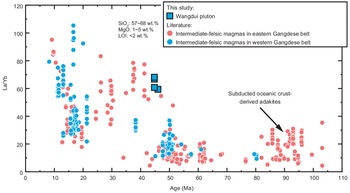
In order to compare the crustal thickness evolution of the western and eastern Gangdese belts, we collected geochemical data concerning Late Cretaceous–Miocene magmatic rocks from both regions, and then filtered the data by SiO2 (57–68 wt %), MgO (1–5 wt %) and loss on ignition (<2 wt %). In Figure 10, firstly, it can be observed that some Late Cretaceous rocks in the eastern Gangdese belt show relatively high La/Yb ratios. However, they are typically interpreted as the products of partial melting of subducted Neo-Tethyan oceanic crust rather than thickened continental crust, due to the geochemical characteristics of high MgO, Cr, Ni contents, and high ϵ Nd(t) and ϵ Hf(t) values (Zhang et al. Reference Zhang, Zhao, Santosh, Wang, Dong and Shen2010; Ma et al. Reference Ma, Wang, Wyman, Li, Jiang, Yang, Gou and Guo2013; Zhu et al. Reference Zhu, Wang, Cawood, Zhao and Mo2017; Wu et al. Reference Wu, Zheng, Xu and Hou2018). Secondly and more importantly, the La/Yb ratios of the western Gangdese magmatic rocks show a remarkable increase during c. 50–40 Ma, which is synchronous with the variation in the eastern Gangdese belt (Fig. 10). This indicates that the western segment experienced significant crustal thickening at a similar time to the eastern segment. In particular, the timing of western segment crustal thickening obtained here matches well with the thermochronology study. The detrital zircon fission-track data from modern river sands in the Kailas area record a rapid cooling event during the Eocene (c. 47–35 Ma), which has been attributed to the surface uplift and exhumation of the western Gangdese belt (Shen & Wang, Reference Shen and Wang2020).
La/Yb vs U–Pb ages plot for the Late Cretaceous–Miocene intermediate-felsic magmatic rocks in the Gangdese belt. Data and literature sources are listed in Table S2 (in the Supplementary Material available online at https://doi.org/10.1017/S0016756822000206).

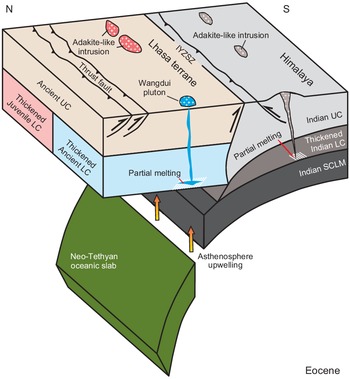
Similar to the eastern Gangdese belt, extensive Eocene magmatism also developed in the western segment, in response to the break-off of the Neo-Tethyan oceanic slab (Q Wang et al. Reference Wang, Zhu, Cawood, Zhao, Liu, Chung, Zhang, Liu, Zheng and Dai2015; R Wang et al. Reference Wang, Richards, Hou, An and Creaser2015). The mantle-derived mafic magmas triggered by asthenospheric upwelling would stall at the base of the continental crust, where they interacted with the ancient basement and provided sufficient heat to induce crustal melting. As a result of the crust–mantle interaction, the isotopic compositions of the Eocene magmatic rocks in the western Gangdese belt show wide variations, ranging between those of the most depleted mantle-derived mafic rocks and those of the pre-collisional Late Cretaceous ancient basement-derived magmas (Fig. 11). However, in contrast to that the Eocene adakitic granitoids in the eastern Gangdese belt have juvenile Sr–Nd–Hf isotopic compositions, and the Wangdui pluton which has the highest La/Yb ratios in the western segment is characterized by the most negative zircon ϵ Hf(t) values. This suggests that the thickened lower crust beneath the western Gangdese belt was composed predominantly of ancient basement materials. In this case, the underplating of juvenile mantle-derived magmas is unsuitable to account for the crustal thickening of the ancient basement; instead, tectonic shortening might play a more crucial role (Fig. 12).
(a) La/Yb and (b) zircon ϵ Hf(t) vs longitude plots for the Eocene magmatic rocks in the western Gangdese belt. Data for intermediate-felsic magmas are from the sources listed in Table S2 (in the Supplementary Material available online at https://doi.org/10.1017/S0016756822000206) and our unpublished data. Data for Eocene mantle-derived mafic rocks and Late Cretaceous magmas are from the same source as Figures 6 and 8, respectively.

Schematic illustration (not to scale) showing the proposed petrogenesis of Eocene Wangdui adakitic rocks (modified from Zheng et al. Reference Zheng, Wu, Tian, Hou, Fu and Zhu2020). Abbreviations: IYZSZ = Indus–Yarlung Zangbo suture zones; LC = lower crust; SCLM = sub-continental lithospheric mantle; UC = upper crust.

In fact, the thickened lower-crust-derived adakitic rocks began to appear during the Eocene, not only along the Gangdese belt but also in the Tethyan Himalaya and Qiangtang terranes (Zeng et al. Reference Zeng, Gao, Xie and Jing2011; Hou et al. Reference Hou, Zheng, Zeng, Gao, Huang, Li, Li, Fu, Liang and Sun2012; Long et al. Reference Long, Wilde, Wang, Yuan, Wang, Li, Jiang and Dan2015; Ou et al. Reference Ou, Wang, Wyman, Zhang, Yang, Zeng, Hao, Chen, Liang and Qi2017). Such a widespread distribution indicates that the central Himalayan–Tibetan orogen experienced crustal thickening as a whole in this period. This inference is supported by other studies. Since the disappearance of marine strata can constrain the onset of plateau uplift, the youngest marine strata in the Tethyan Himalaya are Early Eocene in age, suggesting that the uplift was active during the Eocene (Wang et al. Reference Wang, Dai, Zhao, Li, Graham, He, Ran and Meng2014). As for the Lhasa and Qiangtang terranes, published thermochronological data show an exhumation peak at c. 55–35 Ma, also indicating an Eocene rapid uplift (Rohrmann et al. Reference Rohrmann, Kapp, Carrapa, Reiners, Guynn, Ding and Heizler2012; Dai et al. Reference Dai, Wang, Hourigan, Li and Zhuang2013; Shen & Wang Reference Shen and Wang2020). Furthermore, the above adakitic rocks in Tethyan Himalaya and Qiangtang terranes show enriched Sr–Nd–Hf isotopic compositions, consistent with the Wangdui pluton in the western Gangdese belt. This implies that the underplating of mantle-derived magmas might have a limited effect on crustal thickening there, while tectonic shortening might have more. Plate reconstructions show that there was a strong convergence after the India–Asia continental collision in the Early Eocene, which resulted in the extensive development of fold–thrust belts in the central Himalayan–Tibetan orogen (van Hinsbergen et al. Reference van Hinsbergen, Steinberger, Doubrovine and Gassmöller2011; Li et al. Reference Li, Wang, Dai, Xu, Hou and Li2015). These fold–thrust belts, in turn, would accommodate most of the convergence and lead to the crustal shortening and thickening (Wang et al. Reference Wang, Dai, Zhao, Li, Graham, He, Ran and Meng2014; Li et al. Reference Li, Wang, Dai, Xu, Hou and Li2015 and references therein). Therefore, we believe that the Eocene crustal thickening of the central Himalayan–Tibetan orogen might be primarily caused by tectonic shortening rather than mantle-derived magma underplating.
6. Conclusions
-
(1) The Wangdui porphyritic monzogranites in the western Gangdese belt were emplaced at c. 46–44 Ma and show geochemical affinities with adakites. Similar to the previously reported coeval adakitic rocks in the eastern Gangdese belt, the Wangdui pluton was also most likely produced by partial melting of the thickened lower crust. However, in contrast to the juvenile lower-crust source in the eastern segment, the magmatic source of Wangdui pluton was composed predominantly of ancient basement materials, revealing the east–west-trending heterogeneity of lower-crustal composition in the Gangdese belt.
-
(2) The La/Yb ratios of magmatic rocks suggest that both the western and eastern Gangdese belts experienced significant crustal thickening in the Eocene. However, the disparity in crustal composition implies that these two regions have diverse tectonic–magmatic evolution processes and different thickening mechanisms. Unlike the crustal thickening caused by the underplating of juvenile mantle-derived magmas in the eastern segment, the tectonic shortening might play a more crucial role in the western segment. In fact, the Eocene adakitic rocks, which were derived from thickened lower crust and have enriched isotopic compositions, are widely distributed in the central Himalayan–Tibetan orogen. This, in combination with the extensive development of fold–thrust belts, suggests that tectonic shortening might be the main mechanism accounting for the crustal thickening associated with the India–Asia continental collision.
Supplementary material
To view supplementary material for this article, please visit https://doi.org/10.1017/S0016756822000206
Acknowledgements
This work was funded by the National Key Research and Development Program of China (grants 2019YFA0708602, 2016YFC0600310), the National Natural Science Foundation of China (grants 42022014, 41872083, 41472076), the Program of the China Geological Survey (DD20160024-07, DD20179172), the China Fundamental Research Funds for the Central Universities (grant 2652018133), and the 111 Project of the Ministry of Science and Technology (grant BP0719021).
Conflict of interest
The authors declare that they have no known competing financial interests or personal relationships that could have appeared to influence the work reported in this paper.