INTRODUCTION
Poor sleep is a common problem in people who have been treated for cancer, yet, unlike other symptoms (e.g., pain and fatigue), it is largely overlooked in the medical and supportive care of these patients. Across all cancers, the prevalence rates of sleep disturbance are consistently high (59–79%) (Davidson et al., Reference Davidson, MacLean and Brundage2002; Palesh et al., Reference Palesh, Roscoe and Mustian2010; Savard et al., Reference Savard, Ivers and Villa2011); however, breast cancer patients have been found to be particularly vulnerable to sleep disturbances compared to patients with other types of cancers (Colagiuri et al., Reference Colagiuri, Christensen and Jensen2011). Breast cancer patients have often reported that poor-quality sleep and staying asleep throughout the night are their greatest challenges (Beck et al., Reference Beck, Berger and Barsevick2010; Davidson et al., Reference Davidson, MacLean and Brundage2002; Kotronoulas et al., Reference Kotronoulas, Wengstrom and Kearney2012). Impaired daytime functioning—including low activity levels, fatigue, and naps—are also frequently reported (Berger et al., Reference Berger, Kuhn and Farr2009a; Kotronoulas et al., Reference Kotronoulas, Wengstrom and Kearney2012). Although several studies have found that sleep disturbances begin or worsen during cancer treatment (Beck et al., Reference Beck, Berger and Barsevick2010; Enderlin et al., Reference Enderlin, Coleman and Cole2010; Kotronoulas et al., Reference Kotronoulas, Wengstrom and Kearney2012; Savard & Morin, Reference Savard and Morin2001), some research has demonstrated that, even after cessation of cancer treatment, breast cancer survivors continue to experience sleep problems for many years (Lindley et al., Reference Lindley, Vasa and Sawyer1998; Savard & Morin, Reference Savard and Morin2001). This is a matter for concern, given that there are serious negative physical and psychological consequences of long-term sleep disturbance (Colten & Altevogt, Reference Colten and Altevogt2007). The quality of sleep of breast cancer patients who are surviving for years posttreatment has not been well-studied, despite this being one of the largest survivorship populations. By increased research focused on this area, sleep problems can become mainstream in terms of symptom screening and management as part of comprehensive supportive cancer care.
There are a number of physical and psychological variables thought to contribute to the high rate of sleep disturbances in breast cancer survivors (Palesh et al., Reference Palesh, Roscoe and Mustian2010; Savard et al., Reference Savard, Davidson and Ivers2004; Ellis et al., Reference Ellis, Perlis and Bastien2014). Some 40–70% of breast cancer survivors experience vasomotor symptoms (such as night sweats and hot flashes) and report a greater symptom burden at night (Carpenter et al., Reference Carpenter, Elam and Ridner2004; Harris et al., Reference Harris, Remington and Trentham-Dietz2002). Tamoxifen, typically given to breast cancer survivors for 5 years following treatment, is known to increase the frequency of hot flashes (Colagiuri et al., Reference Colagiuri, Christensen and Jensen2011; Savard et al., Reference Savard, Davidson and Ivers2004; Reference Savard, Simard and Blanchet2001). In fact, Mourits et al. (Reference Mourits, Bockermann and de Vries2002) found that as many as 50% of women taking tamoxifen reported multiple awakenings through the night. Such physical symptoms as pain can also impact sleep (Miaskowski et al., Reference Miaskowski, Dodd and Lee2004). In addition, when patients cannot sleep, they expose themselves to stressful and upsetting thoughts. Some studies have found that most patients attribute their sleep disturbance to negative thoughts, worry, and anxiety (Dupont et al., Reference Dupont, Bower and Stanton2014; Hall et al., Reference Hall, Mishel and Germino2014; Rumble et al., Reference Rumble, Keefe and Edinger2010). In a study of cancer patients, Rumble and colleagues (Reference Rumble, Keefe and Edinger2010) found that higher levels of sleep-inhibitory thoughts and behaviors are antecedents of insomnia, as well as higher levels of pain, fatigue, and hot flashes and lower levels of positive mood as consequences of insomnia. Carpenter et al. (Reference Carpenter, Elam and Ridner2004) found that self-reported sleep disturbances were more common in breast cancer patients than in age-matched healthy controls; however, sleep disturbances were more strongly correlated with depression and fatigue than to frequency of hot flashes. The evidence is not clear as to which factors contribute most to sleep disturbances.
Poor sleep can negatively impact quality of life (QoL) during survivorship and exacerbate such symptoms commonly seen in breast cancer survivors as pain, depression, anxiety/worry, and hot flashes (Davidson et al., Reference Davidson, MacLean and Brundage2002). A vast body of literature has shown that untreated chronic insomnia negatively impacts mood, physical symptoms, pain sensitivity, fatigue, and QoL (Colten & Altevogt, Reference Colten and Altevogt2007). Insomnia is increasingly viewed as an independent risk factor for future depression (Irwin et al., Reference Irwin, Olmstead and Ganz2013; Jim et al., Reference Jim, Jacobsen and Phillips2013). Breast cancer patients have also reported on sleep disturbance as part of a dietary intervention study (Bardwell et al., Reference Bardwell, Profant and Casden2008), where the authors found that demographic, medical, and health behavior variables were not significant risk factors for sleep disturbance (only worse depressive and vasomotor symptoms were meaningful predictors). Further research is needed to better understand the interaction of the above factors and their impact on sleep in posttreatment survivors of breast cancer. Engaging in a sleep-improvement intervention has the potential to enhance breast cancer survivors' QoL, reduce physical symptoms, improve mood (Berger et al., Reference Berger, Kuhn and Farr2009a; Espie et al., Reference Espie, Fleming and Cassidy2008; Savard et al., Reference Savard, Simard and Ivers2005), and even affect the disease course and survival (Palesh et al., Reference Palesh, Aldridge-Gerry and Zeitzer2014; Savard et al., Reference Savard, Laroche and Simard2003; Colten & Altevogt, Reference Colten and Altevogt2007; Spiegel et al., Reference Spiegel, Sheridan and Van Cauter2002). The importance of understanding sleep disturbances in cancer populations has been highlighted by national agencies and professional societies (Colten & Altevogt, Reference Colten and Altevogt2007). The U.S. Department of Health and Human Services has recognized sleep disorders as warranting further scientific investigation, with cancer named specifically as a high-priority research focus (Buscemi et al., Reference Buscemi, Vandermeer and Friesen2005).
In the current study, we examined the prevalence, severity, and nature of subjective sleep complaints in women who had survived stage I–III breast cancer and were 1–10 years posttreatment. We also examined the demographic, medical, physical, and psychosocial correlates of poor sleep in order to describe identifiable subgroups of breast cancer survivors. The study included a subset of participants (n = 27) who underwent polysomnography sleep studies in order to enhance our understanding of the physiological nature of the sleep disturbances experienced. Those findings are reported in a separate article (Reinsel et al., Reference Reinsel, Starr and O'Sullivan2015).
METHODS
Participants
Our sample included 200 female adult breast cancer survivors who were receiving follow-up care at the Breast Cancer Service at the Memorial Sloan Kettering Cancer Center. The eligibility criteria included: (1) a diagnosis of primary stage I, II, or III breast cancer; (2) being at least 1 year and no more than 10 years posttreatment; (3) having no evidence of disease at the time of assessment; (4) showing no evidence of acute or chronic encephalopathy; (5) no evidence of psychiatric disease severe enough to compromise data collection; (6) being at least 18 years of age; and (7) having the ability to speak and read English.
Measures
Sociodemographic Characteristics
Participants completed a demographics questionnaire that included questions related to age, race/ethnicity, marital status, education level, employment status, and income.
Medical Characteristics
Participants' medical data were reviewed upon entry into the study to obtain site and stage of disease, Eastern Cooperative Oncology Group rating, current medications, present oncologic therapy, and medications for palliative care.
Subjective Sleep Assessments
The Pittsburgh Sleep Quality Index (PSQI) (Buysse et al., Reference Buysse, Reynolds and Monk1989) is a 24-item questionnaire about a patient's sleep habits. It describes sleep disturbance in terms of seven domains along with a global score. It has good reliability and validity and has been used in psychiatric and general medical as well as oncology studies (Carpenter & Andrykowski, Reference Carpenter and Andrykowski1998). The Insomnia Severity Index (ISI) (Bastien et al., Reference Bastien, Vallieres and Morin2001) is a 7-item self-report measure of perceived severity of insomnia symptoms over the course of the previous two weeks. The overall severity of insomnia can be calculated by summing individual items (difficulties with falling asleep, maintaining sleep, and early morning awakenings, as well as degree of dissatisfaction with current sleep). The Epworth Sleepiness Scale (ESS) (Johns, Reference Johns1991) is an 8-item self-report questionnaire employed to assess daytime sleepiness in adults.
Associated Symptoms and Quality of Life
The Numeric Rating Scale (NRS) (Paice & Cohen, Reference Paice and Cohen1997) is a pain symptom inventory that assesses a range of symptoms associated with pain severity (e.g., energy level, pain, and daytime sedation) on a 0-to-10 Likert-type scale. The Quality of Life Cancer Survivor Summary (QoL–CS) (Ferrell et al., Reference Ferrell, Dow and Grant1995) is a 41-item instrument that assesses four domains of QoL: physical, psychological, social, and spiritual well-being. The Postmenopausal Estrogen/Progestin Intervention Scale (PEPI) (Greendale et al., Reference Greendale, Reboussin and Hogan1998) is a 47-item self-report measure of postmenopausal symptoms. For the current study, we adapted the original version of the PEPI by asking women to respond on a 0 (not at all) to 4 (extremely) Likert-type scale about the impact of their menopausal symptoms during the previous week. It has been used in several large-scale clinical trials with healthy and medically ill populations and has good reliability and a wide distribution of responses (Espeland et al., Reference Espeland, Bush and Mebane-Sims1995; Greendale et al., Reference Greendale, Reboussin and Hogan1998).
Psychological Distress Measures
The Brief Zung Self-Rating Depression Scale (BZSDS) (Dugan et al., Reference Dugan, McDonald and Passik1998) is an 11-item measure of depressive symptoms (e.g., anhedonia, dysphoria, concentration, and hopelessness) that does not assess the somatic symptoms of depression that are often confounded by cancer and its treatment (e.g., fatigue, appetite changes, and insomnia). In the current sample, the BZSDS demonstrated good internal consistency (α = 0.86). The Concerns About Recurrence Scale (CARS) (Vickberg, Reference Vickberg2003) is a 30-item scale designed to assess women's fears about the possibility of recurrence of breast cancer. This scale assesses overall fear of recurrence by asking about the frequency, potential for upset, consistency, and intensity of fears, in addition to the nature of women's fears, including health, womanhood, role, and death worries.
Procedure
Our protocol was submitted and approved by the institutional review board at Memorial Sloan Kettering. All the procedures performed involving human participants were in accordance with the ethical standards of the institutional and/or national research committee and the 1964 Declaration of Helsinki and its later amendments, or comparable ethical standards. A list of participants based on study eligibility criteria was generated by querying our institutional database. Breast cancer survivors who met the eligibility criteria were randomly selected for participation. A trained research study assistant reviewed patients' electronic medical records, confirmed survivor eligibility status with the clinic's attending physician, and obtained permission to approach the survivor. Informed consent was obtained from all the individual participants included in the study.
Eligible participants who gave informed consent completed the battery of questionnaires in person at the time of their clinic appointment, at their own home, and returned it by mail, or via telephone with the assistance of a trained research study assistant. A $20 stipend was provided upon completion of the battery of questionnaires.
Statistical Analysis
Descriptive statistics were calculated to characterize the current sample of breast cancer survivors with respect to sleep variables, as well as demographic, medical, physical, and psychosocial variables. Correlation analysis was conducted to understand bivariate associations among study variables. To examine group differences, breast cancer survivors were categorized into good and poor sleepers, based on a PSQI global cutoff score of 8 (Carpenter & Andrykowski, Reference Carpenter and Andrykowski1998). Differences were analyzed using independent-means t or chi-square tests, as appropriate.
RESULTS
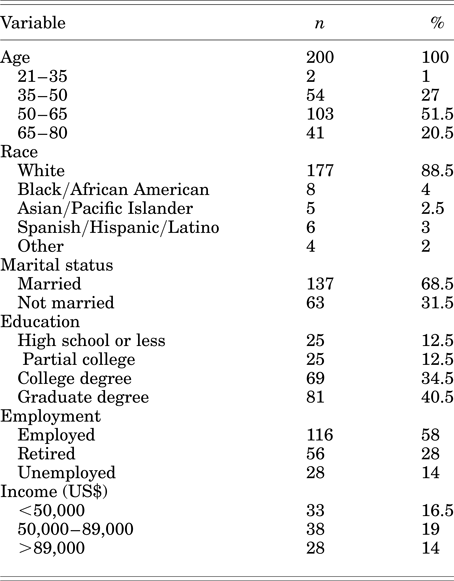
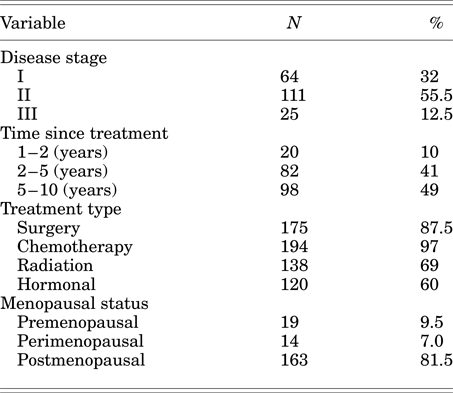
For our analysis, questionnaires were completed by 200 breast cancer survivors. The majority of women were Caucasian (88.5%), married (68.5%), employed (58%), had a college degree (75%), were postmenopausal (81.5%), and were 50 years of age or older (73%). More than half of the women (55%) in our study were diagnosed with stage II breast cancer. Additional demographic and medical characteristics of the sample are presented in Table 1.
Demographic variables in breast cancer survivors (N = 200)

Using a PSQI global score of 8 as a conservative cutoff (as suggested by Carpenter & Andrykowski [1998]) for use in cancer populations), we found that 38% of breast cancer survivors were categorized as having very poor-quality sleep (PSQI global score >8). Among these women, 54% reported difficulty falling asleep (10% rated this problem as severe or very severe), 67% had difficulty staying asleep (24% rated this as severe or very severe), and 58% reported problems waking up too early (16% rated this as severe or very severe). Compared to those with good-quality sleep, women with poor-quality sleep took more than twice as much time to fall asleep (M = 39 vs. 15 min; t(86) = –5.68, p < 0.001, d = 0.90), had almost double the number of nighttime awakenings (M = 2.7 vs. 1.6 awakenings per night; t(197) = –7.84, p < 0.001, d = 1.07), and slept a total of 2 hours less each night (M = 5.1 vs. 7.0 hours; t(86) = 10.96, p < 0.001, d = 1.72).
Chi-square analyses revealed that good and poor sleepers did not differ on such demographic variables as marital status (X2(3,200) = 4.12, p > 0.05), race (X2(4,200) = 4.93, p > 0.05), and education level (X2(5,200) = 9.12, p > 0.05), but poor sleepers were less likely to be working (X2(6,200) = 14.5, p < 0.05). Moreover, poor sleepers were more likely to endorse such behaviors as smoking cigarettes (X2(1,199) = 5.85, p < 0.05) and drinking alcohol (X2(3,198) = 3.93, p < 0.05), but they did not differ when compared to good sleepers with respect to caffeine use (X2(3,200) = 0.887, p > 0.05). Chi-square tests revealed that good and poor sleepers did not differ on such medical factors as disease stage (X2(2,184) = 1.30, p > 0.05) or cancer treatment types: surgery (X2(1,199) = 5.85, p < 0.05), chemotherapy (X2(1,200) = 0.327, p > 0.05), radiation (X2(1,200) = 0.966, p > 0.05), hormonal (X2(1,200) = 0.644, p > 0.05), and biologic (X2(1,200) = 0.584, p > 0.05). Menopausal status, however, did appear to play a role in sleep quality. Poor sleep quality was reported in 33% of postmenopausal women, in 50% of perimenopausal women, and in only 9% of premenopausal women.
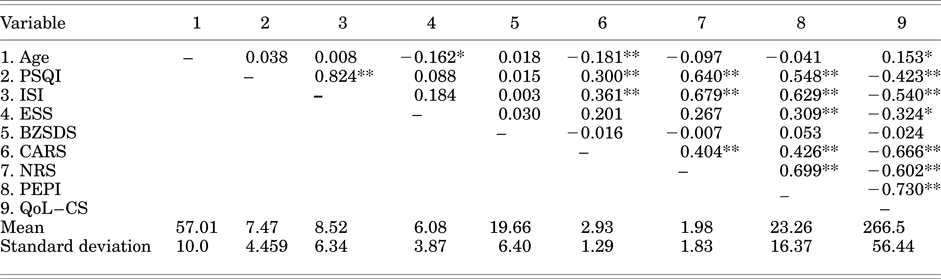
Means, standard deviations, and correlations among age, psychosocial, QoL, and sleep variables can be found in Table 2. PSQI global score, daytime sleepiness (based on ESS score), and severity of insomnia (based on ISI score) were all significantly positively correlated with menopausal symptoms, pain symptoms, and concerns about recurrence, and negatively correlated with cancer-related QoL. Depressive symptoms were unrelated to severity of insomnia, daytime sleepiness, and PSQI global score. PSQI global score was significantly positively associated with severity of insomnia but unrelated to ratings of daytime sleepiness. Correlation analyses also revealed that PSQI global score was significantly associated with increased concerns about recurrence and increased menopausal symptoms.
Treatment and medical variables in breast cancer survivors (N = 200)

Treatment type total percentage is greater than 100% because some women received multiple treatments.
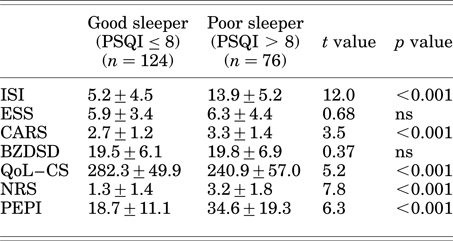
Mean differences in QoL, depressive symptoms, pain symptoms, concerns about recurrence, insomnia severity, and daytime sleepiness between those with good- and poor-quality sleep are given in Table 3. Compared to women with good-quality sleep, women with poor sleep had significantly more symptoms of insomnia, a poorer QoL, more concerns about cancer recurrence, and greater pain severity, but they did not differ significantly with regard to daytime sleepiness ratings or depressive symptoms.
Mean differences between good and poor sleepers on psychosocial and quality of life variables

Values are given as mean ± standard deviation. The given p value is for a two-tailed test.
ns = nonsignificant; PSQI = Pittsburgh Sleep Quality Index; ISI = Insomnia Severity Index; ESS = Epworth Sleepiness Scale; BZSDS = Brief Zung Self-Rating Depression Scale; CARS = Concerns About Recurrence Scale; NRS = Numerical Rating Scale; PEPI = Postmenopausal Estrogen/Progestin Intervention Scale; QoL–CS = Quality of Life Cancer Survivor Summary.
Given that vasomotor symptoms are common among breast cancer survivors and can impact their sleep, we wanted to understand the associations of hot flashes and night sweats, as well as associated tamoxifen use, with sleep in our sample. Compared to women with good-quality sleep, those with poor-quality sleep reported more hot flashes (t = 4.3, p < 0.001, d = 0.46) and night sweats (t = 3.1, p < 0.001, d = 0.66). Difficulties with falling and staying asleep and problems with waking up too early were all positively associated with night sweats and hot flashes (p < 0.05). The strongest association between insomnia symptoms and vasomotor symptoms was for difficulties staying asleep and both hot flashes (r = 0.38, p < 0.001) and night sweats (r = 0.45, p < 0.001). A total of 122 women, some 61% of the sample, were taking hormones. Women taking tamoxifen (13.5%) reported a larger number of hot flashes (t = –3.96, p < 0.001) and night sweats (t = –3.13, p < 0.001). Tamoxifen use was also significantly correlated with worse sleep on the PSQI (r = 0.14, p < 0.05).
Finally, we wanted to understand if women who reported good- versus poor-quality sleep differed on the psychosocial factors commonly reported by breast cancer survivors (e.g., difficulty coping, concerns about appearance, social isolation, purpose in life, and concerns about health, recurrence, and death). Women with poor-quality sleep reported greater difficulty coping (t = 3.9, p < 0.001, d = 0.61), more concerns about their appearance (t = 3.1, p < 0.01, d = 0.23), and were more socially isolated (t = 3.5, p < 0.001, d = 0.52). They also reported greater concerns about their overall health (t = –1.98, p = 0.05, d = 0.29) and recurrence (t = 3.64, p < 0.001, d = 0.53). There were no differences with respect to purpose in life (t = 0.387, ns, d = 0.06) or concerns about death (t = 0.37, ns, d = 0.05 (see Table 4).
Correlations, means, and standard deviations among study variables

PSQI = Pittsburgh Sleep Quality Index Global Score; ISI = Insomnia Severity Index; ESS = Epworth Sleepiness Scale; BZSDS = Brief Zung Self-Rating Depression Scale; CARS = Concerns About Recurrence Scale; NRS = Numerical Rating Scale; PEPI = Postmenopausal Estrogen/Progestin Intervention Scale; QoL–CS = Quality of Life Cancer Survivor Summary.
* p < 0.05. ** p < 0.01.
DISCUSSION
The primary goal of our study was to describe the prevalence, severity, and nature of sleep disturbance in a sample of breast cancer survivors up to 10 years posttreatment. More than a third of them had subjectively poor sleep, with clinically important differences. They reported taking more than twice as long to fall asleep. They also had twice as many awakenings during the night, and they slept 2 hours less on average every night. That equates to an average of 14 hours, or two full nights, less sleep every week. This suggests that these women had only 5 hours of total sleep time per night. By that subjective assessment, they were very sleep-deprived compared to those with good-quality sleep, and that could have enormous consequences. Of the 38% of women with poor-quality sleep, trouble staying asleep was the most common sleep complaint (67%), with 24% rating this problem as severe or very severe. This is consistent with the findings from several studies of breast cancer patients undergoing treatment (Beck et al., Reference Beck, Berger and Barsevick2010; Davidson et al., Reference Davidson, MacLean and Brundage2002; Kotronoulas et al., Reference Kotronoulas, Wengstrom and Kearney2012), as well as a recent review focused on sleep during the posttreatment survivorship period (Budhrani et al., Reference Budhrani, Lengacher and Kip2015).
Our secondary goal was to identify the demographic, medical, physical, and psychosocial correlates of poor sleep among survivors. We found that women who were unemployed or retired were more likely to report poor-quality sleep, but this was not merely due to age, as age was not related to sleep quality. There are very few studies on sleep and aging in cancer patients, and the existing evidence is mixed. Some studies have found poorer sleep in older individuals, and other research has found an association with younger age (see Palesh et al. [Reference Palesh, Aldridge-Gerry and Ulusakarya2013] for a review). There are multiple potential explanations for such mixed associations, such as confounding factors, including psychosocial burden and employment status. Perimenopausal breast cancer survivors may also gain particular benefit from sleep interventions, as they are more likely to report poor sleep. This may be due to the greater likelihood of experiencing hot flashes and night sweats, as well as tamoxifen use, which we found to be associated with more sleep disturbances, especially nighttime awakenings. These results are consistent with Berger et al.'s (Reference Berger, Treat Marunda and Agrawal2009b) findings that interrupted sleep from hot flashes varies by menopausal status. Vasomotor symptoms have been reported to affect sleep in breast cancer survivors (Savard et al., Reference Savard, Davidson and Ivers2004), and healthy women with hot flashes have reported poor sleep (Carpenter et al., Reference Carpenter, Johnson and Wagner2002). Breast cancer survivors tend to have more severe and distressing hot flashes than women without cancer (Carpenter & Andrykowski, Reference Carpenter and Andrykowski1998; Carpenter et al., Reference Carpenter, Johnson and Wagner2002). These findings support the importance of addressing vasomotor symptoms.
Individuals who engaged in such behaviors as smoking and drinking alcohol reported poorer overall sleep quality. Further research is needed to examine the possible explanations for this association, such as whether the smoking and drinking behaviors developed as an attempt to self-medicate for the poor sleep. Interestingly, caffeine use was not significantly related to reported sleep quality. In a previous study of 20-year survival in 96 women with breast cancer (Lehrer et al., Reference Lehrer, Green and Rosenzweig2013), coffee consumption was found to have a significant effect on overall survival independent of the effects of lymph node involvement, age at diagnosis, and smoking history. The authors of that study suggested that coffee consumption may have been an attempt to self-medicate for persistent fatigue. Taken together, these results suggest that breast cancer survivors may have a poor understanding of how these substances impact sleep and how they themselves might benefit from interventions that promote sleep education (e.g., sleep hygiene).
With regard to psychosocial variables, there was an association between poor sleep and concerns about health and cancer recurrence. Previous research has found inconsistent evidence regarding such associations in breast cancer survivors. Hall et al. (Reference Hall, Mishel and Germino2014) found that, among younger women 2–4 years post-breast cancer treatment, subsyndromal insomnia was common and associated with cancer-related anxiety. Dupont et al. (Reference Dupont, Bower and Stanton2014) followed breast cancer survivors for a year posttreatment and found that cancer-related worry was not associated with sleep disturbance. Although there is limited relevant research on long-term posttreatment survivors, there is some evidence linking worry and rumination with insomnia in cancer patient populations (Rumble et al., Reference Rumble, Keefe and Edinger2010), as well as prior research on general adult populations (Carney et al., Reference Carney, Harris and Moss2010). Thus, further examination of potential associations between cancer-related worry and sleep is warranted in future studies of sleep correlates in posttreatment breast cancer survivors.
Higher levels of pain have been reported by women with poorer-quality sleep. This finding is consistent with prior research in cancer patients (Miaskowski et al., Reference Miaskowski, Cooper and Paul2012; Syrjala et al., Reference Syrjala, Jensen and Mendoza2014) and in other populations (Vitiello et al., Reference Vitiello, McCurry and Shortreed2014). Breast cancer survivors with chronic pain may have impaired sleep and might benefit from sleep interventions that incorporate pain management techniques (Syrjala et al., Reference Syrjala, Jensen and Mendoza2014). However, further research exploring the relationship between pain and sleep in posttreatment survivors is required.
Reported sleep quality was not associated with daytime sleepiness in our participants. Although the relationship between daytime sleepiness and sleep quality has not been well-studied in cancer survivors (Forsythe et al., Reference Forsythe, Helzlsouer and MacDonald2012), a similar lack of association has been found in studies of other medical populations (Lu et al., Reference Lu, Cantor and Aurora2015; Setthawatcharawanich et al., Reference Setthawatcharawanich, Limapichat and Sathirapanya2014). The populations in which a relationship has been found include newly diagnosed lung cancer patients (Le Guen et al., Reference Le Guen, Gagnadoux and Hureaux2007) and individuals with such breathing-related sleep disorders as sleep apnea (Vanaparthy et al., Reference Vanaparthy, Mota and Khan2015), suggesting that a more complex relationship may exist between sleep quality and daytime sleepiness that should be examined in future research.
We also found no association between sleep quality and depression. Previous research has yielded inconsistent evidence regarding such associations in both cancer patients and the general population. In a longitudinal study of postsurgery breast cancer patients (Van Onselen et al., Reference Van Onselen, Paul and Lee2013), women with lower depression scores immediately following surgery experienced more sleep disturbances (compared to women with higher depression scores), but their sleep had improved at the 3-month follow-up assessment. In Ellis et al.'s (Reference Ellis, Perlis and Bastien2014) longitudinal study of healthy participants, acute insomnia was associated with first-onset depression 3 months later. In a study of 419 older adults (Lee et al., Reference Lee, Cho and Olmstead2013), persistent sleep disturbance during a year-long period was associated with depression during the following year in older adults with a history of depression; however, depression did not develop in any individuals who had no history of depression. Future study is certainly needed to examine the association between depression and sleep quality over time in posttreatment breast cancer survivors.
In addition, we found that women reporting poor sleep had poorer QoL. Combining this knowledge with other results presented in our present research, there is a clear need to implement routine sleep disturbance screening and interventions in supportive cancer care, particularly for breast cancer survivors. The practice of identifying and effectively treating sleep disturbances as a part of cancer care is currently suboptimal due to numerous barriers (Savard & Morin, Reference Savard and Morin2001). Further efforts are needed to increase awareness via education, to develop brief validated sleep questionnaires, and to integrate screening (using multiple tools, if necessary) and treatment of sleep disturbances in cancer care. Interventions should take into account the fact that breast cancer survivors are often peri- or postmenopausal, taking tamoxifen, and may be experiencing hot flashes, night sweats, and pain along with impaired QoL (Berger et al., Reference Berger, Visovsky and Hertzog2012; Otte et al., Reference Otte, Carpenter and Russell2010; Van Onselen et al., Reference Van Onselen, Paul and Lee2013). Interventions that promote sleep education and relaxation training may be particularly beneficial for breast cancer survivors, offering new skills and awareness that may have been lacking. Medications for sleep should also be considered. Future research is needed to examine specific therapeutic techniques with regard to sleep that would be most beneficial for and preferred by breast cancer survivors.
STUDY LIMITATIONS AND STRENGTHS
Our study findings should be considered in the context of several limitations. The sample consisted primarily of women who were well-educated, non-Hispanic, white, and married, so that our results may not extrapolate to breast cancer survivor groups with other demographic and medical profiles. In addition, our study relied mostly on self-report, which is subject to response bias. However, sleep quality is ultimately a subjective experience, and objectively measured sleep does not always correlate with outcomes as successfully as subjective reports of sleep do. Finally, with a cross-sectional design, the direction of causation of the relationships between variables could not be determined. The relationships examined in our study should be further tested in future longitudinal descriptive and interventional research. The strengths of the current study include its focus on an understudied cancer survivorship period (up to 10 years posttreatment) and its examination of a comprehensive set of the demographic, medical, physical, and psychosocial correlates of sleep.
CONCLUSIONS
The present study provides novel and important information regarding the correlates of sleep in long-term breast cancer survivors. Our results highlight several subgroups of breast cancer survivors who may be most in need of sleep interventions. Furthermore, by identifying multiple physical, psychosocial, and behavioral correlates of poor sleep, our study provides valuable information that should be targeted in future sleep interventions for breast cancer survivors. Such interventions have the potential to enhance breast cancer survivors' quality of life, overall well-being, and possibly even survival.