INTRODUCTION
Laws and legal statutes are crucial tools to protect and conserve wetland habitats. How these laws are written has important implications for wetland conservation. As such, the terminology used to legally identify and define wetland habitats is important because it can facilitate the identification of different types of wetlands. Internationally, the most widely used definition of ‘wetlands’ was proposed at the 1971 Ramsar Convention: ‘areas of marsh, fen, peatland or water, whether natural or artificial, permanent or temporary, with water that is static or flowing, fresh, brackish or salt, including areas of marine water the depth of which at low tide does not exceed six metres.’ This definition clearly identifies three wetland types (marsh, fen and peatland), but these types are not present in many of the world's countries. In addition, this definition does not use clear descriptors that help in the accurate identification of wetlands (such as the presence of saturated soil or aquatic vegetation).
Definitions with clear descriptors enable scientists and planners to classify a habitat as being a wetland. In the United States, the term ‘wetlands’ has a fairly narrow definition: ‘those areas that are inundated or saturated by surface or ground water at a frequency and duration sufficient to support, and that under normal circumstances do support, a prevalence of vegetation typically adapted for life in saturated soils’ (US EPA 2017). Because US legislation uses ‘wetlands’ as a generic term with clear descriptors to identify a wetland system (in this case water presence, aquatic vegetation and hydric soils), considerable efforts have been made to determine what is and what is not a wetland. However, this specificity does not apply to many countries. Thus, legislation to protect and regulate wetlands often uses regional terms and related definitions sometimes use non-scientific descriptors, generating confusion among environmental managers trying to identify habitats as wetlands. Understanding terminologies and definitions regarding wetland habitats in legislation is an important first step for evaluating the efficacy of existing wetland legislation.
In South America, c. 50% of the total wetland area occurs in Brazil (Naranjo Reference Naranjo1995), making the country a focal point for aquatic biodiversity throughout the continent and the neotropical region in general (Lewinsohn & Prado Reference Lewinsohn and Prado2002; Chambers et al. Reference Chambers, Lacoul, Murphy and Thomaz2008). Wetland loss rates in Brazil are largely unknown. Maltchik et al. (Reference Maltchik2003a, Reference Maltchik, Costa, Becker and Oliveira2003b) estimated that c. 90% of the wetlands in southern Brazil are already fragmented. The main causes of wetland loss in Brazil are agricultural and urban expansion, pollution, drainage for cattle grazing and pine invasion. In order to advance legal protection for wetlands in Brazil, it would be useful to better understand how the country defines wetlands in their legislation. To this end, the main goal of this study was to assess all wetland terms and definitions in current Brazilian legislation and how they vary across different hierarchies: federal and state. We identified whether Brazilian legislation used any generic terms that represent several types of wetlands and if definitions with clear descriptors exist that can easily be used to identify wetland systems. We believe that these results could help wetland conservation programmes in Brazil, where the ongoing loss of wetlands and their biodiversity remains a serious problem.
METHODS
Quantitative survey of Brazilian legislation
The federal constitution is the highest legal standard of the Federative Republic of Brazil; below it are federal laws, state constitutions, state ordinary laws (state level) and municipal laws (county level). Our survey addressed legislation at both federal and state levels. In the federal ambit, we surveyed two federal laws (the Brazilian Forest Code of 1965 and the New Brazilian Forest Code of May of 2012 (Law 12.651/2012)). We analysed two National Resolutions of Conselho Nacional do Meio Ambiente (CONAMA; National Council on the Environment) (resolutions of CONAMA 303 and 302 from 2002) of the federal ambit. In the state ambit, we analysed the constitutions and ordinary environmental laws of all 26 Brazilian states distributed over the five official Brazilian regions (North, Northeast, Centre-West, Southeast and South).
The Brazilian Federal Code of 1965 (Law 4.771 from 25 September 1965) gathered into a single federal law the norms of Brazilian environmental law related to the protection of the country's vegetation. The Brazilian Forest Code of 1965 was then replaced by a new federal law, the New Forest Code of 2012 (Law 12.651 from 25 March 2012) that currently is in effect. The Brazilian Forest Codes are federal laws establishing the general rules about where and how the Brazilian territory can be exploited, determining which vegetated areas should be preserved and which areas are permitted to be economically exploited by human activities. The two resolutions of CONAMA surveyed in our study (number 303 from 2002 and number 302 from 2002) are federal administrative acts with legal implications for environmental themes across the Brazilian territory. The state constitutions analysed are laws establishing the general rules of each state of the Federation, including for the environment. Ordinary environmental laws are Brazilian state laws approved by a simple majority of state legislators. Federal laws and resolutions take precedence over state constitutions and ordinary laws; state legislation cannot be contrary to the rules of federal law.
Our research was conducted using official internet sites and documents belonging to state governments and secretaries of state for the environment. The New Forest Code (2012), the Forest Code (1965) and the two resolutions of CONAMA (2002) came from the Environmental Laws Collection (Medauar Reference Medauar2007, Reference Medauar2015). The state constitutions and the state ordinary laws had been developed by individual states or regions (North, Northeast, Centre-West, Southeast and South).
The selected laws were each read carefully three times by two researchers (for a total of six examinations) to minimize error in the search for the total number of wetland terms. All definitions of wetlands found in the Brazilian laws and resolutions were assessed, searching for clear descriptors that could easily identify a wetland system, such as the presence of hydric soils or biota adapted for life in water or in saturated soil (Cowardin et al. Reference Cowardin, Carter, Golet and Laroe1979). In addition, we analysed the definitions of all wetland terms found in the Brazilian legislations using a Brazilian ecological glossary (ACIESP 1997) and a widely used Brazilian dictionary (Ferreira Reference Ferreira2004).
Venn diagrams with three sets were generated to show the number of terms and definitions unique to each legislative level, how much overlap in terminology existed and the number the terms and definitions that were introduced. The three sets corresponded to: (1) the New Forest Code; (2) other federal legislations (the Forest Code, CONAMA 302 and CONAMA 303); and (3) state legislations (constitutions and ordinary laws). Venn diagrams were created using eulerAPE software version 3 (Micallef & Rodgers Reference Micallef and Rodgers2014).
RESULTS
A total of 116 local wetland-related terms were found in Brazilian legislation across two ambits: federal and state (Table 1). The state constitutions contained the largest number of wetland-related terms (75), followed by the state ordinary laws (63) and federal laws and national resolutions (35) (Table 1).
Number of wetland terms and definitions observed in two ambits of Brazilian legislation: federal and state. Totals are less than the summations of individual entries due to the overlap of some terms across multiple categories. CONAMA = Conselho Nacional do Meio Ambiente.

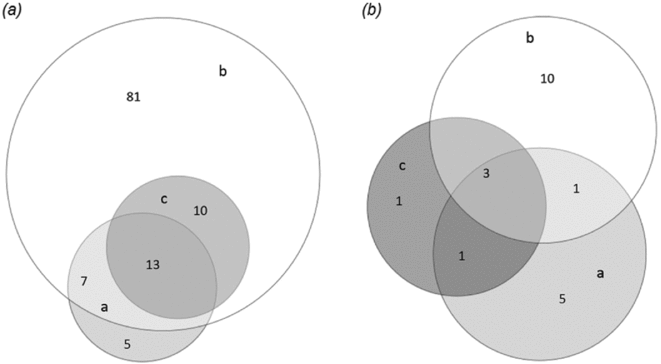
Direct Portuguese translations of the term ‘wetlands’, such as ‘áreas úmidas’ (áreas = land, úmidas = wet), were found only in the current New Forest Code. Several representative Brazilian wetland types, such as swamps, mangroves, lakes, ponds, springs and streams, also were observed in the New Forest Code. Three terms covered man-made ecosystems (dammed watercourses, water reservoirs and artificial water bodies) in the federal ambit. The New Forest Code had the largest number of wetland terms in a single statute (25) (Table 1) and it introduced 12 new wetland terms into the national ambit (federal law and resolutions). However, only five of these terms (hydric resources, Pantanal, surface water, vazantes and wetlands) were added for the first time to Brazilian legislation (Fig. 1(a)). The New Forest Code modestly reduced the overlap of terms between federal and state legislations (Fig. 1(a)).
Venn diagrams comparing the number of (a) terms and their overlap between the New Forest Code, other federal legislations and state legislations and (b) definitions and their overlap between the New Forest Code, other federal legislations and state legislations. a = New Forest Code. b = State legislations (constitutions and ordinary laws). c = Other federal legislations (Forest Code, CONAMA 302 and CONAMA 303).

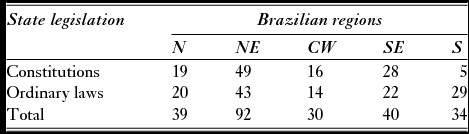
Overall, the greatest numbers of wetland terms were found across the 26 state constitutions, with most of them being found in the Northeast region (Table 2). A direct equivalent to the term ‘wetlands’ was not found in any state constitution. Terminology in state constitutions primarily identified wetland habitats using local words. Of the total 63 wetland terms encountered in state ordinary laws, extensive variation of terms was found across the five Brazilian regions (Table 2). The states with the largest Brazilian wetlands (‘Pantanal wetlands’ in Mato Grosso State – Centre-West region; and ‘varzea’ and ‘igapos’ wetlands in Amazon State – North region) had a higher number of wetland terms in their state legislation. The term ‘wetlands’ was again not found in any state ordinary law.
Number of wetland terms observed in Brazilian state legislation (constitutions and ordinary laws) per Brazilian region (N = North; NE = Northeastern; CW = Centre-West; SE = Southeastern; S = South).

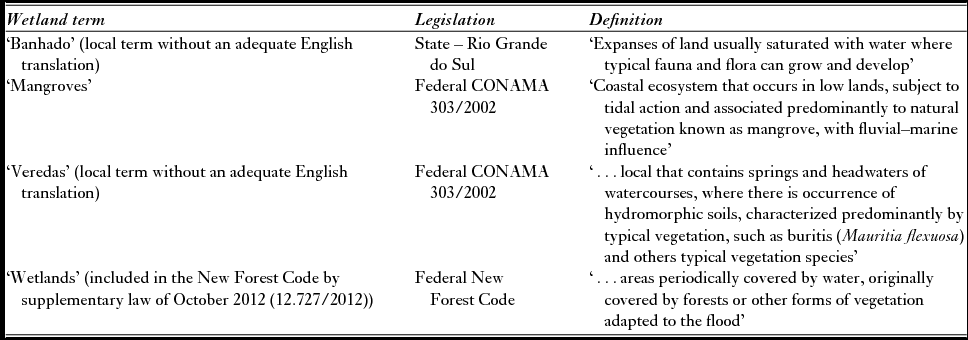
Only 21 of the 116 wetland-related terms listed across all Brazilian legislation were specifically defined by legislators (11 terms are in federal laws and national resolutions, 14 terms are in state ordinary laws and four terms are shared by both legislation types) (Table 1). The New Forest Code had the largest number of wetland definitions in the federal ambit (10) and it introduced five new definitions of wetland terms to Brazilian legislation (flooding area, flooding varzea, floodplain, regular channel and wetlands) (Fig. 1(b)). The New Forest Code reduced the overlap of definitions between federal and state legislations (Fig. 1(b)). Of the 116 wetland terms found across all Brazilian legislation, 115 terms were defined, at least in part, by a major Brazilian dictionary (Ferreira Reference Ferreira2004) and 20 terms were defined by an ecological glossary (ACIESP 1997). Most of the wetland definitions in the Brazilian legislation were vague because they lacked clear descriptors to identify wetland systems such as hydrology, hydric soils or the occurrence of biota adapted for life in water. We found only four definitions in Brazilian legislation that included attributes of water or biota in their descriptions (Table 3): three in federal legislation and one in state legislation. The best definition that we have found in the Brazilian legislation was the definition of the generic term for ‘wetlands’ included in the New Forest Code. This definition was associated with attributes of water and biota (‘areas periodically covered by water, originally covered by forests or other forms of vegetation adapted to the flood’) (Table 3). The other three definitions were not associated with a generic term such as ‘wetlands’, but instead associated with a term for a specific wetland type (e.g. mangroves) or with terms that lacked nationwide application (veredas or banhados) (Table 3).
Wetland terms and their respective definitions in Brazilian legislation that included attributes of water, biota or hydric soil in their descriptions. CONAMA = Conselho Nacional do Meio Ambiente.

DISCUSSION
The high number of wetland terms observed in Brazilian legislation may be related to the large size of Brazil and to its substantial environmental and geomorphological variability (climate, topography, soil and vegetation). The largest number of wetland terms was observed in state legislation probably because state legislators are acquainted with the locally used wetland terms. Variation among Brazilian regions may have occurred either because some regions had more wetlands or because some state legislators exhibit more concern for the conservation of locally important wetlands. State legislation in the Northeast region had more than twice the number of wetland-related terms than any other Brazilian region. The granted protections to local wetland areas in the Northeast region may be related to the relatively low precipitation in the region (400 mm per year), making wetlands important sources of water to the local population.
The New Forest Code of 2012 added five new wetland terms to the overall Brazilian legislation. This number seems low, especially because the New Forest Code was designed to replace a code produced 50 years ago. The five new wetland terms in the New Forest Code modestly reduced the overlap of terms between federal and state legislations. This reduction was a positive trend because the vast majority of the terms introduced were not regional, but rather were generally representative across the country. Of the five terms introduced, only one had only regional relevance. However, the introduction of the regional term ‘Pantanal’ in federal legislation was appropriate since it protects one of the Brazilian wetlands of greatest biodiversity and size at the federal level. Additionally, in terms of conservation, the low number of new terms introduced is not problematic because of the introduction in the New Forest Code of a generic term for ‘wetlands’ (i.e. ‘áreas úmidas’, which is the translation into Portuguese of the term ‘wetlands’). This was an important step forwards for conservation of Brazilian wetland biodiversity. The term for generic ‘wetlands’ introduced in the New Forest Code now should represent all different wetland types across the entirety of Brazil, making most of the regional wetland terms used across all other Brazilian legislation redundant. The insertion of the term ‘wetlands’ into the New Forest Code has important practical implications for the conservation of these ecosystems, since all different Brazilian wetland types would be represented by the same term and thus they all would be protected by law.
Of the 116 wetland terms mentioned in Brazilian legislation, 21 were also defined in the statutes. The five new wetland definitions in the New Forest Code also reduced the overlap of definitions between federal and state legislations. This reduction was positive because the new definitions introduced in the New Forest Code were from terms of greater representativeness throughout the country. Only four wetland terms were defined using clear descriptors (such as water and biota adapted for life in water). The terms ‘mangroves’, ‘veredas’ and ‘wetlands’ were defined in federal legislation and the term ‘banhados’ was defined in a state ordinary law. In terms of conservation, these four definitions were probably the most useful ones observed in Brazilian legislation because they used clear descriptors to identify wetland systems. These definitions shared characteristics of definitions of wetlands proposed for Australia (Paijmans et al. Reference Paijmans, Galloway, Faith, Fleming, Haantjens, Heyligers, Kalma and Loffler1985), Canada (Zoltai et al. Reference Zoltai, Pollett, Jeglum, Adams, Bernier and Winget1975), the USA (Cowardin et al. Reference Cowardin, Carter, Golet and Laroe1979) and recently by Brazilian researchers (Junk et al. Reference Junk, Piedade, Lourival, Wittmann, Kandus, Lacerda, Bozelli, Esteves, Nunes Da Cunha, Maltchik, Schöngart, Schaeffer-Novelli and Agostinho2014). However, three of the four definitions had limitations for the conservation of wetlands nationwide. The term ‘banhado’ is a term that is relevant only in one Brazilian region and its use is restricted to the extreme south of Brazil. This definition was also present only in the state ordinary law; that is, it has no application to the 25 other Brazilian states analysed. The term ‘mangrove’ is widely used nationally, but any wetland protection is restricted to one specific wetland type in Brazil. The term ‘veredas’ also occurs in a federal law, but this term is very local and it is not used across much of the country.
However, the definition of the generic term ‘wetlands’ in the New Forest Code using clear descriptors confers importance in terms of policy. Federal law is hierarchically superior to state constitutions and ordinary laws and this definition should prevail over all other definitions of wetlands in Brazilian legislation. Of the ten new wetland definitions introduced in the New Forest Code, the definition of a generic term ‘wetlands’ was the most important in terms of conservation. The existence of this definition in the New Forest Code will help workers and planners to more easily identify any wetland type throughout the country and consequently provide broad protections to wetland systems. This definition makes it clear that any land flooded by water where aquatic plants have developed, including trees, is a wetland and must be protected by law. This definition protects all types of wetlands, regardless of their size, number of species, habitat diversity or any other wetland attribute.
The definition based on these attributes will help environmental technicians and decision-makers to identify wetland systems and recognize different wetland types. The possibility of error in what is or is not a wetland decreases when definitions are linked to environmental descriptors that are easily observed in the field. This definition in the New Forest Code would make it clear that the drainage of any wetland type – large or small – is prohibited, and those who do so would be breaking Brazilian environmental law.
ACKNOWLEDGEMENTS
We would like to thank Dr Johan Oldekop and two anonymous reviewers for their important suggestions that greatly helped to improve this manuscript.
FINANCIAL SUPPORT
This research was supported by funds from UNISINOS (grant number 02.00.023/00-0) and Conselho Nacional de Desenvolvimento Científico e Tecnológico – CNPq (grant number 555387/2006-2). L. Maltchik, C. Stenert and M.T.F. Piedade hold Research Productivity Grants from CNPq.
CONFLICT OF INTEREST
None.
ETHICAL STANDARDS
None.