Highlights
-
• The scientific literature on returning to driving after a craniotomy is scarce.
-
• Some G20 countries have developed guidelines and laws on returning to driving after a craniotomy.
-
• Using accepted risk thresholds and calculations from the epilepsy literature, we provide a preliminary framework to guide clinicians’ recommendations.
Introduction
The Canadian Council of Motor Transport Administrators (CCMTA) national standards and their equivalents worldwide suggest that following craniotomy, patients with postoperative neurological impairments (e.g., hemiparesis, cognitive deficits, hemianopsia) undergo specialized evaluation to determine their fitness to drive.Reference Williams1–Reference McLean, Mueller, Buttery and Mackey6 Similarly, patients with pre- or perioperative seizures must stop driving based on specific guidelines and laws (e.g., 6 months without seizure in Canada).Reference Williams1–Reference Krumholz8 Currently, standardized Canadian guidelines pertaining to driving restrictions following cranial procedures in patients with no pre- or perioperative history of neurological deficit or seizures are lacking.
In patients without preoperative seizures, undergoing craniotomy increases the risk of seizures in the ensuing months.Reference Giraldi, Vinsløv Hansen, Wohlfahrt, Fugleholm, Melbye and Munch9 This risk varies by type of procedure and underlying pathology. For example, the 6-month cumulative risk of postoperative seizures has been reported at 17% following glioblastoma resection (in patients without prior seizures), 4% following clipping of an unruptured aneurysm and 1% following resection of a cranial nerve tumor such as a schwannoma.Reference Giraldi, Vinsløv Hansen, Wohlfahrt, Fugleholm, Melbye and Munch9 Given the absence of standardized guidelines and differences in risk profiles based on underlying pathology, it is perhaps not surprising that driving recommendations post-craniotomy greatly vary among practicing Canadian neurosurgeons (Sonfack et al. 2024; reference joint submission).
The overarching aim of this study was to broadly review and synthesize the existing evidence on post-craniotomy driving recommendations and seizure risk in order to delineate an appropriate timeframe for safe return to driving following craniotomy in patients not otherwise limited by neurological deficits or a history of epilepsy. Specific objectives were (1) to review the published literature regarding return to driving recommendations post-craniotomy, (2) to review post-craniotomy return to driving recommendations from the Driving and Vehicle Licensing Agency (DVLA) of G20 countries, (3) to perform a scoping review of seizure risk post-craniotomy and (4) to use risk calculations and accepted risk thresholds derived from the epilepsy literature to formulate evidence-based recommendations for return to driving post-craniotomy.
Methods
Literature review on return to driving after a craniotomy
The Preferred Reporting Items for Systematic Reviews and Meta-Analysis Statement (PRISMA) guidelines and checklist were followed.Reference Page, McKenzie and Bossuyt10 The literature search was carried out using Medline (Ovid), Embase and PubMed databases. Search strategies are detailed in Appendices A–C. Databases were searched in April 2025 using a mixture of keywords and MESH terms related to automobile driving, craniotomy and seizures. Additionally, we searched titles, abstracts and keywords sections for synonyms of MESH terms (e.g., car, automobile, driving, driving guidelines, cranial procedures, neurosurgery and epilepsy). Our search strategy was verified by a medical librarian. Abstracts were screened by two independent reviewers (DJNS, DB) according to the inclusion and exclusion criteria. To qualify for inclusion, studies were required to (1) mention guidelines for return to driving after craniotomy or (2) assess the seizure risk in the months following a craniotomy among patients without a preoperative history of epilepsy. Abstracts were screened using Covidence (Veritas Health Innovation, Melbourne, Australia).11 No publication date restriction was applied. Gray literature (e.g., online, non-peer-reviewed documents and pre-print publications) was included. Only studies written in English or French were retained. Conference abstracts, studies without specific driving guidelines and literature including patients with a history of preoperative seizures were excluded. Full text review of selected articles was also performed by two independent reviewers (DJNS, DB). Discrepancies were resolved by a third independent reviewer (RM). Data elements extracted included article title, first author, year of publication, country of study, indications for craniotomy, seizure risk assessment, anti-seizure prescription (drug, dosing and duration), length of follow-up and driving recommendations.
Review of driving guidelines in G20 countries
We separately performed a comprehensive review of DVLA guideline recommendations for return to driving among G20 countries (Argentina, Australia, Brazil, Canada, China, France, Germany, India, Indonesia, Italy, Japan, Republic of Korea, Mexico, Russia, Saudi Arabia, South Africa, Turkey, the United Kingdom, the USA, European Union and the African Union). Official publications, regulations and online resources were obtained via the respective DVLA websites. We utilized Google Translate for websites in languages other than English and French. We additionally searched North American institution-specific guidelines for post-craniotomy counseling. The references contained in these documents were also screened.
Evidence-based approach to driving recommendations
To facilitate an evidence-based approach to driving recommendations following craniotomy, we performed separate scoping literature reviews of (1) literature pertaining to driving recommendations after a first unprovoked seizure, in an effort to identify seizure risk calculations and accepted risk thresholds for driving in patients with epilepsy, and (2) literature pertaining to the risk of epilepsy post-craniotomy, in patients without prior epilepsy. We then applied these risk calculations and thresholds to the post-craniotomy population using available data on the risk of postoperative seizures.
Results
Guidelines for return to driving
Our initial search yielded a total of 85 articles across databases after excluding duplicates (Figure 1). Two articles met the inclusion criteria.
Flow diagram of the article selection process from the Medline (Ovid), Embase and PubMed databases.

-
• Charmley et al. aimed to provide return to driving guidelines following deep brain stimulation surgery.Reference Charmley, Kimber, Mahant and Lehn12 They highlighted sparse literature and supporting data. They advised a period of 6 weeks without driving for personal vehicles, while patients operating commercial vehicles were advised to wait 6 months prior to resuming driving. In both instances, surgery and the associated recovery had to be uneventful and the underlying disease controlled. Disease control was defined as adequate management of symptoms that might affect driving performance (e.g., cognitive dysfunction, motor symptoms and excessive daytime sleepiness).
-
• Cho et al. reported results of a survey examining practice patterns of Australian and New Zealand neurosurgeons regarding the utilization of Prophylactic Antiepileptic Drugs and recommendations for driving restrictions following craniotomy surgery in patients without a history of seizures.Reference Cho and Olson13 Driving restrictions varied among respondents, but the most common driving restriction recommendation following craniotomy was 6 months, consistent with the Austroads recommendations.Reference Cho and Olson13 There was some variability in recommendations, as restriction durations stated by Austroads are advisory and the decision is ultimately left to the clinician.
Review of guidelines in G20 countries
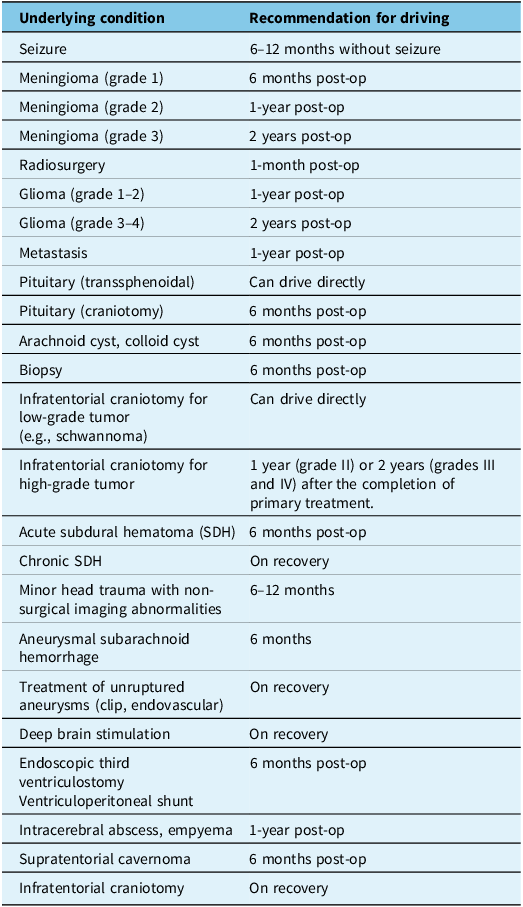
Table 1 summarizes recommendations for return to driving following cranial procedures in G20 countries. Our review identified three national guidelines for return to driving after a craniotomy (New Zealand, Australia and the United Kingdom). We also found local recommendations on the website of individual institutions. New Zealand’s guidelines suggested waiting at least 3 months before resuming driving following a craniotomy for patients presenting without seizures; 6 months was recommended if a craniotomy was performed for a brain tumor.14 Australia recommends that driving be avoided for 6 and 12 months for personal and commercial vehicles, respectively.15 The UK DVLA has a comprehensive guideline for return to driving after a craniotomy, which stratifies based on pathology16 (see Table 2). For instance, following a craniotomy to remove a meningioma, the recommendations for the return to driving depend on the meningioma’s pathological grade: 6 months without seizure for grade 1, 12 months if grade 2 and 24 months if grade 3. Similarly, following craniotomy for glioma resection, the recommendation is to wait 12 months without seizure if the pathology is low grade (WHO 1 or 2) and 24 months if the pathology is high grade (WHO 3 or 4). In contrast, patients who have undergone transsphenoidal surgery for pituitary adenoma, infratentorial craniotomy for low-grade tumors or craniotomy for unruptured aneurysms can return to driving immediately without consideration for postoperative seizure.16
Recommendations for return to driving following uncomplicated cranial procedures in countries of the G20

* The recommendations provided by the Driving and Vehicle Licensing Agency of these countries refer specifically to the postoperative seizure risk in patients who do not have a prior history of seizures or significant neurological impairment.
Recommendations for return to driving following cranial procedures from the UK Driving and Vehicle Licensing Agency16

Select academic institutions have developed specific driving protocols that were not captured in the aforementioned search.17 One such protocol from the University of Colorado Denver recommends that patients resume driving after 1 week if they have never experienced a seizure, are no longer on narcotic pain medication and have no neurological impairments.17 While Canada lacks formal national recommendations, some institution-specific guidelines exist.18,19 For instance, the University Health Network, Toronto, Ontario, suggests that patients should avoid driving for at least 2 weeks after craniotomy surgery.19 The institutional recommendation at the University of Montreal Hospital Center18 (Montreal, Quebec) is to avoid driving for at least 2 months after craniotomy surgery.
Risk of seizures following a craniotomy
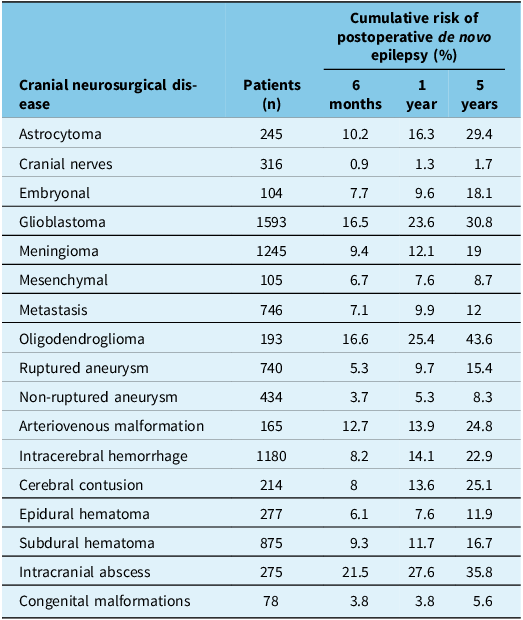
We performed a scoping review to determine seizure risk following craniotomy.Reference Giraldi, Vinsløv Hansen, Wohlfahrt, Fugleholm, Melbye and Munch9,Reference Horiuchi, Kanaya and Horiuchi20–Reference Kuijlen, Teernstra, Kessels, Herpers and Beuls34 Most studies stratified postoperative seizures as “early” (in the first week after surgery) and “late” (more than 1 week after surgery). Approximately half of postoperative seizures occurred early.Reference Horiuchi, Kanaya and Horiuchi20,Reference Ersoy, Ridwan, Grote, Coras and Simon22,Reference Baumgarten, Sarlak and Monden24,Reference Zheng, Chen and Fu31,Reference Bogdanovic, Ristic and Ilic32 Most studies had a small sample size (n < 100), included patients with preoperative epilepsy and had variable durations of follow-up. However, a single study had a sufficient sample size to stratify the risk of postoperative seizures based on etiology, as well as a sufficient follow-up to estimate the chance of occurrence of seizure in the next year (COSY) required to calculate an accident risk ratio (ARR) and formulate driving recommendations.Reference Giraldi, Vinsløv Hansen, Wohlfahrt, Fugleholm, Melbye and Munch9 Giraldi et al. recently reported a nationwide register-based cohort study in Denmark where they evaluated postoperative de novo epilepsy after craniotomy.Reference Giraldi, Vinsløv Hansen, Wohlfahrt, Fugleholm, Melbye and Munch9 They included approximately 9000 patients without prior epilepsy who underwent index craniotomy in Denmark between 2015 and 2016. They calculated the cumulative risk of de novo seizure at 6 months, 12 months and 5 years postoperatively Reference Giraldi, Vinsløv Hansen, Wohlfahrt, Fugleholm, Melbye and Munch9 (summarized in Table 3). At 12 months post-craniotomy, patients had a cumulative risk of de novo epilepsy of 13.9% (which varied based on etiology). For example, the cumulative risk was 25% at 12 months for patients operated on for glioblastoma or low-grade glioma, compared to 5% for patients operated on for unruptured aneurysms.
Cumulative risk of postoperative de novo epilepsy after a craniotomy for various underlying pathologies, based on a national registry of 9000 patients without preoperative epilepsy (modified from Giraldi et al.Reference Giraldi, Vinsløv Hansen, Wohlfahrt, Fugleholm, Melbye and Munch9)

Evidence-based approach to driving recommendations and risk calculations
We used data directly from the supplementary material including in Giraldi et al. rather than performing a meta-analysis of small heterogeneous studies as we felt the rigorous, registry-based, high sample size data provided in Giraldi et al. would be more reliable and more granular for underlying pathologies. Based on current epilepsy guidelines, patients who have had a single unprovoked seizure are typically allowed to return to driving 6 months after a seizure, provided their risk of seizure recurrence in the next year is below 20%.Reference Brown, Lawn, Lee and Dunne35–38 Drivers can regain their “heavy (commercial) vehicle” license after 5 years, provided their risk of a recurrence is below 2%.Reference Brown, Lawn, Lee and Dunne35–Reference Rémillard, Zifkin and Andermann40 Although somewhat arbitrary, these recommendations are based on the calculation of patients’ ARR: the patient-specific relative risk of a motor vehicle collision compared with the general population.Reference Brown, Lawn, Lee and Dunne35,38 Many conditions and demographic characteristics may increase the ARR, for instance, being a male driver age < 25 years (ARR = 7) or age > 70 years (ARR = 2).38 The European Working Group on Epilepsy and Driving concluded that in patients with epilepsy, ARR < 2 is acceptable to allow driving.Reference Sonnen37,38 Calculating an individual’s ARR compared to the general population can use the formula:
 $$ ARR={\left(COSY \times D \times X\right) \over F+1} $$
where:
COSY = Chance of occurrence of seizure in the next 12 months (as a ratio)
D = Driving time (as a proportion of time spent driving)
X = Probability of a seizure at the wheel causing a fatal accident
F = Overall community fatal accidents per driver per year
Regarding the calculation of the ARR related to epilepsy, expert working groups have assumed a mean driving time of 1 h/day, a 1.8% risk of fatal accident if a seizure occurs at the wheels (60% accident rate, of which 3% are deadly) and an equally distributed risk of seizure among time of day and week.38 The risk of fatal accident due to seizures is compared to the overall rate of community fatal accidents per driver per year (1/7000 per year).38 By these calculations, if the COSY is less than 20%, the ARR related to epilepsy falls in an “acceptable” range for driving (<2). For a first seizure, a COSY < 20% is reached after 6 months without seizure, hence the general recommendation of 6 months of seizure freedom required to resume driving. When considering a permit to drive a large commercial vehicle, the epilepsy literature suggests that a COSY < 2% is required, given the higher probability that a seizure at the wheel would cause a fatal accident or even mass casualty (X variable in the formula).38
If we apply these same standards to patients who undergo craniotomy, procedures that do not violate the pia (e.g., clipping of an unruptured intracranial aneurysm or resection of a grade 1 meningioma) imply a postoperative risk of seizure of <20% throughout the first 12 months (5%–10%).Reference Giraldi, Vinsløv Hansen, Wohlfahrt, Fugleholm, Melbye and Munch9 Therefore, an extended restriction of driving may not be warranted with regard to seizure risk in these patients; they may resume driving immediately if they do not take opioid medication and do not have significant neurological impairment. However, procedures involving a violation of supratentorial pia (e.g., resection of a glioblastoma or low-grade glioma) imply a postoperative risk of epilepsy of more than 20% in the first 12 months (20%–25%).Reference Giraldi, Vinsløv Hansen, Wohlfahrt, Fugleholm, Melbye and Munch9 For these patients, waiting at least 1 month before driving may be reasonable. The best available data on postoperative seizure risk after a craniotomy only provides seizure risk at 6 months, 12 months and annually thereafter; granular data is lacking for seizure risk at 1 month or 2 months postoperative, similarly at 13 months or 14 months. As such, we cannot presently calculate a precise COSY at these time points. Therefore, based on currently available data, it is not possible to precisely calculate exactly how long after craniotomy patients with higher-risk pathologies must remain seizure free to reach a COSY < 20% (hence an ARR < 2). In the literature, about half of postoperative seizures occur within the first week (“early postoperative seizures”).Reference Horiuchi, Kanaya and Horiuchi20,Reference Ersoy, Ridwan, Grote, Coras and Simon22,Reference Baumgarten, Sarlak and Monden24,Reference Zheng, Chen and Fu31,Reference Bogdanovic, Ristic and Ilic32 Given the high proportion of overall postoperative seizures occurring early (within 1 week), the COSY < 20% is likely reached within 1 month without seizures in all patients, even among those with higher-risk underlying conditions (e.g., high-grade glioma).Reference Giraldi, Vinsløv Hansen, Wohlfahrt, Fugleholm, Melbye and Munch9 Since this is an estimation not backed by primary data from Giraldi et al., we opt for a more vague and nuanced recommendation: avoiding driving for at least 1 month without seizure after a craniotomy performed for higher-risk conditions.
Regarding the driving of large commercial vehicles, the annual risk of seizure (COSY) in the first postoperative year is more than 2% for all documented conditions in Giraldi et al. except for surgeries performed for cranial nerve pathologies (e.g., microvascular decompression for trigeminal neuralgia; 1.3% at 1 year, see Table 3). For some other low-risk conditions (craniotomy for the clipping of unruptured aneurysms, congenital malformations such as arachnoid cysts, meningioma, subdural and epidural hematoma), the annual risk of seizures after one postoperative year without seizure becomes less than 2% for the ensuing years. For all higher-risk conditions (low-grade glioma, high-grade glioma, intracranial abscess), a COSY < 2% is never reached, even in patients who have not had a seizure for 1 year postoperatively. Longer-term data (for instance, over 5 years postoperatively) is not available.
Discussion
Most global jurisdictions establish guidelines for return to driving in patients at higher risk of seizures, such as patients treated for epilepsy or patients with neurological deficits. Although the risk of seizures increases after a craniotomy, there are currently no Canadian guidelines providing an appropriate timeframe for safe return to driving following craniotomy in patients not otherwise limited by neurological deficits or a history of epilepsy. Herein, we systematically reviewed the literature on returning to driving after a craniotomy, reviewed the DVLA guidelines from G20 countries for the return to driving after a craniotomy and applied risk estimate equations commonly employed in patients with epilepsy to the post-craniotomy population to derive absolute risk ratios and formulate return to driving recommendations.
A pragmatic approach for return to driving following craniotomy in patients without a prior history of seizures, based on accepted risk thresholds used for patients with epilepsy:
-
1. After a craniotomy performed for “higher-risk” conditions (e.g., low-grade or high-grade glioma, high-grade meningioma, supratentorial metastasis, abscess): patients may resume driving after a least 1 month without seizures. Based on available data, they should not return to driving heavy commercial vehicles for at least 5 years without a seizure.
-
2. After a craniotomy performed for a “lower-risk” condition (infratentorial pathology, transsphenoidal surgery, supratentorial surgery without pia violation, such as clipping of an unruptured aneurysm or resection of a grade 1 meningioma), patients can resume driving immediately if they do not require opioid medication and do not have significant neurological deficits (i.e., seizure risk is not a factor). For heavy commercial vehicles, patients with lower-risk conditions may resume driving after 12 months without seizure.
These recommendations pertain specifically to the seizure risk after craniotomy in patients with no prior history of epilepsy or neurological deficit at the time of surgery or in the perioperative period. Other variables that may preclude return to driving but are outside the scope of this review include prior history of epilepsy, ongoing opioid intake for pain relief, significant neurological impairment (visual, motor, cognitive) requiring specialized evaluation, poor insight, advanced age, poor performance status and other comorbidities. These conditions are covered separately in the CCMTA national standards and their international counterparts.Reference Yale, Hansotia, Knapp and Ehrfurth5 Importantly, the recommendation regarding fitness to drive must be made after a clinical re-assessment evaluating these factors and not merely after some postoperative delay without seizures. Some patients at higher risk due to a progressive condition (glioma, glioblastoma) must be re-assessed more frequently thereafter for new or progressive neurological deficits or symptoms suspect of seizures.
Our recommendations are limited by the availability of good-quality data for every variable and timepoint. For instance, the recommendation of “at least 1 month” is purposefully vague; Giraldi et al. provide seizure risks at 6 months, 12 months and 5 years, thus not allowing precise risk calculations of COSY after 1 versus 2 months without seizure. In addition, other variables not included in this study likely impact the risk of de novo postoperative seizures, such as the location of the lesion or tumor (temporal more at risk, infratentorial at much less risk), histological subtype (more aggressive histological or molecular phenotype), use of intraoperative cortical stimulation, extent of resection (less than gross total) and postoperative tumor progression.Reference Li, Li and Fang41–Reference Stritzelberger, Gesmann and Fuhrmann43 Eventually, the use of noninvasive methods such as postoperative Electroencephalography (EEG) may help better stratify the risk of de novo postoperative epilepsy.Reference Freund, Probasco and Ritzl44 Using prophylactic anti-epileptic medication in the postoperative period in seizure-naïve patients is currently not recommended by the Society for Neuro-Oncologydue to insufficient evidence (level C recommendation).Reference Walbert, Harrison and Schiff45,Reference Greenhalgh, Weston, Dundar, Nevitt and Marson46
These recommendations are more lenient than existing recommendations such as the UK DVLA, which precludes driving up to 24 months without seizures for some high-risk conditions. The acceptable ARR and COSY to allow return to driving is inherently arbitrary, subject to cultural norms and a complex balancing of the need for road safety and the need for patient autonomy. Males younger than 25 years old have an ARR of 7 as a group (much higher than accepted thresholds for epileptic patients) yet are allowed to drive without restriction. Overly conservative recommendations risk being ignored altogether by patients. For example, when Belgium required 24 months of seizure-freedom to resume driving for patients with epilepsy, a group of neurologists estimated that 70% of their epilepsy patients who were not allowed to drive still did so.38 Driving recommendations must appear reasonable to patients and be internally consistent with recommendations for similar conditions. Therefore, our goal was to design an approach consistent with risk thresholds accepted for epilepsy and a first unprovoked seizure in Canada (ARR < 2, COSY < 20%). The UK DVLA has a uniformly conservative approach to driving recommendations in neurological and other medical conditions, which is also internally consistent.
Ultimately, clinicians may adapt their driving recommendations to the individual clinical situations, following the rationale described in this manuscript.
Conclusion
Craniotomy increases the risk of postoperative seizures, particularly for intra-axial, supratentorial pathologies. Herein, we reviewed the literature and existing guidelines regarding the return to driving after uncomplicated craniotomy and used an evidence-based approach to formulate recommendations consistent with risk thresholds accepted for patients with epilepsy. The evidence-based approach to recommendations presented in this manuscript is a first step toward the formulation of expert consensus guidelines for return to driving after cranial procedures. More data on the timeline of seizure occurrence in the first postoperative weeks and months is needed to refine these recommendations.
Supplementary material
The supplementary material for this article can be found at https://doi.org/10.1017/cjn.2025.10430.
Acknowledgments
We thank Frederic Bergeron, our medical librarian, for verifying our search strategy.
Author contributions
DB and DJNS participated equally in the project. DB and DJNS drafted the initial version of the manuscript. DB, DJNS, RM, MAM and MAR contributed to data collection and analysis. SW and SDC supervised the project. All authors approved the final version of the manuscript.
Funding statement
No direct funding was obtained for this study.
Competing interests
The authors report no conflict of interest related to this study. The Canadian Neurosurgery Research Collaborative (CNRC) receives an annual operational grant from the Canadian Neurosurgical Society. SDC reports consulting fees for Medtronic Canada, Stryker Canada, Cerapeutics and DePuy Canada and research grants from Praxis.
Ethical standard
The ethical committee approval was not required given the article type (systematic review).