Patients undergoing tetralogy of Fallot repair have in general uncomplicated post-operative course. However, some patients develop right ventricle restrictive physiology that affects post-operative course. This is characterised by the presence of stiff hypertrophic right ventricle, diastolic dysfunction and reduced right ventricle compliance. In the presence of restrictive physiology, the right ventricle functions as stiff conduit between right atrium and pulmonary artery. The diastolic filling becomes impaired with resultant increase in central venous pressure, decrease cardiac output, ascites and increase pleural drainage. Usually, right ventricle restrictive physiology is transient and improves within few days up to few weeks post-surgery. Reference Sandeep, Huang, Xu, Su, Wang and Sun1,Reference Cullen, Shore and Redington2
There are risk factors for developing right ventricle restrictive physiology after tetralogy of Fallot repair such as late surgical repair in comparison to early repair. Reference Munkhammar, Cullen, Jogi, de Leval, Elliott and Norgard3 Furthermore, recent study suggested that low oxygen saturation, increased haematocrit level, ventricular hypertrophy, right ventricular enlargement, transannular patch repair, longer duration of cardiopulmonary bypass and aortic cross clamping are peri-operative risk factors associated with right ventricle restrictive physiology. Reference Sandeep, Huang, Xu, Su, Wang and Sun1
To facilitate post-operative course in children undergoing tetralogy of Fallot surgical repair particularly those at risk of right ventricle restrictive physiology, many surgeons deliberately leave interatrial communication or create one intra-operatively which allows a vent for right side heart to the left side. In the presence of right ventricle restrictive physiology, interatrial communication permits blood shunting from right side venous system to the left side system, maintaining good cardiac output at the expense of systemic saturation. Reference Laudito, Graham and Stroud4
Despite its theoretical plausibility, the true effects of interatrial communication on post-operative course of children undergoing tetralogy of Fallot repair has not been objectively evaluated. We aim in this study to evaluate the effects of having interatrial communication on the post-operative intensive care unit course of children who underwent tetralogy of Fallot repair. Furthermore, we analysed the incidence of right ventricle restrictive physiology, and the effects of early repair performed before 3 months of age on the post-operative course of children undergoing tetralogy of Fallot repair.
Methods
We conducted a retrospective cohort study between 2003 and 2018 that included all children from birth till 14 years of age who had tetralogy of Fallot surgical repair in single centre experience. Only patients who had primary repair were included. We excluded patients palliated with systemic to pulmonary shunt or by catheter intervention. Institutional review board approved the study that was conducted in paediatric cardiac intensive care unit in a tertiary cardiac centre.
During the study period, three surgeons were operating on children with congenital heart diseases, and all cases were managed post-operatively by a group of paediatric cardiac intensivists in a dedicated paediatric cardiac intensive care unit.
When achievable surgical sparing of pulmonary valve technique was generally aimed for repair of tetralogy of Fallot cases. Decision to close, leave or create interatrial communication was according to surgeon discretion. One surgeon favoured closing any inter atrial septal communications leaving no connection between both atria irrespective of patient age, weight or severity of tetralogy of Fallot. The second surgeon closes large inter atrial communication leaving small patent foramen ovale. The third surgeon leaves all patent foramen ovale and in case there is no patent foramen ovale, he would open small inter atrial communication ranging between 0.4 and 0.8 cm. Presence or closure of inter atrial communication were confirmed by intra-operative transesophageal echocardiogram and post-operative transthoracic echocardiogram.
We divided subjects into two groups: tetralogy of Fallot repair with interatrial communication (TOFASD) group and group of tetralogy of Fallot cases with no interatrial communication labelled as intact atrial septum (TOFIAS) group. Furthermore, we used propensity matching score with one-to-one matching ratio to compare TOFASD group with comparable matched cases of TOFIAS group. We matched expected variables that may affect the outcome and post-operative course including age, weight, cardiopulmonary bypass time, cross clamp time and whether the patient has right ventricle restrictive physiology or not post repair. Various surgical techniques applied during repair that may affect study outcome including valve-sparing, ventriculotomy, or trans-annular patch augmentation of right ventricle outflow tract were comparable among matched groups.
We defined early repair if the age at surgery was less than 3 months. Reference Pigula, Khalil, Mayer, del Nido and Jonas5 Usual repair was considered if the age at surgery equal or more than 3 months. We identified right ventricle restrictive physiology if there is a diastolic forward flow at the pulmonary valve continuous Doppler waves in post-operative echocardiography. Reference Cullen, Shore and Redington2 In our study, we depended mainly on echocardiographic features of right ventricle restrictive physiology for diagnosis. However, we correlated the echocardiographic findings with clinical signs of right ventricle restrictive physiology that included elevated central venous pressure, tachycardia and hypotension. Whereas we adapted echocardiographic criteria for RVRP diagnosis, we excluded other causes that may mimic right ventricle restrictive physiology such as pericardial effusion, junctional ectopic tachycardia and tamponade.
During the first 72 hours post-surgery, we calculated highest vasoactive inotropic score Reference Gaies, Gurney and Yen6 serum lactic acid and creatinine levels. We determined lowest consistent peripheral oxygen saturation (SpO2) reading as reported by at least two consecutive readings documented by nursing charting of vital signs while O2 was supplemented. The cumulative duration of all types of positive pressure ventilation including invasive and non-invasive ventilation were documented. Duration and total amount of chest tubes drainage were calculated, and the amount was indexed to body weight. We determine highest post-operative creatinine and development of acute kidney injury according KDIGO staging criteria (https://kdigo.org/wp-content/uploads/2016/10/KDIGO-2012-Blood-Pressure-Guideline-English.pdf).
Continuous variables were presented as mean ± standard deviation and compared using student t-test. Continuous skewed data was presented as median [inter quartile range 25−75%] and compared by Mann−Whitney test. Categorical variables were presented as number (percentage) and compared using Chi-square test or Fisher exact test as appropriate. A p value of less than or equal to 0.05 was considered to be statistically significant. Statistical analysis was conducted using SAS 9.4 (SAS Institute Inc., Cary, NC, USA).
Results
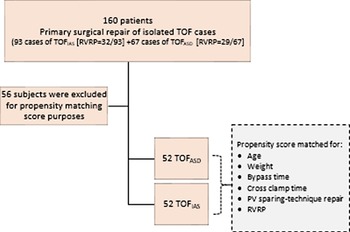
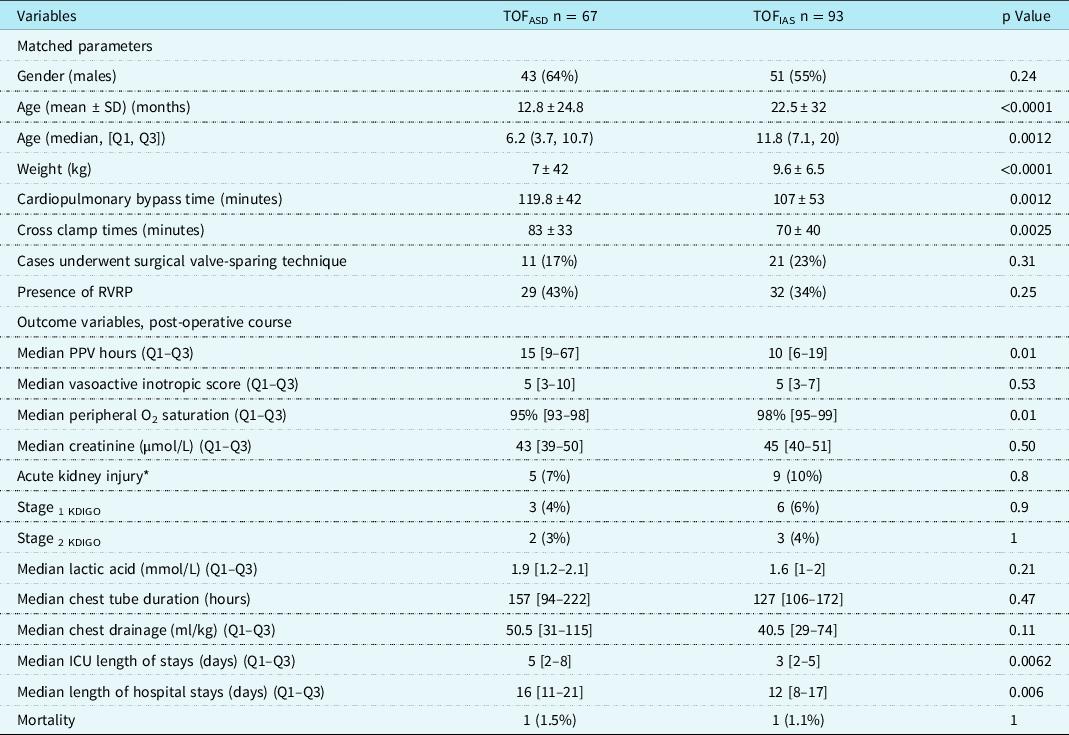
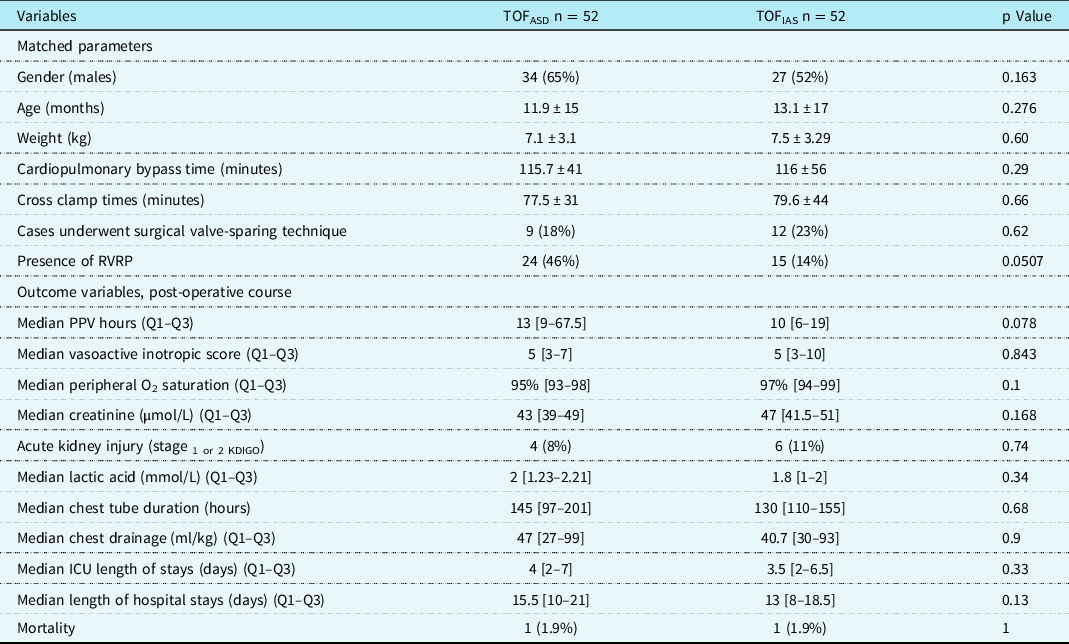
During study period (160) children had tetralogy of Fallot surgical repair. They included (93) cases of TOFIAS (58%) and (67) cases of TOFASD (42%). Fifty-six patients were excluded for the propensity matching purposes (Fig 1). As such, propensity score selected 52 subjects with TOFIAS and matched to 52 subjects with TOFASD. Table 1 demonstrates comparison in the variables between both groups for all 160 patients before propensity matching while Table 2 demonstrates the difference in demographic and outcome variables after propensity matchings. Before matching, TOFASD group had younger children with lower body weight (Table 1). After matching, both groups had comparable variable including weight, age, cardiopulmonary bypass time, cross clamp time, surgical valve-sparing technique repair and incidence of RVRP (Table 2).
Distribution of tetralogy of Fallot cases between TOF-IAS and TOF-ASD groups before and after propensity score matching. RVRP: Right ventricle restrictive physiology.

Patients’ characteristics and outcome variables in 160 children underwent TOF repair with and without interatrial communication before propensity score matching

ICU = intensive care unit; PPV = positive pressure ventilation; RVRP = right ventricle restrictive physiology.
* Acute kidney injury was classified based on KDIGO criteria; https://kdigo.org/wp-content/uploads/2016/10/KDIGO-2012-Blood-Pressure-Guideline-English.pdf.
Patients’ characteristics and outcome variables in 104 children underwent TOF repair with and without interatrial communication post propensity score matching (1:1)

ICU = intensive care unit; PPV = positive pressure ventilation; RVRP = right ventricle restrictive physiology.
Post-surgery and before propensity matching, TOFASD group had lower peripheral oxygen saturation, required longer positive pressure ventilation and longer intensive care and hospital stay in comparison to TOFIAS group with p values of (0.014, 0.0101, 0.0062, 0.006), respectively (Table 1). After propensity matching, there were no statistically significant differences in the outcome variables between TOFIAS and TOFASD groups (Table 2).
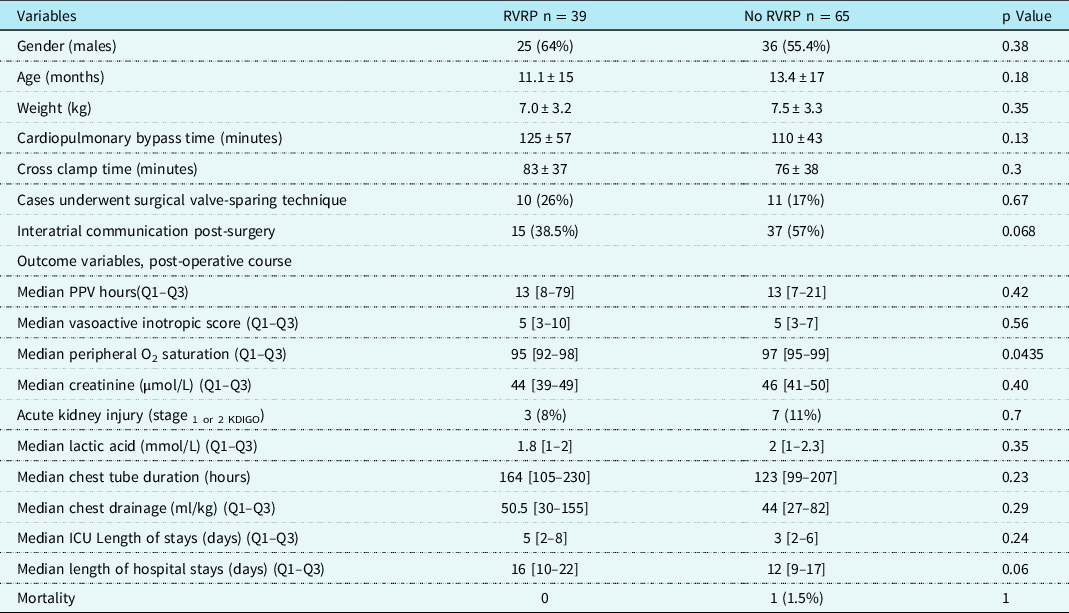
Acute kidney injury mainly stages 1 and 2 KDIGO occurred in 10 and 7% of TOFIAS and TOFASD groups, respectively (p = 0.8). None of our patients required renal replacement therapy or extracorporeal membrane oxygenation. One case in TOFASD group and one case from TOFIAS group expired. Before propensity matching 61/160 (38%) patients had right ventricle restrictive physiology by post-operative echocardiography. After propensity matching 39/104 (38%) cases had RVRP with no statistical difference in the incidence of right ventricle restrictive physiology between TOFIAS and TOFASD groups. Table 3 demonstrates the difference in variables between patients who developed right ventricle restrictive physiology and those who did not post propensity matching score. Age and weight were not risk factors for developing right ventricle restrictive physiology (Table 3). Except for mild desaturation [94.7% (4.04) versus 95.3% (8.41)] noted in RVRP in comparison to no right ventricle restrictive physiology groups (p = 0.0435), other outcome variables were not different. Right ventricle restrictive physiology did not affect the post-operative course, that is, vasoactive inotropes score, levels of creatinine and lactic acid, duration and amount of chest drainage and duration of positive pressure ventilation, intensive care unit and hospital stay (Table 3).
Association of participants’ characteristics and outcome variables with post-operative right ventricle restrictive physiology post propensity score matching

Demographic and peri-operative variables of RVRP and No RVRP groups.
RVRP = right ventricle restrictive physiology.
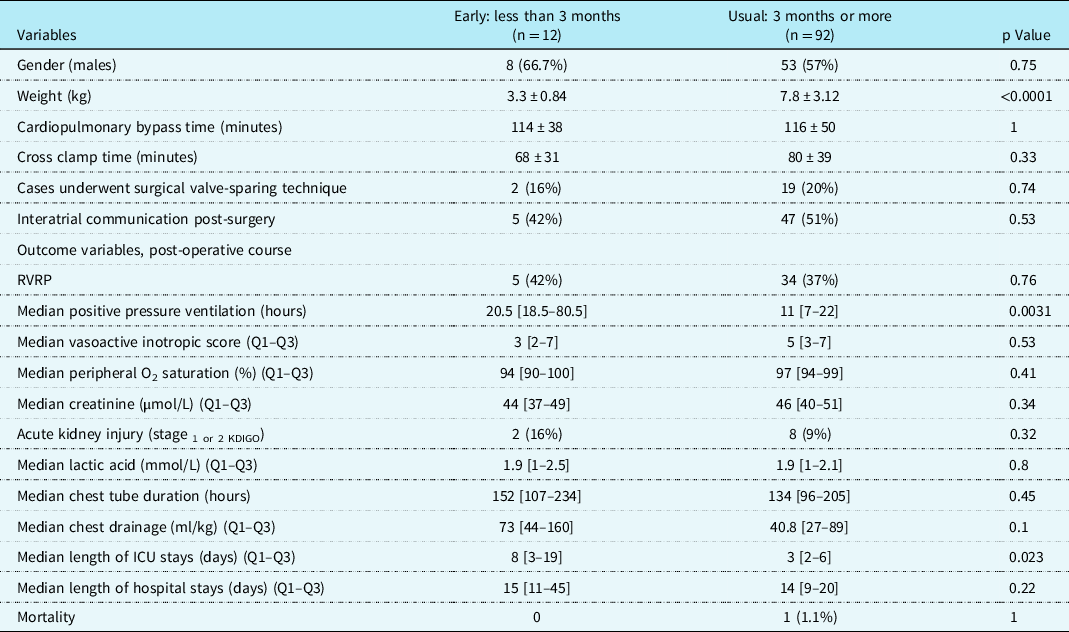
Twelve out of 104 matched patients (12%) were operated early before 3 months of age while the rest of the patients [92, (88%)] were operated as usual. Early repair did not prolong the time of surgery (Table 4). Younger and smaller body weight patients required longer positive pressure ventilation (20.5 [18.5–80.5] hours versus 11 [7–21.5] hours, p = 0.003) and more intensive care unit stay (8 [2.5–18.5] days versus 3 [2–6] days, p = 0.02). In comparison to patients who had early versus usual repair, peripheral oxygen saturation post-operatively, vasoactive inotropes score, amount and duration of chest drainage, serum lactic acid, creatinine levels, acute kidney injury incidence and length of hospital stay were statistically indifferent (Table 4).
Association of participants characteristics and outcome variables with age at the time of surgery post propensity score matching

Discussion
The incidence of right ventricle restrictive physiology after tetralogy of Fallot repair ranges between 50 and 70%. Reference Sandeep, Huang, Xu, Su, Wang and Sun1 In our patients’ population, we observed right ventricle restrictive physiology in almost 40% of children who had tetralogy of Fallot surgical repair. It manifests as slow recovery after surgery with increase central venous pressure, ascites, pleural effusion, and low cardiac output state. There are suggested risk factors for developing right ventricle restrictive physiology that include use of transannular patch during repair, Reference Sachdev, Bhagyavathy, Varghese, Coelho and Kumar7 having right ventricle enlargement and post-operative pulmonary insufficiency. Reference Samyn, Kwon and Gorentz8
To minimise the effects of right ventricle restrictive physiology, some surgeons favour leaving inter-atrial communication or even creating small interatrial communication. The principle of this communication that it vents out the right ventricle by decreasing its preload while it improves left ventricle cardiac output at the expense of lower saturation. Reference Sandeep, Huang, Xu, Su, Wang and Sun1 In one study, the authors described one-way valved atrial septal patch in patients at risk for developing right heart failure post-surgery due to hypoplastic right heart or long-standing pulmonary hypertension. The authors concluded that the use of this one-way valve may prevent right heart failure and ease post-operative care. Reference Ad, Birk, Barak, Diamant, Snir and Vidne9 Children who had tetralogy of Fallot repair with interatrial communication had lower partial pressure of oxygen and peripheral oxygen saturation with their nadir levels reaching 48 hours post-surgery. Reference Laudito, Graham and Stroud4 Furthermore, majority of patients with interatrial communication demonstrated slow improvement post-surgery and by the time of hospital discharge their oxygen saturation usually become normal. Reference Laudito, Graham and Stroud4
Although the practice of leaving or creating interatrial communication appears to be well tolerated by patients, their benefits have not been studied in randomised trials. On the other hand, there are some surgeons who favour complete repair with leaving no inter-atrial communication or closing any interatrial communication if present. Reference Sousa Uva, Lacour-Gayet and Komiya10 Furthermore, closing any source of right to left shunt prevents desaturation and enhances quick recovery of diastolic dysfunction or right ventricle restrictive physiology. Reference Sousa Uva, Lacour-Gayet and Komiya10
There is knowledge gap related to the true effects of creating or leaving interatrial communication after tetralogy of Fallot repair. In our study, when we compared both groups before matching, we noted lower post-operative peripheral O2 saturation, more need for positive pressure ventilation and longer intensive care unit stay and hospitalisation in TOFASD group in compared to TOFIAS group (Table 1). This is could be due to lack of uniformity between both groups with younger and lower body weight patients in TOFASD group that possibly affected their outcome. However, using propensity matching score allowed comparing two homogenous groups of patients having matched variables including anatomy, demographics, surgical approach, cardiopulmonary bypass duration, cross clamp time, use of pulmonary valve sparing technique and incidence of right ventricle restrictive physiology except for leaving or creating atrial septal defect in one group versus closing any interatrial communication in the other. With propensity matching we noted no major differences in post-operative care with insignificant differences between both groups in term of duration of positive pressure ventilation, amount and duration of chest tube drainage, evidence of low cardiac output state such as inotropes requirement, lactic acid, acute kidney injury development and creatinine levels. We observed however, slightly lower post-operative peripheral O2 saturation in TOFASD cases that was transitional, tolerated, and gradually improved to reach near normal peripheral oxygen saturation by the time of home discharge. This transitional decline in O2 saturation is most likely related to right to left shunt through interatrial communication due to non-compliant right ventricle that gradually improves post-surgery. Though the decline seen in peripheral O2 saturation is statistically significant, it is likely to be clinically insignificant and with minimal impacts on clinical management or need for intervention.
Our comparison between patients who had right ventricle restrictive physiology and those who did not revealed no specific risk factors for right ventricle restrictive physiology. In one study, the authors reported inverse relationship between right ventricle restrictive physiology and age at repair and independent relationship between right ventricle restrictive physiology and type of outflow tract repair whether trans-atrial versus trans-ventricular repair. Reference Munkhammar, Cullen, Jogi, de Leval, Elliott and Norgard3
Similarly, when we compared cases who had early repair before 3 months of age versus usual repair at 3 months of age or thereafter, we observed longer need for pressure ventilation time and intensive care unit care in infants who underwent early repair in compare to those who had usual repair. In recent meta-analysis comparing neonatal versus non-neonatal tetralogy of Fallot repair, the authors reported an 18% longer intensive care unit stay, a 47% longer hospital stay and a threefold increase in mortality in infants who had neonatal tetralogy of Fallot repair. Reference Loomba, Buelow and Woods11
We did not observe significant increase in mortality in infants who had early repair, but our number of neonatal repair cases were relatively small in comparison to the number reported in the meta-analysis study. Reference Loomba, Buelow and Woods11
Our study has limitation that includes the retrospective nature of the study and the small number of cases particularly in early repaired cases. There are potential unmeasured confounders that could have affected outcome including surgical expertise and inter-surgeon practice preference differences. Furthermore, having echocardiographic limitation made us not to grade the severity of right ventricle restrictive physiology hence we couldn't tell if the severe form of right ventricle restrictive physiology needs or doesn't need atrial communication to help overcoming severe right ventricle failure. Nevertheless, we feel that our study serves as a good initial step using propensity matching score to demonstrate no essential differences in post-operative care with the presence of interatrial communication in children undergoing tetralogy of Fallot repair. Prospective randomised trial can help in confirming our finding.
Conclusion
Leaving interatrial communication in tetralogy of Fallot repair did not affect post-operative course. Presence of right ventricle restrictive physiology did not affect post-operative course. Infants undergoing early tetralogy of Fallot repair may require longer duration of positive pressure ventilation time and intensive care unit stay.