In recent decades, research on mental illness during the postpartum period has highlighted its negative long-lasting impact on mothers’ health and children’s overall development (Reference Slomian, Honvo, Emonts, Reginster and Bruyere1;Reference Stein, Pearson and Goodman2), making it a public health problem. Although less emphasized, untreated psychological symptoms and disorders during this period can also have a negative impact on society, being linked to significant economic burden (Reference Bauer, Parsonage, Knapp, Iemmi and Adelaja3). For instance, mother’s mental illness during the perinatal period has been associated with increased maternal and child use of health services (Reference Dagher, McGovern, Dowd and Gjerdingen4;Reference Petrou, Cooper, Murray and Davidson5). It has been estimated that most of the economic cost of maternal mental illness relates to adverse impacts on the child at different life stages, from increased mental and physical health costs to future productivity losses and lower earnings (Reference Bauer, Knapp and Parsonage6). Although economic evidence from the postpartum period is scarce, it is in line with previous findings indicating that depressive disorders are associated with increased healthcare use and work absenteeism (Reference Donohue and Pincus7).
Taking previous findings into account, psychological interventions could play a central role in reducing human and economic costs. Trials have shown the efficacy of psychological interventions in treating and preventing psychological disorders during the perinatal period (Reference Lau, Htun, Wong, Tam and Klainin-Yobas8;Reference Sockol9). However, extensive research has suggested that focusing solely on treatment and reduction of mental illness may not be enough (Reference Trompetter, Lamers, Westerhof, Fledderus and Bohlmeijer10;Reference Iasiello, van Agteren and Cochrane11). Rather, increasing recognition has been given to the need of prioritizing a more comprehensive approach that also comprises the promotion of positive mental health (Reference Forsman, Wahlbeck and Aaro12–Reference Barry, Clarke, Petersen and Jenkins14). A strategy that goes beyond targeting at-risk groups for prevention and treatment of disorders could lead to significant mental health benefits in population terms (Reference Huppert15).
Positive mental health has been linked not only to better psychosocial functioning but also to fewer missed days of work and fewer health-related limitations on activities of daily living, decreased mortality and better physical health (Reference Keyes16–Reference Keyes and Simoes18). Furthermore, children of mothers with higher levels of positive mental health have demonstrated better development outcomes (Reference Phua, Kee and Koh19). Therefore, interventions aiming to promote positive mental health in the postpartum period could be greatly beneficial in reducing the societal burden of postpartum mental illness.
A few trials using unguided web-based interventions have shown their efficacy in enhancing positive mental health among postpartum women (Reference Gammer, Hartley-Jones and Jones20;Reference Monteiro, Pereira, Canavarro and Fonseca21). The use of technology-based interventions may help overcome identified barriers to mental health care during this period (Reference Fonseca, Gorayeb and Canavarro22;Reference Dennis and Chung-Lee23) as the intervention can be available at any time of the day or night and be delivered with privacy. Additionally, web-based interventions have the potential to be easily disseminated at a population level, and current evidence suggests that they can be cost-effective (Reference Donker, Blankers and Hedman24–Reference Buntrock, Berking and Smit26).
Regarding the postpartum period, evidence for the cost-effectiveness of psychological interventions is still scarce. A systematic review of eight studies suggested that psychological screening, prevention and treatment during the postpartum period can be cost-effective (Reference Camacho and Shields27). However, there was notable heterogeneity across studies, making it difficult to reach a conclusion and offer solid recommendations. Additionally, to the best of our knowledge, no studies have investigated the cost-effectiveness of web-based interventions to promote positive mental health in this context. Given that the postpartum represents a crucial period, information on the cost-effectiveness of this kind of intervention could inform policy makers in balancing mental health promotion strategies.
Be a Mom is a self-guided web-based intervention developed according to cognitive behavioral therapy (CBT) principles (for the formative evaluation process that informed the design and components of the intervention please see (Reference Fonseca, Pereira and Araújo-Pedrosa28)) and includes content based on the third wave of CBT, namely, acceptance- and compassion-focused approaches. It was originally developed to be a preventive intervention for postpartum depression (PPD) among high-risk postpartum women and preliminary evidence showed its efficacy in reducing depressive and anxiety symptoms (Reference Fonseca, Alves, Monteiro, Gorayeb and Canavarro29). More recently, a randomized controlled trial (RCT) was conducted to examine Be a Mom’s efficacy in enhancing positive mental health among postpartum women presenting low risk for PPD (Reference Monteiro, Pereira, Canavarro and Fonseca21). In the present study, we aim to describe the results of an economic evaluation conducted alongside this RCT. More specifically, in this study we aim to investigate the cost-utility of Be a Mom compared with a waiting-list control (WLC) group.
Methods
Design and Procedure
This study is an economic evaluation with a 14-month time horizon from a societal perspective alongside a two-arm RCT to establish the cost-utility of Be a Mom for low-risk postpartum women compared with a WLC group. The results of the RCT have been reported elsewhere and showed the efficacy of Be a Mom in significantly improving positive mental health levels (Reference Monteiro, Pereira, Canavarro and Fonseca21). The present study focuses only on aspects relevant to economic evaluation. The recommendations of the Consolidated Health Economic Evaluation Reporting Standards statement (Reference Husereau, Drummond and Petrou30) on conducting economic evaluations and reporting the outcomes were followed. The study was approved by the Ethics Committee of the Faculty of Psychology and Educational Sciences, University of Coimbra, and it was registered on ClinicalTrials.gov (NCT04055974).
Participants were recruited online and included in the study if they fulfilled the following criteria: to be in the early postpartum period (up to 3 months postpartum); aged ≥ 18 years; to present low risk for PPD (PPD Predictors Inventory-Revised <5.5; Reference Alves, Fonseca, Canavarro and Pereira31); to have internet access at home; to be a resident of Portugal; and to understand Portuguese. Participants were excluded if they had a serious medical condition (physical or psychiatric) or if the infant had a serious health condition (both were self-reported).
Eligible participants were randomly assigned (allocation ratio 1:1) to the intervention group or to the WLC group. All data were collected between January 2019 and March 2021. Data were assessed in both groups at baseline (Time 1, T1), 8 weeks after randomization (Time 2, T2) and 4 and 12 months after the postintervention assessment (Time 3, T3; Time 4, T4) by self-report using the online survey platform Limesurvey.
Intervention
Participants in the intervention group were invited to a password-protected Web site that contained the Be a Mom intervention (beamom.pt). Be a Mom is a web-based CBT intervention with a fully self-guided format targeting mental health promotion of postpartum women. Fonseca et al. (Reference Fonseca, Pereira and Araújo-Pedrosa28) previously published the formative evaluation of Be a Mom, which describes in detail the development process and components of the intervention. Briefly, Be a Mom comprises five sequential modules (with a duration of approximately 45 min each) that address aspects relevant to the postpartum period (Changes and Emotions; Cognitions; Values and Support; Couple relationship; and Signs of PPD and Help-seeking). The duration of the intervention was 5 weeks, but participants were given 8 weeks after randomization to complete the five modules. All modules follow the structured and goal-oriented nature of CBT and include exercises and practical strategies to be implemented during the week. Be a Mom’s content is presented in an attractive format with animations, audio exercises, and interactive exercises targeting the promotion of psychological resources. The interactive exercises have personalized feedback to support learning. Asynchronous communication channels (e.g., reminders and email contact for program-related support) are available to enable communication. In addition, the systems used are continuously updated to meet the latest security requirements.
WLC Group
Participants that were randomly assigned to the WLC arm did not have access to the intervention but were informed that they could have access to it at the end of the study. Participants in both groups had unrestricted access to usual treatment options.
Measures
The study was designed to assess the participants of both groups at four observation points: baseline, postintervention, 4 and 12 months after postintervention. For the cost-utility analysis, cost outcomes included costs related to healthcare use, cost related to productivity losses and intervention costs and health outcomes were measured in terms of QALYs. In addition, participants answered a self-report questionnaire, which included questions about sociodemographic (e.g., age, marital status, and educational level), clinical (e.g., psychopathological history), and infant-related data (e.g., infant age and gestational weeks at birth).
Costs were expressed in Euro (EUR) for the reference year 2020. Because the average rate of change in the Portuguese consumer price index between 2019 and 2020 was null (32), there was no need to adjust for the effects of inflation. Since the time frame in which costs and effects occurred went beyond 12 months, a discount rate of 3.5 percent (0.3 percent per month) was used for both costs and effects (33).
Costs: Cost Related to Healthcare Resource Use, Productivity Losses, and Intervention Costs
To collect data on healthcare utilization and productivity losses, the Portuguese version (PV) of the Trimbos and iMTA questionnaire for costs associated with psychiatric illness (TiC-P; Reference Bouwmans, De Jong and Timman34) was used. The TiC-P asks participants to report their healthcare resource-use and productivity losses over the previous 3 months. However, aside from their baseline assessment, participants were instructed to report all health care use and productivity losses in the period since their last assessment (i.e., at T2, participants were instructed to report their resource use over the previous 2 months, at T3, over the previous 4 months, and at T4, over the previous 8 months). The TiC-P was also adapted for use in the postpartum period (e.g., mothers were asked to also report their infants’ healthcare use).
Healthcare Use Costs
Healthcare use included medical consultations, contacts with a psychologist, psychiatrist, or ambulatory mental health services, contacts with other health professionals (e.g., nursing, physiotherapy, osteopathy, and nutrition), hospitalizations, outpatient specialist care, emergency care, and use of medication. Healthcare unit costs were calculated based on prices from Portaria n.° 207/2017 de 11 de julho issued by the Portuguese Ministry of Health. Unit costs for prescription medication were calculated using the prices of the Portuguese National Authority of Medicines and Health Products, INFARMED. Therefore, for each participant, unit costs were multiplied by the corresponding reported number of consultations/health services used or reported medication dose.
Costs from Productivity Losses
Data regarding absence from work (absenteeism) or reduced efficiency during paid work (presenteeism) or unpaid work were collected. To measure absenteeism, participants were asked to report how many days they had been absent from work. To estimate productivity losses due to absenteeism, the participant’s average daily wage based on their reported monthly income was multiplied by the number of lost workdays.
To measure presenteeism, participants were asked to report the number of days they worked while feeling ill and their personal efficiency score on those days through a rating scale from 0 to 10 (0 meaning that feeling ill prevented them from working as efficiently and 10 meaning that feeling ill had no effect on their work). To estimate the costs that occurred due to presenteeism, the reported efficiency score was converted into a percentage reduction in productive work due to health problems. In other words, if a participant reported a value of 4, it was converted to a 60 percent reduction in productive work. The number of reported workdays with reduced functioning was multiplied by the respective percentage of productivity loss. Subsequently, this value was multiplied by the participant’s average daily wage, which was calculated based on their self-reported monthly income.
Productivity losses resulting from unpaid work (e.g., domestic tasks, caring for children, and running errands) were measured by asking participants the number of days they performed these tasks while feeling ill. Similar to presenteeism, they were also asked their personal efficiency score on those days on a rating scale from 0 to 10. To estimate costs for unpaid work, a substitution cost of EUR 9.5 per hour was used by using the average market price for domestic help in Portugal (Reference Bock, Brettschneider and Seidl35).
Intervention Costs
Intervention cost included maintenance and hosting costs for the Web site and the time participants spent investing in the intervention (opportunity costs). The costs related to software development (“sunk costs”) and research-specific costs were not assessed.
Web site hosting costs were EUR 500 per year, and preventive maintenance (e.g., security updates and bug fixes) was approximately EUR 500 per year. Opportunity costs of participants’ time were estimated based on Portugal’s gross average wage of EUR 1,314 per month, and valued at EUR 8.84 per hour (Reference Tate, Finkelstein, Khavjou and Gustafson36). Considering that all five modules of Be a Mom take approximately 4 hours to complete, participants’ time on the intervention was valued at EUR 35.36 per participant. Considering this, the total costs for the intervention were estimated at EUR 40.6 per participant.
Quality-Adjusted Life Years
Health benefit outcomes were measured as QALYs (Reference Weinstein, Torrance and McGuire37) based on the EQ-5D-3L (38; PV: (Reference Ferreira, Ferreira, Pereira and Oppe39)). The EQ-5D-3L comprises five items covering five dimensions (mobility, self-care, usual activities, pain/discomfort, and anxiety/depression). Considering a 3-point response scale, participants had to indicate their own state of health (from “no problems” to “extreme problems”). This classification system describes 243 possible health states. Using the validated Portuguese value set (Reference Ferreira, Ferreira, Pereira and Oppe39), a utility score was calculated for each measurement point. Utilities represent the value of a particular health state on a scale from 0 to 1 (0 reflecting death and 1 reflecting perfect health). This allowed to estimate QALYs during the study period by calculating the area under the curve using the trapezoidal method (Reference Manca, Hawkins and Sculpher40;Reference Hunter, Baio and Butt41). The area under the curve method was implemented summing the areas of the geometrical shapes obtained by linearly interpolating between utility scores over the 14-month period. Therefore, participant’s utility values were multiplied by the duration spent in that particular health state, which allowed to generate one QALY score per participant.
Data Analysis
The statistical analysis for the economic evaluation was based on a probabilistic decision-making approach rather than a hypothesis-testing approach (Reference Briggs and O’Brien42). Accordingly, the results were calculated irrespective of statistically significant differences in costs or QALYs between the intervention and control groups. A greater focus was given to estimating the central parameter of interest, the incremental cost-effectiveness ratio (ICER), along with the representation of the uncertainty surrounding that estimate.
Descriptive statistics and comparison tests (t-test and chi-squared) were computed for sample characterization and to compare the intervention and WLC groups, as well as completers and dropouts in terms of their background characteristics.
All data were analyzed according to the intention-to-treat principles, meaning that all randomized participants were included in the analyses, following the CONSORT statement (Reference Schulz, Altman, Moher and Group43). To that end, missing data were imputed using a Markov chain Monte Carlo imputation algorithm (missing data module in SPSS 23.0) with predictive mean matching. Based on the fraction of missing information (Reference Madley-Dowd, Hughes, Tilling and Heron44), the number of imputations was set to 40. Baseline data of the variables with missing values and variables that differed between groups at baseline (history of psychological/psychiatric problems) and between completers and dropouts at T2, T3, and T4 (education level, infant age) were included in the imputation model as predictors.
To investigate the uncertainty around the ICER, cost–QALY pairs from the original data were bootstrapped (1,000 bootstrap replications). Bootstrapping is a nonparametric method used to create new samples by generating values at random from cost–QALY pairs from the original data with replacement (Reference Gray, Clarke, Wolstenholme and Wordsworth45;Reference Briggs, Wonderling and Mooney46). The bootstrap estimate of the difference in costs, difference in QALYs and ICER were then calculated based on the bootstrapped means of the costs and QALYs in each group. The means from the resamples were plotted in a cost-effectiveness plane to give a nonparametric estimate of the joint distribution of cost and QALY differences.
Based on the nonparametric bootstrapping procedure, a cost-effectiveness acceptability curve (CEAC) was graphed to show the probability of the cost-utility of Be a Mom compared to the WLC across a range of willingness-to-pay (WTP) ceilings. Currently, there is no fixed WTP threshold in Portugal, so we used a maximum WTP of EUR 20,000/QALY.
To examine the robustness of the results, sensitivity analyses were performed. First, baseline adjustments were made to cost and QALYs using least squares regression as previously recommended (Reference Hunter, Baio and Butt41;Reference van Asselt, van Mastrigt and Dirksen47) to determine the impact of these adjustments on the ICER. Covariates used in the models were study group and baseline costs for cost data and study group and baseline utility for QALYs. Second, we performed analyses excluding absenteeism and presenteeism. This allowed to assess the impact of maternity leave on the results since participants had different durations of maternity leave (in Portugal, it can be up to 240 days). Additionally, since we only used the human capital approach to establish productivity losses, we conducted an analysis excluding all costs related to productivity losses. Finally, a complete cases analysis was performed (i.e., only participants who reported costs and utilities in all assessment points were analyzed).
Bootstrap analyses were performed using Microsoft Office Excel 2010, and all other analyses were conducted using the Statistical Package for Social Sciences version 23.0 (IBM Corp, Armonk, NY).
Results
Participants
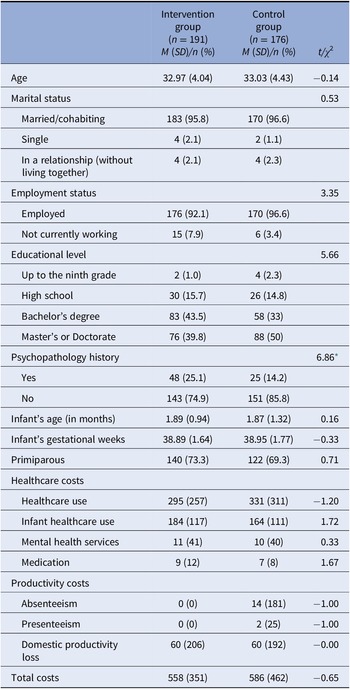
The 367 participants who completed the baseline assessment were randomized to the intervention (n = 191) or the WLC group (n = 176). A comprehensive description of the study sample and the participant flow can be found elsewhere (Reference Monteiro, Pereira, Canavarro and Fonseca21). The baseline characteristics of the sample can be found in Table 1.
Participants’ Characteristics at Baseline

* p < .05.
The EQ-5D-3L and cost data completion rates were 100 percent (367/367), 73.8 percent (271/367), 59.7 percent (219/367) and 51 percent (187/367) at T1, T2, T3, and T4, respectively. The intervention group presented a significantly higher loss to postintervention and follow-up than the WLC arm. In total, 173 women completed all four assessment points, 64 (37 percent) from the intervention group and 109 (63 percent) women from the WLC group. The infants of the participants who dropped out from the study were significantly older than the infants of those who completed the assessments. Additionally, participants who did not complete the T3 assessment had significantly lower education than those who completed.
Costs and QALYs
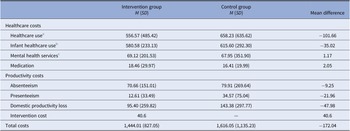
Table 2 presents the average healthcare and productivity-related per-participant costs accumulated over the 14-month study period. Presented costs were based on the intention-to-treat sample. Mean total costs were EUR 1,444 (SD = EUR 827) for the Be a Mom group and EUR 1,616 (SD = EUR 1,135) for the WLC group, resulting in a mean difference of EUR −172. The mother’s healthcare use and higher productivity losses taking unpaid work into account contributed considerably to the overall higher costs in the control group.
Average Per-Participant Costs (in EUR) by Condition Cumulative over the 14-Month Study Period (Based on Intention-to-Treat Sample, N = 367)

a Medical consultations, hospitalizations, outpatient care, emergency room, contact with nursing practitioners, physiotherapists, and dietitians.
b Medical consultations, emergency room, contacts with nursing practitioners, physiotherapists, and osteopathy.
c Contacts with psychologist, psychiatrist, or ambulatory mental health services.
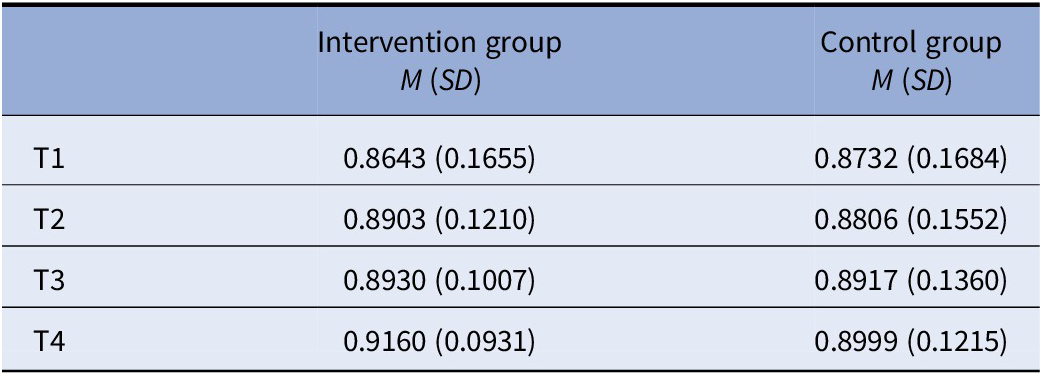
Table 3 presents the average per-participant utility score at all study time points for both groups. After applying the AUC method and the 3.5 percent discount rate, the average per-participant QALY during the 14-month period was 0.8807 (SD = 0.730) in the intervention group and 0.8743 (SD = 1.001) in the control group, resulting in a mean difference of 0.0064 (SE = 0.0092).
Average Per-Participant Utility Score by Condition at Each Time-Point (Based on Intention-to-Treat Sample, N = 367)

Cost-Utility
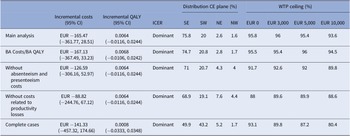
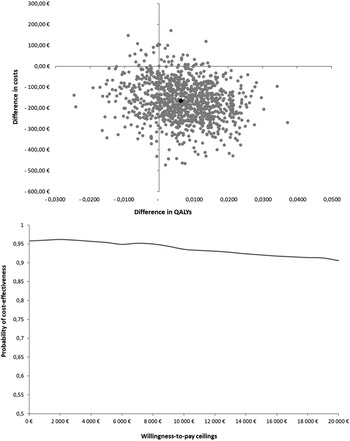
Table 4 displays the findings of the main and sensitivity analyses. Considering the main analysis, and after applying the discount rate of 3.5 percent, Be a Mom resulted in a yearly cost savings of EUR 165.47 (95% CI, 361.77, 28.51) and in a 0.0064 QALY gain (95% CI, .0116, .0244). As seen in the cost-effectiveness plane in Figure 1, the point estimate of cost-effectiveness and the associated uncertainty were mostly contained within the southeast quadrant of the cost-effectiveness plane (75.8 percent of the bootstrapped ICERs). However, there are some instances where the ICER is less effective and less costly (1.6 percent), more effective and more costly (2.6 percent) and less effective and less costly (20 percent).
Incremental Costs and QALYs, ICERs, and Summary of Cost-Utility Results for Main and Sensitivity Analyses with all Estimates Based on 1,000 Bootstrap Replications

BA, baseline adjusted; CE, cost-effectiveness; ICER, incremental cost-effectiveness ratio; NE, northeast quadrant (the intervention was more effective and more costly than the WLC group); NW, northwest quadrant (the intervention was less effective and more costly than the WLC group); SE, southeast quadrant (the intervention was more effective and less costly than the WLC group); SW, southwest quadrant (the intervention was less effective and less costly than the WLC group); WTP, willingness to pay.
Cost-effectiveness plane of 1,000 bootstrapped incremental cost-effectiveness ratios (ICERs) and cost-effectiveness acceptability curve, main analysis.

The estimated probability that Be a Mom was cost-effective was 95.8 percent at a WTP of EUR 0 for one QALY gained (see Table 4 and Figure 1). Be a Mom had a higher probability of being cost-effective at lower WTP ceilings.
To check the robustness of these findings, different scenarios were analyzed (see Table 4). Overall, Be a Mom was found to be predominantly cost-effective compared to the WLC across all analyses, with ICERs falling mostly in the southeast quadrant. Analysis with baseline adjustments yielded similar results to the main analysis, with a slightly higher mean difference in QALYs and costs. When excluding absenteeism and presenteeism costs all costs related to productivity losses, a dominant ICER was also found. When considering the complete case analysis and comparing it with the main analysis with the intention-to-treat sample, there was a decrease in the mean difference in QALYs. Consequently, the bootstrapped ICERs fell mostly between the southeast and southwest quadrants.
Discussion
The purpose of the current study was to gain insight into the cost-utility of Be a Mom, a self-guided CBT web-based intervention, in comparison with a WLC, in low-risk postpartum women. Globally, although results were statistically nonsignificant, they showed that Be a Mom resulted in higher mean QALYs and lower total costs than the WLC and is likely to be cost-effective. Three different sensitivity analyses were performed to test the robustness of the results. Despite some variations in the different sensitivity analyses, the results showed that, overall, the intervention was likely to be more effective and less costly than the control group.
Based on nonparametric bootstrapping, the results demonstrated a dominant ICER over a 14-month time frame, indicating that Be a Mom was likely to be more cost-effective among low-risk postpartum women than no immediate intervention. Under the scenario that there is no willingness to pay for each QALY gained, the probability that the intervention is more cost-effective than the WLC ranged from 88 to 95.8 percent. This finding is consistent with the growing body of evidence showing that web-based psychological interventions can be cost-effective (Reference Donker, Blankers and Hedman24), including those that are unguided (Reference Wijnen, Lokman, Leone, Evers and Smit25), and add to the insufficient knowledge on the cost-effectiveness of these interventions during the postpartum period.
Although there were some differences from the main analysis regarding the probability of being cost-effective, sensitivity analyses showed that Be a Mom was the preferable intervention, suggesting the robustness of the findings. When performing a cost-utility analysis including only participants who completed the four assessment points, the results suggest that approximately 50 percent of bootstrapped ICERs fall in the southeast quadrant. About 43 percent of bootstrapped ICERs fell in the southwest quadrant, suggesting that there is a moderate probability that Be a Mom could result in more savings than the WLC for a given decrease in QALYs. Although the complete case analysis could be biased because it only included 34 percent of participants in the intervention group, the results could cause uncertainty in the decision-making process. The percentage of ICERs falling in the southwest quadrant could be explained by the relatively small QALY differences between groups. Indeed, it is important to highlight that the small incremental QALY found throughout all analyses (the largest observation was an effect of 0.007), may be potentially not clinically relevant, making it difficult to draw conclusions. This result could be explained by different reasons, including the characteristics of the sample and the instrument used to assess QALYs. In particular, this is a sample of healthy postpartum women presenting low risk for PPD and baseline scores on the EQ-5D-3L were relatively high (intervention group: M = 0.864, SD = 0.166; control group: M = 0.873, SD = 0.168), leaving limited space for improvement. This may also be related to a restriction of the measurement tool. It has been previously shown that the EQ-5D-3L has a ceiling effect and may not be sensitive enough for detecting change in low-risk samples (Reference Kopec and Willison48;Reference Brazier, Roberts, Tsuchiya and Busschbach49). Previous reviews have suggested that the effects of psychological interventions during the perinatal period may be more robust among higher-risk groups (Reference Sockol9), which could mean that they have the potential to be more cost-effective. For public health interventions, the development of a measure that is more sensitive to changes in a healthy low-risk population is necessary, allowing for cost-utility analyses in economic evaluations. The use of a more sensitive measure could further clarify the impact of the intervention in the change in QALYs. Nevertheless, it is important to highlight that Be a Mom could be a potential cost-saving intervention and not produce significant QALY changes among healthy low-risk women. From a decision-making point of view, it might be worthwhile to consider reaching low-risk groups, as the results of our study suggest that Be a Mom can present good value for the cost. Current mental health services provide “reactive” healthcare, mainly focused on the treatment of mental illness. Our findings call attention to the need to promote mental health, rather than just prevent and treat disorders, drawing attention to the role of e-mental health interventions as an effective pathway to deliver mental health promotion in the postpartum period.
Nevertheless, in all scenarios, our findings showed that the intervention group consistently generated lower healthcare and productivity costs. A possible explanation for this result could be associated with the significant improvement in positive mental health in the intervention group (Reference Monteiro, Pereira, Canavarro and Fonseca21). There is growing evidence on the economic benefits of promoting positive mental health, such as less use of healthcare services and less absenteeism and presenteeism (Reference Keyes16;Reference Zechmeister, Kilian and McDaid50).
In Portugal, there is currently no implemented strategy in the public health system to screen, prevent or promote maternal mental health in the postpartum period. The short and unguided format of Be a Mom makes it easily accessible with the potential to reach large groups of people and be integrated into primary care as an early intervention. Additionally, if Be a Mom is offered on a wide scale, the intervention cost per user could be significantly cheaper, as the costs associated with the intervention are mostly fixed and not dependent on the number of users. Therefore, this approach could represent an important pathway that could help alleviate the burden of perinatal mental illness in an economically viable way.
Although this study provides promising results, it has some limitations that should be considered. First, the generalizability of the results is limited because the participants were a self-selected sample that was mainly composed of highly educated and employed women. Furthermore, measurements were based on self-reports and, in the case of cost data, this could have resulted in recall bias and led to over- or underestimation of total costs. Third, the use of a measure that is more sensitive to changes in healthy populations and that does not have a tendency for ceiling effects (such as the SF-6D or the CORE-6D; Reference Brazier, Roberts, Tsuchiya and Busschbach49;Reference Touré, Kouakou and Poder51) could be beneficial to differentiate between high scores of the healthy utility range. Fourth, consistent with other studies of web-based interventions (Reference Lee, Denison, Hor and Reynolds52), dropout rates were relatively high, particularly at the last assessment point. The high loss to follow-up could be explained by the demanding nature of the early postpartum period and future intervention studies during the postpartum period need to take into account the challenging and time-restricted period women are experiencing when designing research. Consequently, missing values had to be imputed and the procedure for handling the missing data may have led to biased results. To minimize bias, baseline costs and utilities and variables that presented significant differences between groups at baseline and between completers and dropouts were included as predictors in the imputation model. In the future, it would be ideal to perform several sensitivity analyses using different techniques to input missing data to minimize bias and gather further information on the cost-utility of the intervention. Finally, in this study, we did not capture the long-term cost-utility of Be a Mom, as our last follow-up assessment was 14 months after baseline. Because of the long-term impact of perinatal mental illness, future studies with longer follow-up assessments may provide important insights.
Despite these limitations, to our knowledge, this was the first study assessing the cost-utility of a web-based intervention aimed at promoting maternal mental health among low-risk postpartum women. Given the insufficient knowledge on this topic, these findings contribute to informing healthcare professionals and policy makers, and consequently promote a more efficient use of available resources. Be a Mom could be a cost-effective early intervention for mothers in the postpartum period and contribute to better maternal mental health, which could consequently impact their children’s health and development.
Funding Statement
This project was cofunded by the European Regional Development Fund (FEDER), through the Portugal-2020 program (PT2020), under the Centre’s Regional Operational Program (CENTRO-01-0145-FEDER-028699), and by the Portuguese Foundation for Science and Technology/MCTES through national funds (PIDDAC). F.M. was supported by a doctoral grant from the Portuguese Foundation for Science and Technology (SFRH/BD/115585/2016). This study is part of the research project “Promoting maternal mental health: Applicability and effectiveness of an eHealth intervention for Portuguese postpartum women,” integrated in the research group Relationships, Development & Health of the R&D Unit Center for Research in Neuropsychology and Cognitive Behavioral Center Intervention (CINEICC) of the Faculty of Psychology and Educational Sciences, University of Coimbra.
Conflicts of Interest
The authors declare that they have no conflict of interest.