INTRODUCTION
During recent years, there has been a significant increase in long-term, disease-free survival in women with breast cancer. Two factors cited as important for disease-free survival are the availability of screening programs for an early diagnosis and adjuvant therapy that reduce the risk of cancer recurrence (Helgeson et al., Reference Helgeson, Snyder and Seltman2004; Singletary & Connolly, Reference Singletary and Connolly2006; The Swedish Organised Service Screening Evaluation Group, 2006). Considering that women are at higher risk for becoming depressed compared to men (Üstün et al., Reference Üstün, Ayuso-Mateos and Chatterji2004), it is of critical importance to examine how women with breast cancer cope with the illness and its trajectory and with suicide (Björkenstam et al., 2005; Yousaf et al., 2005).
Cross-sectional studies have found that women with breast cancer report fatigue, pain, depression, anxiety, and a failing self-esteem. They also show that psychological support and therapy have a positive impact in response to the burden of illness (Spiegel et al., Reference Spiegel, Bloom and Kraemer1989; Spiegel, Reference Spiegel1997; Badger et al., Reference Badger, Braden and Mishel2004; Burgess et al., Reference Burgess, Cornelius and Love2005).
In the study by Burgess et al. (Reference Burgess, Cornelius and Love2005), nearly 50% of a consecutive sample of women with early breast cancer had depressive symptoms, anxiety, or both depressive and anxious symptoms during the first year after diagnosis. In the second year, this proportion had decreased to 25%, and 5 years after diagnosis, this proportion had decreased to 15%. They also reported a point prevalence of depressive symptoms, anxiety, or both at the first time of diagnosis (33%) and after a year (15%).
Another aspect that deserves comment is that Burgess et al. (Reference Burgess, Cornelius and Love2005) found that longer term depression and anxiety were associated with younger age. In a hierarchical regression model made by Wong-Kim and Bloom (Reference Wong-Kim and Bloom2005), the age variable was found to be the one statistically significant predictor for depression of a number of social variables. This finding is in line with results summarized in a recent review (Mosher & Danoff-Burg, Reference Mosher and Danoff-Burg2005) but not with earlier studies, where the relationship between age and adjustment to breast cancer is inconsistent (Glanz & Lerman, Reference Glanz and Lerman1992). Helgeson et al. (Reference Helgeson, Snyder and Seltman2004) suggested that the reason that older women are less distressed might be that they are more likely than younger women to expect declines in their health. In a similar vein, Scheier et al. (Reference Scheier, Helgeson and Schultz2005) observed that younger women have different needs compared to older women. Erikson (Reference Erikson1977) claimed that every age has its own challenges. For example, the concerns between 30 and 50 years are work and children. These are life events that may be put to an end or never happen because of the breast cancer. Erikson (Reference Erikson1997) also claimed that in a present crisis earlier crises not worked on would influence it. In spite of the needs of patients with breast cancer, they are often left without help (Hanson Frost et al., Reference Hanson Frost, Suman and Rummans2000; Luzzatto & Gabriel, Reference Luzzatto and Gabriel2000). Empirical studies published between 1982 and 2002 on women with breast cancer showed that educative, relaxation or hypnosis imagery, and behavioral and cognitive behavioral therapy programs gave a positive outcome for breast cancer patients (Spiegel et al., Reference Spiegel, Bloom and Kraemer1989; Spiegel, Reference Spiegel1994; Postone, Reference Postone1998; Badger et al., Reference Badger, Braden and Mishel2004; Institute of Medicine, 2004).
All human relationships activate the Mirror neuron, which is a special class of neurons in the primate premotor cortex (Bauer, Reference Björkenstam, Edberg and Ayoubi2007) that fires for the same class of actions as seen in others. In art therapy, with its several modes of expression, this neuronal function is stimulated repeatedly: the bodily moments during the process of painting, the view of the product or image, and in the relation between patient and therapist. Art therapy is regarded as a complementary medicine that can be used as a model for processing the emotional trauma and stress (Suzuki, Reference Suzuki2004). For many years, art therapy has been used for this purpose in rehabilitation settings (Pratt & Wood, Reference Pratt and Wood1998; Hiltebrandt, Reference Hiltebrandt and Malchiodi1999; Malchiodi, Reference Malchiodi1999; Minar, Reference Minar and Malchiodi1999; Borgmann, Reference Borgmann2002; Heywood, Reference Heywood2003; Luzzatto et al., Reference Luzzatto, Sereno and Capps2003). Up until now, art therapy research is scant; however Gabriel et al. (Reference Gabriel, Bromberg and Vandenbovencamp2001) reported that art therapy was beneficial for adult bone marrow transplant inpatients, and Rusted et al. (Reference Rusted, Sheppard and Waller2002) found that patients with dementia had better emotional adjustment skills after therapy. More recently, a randomized controlled study (Monti et al., Reference Monti, Peterson and Shakin Kunkel2006) showed that female cancer patients who received mindfulness-based art therapy experienced less psychological distress compared to a control group. Other randomized controlled studies have shown that short-term art psychotherapy can be a beneficial treatment for depressed women (Egberg Thyme et al., Reference Egberg Thyme, Sundin and Ståhlberg2007b) and for women with vulvar vestibulitis (Egberg Thyme et al., Reference Egberg Thyme, Sundin and Lindström2007a). In two reports based on the same randomized clinical trial of women with breast cancer as the present report, the art therapy group reported improved coping resources (Öster et al., Reference Yousaf, Christensen and Engholm2006) and strengthened boundaries (Öster et al., Reference Öster, Magnusson and Egberg Thyme2007).
The aim of this study is to investigate women's psychological response to breast cancer, as much life threatening as the diagnosis of breast cancer itself. The present study explores the psychological responses in terms of self-image and psychiatric symptoms in women with nonmetastatic breast cancer participating in five sessions of art therapy compared with a control group who did not receive art therapy.
METHOD
Design
This is a naturalistic, longitudinal study where several measures were used to examine self-image and psychiatric symptoms. Data used in this report were drawn from a randomized controlled clinical trial comparing brief art therapy intervention with a no-psychological-intervention control condition for women with newly diagnosed nonmetastatic breast cancer undergoing a 5-week-long period of postoperative radiotherapy. The randomization procedure was computer generated and undertaken at the Regional Centre of Oncology at Umea University. The randomization procedure made sure that both groups contained an equal number of participants who were treated with cytostatics.
Because of the entire project's design with analysis of both qualitative (interviews, diaries) and quantitative data (questionnaires), it was not possible to include a large patient sample in the study. Nor was it possible to implement a multicenter study with this approach. However, we found a randomized design important because very few studies are using art therapy in a randomized design, and none in the cancer field, were published at start of this project.
The study was run at the Department of Oncology at Umea University Hospital in Sweden in 2001–2004.
Participants
Out of a convenience sample of 143 women with nonmetastatic breast cancer who answered an invitation, 42 women participated. Exclusion criterion was a preexisting physical or psychiatric illness. The randomization procedure assigned half of the participants (n = 20) to the art therapy group and the remaining participants (n = 22) were assigned to a control group. Participants were between 37 and 69 years of age; six participants in each group were younger than 50. Data from one participant were incomplete and discarded. Hence, the analyses presented in this report were based on data from 41 participants. Data from two previous studies served as comparison. The set of Structural Analysis of Social Behavior data (Benjamin, Reference Benjamin1974) was collected from female mental health workers (n = 679) (Armelius, unpublished data) and the set of Symptom Check List–90 data (Derogatis et al., Reference Derogatis, Lipman and Covi1973) was collected from Swedish females (n = 707) (Fridell et al., Reference Fridell, Cesarec and Johansson2002).
Dropouts
Out of the women (n = 55) who initially had given their consent to participate in the study, 13 (approximately 24%) women dropped out. Of these, 5 (n = 5) were assigned to the study group and 9 (n = 9) were assigned to the control. Reasons for declining to participate were experiences of too much strain (n = 7), disease complications (n = 2), and dissatisfaction with the randomization (n = 4).
Demographic Data
Table 1 shows that the groups are similar on all variables except for hormone treatment.
Summarizing groups, median age, civil status, and number of children, domestic children, mastectomy, chemotherapy, and hormone treatment

Note: Group 1 = Breast cancer patients who received art therapy (n = 20); Group 2 = Breast cancer patients who did not receive art therapy (n = 21).
Measurements
Structural Analysis of Social Behavior
The SASB (Benjamin, Reference Benjamin1974) is a self-rating scale with 36 items that measures perceived self-image. In the cluster version of the instrument, which is used in this study, the 36 items are grouped into eight clusters: Spontaneous and impulsive self, Accepting and exploring self, Self-loving self, Helping and nourishing self, Controlling and restraining self, Accusing and blaming self, Self-hating self, and Ignoring and neglecting self. The three loving clusters (Accepting and exploring self, Self-loving self, Helping and nourishing self) are grouped into the subscale of Attachment group of clusters (AG) and the three negative (Accusing and blaming self, Self-hating self, Ignoring and neglecting self) are grouped into the Disruptive attachment group of clusters (DAG).
Symptom Check List–90
The SCL 90 (Derogatis et al., Reference Derogatis, Lipman and Covi1973) is a self-rating scale with 90 items that measures perceived symptoms. The 90 symptoms are combined into nine subscales: Somatization, Obsession, Interpersonal sensitivity, Depression, Anxiety, Hostility, Phobic, Paranoid, and Psychotic symptoms, and into a General Severity Index (GSI). In this study, GSI along with the subscales of Depression, Anxiety, and Somatization are used.
Interview
A thematic interview focusing on perceived psychological and social experiences to self and others was performed by the art therapists (KET, IÖ) prior to the art therapy, after 2 months and, finally, 6 months after the first interview. At the first interview, the interviewers were blind to the result of the randomization. The interview focused on the perceived physical, emotional, and social changes of the interviewee.
Adjuvant Therapy
A subgroup of participants in both the study group and the control group had received chemotherapy 5 months before radiotherapy treatment (n = 9 and 10, respectively). Slightly fewer participants in both groups had received hormone treatment (n = 7 and 10, respectively).
At the first measurement, a small number of participants in both groups (n = 4 and n = 3, respectively) received antidepressants. At the second measurement, the number of women in the study group who took antidepressants had decreased (n = 2) but not the number in the control group (n = 3). The same tendency was observed at the third measurement (only 1 participant in the study group took antidepressants in comparison to 3 participants in the control group). Note that the usage of antidepressants was self-reported, and therefore this information may be incomplete.
Art Therapy
The intervention in this study provided the participant with five sessions of art therapy where they were encouraged to express their feelings and thoughts. This intervention aimed at triggering a chain of feelings and thoughts as an important object for communication. With the spotlight on the painting as a new mode of expression, habitual as well as new chains of emotions and ideas created colors, lines, and forms (Betensky, Reference Betensky1995). The basic idea with this approach was to use the participant's picture as the new mode, followed by a reflective dialog. The same material was offered at all therapy sessions: oil pastels, watercolors, lead pencils, charcoal, tape, scissors, paintbrushes, and sheets of paper and paper rolls.
The first session of art therapy focused on visualization of feelings set up as analogue drawings (Edwards, Reference Edwards1987), that is, to draw a stroke of a pen on an impulse after hearing a read word.
The participant got a sheet of paper divided into 16 sections for the 16 words she was about to hear. The therapist then read 16 words loudly approximately every 10th second; the words represented feelings, for example, “love,” “hate,” and “shame” or words such as “female” and “male.” After each word, the participant drew a stroke with her lead pencil. Afterward, she named each mark she made with the word it represented. Next, the woman was encouraged to choose one or several of her strokes responses to the read words and make one or several images.
The second session focused on life-size body outline (Luzzatto et al., Reference Luzzatto, Sereno and Capps2003). The participant selected a color for the therapist to use when she made her body outline on a large sheet of paper nailed to the wall. As this was done, the participant painted her different feelings in colors, figures, and forms within the outline expressing her feelings in the different parts of her body.
During the third and fourth sessions, the participant painted whatever she wanted in several pictures. Taken together, final sessions formed a conclusion. The paintings made throughout the sessions were shown. The participant reflected upon the themes and then she made a final picture, which aimed to summarize her experiences.
Therapists
Therapists were two experienced art therapists. They alternated between the role of interviewer and therapist; the therapist never functioned as both interviewer and therapist for the same patient.
Procedure
Each participant received information about the project prior to signing a written consent to participate. At the initial measurement, after 2 months and after another 4 months a thematic interview was accomplished.
Statistical Analysis
Data analyses were conducted using SPSS 11.5 for Windows (SPSS Inc., Chicago, IL). Analyses of group differences on the SASB and SCL-90 were performed as well as hierarchical regression analysis. The regression analyses were performed using the backward elimination method. Changes over time were analyzed using General Linear Model, Repeated Measure.
Ethics
The ethics in art therapy is strong. It should be conducted as a moral practise with regard to its specific context, not to the hospital context per se. Ethical considerations have also been taken according to the crisis of the participants; art therapy may be trying as well as an advantage. The Ethical Committee of Medical Faculty at the University of Umea, Sweden, has approved the project (archive number 99-386).
RESULTS
Means and Standard Deviations on the SASB and SCL-90
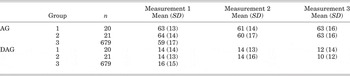
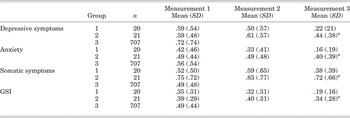
The mean scores and standard deviations on the SASB at the three measurements for the group of women who received art therapy, the group of women who did not receive art therapy, and a comparison group are presented in Tables 2 and 3.
Ratings of positive (AG) and negative (DAG) self image using the SASB

Note: Group 1 = Breast cancer patients who received art therapy (n = 20); Group 2 = Breast cancer patients who did not receive art therapy (n = 21); Group 3 = Female mental health workers (n = 679).
Ratings of depressive symptoms, anxiety, somatic symptoms, and general distress using the SCL-90

Note: Group 1 = Breast cancer patients who received art therapy (n = 20); Group 2 = Breast cancer patients who did not receive art therapy (n = 21); Group 3 = Female comparison group (n = 707) from Fridell et al. (Reference Fridell, Cesarec and Johansson2002).
aAt Measurement 3, Group 2, which is the group that did not receive art therapy, had significantly higher ratings of depressive symptoms, anxiety, somatic symptoms, and also significantly higher GSI ratings compared to the group who received art therapy (p < .05).
As is shown in Table 2, at Measurement 1 both groups of women with breast cancer (Groups 1 and 2) had a self-image that was on the same level as that of women who worked as psychiatric nurses (n = 679) (Armelius, unpublished data). Thus, the women's global perception of themselves seemed to be unaffected by the cancer.
Table 3 shows that both groups had approximately the same amount of depression, symptoms, anxiety, and somatization symptoms as a group of healthy female individuals (n = 707; Fridell et al., Reference Fridell, Cesarec and Johansson2002). Their general severity symptom (GSI) level was also on par with the healthy comparison group.
The group of women who received art therapy showed a decrease in psychiatric symptoms over time, whereas the symptom level for the group who did not receive art therapy remained on the same level. Thus, at the third measurement, the group who received art therapy showed a significant decrease in depression (p = .002), anxiety (p = .009), somatic symptoms (p = .049), and in GSI scores (p = .005) whereas the group who did not receive art therapy showed no significant change in symptoms.
Relations between Art Therapy/No Art Therapy, Perceived Symptoms, Psychosocial Variables, Age, Treatment Modalities, and Self-image
To examine whether group (women who received art therapy/women who did not receive art therapy), age, psychosocial variables (marital status, parenthood, childrearing), different treatment modalities, and symptom ratings at the initial measurement contributed to the participants' experience of symptoms of depression, anxiety, somatic symptoms, and GSI at Measurement 3, four different hierarchical regression analyses were performed. The analyses were performed using the backward elimination procedure.
The first analysis examined the relation between the regression model and depressive symptoms at Measurement 3. The model accounted for 65% of the variation in ratings of depressive symptoms at measurement 3, R 2 = .65, F(6, 34) = 10.483, p < .001. The variables that contributed significantly to the model were depressive symptoms at Measurement 1 (standardized β = .65, p < .001), surgery (standardized β = .39, p < .005), chemotherapy (standardized β = −.25, p < .04), parenthood (standardized β = −.25, p < .05), and group (standardized β = .37, p < .001). Thus, the more depressive symptoms a participant had at the first measurement, the more depressive symptoms she had at the third measurement. Having received mastectomy predicted higher depressive symptom ratings than having received lumpectomy, and chemotherapy predicted lower ratings. Not being a parent and belonging to the group that received art therapy predicted lower ratings of depression at Measurement 3.
In the second multiple regression analysis, the same regression model was used to predict anxiety at Measurement 3; here, however, the variable depressive symptoms at Measurement 1 was replaced with anxiety at Measurement 1.
The model accounted for 68% of the variation in ratings of anxiety at Measurement 3, R 2 = .68, F(9, 31) = 19.045, p < .001. The variables that contributed significantly to the model were anxiety, Measurement 1 (standardized β = .65, p < .001), axilliary surgery (standardized β = .27, p < .007), hormonal treatment (standardized β = .27, p < .007), and group (standardized β = .31, p < .002). The result indicated that the more anxiety a participant had at the first measurement, the more anxiety she had at the third measurement. Axilliary surgery and hormonal treatment predicted higher ratings of anxiety at Measurement 3. Belonging to the group that received art therapy predicted lower ratings of anxiety at Measurement 3.
The third MRA analyzed the relation between the regression model and somatic symptoms at Measurement 3. The model accounted for 76% of the variation in ratings of somatic symptoms at measurement 3, R 2 = .76, F(4, 36) = 27.766, p < .001. There were only two variables that contributed significantly to the model: somatic symptoms at Measurement 1 (standardized β = .77, p < .001), and group (standardized β = .18, p < .04). This result suggested that the more somatic symptoms a participant had at the first measurement, the more somatic symptoms she had at the third measurement. Participants who belonged to the group who received art therapy experienced fewer somatic symptoms at the third measurement compared to those who did not received art therapy. Neither the psychosocial variables nor cancer treatment modalities seemed to have an impact on the participants' somatic symptoms.
The final analysis examined the relation between the regression model and the women's general psychiatric symptoms as measured with GSI. The model accounted for 67% of the variation in ratings of general symptoms at Measurement 3, R 2 = .67, F(10, 30) = 18.145, p < .001. General symptom level at Measurement 1 (standardized β = .58, p < .001) predicted more general symptoms at the third measurement. Axilliary surgery and hormonal treatment also predicted higher symptoms (standardized β = .21, p < .03 and standardized β = .20, p < .05), respectively. Belonging to the group that received art therapy predicted lower ratings on the GSI (standardized β = .70, p < .001).
Summing up, the hierarchical regression analyses suggested that art therapy was related to lower ratings of depression, anxiety, and somatic symptoms, as well as a lower level of general symptoms. Chemotherapy was related to lower ratings of depressive symptoms and general symptoms whereas axilliary surgery and hormonal treatment were related to higher levels of general symptoms.
DISCUSSION
A woman with breast cancer is in a vulnerable state; she is at risk of getting depressed for the first time or to relapse into a depressive mood state (Nolen-Hoeksema et al., Reference Nolen-Hoeksema, Larson and Grayson1999; Üstün et al., Reference Üstün, Ayuso-Mateos and Chatterji2004). The present study examined how a group of forty-one women handled the knowledge of having breast cancer, in terms of psychiatric symptoms and self-image. Seven of these (17%) reported initially that they were diagnosed with depression according to the Diagnostic and Statistical Manual, fourth edition (American Psychiatric Association, 1994) by their doctors. This information should be compared with other findings. For example, Burgess et al. (Reference Burgess, Cornelius and Love2005) found that 25%–50% in their samples of women with breast cancer also had depressive difficulties. They used the Structural Clinical Interview for DSM-III (SCID) whereas we used SCL-90. In addition, Derogatis et al., (Reference Derogatis, Morrow and Fetting1983) reported that patients with cancer frequently reported depressive symptoms. The discrepancies between our results and theirs may imply differences between social or cultural conditions in different catchments' areas or that our findings are based on a sampling procedure that may have recruited women who did not react to the news of having breast cancer with heightened psychiatric symptoms. Still, our findings show improvement in depressive symptoms and symptoms of anxiety as well as general psychiatric symptoms (GSI). Two previous reports from the same study (Öster et al., Reference Yousaf, Christensen and Engholm2006, 2007) validate our results. The first study examined the women's coping strategies; the average participant in the art therapy group was found to improve her coping significantly, both at the second and the third measurement. The second study reported to what extent the treatment group improved their interpretative repertoires. This is also in line with suggestions from a case study on depressed women (Egberg Thyme, Wiberg, Sundin, in preparation). Furthermore, our results of a significant decrease in psychiatric symptom are comparable to a study of mindfulness-based art therapy for women with breast cancer and of scribble as a method of art therapy with depressed women (Monti et al., Reference Monti, Peterson and Shakin Kunkel2006; Egberg Thyme et al., Reference Egberg Thyme, Sundin and Ståhlberg2007b). Both obtained findings that suggested a decrease in symptoms of depression measured with SCL-90. Additional studies that support the effectiveness of art therapy reported that elderly people with dementia showed a better functioning (Rusted et al., Reference Rusted, Sheppard and Waller2002) and women with vulva vestibulitis experienced decreased pain after therapy (Egberg Thyme et al., Reference Egberg Thyme, Sundin and Lindström2007a).
In this study, the women did not experience that their self-image was distorted. This contrasted with previous studies that have reported that major difficulties in life along with strong feelings of shame and guilt often have the power to undermine a sound image of self (e.g., Giese-Davis, Reference Giese-Davis2007). However, Jeanneau and Armelius (Reference Jeanneau and Armelius2000) reported that women who had more depressive symptoms reported a more negative self-image than those with less depressive symptoms, which is in line with the present result.
A major finding in this study was that the women who received art therapy scored significantly lower depression, anxiety, and somatic symptoms over time. A corresponding result was obtained in the regression analysis; less somatic symptoms at the third measurement were only related significantly to art therapy; social or medical variables seemed not to make a difference in this respect. Despite the fact that the women in this study reported a low symptom level throughout the study, the significant decrease in psychiatric symptoms at the follow-up should be considered as an asset for these women; they were in the midst of their recuperation, on their way back to their normal lives (Institute of Medicine, 2004). The significant reduction of symptoms between the second and third measurements is similar to what is reported in short-term psychotherapy research; the therapeutic process goes on after termination of therapy (Leichsenring et al., Reference Leichsenring, Rabung and Leibing2004). The three interviews in the study, at entrance, after 2 months, and, finally, after 6 months from start are regarded to affect the result but not distort them; all participated in the interviews.
The result of the regression analysis suggested that creative expressions give the personal somatic symptoms a form and a color instead of the somatic or depressive symptoms (McDougall, Reference McDougall1989). Our tentative interpretation is that the togetherness in actions and reflections in art making are playing a necessary role. It promotes the participant's process of understanding herself and her current situation (Sugerman, Reference Sugerman2006). Schaverien (Reference Schaverien1992) remarked that in art therapy the picture lasts: it can be focused and felt and be seen and touched as well as moved. The picture is there in relation with feelings and thoughts, even afterward, like a transitional phenomenon in Winnicott's (Reference Winnicott1971) terms. We agree with Schaverien and Winnicott; in the sessions, the painter is always free to look at her or his feelings in forms, figures, lines, and colors to recognize different feelings and thoughts from time to time and to distinguish emotional or cognitive alterations on the paper. We believe that the Mirror neuron (Lukowski et al., Reference Lukowski, Wiebe and Haight2005) provides intersubjective consciousness that aims to internalize the therapeutic relationship to give the patient a new model to relate to oneself/the picture and others/the therapist.
The fears and strength of this group of women are still better understood from the regression model. The outcome shows that mastectomy and parenthood relate to higher ratings of depressive symptoms, chemotherapy relates to lower ratings, and auxiliary surgery and hormonal treatment predict higher ratings of general symptoms and anxiety symptoms. Thus, the result concerning parenthood and hormonal treatment links to age (Helgeson et al., Reference Helgeson, Snyder and Seltman2004; Mosher & Danoff-Burg, Reference Mosher and Danoff-Burg2005; Wong-Kim, and Bloom, Reference Wong-Kim and Bloom2005), and the result concerning mastectomy and auxiliary surgery links to the perception of the body (Anzieu, Reference Anzieu2000; Öster et al., Reference Öster, Magnusson and Egberg Thyme2007). Furthermore, Coombes et al. (Reference Coombes, Hall and Gibson2004) emphasized that hormonal treatment is connected with a number of side effects for all women to cope with. All changes disturb one's life circle (Ericson, 1977, 1997); hence, professionals who meet women during treatment of breast cancer will have to understand what clinical implications they have on the separate women in her context.
Some important limitations in this study are related to the design. Participants in this study were recruited from a large catchments' area in the northern part of Sweden, and potential participants were informed about the study by a postal letter. The fact that a small number of women chose to participate may have been caused by an uncertainty among the invited women either because art therapy is a relatively unknown form of treatment or due to difficulties in fitting participation in the study into the stay at the hospital when coming to the radiation treatment.
The conclusion is that the tendency in this rapport of individual brief art therapy agrees with other results in the same sample (Öster et al., Reference Yousaf, Christensen and Engholm2006, 2007); though a small sample size, art therapy can be helpful for women with breast cancer. Furthermore, the intervention is described systematically as Luzzatto and Gabriel (Reference Luzzatto and Gabriel2000) do in their study; hence, the model is replicable. Furthermore, the findings show that individual brief art therapy is beneficial for older as well as younger women with breast cancer, though the intervention is delivered in a hospital setting. It provides a new model of processing difficult feelings connected with the crisis of breast cancer; related psychosocially consequences attached to the diagnosis. Further studies should investigate if brief art therapy in group can be valuable for the medical treatment proper to make the most of the clinical care that woman with breast cancer and patients with other types of cancer have to undergo.
ACKNOWLEDGMENTS
The authors are grateful to the Swedish Research Council, the County Council of Västerbotten, the Cancer-, and Traffic- Injured Rehabilitation Foundation (CTRF), the Elsa and Folke Sandberg fund for Medical Research, and the Medical Faculty of Umea University. We express our gratitude to all women who participated. We also express our gratitude to Dr. Marie Sjödin and registered nurse Ulla Sandgren at the Department of Oncology for administrating the invitations to the study. We appreciate the help and support of Ulf Isaksson at the Department of Nursing who administered the database. The authors thank Professor Martin Eisemann, at the Department of Psychiatry, University of Tromsö, Tromsö, Norway for advice regarding the study design.