Introduction
Rhopalosiphum padi (Linnaeus) (Hemiptera Aphididae) is an important grain pest that is widely distributed in grain-growing regions (Peng et al., Reference Peng, Liu, Guo, Wang, Song, Su, Fang and Chen2020). The degree of damage caused by this pest differs among growth stages, growth parts, and ecological areas (Aqueel and Leather, Reference Aqueel and Leather2011). Rhopalosiphum padi is harmful to wheat to different degrees from the seedling stage to the ear stage of wheat harvest, including malt, awns, stem, and leaf tip. The yield and quality of wheat are directly affected, and wheat production is severely threatened (Macaulay et al., Reference Macaulay, Ramsay and Åhman2020). At present, aphids are subjected mainly to chemical control, and the main insecticides used are pyrethroids, neonicotinoids, carbamates, and organophosphates. Flonicamid is a newer low-toxicity pyridinamide insecticide that can be effective in controlling sucking insects on crops, especially aphids (Morita et al., Reference Morita, Yoneda and Akiyoshi2014). Its specific mechanisms of action manifest as refusal to feed by aphids and other sucking mouthpart pests and by paralysis of nerves, which does not affect acetylcholinesterase or nicotinic acetylcholine receptors, has no cross-resistance with other insecticides currently on the market, and has low toxicity to bees (Roditakis et al., Reference Roditakis, Fytrou, Staurakaki, Vontas and Tsagkarakou2014). As a typical selective insecticide with good safety against nontarget organisms, it has been registered as an insecticide for controlling pests in many countries worldwide (Zhang et al., Reference Zhang, Yang, Liu, Chen, Hu and Lu2019).
However, some aphids have developed different degrees of resistance to commonly used insecticides because of relatively simple insecticide types and high application frequency during production (Bass et al., Reference Bass, Denholm, Williamson and Nauen2015). Therefore, selection theory was proposed to explain resistance formation. After long-term use of a single high-concentration agent on a certain pest, the stronger the resistance of the pest is, the more likely it is to survive and pass on a resistance advantage to the next generation, thus increasing population resistance. However, the effectiveness of insecticides can be influenced by various factors, including the individual, environment, and type of application, leading to different dosages of insecticides. While most wheat aphids are directly killed by insecticides at lethal concentrations, some wheat aphids experience adverse conditions at sublethal doses, and aphids receiving sublethal doses are affected by sublethal effects, resulting in the development of pest resistance and frequent pest recurrence (He et al., Reference He, Zhao, Zheng, Desneux and Wu2012; Kheradmand et al., Reference Kheradmand, Heidari, Sedaratian-Jahromi, Talaei-Hassanloui and Havasi2022; Ma et al., Reference Ma, Tang, Liang, Li and Gao2022).
The sublethal effect of insecticides refers to the damaging effect of insecticides on the physiology/behaviour of surviving individuals under exposure to sublethal concentrations of insecticides, which is not only an important index for evaluating the effects of insecticides but also affects the quantity and quality of insect offspring (Desneux et al., Reference Desneux, Decourtye and Delpuech2007; Gul et al., Reference Gul, Ul Haq, Ullah, Khan, Yaseen, Shah, Tariq, Güncan, Desneux and Liu2023), such as the number of surviving insect individuals (Santos et al., Reference Santos, Santos, Tomé, Barbosa, Martins, Guedes and Oliveira2016; Zhang et al., Reference Zhang, Yang, Liu, Chen, Hu and Lu2019), development duration (Passos et al., Reference Passos, Soares, Collares, Malagoli, Desneux and Carvalho2018; Xu et al., Reference Xu, Zhao, Zhang, Liu and Gu2016), and fecundity (Yuan et al., Reference Yuan, Li, Liu, Cui, Lu, Xu, Li, Wu and Desneux2017; Zhang et al., Reference Zhang, Yuan, Liu, Chen and Zhang2010). Yuan et al. (Reference Yuan, Li, Liu, Cui, Lu, Xu, Li, Wu and Desneux2017) reported that the adult fecundity and net productive rates in Aphis gossypii (Glover) decreased significantly under exposure to a 10% lethal concentration (LC10) or a 40% lethal concentration (LC40) of cycloxaprid relative to the controls.
The effects of plant growth and field degradation on initial insecticide application efficiency lead to the occurrence of a low dose of insecticides (Desneux et al., Reference Desneux, Fauvergue, Dechaume-Moncharmont, Kerhoas, Ballanger and Kaiser2005; Lu et al., Reference Lu, Zheng and Gao2016). Consequently, low doses of insecticides can influence pest behaviour and physiology under field conditions and result in the transgenerational transmission of traits from surviving individuals to their offspring (Desneux et al., Reference Desneux, Decourtye and Delpuech2007; Liu et al., Reference Liu, Lu, Wu, Wyckhuys and Xue2008). Sitobion avenae (Fabricius) and R. padi respond differently to sublethal doses of pirimicarb (Xiao et al., Reference Xiao, Yang, Desneux, Han and Gao2015). He et al. (Reference He, Zhao, Zheng, Weng, Biondi, Desneux and Wu2013) observed that honeydew excretion, phloem feeding, and reproductive ability in Bemisia tabaci (Gennadius) were significantly reduced, exerting these harmful effects under exposure to sublethal doses of bifenthrin and imidacloprid but not chlorpyrifos or carbosulfan. Cui et al. (Reference Cui, Sun, Yang, Yan and Yuan2012) reported that the growth and feeding behaviour of S. avenae was negatively impacted by a sublethal concentration of cycloxaprid applied to the soil.
Shi et al. (Reference Shi, Luo, Lv, Zhang, Desneux, You, Li, Ullah and Ma2022) reported that A. gossypii growth could be suppressed by a sublethal dose of flonicamid. Gul et al. (Reference Gul, Ul Haq, Ullah, Khan, Yaseen, Shah, Tariq, Güncan, Desneux and Liu2023) reported that population growth could be suppressed by sublethal doses of flonicamid in Schizaphis graminum (Rondani). However, other reports have shown that the duration of phloem ingestion is significantly affected by sublethal doses of imidacloprid and flonicamid in A. gossypii (Koo et al., Reference Koo, Lee, Yun, Kim and Kim2015), and the duration of phloem ingestion is significantly affected by sublethal doses of flonicamid and thiamethoxam (Cho et al., Reference Cho, Koo, Yoon and Kim2011). Population dynamics can be comprehensively described by life table construction and analysis to elucidate the sublethal effects of insecticides under low- or high-dose exposure to pests (Chi et al., Reference Chi, You, Atlıhan, Smith, Kavousi, Özgökçe, Saska, Smith, Tuan, Xu, Ye, You, Yu and Gökçe2020).
Thus, we explored the sublethal and transgenerational effects of flonicamid on R. padi by life table construction and analysis. This approach provides a better theoretical basis for the response of insects to insecticides and has potential practical significance for optimising the rational application of insecticides in the field.
Materials and methods
Insects and insecticides
Fresh wheat (Zhoumai 18) seedlings were used to feed and raise R. padi under laboratory conditions at a temperature of 23 ± 2°C and a relative humidity of 65 ± 5%, with a photoperiod of 14 h:10 h (L:D) (Lu and Gao, Reference Lu and Gao2009). Rhopalosiphum padi were reared without contact with any insecticides. Flonicamid (95% active ingredient, w/w) was purchased from Dr. Ehrenstorfer Inc. (Germany).
Insecticide toxicity bioassays
The lethal concentrations of flonicamid for R. padi were tested via the leaf-dipping method (Hu et al., Reference Hu, Lu, Li, Su, Dong, Zhang, Liu, Shi, Wang and Chen2022). The original flonicamid (95%) was added to acetone and prepared with a 1000 mg/L stock solution. The five concentrations tested, 0.1, 1, 10, 50, and 100 mg/L, were diluted with distilled water containing 0.05% (v/v) X-100 surfactant. The detailed experimental procedures have been described previously (Hu et al., Reference Hu, Lu, Li, Su, Dong, Zhang, Liu, Shi, Wang and Chen2022; Moores et al., Reference Moores, Gao, Denholm and Devonshire1996). The LC25 and LC50 values of flonicamid for R. padi were calculated using PoloPlus software 2.0 (LeOra Software Inc., Berkeley, CA, USA) according to the flonicamid bioassay data to determine the sublethal and transgenerational effects of flonicamid on R. padi.
Lehal and transgenerational effects of flonicamid on R. padi
The lethal and transgenerational effects of flonicamid on R. padi were determined via the construction of a life table designed under the LC25 (1 mg L−1) and LC50 (10 mg L−1) concentrations of flonicamid. In addition to the lethal effects of insecticides, insect populations in the field are inevitably exposed to low concentrations of insecticides because of their uneven distribution and degradation (Desneux et al., Reference Desneux, Fauvergue, Dechaume-Moncharmont, Kerhoas, Ballanger and Kaiser2005). Low concentrations of insecticides may affect insect development and reproduction (Desneux et al., Reference Desneux, Decourtye and Delpuech2007).
Wheat leaves with adults were dipped into LC25 and LC50 solutions of flonicamid for 10 s, after which 90 surviving aphids were selected, reared, and labelled LC25_F0 and LC50_F0, respectively, at 24 h after treatment. Wheat leaves with R. padi adults were treated with distilled water supplemented with 0.05% Triton X-100 surfactant and an equal volume of acetone as the control, after which 90 surviving aphids were selected, reared, and labelled CK_Rp_F0. These treatments (LC25_F0, LC50_F0 and CK_F0) were conducted for 90 replicates, and each replicate was conducted with single-head rearing. The adult longevity of the F0 generation and produced new nymphs were determined every 12 h.
Nymphs of the F1 generation were selected for continuous rearing. The new nymphs of the F1 generation (aged < 24 h) were collected from each treatment, LC25_F0, LC50_F0 and CK_F0, after daily counts, reared individually, and observed every 12 h. At the same time, the developmental time, offspring produced by each adult, and duration of the spawning period were recorded in each growth stage of the F1 generation, and newborn nymphs were recorded and collected daily.
Life table construction and analysis
The life history of R. padi was analysed according to the age-stage, two-sex life table theory method (Chi, Reference Chi1988; Chi and Liu, Reference Chi and Liu1985) using the TWOSEX-MSChar computer program (Chi, Reference Chi2023). The finite rate of increase (λ), net reproductive rate (R 0), mean generation time (T), intrinsic rate of increase (r), and other curve data for the life table parameters were calculated via the bootstrap procedure (Beran, Reference Beran2008) with 100,000 random resamplings. Furthermore, the fecundity, developmental duration, age-specific life expectancy (exj), age-specific maternity (lxmx), age-specific survival rate (lx), age-stage-specific survival rate (sxj), age-specific fecundity (mx), and age-stage reproductive value (vxj) were also determined (Chi, Reference Chi1988, Reference Chi2023; Chi and Liu, Reference Chi and Liu1985; Chi and Su, Reference Chi and Su2006). The data for the life table and population parameters were obtained via the bootstrap procedure with 100,000 random resamplings and paired bootstrap tests according to 5% significant variation in the TWOSEX-MS Chart program (Huang and Chi, Reference Huang and Chi2013; Huang et al., Reference Huang, Chi and Smith2018; Wei et al., Reference Wei, Chi, Guo, Li, Zhao and Ma2020), respectively. The survival rates, life expectancies, reproductive rate curves and reproductive rates were constructed and analysed using GraphPad Prism (version 3.02, GraphPad Software, San Diego, CA). The calculation formulas of the life table parameters are shown in Table S1.
Results
Flonicamid toxicity and mortality
Flonicamid toxicity to R. padi was highly efficient, with LC25 and LC50 values of 1.227 and 9.068 mg L−1, respectively. The mortality rates were 16.67% and 33.34% under the LC25 and LC50 of flonicamid treatments, respectively (Table 1).
Toxicity and lethal concentration effects of flonicamid on Rhopalosiphum padi

Note: SE, standard error; LC50, 50% lethal concentration in mortality (%); CI, confidence interval; LC25, 25% lethal concentration in mortality (%).
Effects of lethal concentrations of flonicamid on the F0 generation
The surviving R. padi aphids were selected and reared as the F0 generation for persistent life table construction when they were subjected to LC25 and LC50 concentrations of flonicamid for 24 h. The F0 generation parameter data for R. padi treated with the LC25 and LC50 concentrations of flonicamid were calculated and analysed (Table 2). The fecundity and adult longevity of the R. padi F0 generation population significantly decreased under the LC25 and LC50 flonicamid treatments compared with those of the controls.
Effects of the LC25 and LC50 concentrations of flonicamid on the fecundity and longevity of the F0 generation of Rhopalosiphum padi

Note: The data are presented as the means ± SEs, which were estimated by bootstrapping (100,000 random resamplings) using the TWOSEX-MS Chart program. Values in the same row followed by different letters are significantly different (P< 0.05) from the respective control values.
Transgenerational effects on the parameters of the life table
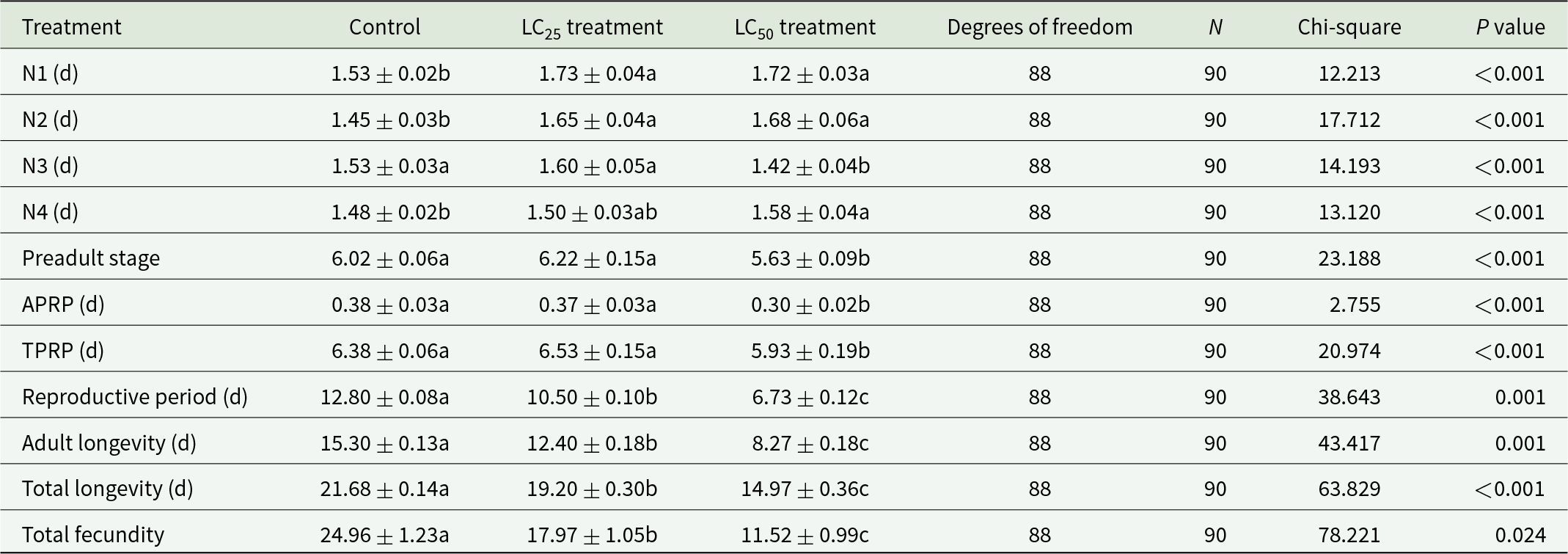
N1 and N2 of the F1 nymphs increased significantly, whereas the reproductive period, adult longevity, total longevity, and total fecundity of the F1 generation markedly decreased, and N3, N4, the nymph stage, duration of the adult pre-reproductive period (APRP), and duration of the total pre-reproductive period (TPRP) were not significantly different under the LC25 concentration of flonicamid treatment compared with those of the controls. N1, N2, and N4 of the F1 nymphs increased significantly, whereas N3, the nymph stage, APRP, TPRP, the reproductive period, total longevity, adult longevity, and total fecundity of the F1 generation were noticeably reduced under the LC50 concentration of flonicamid exposure (Table 3).
Effects of the LC25 and LC50 concentrations of flonicamid on the developmental duration and fecundity of the F1 generation of Rhopalosiphum padi

Note: N1, the first nymph stage; N2, the second nymph stage; N3, the third nymph stage; N4, the fourth nymph stage; preadult stage, the duration of the complete nymph stage; APRP, the duration of the adult prereproductive period. TPRP, duration of the total prereproductive period. SE, standard error. The data are presented as the means ± SEs, which were estimated by bootstrapping (100,000 random resamplings) using the TWOSEX-MS Chart program. The same lowercase letter in the same row of data in the table indicates that the Tukey‒Kramer test results were not significantly different at P > 0.05.
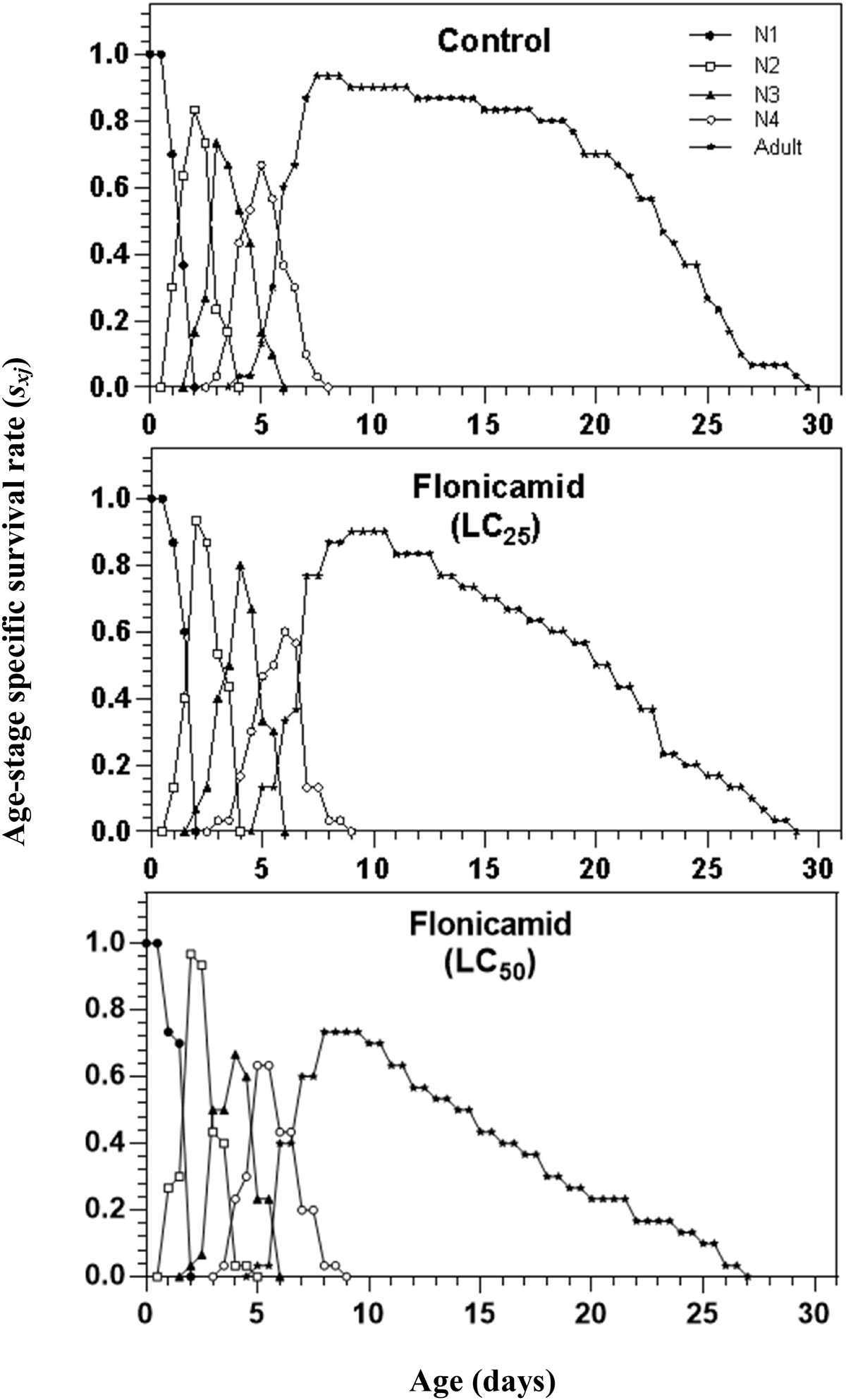
The sxj values of R. padi (CK, LC25 treatment and LC50 treatment) are shown in Fig. 1. The results suggest that the newborn nymphs may survive to age x and period j. The survival rate curve reflects different traits of surviving aphids among the treatments. Significant overlap in periods was observed as the developmental rates differed. The differences in periods can be represented by life tables, and the start and end of subsequent periods can be reflected through the survival curves of each period. For example, the first adult R. padi in the control group appeared at 3.5 days, and the last adult died at 29.5 days, which was greater than that in the treatment with the LC25 concentration of flonicamid (4.5 d and 29 d, respectively) and the LC50 treatment (4.5 d and 27 d, respectively).
Age-stage-specific survival rates (sxj) of the F1 generation of Rhopalosiphum padi, with the control groups compared with the groups treated with the lethal concentrations of flonicamid. sxj of the F1 generation of Rhopalosiphum padi. L1, the first nymph stage; L2, the second nymph stage; L3, the third nymph stage; L4, the fourth nymph stage.

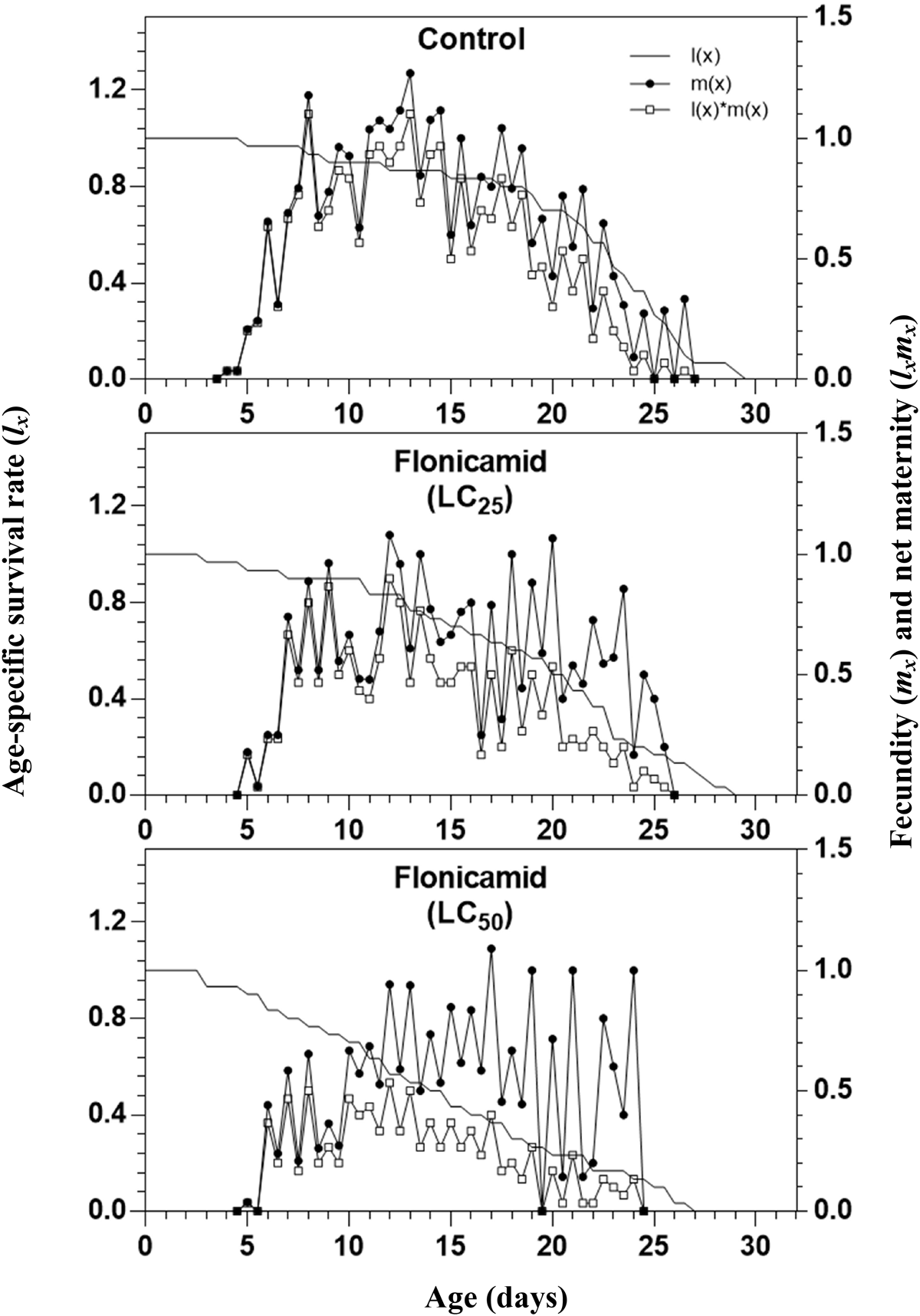
The lx and mx can be used to analyse the contribution of aphids to the population. For example, the decreasing slope of the lx curve for the LC50 concentration of flonicamid was higher than that of the control and the LC25 concentration, and the fluctuation of the mx curve peak in the LC50 concentration was greater than that of the control and the LC25 concentration, while the average value was lower than that of the control and the LC25 concentration (Fig. 2). The mx indicated that the aphids in the LC25 concentration started to breed on the 5th day, and breeding peaked on days 11–13 and was complete on the 25.5th day. The aphids treated with the LC50 concentration of flonicamid started to breed on the 5th day, with breeding peaking on days 10–12 and complete on the 24th day. The aphids in the control group started to breed on the 4th day, and breeding peaked on days 11–13 and completed on the 26.5th day (Fig. 2). The average period of reproduction in the LC25 F1 generation and the control was 10.5 days and 12.8 days, respectively, whereas in the LC50 treatment, it was 8.08 days, indicating a significant decrease compared with that in the control (12.8 days). Each aphid in the LC25 F1 generation and the LC50 F1 generation produced, on average, 17.9 and 11.5 new nymphs, respectively, whereas in the control, each aphid bred 24.13 new nymphs on average (Table 3). Thus, the total fecundity in the LC25 F1 generation or the LC50 F1 generation was significantly lower than that in the control F1 generation.
Age-specific survival rate (lx), age-specific fecundity of the total population (mx), and age-specific fertility (lxmx) of the F1 generation of Rhopalosiphum padi, with the control groups compared with the groups treated with the lethal concentrations of flonicamid. lx, mx, and lxmx of the F1 generation of Rhopalosiphum padi.

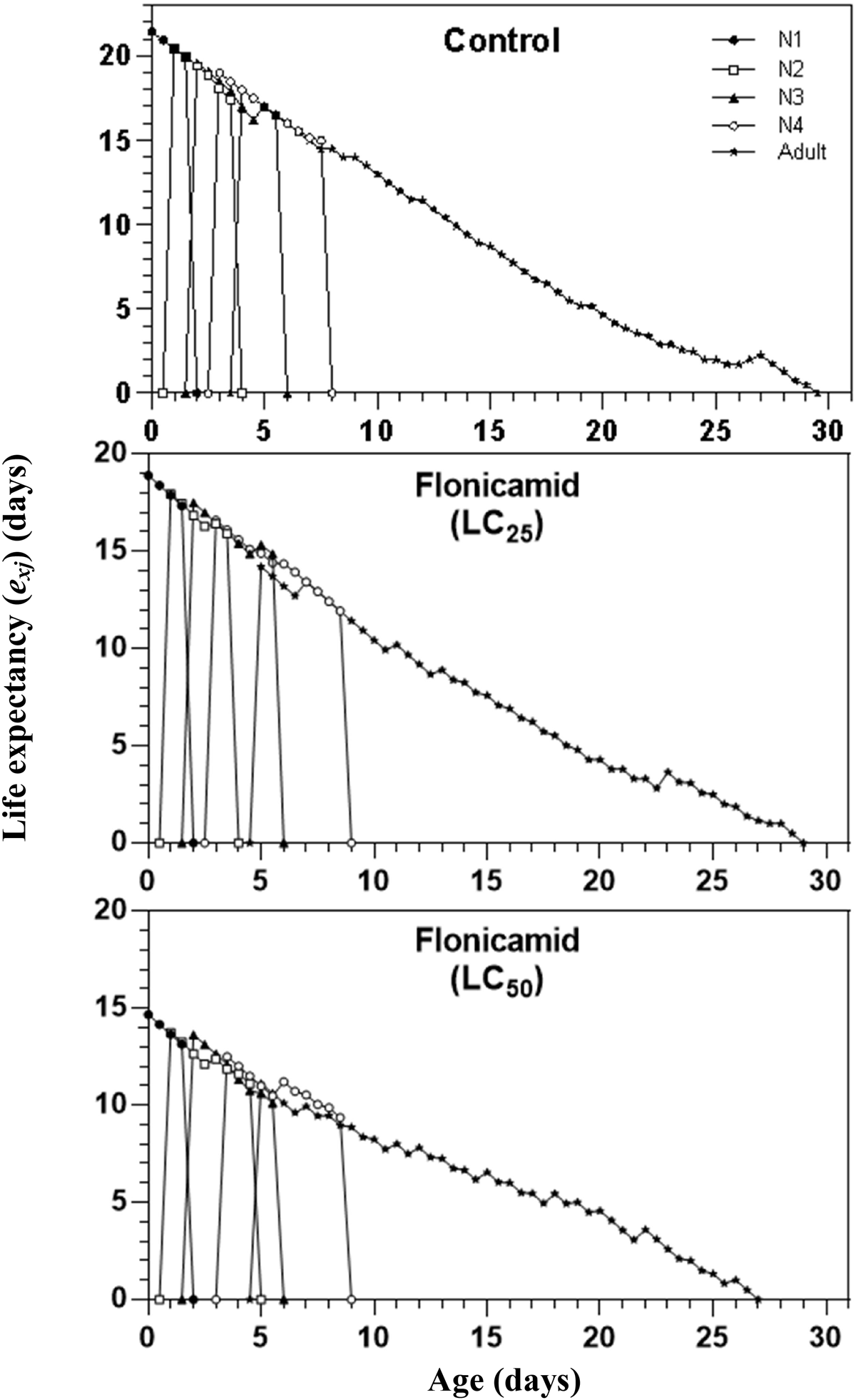
The exj exhibits the duration for which each aphid of age x in period j is predicted to survive. Compared with that of the control, the average expected lifespan decreased with increasing age most significantly in the LC50 treatment (Fig. 3). The life expectancies of newborn nymphs of R. padi in the LC25 treatment, LC50 treatment, and control groups were 19.20, 14.97, and 21.68 days, respectively (Table 3).
Age-stage-specific life expectancy (exj) of the F1 generation of Rhopalosiphum padi, with the control groups compared with the groups treated with the lethal concentrations of flonicamid. exj of the F1 generation of Rhopalosiphum padi.

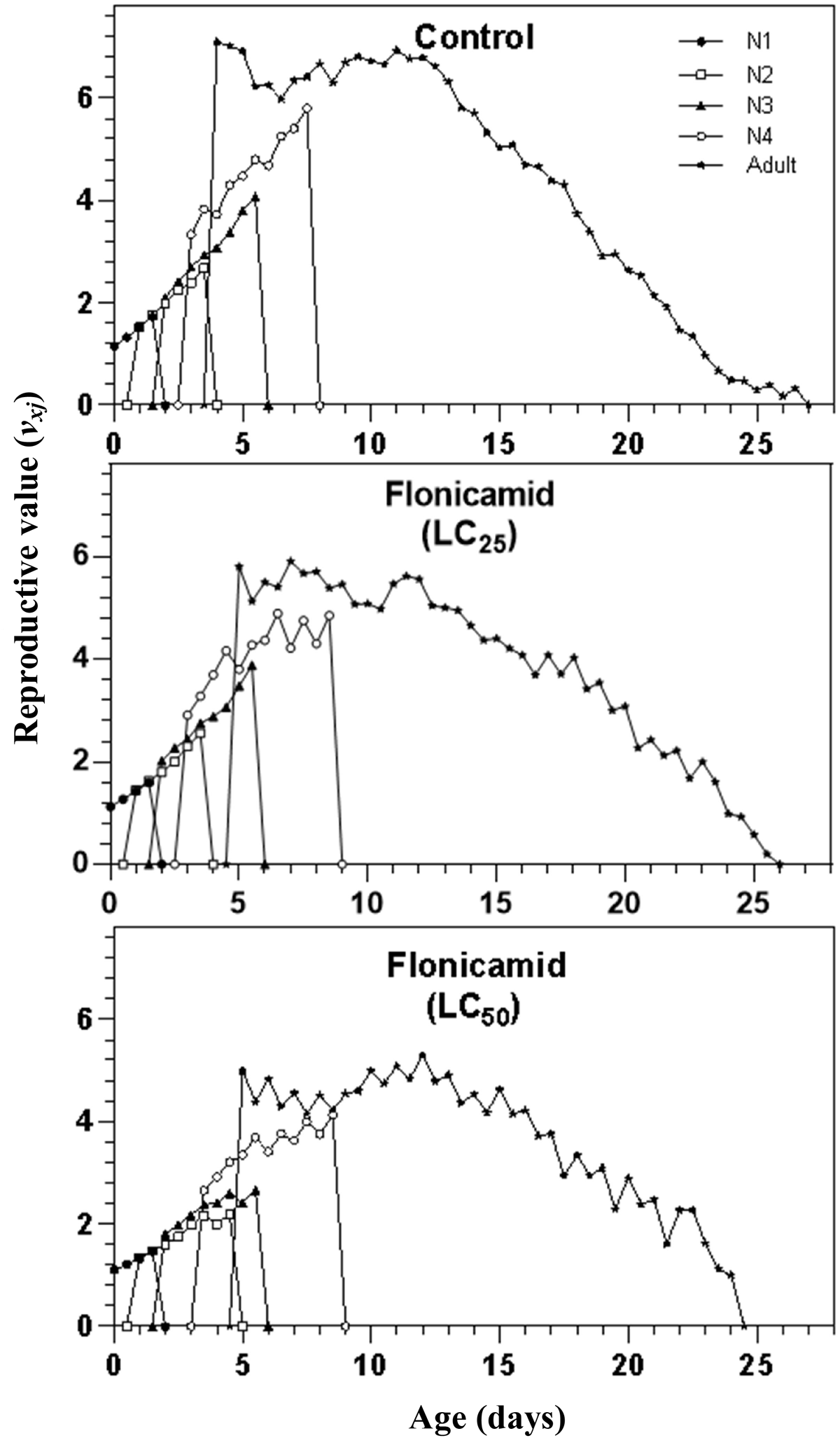
The vxj represents the predicted contribution of aphids at age x and period j to the development of the future population (Fig. 4). For adult aphids, the reproductive value first increased and then decreased in all three treatments, and the reproductive value of adult aphids was significantly higher in the control than in the other two treatments. The vxj values for the control, LC25 treatment, and LC50 treatment reached their respective peak values of 6.8, 6.0, and 5.5, respectively, when adults appeared.
Age-stage reproductive value (vxj) of the F1 generation of Rhopalosiphum padi, with the control groups compared with the groups treated with sublethal concentrations of flonicamid. vxj of the F1 generation of Rhopalosiphum padi.

The life table parameters of the F1 generation in a specific period were determined when the R. padi aphids were treated with the LC25 and LC50 concentrations of flonicamid (Table 4). The R 0 decreased significantly in the LC25 and LC50 treatments compared with that in the control. Compared with that of the control, the value of r was significantly lower in the LC50 treatment but not in the LC25 treatment. T and λ did not significantly differ among the treatments.
Life table parameters of F1 aphids in treatments with the LC25 and LC50 concentrations of flonicamid

Note: The data are presented as the means ± SEs, which were estimated by bootstrapping (100,000 random resamplings) using the TWOSEX-MS Chart program. The same lowercase letter in the same row of data in the table indicates that the Tukey‒Kramer test results were not significantly different at P > 0.05.
Discussion and conclusion
The utilisation of chemical control remains a crucial approach for the management of crop pests. Many studies have shown that insecticides can affect the development, growth and survival of pests (Nauen and Elbert, Reference Nauen and Elbert2003; Rix and Cutler, Reference Rix and Cutler2018; Ullah et al., Reference Ullah, Gul, Tariq, Desneux, Gao and Song2020). Insecticides can also affect the survival and reproductive ability of insects, which have an impact on the fluctuation of their population through different responses to life table parameters (Ayyanath et al., Reference Ayyanath, Cutler, Scott-Dupree and Sibley2013; Cao et al., Reference Cao, Yang, Li, Wang, Li and Gao2019; Hunn et al., Reference Hunn, Macaulay and Matthaei2019; Rix et al., Reference Rix, Ayyanath and Christopher Cutler2016). In the current study, a life table was constructed and used to analyse the effects of the LC25 and LC50 concentrations of flonicamid on R. padi growth, development, and life table parameters. The longevity and fecundity of the parental generation (F0 generation) were markedly reduced under the LC25 and LC50 concentrations of flonicamid in R. padi. It has been shown that population growth in A. gossypii could be slowed under exposure to the LC25 concentration of sulfoxaflor (Chen et al., Reference Chen, Ma, Li, Liang, Liu, Guo, Song, Desneux and Gao2016). The daily fecundity of A. gossypii decreased significantly under sublethal concentrations of spirotetramat (Gong et al., Reference Gong, Shi, Desneux and Gao2016). This finding is somewhat similar to reports that sublethal concentrations of flonicamid lead to significant decreases in the fecundity or longevity of the F0 generation of S. graminum (Gul et al., Reference Gul, Ul Haq, Ullah, Khan, Yaseen, Shah, Tariq, Güncan, Desneux and Liu2023).
We also found that the yield of aphids, reproductive period, longevity, fecundity, and whole generation decreased significantly under flonicamid exposure compared with those of the control for the F1 generation. There are several similar reports that the longevity and fecundity of the F0 and F1 generations were noticeably reduced under treatment with the LC10 concentration of cycloxaprid in A. gossypii (Yuan et al., Reference Yuan, Li, Liu, Cui, Lu, Xu, Li, Wu and Desneux2017). Shi et al. (Reference Shi, Luo, Lv, Zhang, Desneux, You, Li, Ullah and Ma2022) reported that the fecundity of the F0 generation was reduced significantly under sublethal (LC5) and low lethal (LC15) concentrations of flonicamid exposure in A. gossypii. These findings indicate the detrimental lethal or sublethal effects of insecticides on the lifespan and fecundity of some aphids.
In addition, the development of the first and second F1 nymphs increased significantly, whereas the adult longevity, reproductive period, total longevity, and total fecundity of the F1 generation decreased significantly, and there was no significant change in the third or fourth F1 nymph, nymph, APRP, or TPRP stage under the LC25 flonicamid treatment. Compared with those of the control nymphs, the first, second, and fourth F1 nymphs increased significantly, whereas the reproduction of the third F1 nymph, nymph, APRP, or TPRP stage, reproductive period, adult longevity, total longevity, and total fecundity of the F1 generation markedly decreased under the LC50 treatment. Shi et al. (Reference Shi, Luo, Lv, Zhang, Desneux, You, Li, Ullah and Ma2022) reported that the developmental duration of first-instar nymphs noticeably increased after exposure to sublethal concentrations of flonicamid. The durations of the first, second, third, and fourth nymph and preadult stages markedly increased, whereas the longevity of the F1 generation clearly decreased when the parental generation (F0 generation) was exposed to the LC10 concentration of afidopyropen in A. gossypii (Ma et al., Reference Ma, Tang, Liang, Li and Gao2022). However, other reports have shown that the developmental duration of the F1 generation noticeably decreased when the parental generation (F0 generation) was exposed to sublethal concentrations of insecticides (Tang et al., Reference Tang, Ma, Chi, Hou and Gao2019; Ullah et al., Reference Ullah, Gul, Tariq, Desneux, Gao and Song2020; Yuan et al., Reference Yuan, Li, Liu, Cui, Lu, Xu, Li, Wu and Desneux2017).
In this study, combined with the life table parameters, R 0 and r decreased significantly, which is consistent with reports that key biological parameters, including R 0 and rm, decreased significantly (Gul et al., Reference Gul, Ul Haq, Ullah, Khan, Yaseen, Shah, Tariq, Güncan, Desneux and Liu2023), whereas T and λ increased significantly in R. padi exposed to the LC25 or LC50 concentration of flonicamid compared with those in the control. It has been reported that R 0, r, and λ were greater while T and TPRP were lower in A. gossypii under sublethal concentrations of afidopyropen than in the control (Ma et al., Reference Ma, Tang, Liang, Li and Gao2022). Atta et al. (Reference Atta, Rizwan, Sabir, Gogi, Farooq and Jamal2021) reported that the biological activities of S. graminum were suppressed under the LC10 and LC30 concentrations of imidacloprid, sulfoxaflor, and clothianidin exposure.. Koo et al. (Reference Koo, Lee, Yun, Kim and Kim2015) observed that longevity, fecundity, and R 0 of A. gossypii were significantly lower under treatment with the LC30 concentration of flonicamid.
Some insecticides inhibit hormesis under high-dose treatment and stimulate hormesis under low-dose treatment in certain pests (Guedes and Cutler, Reference Guedes and Cutler2014). James (Reference James1997) reported that the spawning rate and population growth were stimulated under the recommended concentration (high-dose) of imidacloprid in Amblyseius victoriensis. Christopher et al. (Reference Christopher Cutler, Ramanaidu, Astatkie and Isman2009) reported that the reproductive rate of offspring but not parents changed under low concentrations of imidacloprid exposure in Myzus persicae (Sulzer). Therefore, different lethal or sublethal doses of insecticides may have different effects on reproduction in insects. In the current study, the key life history traits were affected, and overall R. padi population growth was suppressed under lethal concentrations of flonicamid.
In summary, the longevity and fecundity of adult R. padi in the F0 generation were markedly reduced under the LC25 and LC50 flonicamid treatments. Aphid fecundity was also noticeably reduced, and the growth and development of F1 generation adult aphids were significantly affected. This study provides a strong reference for understanding natural population dynamics, pest resistance management, and the rational use of insecticides in the field.
Supplementary material
The supplementary material for this article can be found at https://doi.org/10.1017/S0007485325000045.
Acknowledgements
Not applicable.
Financial support
This work was supported by the Key Science and Technology Program of Henan (Agriculture) (212102110441), the Project of Plant Protection Key Discipline of Henan Province (1070202190011005), and the Key Scientific and Technological Research Project of Henan Province (232102111012). The funders had no role in the study design, data collection and analysis, decision to publish, or preparation of the manuscript.
Competing interests
The authors declare no conflicts of interest.