Introduction
Interpersonal influence has been a central topic of electoral and political behavior studies (Klofstad, Reference Klofstad2007; Christakis and Fowler, Reference Christakis and Fowler2007, Reference Christakis and Fowler2008; Fowler et al., Reference Fowler, Heaney, Nickerson, Padgett and Sinclair2011; Rogowski and Sinclair, Reference Rogowski and Sinclair2012; Bello and Rolfe, Reference Bello and Rolfe2014; Guidetti et al., Reference Guidetti, Cavazza and Graziani2016). People, by confronting and exchanging ideas with their relevant others (friends, spouses, relatives, co-workers, neighbors etc.,), can come in contact with new political information, arguments, and ideas. In particular, it has been shown that political disagreement with others can lead individuals to change their minds. The effect of disagreement on opinion change has been shown to be relevant in many Western democracies, including the UK (Bello and Rolfe, Reference Bello and Rolfe2014), the US (Huckfeldt et al., Reference Huckfeldt, Johnson and Sprague2004), Italy (Mancosu and Vezzoni, Reference Mancosu and Vezzoni2017) and Germany (Schmitt-Beck and Partheymüller, Reference Schmitt-Beck and Partheymüller2016; Mancosu, Reference Mancosu2017).
The vast majority of previous studies, however, is constituted by single-case studies (Hopmann et al., Reference Hopmann, Matthes and Nir2015). This limitation raises the question concerning the stability of patterns and effects of interpersonal discussions across political and cultural settings. Few studies (e.g.,Ikeda and Huckfeldt, Reference Ikeda and Huckfeldt2001; Huckfeldt et al., Reference Huckfeldt, Ikeda and Pappi2005; Lup, Reference Lup, Tenscher and Rußmann2016) have attempted to tackle the issue of whether political network characteristics present differences or similarities across national contexts. Yet, academic research has not investigated in detail these differences, in particular across European countries.
With this paper, we add to the slowly growing body of comparative studies on interpersonal political communication by addressing the question of how cultural differences across political systems influence patterns and effects of interpersonal political communication. A long-standing theoretical framework in sociology and demography states that Western societies can be divided into strong and weak family regimes (Reher, Reference Reher1998). In strong family regimes (or familistic contexts), the individual is embedded in a strong familial network, which, in general, guarantees him/her a high level of intimacy: as a result, children in strong family contexts tend to live nearer to their own family of origin, exit their parents’ home later, have more frequent encounters with them and receive more assistance (also at an economic level) compared to the children in weak family contexts (Hajnal, Reference Hajnal1982). Generally speaking, we can identify strong family contexts in the Mediterranean countries and weak family regimes in northern Europe and Anglo-Saxon countries with continental Europe representing some sort of a mixed context, in which the level of familism is in between these two extremes (Hajnal, Reference Hajnal1982; Reher, Reference Reher1998).
The argument driving the analyses of this paper is that this strong/weak family pattern might influence individuals’ political behavior and the ways in which people are politically affected by their relevant others. To test our hypotheses, three National Election datasets collected in Italy, Germany and the UK (to the best of our knowledge, the only longitudinal data that also contain detailed enough network information from Western Europe) are harmonized. The analyses of pooled and country-specific influence patterns show that in the strong family context (Italy), people tend to present higher levels of volatility over time when exposed to a disagreeable relative, while no such effect is detected for people exposed to disagreeable spouses (an intimate discussant who is not part of the family). On the contrary, the spouse seems to matter much more than relatives in the UK (the context in which family ties are weaker), and no significant differences are seen in Germany (the mixed context). Besides showing that political behavior and interactions are to be evaluated in the light of family arrangements across Europe, our analyses also emphasize the importance of demographic patterns in political and electoral studies. Results and theoretical arguments of the article go toward the direction indicated by previous works (Hopmann, Reference Hopmann2012), which demanded technical and theoretical tools to understand country differences and analogies in political behavior, demonstrating the benefits of connecting, in a theoretically fruitful way, the two relevant disciplines (demography and political science/communication) that rarely interact with each other.
Prevalence and effects of disagreement
In political science and, in particular, in the debate that aims at explaining electoral behavior by means of interpersonal discussion, one of the main topics of interest is the nature and consequences of political disagreement. The term political disagreement refers to a situation in which individuals, when discussing politics with their relatives, friends, co-workers etc., are exposed to viewpoints that are different from their own (Huckfeldt et al., Reference Huckfeldt, Johnson and Sprague2004; Klofstad et al., Reference Klofstad, Sokhey and McClurg2013). Contrary to the arguments of classic studies of interpersonal influence (e.g., Berelson et al., Reference Berelson, Lazarsfeld and McPhee1954), which tended to emphasize the homogeneity of social circles, more recent research has shown that exposure to political disagreement is a quite common phenomenon (Huckfeldt et al., Reference Huckfeldt, Johnson and Sprague2004). However, disagreement can lead to cognitive dissonance (see Festinger, Reference Festinger1957; Huckfeldt et al., Reference Huckfeldt, Johnson and Sprague2004), a situation of psychological discomfort produced by confronting citizens with new information that challenges their system of beliefs and values.
Previous research showed that citizens have several ways to deal with political disagreement. Recent studies focused on possible situations in which people ‘filter’ their disagreeable discussants, employing selection processes (Noel and Nyhan, Reference Noel and Nyhan2011; Bello and Rolfe, Reference Bello and Rolfe2014). As Rolfe and Bello (Reference Bello and Rolfe2014) stressed, selection, intuitively, is as easy as choosing to stay at the opposite side of the table of a politically disagreeable relative at family gatherings, or choosing other topics when talking with that person. Though this behavior can seem common according to a naïve empiricist point of view, weak empirical evidence has been brought to sustain this interpersonal communication mechanism. In other words, people tend not to systematically filter away their disagreeable discussants. Different works (Bello and Rolfe, Reference Bello and Rolfe2014; Mancosu and Vezzoni, Reference Mancosu and Vezzoni2017), by employing data collected in different countries, indeed showed that disagreeing with discussants in t0 does not lead to a significantly higher propensity to stop talking about politics with that same individual in time t1.
These studies, moreover, showed that a second mechanism related to political disagreement is much more empirically relevant: influence. According to Bello and Rolfe (Reference Bello and Rolfe2014: 136), ‘one person may change his or her mind as a result of new information, social pressure, imitation of peers or some other psychological mechanism associated with making conditional choices’. We can identify two different ‘types’ of influence. We can see influence as a process in which one of the two discussants in a dyad remains in her position and the other one changes her mind toward the first (persuasion), or, given different political ideas at time t0, two discussants reach an intermediate position at time t1, by both changing their minds (convergence). The baseline to assess the relevance of an influence mechanism empirically, however, is that, given a previous situation of disagreement and after an opinion exchange by means of political communication, an agreement is reached in a subsequent time by means of one or both members of the dyad changing their political opinion (Mancosu, Reference Mancosu2017).
Previous studies have stressed that the level of intimacy that one shares with a discussant is crucial in shaping the likelihood of interpersonal influence, whether it is persuasion or convergence. While sociological research focused on the concept of strength of a tie—namely, the intimacy that two individuals share (Granovetter, Reference Granovetter1973) —a standard approach in political communication research has been to divide people’s discussants into three main categories. The first, and the most intimate, is the spouse/partner (Burt, Reference Burt1986; Liao and Stevens, Reference Liao and Stevens1994). The partner represents a discussant that is chosen by the individual, and represents the person with whom the individual spends more time and presents the highest levels of reciprocity, mutual trust and intimacy compared to other possible interactions that individuals experience in their everyday lives. Spouses and partners, in granovetterian terms, are thus expected to be the best representation of a strong tie. The other two categories of discussants are better represented by social groups (Huckfeldt et al., Reference Huckfeldt, Beck, Dalton and Levine1995). Discussants belonging to cohesive social groups, namely relatives (such as parents, grandparents, uncles and aunts, etc.,), have a higher likelihood of presenting high levels of intimacy, trust, mutual regard and so on (see Huckfeldt and Sprague, Reference Huckfeldt and Sprague1991; Huckfeldt et al., Reference Huckfeldt, Beck, Dalton and Levine1995), though usually lower than spouses. Finally, people who belong to social circles beyond the boundaries of cohesive networks tend to present less pronounced levels of intimacy. For what concerns our aims, previous literature showed, quite straightforwardly, that intimate discussants are more likely to agree with each other (by influence and/or selection processes see Morey et al., Reference Morey, Eveland and Hutchens2012; Bello and Rolfe, Reference Bello and Rolfe2014) with respect to non-intimate ones: being in disagreement with the partner or a relative leads one to be more prone to change one’s mind than being in disagreement with a co-worker or a friend.
Differences across space
A review of the literature reveals notable differences across national and cultural contexts, especially concerning the relationship between disagreement, intimacy and influence. In the Anglo-American context, high levels of persistent disagreement are found among family members (Bello and Rolfe, Reference Bello and Rolfe2014; Lyons and Sokhey, Reference Lyons and Sokhey2017): it seems that in those national contexts, the family is an arena in which political disagreement is tolerated. In other national contexts, such as Italy (Mancosu and Vezzoni, Reference Mancosu and Vezzoni2017), the family environment is the one in which people appear to be influenced the most – in other words, people who disagree with a more or less considerable part of their network at time t0 tend to change their political preference at t1. Summarizing, it seems that in Italy the family is a context in which the discussion network tends to assimilate deviant individuals (see Huckfeldt, Reference Huckfeldt1979), while in Anglo-American contexts, people tend to tolerate more disagreement in the family. It seems, thus, that the relationship between intimacy and influence mechanisms could be further moderated by the cultural/demographic context in which citizens are embedded. To date, few studies have focused on the cultural variations in the relationship between network and vote (for an example, see Huckfeldt et al., Reference Huckfeldt, Ikeda and Pappi2005; Eveland et al., Reference Eveland, Song and Beck2015; Lup, Reference Lup, Tenscher and Rußmann2016) but, to the best of our knowledge, no one has focused on the moderating effects that the national context can exert on the relation between influence mechanisms and intimacy. This paper aims at addressing and testing whether cross-national differences might affect influence mechanisms in discussion networks by comparing different countries in Europe in the light of a theory that subdivides countries in strong and weak family contexts.
Strong/weak family countries and political communication
Demographic and economic research has dedicated an impressive amount of effort to identifying countries and regions in which a strong family system prevails, and others in which the power of the family in an individual’s life is weaker (Reher, Reference Reher1998; Alesina and Giuliano, Reference Alesina and Giuliano2010). According to this theoretical line of research, there are regions in which the family group traditionally has the priority over the individual, and others where individuals and their values have the priority (Reher, Reference Reher1998). The dividing lines of this geography describe the central and northern parts of Europe (Scandinavia, Britain, and parts of Germany and Austria), together with North-America, as characterized by relatively weak family links. On the other hand, the Mediterranean region is characterized by strong family ties (Reher, Reference Reher1998). The differentiation can be seen in many comparative contributions stressing economic, demographic, and social differences across countries. For instance, it is possible to evaluate this difference in adulthood transition patterns,Footnote 1 in the material aids that parents give to children, in the geographical nearness between parents and adult children (Lawton et al., Reference Lawton, Silverstein and Bengtson1994) and in the role of the family in shaping individuals’ decisions in family choices (such as, for instance, whether or not cohabiting, see Guetto et al., Reference Guetto, Mancosu, Scherer and Torricelli2016).
This phenomenon seems to have profound historical determinants. As stressed in many contributions (Laslett, Reference Laslett1977; Kussmaul, Reference Kussmaul1981; Reher, Reference Reher1998), during the middle ages and until the second part of the 19th century, it was very common for a parent in rural Britain (as well as northern European countries) ‘to send his son out as an agricultural servant on a farm, say, in the neighboring village, while he took other young servants into his own household as agricultural laborer’ (Reher, Reference Reher1998: 205). The practice was much less common in southern European countries (such as Italy and Spain), in which, on the contrary, children have always tended to remain in their parents’ house, even after marriage (Reher, Reference Reher1998; Schröder, Reference Schröder2008). According to the demographic literature, these historical patterns contributed to form the differences in the relationship between children and their families of origin that also persist today.
In line with the previous research, this paper argues that discrepancies between strong and weak family regimes lead to differences also for what concerns interpersonal political communication and, in turn, its effects on electoral choices or turnout. According to the strong–weak family regime theory, in strong family countries, relatives contribute in a much stronger way to the socio-economic development of the younger members of the family, and this leads, in turn, to a higher frequency of contact between people and their family (Hank, Reference Hank2007), a more intense sense of belonging to the family (Alesina and Giuliano, Reference Alesina and Giuliano2010), and a higher level of perceived authority of the opinions and preferences of the family in several crucial aspects of one’s life (Schröder, Reference Schröder2008). This perception is relevant also in later stages of individuals’ lives, that is, it does not only affects younger individuals […] (Brandt et al., Reference Brandt, Haberkern and Szydlik2009).
At the social mechanism level, thus, people embedded in familistic contexts tend to share a larger amount of social background and common experiences with their family of origin, because of the geographical proximity that binds them. Since strong ties are often the ones an ego is frequently and routinely interacting with in their daily social lives (Marsden, Reference Marsden1987; Pescosolido, Reference Pescosolido1992; Small, Reference Small2013) and tend to be homophonous along different socio-demographic dimensions (see Huckfeldt et al., Reference Huckfeldt, Beck, Dalton and Levine1995), people are more likely to develop a higher level of social cohesion and shared sense of belonging with their family of origin, as well as they are more prone to conform to their members’ dominant attitudes and behaviors. Any potential disagreement between ego and their family of origin is weighted more than that in non-familistic contexts.
Conformism to the dominant attitudes in the family of origin might also be due to cultural differences (such as those suggested by Eveland et al., Reference Eveland, Song and Beck2015) that lead citizens to perceive any form of isolation as more harmful in some cultural contexts (e.g., in Mediterranean countries) than in others (e.g., in Nordic countries).
The theoretical expectation that both these mechanisms suggest is that the family of origin can be more intimate in strong family regimes with respect to weak family ones and can exert, in those contexts, a stronger influence in people’s behavior and attitudes.
We have seen above that in nearly all the countries considered in previous works, the influence mechanism was stronger when people were exposed to strong ties compared to weak ones (Bello and Rolfe, Reference Bello and Rolfe2014; Mancosu and Vezzoni, Reference Mancosu and Vezzoni2017) – the results are pretty straightforward, since it is clear that the influence power of a disagreeable intimate discussant, say the partner, is expected to be stronger than that of a non-intimate one, such as a co-worker. We can expect that the simple difference between strong and weak ties (namely spouse/family vis-à-vis non-relatives) is not informative of the differences that we might expect among different family regimes. A much more promising, and theoretically appropriate, expectation would be comparing two different types of strong ties, namely, members of the family, the non-chosen strong ties par excellence (Huckfeldt et al., Reference Huckfeldt, Beck, Dalton and Levine1995), and the partner, a discussant who does not belong to the process of primary socialization of the individual but nonetheless represents an intimate discussant, if not the most important one (for more information about this point, see Burt, Reference Burt1986). To clarify the concept further, the paper aims at testing two different mechanisms. From one side, the influence power of the family at the ego–network level, and from the other side, the effect that the cultural and social norms shared in the national context might exert on these patterns of interpersonal influence. If the differentiated role of the family is the central element that characterizes strong and weak family regimes, a pronounced difference should be assessed by comparing a close, chosen, person of one’s everyday life—the partner—with a non-chosen, close, source of influence power, the family.
Hypotheses
As stressed above, recent research has argued that an (indirect) proof of influence mechanisms is the relationship between disagreement and vote choice volatility. The first hypothesis, in line with previous research, aims at assessing whether this relationship can be assessed in our data and reads as follows:
Hypothesis 1: Disagreement with a discussant will lead individuals to present higher vote volatility.
We have stressed above that if the family constraints are differentiated according to the weak/strong family regime in which people live, we will see that the influence exerted by the family is stronger than the one exerted by other strong ties (the partner) in strong family contexts, and will be lower in weak family ones. In this case, the partner represents a benchmark of the influence capacities that a strong tie has on the individual. If the strength of family ties indeed is as powerful in strong family regimes as argued, then it will be more powerful than other sources of political discussion. The second and third hypotheses will thus read as follows:
Hypothesis 2: In strong family contexts, the partner’s influence effect is weaker than the relatives’.
Hypothesis 3: In weak family contexts, the relatives’ influence effect is weaker than the partner’s.
Data, methods, and models
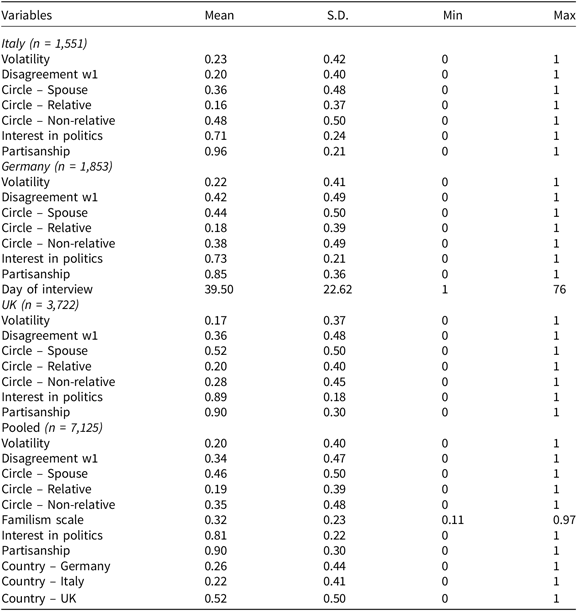
This article aims at testing the hypotheses in three national contexts that represent different family regimes. Italy, the quintessential case of a Mediterranean/strong family context; the UK, which represents a highly weak family context; and Germany, which represents a mixed case, in which weakness of the family ties is not so pronounced (see Reher, Reference Reher1998). We have harmonized three National Elections datasets for these three countries: more precisely, we use data from ITANES 2014 for Italy, the GLES RCS survey 2013 for Germany and the BES survey of 2015 for the UK. The datasets are all collected with CAWI mode (except for the German sample, collected with CATI mode) and aim to reproduce the quota of the three populations for gender and age – for more information on the data employed see Vezzoni (Reference Vezzoni2014) for the Italian dataset, Rattinger et al. (Reference Rattinger, Roßteutscher, Schmitt-Beck, Weßels, Wolf and Partheymüller2017) for the German data, and Fieldhouse et al. (Reference Fieldhouse, Green, Evans, Schmitt, van der Eijk, Mellon and Prosser2015) for the British data (for descriptive statistics of the variables employed in the models, see Appendix of this paper).Footnote 2
In addition to being explicitly employed for electoral research, all three datasets present a longitudinal pre–post-election design, which allows us to assess whether disagreement in the pre-election wave leads to a change of vote choice in the post-election one. In the three datasets, respondents were asked to provide information about their vote intention, their actual vote in the post-election wave, their partisanship, and their interest in politics (measured in the pre-election wave)Footnote 3. Also, respondents were asked to indicate the individual with whom they talk more about politics: in particular, people have been asked about the relationship that they have with him/her and a guess of their vote choice, collected in the pre-election wave. These panel data, once harmonized, present information for a single discussant (what has been described in the literature as the ‘main discussant’, see Huckfeldt et al., Reference Huckfeldt, Beck, Dalton and Levine1995) and do not provide information for the larger network.Footnote 4 This forcedly leads us to analyze an influence mechanism in a dyadic fashion. Though other studies apply this strategy (see Schmitt-Beck and Partheymüller, Reference Schmitt-Beck and Partheymüller2016; Mancosu, Reference Mancosu2017), we must stress that previous research demonstrated that influence is also moderated by the general consensus toward the switching within the broader social network (see Bello and Rolfe, Reference Bello and Rolfe2014). In other words, our coefficients could be biased by the so-called ‘autoregressive influence‘ (Huckfeldt et al., Reference Huckfeldt, Johnson and Sprague2004), which usually plays a role in convincing ego to switch vote choices.Footnote 5 Also, selecting the sole main discussants in the analysis might lead to a higher probability of picking an agreeable discussant (it has been shown in previous literature that the main discussant is usually more agreeable than other discussants, see Huckfeldt et al., Reference Huckfeldt, Beck, Dalton and Levine1995). This might deflate the influence coefficients, however leading to a type-II error, namely, finding no effect when actually there could be an effect, rather than a type-I error (more dangerous in this situation).
Models
To test the hypotheses, two sets of models will be tested (each of them performed for each national context). The first set of models aims at testing Hypothesis 1, while the second tests whether different intimacy levels are more likely to change respondents’ ideas in different family regimes (Hypothesis 2 and Hypothesis 3). We employ first-difference models, a widely used technique to test whether changes in an individual characteristic from t0 to t1 are likely to be affected by exogenous individual/social characteristics in t0 (see Jackman and Vavreck, Reference Jackman and Vavreck2010; Bello and Rolfe, Reference Bello and Rolfe2014; Schmitt-Beck and Partheymüller, Reference Schmitt-Beck and Partheymüller2016; Mancosu and Vezzoni, Reference Mancosu and Vezzoni2017). In our model, the dependent variable is a dichotomous variable that is equal to 1 if the respondent changed his or her vote intention from the pre- to the post-election wave.
One of the main independent variables is the disagreement between the respondent and the discussant, coded as 1 if vote intention of the respondent and perceived vote intention of the discussant diverged in the pre-election wave. The second main variable is the intimacy between the respondent and her main discussant, categorized in ‘Spouse/partner’, ‘Relative’ and ‘Non-relative’ (this latter category includes friends, co-workers, neighbors, etc., – two dummy variables referring to ‘Relative’ and ‘Non-relative’ discussant will be inserted in the model, leading to using ‘Spouse/partner’ as reference category, making in this way possible to assess the difference between partner and the family in an easier way). Additional control variables, consistent with previous literature, are interested in politics (rescaled on a 0–1 score in order to harmonize the three datasets) and partisanship (a dummy variable that is equal to 1 when the respondent feels near to a party and 0 otherwise). Both the control variables are expected to increase vote stability between the two waves.Footnote 6
As stressed in previous research (see Jackman and Vavreck, Reference Jackman and Vavreck2010), the model is non-directional, namely, it is only able to test the association between disagreement in a certain moment and volatility in the subsequent one, without focusing on whether the vote choice is actually directed toward converging positions. We must stress, however, that fitting this kind of model gives us a reasonable indirect evidence of the influence process (see Bello and Rolfe, Reference Bello and Rolfe2014).
The first three logistic regression models, one for each national context to test Hypothesis 1, are designed as follows:
 $$p\left( {volatilit{y_{w1w2}} = 1} \right) = disag{r_{w1}} + inti{m_{w1}} + interes{t_{w1}} + partyi{d_{w1}}$$
Where volatility w1w2 is the dichotomous dependent variable exposed above, disagr w1 is the variable that indicates disagreement in pre-election wave, intim w1 is a set of dummies that indicate intimacy with the main discussant (subdivided in ‘Spouse’, ‘Relative’, and ‘Non-relative’), interest w1 is a 0–1 scale indicating interest in politics (in all the three contexts, from ‘Not at all’ to ‘Very much’), and partyid w1 is partisanship. The second set of models is designed as follows:
 $$p\left( {volatilit{y_{w1w2}} = 1} \right) = + disag{r_{w1}}*inti{m_{w1}} + interes{t_{w1}} + partyi{d_{w1}}$$
Model 2 is basically Model 1 fitted with a two-way interaction between the disagreement and intimacy variable. In this way, it is possible to estimate whether being exposed to a disagreeable spouse, relative or non-relative changes, in different family regimes, the likelihood to be more volatile. Operationally, Hypothesis 2 and Hypothesis 3 expect that the strength of the spouse effect will rise passing from the most familistic national context (Italy) to the least familistic one (UK). At the same time, the effect of the family is expected to decrease.
Exploiting regional differences and measuring familism
To validate our hypotheses, we start from two assumptions: the first is that Italy, Germany, and the UK present differentiated and decreasing levels of familism. Even if this argument is corroborated by previous works (see Hajnal, Reference Hajnal1982; Reher, Reference Reher1998; Alesina and Giuliano, Reference Alesina and Giuliano2010), we do not have any empirical evidence of this pattern. The second assumption is that even if the pattern can be verified empirically, only three national cases could not be enough to defend and externally validate our argument. To address this limitation, we further analyze our data by exploiting the sub-national differences present in the three national contexts, employing a measure of the degree of familism at the regional level. Sub-national differences in familism are consistent in the cultural and demographic structure of West European countries. For instance, an extensive debate emerged in the differences in demographic choices of people from the south of Italy and the north (see Schröder, Reference Schröder2008; Guetto et al., Reference Guetto, Mancosu, Scherer and Torricelli2016), with southerners more linked to traditional family values and northerners more prone to engage in northern European behaviors. Also, Germany sees substantial differences in demographic/cultural behaviors and attitudes between people living in the former GDR and West Germany, as well as people coming from Catholic and Protestant regions (see, for instance, Neugebauer, Reference Neugebauer2007; Traunmüller, Reference Traunmüller2010). The idea behind this further set of models is that we are able to exploit the differentiated levels of familism inside the three national contexts selected to find stronger evidence of our theoretical argument.
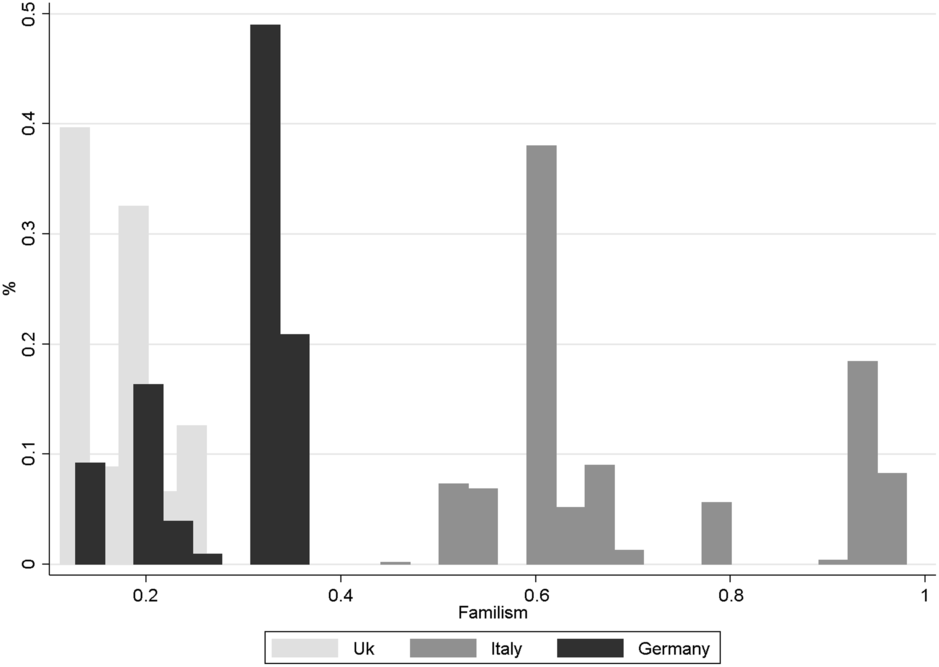
How can familism be measured empirically? For instance, Alesina and Giuliano (Reference Alesina and Giuliano2010) have employed data from the World Values Survey tapping how much people care about their family, think that parents must be respected, and so on. The challenge with the World Values Survey (and comparable data sources) is that they do not provide large enough samples on the regional level. We have therefore focused on measures produced by official sources. Previous literature suggests that to tap familism we can rely on the prevalence of non-traditional family behavior (such as cohabitation out of marriage, divorces, separation), as well as any other behavior that represents an alternative to the traditional marriage (see Nazio and Blossfeld, Reference Nazio and Blossfeld2003; Alesina and Giuliano, Reference Alesina and Giuliano2010; Guetto et al., Reference Guetto, Mancosu, Scherer and Torricelli2016). Following this reasoning, we considered three indicators: (1) the percentage of cohabitation, and (2) divorces (on the number of couples), and (3) the female occupation rate, in each region.Footnote 7 The average inter-item correlation among the three items at the regional level is 0.85. The three measures have been collected for every one of the 47 regions in the three countries selected, they have been rescaled to a 0–1 scale, averaged and its polarity appropriately switched (see Appendix for descriptive statistics). The resulting scale is a 0–1 score in which lower scores represent the least familistic regions and the higher scores the most familistic regions among the three countries selected. The result of the scale, subdivided by country, is available in Figure 1.
Levels of familism in UK, Italy, and Germany (by regions).

As it is possible to see from the figure, Italy presents the highest (and the most varying) scores of familism, while German regions see a smaller variance and in general lower levels of the score. Finally, the UK regions present an even lower variance and the lowest levels of familism, empirically supporting the ranking of strong/weak family regimes that we have derived from the literature.
In addition to the pooled version of Models 1 and 2, we will present a pooled model in which the two-way interaction between disagreement and intimacy with the discussant will be further interacted with the regional familism variable. To account for the variance at the regional level, the pooled models will be fitted as a multilevel logistic regression model with people (level-1) nested into regions (level-2, see Snijders and Bosker, Reference Snijders and Bosker1999). A further control variable is added to model 3, country, which is a set of dummies indicating the country of respondents.
 $$p\left( {volatilit{y_{w1w2}} = 1} \right) = + disag{r_{w1}}*inti{m_{w1}}*familism + interes{t_{w1}} + partyi{d_{w1}} + country$$
Results
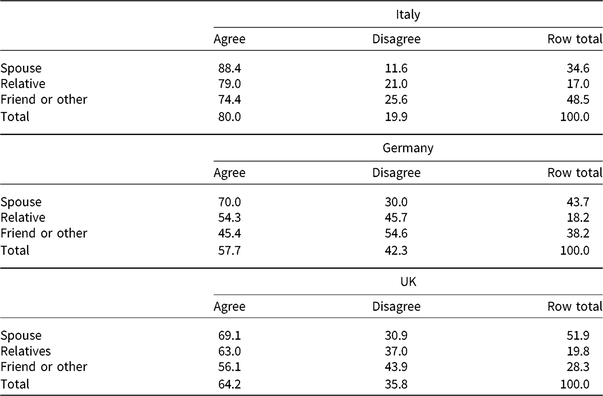
Before showing the models, Table 1 descriptively assesses the relationship between the two main independent variables (intimacy between respondent and the main discussant and disagreement with him/her) in the pre-election wave.
Agreement by levels of intimacy and country

As it is possible to assess from the table, the levels of agreement with discussants decrease according to the levels of intimacy that are usually assumed in the literature (for instance, see Huckfeldt et al., Reference Huckfeldt, Beck, Dalton and Levine1995): spouses tend to present, in all the countries, the highest levels of agreement, followed by members of the family and non-relatives. This might represent an empirical validation of the structure of different levels of intimacy. Another interesting feature of the table is represented by the probability of citation as a main discussant that different circles present. In this case, the likelihood to cite a spouse in Italy is smaller than that in Germany and, in turn, this is smaller than that in the UK. This can be an indirect proof of the fact that, though intimate and agreeable, spouses tend to be less likely involved in political discussions in familistic countries. Of course, this table, however, does not tell us anything about whether disagreeable discussants coming from different circles might affect respondents’ vote choices.
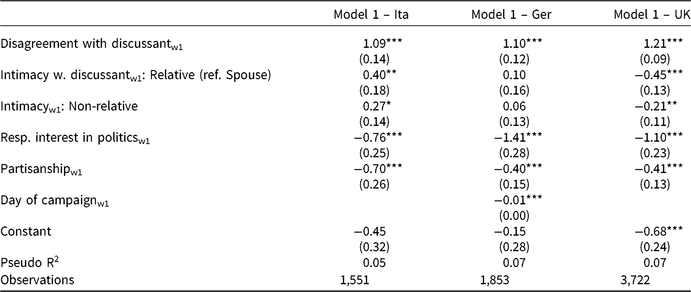
Table 2 shows coefficients for Model 1 in each country. With respect to the control variables, we see that respondents interested in politics are more likely to maintain the vote intention they had in the pre-election wave, as well as partisans. This pattern is common to every countryFootnote 8. As far as our primary independent variable is concerned, we see that, consistent with our expectations, and in every country considered, disagreement with discussants in the previous wave increases the respondents’ probability of changing their vote choice in the following wave.
Three national models to study pre–post electoral volatility – Model 1

Standard errors in parentheses
*** P < 0.01,
** P < 0.05,
* P < 0.1
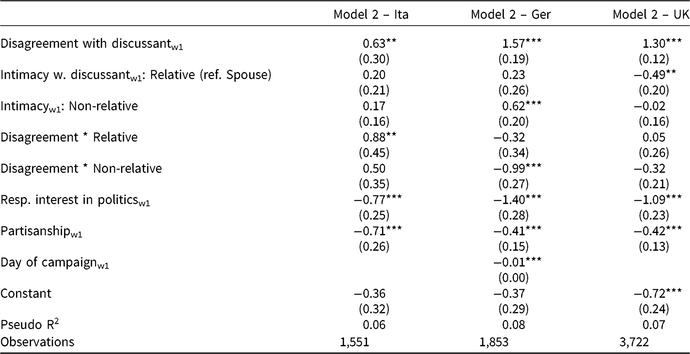
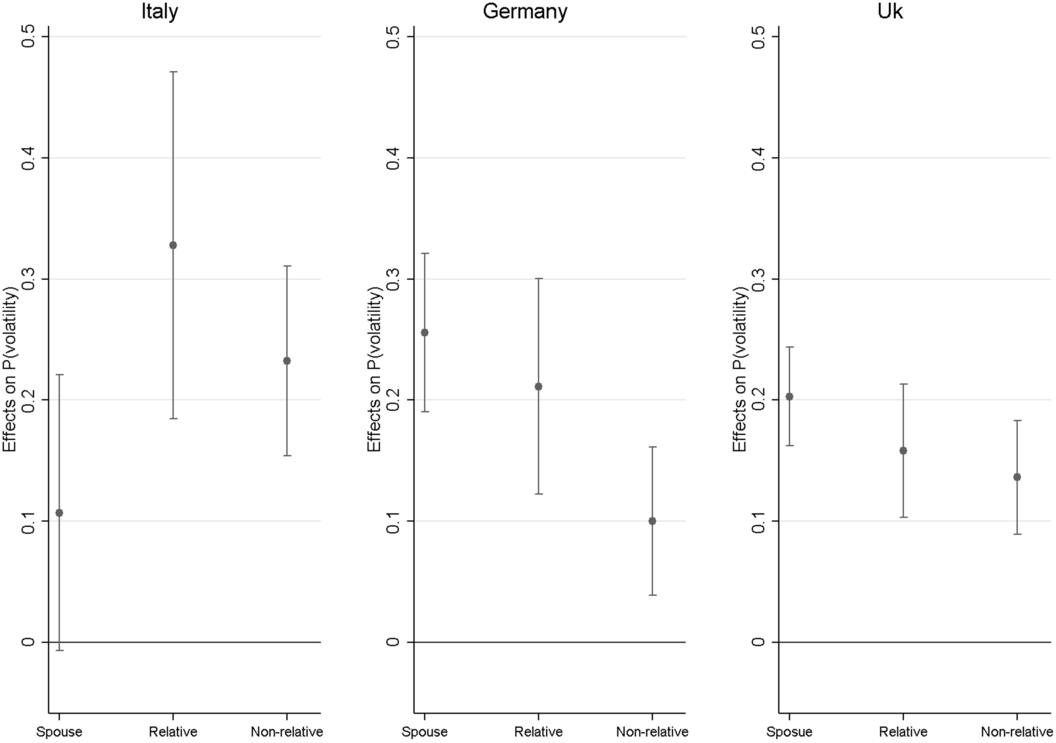
Table 3 shows coefficients for Model 2 for each country. As it is possible to see, the interaction between disagreement and relatives is significant and positive in Italy, while the interaction between disagreement and non-relatives is significant and negative in Germany. A better understanding of the pattern in each country is provided by Figure 2 depicting the average marginal effects of passing from agreement to disagreement for people, separated between spouse, relative or non-relative discussants, separated for each country.
Three national models to study pre–post electoral volatility – Model 2

Standard errors in parentheses
*** P < 0.01,
** P < 0.05,
* P < 0.1
Pre–post electoral Volatility’s Average Marginal effects of passing from agreement to disagreement – by intimacy (spouse, relative, non-relative) and country (based on Model 2 – Italy, Model 2 – Germany, Model 2 – UK of Table 3).

As it is also possible to see both in Table 3 and Figure 2, in the most familistic country, Italy, the effect of passing from agreement to disagreement with the spouse leads to a non-significant change in the probability to change vote choice. The effect of the family, moreover, is strong and significant (and higher than both partner and non-relative effects). In Germany, which presents an intermediate level of strength of family ties, we see that the marginal effect for respondents exposed to disagreeable spouses/partners increases, and it is not significantly different from the effect for those who declare a relative as main discussant. Finally, in the UK, people seem to consider the opinion of the partner more relevant than that of relatives. A Wald test of the statistical difference between the two latter marginal effects leads to a χ-square of 5.98 (P = 0.012).
Summarizing our findings so far, it seems that people confronted with disagreeing relatives are more prone to change according to the levels of familism in the contexts in which they reside. This represents an indirect proof of the fact that people in familistic contexts seem to care more about the opinion of a relative than the opinion of another strong tie, roughly similar in terms of intimacy (namely, the spouse). On the other hand, the spouse’s opinion exerts a stronger influence on the individual with respect to relatives in the context that we have hypothesized to be the least familistic one.
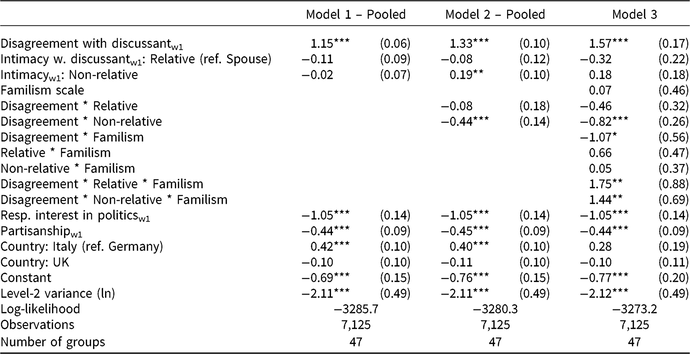
Though giving interesting insights on country-specific differences in political communication and confirming our hypotheses, we argued that the exploitation of the subnational variations in the three countries could lead to additional evidence of the differentiated disagreement effects in places where the family is stronger. Table 4 shows the pooled version of Models 1 and 2 and Model 3, which tests further our Hypothesis 2 and Hypothesis 3.
Three pooled models to study pre–post electoral volatility

Standard errors in parentheses
*** P < 0.01,
** P < 0.05,
* P < 0.1
Pooled Models 1 and 2 are substantially equivalent to the models fitted by country reported in Table 3, except for the interaction in the pooled Model 2, which represents a weighted average of the interactions seen in Table 3. Model 3 fits a three-way interaction that differentiates the effect of the spouse, relative, and non-relative disagreement by levels of familism: as it is possible to see in the table, the three-way interactions’ coefficients are positive and significant. Also, the disagreement *familism two-way interaction and the one identifying a situation of a person in disagreement with a non-relative present negative and significant figures.
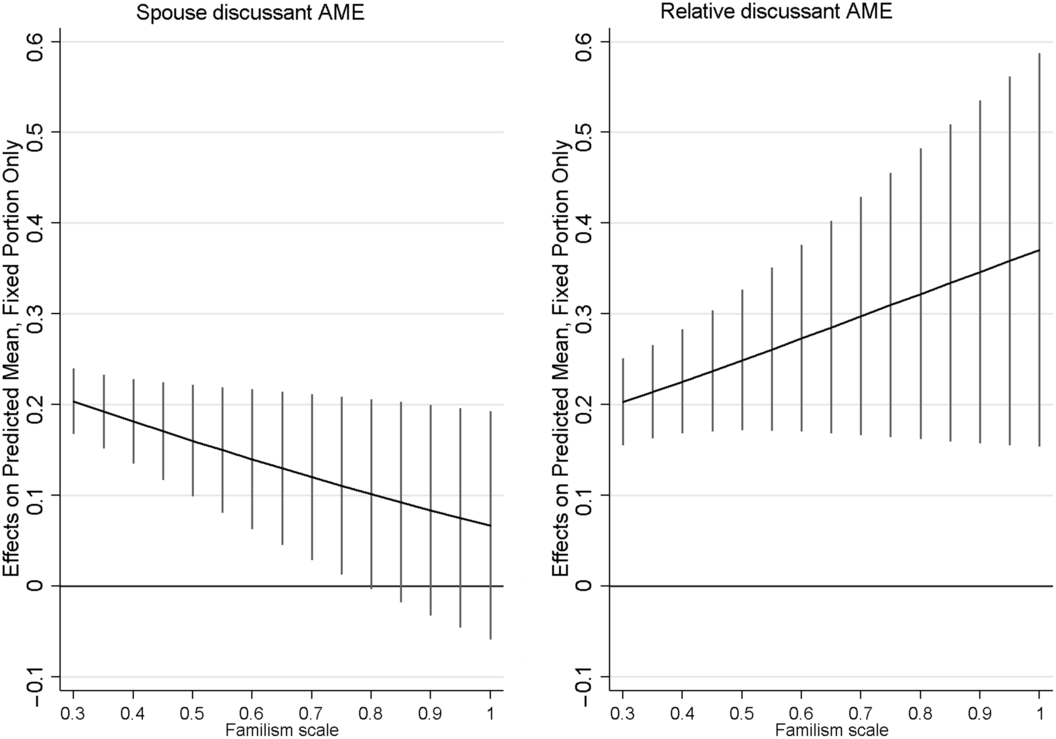
Since the substantive interpretation of a three-way interaction is not straightforward, Figure 3 shows, by levels of familism, the average marginal effect of spouse (left panel) and relatives’ disagreement in relation to agreement. Evidently, for regions where familism is stronger, we find larger confidence intervals – this is mainly because the Italian sample, especially in regions with high levels of familism, has a smaller sample size than the German and the British samples. Notwithstanding, we see from the left panel of Figure 3 that the spouse effect (the effect driven by a strong tie that has been chosen by the respondent) is stronger as long as the contextual familism levels are lower: the marginal effect where familism score is equal to 0.3 is 0.20 (namely, disagreement with the spouse increases the likelihood of changing opinion in the post-election wave by 20 percentage points), and is 0.08 (non-significant to the 5% threshold) when familism is equal to 1. A Wald test that compares the two marginal effects shows that their difference is significant to the level of 5% (χ 2= 5.53, P-value = 0.019). In the right panel, the effect of disagreement with relatives is plotted by different levels of familism. Though less clear, we see that the trend is positive: the marginal effect where familism score is equal to 0.3 is 0.20, and it is 0.35 when familism is equal to 1. The Wald test to compare these two marginal effects detects that this marginal effect’s difference on the familism scale is on the edge of significance to the level of 10% (χ 2 = 2.45, P-value = 0.117).Footnote 9 Overall, our Hypothesis 2 is confirmed by the results, while Hypothesis 3 presents a weaker evidence, although the directions of the coefficients are consistent with the theory.
Pre–post electoral Volatility’s Average Marginal effects of passing from agreement to disagreement – by intimacy (spouse effect – left panel; relative effect – right panel) and level of familism scale (based on Model 3 – Table 4).

Discussion
The concept of interpersonal influence has been discussed in the academic literature at least since the seminal works dealing with the relationship between political discussions and vote (Berelson et al., Reference Berelson, Lazarsfeld and McPhee1954; Katz, Reference Katz1957). However, a large part of these studies focused on the American context (cf. Hopmann, Reference Hopmann2012). So far, few studies have attempted to tackle the problem comparatively (Hopmann, Reference Hopmann2012; Hopmann et al., Reference Hopmann, Matthes and Nir2015), and even fewer have attempted to combine cultural/contextual differences, political discussion and electoral behavior (Huckfeldt et al., Reference Huckfeldt, Ikeda and Pappi2005; Ikeda and Huckfeldt, Reference Ikeda and Huckfeldt2001; Lup, Reference Lup, Tenscher and Rußmann2016). Overall, the literature focusing on contextual determinants of the differences and similarities across countries in political discussion is limited.
The present paper has introduced, into the scholarly discussion on the effects of interpersonal political communication, one of the most important demographic fractures that characterizes West-European societies, namely, the differentiation between strong and weak family regimes. This differentiation has guided a significant amount of sociological (Nazio and Blossfeld, Reference Nazio and Blossfeld2003), economic (Alesina and Giuliano, Reference Alesina and Giuliano2010), and demographic literature (Hajnal, Reference Hajnal1982; Reher, Reference Reher1998). Our paper aimed at assessing whether, pertaining to social relations in people’s everyday lives, this fracture is relevant also in the debate dealing with political discussion networks, and whether expectations related to this theoretical framework can be derived. The results, based on harmonized longitudinal datasets of three countries, suggest that such a demographic fracture also affects the political discussion sphere: people living in a more familistic context seem to care more about disagreement with a relative than with the spouse, with the opposite happening for people living in less familistic contexts. This pattern holds when considering the three countries both at the national and the regional level. These results contribute to the increasing literature that focuses on the cross-national differences that alter the patterns of interpersonal influence. In line with previous literature (in particular, Eveland et al., Reference Eveland, Song and Beck2015), we see that patterns of disagreement vary across national contexts. In addition, the paper aims at stressing that deep-rooted cultural differences between countries might alter the patterns of political influence. The most interesting implication of our results is that the influence that certain circles possess is differentiated according to the cultural constraints that surround discussion networks. Hence, this result, in particular, contributes to further increasing our knowledge on the political network debate and to stimulate additional comparative research on this topic.
Needless to note, the analyses presented in this paper have limitations. The first issue, partly due to the need to compare different national contexts and datasets, is data related. The available data allow us to analyze only perceived characteristics of one discussant for each respondent: this limitation penalizes the possibility of analyzing whether influence processes can affect discussants, in addition to respondents (Mancosu and Vezzoni, Reference Mancosu and Vezzoni2018), and forbids extending our argument to a larger number of political discussants and to the possibility that the levels of homogeneity of the larger network might moderate the dyadic influence (Nir, Reference Nir2011; Bello and Rolfe, Reference Bello and Rolfe2014). Second, our study does not cover more than three Western European countries. Nevertheless, we think that the evidence proposed clear results, especially if we consider the limitations of the data.Footnote 10 Third, some of the findings reported here are not fully explainable by our theoretical argument. In Italy, consistent with our expectations, the effect of disagreement with spouse is lower than that of family, but it appears also lower than that of non-relatives, who are expected to be, overall, the less intimate circle (the difference is however non-significant according to the Wald test results reported above). A more thorough case study investigating this pattern in more detail might lead to interesting results, contributing to a more precise understanding of the effects of interpersonal political communication.
The most relevant ambition of this paper was to connect two disciplines (political science/communication and demography), which rarely interact with each other. While this paper presents insights into the relationship between familism and interpersonal political disagreement, it is a first step only. We are confident that this line of research is promising, and the arguments of the paper can be further tested, primarily by means of survey data collections that include more discussants, and more national contexts.
Appendix
Descriptive statistics