


Introduction
Bipolar disorder (BD) can be severely debilitating, characterized by recurrent episodes of depression, mania or hypomania (American Psychiatric Association, 2000). Research regarding psychological vulnerability to BD has been developed primarily by employing trait measures, such as the Hypomanic Personality Scale (HYP; Eckblad and Chapman, Reference Eckblad and Chapman1986) and the Behavioural Inhibition and Behavioural Activation Scales (BIS/BAS; Carver and White, Reference Carver and White1994).
Many findings support the concept of a “bipolar spectrum”, encompassing “softer” symptom expression and a broader definition of hypomania (Angst, Reference Angst1998; Angst et al., Reference Angst, Gamma, Benazzi, Ajdacic, Eich and Rossler2003; Benazzi, Reference Benazzi2007a; Benazzi and Akiskal, Reference Benazzi and Akiskal2003). It has been argued (Angst, 2007) that utilizing more expansive definitions within research provides more representative pictures of the nature of mood disorders, deviating from the conservative criteria of the Diagnostic and Statistical Manual for Mental Disorders (DSM-IV-TR; American Psychiatric Association, 2000). It has been argued that stable hypomanic personality traits (Akiskal, Reference Akiskal1992; Eckblad and Chapman, Reference Eckblad and Chapman1986) fall on the bipolar spectrum. In this vein, the HYP was designed to assess a personality style proposed to put people at risk of developing BD, and elevated scores on the HYP have been associated with past hypomanic and depressive symptoms (Eckblad and Chapman, Reference Eckblad and Chapman1986; Meyer, Reference Meyer2002; Meyer and Hautzinger, Reference Meyer and Hautzinger2003), as well as greater incidence of bipolar disorder at 13-year follow-up (Kwapil et al., Reference Kwapil, Miller, Zinser, Chapman, Chapman and Eckblad2000).
The BIS/BAS scales (Carver and White, Reference Carver and White1994) were developed as self-report measures of the sensitivity of two neurophysiological structures, the Behavioural Activation (BAS) and Inhibition (BIS) systems. According to theory, BAS is sensitive to reward cues, and BIS is sensitive to signals of threat and non-reward. Behavioural activation theory of BD (e.g. Depue and Iacono, Reference Depue and Iacono1989; Fowles, Reference Fowles1988; Gray, Reference Gray1990) postulates that manic and depressive symptoms are facilitated by high- and low-BAS activity, respectively. High-BIS activity has also been linked with depression (Fowles, Reference Fowles1988). Correspondingly, the BIS/BAS scales have been related to bipolar symptomatology in both analogue (Alloy et al., Reference Alloy, Abramson, Walshaw, Cogswell, Smith, Neeren, Hughes, Iacoviello, Gerstein, Keyser, Urosevic and Nusslock2006; Applegate, El-Deredy and Bentall, Reference Applegate, El-Deredy and Bentall2009; Blechert and Meyer, Reference Blechert and Meyer2005; Jones and Day, Reference Jones and Day2008; Meyer, Johnson and Carver, Reference Meyer, Johnson and Carver1999) and clinical studies (Alloy et al., Reference Alloy, Abramson, Walshaw, Cogswell, Grandin, Hughes, Iacoviello, Whitehouse, Urosevic, Nusslock and Hogan2008; Meyer, Johnson and Winters, Reference Meyer, Johnson and Winters2001). However, there have been discrepancies in results across studies. Further, a lack of convergence between the scales with behavioural and brain activity measures of BAS sensitivity in BD participants (Hayden et al., Reference Hayden, Bodkins, Brenner, Shekhar, Nurnberger, O'Donnell and Hetrick2008) has provoked some criticism about their use.
Nonetheless, bipolar vulnerability has been related to other constructs thought to reflect BAS sensitivity, such as goal-related life events (Johnson et al., Reference Johnson, Cueller, Ruggero, Winett-Perlman, Goodnick, White and Miller2008; Nusslock, Abramson, Harmon-Jones, Alloy and Hogan, Reference Nusslock, Abramson, Harmon-Jones, Alloy and Hogan2007), approach motivation (Jones, Shams and Liversidge, Reference Jones, Shams and Liversidge2007; Meyer, Beevers, Johnson and Simmons, Reference Meyer, Beevers, Johnson and Simmons2007), and overly ambitious goal-setting, as measured by the Willingly Approached Set of Statistically Unlikely Pursuits (WASSUP; Johnson and Carver, Reference Johnson and Carver2006). Therefore, extreme, positive goal-seeking beliefs and behaviours can be viewed as a specific facet of vulnerability to BD, particularly (hypo)mania.
Depression avoidance theory was derived from the psychoanalytic notion that mania arises from dysfunctional attempts to avoid depression (Abraham, Reference Abraham and Jones1911). Building on this theory, Neale (Reference Neale, Oltmanns and Maher1988) proposed that unstable self-esteem predisposes individuals to BD. A number of studies have provided support for unstable self-esteem or self-perception in BD (Bentall and Thompson, Reference Bentall and Thompson1990; Knowles et al., Reference Knowles, Tai, Jones, Highfield, Morriss and Bentall2007; Lyon, Startup and Bentall, Reference Lyon, Startup and Bentall1999; Winters and Neale, Reference Winters and Neale1985). The depression avoidance account is also supported by findings that, while depression and mania share a similar ruminative response style, mania is also associated with risk-taking and distraction, which perhaps reflect attempts to avoid low mood (Knowles, Tai, Christensen and Bentall, Reference Knowles, Tai, Christensen and Bentall2005; Thomas, Knowles, Tai and Bentall, Reference Thomas, Knowles, Tai and Bentall2007).
These results suggest there is a similar underlying cognitive vulnerability to bipolar and unipolar depression. Consequently, several researchers have utilized a measure of cognitive style originally developed to measure the beliefs central to Beck's (Reference Beck1967) cognitive theory of depression, the Dysfunctional Attitudes Scale (DAS; Weissman and Beck, Reference Weissman and Beck1978). Results have been mixed, particularly with regard to mania (Alloy, Reilly-Harrington, Fresco, Whitehouse and Zechmeister, Reference Reilly-Harrington, Alloy, Fresco and Whitehouse1999; Goldberg, Gerstein, Wenze, Welker and Beck, Reference Goldberg, Gerstein, Wenze, Welker and Beck2008; Johnson and Fingerhut, Reference Johnson and Fingerhut2004; Jones et al., Reference Jones, Scott, Haque, Gordon-Smith, Heron, Caesar, Cooper, Forty, Hyde, Lyon, Greening, Sham, Farmer, McGuffin, Jones and Craddock2005; Lam, Wright and Smith, Reference Lam, Wright and Smith2004; Reilly-Harrington, Alloy, Fresco and Whitehouse, Reference Reilly-Harrington, Alloy, Fresco and Whitehouse1999; Scott and Pope, Reference Scott and Pope2003; Scott, Stanton, Garland and Ferrier, Reference Scott, Stanton, Garland and Ferrier2000).
A further line of work proposed that, when individuals with BD experience changes in activation due to disruptions in circadian rhythms, they attribute these changes to personal rather than situational factors (Healy and Williams, Reference Healy and Williams1989; Jones, Reference Jones2001). In light of this, the Hypomanic Interpretations Questionnaire (HIQ; Jones, Mansell and Waller, Reference Jones, Mansell and Waller2006) was developed to measure how individuals interpret hypomania-relevant experiences, such as racing thoughts and increased energy. Positive self appraisals of hypomanic experiences have been associated with hypomanic personality (Jones and Day, Reference Jones and Day2008; Jones et al., Reference Jones, Mansell and Waller2006), and were elevated in bipolar individuals relative to controls, even when controlling for current symptoms (Jones et al., Reference Jones, Mansell and Waller2006).
Thus, research to date has indicated that reward sensitivity, unstable self-esteem, dysfunctional attitudes, goal-attainment beliefs and positive appraisals are pertinent in the development of bipolar symptoms. Several studies have acknowledged the role of life events in the exacerbation of symptoms (for a review, see Johnson et al., Reference Johnson, Cueller, Ruggero, Winett-Perlman, Goodnick, White and Miller2008), with cognitive style and poor goal regulation implicated as mediating mechanisms (e.g. Alloy et al., Reference Alloy, Reilly-Harrington, Fresco, Whitehouse and Zechmeister1999; Johnson et al., Reference Johnson, Sandrow, Meyer, Winters, Miller, Solomon and Keitner2000). These findings have progressed our understanding of BD. However, it has been argued (Mansell, Morrison, Reid, Lowens and Tai, Reference Mansell, Morrison, Reid, Lowens and Tai2007) that there are still gaps in the knowledge of the cognitive processes underlying the full range of symptoms, plus explanations of shifts in mood, cognition and behavioural facets over time. Also, these often complex hypothetical explanations of BD are difficult to test, making it challenging to formulate interventions based on theory. Further integrative understanding is required to address these issues.
The Hypomanic Attitudes and Positive Predictions Inventory (HAPPI)
An integrative cognitive model of mood swings and bipolar disorder (Mansell et al., Reference Mansell, Morrison, Reid, Lowens and Tai2007) incorporated ideas from previous theories. The model proposed that having access to extreme, conflicting and personalized interpretations of changes in internal state was central to the development of mood swings and, at the extreme, the symptoms of BD. These appraisals were proposed to be multiple and contradictory, such that an increase in activation could be appraised as positive (e.g. “When I feel good, I know that whatever I do, I could do no wrong”) or negative (e.g. “Doing anything very active can lead me to have a breakdown”). Responses to changes in internal state depend on the nature of the appraisal occupying awareness at that time. Overly positive appraisals would be expected to drive mood upwards via engaging in ascent behaviours, such as increased goal-directed activity. Conversely, a negative appraisal of being in an activated state would trigger descent behaviours, such as withdrawing from other people, which would drive mood downwards. It is the conflicting nature of the multiple appraisals believed to make individuals vulnerable to the mood swings characteristic of BD. For example, during an interpersonal, goal-directed task (Taylor and Mansell, Reference Taylor and Mansell2008), high scorers on the HYP made more extreme self-appraisals on both positive and negative high-intensity adjectives, relative to controls. These conflicting self-appraisals were present when participants assessed how they viewed themselves, and when judging how other people described them.
The HAPPI (Mansell, Reference Mansell2006) was designed to assess the multiple, extreme appraisals of internal states. These were both positive and negative, and were based around five themes: Self-Activation, Self-Catastrophic, Other-Negative, Other-Positive, and Response Style. When controlling for current symptoms, HAPPI scores were significantly higher in individuals with a diagnosis of BD, relative to non-clinical controls (Mansell, Reference Mansell2006; Mansell and Jones, Reference Mansell and Jones2006). Further, in an undergraduate sample (Mansell, Rigby, Tai and Lowe, Reference Mansell, Rigby, Tai and Lowe2008), HAPPI score was associated with history of hypomanic symptoms as measured by the Mood Disorders Questionnaire (MDQ; Hirschfeld et al., Reference Hirschfeld, Williams, Spitzer, Calabrese, Flynn, Keck, Lewis, McElroy, Post, Rapport, Russell, Sachs and Zajecka2000), independently of age, gender, BIS/BAS, and hypomanic personality. Principal components analysis (PCA) of the HAPPI (Mansell et al., Reference Mansell, Rigby, Tai and Lowe2008) identified five factors, which largely overlapped with the original subscales: Catastrophic; Reduced Social Regulation; Activating Response Style; Success Activation; and a new dimension, Loss of Control. There were also specific associations between these factors and internal states. However, the version of the HAPPI used in this study did not include any self-critical beliefs, despite being described in Mansell et al.'s (Reference Mansell, Morrison, Reid, Lowens and Tai2007) cognitive model, upon which the HAPPI was based. Also, symptoms were not examined prospectively.
In light of further research and clinical observations since its initial inception (Mansell, Reference Mansell2006), new items were added to the HAPPI. PCA was conducted on this expanded version to test if the key themes (Mansell, Reference Mansell2006; Mansell et al., Reference Mansell, Rigby, Tai and Lowe2008) were supported.
The HAPPI was expanded by 11 items to reflect themes relevant to the model and recent research in BD, which were not addressed in the original HAPPI. First, self-critical beliefs during activated states were added (e.g. “When I get agitated and restless, I must be hard on myself to cope”), as described in Mansell et al.'s (Reference Mansell, Morrison, Reid, Lowens and Tai2007) model (see also Mansell, Colom and Scott, Reference Mansell, Colom and Scott2005). Second, the original Self Activation items (Mansell, Reference Mansell2006) were embellished by including desires for achieving extreme personal goals (e.g. “If I am not extremely famous then I am worthless as a person”), drawing upon the finding that individuals with a putative propensity to mania place much importance on personal aspirations for fame, political influence and wealth (Johnson and Carver, Reference Johnson and Carver2006); these beliefs may be specific to BD, having not been evident in unipolar individuals (Lam et al., Reference Lam, Wright and Smith2004). There is a relative wealth of literature linking goal-attainment beliefs with vulnerability to mania (for a review, see Johnson, Reference Johnson2005). The remaining new items were relevant to clinical experience regarding confusion during activated states (e.g. “The more excited I get the more confused I feel about what is real in the world”); bipolar individuals frequently report that their experiences when high are confusing and overwhelming. The current study aimed to replicate the underlying components previously reported (Mansell et al., Reference Mansell, Rigby, Tai and Lowe2008), and to assess the influence of additional items.
In a cross-sectional design (Mansell et al., Reference Mansell, Rigby, Tai and Lowe2008), the HAPPI and its subscales were related to past and present symptoms, independent of personality variables. To complement these findings, this study adopted a prospective design over 3 months. The first aim was to identify a factor structure of subscales that mapped onto the components of the cognitive model. Second, in line with the model, we hypothesized that the extended HAPPI (as measuring the extreme appraisals of internal states implicated in the model) at Time 1 would predict analogue bipolar symptoms at Time 2. Finally, in a more rigorous analysis, we tested the capacity of the HAPPI scale to predict bipolar symptoms at Time 2 independently of baseline bipolar symptoms, past hypomanic symptoms, hypomanic personality, behavioural activation sensitivity and dysfunctional attitudes.
Method
Participants
Students of the University of Manchester were recruited via an email distributed to the student population. Participants completed a battery of questionnaires at two time points 3 months apart. A total of 134 participants completed measures at both time points, and had a mean age of 19 years (SD = 2.54). Females made up 93% of the final sample.
Measures
HAPPI (Mansell, Reference Mansell2006). This study utilized an extended, 61-item version of the HAPPI (see Introduction). Participants rated 61 statements regarding beliefs about internal states from 0 (“I don't believe this at all”) to 100 (“I believe this completely”), on a visual analogue scale.
BIS/BAS (Carver and White, Reference Carver and White1994). The extended version (Holzwarth and Meyer, Reference Holzwarth and Meyer2006) was used. There were three Behavioural Activation subscales: BAS Drive (e.g. “I go out of my way to get things I want”); BAS Fun Seeking (e.g. “I'm always willing to try something new if I think it will be fun”); and BAS Reward Responsiveness (e.g. “When I get something I want, I feel excited and energized”). Additionally, there is a Behavioural Inhibition subscale, BIS (e.g. “Criticism or scolding hurts me quite a bit”). This version includes a fifth subscale, BAS Dysregulation, designed to measure BAS instability (e.g. “There are times in which I get immediately excited when I see an opportunity for something, while in other periods of time this is not the case at all”). Internal consistencies ranged from Cronbach's α of .60 to .84.
DAS (Weissman and Beck, Reference Weissman and Beck1978). This study utilized the DAS-24 (Power et al., Reference Power, Katz, McGuffin, Duggan, Lam and Beck1994), a shortened version of the original 40-item DAS. In a bipolar population (Lam et al., Reference Lam, Wright and Smith2004), three subscales of the DAS-24 were identified: Goal Attainment (e.g. “I should always have complete control over my feelings”); Dependency (e.g. “If others dislike you, you cannot be happy”); and Achievement (e.g. “If I don't set the highest standards for myself, I am likely to end up a second rate person”). Cronbach's α ranged from .78 to .80.
HYP (Eckblad and Chapman, Reference Eckblad and Chapman1986). The HYP is a 48-item True/False questionnaire aimed to look at personality traits that are indicative of hypomanic qualities. Examples of items are: “I am considered to be a kind of ‘hyper’ person” and “People often come to me when they need a clever idea.” An internal consistency of .87 was reported in the original validation of the study, and the scale also had high test-retest reliability of .81.
Internal State Scale (ISS; Bauer et al., Reference Bauer, Crits-Christoph, Ball, Dewees, McAllister, Alahi, Cacciola and Whybrow1991). The ISS assesses symptoms of bipolar disorder over the previous 24 hours. The 15-item scale consists of 4 subscales: Activation (e.g. “Today I feel impulsive”); Well-being (e.g. Today I feel like a capable person”); Perceived conflict (e.g. “Today my mood is changeable”); and Depression (e.g. “Today it seems like nothing will ever work out for me”). The subscales had a high internal consistency, ranging from .81 to .92. Further ISS scores were associated with clinician-rated mood states in bipolar disorder (Bauer et al., Reference Bauer, Crits-Christoph, Ball, Dewees, McAllister, Alahi, Cacciola and Whybrow1991).
MDQ (Hirschfeld et al., Reference Hirschfeld, Williams, Spitzer, Calabrese, Flynn, Keck, Lewis, McElroy, Post, Rapport, Russell, Sachs and Zajecka2000). The MDQ was designed to screen for bipolar spectrum disorders in the general population. The questionnaire is headed with the following statement; “Has there ever been a period of time when you were not your normal self and. . .?” followed by 13 items derived from the DSM-IV characteristics of mania e.g. “. . .you were much more talkative or spoke faster than usual?” The MDQ also asks whether any of the symptoms experienced occurred simultaneously, along with a rating of how functioning was impaired because of this behaviour.
For the current study, the instructions for completing the MDQ at Time 2 were amended to specifically measure hypomanic symptoms during the period of time from Time 1 to Time 2. The instructions read: “Please think back to the time when you first completed these questionnaires. Since then has there been a period of time when you were not your normal self and. . .” This was followed by the same list of symptoms as in the standard version of the MDQ.
Procedure
This study was approved by the School of Psychological Sciences Research Ethics Committee. All participants were asked to read through the information sheet and sign a consent form before taking part. The study had a prospective design with two time points. Time 1 occurred during the first semester and Time 2 occurred during the beginning of the second semester. There was an approximate 3-month interval between Time 1 and Time 2. Questionnaire packs were put together containing self-report measures and demographic information. Participants chose to complete either paper-based or online versions of the questionnaires. After 3 months (Time 2), each participant was given the opportunity to complete the questionnaires again, in the same format as they had originally. At the end of the study, an email was sent out to all participants to debrief and thank them for their time. PCA of the HAPPI was conducted on the Time 2 data.
Results
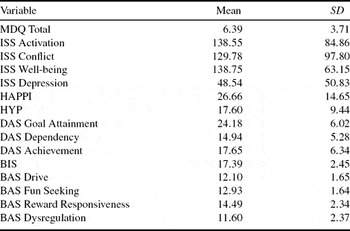
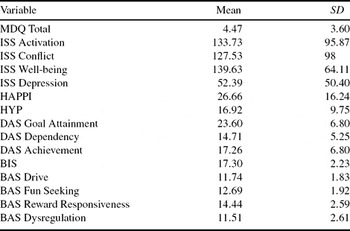
Descriptive statistics for all variables at Time 1 and Time 2 are displayed in Tables 1 and 2, respectively (N = 134).
Descriptive statistics for Time 1 variables

Descriptive statistics for Time 2 variables

Predicting bipolar symptoms
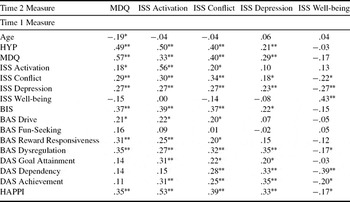
Initially, bivariate correlations were conducted to explore whether the Time 1 variables were significantly related to any outcome measures at Time 2 (specifically the ISS subscales and MDQ). These are displayed in Table 3. The HAPPI was significantly related to all outcome variables, justifying further analyses.
Correlations between the Time 1 measures and outcome measures at Time 2

*p < .05 **p < .01
For each regression model, the Durbin-Watson statistic was greater than 1 and less than 3, so the assumption of independent errors was satisfied. The Variance Inflation Factor (VIF) was not substantially greater than 1, and no Tolerance statistic was less than 0.2 in any of the models, suggesting there was no perfect multicollinearity. Further, the assumption of homoscedasticity was satisfied. Standardized residuals were examined for extreme cases.
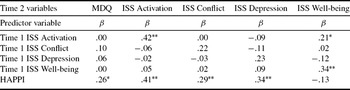
We conducted hierarchical regressions to assess our hypothesis that the HAPPI would predict outcome measures at Time 2 (namely, MDQ, ISS Activation, Conflict, Depression and Well-being), when controlling for baseline symptoms. The ISS subscales from Time 1 were entered in the first step of each model. The HAPPI was entered in the second step, in order to test its independent contribution. Table 4 displays the final β values and their significance level for the final step of the regression model for each outcome variable. For Time 2 MDQ, ISS Conflict, and ISS Depression, the HAPPI was the only significant predictor. For Time 2 ISS Activation, Time 1 ISS Activation and the HAPPI were both significant predictors. For Time 2 ISS Well-being, Time 1 Activation and Well-being were both unique predictors.
Results of regression analysis of prediction of Time 2 variables by baseline symptoms and HAPPI score

Note: MDQ: R2 = .09* for Step 1; ΔR2 = .04* for Step 2
ISS Activation: R2 = .32** for Step 1; ΔR2 = .11** for Step 2
ISS Conflict: R2 = .12** for Step 1; ΔR2 = .05** for Step 2
ISS Depression: R2 = .06 for Step 1; ΔR2 = .07** for Step 2
ISS Well-being: R2 = .21** for Step 1; ΔR2 = .22 for Step 2
*p < .05 **p < .01
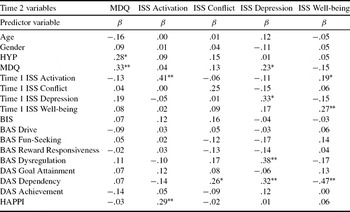
To provide a more rigorous test, separate hierarchical multiple regressions incorporated demographic, personality and cognitive measures. Considering the age and gender differences in previous research on HYP and BIS/BAS scores (e.g. Campbell-Sills, Liverant and Brown, Reference Campbell-Sills, Liverant and Brown2004; Jorm et al., Reference Jorm, Christensen, Henderson, Jacomb, Korten and Rodgers1998; Meyer et al., Reference Meyer, Johnson and Carver1999; Petzel and Rado, Reference Petzel and Rado1990), these were controlled for in the first step. Other predictors entered at step 1 were MDQ; HYP; DAS Goal Attainment, Achievement, and Dependency; BIS, BAS Reward Responsiveness, Drive and Fun-Seeking; and baseline ISS subscale scores. Again, the HAPPI was entered in the second step of the regression. All assumptions were satisfied, as before.
Table 5 displays the final β values and their significance level for the final step of the regression model for each outcome variable.
Results of regression analysis of prediction of Time 2 variables by demographics and Time 1 variables

Note: MDQ: R2 = .43** for Step 1; ΔR2 = .00 for Step 2
ISS Activation: R2 = .48** for Step 1; ΔR2 = .03** for Step 2
ISS Conflict: R2 = .35** for Step 1; ΔR2 = .00 for Step 2
ISS Depression: R2 = .34** for Step 1; ΔR2 = .00 for Step 2
ISS Well-being: R2 = .41** for Step 1; ΔR2 = .00 for Step 2
*p < .05 **p < .01
Time 2 MDQ: The addition of HAPPI at step 2 did not make a significant contribution to the variance. Time 1 MDQ and HYP were positive predictors. The final model accounted for 43.2% of the variance in MDQ.
Time 2 ISS Activation: The addition of the HAPPI contributed significantly to the variance at step 2. Time 1 ISS Activation and HAPPI were both unique predictors, both in a positive direction. The final model accounted for 51.2% of the variance.
Time 2 ISS Conflict: HAPPI score did not contribute significantly to the model. DAS Dependency was a positive predictor. The final model accounted for 35% of the variance.
Time 2 ISS Depression: Again, HAPPI score did not contribute significantly to the variance. BAS Dysregulation, Time 1 ISS Depression, DAS Dependency and Time 1 MDQ were uniquely associated with Time 2 ISS Depression, all in a positive direction. The final model accounted for 34.2% of the variance.
Time 2 ISS Well-being: HAPPI did not contribute significantly to the variance. At step 2, Time 1 ISS Well-being and ISS Activation were positive predictors, whereas DAS Dependency had a negative relationship. The final model accounted for 40.7% of the variance.
Principal components analysis
PCA was conducted to identify whether the previously established HAPPI subscales (Mansell et al., Reference Mansell, Rigby, Tai and Lowe2008) would be validated in the HAPPI. Time 2 HAPPI data were used, as these were found to show a more stable solution.
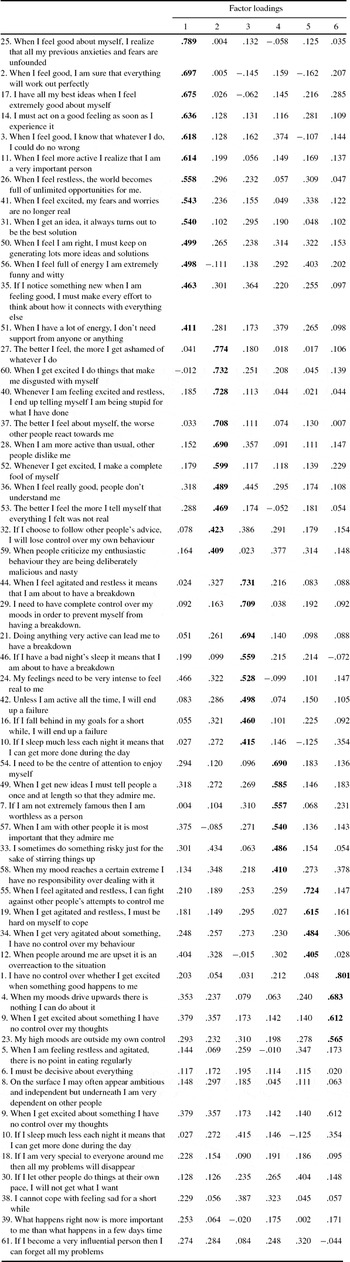
In the initial PCA using Varimax rotation, six dominant factors were found. However, there were 8 items that had a loading of .4 and above on more than one factor. Therefore, they could not be meaningfully interpreted. PCA was run again, excluding these items. Kaiser-Meyer-Olkin = .89, indicating the sample was appropriate for PCA. Bartlett's test of sphericity was also significant, X2(1378) = 5053.34, p < .01. The scree plot indicated a six-factor solution, explaining 51.7% of variance. Factor loadings of the HAPPI items are displayed in Table 6. Within this analysis, five items still double loaded, yet removal of these items led to further double loading in subsequent analyses. Therefore, the factor structure at this stage was retained, and each double loading item was assigned to the component on which it loaded more robustly.
Factor loadings of the HAPPI for the final PCA

The most prominent factor explained 12.34% of variance, and was named Self Activation, as the items referred to positive self beliefs an individual holds during activated states. Factor 2 explained 11.32% of variance, and was labelled Self-and-Other Critical beliefs, as the items represented overly critical or negative thoughts with regard to the self, the activated states, and others. Factor 3 explained a further 9.23% of variance, and was named Catastrophic beliefs. This factor consisted of items that signified fear and perceived inevitability of breakdown or failure. Factor 4 explained 6.9% of variance and was named Appraisals of Extreme Social Approval. This referred to the need for others to admire and look up to them. Factor 5 accounted for 6.31% of variance, and was named Extreme Appraisals of Agitation. The items represented extreme responses to feelings of agitation or restlessness. The 6th explained 5.59% of variance and was labelled Loss of Control, as the items represented beliefs about lack of control over heightened moods.
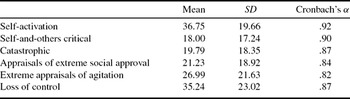
Descriptive statistics and internal consistencies are displayed in Table 7 (N = 134). Overall internal consistency was high (Cronbach's α = .97).
Descriptive statistics and internal consistencies for HAPPI factors

Discussion
This extended version of the HAPPI was significantly and positively related to prospective ISS Activation, Conflict and Depression. There was also a negative relationship between HAPPI and ISS Well-being. This suggested that having stronger belief in multiple, conflicting and personalized appraisals was related to greater hypomania and depression and reduced psychological well-being after 3 months. Additionally, the HAPPI was associated with the MDQ, ISS Activation, Conflict and Depression after 3 months, when controlling for baseline scores on these measures.
Further, the HAPPI was also able to predict ISS Activation after 3 months, when controlling for age, gender, baseline symptoms, and measures of hypomanic personality and behavioural activation, which have previously been predictive of hypomania (Alloy et al., Reference Alloy, Abramson, Walshaw, Cogswell, Grandin, Hughes, Iacoviello, Whitehouse, Urosevic, Nusslock and Hogan2008; Hofmann and Meyer, Reference Hofmann and Meyer2006; Meyer et al., Reference Meyer, Johnson and Winters2001). This finding is significant, as it has been argued that over-activity is a key construct underlying hypomania (Benazzi, Reference Benazzi2007b). However, whereas Mansell et al. (Reference Mansell, Rigby, Tai and Lowe2008) found that the HAPPI was independently associated with the MDQ and other ISS subscales when controlling for personality measures, this relationship was not replicated in the current study.
Besides Time 1 MDQ, only HYP predicted Time 2 MDQ. This association was positive, consistent with previous studies (Mansell et al., Reference Mansell, Rigby, Tai and Lowe2008; Udachina and Mansell, Reference Udachina and Mansell2007). Contrary to previous findings (Mansell et al., Reference Mansell, Rigby, Tai and Lowe2008; Udachina and Mansell, Reference Udachina and Mansell2007), hypomanic personality was not independently associated with activation. Baseline MDQ and BAS Dysregulation predicted ISS Depression, consistent with previous literature (Holzwarth and Meyer, Reference Holzwarth and Meyer2006; Udachina and Mansell, Reference Udachina and Mansell2007). However, none of the other 3 BAS subscales (Drive, Fun Seeking, and Reward Responsiveness) or BIS predicted analogue bipolar symptoms after 3 months. DAS Dependency had a positive relationship with ISS Conflict (e.g., irritability and suspiciousness) and Depression, whereas ISS Well-being had a negative relationship with DAS Dependency. This is consistent with previous findings that DAS Dependency is related to low mood (Lam et al., Reference Lam, Wright and Smith2004). However, associations between DAS Goal Attainment and Achievement and bipolar symptoms did not hold up when directly compared with other measures in the regression. Time 1 ISS Activation was independently and positively associated with ISS Well-being, suggesting that greater activation improves psychological well-being.
PCA of the HAPPI indicated six factors: Self-Activation, Self-and-Other Critical Beliefs, Catastrophic Beliefs, Extreme Appraisals of Social Approval, Appraisals of Extreme Agitation, and Loss of Control. The Loss of Control and Catastrophic factors overlapped with Mansell et al.'s (Reference Mansell, Rigby, Tai and Lowe2008) factors of the same names. In addition, the strongest factor in the analysis reported here, Self Activation, appeared to be a combination of items from the previous factors Activating Response Style and Success Activation. Several of the novel items loaded on to the Self-and-Other Critical factor, as did one of the confusion items (“The better I feel the more I tell myself that everything I felt was not real”). A further self-critical item formed part of the Appraisals of Extreme Agitation factor (“When I get agitated and restless, I must be hard on myself to cope”). One goal-attainment belief loaded on to the factor Extreme Appraisals of Social Approval (“If I am not extremely famous then I am worthless as a person”). The remaining new items did not load on to any of the factors.
Therefore, it appears that the addition of these items was valuable, particularly those pertaining to self-critical beliefs, which formed a large proportion of the new Self-and-Other Critical factor. The emergence of this novel factor provides further indirect support for the cognitive model (Mansell et al., Reference Mansell, Morrison, Reid, Lowens and Tai2007), as self-critical appraisals were conceptualized as a way of attaching extreme personal significance to changes in internal state. Also, these factors represent conflicting beliefs about internal states; for example, there are contradictory self-activating beliefs (e.g. “When I feel restless, the world becomes full of unlimited opportunities for me”) versus self-critical beliefs (e.g. “Whenever I am feeling excited and restless, I end up telling myself I am being stupid for what I have done”). Recent evidence that these conflicted appraisals are important comes from a study of a goal-directed task in which an activated state was induced in individuals with either high or low levels of hypomanic personality. The high hypomania-prone participants rated themselves higher on both positive (e.g. dynamic) and negative (e.g. selfish) trait words pertaining to highly activated internal states (Taylor and Mansell, Reference Taylor and Mansell2008). The current study provides further validation, as the hypothetical conflicting categories of appraisals emerged.
The HAPPI predicted all the key clinical variables (ISS Activation, Conflict and Depression, and the MDQ) after 3 months, when controlling for base rates of symptoms. However, the HAPPI only had an association with ISS Activation when controlling for the BIS/BAS, HYP and MDQ, in addition to baseline symptoms. This suggests that a variety of psychological factors predict bipolar symptoms over time in addition to the extreme appraisals of internal states. This complex relationship between factors is likely to prove the subject of future research.
The results of the PCA overlap with results from a previous study (Mansell et al., Reference Mansell, Rigby, Tai and Lowe2008), as well as the conceptual categories of beliefs described in the cognitive model (Mansell et al., Reference Mansell, Morrison, Reid, Lowens and Tai2007) and included in the original HAPPI (Mansell, Reference Mansell2006). These results provide tentative support for the predictive and construct validity of the HAPPI.
Limitations and future directions
In the present research, the MDQ was used as a retrospective measure of hypomanic experiences over the previous 3 months; the original MDQ is a measure of lifetime hypomanic experiences, based on diagnostic criteria, which may not be as suited to a student sample as alternative measures, such as the General Behaviour Inventory (GBI; Depue et al., Reference Depue, Slater, Wolfstetter-Kausch, Klein, Goplerud and Farr1981). The GBI is a more comprehensive and detailed measure of both historical hypomanic and depressive symptoms, developed in a student sample.
Participants were all university students, and mostly female. Also, all of the measures used in the study were self-report. In combination, these limitations may have produced biased results. However, there are strong arguments for recruiting student samples (Depue et al., Reference Depue, Slater, Wolfstetter-Kausch, Klein, Goplerud and Farr1981), and the concept of the bipolar spectrum would suggest that hypomanic experiences are on a continuum.
There was only one follow-up time point in the current study; it would be valuable to examine symptoms prospectively across multiple time points. Further, the sample size was small considering the number of predictors adopted in regression, and the resulting beta values in the regressions were small, albeit significant. Furthermore, the sample was relatively poor for PCA, so these factors should be treated tentatively. However, it has been argued that where three or more items represent each factor and communalities are high (greater than .7, on average; Fabrigar, Wegener, MacCallum and Strahan, Reference Fabrigar, Wegener, MacCallum and Strahan1999), a sample size of 100 is adequate. It has also been argued that PCA is not strictly a method of factor analysis (Costello and Osborne, Reference Costello and Osborne2005; Fabrigar et al., Reference Fabrigar, Wegener, MacCallum and Strahan1999; Henson and Roberts, Reference Henson and Roberts2006). Also, several items loaded onto more than one component in the final analysis, but were included to retain the integrity of the factor structure, and attributed to the component on which they loaded most robustly. For these reasons, it may be valuable to perform a larger-scale factor analysis of the HAPPI, utilizing a different method of extraction, such as maximum likelihood or principal axis factors. This may be useful for determining a definitive version of the HAPPI. A clinical prospective study would be required to examine if extreme, conflicting appraisals measured by the HAPPI are related to future symptoms in individuals with a diagnosis of BD.
Acknowledgements
The work was carried out at the School of Psychological Sciences, University of Manchester, Manchester, UK. This research was funded by the University of Manchester and will form part of the first author's PhD thesis. Dr Warren Mansell is supported for the Emotion Regulation of Others and Self (EROS) research grant.



Comments
No Comments have been published for this article.