




No CrossRef data available.
Article contents
Knowledge and attitudes toward end-of-life care in veterans with symptomatic metastatic cancer
Published online by Cambridge University Press: 26 February 2004
Abstract
Objectives: The purposes of this study were to study symptomatic metastatic cancer patients' knowledge and attitudes toward end-of-life (EOL) care and to examine how patient-perceived health status affects attitudes toward EOL care and survival.
Methods: From 1999 to 2002, 254 symptomatic metastatic cancer patients at the VA New Jersey Health Care System completed the Vermont Voices on Care of the Dying Questionnaire. Survival status and location of death were obtained. Descriptive statistics and the chi square method were used to assess the differences between African Americans (N = 109) and Caucasians (N = 135), and between different patient-perceived health status groups. A log-rank test was performed to assess for differences in median survival length between different patient-perceived health-status groups.
Results: Veterans' responses to the Vermont questionnaire showed knowledge deficits regarding EOL care. There was wide variation in self-rankings of health status: 45.6% of patients rated their illness as serious and life threatening, 18.9% considered their health problem significant but not life threatening, 2.8% thought they were in good health, and one-third of patients were unsure about their health status. Most patients (86.2%) preferred physician frankness when communicating bad news and 61.8% preferred family involvement in EOL discussions. African American patients were less likely to have completed advance directives (p < 0.0001), to have knowledge about hospice programs (p < 0.00001), and to feel capable of assessing their health situation (p = 0.04). Patient-rated health status affected completion rates of advance directives and survival.
Significance of the research: These findings demonstrate knowledge deficits and racial differences in attitudes and values toward EOL care in veterans with cancer. The Vermont questionnaire enables patients to state their EOL preferences but may not be detailed enough for clinical applications. Patient-rated health status may be an important explanatory variable for EOL preferences and length of survival.
Keywords
Information
- Type
- Research Article
- Information
- Copyright
- © 2003 Cambridge University Press
INTRODUCTION
High quality palliative care emphasizes honoring patient preferences and communication. Significant end of life (EOL) knowledge deficits have been documented in different patient population (Gamble et al., 1991; Uhlmann & Pearlman, 1991; Blackhall et al., 1995; Schonwetter et al., 1996; Hoffmann et al., 1997; Patrick et al., 1997; Fried et al., 1999; McKinley et al., 2000; Silveria et al., 2000; Wilson, 2000; Steinhauser et al., 2001; Schwartz et al., 2002; Vig et al., 2002), and the determinants of patient preferences are unknown (Hamel et al., 1999). Race has been correlated with levels of knowledge and preferences for life sustaining treatments (Emanuel, 1991; Blackhall et al., 1995; Hoffmann et al., 1997; Hornung et al., 1998; Hopp & Duffy, 2000; McKinley et al., 2000; Silveria et al., 2000; Waters, 2001). Caucasians usually had better understanding of EOL care options, less life-sustaining treatments, better communication with health professionals, and were more likely to complete living wills (Blackhall et al., 1995; Hoffmann et al., 1997; McKinley et al., 2000; Silveria et al., 2000). Another interesting explanatory factor may be patient perception of health status. In an interview study of hypothetical scenarios, patient perceptions of health status were important in their formulation of end-of-life preferences (Patrick et al., 1997).
Little is known about knowledge and attitudes toward EOL issues in veterans. It is important to study the palliative care needs of this population. Veterans account for a large percentage of deaths in the United States. The veteran population has a higher mortality rate (Fisher & Welch, 1995), reflects the lower 10% of the socioeconomic strata (Harris et al., 1989), and has poor health status scores compared with non-veteran populations (Kazis et al., 1998).
The Vermont Voices on Care of the Dying Questionnaire (Vermont Ethics Network, 1997) was developed to elicit knowledge and attitudes about EOL care from communities. We prospectively collected patient responses to the Vermont Voices on Care of the Dying Questionnaire to better characterize the preferences of veterans with metastatic cancer. The data was collected as part of demographic data in a cohort of symptomatic metastatic cancer patients who participated in the Unmet Needs Project (S.S. Hwang, V.T. Chang, Q. Zhang, Y. Alejandro, P. Osenenko, J. Cogswell, E. Morales, S. Srinvas, & B. Kasimis, submitted) at the VA New Jersey Health Care System (VANJHCS).
In this article, we present the results from the Vermont Voices on Care of the Dying Questionnaire with the following three main objectives: (1) to describe the knowledge and attitudes about EOL care of veterans with symptomatic metastatic cancer, (2) to explore the relationship between race and EOL preferences, and (3) to explore the association between patient-perceived health status and survival.
METHODS
Patient Selection
The Section of Hematology/Oncology of the VANJHCS is the sole tertiary care provider in the state of New Jersey for veterans with cancer. From August 1999 to October 2002, a total of 296 symptomatic advanced cancer patients with distressing symptom(s), defined as presenting with at least “somewhat” distress for a minimum of one physical symptom or at least “occasional” frequency for a minimum of one psychological symptom measured by the Memorial Symptom Assessment Scale-Short Form (MSAS-SF; Chang et al., 2000), seen in the outpatient Hematology/Oncology clinic and the inpatient service, participated in the Unmet Needs Project and completed the Vermont Voices on Care of the Dying Questionnaire. Of the 296 patients, 42 patients were excluded from this analysis as 38 patients only had regional-advanced stage disease and four patients did not complete the Vermont Voices on Care of the Dying Questionnaire. The final data set contained 254 symptomatic metastatic cancer patients.
The protocol was approved by the Institutional Review Board and all patients signed informed consent. Outpatients completed the survey during their clinic visit and the inpatients completed the survey within two days of admission.
Instruments
The Vermont Voices on Care of the Dying Questionnaire was originally designed for and used in the Journey's End Project (Vermont Ethics Network, 1997) to assess the individual's knowledge of and attitude toward EOL issues through either community forums or personal interviews and to communicate these needs to health care providers. The questions cover the following areas: perception of health, awareness of hospice program, advance directives documentation, experience with dying, breaking bad news, communication, preference of location of death, and perception of pain and EOL care delivered by the current health care system. We chose this instrument as it was recommended by the Institute of Medicine (IOM; Field & Cassel, 1996) to assess the individual's knowledge and attitude about EOL care. The applicability of this instrument in a sample of seriously ill patients has not been reported.
Statistical Analysis
Responses to the knowledge and values items about EOL care were tabulated. Based on the response to the question, “Which state applies best to your current health situation?” patients were grouped into the following four patient-perceived health groups: good health (N = 7, 2.8%), serious and life-threatening illness (N = 116, 45.6%), significant but not life-threatening health problems (N = 48, 18.9%), and don't know (N = 83, 32.7%).
The chi square test was used to assess for differences in response patterns for each knowledge and attitude item between inpatients and outpatients status, between three different age groups (<65 years vs. 66–75 years vs. >75 years), between four different health groups, and between different racial groups (African Americans vs. Caucasians). The survival status and location of death (home vs. hospital) as of December 30, 2002 for each subject was obtained and confirmed. The Log-rank test for equality of survivor functions was performed to assess for differences in median survival length between the four different health groups.
Statistical analyses were performed with the STATA program, v7.0. (StatCorp., 1997).
RESULTS
Patient Characteristics
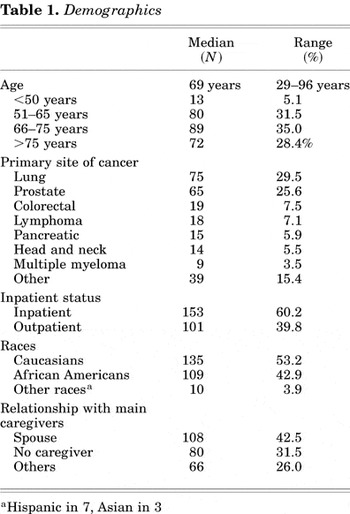
The 254 patients were all men. The median age was 69 years (range 29–96). The four most common primary cancer sites were lung in 75 patients (29.5%), prostate in 65 patients (25.6%), colorectal in 19 patients (7.5%), and lymphoma in 18 patients (7.1%). There were 135 Caucasians (53.2%), 109 African Americans (42.9%), and other races in 10 patients (3.9%; Table 1).
Demographics

Knowledge and Attitude toward EOL
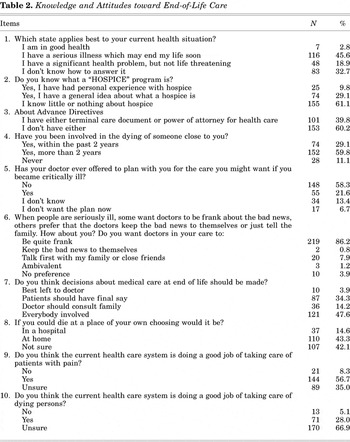
The results regarding knowledge and attitudes toward EOL care are listed in Table 2. Most patients thought they had either a serious and life-threatening illness (45.6%) or had a significant but not life-threatening illness (18.9%); one-third of patients (32.7%) did not know how to answer this question. About 60% of patients knew little or nothing about hospice programs (61.1%) and did not have any terminal care documents (60.2%). The majority of patients had experienced the death of someone close to them (88.9%). One hundred eighty-two patients (71.7%) either had not received any care plans (58.3%) or did not know whether their physicians had offered them the care plans or not if they became critically ill (13.4%). Most patients (86.2%) preferred doctors to be quite frank in communicating bad news, and 7.9% of patients preferred doctors to discuss bad news with their family or close friends first. Nearly half of the patients (47.6%) thought everyone (patient, family members, and health care providers) should be involved in their EOL medical care decision making, and 34.3% of patients preferred to make the EOL medical care decision by themselves. If patients could choose the place of death, 43.3% preferred to die at home, 14.6% preferred to die in a hospital, and 42.1% did not have any preferences. More than half (56.7%) of patients thought that the current health care system is doing a good job of addressing the needs of patients with pain but only 28.0% of patients thought that the current health care system is doing a good job of taking care of dying persons.
Knowledge and Attitudes toward End-of-Life Care

There were no differences in patterns of responses to the items between three different age groups and by inpatient and outpatient status.
Comparison of Knowledge and Attitudes toward EOL and Location of Death between Racial Groups
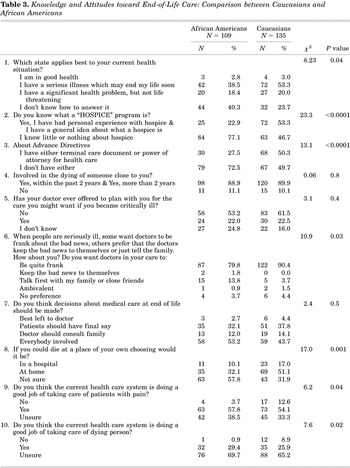
In comparison with Caucasians, African American patients had significantly higher responses in the following items: uncertainty about their current health situation (40.3% vs. 23.7%), lack of knowledge about hospice programs (77.1% vs. 46.7%), absence of terminal care documents (72.5% vs. 49.7%), desire for bad news to be discussed with their family or friends first (13.8% vs. 3.7%), and uncertainty about the preferred location of death (57.8% vs. 31.9%). In contrast, Caucasian patients had higher responses in the following areas: knowledge of the severity of illness (53.3% vs. 38.5%), desire for frankness when breaking bad news (90.4% vs. 79.8%), preference to die at home (51.1% vs. 32.1%), and belief that the current health care system is not doing a good job in addressing the needs of patients with pain (12.6% vs. 3.7%) or in taking care of dying persons (8.9% vs. 0.9%; Table 3).
Knowledge and Attitudes toward End-of-Life Care: Comparison between Caucasians and African Americans

Patient-Perceived Health Status and Knowledge and Attitudes toward EOL Care
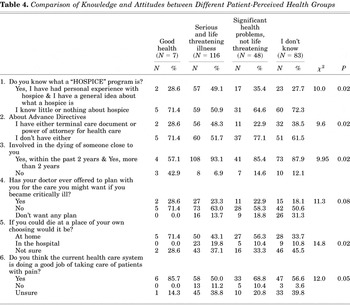
There were significant differences in the following items between patients in the four different self-perceived health groups (good health vs. serious and life-threatening illness vs. significant but not life-threatening health problems vs. don't know) by chi square analysis: awareness of hospice program (p = 0.02), knowledge of care plans if illness becomes critical (p = 0.02), preference in the location of death (p = 0.02), and perception of health care system in taking care of pain (p = 0.05; see Table 4). The results remained the same after removing the good-health group.
Comparison of Knowledge and Attitudes between Different Patient-Perceived Health Groups

Survival Outcomes
As of December 30, 2002, 190 patients (74.8%) had died (102 Caucasians and 88 African Americans) with median survival of 5.7 months (25–75% range: 1.7–16.1 months). The location of death included VANJHCS (N = 95, 48.7%), other hospitals and long term care facilities (N = 30, 15.4%), and home (N = 70, 35.9%). A significantly higher proportion of African American patients died in the hospital compared to Caucasians (78.4% vs. 52.9%; χ2 = 13.4, p < 0.0001).
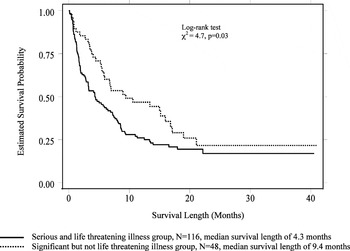
There were no differences in median survival length between different racial groups and different age groups. Patients who perceived themselves as having a serious and life-threatening illness had the shortest median survival of 4.3 months (25–75% range: 1.5–12.5 months), followed by the don't know group (median 5.6 months, 25–75% range: 1.5–14.0 months), the good-health group (median 8.3 months, 25–75% range: 3.8–10.2 months), and the significant but not life-threatening health problems group (median 9.4 months, 25–75% range: 4.0–21.1 months; χ2 = 5.3, p = 0.15).
If we compared only the survival length between the serious and life-threatening illness and the significant but not life-threatening problems groups, then there was a significant difference between these two groups (χ2 = 4.7, p = 0.03). The Kaplan-Meier survival curve for these two groups is illustrated in Figure 1.

Kaplan-Meier survival estimates, by patient-perceived health groups.
DISCUSSION
In this study, we have reported responses of veterans with metastatic cancer to the Vermont Voices on Care of the Dying Questionnaire to better understand patient preferences for EOL care. Our findings confirm previous reports that patients have significant knowledge deficits with regards of EOL care (Hoffmann et al., 1997; McKinley et al., 2000; Silveria et al., 2000). Sixty percent of patients in our study reported either no knowledge about hospice programs or no advance directives ready at time of interview, and one-third of our patients were unsure about their own health status. Even though we make efforts to educate our patients at each step of the disease, a lack of knowledge of EOL care and the severity of their disease is still evident. There are a number of possible explanations. Some of the patients were newly referred patients. Some patients may have thought “health situation” was for the doctor to decide, or the question itself difficult to understand. Some patients may have been uncertain about their health because they had cancer or because they used denial as a coping mechanism. Age and inpatient status did not account for the lack of knowledge. The reasons for this knowledge deficit need to be further studied.
The results from our study are similar to a survey of 70 veteran outpatients from a general medical clinic who were interviewed regarding living wills. Forty-three percent of patients had never heard of living wills. Those who had heard of a living will and intended to complete one were more likely to be Caucasian and express poorer self-perceived health status (Sugarman et al., 1992).
The VA prioritizes care to veterans with service-connected disabilities and those with low income (Skydell, 1998). It has been suggested that the VA can serve as a medical safety net provider and mitigate racial disparities in access to outpatient care for minority veterans (Washington et al., 2002). Our study confirms findings in other populations that there are significant disparities between African American and Caucasian veterans in advanced care planning, EOL decision making, and location of death (McKinley et al., 2000; Silveria et al., 2000). Previous experiences with being denied medical care, distrust of the medical system (Elazer et al., 1995; Hallenbeck et al., 1996), a fear of being treated differently and receiving less care if they had a living will (Carlais et al., 1993), and religious values and cultural beliefs (Garrett et al., 1993) have all have been suggested to explain low rates of advance care planning among African Americans. Hopp and Duffy (2000) interviewed 540 proxy respondents and concluded that race was a significant predictor of advance care planning and treatment decisions. McKinley et al. (2000) studied the differences in EOL decision making between black and white ambulatory cancer patients in North Carolina and found that black patients wanted more life-sustaining treatments and were less likely to complete a living will. In contrast, Blackhall et al. (1995) interviewed senior citizens from Los Angeles and found that African Americans and Caucasians had similar preferences for receiving information on diagnosis and prognosis and for who should make decisions.
Further studies to identify the factors associated with racial disparities in EOL care decision making and how they may affect delivery of palliative care at VA settings are needed.
The importance of communication as a component of quality palliative care has been demonstrated in surveys of patients and providers (Curtis et al., 2001). Discomfort discussing death and dying (Curtis & Patrick, 1997) and physician's reluctance to discuss death with patients have been suggested as the most significant EOL communication barriers (Morrison et al., 1994; Pfeifer et al., 1994). We found that 90% of our patients wanted physicians to be frank when delivering bad news and more than 60% of patients would like to involve their family members in EOL care decision making. How to design and deliver effective EOL care educational programs and how to assess the EOL care communication and educational outcomes remains challenging and deserves further study.
This study provides information on the association between patient-perceived health status and knowledge and attitudes toward EOL care and survival. This data has not been reported before in veteran patients with cancer. We found that patients who perceived themselves as having a serious and life-threatening illness had significantly higher rates in completion of advance directives and increased awareness of hospice programs. These findings extend the conclusions by Patrick et al. (1997), who showed that hypothetical changes in health status can be associated with changes in EOL care preferences. We also found that patients who perceived themselves as having serious and life-threatening illness had the shortest median survival. Perceptions of health have been linked to survival in studies of elderly patients (Kaplan et al., 1988; Leung et al., 1997) and in patients with diabetes (Dasbach et al., 1994). In a survey study of 2657 medical inpatients at nine VA medical centers, poor self-rated health at baseline and at the time closest to death were predictors of mortality (Lavretsky et al., 2002). These studies suggest that patient self-rated health predicted survival independently. Our results support the potential clinical usefulness of patient-rated health assessments as a way of understanding patient preferences and discussing treatment goals (Shadbolt et al., 2002).
To the best of our knowledge, this is the first time that the Vermont questionnaire has been used in seriously ill patients. This study provides a better understanding of the strengths and limitations of the Vermont Questionnaire. The “Vermont Voices on Care of the Dying Questionnaire” allows patients to express their preferences, but in retrospect, we feel that while this instrument may be useful in community forums, the items do not reflect specific aspects of knowledge and attitudes of patients with metastatic cancer in the hospital setting. Several potentially important clinical issues such as treatment burden, detailed discussion of EOL care options, perception of death, and preferences for life-sustaining treatments are not included in the Vermont questionnaire. Some of these issues are addressed in recently developed instruments such as the “Needs at the End-of-Life Screening Tool” (Emanuel et al., 2001) and the “Quality of Dying and Death Questionnaire” (Patrick et al., 2001; Curtis et al., 2002). Second, as there were no female patients, further studies should be done in different populations. Third, several potentially important factors such as education level, oncologic treatment information, and cormorbidity were not available for analysis. Further studies, including both genders in community settings with more socioeconomic and demographic variables, and newly validated multidimensional instruments can effectively address these limitations.
In conclusion, the results demonstrate knowledge deficits and racial differences related to EOL care in veteran cancer patients. The Vermont questionnaire may not be detailed enough for the seriously ill patients and for clinical applications. Patient-rated health status may be an important explanatory variable for EOL preferences and length of survival.
ACKNOWLEDGMENTS
The authors thank Pamela Osenenko, R.N., and Yvette Alejandro, R.N., for data collection and thank to Ms. Helen Yan for data entry and verification.
This research was partially supported by the New Jersey Commission on Cancer Research, Grant Award No. CCR-01-56-EO and by VA HSR&D, Grant Award No. PCC 98-068-02.
The views expressed herein do not necessarily reflect the views of the Department of Veterans Affairs or of the U.S. Government.
References
REFERENCES
Blackhall, L.J.,
Murphy, S.T.,
Frank, & G.,
et al.
(1995).
Ethnicity and attitudes towards patient autonomy.
Journal of the American Medical Association,
274,
820–825.Google Scholar
Carlais, P.V.,
Davis, B.,
Wright, & K.,
et al.
(1993).
The influence between ethnicity and race on attitudes towards
advance directive, life prolonging treatments and euthanasia.
Journal of Clinical Ethics,
3,
155–165.Google Scholar
Chang, V.T.,
Hwang, S.S.,
Feuerman, & M.,
et al.
(2000).
The Memorial Symptom Assessment Scale Short Form. Validity and
reliability.
Cancer,
89,
1162–1171.Google Scholar
Curtis, J.R. &
Patrick, D.L.
(1997).
Barriers to communication about end-of-life care in AIDS patients.
Journal of General Internal Medicine,
12,
736–741.CrossRefGoogle Scholar
Curtis, J.R.,
Patrick, D.L.,
Engelberg, & R.A.,
et al.
(2002).
A measure of the quality of dying and death: Initial validation
using after-death interviews with family members.
Journal of Pain and Symptom Management,
24,
17–31.CrossRefGoogle Scholar
Curtis, J.R.,
Wenrich, M.D.,
Carline, & J.D.,
et al.
(2001).
Understanding physicians' skills at providing end-of-life
care: Perspective of patients, families, and health care workers.
Journal of General Internal Medicine,
16,
41–49.Google Scholar
Dasbach, E.J.,
Klein, R.,
Klein, & B.E.,
et al.
(1994).
Self-rated health and mortality in people with diabetes.
American Journal of Public Health,
84,
1775–1779.Google Scholar
Elazer, G.P.,
Hornung, C.A.,
Egbert, & C.B.,
et al.
(1995).
The relationship between ethnicity and advance directives in a
frail older population.
Journal of the American Geriatric Society,
44,
938–948.Google Scholar
Emanuel, L.
(1991).
The health care directive: Learning how to draft advance care
documents.
Journal of the American Geriatric Society,
39,
1228–1291.Google Scholar
Emanuel, L.L.,
Alpert, H.R., &
Emanuel, E.E.
(2001).
Concise screening questions for clinical assessments of terminal
care: The Needs Near the End-of-Life Care Screening Tool.
Journal of Palliative Medicine,
4,
465–474.Google Scholar
Field, M.J. &
Cassel, C.K.
(1996).
Approach death: Improving care at the end of life.
Washington, DC:
National Academy Press.
Fisher, E.S. &
Welch, H.G.
(1995).
The future of the Department of Veterans Affairs health care system.
Journal of the American Medical Association,
273,
651–655.CrossRefGoogle Scholar
Fried, T.,
O'Leary, J.,
Tinetti, & M.E.,
et al.
(1999).
Older persons' preferences for site of terminal care.
Annals of Internal Medicine,
131,
109–112.Google Scholar
Gamble, E.R.,
McDonald, P.J., &
Lichstein, P.R.
(1991).
Knowledge, attitudes, and behavior of elderly persons regarding
living wills.
Archives of Internal Medicine,
151,
277–280.Google Scholar
Garrett, J.M.,
Harris, R.P.,
Norburn, & J.K.,
et al.
(1993).
Life-sustaining treatments during terminal illness: Who wants what?
Journal of General Internal Medicine,
8,
361–368.Google Scholar
Hallenbeck, J.,
Goldstein, M.K., &
Mebane, E.W.
(1996).
Culture considerations of death and dying in the United States.
Clinical Geriatric Medicine,
12,
393–406.Google Scholar
Hamel, M.B.,
Teno, J.M.,
Goldman, & L.,
et al.
(1999).
Patient age and decisions to withhold life-sustaining treatments
from seriously ill, hospitalized adults.
Annals of Internal Medicine,
130,
116–125.Google Scholar
Harris, R.E.,
Hebert, J.R., &
Wynder, E.L.
(1989).
Cancer risk in male veterans utilizing the Veterans Administration
medical system.
Cancer,
64,
1160–1168.Google Scholar
Hoffmann, J.C.,
Wenger, N.S.,
Davis, & R.B.,
et al.
(1997).
Patient preferences for communication with physicians about
end-of-life decisions.
Annals of Internal Medicine,
127,
1–12.Google Scholar
Hopp, F.P. &
Duffy, S.A.
(2000).
Racial variations in end-of-life care.
Journal of the American Geriatric Society,
48,
658–663.Google Scholar
Hornung, C.A.,
Eleazer, G.P,
Strothers, H.S., 3rd, &
et al.
(1998).
Ethnicity and decision-makers in a group of frail older people.
Journal of the American Geriatric Society,
46,
280–286.Google Scholar
Hwang, S.S.,
Chang, V.T.,
Cogswell, J.,
et al.
(in press).
Caregiver unmet needs, caregiver burden and caregiver satisfaction in symptomatic advanced cancer patients at a VA Medical Center.
Palliative and Supportive Care.
Kaplan, G.,
Barell, V., &
Lusky, A.
(1988).
Subjective state of health and survival in elderly adults.
Journal of Gerontology,
43,
S114–S120.Google Scholar
Kazis, L.E.,
Miller, D.R.,
Clark, & J.,
et al.
(1998).
Health-related quality of life in patients served by the Department
of Veterans Affairs.
Archives of Internal Medicine,
158,
626–632.CrossRefGoogle Scholar
Lavretsky, H.,
Bastani, R.,
Gould, & R.,
et al.
(2002).
Predictors of two year mortality in a prospective
“UPBEAT” study of elderly veterans with comorbid medical
and psychiatric symptoms.
American Journal of Geriatric Psychiatry,
10,
458–468.Google Scholar
Leung, K.K.,
Tang, L.Y., &
Lue, B.H.
(1997).
Self-rated health and mortality in Chinese institutional elderly
persons.
Journal of Clinical Epidemiology,
50,
1107–1016.Google Scholar
McKinley, E.D.,
Garrett, J.M.,
Evans, & A.T.,
et al.
(2000).
Differences in end-of-life decision making among black and white
ambulatory cancer patients.
Journal of General Internal Medicine,
11,
651–656.Google Scholar
Morrison, R.S.,
Morisson, E.W., &
Clickman, D.F.
(1994).
Physician reluctance to discuss advance directives: An empiric
investigation of potential barriers.
Archives of Internal Medicine,
154,
2311–2318.Google Scholar
Patrick, D.L.,
Engelberg, R.A., &
Curtis, J.R.
(2001).
Evaluating the quality of dying and death.
Journal of Pain and Symptom Management,
22,
717–726.Google Scholar
Patrick, D.L.,
Pearlman, R.A.,
Starks, & H.E.,
et al.
(1997).
Validation of preferences for life-sustaining treatment:
Implications for advance care planning.
Annals of Internal Medicine,
127,
509–517.Google Scholar
Pfeifer, M.P.,
Sidorov, J.E.,
Smith, & A.C.,
et al.
(1994).
The discussion of end-of-life medical care by primary care patients
and physicians: A multicenter study using qualitative interviews.
Journal of General Internal Medicine,
9,
82–88.CrossRefGoogle Scholar
Schonwetter, R.S.,
Walker, R.M.,
Solomon, & M.,
et al.
(1996).
Life values, resuscitation preferences, and the applicability of
living wills in an older population.
Journal of the American Geriatric Society,
44,
954–958.CrossRefGoogle Scholar
Schwartz, C.E.,
Wheeler, H.B.,
Hammes, & B.,
et al.
(2002).
Early intervention in planning end-of-life care with ambulatory
geriatric patients.
Archives of Internal Medicine,
162,
1611–1618.Google Scholar
Shadbolt, B.,
Barresi, J., &
Craft, P.
(2002).
Self-rated health as a predictor of survival among patients with
cancer.
Journal of Clinical Oncology,
20,
2514–2519.Google Scholar
Silveria, M.J.,
DiPiero, A.,
Gerrity, & M.S.,
et al.
(2000).
Patients' knowledge of options at the end of life: Ignorance
in the face of death.
Journal of American Medical Association,
284,
2483–2488.Google Scholar
Skydell, B.
(1998).
Restructuring the VA Health Care System: Safety net, training, and
other considerations.
Issues brief 716. Washington, DC:
National Health Policy Forum.
StatCorp.
1997.
Stata statistical software: Release 5.0.
College Station, TX:
Stata Corporation.
Steinhauser, K.E.,
Christakis, N.A.,
Clipp, & E.C.,
et al.
(2001).
Preparing for the end of life: Preferences of patients, families,
physicians, and other care providers.
Journal of Pain and Symptom Management,
22,
727–737.Google Scholar
Sugarman, J.,
Weinberger, M., &
Samsa, G.
(1992).
Factors associated with veterans decisions about living wills.
Archives of Internal Medicine,
152,
343–347.CrossRefGoogle Scholar
Uhlmann, R.F. &
Pearlman, R.A.
(1991).
Perceived quality of life and preferences for life-sustaining
treatment in older adults.
Archives of Internal Medicine,
151,
495–497.Google Scholar
Vermont Ethics Network.
(1997).
Vermont Voices on Care of the Dying: A report from the Journey's
End Project of the Vermont Ethics Network.
Montpelier, VT:
VEN Publication.
Vig, E.K.,
Davenport, N.A., &
Pearlman, R.A.
(2002).
Good death, bad death, and preferences for the end of life: A
qualitative study of geriatric outpatients.
Journal of the American Geriatric Society,
50,
1541–1548.Google Scholar
Washington, D.L.,
Harada, N.D.,
Villa, & V.M.,
et al.
(2002).
Racial variations in Department of Veterans Affairs ambulatory care
use and unmet health care needs.
Military Medicine,
167,
235–241.Google Scholar
Waters, C.M.
(2001).
Understanding and supporting African Americans' perspectives
of end-of-life care planning and decision making.
Quality of Health Research,
11,
385–398.CrossRefGoogle Scholar
Wilson, D.M.
(2000).
End-of-life care preferences of Canadian senior citizens with
caregiving experience.
Journal of Advanced Nursing,
31,
1416–1421.CrossRefGoogle Scholar
Demographics
Knowledge and Attitudes toward End-of-Life Care
Knowledge and Attitudes toward End-of-Life Care: Comparison between Caucasians and African Americans
Comparison of Knowledge and Attitudes between Different Patient-Perceived Health Groups
Kaplan-Meier survival estimates, by patient-perceived health groups.
 You have
Access
- 16
- Cited by