Introduction
Interest in the Canadian judicial system has grown in the post-Charter era motivating scholars to examine the Supreme Court's patterns of behaviour and the theoretical underpinnings of judicial decision making. Critics of the Court point to its increasingly significant role in politics, with some attention paid to the role of individual justices. For instance, Chief Justice Beverley McLachlin faced criticism for expressing her views on the appointment process (Fine, Reference Fine2014). The public interest and scholarly attention aimed at the Supreme Court is understandable given the Court's significant role. The passage of the Charter of Rights in 1982 undoubtedly hastened concerns from some court observers about “American-style judicial supremacy” (Fletcher, Reference Fletcher1999).
Some scholars point to increased policy influence by the Court in the Charter years, noting that the justices follow their own ideological leanings when deciding cases (Songer, Reference Songer2008). However, most scholars advance a moderate approach, noting that the Court is not as ideological in its decisions or as split along partisan lines as the US Supreme Court (Ostberg and Wetstein, Reference Ostberg and Wetstein2007). Though scholars presume that the Charter had an impact on the Supreme Court, I take a step back from direct impact studies of the Charter to gauge judicial decision making over a sixty-year period in other case categories. The importance of studying the Court before and after the Charter allows scholars to compare decisions to determine the relative activism of the Court in its earlier years. Manfredi argues that the Charter led the Court to a “very broad conception of its review powers” (Reference Manfredi1989: 319), while McCormick and Greene remark that the “Charter of Rights changed everything” (Reference McCormick and Greene1990: 237). Morton and Knopff (Reference Morton and Knopff2000), however, argue changes in the Court's decisions are justice-driven rather than institutionally driven. Some scholars argue that the post-Charter court is more ideological than previously (Baar, Reference Baar and Holland1991; Russell, Reference Russell, Neal Tate and Vallinder1995), while others emphasize the emergence of a dialogue between the Court and Parliament in the post-Charter period (Kelly, Reference Kelly2005; Manfredi and Kelly, Reference Manfredi and Kelly1999). The justices’ views of their institutional role might be affected by the political, cultural and social climate of the current day (Wetstein and Ostberg, Reference Wetstein and Ostberg2017) but, also institutional rules that govern their decision making, such as the Charter of Rights. Understanding decision patterns in previous eras, including case categories untouched by the Charter, can provide a reference point for inferring implications about the Court's relative activism today versus earlier periods.
Beyond the Court's role as an institution, studying the judicial branch and its decisions is significant for public policy analysis because the resolution of legal disputes has implications for issue framing in lower courts as well as policy debates in Parliament and provincial governments (Songer et al., Reference Songer, Johnson, Ostberg and Wetstein2012). The decision-making process thus becomes central to understanding the proper role of judicial power. In the post-Charter era, groups increasingly rely on courts to settle disputes (Epp, Reference Epp1998; Ostberg and Wetstein, Reference Ostberg and Wetstein2007) extending far beyond individual legal claims to matters of public policy. Tate and Vallinder (Reference Tate and Vallinder1995) discuss the “judicialization of politics” trend in the latter half of the twentieth century with legal institutions assuming policy-makingFootnote 1 functions. Scholars suggest that policy making through legal institutions in modern, complex, pluralistic democracies never occurs solely through the efforts of a single political actor or institution. Awareness of the interactions of institutions and political players assists us in understanding mechanisms for policy recommendations, including rules that govern court procedures and judicial selection methods.
In Canada, as in other pluralist societies, interactions among lawyers and groups, changes to the Court's rules and power, the policy agendas of elected officials and the preferences of the justices themselves are complex and multifaceted. If Court decisions vary considerably from one era to the next, then it is important to understand why. If change in outcomes over time is the result of issue change, then one can consider institutional factors such as the Charter of Rights as a possible impetus. However, personnel changes on the Court might affect changes in decision trends over time. If this is the case, then it becomes more difficult to point to external factors as the cause of policy change, and judicial appointments and power within the Court become much more important.
In order to frame the Court's changing role, I examine the universe of decisions of the Supreme Court of Canada (SCC) from 1945 to 2005 in criminal, tax, and tort cases, which comprise a significant enough portion of the Court's docket for statistical analysis over a sixty-year periodFootnote 2, using Baum's method (Reference Baum1988, Reference Baum1989) to examine policy change over time. This study builds on SCC decision-making scholarship by providing a method to compare decisions from one court era to another.
The study first examines judicial decision-making theories and existing scholarship on the policy-making role of the SCC. I then explain potential causes of changes in decisions over time and introduce Schubert's ideology (Reference Schubert1965) scale to explain justices’ voting patterns and Baum's adaptation of the scale to assess policy change. I then use these data and methods to estimate policy change over time, as applied specifically to the Canadian context. The findings and conclusions indicate less policy change has occurred over time than perhaps initial observations suggest after factoring out issue change. This has important implications for evaluating the Court's role in Canadian politics, especially to ease criticism of the Court's activism in the post-Charter era.
Theories of Judicial Decision Making
Several competing judicial decision-making theories exist, but the dominant approach in the mid-nineteenth and early twentieth centuries in the US and Canada was the legal model. This theory assumes that judges are neutral arbiters of disputes whereby judges apply the law mechanically to case facts, leaving their own values and ideological proclivities aside when rendering their decisions (Segal and Spaeth, Reference Segal and Spaeth1993). The approach came under wide criticism and scepticism beginning in the latter half of the twentieth century (Pritchett, Reference Pritchett1948; Schubert, Reference Schubert1965; Segal and Spaeth, Reference Segal and Spaeth1993) leading scholars to emphasize an attitudinal explanation of judicial behaviour.
The attitudinal model presumes judges rely on their own values when deciding cases. Begun by the legal realist movement, sceptics of the legal model questioned how justices arrived at different conclusions in cases. If the law is unbiased and mechanical in its application, then all justices hearing the same case should agree on its outcome. In the US, seminal works such as Pritchett (Reference Pritchett1948), Schubert (Reference Schubert1965) and Segal and Spaeth (Reference Segal and Spaeth1993) led this movement away from legal explanations of judicial behaviour, arguing that high levels of judicial independence allow justices to make decisions aligned with their own attitudes and values. Scholars in Canada have applied the attitudinal model to the Supreme Court, finding it explains decisions in a variety of cases (Ostberg and Wetstein, Reference Ostberg and Wetstein2007; Songer Reference Songer2008). However, they note a more nuanced, complex application of the attitudinal model than in the US (Alarie and Green, Reference Alarie and Green2008; Ostberg and Wetstein, Reference Ostberg and Wetstein2007; Songer et al., Reference Songer, Johnson, Ostberg and Wetstein2012; Tate and Sittiwong, Reference Tate and Sittiwong1989). Similarities between the US and Canadian supreme courts include judicial review, considerable docket control and being a court of last resort whose decisions are final. However, while both courts exhibit similar tendencies with enhanced judicial review in the post-Charter era, other factors may mitigate attitudinal influence in Canada. These include cultural, political, and historical traditions, institutional collegiality norms and criticism of activist rulings (Ostberg and Wetstein, Reference Ostberg and Wetstein2007; Songer et al., Reference Songer, Johnson, Ostberg and Wetstein2012). Norms of consensus and collegiality exist to a greater extent in Canada than the US, which is illustrated in higher rates of unanimity in Canada (Songer, Reference Songer2008).
Critics of the attitudinal model's application to the SCC point to its omission of role perceptions by the justices (Macfarlane, Reference Macfarlane2013) or other social forces that affect decisions including external actors’ influence (Epp, Reference Epp1998). The model also omits examination of the accompanying opinion (Epstein and Knight, Reference Epstein and Knight1998; Maltzman et al., Reference Maltzman, Spriggs II and Wahlbeck2000), which might reveal strategic behaviour by the justices in arriving at a consensus on the legal rule developed in the case. The strategic model suggests judges in a small-group environment influence each other through a collegial bargaining process in order to maximize policy goals (Epstein and Knight, 1995; Maltzman et al., Reference Maltzman, Spriggs II and Wahlbeck2000), and that reaching consensus might lessen threats to the Court's legitimacy from other external actors.
Building on attitudinal theory, Wetstein and Ostberg argue that SCC decisions “reflect the interplay between individual-level factors, [justices'] own views and how they acquired them, and the views and perspectives advanced by key actors in the legal arena” (Reference Wetstein and Ostberg2017: 10). Like Wetstein and Ostberg (Reference Wetstein and Ostberg2017), this study advances a nuanced view of decision making. Though utilizing behaviouralist methodology, I do not minimize the complementary role other decision-making models contribute to the discussion. Rather, I hope to develop a more complete view of decision making over time by separating issue change from personnel change to clarify the extent to which justices’ attitudes have affected decisions over time.
Measuring Ideology: The Supreme Court of Canada as a Policy-Making Institution
Attitudinal scholarship in Canada uses quantitative analysis to examine various aspects of decision making (Hausegger et al., Reference Hausegger, Riddell and Hennigar2013; Ostberg and Wetstein, Reference Ostberg and Wetstein2007; Russell, Reference Russell1992; Tate and Sittiwong, Reference Tate and Sittiwong1989). Some scholars utilize exogenous measures of ideology, including judicial attributes such as region, religion, party of the appointing PM, prior political and/or judicial experience (Tate and Sittiwong, Reference Tate and Sittiwong1989), gender, and social class (McCormick and Greene, Reference McCormick and Greene1990) to predict voting patterns in criminal, civil liberties and economic cases. Others use factor analysis, judicial attributes, and newspaper ideology scores (Ostberg and Wetstein, Reference Ostberg and Wetstein2007) to uncover ideological voting patterns. Most note less ideological polarization in Canada than the US with justices appearing to be political centrists and highly collegial (Songer et al., Reference Songer, Johnson, Ostberg and Wetstein2012).
Some critics of the attitudinal model have noted the imperfect measures provided by judicial attributes and newspaper scores (Macfarlane, Reference Macfarlane2013). The approach adapted for this study departs from those studies, instead relying on Schubert's scaling (Reference Schubert1965) of justices’ votes adapted by Baum (Reference Baum1988, Reference Baum1989) to explain policy change in different court eras. This method overcomes some of the shortcomings of judicial attributes and newspaper ideology scores. Schubert (Reference Schubert1965) scaled US Supreme Court justices’ votes in order to uncover voting patterns to predict justices’ likely voting blocs in future cases. Schubert aligns justices along several ideological one-dimensional continuums, assigning i-points to represent the judge's ideology and j-points to represent the two possible case outcomes. Spaeth explains unidimensionality as a “stimulus-response model” which assumes a judge votes a certain way because of the judge's “attitude toward recurring issues of public policy.” He continues, “Each case becomes a stimulus to which [the judge] responds according to [their] attitude toward the stimulus class, the fundamental policy issue” (Reference Spaeth1965: 290). Two scales (an e-scale for economic cases and a c-scale for civil liberties cases) were the most successful in predicting US Supreme Court justices’ votes in subsequent cases. Figure 1 illustrates justice ideal points (i-points) and alternative case outcomes (j-points). This illustration provides the basis for Baum's method (Reference Baum1988, Reference Baum1989) for estimating issue and policy change.
Illustration of Ideal Points (i-points) and Alternative Case Outcomes (j-points) for One-Dimensional Cases

What causes change over time?
The Supreme Court has changed considerably during the sixty-year period analyzed. In 1949, appeals to the Judicial Committee of the Privy Council officially ended, and the Court's size increased from seven to nine justices. Canada adopted a statutory bill of rights in 1960, but the document did little to increase the Court's civil liberties docket (Epp, Reference Epp1998). In 1975, Parliament granted the Court nearly complete control over its docket except for some criminal appeals as of right, eliminating mandatory appeals in 1997 (Songer, Reference Songer2008). Finally, the Court entered a new policy era with the first cases filed under the Charter reaching the Court in 1984. During this sixty-year period, the Court's personnel changed considerably, with natural courts lasting roughly three to four years before justices retired. A natural court is the period when a court's membership remains stable with no new justices joining the Court. In 1985, Parliament instituted a mandatory retirement age of 75, also playing an important role in turnover on the Court. Segal and Spaeth (Reference Segal and Spaeth1993) explain that each institutional feature increases the Court's ability to pursue policy goals. Becoming a court of last resort with no other judicial body to overturn the Court's decisions, increased control over their docket with the Court deciding fewer frivolous cases, and the power to strike down laws inconsistent with the constitution are external forces that influence the likelihood that justices will increasingly pursue policy goals. This would be evident through increased attitudinal voting patterns by the Court over time.
Baum (Reference Baum1988) explains that judicial outcomes change over time due to several potential factors including changes in personnel, membership and issues. Personnel change occurs when others replace retiring justices with different i-points on the same dimension. Member change occurs because i-points shift for some justices over time. Issues change because a new set of cases has a different mix of j-points from the earlier set. In the context of civil liberties cases in the US, Baum notes, “If the j-points generally move to the left, it becomes more ‘difficult’ to cast a liberal vote and the proportion of liberal outcomes declines. ” He continues, “One should not interpret issue change causing changes in outcomes as policy change, because the Court would still reach the same outcomes if confronted with the same cases. Moreover, outcome changes that result from personnel and member change qualify as policy change, because the Court has shifted rather than the cases. The analytic task is to separate out issue change from these other two sources of change in case outcomes, in order to ascertain the extent of actual policy change” (Reference Baum1988: 906).
While the cause of issue change is uncertain, scholars have found several factors potentially explaining it. Legal mobilization theory suggests forces in society, including interest groups, mobilize to affect courts by pushing cases that will develop the law toward their policy preferences (Brodie, Reference Brodie2002; Epp, Reference Epp1998; Hausegger et al., Reference Hausegger, Hennigar and Riddell2009; Manfredi, Reference Manfredi2004; Morton and Knopff, Reference Morton and Knopff2000). Further, legal mobilization by individuals and groups in society causes issue change through intervener participation when sponsoring cases (Epp, Reference Epp1998; Wetstein and Ostberg, Reference Wetstein and Ostberg2017). Social forces affect the types of cases that interest groups sponsor and the legal arguments justices address in their opinions. However, unlike the US where interest groups intervene frequently during case selection, interest groups in Canada are most likely to intervene at the merits stage and very rarely at the leave-to-appeal stage (Hausegger et al., Reference Hausegger, Hennigar and Riddell2009). The growth in interest group involvement in the period just preceding the Charter and in the post-Charter period (Epp, Reference Epp1998; Hausegger et al., Reference Hausegger, Hennigar and Riddell2009) provides a strong theoretical reason to assume that the nature of cases coming to the Court changes over time.
External actors and institutional changes also cause issue change. For example, in criminal and civil liberties cases, the primary impetus to shifting issues is the Charter of Rights (Wetstein and Ostberg, Reference Wetstein and Ostberg2017) because of its protections for individuals. Justices react to cases filed by litigants influenced by changes in institutional structures, avenues available for recourse of legal wrongs through changing legislation and constitutions, and interest group involvement in bringing new issues to the forefront. The justices are attitudinal in their decision-making patterns (Ostberg and Wetstein, Reference Ostberg and Wetstein2007; Wetstein and Ostberg, Reference Wetstein and Ostberg2017), yet within each natural court period, justices are also reacting to different sets of case stimuli.
Alternatively, the strategic model might predict that while justices’ individual votes have an ideological component (Ostberg and Wetstein, Reference Ostberg and Wetstein2007, Songer et al., Reference Songer, Johnson, Ostberg and Wetstein2012), decisions may not vary much over time. Slow change from one era to the next, after controlling for personnel changes, could suggest that justices are acting strategically in order to maintain legitimacy and collegiality. For instance, Songer and colleagues (Reference Songer, Johnson, Ostberg and Wetstein2012) find evidence of strategic interaction in interviews with the justices, noting, “Justice D reports that his colleagues more often change his mind on the meaning of precedent than do the arguments of counsel” (Reference Songer, Johnson, Ostberg and Wetstein2012: 63), and that “the justices are often willing to compromise their differences, not just to produce a ‘minimum winning coalition’ but more frequently to achieve a unanimous court” (Reference Songer, Johnson, Ostberg and Wetstein2012: 67). Thus, norms of consensus and collegiality might dampen evidence of attitudinal voting. After controlling for issue change, if the Court's decisions remain stable, then one possible explanation is collegiality and consensus building through strategic decision making.
Data and Methods
Baum's method (Reference Baum1988) separates issue change from policy change, described as personnel and membership change, and it presumes case categories are one-dimensional. A one-dimensional space in judicial studies refers to a justice's tendency to respond to a single case in the same way as he or she responds to other cases in the same class. In the US, scholars have found that Supreme Court decisions, particularly in civil rights and liberties, comprise a single dimension (Baum, Reference Baum1988; Segal and Spaeth, Reference Segal and Spaeth1993; Spaeth, Reference Spaeth1965). Several studies in Canada indicate that post-Charter courts under the leadership of both Lamer and McLachlin are two-dimensional when civil liberties are grouped with criminal cases (Ostberg and Wetstein, Reference Ostberg and Wetstein2007). However, previous scholars’ work in the post-Charter period suggest narrower issue areas best capture single dimension voting patterns (Alarie and Green, Reference Alarie and Green2009b).
To control for dimensionality, I separately analyze narrower case categories, following Alarie and Green (Reference Alarie and Green2009b) in criminal, tax and tort cases. These three areas are the single largest case categories of public and private law in Canada that allow for sufficient numbers across the entire sixty-year period for quantitative analysisFootnote 3. I employed Baum's method (Reference Baum1988, Reference Baum1989) to construct a support scoreFootnote 4 for each justice for each natural court during the 1945 to 2005 period.Footnote 5 I combined two or more natural courts to produce a period in which the Court decided x number of cases (30 in tax, 40 in torts, 50 in criminal) sufficient for analysis (see Baum, Reference Baum1988, Reference Baum1989).Footnote 6
Since Ostberg and Wetstein (Reference Ostberg and Wetstein2007) found ideology played a role in criminal cases in the post-Charter era, I include criminal cases where support is defined as a decision favouring the defendant's position against the government, for example, a case finding a criminal defendant's right to counsel had been violated in the course of a police investigation.Footnote 7
Ostberg and Wetstein (Reference Ostberg and Wetstein2007) find that, to a lesser degree, ideology plays a role in economic cases. Economic cases comprise a substantial portion of the Court's docket in both the pre- and post-Charter eras. There are several additional reasons to include economic cases in the study. First, scholars have determined attitudinal voting patterns exist in economic cases (Ostberg and Wetstein, Reference Ostberg and Wetstein2007; Songer, Reference Songer2008). Second, economic cases matter not only for the litigants involved, but also due to policy ramifications. For instance, the Court's decisions in tax cases affect the government's ability to raise revenue and regulate economic activity. Additionally, the Chief Justice is more likely to assign economic cases to smaller panels (Ostberg and Wetstein, Reference Ostberg and Wetstein2007) and, as a result, the justices are more likely to reach a consensus. One might expect, then, less policy change to occur over time in economic cases. Without presupposing directionality a priori, I define support scores as a decision supporting the government's ability to tax.Footnote 8 For example, a tax case supporting the government's ability to tax might be a case in which the Court upheld the government's tax assessment of a land sale.
Tort cases are also included in the analysis since these comprise a sufficient number using Baum's method across the entire sixty-year period. Songer (Reference Songer2008) reports that tort plaintiffs win their cases on average 55 per cent of the time during the 1970–2003 period. Tort decisions affect our understanding of the Court's tendency to favour the “haves” versus the “have-nots” because in no other issue area are purely financial interests so apparent (Galanter, Reference Galanter1974; Sheehan et al., Reference Sheehan, Mishler and Songer1992; Songer Reference Songer2008). Galanter (Reference Galanter1974) proposes that litigant success is highly dependent upon the financial means and institutional norms that “haves” who often utilize the judicial system benefit from. For instance, in a product liability case, the petitioner is commonly an injured individual, who likely has less litigation experience and resources compared to a wealthy product manufacturer. Thus, tort cases provide a test to determine whether “haves” benefit in litigation and whether they benefit across various periods. Therefore, I define support scores as a decision supporting the underdog claimant in a tort dispute. Some important caveats are relevant for the Canadian case. Hausegger and colleagues (Reference Hausegger, Hennigar and Riddell2009) point to less litigation in private law disputes in Canada stemming from caps in personal injury suits at $100,000 (adjusted for inflation to $280,000 in Reference Hausegger, Hennigar and Riddell2009) and rare punitive damages they describe as “hav[ing] never reached the hundreds of millions seen in the US” (Reference Hausegger, Hennigar and Riddell2009: 346). Juries are less likely to award monetary damages in frivolous suits, suggesting that when they do it is because the case has merit. These key differences might contribute to overall differences in who wins tort cases in Canada compared with the US. Still, scholars have found an ideological component to justice behaviour in tort cases in the SCC (Songer et al., Reference Songer, Johnson, Ostberg and Wetstein2012).
Following Baum (Reference Baum1988, Reference Baum1989), for each issue area non-supportive outcomes are assigned a “0”; supportive outcomes are assigned a “1” and mixed outcomes (those that were supportive, in part) are assigned “0.5.” Both unanimous and divided decisions were included, consistent with previous studies (Baum, Reference Baum1988, Reference Baum1989; Alarie and Green, Reference Alarie and Green2009b). A potential source of changing support is changes in justices’ preferences. It is possible that a few justices change positions on legal issues over time. For instance, US Supreme Court Justice Black is one example of a justice shifting over time, as Baum (Reference Baum1988) cautions. Still, Epstein and colleagues (Reference Epstein, Walker and Dixon1989) emphasize that attitudinal theorists in the US “have clearly established that the behaviour of individual judges is quite stable and that changes tend to occur gradually rather than precipitously (828). Alarie and Green (Reference Alarie and Green2009a) find that “some justices’ voting patterns have changed considerably” (2009: 40). However, they also note that it is “very difficult to see any systematic patterns of change in judicial preferences over time” (41). Ostberg and Wetstein (Reference Ostberg and Wetstein2007) find justices in the post-Charter period to be relatively stable in criminal, tax, and private economic disputes. Nevertheless, some caution is necessary in examining the results since the methodology presumes fixed individual justices’ preferences over time.
Following Baum (Reference Baum1988, Reference Baum1989) I calculate adjusted support scores for the Court during natural court (or combined natural court) periods. To measure issue change, justices’ support scores are compared across several natural courts.
• For adjacent natural court pairs, I calculate continuing justices’ support scores from their first natural court.
• Then, I subtract that score from their support scores in the second natural court to produce an individual difference score for each justice.
• I then calculate the median difference scores for the continuing justices from one natural court.
• Those scores were subtracted from the median from the change in the Court's proportion of pro-defendant, pro-government or pro-underdog support to produce a policy change measure between adjacent natural courts.
A demonstration of the procedure to calculate adjusted support scores is shown in Table 1a.
• The median of the justices’ difference scores between natural court 8 and natural court 9 was 14.51.
Procedure for Calculating Corrections in Criminal Cases

Note: Median change for continuing justices = 14.51; correction = −14.51; policy change for Court = 14.48–(14.51) = −0.03
This figure shows that it has become slightly easier to support criminal defendants because the average j-point has moved to the right.
• This figure is then subtracted from the change in the proportion of pro-defendant outcomes between natural courts 8 and 9: 14.48–(14.51) = −0.03.
This suggests a small policy change. The 14.51 figure, with the positive sign made negative indicating a correction, also represents a correction for case difficulty in the support score.Footnote 9 This correction, cumulated across natural courts, allows us to compare natural courts and their actual support for defendants across the sixty-year period (see Table 1b, for application of the correction to calculate the adjusted support score).Footnote 10
• For example, for natural court 9, the Court's actual support score was 46.75.
• Taking the cumulative correction from natural court 8, which was 18.14 and cumulating the correction from natural court 9, with a value of −14.51, the result is a cumulative correction of 3.63.
• Thus, the adjusted support score is the actual support score (46.75) plus the cumulative correction (3.63) to provide an adjusted support score for natural court 9 of 50.38.
Procedure for Calculating Adjusted Support Scores Criminal Cases

Findings
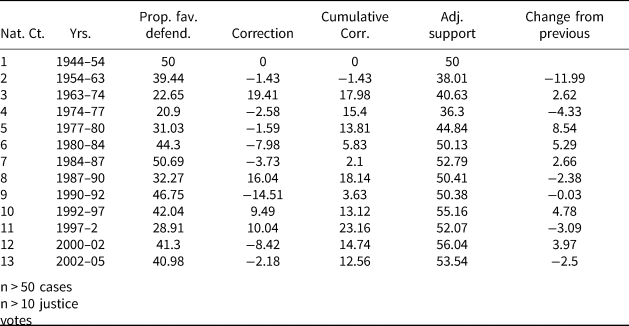
Table 2 shows the proportion of cases supporting defendants in criminal cases.
Criminal cases

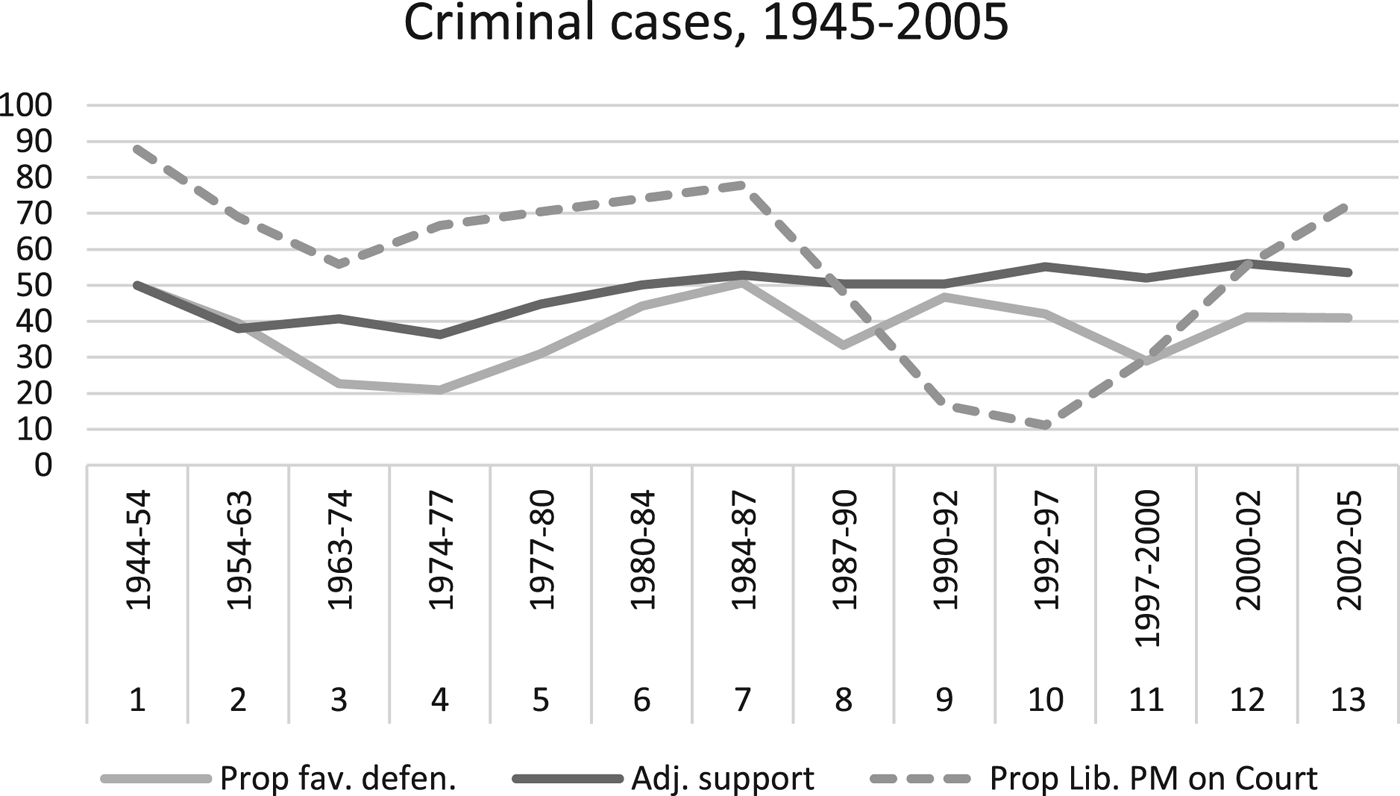
Table 2 also displays the results for adjusted support scores along with the differences in adjusted support scores from one natural court to the next (in the last column). Figure 2 displays a line graph of the actual support scores compared with the adjusted support scores.
Adjusted Support Scores by Natural Court.

To explore potential policy change causes after removing issue change, the percentage of Liberal Prime Minister appointees serving on the Court during each natural court are included in Figure 2 (as a dashed line). After accounting for issue change (actual support), the number of appointees from specific political party prime ministers appears to have slight impact on the Court's decisions over time when compared to the adjusted support scores. The actual support scores vary from 20.9 in 1974–77 to 50.69 in 1984–87, the period following the first Charter cases decided by the Court. These scores suggest drastic fluctuations in defendant support spanning the sixty-year period. The raw scores suggest a downward trend in certain periods following the Charter, particularly in the mid-1980s and mid-1990s. The 1997–2000 Court has an actual support score for defendants of 28.91 percent. This is nearly as low as 1974–1977 and 1977–1980, both periods preceding the Charter of Rights. One would conclude from examining the trends that the late-Lamer court is just as supportive of the government's position in criminal cases as the Laskin courts.
However, when comparing the adjusted support scores, the late-Lamer court is actually closer ideologically to the early Dickson court (1984–87). The adjusted support scores trend upward in the period prior to the Charter and remain above 50 per cent for the entire post-Charter period. This makes sense, intuitively, since the Charter of Rights contains protections for defendants, and the cases overall should be easier for the justices to decide in favour of defendants. Since the adjusted support scores control for issue change, we can conclude that shifts over time in adjusted support scores are the result of policy change. The most significant observation from the adjusted support scores is that the 1980–1984 court had already began to move in a pro-defendant direction prior to the Charter of Rights by about 5 percentage points. The trend continues throughout the post-Charter period with the 2000–2002 court the most supportive of criminal defendants.
After removing issue change, the adjusted support scores indicate that the Court's policy towards defendants has evolved. With the exception of the first natural court in the 1940s to 1950s, the largest increase in support for criminal defendants occurred between natural court 4 and 6. This seems to correspond with an increase in the proportion of justices appointed by Liberal party prime ministers serving on the Court, particularly with Trudeau's appointees holding majority status on the Court in the mid-1970s and early-1980s. Thus, it appears that though most of the policy change is due to changing cases arriving at the Court, policy change is also attributable to partisan differences.
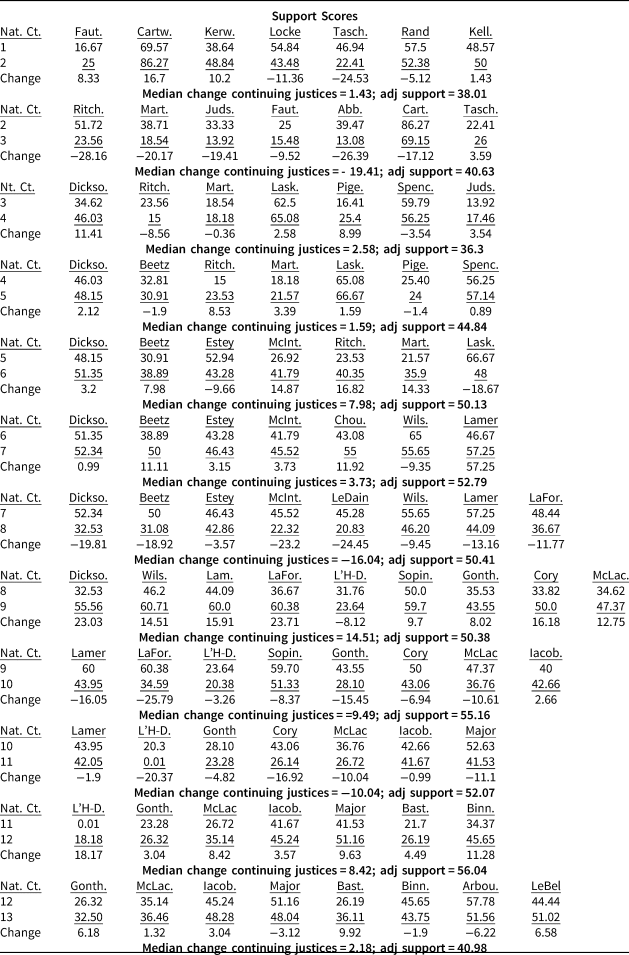
To delve further into these findings, individual justice scores illuminate policy differences occurring over time after removing issue change (shown in appendix A). A significant pro-defendant shift occurs from 1974 to 1987, with the court moving to the left over 16 percentage points. Justice Dickson's support score for defendants increases over eight percentage points from natural court 3 to 4. Interestingly, Laskin's score dives from 67 per cent favouring defendants in natural court 5 to 48 per cent in natural court 6. The median justice shifts to the left, interestingly prior to the Charter's passage and in cases most impacted by the Charter. From one natural court to the next, Dickson is the most consistent, especially between natural courts 4 and 7. However, in his early years on the court, his policy position moved 11 points from natural court 3 to 4. His position shifts again starkly after his ascent to Chief Justice, just as the Charter goes into effect.
Chief Justices Laskin and McLachlin also exhibit high levels of dynamic policy change from court to court. McLachlin, in particular, maintained an average position, yet remained fluid from one natural court to the next, which might suggest strategic action on her part. Wetstein and Ostberg (Reference Wetstein and Ostberg2005) find that Dickson, Lamer and McLachlin showed strategic action by being less likely to dissent after becoming Chief Justice, which corresponds with the evidence presented here. Consistent with Alarie and Green (Reference Alarie and Green2009b) and Ostberg and Wetstein (Reference Ostberg and Wetstein2007), Iacobucci remains consistent as a centrist over time. In contrast, L'Heureux-Dubé begins her career with low levels of support for criminal defendants, and moves further to the right during her career. Figure 2 shows a downward trend in actual support scores coinciding with Conservative party justices dominating the Court in the 1990s, which includes L'Heureux-Dubé’s tenure. Most interestingly, issue change rather than policy change, corresponds with the majority justices’ political party affiliation.
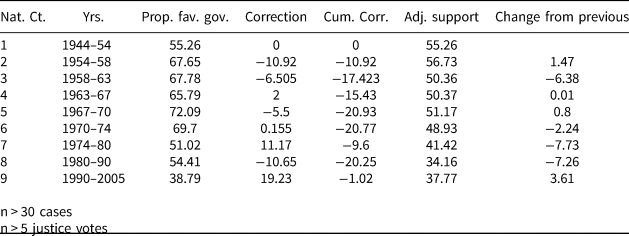
Table 3 displays the findings for tax cases. Column 3 shows the actual proportion of decisions favouring the government in tax cases.
Tax cases

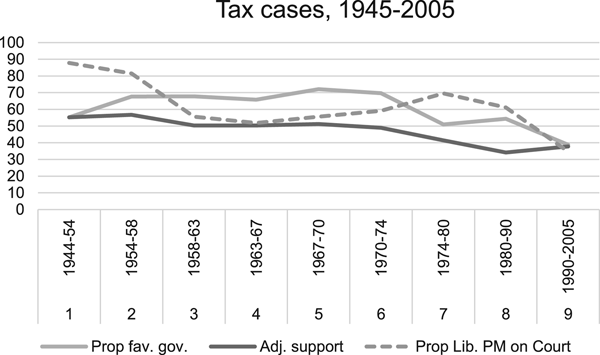
The Court has been deferential to the government in tax suits with most periods favouring government entities at over 50 per cent and several periods at over 60 per cent. Only in 1990–2005 does that number dip below 50 per cent. In comparison, the adjusted support scores across periods are not as stark in their differences. The early court periods are not as pro-government as it first appears which suggests that later courts are only slightly more pro-claimant than earlier courts. Figure 3 better portrays these trends.
Adjusted Support Scores by Natural Court.

It appears, even from the actual support scores, that the Supreme Court has been somewhat stable over time in tax cases, at least in comparison with criminal cases. However, the adjusted support scores indicate even more stability over time. We observe a policy change as government support in tax cases began to trend downward in the mid-1970s. After 1980, the justices adjusted support scores indicate pro-government outcomes in tax cases consistently below 40 per cent compared with support for the government in and around 50 per cent for early periods.
The majority of change in adjusted support scores occurs between 1974 and 1990. At the height of Liberal party appointees holding a majority on the Court (nearly 70 per cent in the 1974–1980 period), the support for the government in tax cases continues to decline. The relationship between adjusted support scores in tax cases corresponds with per cent Liberal appointees serving on the Court in the 1974–1980 period (see figure 3), but does not track together after 1980. After 1980, the actual support scores track closer to the percentage of justices appointed by Liberal PM's. After removing issue change, adjusted support scores do not track as closely with party affiliation. This result could suggest strategic action by the Court in the case selection process. Thus, party affiliation and ideology might have a greater impact prior to the merits stage, which is not captured by Baum's method.
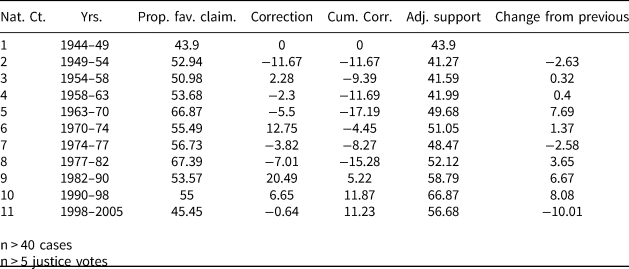
Table 4 displays the results for tort cases.
Tort cases

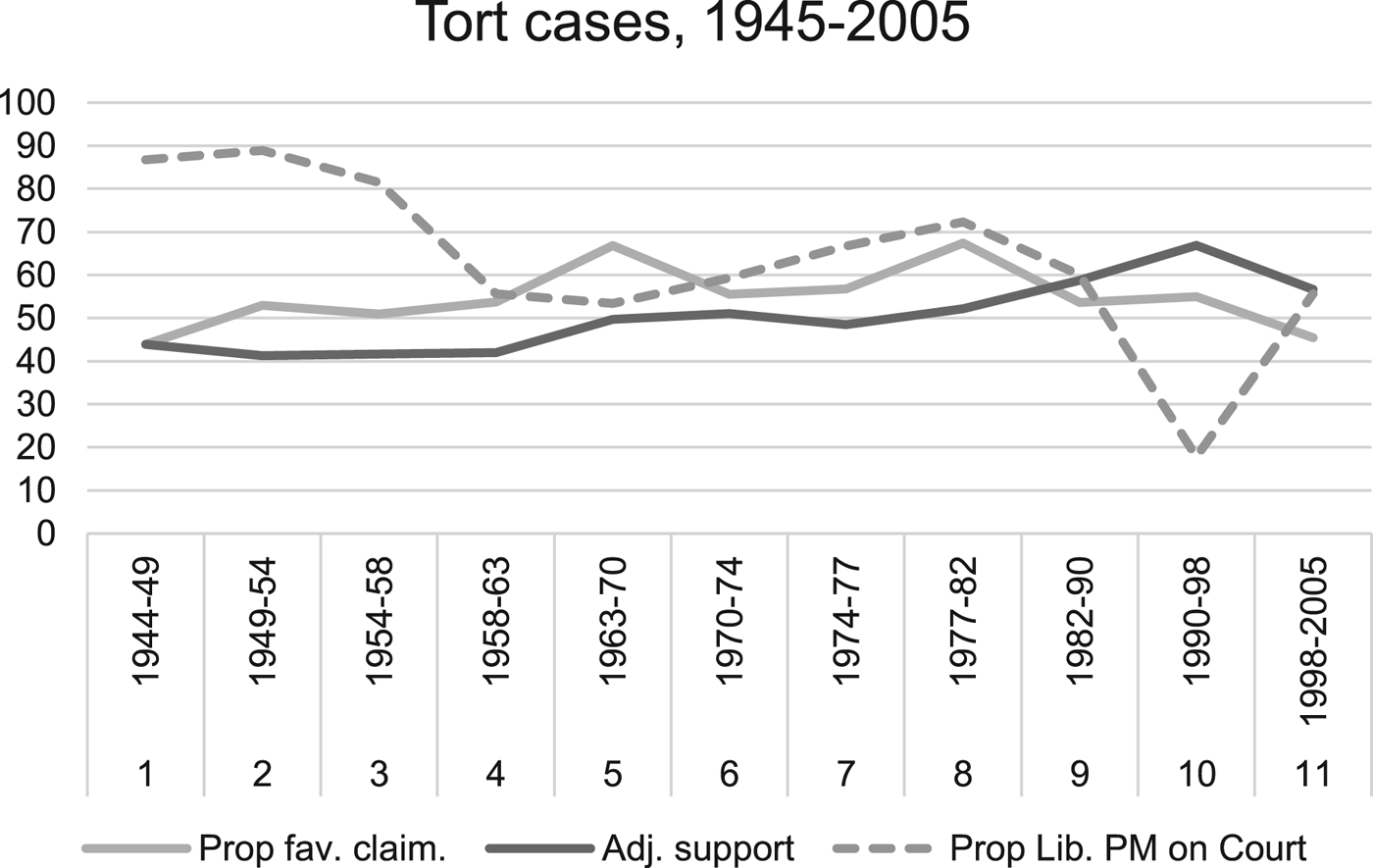
The actual proportion favouring economic underdogs ranges from a low of 43 per cent in the Rinfret (1944–1949) period to a high of 67 per cent in the Laskin (1977–1982) period. However, the adjusted support scores suggest that the Kerwin courts are as likely to favour economic upper dogs as the Rinfret court, and that the Lamer court was actually more favourable to economic underdogs. Figure 4 displays the actual support levels compared to the adjusted support levels.
Adjusted Support Scores by Natural Court.

The trend in the adjusted support scores is closer to the trend in tax cases, with less variation than in criminal cases. Notably, policy change favouring economic underdogs increased markedly in the post-Charter period after quite a substantial increase in the years just preceding the Charter. The largest distance traversed by the Court in tort cases is from 1977 to 1998. It appears that the sharp decline in Liberal party appointed justices on the Court coincides with an increase in support for tort claimants. The Mulroney appointees who dominate the Court in the 1990s are the most supportive of economic claimants. Although the justices moved in a pro-claimant direction beginning in the 1960s, with adjusted support scores increasing by about 8-percentage points, the majority of the shift upward occurs with Conservative PM appointments in the 1990s with another 8-point shift between 1990 and 1998.
It's the Cases and Policy Change
Importantly, this study shows that the SCC is not only consistent over time, but also even when policy shifts occur, the Court remains rather moderate. Adjusted support scores ebb and flow during the sixty-year period, but they do so rather gradually. Across all three issue areas, the Court varies by as much as 23-percentage points after controlling for issue change, and the amount of support hovers mostly between the 40th and 60th percentiles. Consistency is obvious when comparing adjusted support scores to actual support scores. However, the 20-point swing across sixty years after controlling for changing cases indicates that individual justices and their policy views still matter. Thus, the attitudinal model is accurate in its claim of policy impact on the Court's decisions. However, the collegial decision-making environment might also mitigate the most extreme justices’ views since garnering a minimum winning coalition to reach a majority decision must be in accordance with the views of the most moderate justice in the voting bloc.
While much discussion in recent years has centred on the selection process for Supreme Court justices and the impact their views have on administering justice in Canada, the findings suggest that personnel and membership change is not the primary reason shifts occur over time. Policy shifts have occurred; however, the stark differences in decisions appears to be primarily the result of issue change. This has important implications for critics of the Court and for the academic debate surrounding the Court's practices in the post-Charter era. Post-Charter era scholarship suggests increased attitudinal conflict on the SCC, and scholars have primarily found this attitudinal conflict to exist in civil liberties cases, which were directly affected by the Charter (Hausegger and Haynie, Reference Hausegger and Haynie2003; Songer et al., Reference Songer, Johnson, Ostberg and Wetstein2012). The Charter also affects criminal cases, and scholars have discovered attitudinal conflict in those cases. However, in this study we observe that the Court moves to a more pro-defendant stance prior to the Charter but then remains relatively steady for the duration of the post-Charter period, despite personnel change. This suggests that the Court may not be as activist as critics suggest (but see Macfarlane, Reference Macfarlane2013).
Previous studies mostly rely on individual justices’ votes to show ideological voting patterns rather than case outcomes. However, the collegial process can lessen ideological impact because justices are strategic actors who work towards building consensus in a small-group environment, which requires justices to modify preferences in order to be part of the minimum winning coalition in a case. It is also a strong possibility that the case selection stage introduces strategic action, attitudinal in nature, which is filtered out at the merits stage.
Perhaps this is why after controlling for personnel change and issue change, we observe modest amounts of change in output across time. The study covers only cases that comprise a large enough percentage of the Court's docket across sixty years for suitable analysis. It is limited, therefore, by lack of civil liberties cases analyzable in the pre-Charter era. However, in the three distinct issue areas analyzed, we note some changes have occurred but not to a substantial degree as one might expect utilizing a purely attitudinal model.
The overall trend is one of a steady, deliberative Court after controlling for issue change. This trend is consistent with scholarship regarding the collegial nature of the SCC as well as its moderate approach in many cases. Though some policy change occurred, the results suggest the justices are not as polarized, nor perhaps, as overtly policy driven, as the US Supreme Court. Collegiality and consensus norms likely mitigate ideology effects, which has judicial selection implications. The appointment process should recognize justices’ activism (Ostberg and Wetstein, Reference Ostberg and Wetstein2007), and yet be reassured that the process for deciding cases lessens ideology's impact. With strong norms of consensus and unanimity on the Court, the small-group work environment stresses collegiality rather than polarization. Since justices are ideological but not to the extent of US justices, one question is whether it is worth the increased politicization of the appointment process to scrutinize candidates’ views (Ziegel, Reference Ziegel, Howe and H2001). The median justice is especially significant, and appointing actors might carefully consider personnel decisions that affect movement of the Court's centre, as scholars have documented ideological decision making in Charter civil liberties cases (excluded from this analysis).
It is possible that issue change is the result of legal mobilization including intervener participation, changes in law such as legislation and the Charter of Rights (particularly in criminal cases) and changes in the court's jurisdiction. This study does not tell us the cause of issue change observed. However, scholars have provided information on why issue change likely occurred, and the results here provide indirect support for previous theories that hypothesize external forces influence the Court (Epp, Reference Epp1998; Hausegger et al., Reference Hausegger, Hennigar and Riddell2009). The result lends support to Wetstein and Ostberg (Reference Wetstein and Ostberg2017) and Songer and colleagues (Reference Songer, Johnson, Ostberg and Wetstein2012) who suggest decision making is not the result of one single factor but rather a myriad of factors. Ideology “weaves a more complex tapestry” and its influence is conditioned on the “different institutional structures and norms that operate in the high court” (Ostberg and Wetstein, Reference Ostberg and Wetstein2007: 226). Policy change is at work in Canada, and we observe policy shifts even after controlling for shifting j-points. However, personnel change is not as consequential as in the US Supreme Court at the merits stage, and the justices are not as polarized, even from one court era to the next. This further confirms a complex, nuanced view of decision making at work in Canada. Issue change appears to be the driving force in changing decisions during the SCC's modern history, even with attitudinal voting explaining modest evolution in the Court's positions over time.
Acknowledgements
I wish to thank the three anonymous reviewers for their helpful comments and suggestions. I am especially grateful to Donald Songer for his advice and guidance on earlier versions of this article.
APPENDIX
Example of Calculating Adjusted Support Scores: Criminal cases