Pasture-based seasonal-calving dairy production systems have been introduced into Switzerland (CH) in the past 10 years to reduce production costs (Blättler et al. Reference Blättler, Durgai, Kohler, Kunz, Leuenberger, Müller, Schäublin, Spring, Stähli, Thomet, Wanner, Weber and Menzi2004). These systems require that herd feed demand matches pasture growth (Holmes et al. Reference Holmes, Brookes, Garrick, Mackenzie, Parkinson and Wilson2007) which is achieved by having discrete periods of breeding and calving lasting 10–14 weeks on an annual cycle. At the cow level, each step of the reproductive process is crucial (ovarian activity, oestrus, insemination and the establishment of pregnancy) and the choice of an adapted breed or strain is a key of the system.
Many studies of Holstein-Friesian (HF) cows from differing geographical origins and breeding objectives report that a high proportion of North American (NA) genetic background is linked with poorer reproductive performance (Horan et al. Reference Horan, Mee, O'Connor, Rath and Dillon2005; Fulkerson et al. Reference Fulkerson, Davison, Garcia, Hough, Goddard, Dobos and Blockey2008; Macdonald et al. Reference Macdonald, Verkerk, Thorrold, Pryce, Penno, McNaughton, Burton, Lancaster, Williamson and Holmes2008), compromising their suitability for compact calving systems. Some of this poorer performance has been linked to ovarian dysfunction, in particular, a high proportion of persistent corpus luteum (Royal et al. Reference Royal, Flint and Woolliams2002; Petersson et al. Reference Petersson, Gustafsson, Strandberg and Berglund2006).
Although Swiss dairy cows have been highly influenced by NA genetics, as local dual-purpose breeds were crossed with NA Red Holstein, Brown Swiss or HF breeds from the late 1960s (Flückiger, Reference Flückiger1990; Wegmann et al. Reference Wegmann, Chavaz, Hitz, Roulin and Savary1999; Hagger, Reference Hagger2005), functional traits have also been an important component of Swiss genetic selection programmes for more than three decades (Böbner, Reference Böbner1994).
A 3-year experiment (2007–2009) was thus designed to examine the suitability of the three predominant Swiss dairy breeds, Swiss Holstein-Friesian (CH HF), Swiss Fleckvieh (CH FV) and Swiss Brown Swiss (CH BS) for seasonal-calving, pasture-based Swiss milk production systems, by comparing them with New Zealand (NZ) Holstein-Friesian (NZ HF) cows; the latter being chosen as a reference population, recognized for their ability to achieve good fertility in such systems (Kolver et al. Reference Kolver, Roche, Veth, Thorne and Napper2002; Horan et al. Reference Horan, Mee, O'Connor, Rath and Dillon2005; Macdonald et al. Reference Macdonald, Verkerk, Thorrold, Pryce, Penno, McNaughton, Burton, Lancaster, Williamson and Holmes2008). Reproductive performance differed among breeds (Piccand et al. Reference Piccand, Cutullic, Schori, Weilenmann and Thomet2011) with CH FV cows achieving the best reproductive performance: high submission and conception rates led to high pregnancy rates early in the breeding period. Although NZ HF cows achieved a similar pregnancy rate at the end of the breeding period, only 32% were pregnant within 3 weeks owing to a low submission rate. Overall, CH HF cows had lower reproductive performance and CH BS were intermediate. Overall, these results suggested possible differences in the underlying ovarian activity.
In the present study, we focused on the second year of this experiment to investigate to what extent these differences in reproductive performance among breeds were associated with differences in their ovarian activity. Accordingly, ovarian activity and ovulatory cycle patterns were compared between CH HF, CH FV, CH BS and NZ HF cows through progesterone profile analysis.
Materials and Methods
Experimental design
Fifty NZ HF animals were sourced as pregnant heifers from Ireland, imported into Switzerland in late 2006, and randomly allocated in January 2007 to the commercial farms involved in the project. On every farm, each NZ HF cow was paired with a Swiss breed cow, ensuring the pair was balanced for calving date and age. All trial cows were managed similarly within herd, with the farmer in charge of all management decisions concerning his herd.
The observations reported here were undertaken on 13 selected farms from January to July 2008 and involved the 100 second-lactation cows (50, 17, 15, 18 cows of NZ HF, CH HF, CH FV, CH BS, respectively, on 13, 3, 5 and 7 farms, respectively).
Animals
NZ HF
The 50 NZ HF cows were of NZ genetic origin, a strain of HF selected within seasonal calving pasture-based dairy systems for high milk-component production, fertility, and longevity. These animals had at least two generations of NZ ancestry, represented 11 NZ HF sires (86% from five sires) and had an average pedigree index Breeding Worth of NZ$88±14. They were, therefore, representative of the 2005-born HF in New Zealand (NZ$87±42; October 2009, R Wood, NZ Animal Evaluation Limited, Hamilton, New Zealand, personal communication).
CH HF
The 17 CH HF cows were from a HF strain of NA origin, but selected within a breeding index that included both milk production and functional traits. These animals represented 13 CH HF sires. Their average pedigree index for milk production (IPQ) was 103±7·7. They were, therefore, representative of the 2005-born HF in Switzerland (104±9·3 IPQ; November 2009, E Barras, Holstein Association of Switzerland, Posieux, Switzerland, personal communication).
CH FV
The 15 CH FV were crosses between Simmental and Red Holstein breeds, with an average of 67±12% Red Holstein genetics. The herd society's breeding objectives include milk production, functional traits, and beef characteristics. These animals represented 13 CH FV sires. Their pedigree index for milk production (ILM) was 106±5·4. They were, therefore, representative of the CH FV living population (101±9·8 ILM; November 2009, A Bigler, Swissherdbook, Zollikofen, Switzerland, personal communication).
CH BS
The 18 CH BS were Brown Swiss cows, mainly of NA origin with only 6±5% of Original Brown Swiss genetics. They were selected using a balanced breeding index, including milk production and functional traits. These animals represented 15 CH BS sires. Their average pedigree index for milk production (MIW) was 104±5·4. They were, therefore, representative of the 2005-born Brown Swiss in Switzerland (104±7·9 MIW; November 2009, B Bapst, Swiss Brown Cattle Breeders' Federation, Zug, Switzerland, personal communication).
Farms and herd management
Farms
The 13 dairy farms were located in different geographical regions and altitudes: eight were located on the Swiss Plateau (lowland), four in the Pre-Alps (hill country) and two in the Jura (hill and mountain country), with an altitude ranging from 440 to 1050 m and a pasture growth period ranging from 230 to 170 d (Jeanneret & Vautier, Reference Jeanneret and Vautier1977). Management objectives were similar between herds (low-input, pasture-based, spring-calving system).
Feeding
As generally observed in Switzerland, the winter lactating cow ration (from calving to turn out, at 36±27 days in milk) always contained a grass sourced forage. It consisted of hay, or hay and grass silage, or grass silage and maize silage (n=6, 6 and 1 farm, respectively). Concentrate was fed daily at a rate of 3·5±1·8 kg DM/cow to lactating cows during the winter period (mean 303±131 kg/cow per lactation). Winter rations were estimated to contain 6·2±0·4 MJ NEL/kg DM and 15±2·1% CP/kg DM (one sample/forage type per farm). Cows were managed on pasture from 23 March 2008 (±14 d) and progressively reached full grazing after a 2–3 weeks transition period. At grazing, supplementary feed was offered only during periods of pasture deficit. From the time of turning out to pasture until the end of June, pasture was estimated to contain 6·2±0·4 MJ NEL/kg DM and 21±3·3% CP/kg DM (one sample of offered pasture/month per farm). The dry period ration consisted of hay or grass silage of lower quality than the lactating cow ration.
Reproductive events
The average day of the planned start of mating (PSM) was 16 April 2008 (±15 d). Three farms did not follow strict seasonal rules so did not have fixed PSM dates. For the cows on these farms, artificial PSM dates were calculated for each cow by adding a voluntary waiting period (VWP) to the calving date. The VWP was defined for each farm as the shortest observed interval from calving to service (33, 35 and 37 d). All calving dates, artificial insemination (AI) dates, health events and treatments were recorded. For cows not showing oestrus before PSM, the need for treatment was assessed individually by the farm veterinarian. From the 13 farms, seven introduced a bull into the herd 45±15 d after PSM (i.e. after two AI cycles).
Animal measurements and variable definitions
Milk yield, body condition score and live-weight
Milk volume and composition were assessed monthly. Samples were analysed for fat, protein and lactose with an infrared analyser (Foss, Hillerød, Denmark). From these monthly records, 100-d cumulative variables were calculated as follows:

where valuei and daysi are the value (e.g. milk yield) and days after calving of the ith sample, respectively, n is the number of samples <100 days after calving, value0 is set to value1, days0 is set to 0, and daysn+1 is set to 100. Body condition score (BCS) was assessed monthly on a 1–5 scale in increments of 0·25 (Edmonson et al. Reference Edmonson, Lean, Weaver, Farver and Webster1989) by the same trained operator on all farms. Calving BCS was considered as the maximum of the two one-month-spaced scores that framed calving. Body condition scores at 30 and 100 d post partum were calculated from individually fitted cubic spline smoothing curves (smooth.spline function: smoothing parameter=0·25, BCS weights=5, 2 and 1 at calving, before and after 60 d post partum, respectively; R Development Core Team, 2009). Cows were weighed on days 38±19, 116±25 and 281±28 post partum, using a mobile weigh platform (Tru-Test, Auckland, New Zealand). Lactation live-weight was averaged over these three values to calculate milk production efficiency (milk yield per metabolic live-weight, i.e. Lwt0·75).
Milk progesterone analysis
Milk samples were collected after cluster removal at the morning milking every second day between calving and first mating date. Additional samples were collected at 10, 21 and 28 d after the first insemination. Samples were quickly frozen and stored for 12 months at −18°C until analysis. Milk sample were defrosted overnight at 5°C and then centrifuged for 10 min at 3000 rpm at 4°C just before analysis. Milk progesterone (P4) concentration was assayed in skim milk samples by ELISA (Nalge Nunc International, New York, USA) as described by Meyer et al. (Reference Meyer, Gueven and Karg1986). Range of detectable concentration was 0·2–12·5 ng/ml. Intra- and inter-assay coefficients of variation were 23% and 23%, 12% and 26%, and 15% and 17% for skim milk control samples with low, medium and high progesterone concentrations (1·4, 2·3 and 3·0 ng/ml), respectively.
Progesterone profile analysis
Use of P4 to indicate the onset of luteal activity was similar to the method reported by Royal et al. (Reference Royal, Darwash, Flint, Webb, Woolliams and Lamming2000). Cows were defined as being in luteal phase following ovulation if at least two consecutive samples had milk P4 concentrations greater than 0·8 ng/ml (‘positive’ sample; Weiss et al, Reference Weiss, Reist and Bruckmaier2004). Commencement of luteal activity (CLA) was the calculated interval from calving to the first positive sample of the first luteal phase, minus 1 d (sampling bias correction). Inter-ovulatory interval (IOI) was the interval between the first positive samples of two consecutive luteal phases. Luteal phase length (LPL) was the interval from the first to the last positive sample of a luteal phase plus 2 d. Inter-luteal interval (ILI) was the interval between the last and the first positive samples of two consecutive luteal phases minus 2 d. A transient progesterone rise (TPR) corresponds to a single positive sample; TPRs were recorded as they may, in some cases, have been part of a short luteal phase, which was not detected by the sampling routine. Progesterone profiles were classified as Normal, Persistent Corpus Luteum (PCL, if at least one LPL was ⩾19 d), Delayed Ovulation of type I (DOV-I, if CLA ⩾45 d) or Delayed Ovulation of type II (DOV-II, at least one ILI was ⩾12 d). The number of cycles by PSM corresponded to the number of luteal phases started by PSM.
Traditional reproductive parameters
Conception to first service (FSC) was confirmed by three positive P4 samples after AI (days 10, 21 and 28 post AI) and a corresponding subsequent calving date. In two cases conception was only confirmed by positive P4 samples (one cow was culled before calving and one had a mummified calf). Sampling stopped after first service, so for inseminations without P4 information (n=46 cows), dates of conception were estimated from the mating dates and the subsequent calving date, with consideration of the sire's breed gestation length. When several inseminations were performed within the interval [expected −10; expected +14], the last AI event was chosen. For natural mating without a recorded mating date, the date of conception was estimated by subtracting the gestation length for the sire's breed from the subsequent calving date.
Statistical analyses
The GenStat procedure CENSOR (VSN International Ltd., 2007) was used to obtain an estimate of the interval from calving to first luteal activity for cows with censored data (i.e. for cows that had a minimum value for the interval when the P4 monitoring stopped but no actual data). Breed was included as a fixed effect, farm and pair within farm were included as random effects. Cows treated for anoestrus were removed from progesterone analysis from the day of the treatment.
Continuous variables were analysed by linear mixed models including breed as a fixed effect and farm and pair within farm as random effects. Binomial variables were analysed by mixed logistic regressions including breed as a fixed effect and farm as a random effect. Results are expressed as predicted probabilities for each breed. These analyses were performed using R statistical software (lmer and glmer functions, respectively; Bates & Maechler, Reference Bates and Maechler2010; R Development Core Team, 2009).
Results
Progesterone-related parameters and reproductive performance
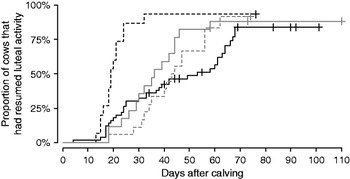
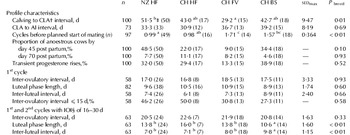
The timing of CLA differed between breeds (Table 1): CH FV cows had an earlier CLA than NZ HF cows, with CH HF and CH BS cows intermediate. This earlier resumption in CH FV cows was explained by a very compact resumption in comparison with NZ HF cows, as shown in Fig. 1. Profiles were classified as PCL and DOV-II from only 3 and 6 cows, respectively, whereas 42 cows had CLA ⩾45 d (DOV-I). There was a tendency for more NZ HF cows to be anoestrous at 45 d post partum (DOV-I) than CH HF (P<0·1) and CH FV (P<0·06) cows. As a result, NZ HF cows completed fewer oestrous cycles before PSM than CH FV cows (Table 1).
Proportions of New Zealand Holstein-Friesian (NZ HF; n=50; solid black line), Swiss Holstein-Friesian (CH HF; n=17; dashed grey line), Swiss Fleckvieh (CH FV; n=15; dashed black line) and Swiss Brown Swiss (CH BS; n=18; solid grey line) second-lactation dairy cows managed in seasonal-calving pasture-based dairy systems of Switzerland having their luteal activity resumed. This illustrative plot was drawn from Kaplan-Meier estimates of survival curves that do not account for the farm effect (the calving to commencement of luteal activity intervals and the proportions of anoestrous cows adjusted for farm effect are given in Table 1)

Postpartum ovarian activity parameters of New Zealand Holstein-Friesian (NZ HF; n=50), Swiss Holstein-Friesian (CH HF; n=17), Swiss Fleckvieh (CH FV; n=15) and Swiss Brown Swiss (CH BS; n=18) second-lactation dairy cows managed in seasonal-calving pasture-based dairy systems of Switzerland (n are given per breed in brackets). sedmax is given for continuous variables only (binomial variables were analysed on logit-scale)

† Commencement of luteal activity
‡ a, b, c values without a common superscript letter are significantly different (P<0·05)
§ Inter-ovulatory interval
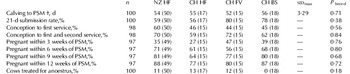
First cycle characteristics did not differ between breeds. When first and second cycles were pooled and IOI ranging from 16 to 30 d were considered (i.e. excluding short first cycles and extreme values), CH BS had both shorter LPL and longer ILI than other breeds (Table 1). Traditional reproduction parameters are given in Table 2, rather as illustrative key figures than as statistically compared figures, owing to the low number of animals.
Reproduction parameters of New Zealand Holstein-Friesian (NZ HF; n=50), Swiss Holstein-Friesian (CH HF; n=17), Swiss Fleckvieh (CH FV; n=15) and Swiss Brown Swiss (CH BS; n=18) second-lactation dairy cows managed in seasonal-calving pasture-based dairy systems of Switzerland (n are given per breed in brackets). sedmax is given for continuous variables only (binomial variables were analysed on logit-scale)

† Planned start of mating
Milk yield and BCS
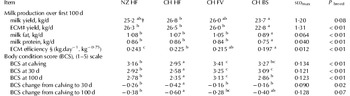
CH BS cows produced less energy-corrected milk (ECM) and milk fat and protein than other breeds during early lactation (Table 3). When accounting for Lwt0·75, a dairy efficiency gradient from the least to the most efficient was observed from CH BS to CH FV, CH HF and NZ HF. CH FV cows had highest BCS at calving and through early lactation (Table 3). Conversely, CH HF had the lowest calving BCS and the greatest BCS loss post partum, with loss most pronounced in the first 30 d (Table 3).
Milk production and body condition of New Zealand Holstein-Friesian (NZ HF; n=50), Swiss Holstein-Friesian (CH HF; n=17), Swiss Fleckvieh (CH FV; n=15) and Swiss Brown Swiss (CH BS; n=18) second-lactation dairy cows managed in seasonal-calving pasture-based dairy systems of Switzerland

† a, b, c values without a common superscript letter are significantly different (P<0·05)
‡ Energy corrected milk (4·0% fat, 3·2% protein and 4·8% lactose)
§ Energy corrected milk per average lactation metabolic weight, i.e. per (average lactation BW)0·75. Seventeen cows with missing weight were excluded from the analysis
Discussion
Commencement of luteal activity
The NZ HF strain took longer to resume ovarian activity after calving than the other breeds. This result is consistent with a previous report that extended anovulatory periods are a major source of reproductive failure in NZ dairy cows (Macmillan, Reference Macmillan2002). To our knowledge, NZ HF always have either longer (McNaughton et al. Reference McNaughton, Verkerk, Parkinson, Macdonald and Holmes2003, Macdonald et al. Reference Macdonald, Verkerk, Thorrold, Pryce, Penno, McNaughton, Burton, Lancaster, Williamson and Holmes2008) or similar (Horan et al. Reference Horan, Mee, O'Connor, Rath and Dillon2005, Chagas et al. Reference Chagas, Gore, Sheahan, Lee, Watkins, Aspin and Roche2006), but never shorter CLA than NA HF, despite their higher fertility.
The longer interval from calving to CLA in the NZ HF is in agreement with the high positive correlation between CLA and Predicted Transmitting Abilities for fat (Veerkamp et al. Reference Veerkamp, Oldenbroek, van der Gaast and van der Werf2000; Royal et al. Reference Royal, Flint and Woolliams2002). The NZ HF strain has been selected for high milk solids (fat plus protein) yield for many decades. In comparison, the three Swiss breeds have been mostly selected on milk volume, which has a lower genetic correlation with CLA. Interestingly, the average CLA increased linearly with the production trait weightings in the selection indices of the four breeds: 39%, 54%, 53% and 67% for CH FV, CH BS, CH HF and NZ HF, respectively (year 2009; Swiss herdbook, Swiss Brown Cattle Breeders' Federation, Holstein Association of Switzerland, New Zealand Animal Evaluation Unit).
According to a recent review (Cutullic, Reference Cutullic2010), an average interval from calving to CLA of 30 d would be expected for herds of multiparous cows with such milk yields. The reason for the longer interval in the present study is not known. It may be related to nutrition or BCS. Although recent studies reported no effect of post-partum feeding level effect on CLA (Horan et al. Reference Horan, Mee, O'Connor, Rath and Dillon2005; Burke & Roche, Reference Burke and Roche2007; Cutullic et al. Reference Cutullic, Delaby, Gallard and Disenhaus2011), possible differences in pre-partum feeding level, calving BCS (Burke & Roche, Reference Burke and Roche2007), or differences in the proportion of structural to non-structural carbohydrates in post-partum diets (Gong et al. Reference Gong, Lee, Garnsworthy and Webb2002; Burke et al. Reference Burke, Kay, Phyn, Meier, Lee and Roche2010) between the farms on this study and that reported by Cutullic (Reference Cutullic2010) cannot be excluded.
Both BCS at calving and BCS change in early lactation, indicating the energy balance of the cow, influence timing of CLA (Butler et al. Reference Butler, Everett and Coppock1981; Roche et al. Reference Roche, Friggens, Kay, Fisher, Stafford and Berry2009; Friggens et al. Reference Friggens, Disenhaus and Petit2010). Although these associations are plausible within breed, they are unlikely to account for the breed differences reported here. For example, based on their BCS profile, NZ HF should resume ovarian activity earlier. Consistent with this, Pollot et al. (Reference Pollott and Coffey2008) could explain differences in timing to CLA by energy deficit differences within strain, but not between strains. This suggests that there are inherent breed influences on the timing of CLA beyond that of BCS, BCS change or energy balance.
Oestrous cycle traits
Oestrous cycle characteristics of CH BS differed from the other breeds, with a shorter LP and longer ILI, although IOI was similar. This may be associated with a slower increase in P4 at the start of the luteal phase for CH BS cows, similar to that previously reported by Yenikoyé et al. (Reference Yenikoyé, Mariana, Ley, Jolivet, Terqui and Lemon-Resplandy1981) and Meier et al. (Reference Meier, Roche, Kolver, Verkerk and Boston2009). Differences in the follicular wave patterns, not measured in the present study, may also underlie the observed cycle differences. The similarity of IOI however suggests that the numbers of follicular waves per cycle were similar across the breeds (Bleach et al. Reference Bleach, Glencross and Knight2004).
Ovarian abnormalities were scarce, apart from delayed resumption of luteal activity post partum. The late resumption of luteal activity in the present study may, in part, have prevented the occurrence of prolonged luteal phases; however it may also be a consequence of different genetic selection priorities within the breeds evaluated. In Sweden, for example, where fertility traits were included in the genetic index in the 1970s, Petersson et al. (Reference Petersson, Gustafsson, Strandberg and Berglund2006) reported only 6 and 11% prolonged luteal phase profiles in Red and White and Holstein breeds respectively.
Overall reproductive performance
The low number of animals in this study limits the conclusions that can be drawn about overall reproductive performance. However, the numerical trends observed have been confirmed by the 3-year analysis reported by Piccand et al. (Reference Piccand, Cutullic, Schori, Weilenmann and Thomet2011).
Late resumption of luteal activity probably explained the low 21-d submission rate in the NZ HF. However, because normal ovarian activity with fertile ovulations resumed quickly beyond CLA, they achieved normal 6-week and 12-week pregnancy rates. According to McNaughton et al. (Reference McNaughton, Sanders, Pryce, Bracefield, Harcourt and Spelman2007), only resumption of luteal activity after 70 d post partum affects the interval from PSM to conception. This is in agreement with the high final pregancy rates observed in CH BS and NZ HF cows, although respectively one-third and one-half of these cows were ‘delayed’ classified (CLA⩾45 d); indeed, most of the cows had resumed luteal activity by day 70 post partum (94 and 90% respectively). In CH HF cows, numerically lower pregnancy rates achieved through the breeding season seemed mostly due to poor fertility to insemination or to low oestrus expression, rather than to abnormal ovarian activity, in agreement with many experiments comparing NZ HF strains with high productivity NA strains (Verkerk et al. Reference Verkerk, Morgan and Kolver2000; Horan et al. Reference Horan, Mee, O'Connor, Rath and Dillon2005; Macdonald et al. Reference Macdonald, Verkerk, Thorrold, Pryce, Penno, McNaughton, Burton, Lancaster, Williamson and Holmes2008). In CH FV cows, the early homogenous CLA allowed a high submission rate and a high 3-week pregnancy rate, which is a non negligible advantage on the long term in compact calving systems. In the 3-year study (Piccand et al. Reference Piccand, Cutullic, Schori, Weilenmann and Thomet2011), this group achieved the best overall reproductive performance.
Conclusions
The Swiss breeds investigated have a shorter interval from calving to CLA than NZ HF cows. However, ovarian activity is only the first step of the reproductive process and the final reproductive performance is also highly modulated by later steps, such as fertility to insemination.
This study was funded by the Swiss Federal Commission for Innovation and Technology, the Swiss College of Agriculture, Swissgenetics and the Swiss Interest Group for Pasture Based Milk (IG Weidemilch). The authors gratefully acknowledge the collaborating farmers and Barbara Dow for statistical advice and analysis.