Assessments of weed seed viability and germination are important in evaluating the weed control efficacy of soil disinfestation methods. Weed seed samples are often artificially introduced at several depths using seed bag assays (Klose et al. Reference Klose, Ajwa, Browne, Subbarao, Martin, Fennimore and Westerdahl2008; Samtani et al. Reference Samtani, Gilbert, Weber, Subbarao, Goodhue and Fennimore2012). The viability of the recovered seeds is commonly determined using the tetrazolium assay (Baalbaki et al. Reference Baalbaki, Elias, Marcos-Filho and McDonald2009; Cottrell Reference Cottrell1947). The installation of seed bags in the field is time consuming and requires careful placement of seed bags at set depths below the soil surface. Also, the recovery process requires careful handling to retrieve bags without damage and loss of samples. Field work can also be dangerous in experiments that include hazardous treatments like heat or fumigation. This is especially true when researchers and staff are in direct contact with soil after soil fumigation, or work close to heavy machinery (e.g., during soil pasteurization research). Under such circumstances, there is need for a method to quickly install and recover weed seed samples from the soil. For this reason, a soil probe system was developed to decrease the time of exposure to hazardous conditions for field personnel.
The general design of the soil probe system is based on the minicontainer system (Eisenbeis et al. Reference Eisenbeis, Dogan, Hebier, Kerber, Lenz and Paulus1995, Reference Eisenbeis, Lenz, Dogan and Schuler1996, Reference Eisenbeis, Lenz and Heiber1999). The minicontainer system consists of two components, the minicontainer bar and the minicontainer (Eisenbeis et al. Reference Eisenbeis, Lenz and Heiber1999). A minicontainer bar is made of polyvinylchloride and contains up to 36 vertically aligned holes. Those holes are chambers for minicontainers, polyethylene containers that are each made of a central body and two rings. Each end of a minicontainer is covered with plastic gauze (which could be various mesh sizes) held in place by one of the plastic rings (Eisenbeis et al. Reference Eisenbeis, Lenz and Heiber1999). The minicontainer system has been used to determine decomposition rates of litter (Hagemann and Moroni Reference Hagemann and Moroni2015; Kreyling et al. Reference Kreyling, Haei and Laudon2013) as well as soil micro- and mesofauna activity at the microhabitat level (Lehmitz et al. Reference Lehmitz, Russell, Hohberg, Christian and Xylander2012; Wolfarth et al. Reference Wolfarth, Schrader, Oldenburg and Weinert2013, Reference Wolfarth, Wedekind, Schrader, Oldenburg and Brunotte2015).
Significant changes to the design were made to allow for fast sample installation and recovery. The design uses easily fabricated and inexpensive materials. The aim of this study was to determine if the soil probe system is as reliable as the traditional seed bag assay. The study follows the hypothesis that weed seed viability is similarly affected by soil disinfestation treatments in both systems. The following objectives were investigated: 1) the impact of soil fumigation (Pic-Clor 60) on weed seed viability in the seed bag assay compared to the soil probe system and 2) the impact of nonchemical soil disinfestation (steam) on seed viability in the seed bag assay compared to the soil probe system.
Material and Methods
A soil probe system was developed and side-by-side comparisons of soil probe system and seed bag assays were conducted in a microplot study and a field study. Seeds of burning nettle, common purslane, common knotweed, and tubers of yellow nutsedge, were subjected to two different soil disinfestation methods (Steam, Pic-Clor 60). These species represent some of the dominant weed species in the Salinas Valley (Fennimore et al. Reference Fennimore, Martin, Miller, Broome, Dorn and Greene2014; Samtani et al. Reference Samtani, Ajwa, Weber, Browne, Klose, Hunzie and Fennimore2011, Reference Samtani, Gilbert, Weber, Subbarao, Goodhue and Fennimore2012). Seeds and tubers were collected directly from field prior to the studies (burning nettle, yellow nutsedge), or plants were collected in the field and grown in pots for later seed collection (common purslane, common knotweed). The seed viability of burning nettle (75%), common purslane (30%), and common knotweed (80%) and the germination rate of yellow nutsedge tubers (25%) were determined. The specifications, manufacture, and costs of the soil probe system and the setup of the microplot and field studies, as well as the results of germination trials and seed viability assays, are explained and presented below.
Soil Probe System
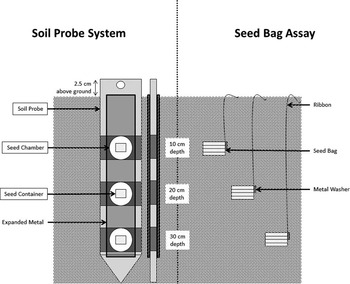
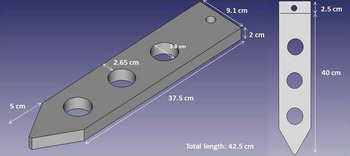
The soil probe system is composed of a probe and several seed containers (Figure 1). The probe is made from maple lumber of 42.5-cm length, 9.1-cm width, and 2-cm thickness (Figure 2). Each probe has three circular holes that serve as seed chambers for the seed containers (explained below). Each hole has a diameter of 3.8 cm, and the centers of the holes are 12.5, 22.5, and 32.5 cm below the top edge of the probe (Figure 2). A mark 2.5 cm below the top edge of the probe indicates the level of the soil surface when the probe is correctly installed. When the probe is installed at this depth, the seed chambers will be 10, 20, and 30 cm below the soil surface. Seed chambers at the desired depth are loaded with seed containers. After the seed chambers are loaded with the seed containers, the soil probe is closed with an expanded metal mesh (steel, 0.7 by 2 cm mesh size) on both sides using standard nuts, screws, and washers. The expanded metal mesh allows free movement of soil water, particles, and air (Figure 3).
The soil probe system (left) is composed of the soil probe (maple lumber), three seed chambers, and a varying number of seed containers for each seed chamber. Expanded metal is attached to both sides of the probe to protect seed containers from falling out in the process of installation and recovery. The soil probe system is installed with the upper 2.5 cm portion above the soil surface. After the probe is installed, the seed chambers are 10, 20, and 30 cm below the soil surface. The seed bag assay (right) uses single seed bags with separate chambers for different types of seeds. A metal washer and a ribbon are attached to each seed bag for easier identification and recovery.

The soil probe itself is manufactured from maple lumber. It is 42.5 cm long in total (including the 5-cm tip). It is 9.1 cm wide and 2 cm thick. A small hole in the upper 2.5 cm of the soil probe is used together with a metal rod (not shown) to recover the soil probe after a soil disinfestation treatment. Seed chambers have a 3.8-cm diameter and are located 2.65 cm from each edge of the soil probe. The centers of the seed chambers are 12.5 cm, 22.5 cm, and 32.5 cm from the upper edge of the soil probe. The upper 2.5-cm portion of the soil probe remains aboveground when the soil probe is installed in the ground. After the probe is installed, the seed chambers are located 10 cm, 20 cm, and 30 cm below the soil surface.

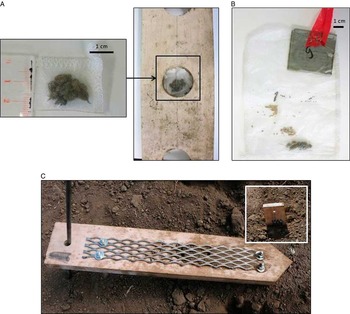
A) A single 2.5- by 2.5-cm seed container filled with 10 freshly harvested yellow nutsedge tubers. Several seed containers fit into one seed chamber. B) The seed bag assay involves a nylon bag with several chambers for seeds and an attached metal washer and ribbon for better detection when belowground. C) An assembled soil probe system with seed containers in seed chambers and expanded metal sheets attached with bolts on both sides. A metal rod is used to pull the soil probe out of the ground.

Seed containers are made of nylon (Delnet® DelStar Technologies Inc, Middletown, DE) and can hold a desired amount of seeds per filling (Figure 3). However, it is important that seed containers do not exceed the size of a single probe chamber (2 cm thick and 3.8 cm in diameter). After the seed containers are filled with seeds, they are sealed on each side with an impulse heat sealer (Packco Inc, Rocky Mount, MO).
The soil probe system is driven into the soil with a rubber mallet to avoid cracking or bending the probe. Removal of the soil probe system is performed using a steel rod inserted into a small hole near the top of the probe as a lever to lift each soil probe from the soil (Figures 1–3). The soil probe systems can be removed by pulling the steel rod with both hands.
Seed Bag Assay
The seed bag assay requires several seed bags made out of nylon. To facilitate the placement and recovery processes, steel washers and colored ribbons are attached to each seed bag (Figure 1). An impulse heat sealer is used to divide the seed bags into separate chambers for each of the weed species to be tested (Figure 3). Seed bags are introduced in the field at the desired depth with a handheld shovel and a measuring tape. Part of the attached ribbon is to be left on the surface for later identification and recovery of seed bags in the field. Ribbons with different colors can be used to indicate different depths, weed species, or treatments. For recovery, seed bags are detected either visually (ribbon) or with a metal detector (attached metal washer) and carefully extracted with a small shovel.
Study Design
The seed bag assay and soil probe system were compared side by side in 1) a microplot study and 2) a field study. The soil probe system was prepared as follows: In both studies, the upper (10 cm) and lower (30 cm) seed chambers were loaded with four seed containers each. Each seed container was filled either with 25 freshly harvested seeds of burning nettle, common purslane, or common knotweed, or with 10 tubers of yellow nutsedge (Figure 3). The seed bag assay was prepared as follows: In both studies, seed bags were filled either with 25 freshly harvested seeds of burning nettle, common purslane, or common knotweed, or with 10 tubers of yellow nutsedge (Figure 3). Seed bags were buried next to the soil probe system at 10-cm and 30-cm depths.
Microplot Study
Microplots were located at the US Department of Agriculture research station in Salinas, California, and each had a 1-m2 surface and was 1.8 m deep. Steam was applied at a pressure of 5 bar for 60 min (90 C soil temperature). Steam was applied through a shank placed in the middle of the microplot at a 15-cm depth with a diesel-powered steam generator (SF-20, Sioux Corp, Beresford, SD). Soil temperatures were recorded with HOBO data loggers (Onset Computer, Bourne, MA). Microplots were filled with a top soil:compost blend (50:50 by weight; Mc Shane’s Nursery, Salinas, CA). The microplots were covered with insulation mats for 24 h to allow heat trapping. Four replicates were installed for each treatment [steam or nontreated control (NTC)]. Four seed bags were installed, two at a 10-cm depth and two at a 30-cm depth. To compare the results of seed bag assays and soil probe systems, two soil probes were installed for each replicate, with seeds at the 10- and 30-cm depths. Seed bags and soil probes were located 7 cm from the steam injection point. The study was repeated twice. In a separate experiment, the time required to install and recover the soil probe system and the seed bag assay at 10, 20, and 30 cm was recorded repeatedly.
Field Study
The trial field was located at Salinas, CA, at the US Department of Agriculture research site (36°37′29.1′′N, 121°32′47.3′′W). The soil was a Chualar sandy loam (fine-loamy, mixed, superactive, thermic Typic Agrixerolls). Two treatments were established with four replicates each: NTC and a mixture of chlorpicrin and 1,3 dichlorpropene (59.6%:39% by volume; Pic-Clor 60) at 187 L ha−1. Beds were shaped on October 15, 2015, and Pic-Clor 60 was applied via drip tape on October 22, 2015. Two probes and four bags per replicate were installed after bed shaping on October 21, 2015, and recovered on November 6, 2015. Soil probes were loaded with two seed containers each at the 10- and 30-cm depths. Strawberry plants (Fragaria ×ananassa (Weston) Duchesne ex Rozier ‘Monterey’) were transplanted in beds on November 14, 2015.
Tetrazolium Assay
After recovery of the soil probe system and seed bag assays, all seeds of burning nettle, common purslane, and common knotweed were tested for viability using a tetrazolium assay, using the method described by Cottrell (Reference Cottrell1947) and Baalbaki et al. (Reference Baalbaki, Elias, Marcos-Filho and McDonald2009). A 0.1% (v/v) solution of 2,3,5-triphenyltetrazolium chloride (Sigma, St. Louis, MO) was used to stain the seeds from the recovered containers and probes. Seeds were plated on germination paper in petri dishes, cut in half, stained, and kept in the dark at 24 C for 24 h. The staining was examined to evaluate the viability of individual seeds under the microscope.
Germination Assay
After recovery of soil probes and seed bags, the germination of yellow nutsedge tubers was assessed via greenhouse assays. Tubers were placed in separate pots, filled with sand, and placed in a greenhouse (24 C, 14/10 h day/night cycle). After 4 wk, the number of sprouted tubers was counted.
Statistical Analysis
To detect possible differences between soil probe system and seed bag assay results, percentages of seed viability and yellow nutsedge tuber germination were analyzed using a multifactorial MANOVA (fixed effect model III; α=0.05). The three factors in the MANOVA were treatment, method, and depth. The treatment factor had two levels. In the microplot study, treatment had the levels NTC and steam. In the field study, treatment had the levels NTC and Pic-Clor 60. The method factor always consisted of two levels: soil probe system and seed bag assay. The depth factor always consisted of two levels: 10 cm and 30 cm. MANOVAs were conducted for each study and weed species separately. Tukey HSD post hoc tests (α=0.05) were performed to separate groups. Beforehand, each group was tested for normal distribution (Shapiro-Wilk, α=0.05). All statistics were performed with R 3.3.0 (https://www.r-project.org). Graphs were developed with SigmaPlot 13.0 (Systat Software Inc, San Jose, CA) and Adobe Illustrator CC 2017 (Adobe Systems Inc, San Jose, CA).
Results and Discussion
Development of the Soil Probe System
The design of the soil probe system is based on the minicontainer system introduced by Eisenbeis et al. (Reference Eisenbeis, Dogan, Hebier, Kerber, Lenz and Paulus1995, Reference Eisenbeis, Lenz, Dogan and Schuler1996, Reference Eisenbeis, Lenz and Heiber1999). The design of the minicontainer bar facilitates fast and accurate introduction and recovery of samples. However, most of the other design features of the minicontainer system do not suit the needs of an accurate evaluation of weed control efficacy in soil disinfestation trials. Minicontainers are manufactured to contain substrate, usually one selective for a certain group of soil organisms (Dunger et al. Reference Dunger, Schulz and Zimdars2002; Lehmitz et al. Reference Lehmitz, Russell, Hohberg, Christian and Xylander2012; Lenz and Eisenbeis Reference Lenz and Eisenbeis1998a, Reference Lenz and Eisenbeis1998b; Maerwitz et al. 2011; Sturm et al. Reference Sturm, Sturm and Eisenbeis2002; Wolfarth et al. Reference Wolfarth, Schrader, Oldenburg and Weinert2013, Reference Wolfarth, Wedekind, Schrader, Oldenburg and Brunotte2015). To accurately assess the effect of soil disinfestation on seed viability or germination, the seeds need to be in direct contact with the soil. Compared to the holes in the minicontainer bar, the diameter-to-depth ratio of the seed chambers was increased to achieve better contact between seeds and soil. The diameter-to-depth ratio of the seed chambers in the soil probe system is 3.8 cm to 2 cm (approximately 2:1). The hole for one minicontainer on the minicontainer bar has a diameter-to-depth ratio of 1.6 cm to 1.65 cm (approximately 1:1; Eisenbeis et al. Reference Eisenbeis, Lenz and Heiber1999). Seed containers provide only one layer of nylon as a physical barrier between seeds and soil. By using seed containers, the use of the more complex minicontainer could be avoided. To hold seed containers in place without having an additional physical barrier between soil and seed, expanded metal was used, which allowed soil to enter the seed chambers.
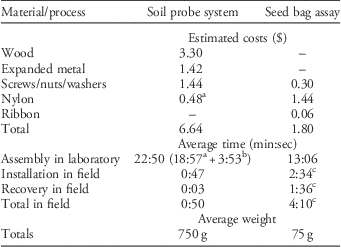
Finding a way to produce the soil probe system inexpensively was one aim of this study. The production of the minicontainer system would result in high manufacturing costs, mainly due to the need for precise polyvinylchloride and polyethylene drilling or 3-D printing techniques (Eisenbeis et al. Reference Eisenbeis, Lenz and Heiber1999). To reduce costs of the soil probe system, the use of seed containers instead of the minicontainers resulted in simpler production methods and lower costs. The cost of materials to produce one soil probe, with each of the three seed chambers filled with four seed containers, were estimated to be roughly $7.00. A set of three seed bags for a seed bag assay was estimated to be $1.80 (Table 1). However, the ability to use the soil probe system multiple times reduces long-term costs. The preparation of the soil probe system in the laboratory takes more time than the preparation of seed bag assays, but the in-field installation and recovery process of the soil probe system requires significantly less time than does the seed bag assay (Table 1). Different materials may be selected for the soil probe system depending on the length of time that it will be belowground; this decision will have an impact on the material costs. Whereas maple lumber might be useful for short times (days to weeks) belowground, more durable materials might be considered for long-term studies (such as seed burial studies).
Cost, time investment, and weight comparison between the soil probe system and the seed bag assay. Compared is a scenario in which seed survival at 10-, 20-, and 30-cm depths are assessed. Values for the seed bag assay are given as an average for three individual seed bags.

a Assembly of 12 seed containers (four per seed chamber).
b Assembly of one soil probe with four seed containers per seed chamber.
c Total amount of time for installation and recovery of a set of three seed bags, one at each depth: 10, 20, and 30 cm.
Microplot and Field Study
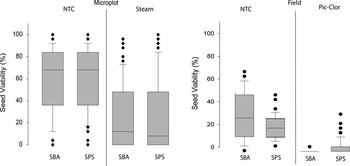
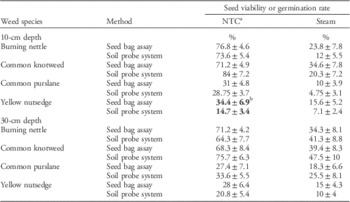
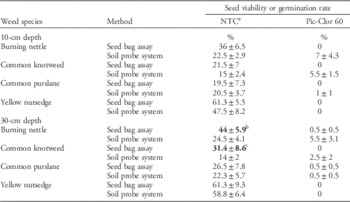
Questions remained as to whether or not the soil probe system is as reliable as the seed bag assay under field conditions. For this reason, two separate studies were conducted, one in microplots (1-m−2 area by 1.8-m depth) and one in a commercial strawberry field. In the microplot study, steam was used as soil the disinfestation treatment. Weed seed samples in the seed bag assay and soil probe system had similar levels of viability (Figure 4, Table 2). However, the germination of nutsedge tubers was lower when tubers were placed in the soil probe system of the NTC (Table 2). Similar differences were found for the viability of burning nettle seeds and common knotweed seeds in the NTC of the field study (Table 3). However, differences between the seed bag assay and the soil probe system in steam treatments and Pic-Clor 60 treatments were not significant (Figure 4, Tables 2 and 3).
Box and whisker plots showing seed viability of all tested seeds of three weed species (burning nettle, common purslane, and common knotweed). The horizontal line in the middle of each box indicates the median, while the top and bottom borders of the box mark the 75th and 25th percentiles, respectively. The whiskers above and below the box mark the minimum and maximum, and the dots represent the outliers. In the microplot study (left), samples derived from seed bag assays (SBA) and the soil probe system (SPS) yielded similar results after exposure to steam treatment or nontreated control (NTC) conditions. In the field study (right), samples derived from the seed bag assay and the soil probe system yielded similar results following Pic-Clor 60 treatment or nontreated control conditions. However, in nontreated samples, a tendency towards lower viability of seeds derived from the soil probe assay compared to the seed bag assay was observed. Also, a slight tendency towards higher seed viability was observed in the soil probe system for the Pic-Clor 60 treatment.

Influence of seed bag assay versus soil probe system on seed viability and tuber germination at 10- and 30-cm depths following steam soil disinfestation in a microplot study. Seed viability (%) of burning nettle, common knotweed, and common purslane, and tuber germination (%) of yellow nutsedge, are shown (Mean±SEM).

a Abbreviation: NTC, nontreated control.
b P=0.1 (Tukey’s HSD), indicates difference within weed species between seed bag assay and soil probe system.
Influence of seed bag assay versus soil probe system in a field study on seed viability and tuber germination at 10- and 30-cm depths following Pic-Clor 60 fumigation. Seed viability (%) of burning nettle, common knotweed, and common purslane, and tuber germination (%) of yellow nutsedge, are shown (Mean±SEM).

a Abbreviation: NTC, nontreated control.
b P=0.067 (Tukey’s HSD), indicates difference within weed species between seed bag assay and soil probe system.
c P=0.025 (Tukey’s HSD), indicates difference within weed species between seed bag assay and soil probe system.
Lower viability and germination rates were found in seeds or tubers placed in the soil probe system of the NTC only. This might be an indication of greater exposure of seeds to the natural soil environment within the soil probe compared to the seed bag assay. A few studies have compared bag assays with probe systems by assessing decomposition rates of litter between litter bags and the minicontainer system. Minicontainer systems seem to produce similar results to litter bags (Hagemann and Moroni Reference Hagemann and Moroni2015; Paulus et al. Reference Paulus, Roembke, Ruf and Beck1999), or might reflect natural processes more closely than do litter bags, due to the different amount of litter used in the different systems (Kula and Roembke Reference Kula and Reombke1998). A possible explanation for the observed differences between the soil probe system and the seed bag assay in the presented study, however, might be related to the considerably smaller size of the seed containers in the soil probe system. In the seed bag assay, a single bag might be more likely to fold over due to soil weight and consequently wrap layers of mesh around seeds. This could provide protection from microbial or chemical degradation. In the soil probe system however, there is little possibility for a seed container to wrap several layers of mesh around the seeds. Consequently, seeds would be less protected from outside conditions in the soil probe system than they would be in the seed bag assay. This would suggest that the soil probe system could be more sensitive to effects of chemical and biological processes on weed seed survival.
Due to the nature of the soil probe system, soil has to penetrate through the steel mesh to reach the seed containers. The soil used in this study easily filled the seed chambers of the soil probe system. However, this might be different in wet soils with high clay and lime contents. This subject would need further evaluation before suggesting the use of the soil probe system in such soils.
Soil disinfestation treatments with high vapor pressure, such as steam or Pic-Clor (21 mmHg at 20 C; Anonymous 2015) are assumed to have unobstructed dispersal through soil pores, increasing the possibility of active ingredients reaching the seeds inside the seed chambers of the soil probe system. However, fumigants such as allyl isothiocyanate have a relatively low vapor pressure (3.4 to 3.5 mmHg at 20 C; Sekiyama et al. Reference Sekiyama, Mizukami, Takada and Shoko1993) and low water solubility. This might lead to a low mobility belowground, and consequently less or no access of active chemical to pathogens and weed seeds in soil. Reports on the pest and weed control efficacy of allyl isothiocyanate are mixed (Fennimore et al. Reference Fennimore, Wilen, Hoffmann, Gerik, Martin, Koike, Westerdahl and Stanghellini2015, Reference Fennimore, Wilen, Hoffmann, Gerik, Marin and Stanghellini2016; Janis Reference Janis2016; Noling Reference Noling2016). The probability of seeds inside the soil probe system being exposed to active chemical would be considerably lower than it would be if the seeds were in directly in the soil. It is not recommended to use the soil probe system for applications of fumigants with low vapor pressure, unless further evaluation is conducted. However, in high vapor pressure soil disinfestation systems, using the soil probe system leads to results as reliable as does the use of the seed bag assay. The installation and recovery processes of the soil probe system are considerably faster than those of the seed bag assay (Table 1). Therefore, the soil probe system should be preferred to the field bag assay under hazardous field conditions.
Acknowledgments
We thank the US Department of Agriculture Methyl Bromide Transition Program 2015-07297 and the California Department of Pesticide Regulation for funding our investigations in California. We thank Jose Garcia for access to his field. We thank John Plemons for his help manufacturing the probe system, and Simon Coelho, Carly Coelho, Adrian Bravo, and Alicia Scholler for their help with the seed viability assays and the microplot study. We further thank John Rachuy and Julio Corona for their support in the field.