INTRODUCTION
Palliative sedation is a common treatment in our specialty. Its definition is a matter of active debate throughout the literature, though there has been a growing consensus in recent years. In its framework document, the European Association for Palliative Care (EAPC) defined it as “the controlled use of medicinal products intended to induce a state of decreased or absent awareness in order to relieve suffering that is untreatable in an ethically acceptable way for patients, families, and health professionals” (Cherny, Reference Cherny and Radbruch2009). In a joint document, the Spanish Palliative Care Society (SECPAL) and the Medical College (OMC) (OMC & SECPAL, 2011) emphasized the need for the presence of a refractory symptom for it to be employed.
The frequency, indications, and medications employed in palliative sedation, both with inpatients and home cohorts, have been reviewed in several studies (Mercadante et al., Reference Mercadante, Valle and Porzio2011 a,Reference Mercadante, Porzio and Valle b ; Bulli et al., Reference Bulli, Miccinesi and Biancalani2007; Rosengarten et al., Reference Rosengarten, Lamed and Zisling2009; Alonso-Babarro et al., Reference Alonso-Babarro, Varela-Cerdeira and Torres-Vigil2010; Mercadante et al., Reference Mercadante, Porzio and Valle2012). The frequency of sedation at home varies in these studies, possibly due to methodological differences. This variation is greater when in comparison to earlier studies (Ventafridda et al., Reference Ventafridda, Ripamonti and de Conno1991) and more recent ones (Alonso-Babarro et al., Reference Alonso-Babarro, Varela-Cerdeira and Torres-Vigil2010; Mercadante et al., Reference Mercadante, Porzio and Valle2012; Porzio et al., Reference Porzio, Aielli and Verna2010). The indications for palliative sedation are also cause for debate, especially in relation to anxiety or existential distress. The different legal frameworks throughout Europe are also a factor regarding the definition of a refractory symptom. There is a move toward consensus about the drugs used, as reflected in recent studies (Alonso-Babarro et al., Reference Alonso-Babarro, Varela-Cerdeira and Torres-Vigil2010; Mercadante et al., Reference Mercadante, Porzio and Valle2012), although doubts remain about the use of nonsedative opioids or neuroleptics (Mercadante et al., Reference Mercadante, Valle and Porzio2011 a,Reference Mercadante, Porzio and Valle b ). There is also growing agreement about the need for guidelines and protocols to aid in procedures and decision making (Alonso-Babarro et al., Reference Alonso-Babarro, Varela-Cerdeira and Torres-Vigil2010; Cherny. Reference Cherny and Radbruch2009).
The home environment is particularly difficult when it comes to research. There are very few studies that focus on this population, and even fewer in the area of palliative care (Mercadante et al., Reference Mercadante, Valle and Porzio2011 a,Reference Mercadante, Porzio and Valle b ). In addition, we believe that further work is needed on palliative sedation with a view to generating greater consensus on controversial ethical issues (e.g., the difference between euthanasia and palliative sedation, and the role of palliative sedation in psychological suffering) (Cherny, Reference Cherny and Radbruch2009; de Graeff et al., Reference de Graeff and Dean2007). Therefore, the goal of our present study was to assess our practice in palliative sedation and analyze its usage in a home cohort.
METHODS
We employed a retrospective cross-sectional descriptive approach. The area of study was the development of a home care program by the Hospital San Juan de Dios in Navarre. This hospital provides coverage within the National Health System for all patients in the region suffering from advanced cancer or amyotrophic lateral sclerosis (ALS). The study period was the year 2011.
The inclusion criteria were as follows: all patients over 18 years enrolled in the Palliative Home Care Program (PHCP) with a diagnosis of advanced oncological disease. We excluded minors and patients with ALS. We recorded how many of the patients died during that year who had received palliative sedation, whether at home or in hospital. Sociodemographic variables (sex and age) and clinical variables (primary tumor location and patient awareness of diagnosis and prognosis) were gathered from the clinical histories of the cohort of patients sedated at home. Regarding data about palliative sedation, we collected the following data: indications that led to patients receiving sedation; the drug(s) employed and the dosages applied on the last day of the patient's life as registered in the records; the presence or absence in the record of implicit or explicit consent from the patient as well as family members; the type of sedation (continuous or discontinuous); the days of survival from the beginning of sedation; the presence of rales, ulcers, or painful mouth; the use of hydration; and the opinions of family members and healthcare professionals about the suffering of the patient during sedation, whenever such opinions were registered in the medical history.
Statistical analysis was performed using SPSS version 19.0, presenting the results of sociodemographic variables, the percentage of sedated patients in both the home cohort and hospital, as well as the value of the arithmetic mean of all sedated patients. Permission to review the medical records was requested from the hospital's ethics committee. Informed consent was considered unnecessary since this was a retrospective analysis.
RESULTS
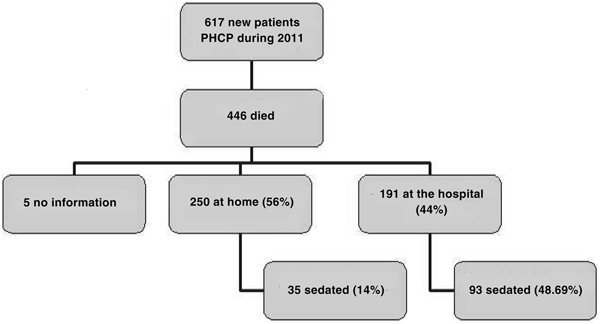
The PHCP treated a total of 617 new patients between January and December of 2011. During this period, 446 patients died, of whom 250 (56%) were cared for at home and 191 (44%) in hospital. There is no record of death-scene information in the medical records for the other five patients (see Figure 1).
Flowchart.

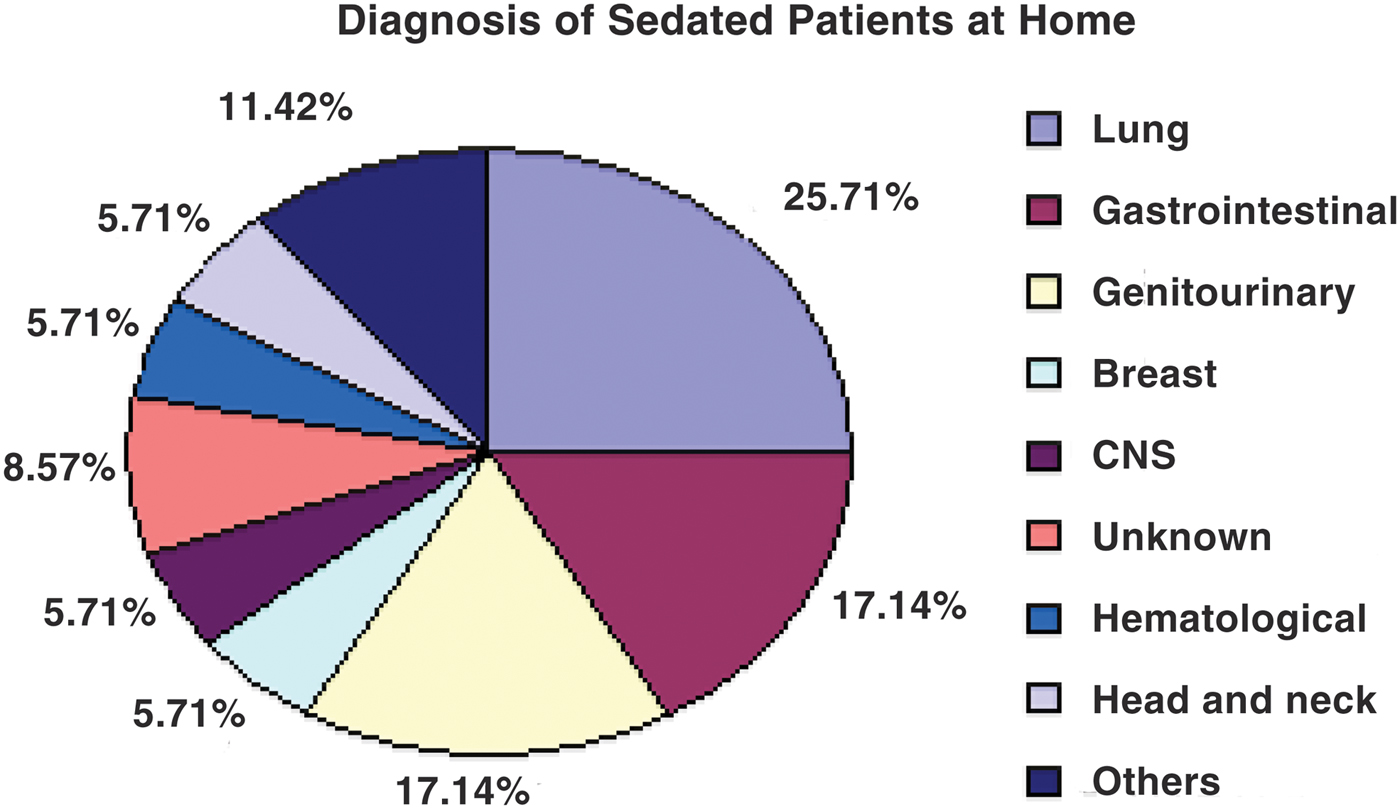
Of the patients who died at home, 35 required sedation (5% of all patients treated, 14% of those who died at home), compared to 93 patients who needed sedation among inpatients (15% of the total, 49% of those hospitalized). The average age of patients sedated at home was 70, of which 54% were male and 45% female. Lung cancer was the most common pathology among the group of patients receiving palliative sedation at home. Figure 2 depicts the percentage of the most prevalent types of tumor in these patients. Among the group of patients receiving palliative sedation at home, 77% were aware of their diagnosis, and 71% were aware of the prognosis.
(Color online) Percentage of the most prevalent tumor types.

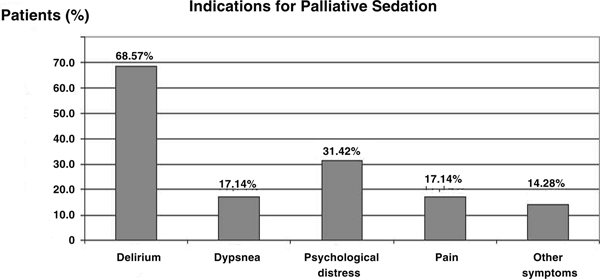
Figure 3 shows the data on the indications for palliative sedation. The most frequent indication was delirium (70%). The drugs most frequently employed were midazolam and levomepromazine, (average dose received in the last 24 hours of life = 40 and 70 mg, respectively) (Table 1). The average duration of palliative sedation (from the beginning of treatment to death) at home was about three days. Only one patient required discontinuous sedation. Some 57% of patients presented with rales, and around 3% suffered from pressure ulcers or painful mouth.
Data on indications for palliative sedation.

Drugs (mean dose needed on the last day of life)

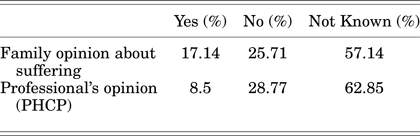
Once palliative sedation had begun, the family felt that the patient was suffering in 17% of cases, compared to 8.5% of PHCP staff. However, most of the records do not contain information with regard to this (Table 2). In about 30% of cases, patients were involved in the decision to initiate sedation, while the family was part of that decision 60% of the time.
Opinion about suffering of sedated patients

DISCUSSION
There is still little research reflecting the realities of palliative sedation, and even less in the home care setting. Therefore, we believe that studies such as ours are needed in order to increase the consensus among palliative care professionals.
The typical patient in our population was a 70 year-old man with lung cancer. This coincides with what most other authors have described (Mercadante et al., Reference Mercadante, Porzio and Valle2012), confirming the homogeneity of our sample compared to that in the literature. The prevalence of sedated patients in studies carried out in a domiciliary cohort ranges from 5 to 52.5% (Mercadante et al., Reference Mercadante, Valle and Porzio2011 a,Reference Mercadante, Porzio and Valle b ). Four of the seven studies in this area have a similar range (5–14.2%) (Bulli et al., Reference Bulli, Miccinesi and Biancalani2007; Rosengarten et al., Reference Rosengarten, Lamed and Zisling2009; Alonso-Babarro et al., Reference Alonso-Babarro, Varela-Cerdeira and Torres-Vigil2010; Mercadante et al., Reference Mercadante, Porzio and Valle2012), which is more suited to our data (5% of the total, 14% of those who died at home). This supports enhancing the role of palliative sedation as a last-line treatment, far from those pioneering works that obtained results of around 50% (Ventafridda et al., Reference Ventafridda, Ripamonti and de Conno1991). In a hospital environment, the literature shows numbers ranging from 3 to 51% (Vainio et al., Reference Vainio and Auvinen1996). This reflects the wide range of opinion in the field of palliative sedation. In this sense, the big difference observed in our study between the two areas (50 vs. 14%) also reaffirms the importance of patient selection. The population of our PHCP that required admittance to hospital presents more complexity. This could make it more vulnerable, and liable to receive sedation than those who die at home.
Management of information is a factor to consider when discussing palliative sedation. A recent study found that patients receiving palliative sedation at home were often better informed of their prognosis than those who did not (86 vs. 62%) (Alonso-Babarro et al., Reference Alonso-Babarro, Varela-Cerdeira and Torres-Vigil2010). In this regard, some authors (Fainsinger et al., Reference Fainsinger, Nuñez-Olarte and Demoissac2003) claimed cultural differences in relation to the pattern of coping with the disease, and with respect to the role of information. Coupled with the importance of receiving consent from the patient, this may be an aid in understanding the high rate of knowledge of diagnosis and prognosis in our sample (70–80%). This contrasts with other phases of the process, as shown elsewhere in the literature (Corli et al., Reference Corli, Apolone and Pizzuto2009; Yun et al., Reference Yun, Lee and Kim2011).
Regarding the indications that led to initiation of sedation, our data are in clear contrast with the literature, except for the aspects of psychological or existential distress. Delirium and dyspnea remain the main causes of refractory symptoms, as shown in our study and argued by many others (Alonso-Babarro et al., Reference Alonso-Babarro, Varela-Cerdeira and Torres-Vigil2010; Mercadante et al., Reference Mercadante, Porzio and Valle2012; Porzio et al., Reference Porzio, Aielli and Verna2010). However, so-called “existential suffering” in our population had a greater influence than in other studies in that environment (Alonso-Babarro et al., Reference Alonso-Babarro, Varela-Cerdeira and Torres-Vigil2010; Mercadante et al., Reference Mercadante, Porzio and Valle2012). In the recently published Palliative Sedation Guide, “panic and distress” were highlighted as possible indications for sedation (OMC & SECPAL 2011). Conversely, the EAPC framework document (Cherny, Reference Cherny and Radbruch2009) reinforced the idea that palliative sedation is a treatment initially triggered by physical symptoms coupled with psychological symptoms. However, that document suggests that there should be a long process of seeking other options, and that the treatment should never be used as first-line treatment in the form of continuous deep sedation. Some authors defend the validity of this indication (Morita, Reference Morita2004; Schuman-Olivier et al., Reference Schuman-Olivier, Brendel and Forstein2008) when including mental symptoms. They suggest that the patient should be the one to indicate when the degree of suffering is unbearable (de Graeff et al., Reference de Graeff and Dean2007). We also believe that the model based on support teams can influence this. Our PHCP is run by specific palliative care teams, which support primary care professionals. This implies that the responsibility for continued close monitoring of patients and families lies with them. The palliative care specialists have a supporting role, with a much lower frequency of visits. We believe this can create difficulties for indicating palliative sedation as the best option in a situation of existential distress.
End-of-life situations are highly emotional. At a time of agony, evaluation of symptoms and clarity in decision making are enormously difficult, and even more so if the information necessary to consider refractoriness requires coordination among all the professionals involved. We believe that this may explain the difference between our results and those of other teams that offered closer monitoring or needed less coordination with other professionals in decision making. In addition, the retrospective nature of our study adds another difficulty in collecting data on the indications for sedation, as these data are not always clearly recorded on medical records. We believe that this area requires further study, where all variables that may distort the results are carefully controlled.
The drug most frequently used in this treatment is midazolam (Alonso-Babarro et al., Reference Alonso-Babarro, Varela-Cerdeira and Torres-Vigil2010; Mercadante et al., Reference Mercadante, Porzio and Valle2012; Porzio et al., Reference Porzio, Aielli and Verna2010; Claessens et al., Reference Claessens, Menten and Schotsmants2008). The use of other agents involves some variability probably related to the age of the study (Ventafridda et al., Reference Ventafridda, Ripamonti and de Conno1991) or the lack of consensus on specific sedative drugs. This is the case, for example, with morphine and haloperidol (Bulli et al., Reference Bulli, Miccinesi and Biancalani2007; Rosengarten et al., Reference Rosengarten, Lamed and Zisling2009). Our data show that the practice of sedation is consistent with the current clinical practice guidelines, both national (OMC & SECPAL, 2001) and European (Cherny, Reference Cherny and Radbruch2009). These strongly recommend the use of sedatives (such as midazolam) or agents with more hypnotic effect (such as levomepromazine) within the group of neuroleptics. As to the doses employed, there are similarities with that recommended in earlier works (de Graeff et al., Reference de Graeff and Dean2007) and differences with other more recent studies (Alonso-Babarro et al., Reference Alonso-Babarro, Varela-Cerdeira and Torres-Vigil2010). Compared to the latter study, our population seemed to require a lower average dose, especially in the case of midazolam (40 vs. 74 mg). We believe this to be related to the retrospective nature of our study, which in some cases has hampered clear identification of the point where sedation began. We also believe that the latter may have led to an underestimation of the necessary dose. However, the average dose used for delirium (58 mg) is closer to ours. This further contextualizes our data, taking into account that 70% of our sample was sedated under this indication. In spite of this, our patients required far lower doses than those in other studies (Rosengarten et al., Reference Rosengarten, Lamed and Zisling2009). We believe that this is due to better management of specific sedative drugs by specialized palliative care teams. In our opinion, this may also explain the low incidence of skin ulcers or lesions in the oral cavity.
Regarding survival since induction, our data confirm the findings in the literature: around three days (Mercadante et al., Reference Mercadante, Valle and Porzio2011 a,Reference Mercadante, Porzio and Valle b ). This reflects the growing consensus on the definition of sedation as a treatment used in an end-of-life context. It also demonstrates the contrast with those studies that report lower survival rates (around 24 hr) (Mercadante et al., Reference Mercadante, Valle and Porzio2011 a,Reference Mercadante, Porzio and Valle b ), which place sedation within agony care.
As to patient suffering, several studies deal with families' doubts in this regard (Bruinsma et al., Reference Bruinsma, Rietjens and Seymour2012; Swart, Reference Swart, Brinkkemper and Rietjens2010). This contrasts with the main objective of palliative sedation, namely, to relieve suffering in patients with refractory symptoms. There are only a few studies that present the opinions of both the family and medical staff on this matter. Given the retrospective nature of our study, we rarely found this variable recorded in the records. In those cases where these data were collected, they reflect a consensus that treatment focused primarily on relief of suffering was effective in the opinion of the relatives and professionals. We think that this is related to the routine management of communication among palliative care professionals. This element has been highlighted as essential in relation to the perception of pain within the patient's environment (Bruera, Reference Bruera2012).
Our study has clear limitations, mainly related to its retrospective nature, as discussed above. In this sense, the quality of the records on sedation in medical histories—which occasionally made data collection difficult—is an area that needs improvement in our unit. This may cause some data to be overly weighted. Furthermore, the presence of a control group would have been useful to allow comparison with nonsedated patient survival, as presented in other studies (Alonso-Babarro et al., Reference Alonso-Babarro, Varela-Cerdeira and Torres-Vigil2010; Mercadante et al., Reference Mercadante, Porzio and Valle2012; Maltoni et al., Reference Maltoni, Scarpi and Rosati2012). We believe that knowledge of patients' functional status and the value of their baseline Edmonton Symptom Assessment System (ESAS) scores would have provided us with interesting information about what factors increase the probability of introduction of sedation. Moreover, the difficulty in accessing information on all inpatients prevented a true comparison between both samples.
We believe that our study confirms the role of palliative sedation as an appropriate therapeutic tool in a home setting. We found several aspects worthy of future in-depth research: (1) the indication of sedation, with special reference to anxiety or existential distress; (2) comparison between samples from different regional areas, and (3) the usefulness of certain tools in order to evaluate the effectiveness of sedation in relief of suffering for both patients and families. Further research employing a prospective methodology would also be most advantageous.
DISCLOSURES
The authors declare that there were no conflicts of interest.