INTRODUCTION
Sharks are widely recognized as important predators on some pinnipeds and small odontocete species (e.g. Lucas & Stobo, Reference Lucas and Stobo2000; Heithaus, Reference Heithaus2001a; Brown et al., Reference Brown, Lee, Bradley and Anderson2010), and increasing evidence suggests that they also are important in shaping behaviours, and possibly population dynamics, of small odontocetes and sirenians (e.g. Heithaus & Dill, Reference Heithaus and Dill2006; Wirsing et al., Reference Wirsing, Heithaus, Frid and Dill2008). Sharks are potential predators of porpoises and dolphins in many habitats around the world (e.g. Heithaus Reference Heithaus2001a, for a review). Likely regular predators of small cetaceans include white (Carcharodon carcharius), tiger (Galeocerdo cuvier), bull (Carcharhinus leucas), sixgill (Hexanchus griseus) and sevengill sharks (Notorynchus cepedianus) (e.g. Heithaus Reference Heithaus2001a). Although it is largely assumed that shark predation and predation risk are unimportant to large cetaceans (Naessig & Lanyon, Reference Naessig and Lanyon2004; Fitzpatrick et al., 2006), whales can make up large portions of the diets of some shark species. Indeed, it has been suggested that large white sharks are largely dependent on whale carcasses in some areas of their range (Carey et al., Reference Carey, Kanwisher, Brazier, Gabrielson, Casey and Pratt1982; Long & Jones, Reference Long, Jones, Klimley and Ainley1996; Dicken, Reference Dicken2008) and scavenging of cetacean carcasses may also be important to the diets of tiger sharks (e.g. Dudley et al., Reference Dudley, Anderson-Reade, Thompson and McMullen2000).
In general, there remain important gaps in our understanding of both the importance of cetaceans—both living and dead—to the diets of sharks and the potential importance of shark predation and predation risk to especially large cetaceans. Here, we investigate interactions between sharks and cetaceans in the Abrolhos Bank, eastern Brazil, including scavenging and the possibility for shark attacks on living humpback whales (Megaptera novaeangliae).
MATERIALS AND METHODS
The continental shelf of north-eastern and eastern Brazil is generally narrow (20 to 50 km in width), but the Abrolhos Bank (16°40′–19°40′S 39°10′–37°20′W) is one of the exceptions, where the shelf extends out to 220 km. This region features one of the richest fish fauna of Brazil, with nearly 300 species, and some of the most extensive coral reefs of the south-western Atlantic Ocean (Dutra et al., Reference Dutra, Allen, Werner and McKenna2006). The bottom consists of an extensive mosaic of algal bottoms and different coral reef formations (Moura & Francini-Filho, Reference Moura, Francini-Filho, Dutra, Allen, Werner and McKenna2006).
Abrolhos Bank is the most important breeding area of humpback whales in the south-western Atlantic (Andriolo et al., Reference Andriolo, Kinas, Engel, Martins and Rufino2010). Other cetaceans found throughout the bank include southern right whales (Eubalaena australis), dwarf minke whales (Balaenoptera acutorostrata), bottlenose dolphins (Tursiops truncatus), rough-toothed dolphins (Steno bredanensis) and Guiana dolphins (Sotalia guianensis) (Rossi-Santos et al., Reference Rossi-Santos, Wedekin and Sousa-Lima2006). Six additional species have been recorded in waters of the continental shelf and slope of the southern Abrolhos Bank: melon headed whale (Peponocephala electra), pantropical spotted dolphin (Stenella attenuata), spinner dolphin (Stenella longirostris), pygmy killer whale (Feresa attenuata), false killer whale (Pseudorca crassidens) and Risso's dolphin (Grampus griseus) (L. Wedekin, personal observation).
The humpback whales in Brazil are one of the seven populations in the Southern Hemisphere and are nominated Breeding Stock A (IWC, 1998). The breeding season spans from early July, reaching a peak around the end of August and beginning of September, until late November (Morete et al., Reference Morete, Bisi, Pace III and Rosso2008) when whales return to the feeding grounds near South Georgia and the South Sandwich Islands (Engel & Martin, Reference Engel and Martin2009). During the breeding season humpback whale carcasses are found adrift and ashore (e.g. Meirelles et al., Reference Meirelles, Monteiro-Neto, Martins, Costa, Barros and Alves2009; Pretto et al., Reference Pretto, Andrade, Oliveira and Oliveira2009) and represent potentially important sources of food for sharks.
Unfortunately, little is known about diets and behaviour of large coastal sharks in Brazilian waters. However, both tiger and bull sharks occur in these waters and are potential threats to cetaceans. While bull sharks likely are only a threat to odontocetes, and perhaps very young mysticete calves (e.g. Heithaus, Reference Heithaus2001a), tiger sharks grow to much larger sizes (>5 m: Randall, Reference Randall1992) and could pose a risk to a wider array of cetaceans. Adult tiger sharks are more common in warm waters (e.g. Bornatowski et al., Reference Bornatowski, Robert and Costa2007).
In order to determine the frequency of shark bites on cetaceans, both living and dead, we used carcasses discovered along the coast of the Abrolhos Bank between 2001 and 2010, and photographs of living cetaceans during systematic and opportunistic visual surveys from 2004 to 2009. For all stranded carcasses and carcasses found adrift that could be investigated (N = 221 individuals and N = 9 species), we recorded carcass location, species, total length and sex. Carcasses were also surveyed for shark bites, which were measured when possible and photographed. This resulted in 530 shark bites from 62 carcasses that were later analysed to determine the shark species responsible for the bite. It was often not possible to survey the entire body because of the difficulty in moving great whales and sometimes missing parts of the carcass, so estimates of the frequency of shark bites should be conservative.
Systematic research cruises were conducted mainly over the waters of the continental shelf, and occasionally the slope, at Abrolhos Bank. The boat followed haphazard or fixed routes, and whenever a group of cetaceans was detected, the boat left the route and approached the group. Photographs of the surfacing animals were taken in order to record the species and assist in photo-identification efforts (see Wedekin et al., Reference Wedekin, Neves, Marcondes, Baracho, Rossi-Santos, Engel and Simões-Lopes2010). We used these photographs of live cetaceans to estimate the frequency of shark predation attempts by both large sharks and ectoparasitic cookiecutter sharks (Isistius spp.).
The bite marks of cookiecutter (Isistius spp.) could be distinguished by diagnostic features detailed by Papastamatiou et al. (Reference Papastamatiou, Wetherbee, Sullivan, Goodmanlowe and Lowe2010). For large sharks, we could sometimes identify the species and estimate the total length of attacker using morphometrics presented by Lowry et al. (Reference Lowry, Castro, Mara, Whitenack, Delius, Burgess and Motta2009). Sharks from the genus Carcharhinus (e.g. Carcharhinus leucas and C. obscurus) have triangular-shaped teeth many of them pointed, the cutting edges of the teeth overlap, and they tend to make a clean, smoother cut. Tiger sharks have widely spaced and much broader teeth that are the same size in the upper and lower jaws and often produce slashing bites (Long & Jones, Reference Long, Jones, Klimley and Ainley1996; Heithaus, Reference Heithaus2001b). Estimates of attack frequencies on living cetaceans certainly are underestimates since only the dorsal and caudal regions were assessed and these regions often are not attacked by sharks as often as the ventral regions of cetaceans (e.g. Long & Jones, Reference Long, Jones, Klimley and Ainley1996; Heithaus, Reference Heithaus2001b).
Finally, we interviewed the local fishing community of Caravelas (State of Bahia), the port where most research cruises departed from, to gain anecdotal insights into the occurrence of sharks in the area. After an initial survey with 25 fishers, three key fishers, who target sharks, were interviewed using open questionnaires.
RESULTS
Scavenging
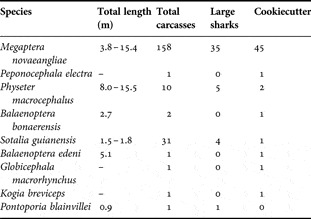
We analysed a total of 221 cetacean carcasses, of which 150 (67.8%) were humpback whales. The other 71 cetacean carcasses included Physeter macrocephalus, Sotalia guianensis, Balaenoptera edeni, B. bonaerensis, Peponocephala electra, Kogia breviceps, Pontoporia blainvillei and Globicephala macrorhynchus (Table 1). Bites from large sharks, which could have been inflicted either before or after death, occurred on 22.3% (35 of 150) of humpback whale carcasses, and 20.8% (10 of 48) of carcasses of other species (Table 1). Bites from cookiecutter sharks were observed on 28.5% (45 of 158) of humpback whale carcasses, and on 16.6% of other cetaceans. In many carcasses it was not possible to determine the causes of death because of the status of decomposition. In the cases in which we know the cause of death there were no clear cases where shark attack was responsible for the death or stranding of the whale.
Total number of carcasses with visible bites from large sharks and cookiecutter sharks.

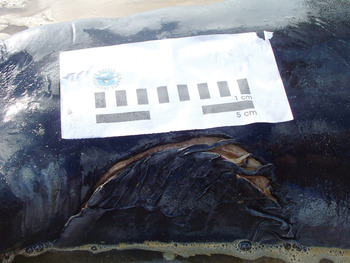
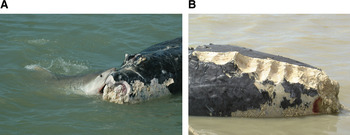
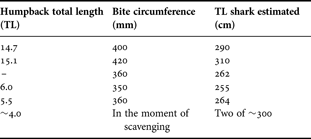
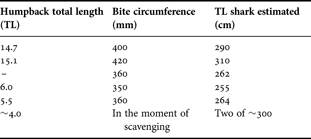
Tiger sharks could be identified as the species that had scavenged 19 of 35 (54.3%) humpback whales (see Figure 1 and Table 2). In addition, we observed tiger sharks consuming carcasses of humpback whale on two occasions (Figure 2A), which allowed examination of bites known to be inflicted by this species (Figure 2B). Other shark bites could not be conclusively identified to the species level and may have been from tiger sharks or other carcharhinids.
Tiger shark bite on a stranded calf humpback whale. Note the broad head and widely spaced tooth marks. Based on the size of the bite, the shark was approximately 265 cm total length.

(A) Tiger shark ~300 cm total length consuming a humpback whale calf's carcass; (B) humpback whale calf with several tiger shark bites.

Shark-size was estimated for six tiger sharks based on measurements of humpback whales carcasses (bite circumferences, and in the moment of scavenging). The estimate was calculated using the method proposed by Lowry et al. (Reference Lowry, Castro, Mara, Whitenack, Delius, Burgess and Motta2009).
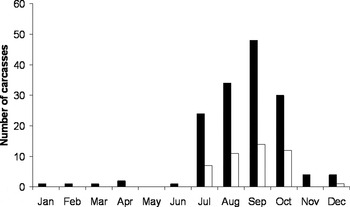
Although no shark bites were recorded between January and June, this appears to be due to the low availability of carcasses during this time. Indeed, there was no significant difference in the temporal patterns of carcass availability and number of carcasses with bites (i.e. the proportion of carcasses with bites did not vary among months; χ2 = 6.3, df = 10, P = 0.85, Figure 3).
Seasonality of humpback whale carcasses in eastern Brazil. Black bars indicate the total number of humpback whale carcasses, and white bars indicate the number of carcasses with large sharks wounds.

Shark attacks on living cetaceans
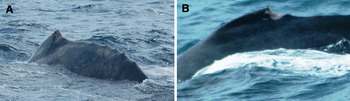
We observed bites from cookiecutter sharks (N = 106) on 42 of 865 (~4.9%) humpback whales that were photographed alive, 4 of 386 (1.0%) bottlenose dolphins, 2 of 5 pantropical spotted dolphins, and 1 of 28 melon headed whales. Of the 106 cookiecutter marks observed on humpback whales, 85 were healed, 15 were fresh and six were partially healed. Although certainly an underestimate of the total number of cookiecutter bites on an individual because only a portion of the body was photographed, we observed up to eight bites on a single individual, and 76% of whales had multiple bite marks (>2 bites). Bite marks from large sharks were observed on the dorsal fins of three (less than 1%) adult humpback whales. Two individuals (Figure 4A, B) had wounds with torn and severed skin and muscle at the edge of the wound, suggesting that attacks were recent. The third individual had tooth marks on its dorsal fin.
Fresh wounds in the dorsal fin of two different humpback whales in the Abrolhos Bank: (A) fresh wound in dorsal fin of an adult; (B) crescent-shape fresh wound of ~35 cm diameter, suggesting to be caused by a shark measuring approximately 250 cm total length.

DISCUSSION
Cetacean carcasses represent a large, energy-rich, food source for sharks. For example, a large white shark consuming 30 kg of blubber may subsist for up to 1.5 months without further feeding (Carey et al., 1982). In other areas of the world, tiger sharks congregate at seasonally available resources (e.g. Simpfendorfer et al., Reference Simpfendorfer, Goodreid and McAuley2001; Wirsing et al., Reference Wirsing, Heithaus and Dill2007). The abundance of whale carcasses available seasonally over Abrolhos Bank may, therefore, be an important component of shark diets seasonally and may attract large sharks. Interviews with local fishers revealed a general belief that shark abundances peak during the humpback whale breeding season. Using fixed longlines, fishers catch many large tiger and bull sharks between July and November. These longlines are anchored around coral reefs of Abrolhos Bank and are frequently baited with pieces of humpback whale blubber, which is said to be one of the best baits for catching sharks. Some fishermen in Abrolhos Bank anchored carcasses of humpback whale to attract sharks (M.C.C. Marcondes, personal observation). Historical accounts of the artisanal whaling operations off Caravelas during the 19th and early 20th Centuries suggest that whaling boats carrying harpooned whales were invariably followed by sharks (Lodi, Reference Lodi1992).
Shark predation attempts on cetaceans along the Brazilian coast have not been investigated in detail. During our study we observed one Guiana dolphin with bites from a relatively small shark and shark bites have been recorded on this species in coastal waters of southern (Santos & Gadig, Reference Santos and Gadig2009) and south-eastern Brazil (Bornatowski et al., unpublished data). At Fernando de Noronha Archipelago 55 of 418 spinner dolphins (Stenella longirostris) had shark-inflicted injuries that may have been caused by mako sharks (Isurus oxyrinchus) or carcharhinids (Silva et al., Reference Silva, Silva, Sazima and Sazima2007).
Shark predation attempts on large marine animals are rare, but recent studies suggest that they may occur more often than previously thought. For example, Fitzpatrick et al. (Reference Fitzpatrick, Meekan and Richards2006) observed a 5.5 m male whale shark (Rhincodon typus) without a part of its dorsal fin, and with tooth marks likely caused by a white or tiger shark. Humpback whales also appear to be at some risk from sharks. Although we only surveyed a small portion of whales’ bodies, we observed several large shark bites on adult humpback whales and a humpback whale calf stranded alive with several shark bite marks (S. Siciliano, personal communication).
Humpback calves have been killed by sharks in Australian waters (Paterson et al., Reference Paterson, Quayle and van Dyke1993) and Naessig & Lanyon (Reference Naessig and Lanyon2004) documented shark bites on four living humpback whales in eastern Australian waters. Mazzuca et al. (Reference Mazzuca, Atkinson and Nitta1998) registered shark attacks as a secondary cause of death of humpback whales in Hawaiian waters. The implications of what appear to be relatively infrequent attacks by sharks are unclear. Indeed, despite higher shark abundances in tropical waters Corkeron & Connor (Reference Corkeron and Connor1999) suggested mysticete breeding migrations may be driven by the need to avoid killer whale predation risk in high latitude waters. Shark attacks, however, can cause serious injuries affecting the locomotor capacity and ultimately lead to death in some cases (Naessig & Lanyon, Reference Naessig and Lanyon2004; Marshall & Bennett, Reference Marshall and Bennett2010). Further work is needed to better understand the frequency of shark attacks on mysticetes and potential costs of sublethal injuries.
Three species of squalioid sharks that are ‘ectoparasites’ of cetaceans, can be found in Brazilian waters (Souto et al., Reference Souto, Abrão-Oliveira, Nunes, Maia-Nogueira and Sampaio2007). However, the criteria for determining species identity established by Gasparini & Sazima (Reference Gasparini and Sazima1996), Cunha & Gonzalez (Reference Cunha and Gonzalez2000) and Souto et al. (2007) are divergent and do not allow adequate discrimination among species of the genus Isistius. Therefore, we did not attempt to distinguish the attacking species beyond Isistius spp. Our estimates of the proportion of humpback whales with bites from cookiecutter sharks (~5%) was certainly an underestimate of the proportion of whales that had been bitten since we only recorded bites from photographs of the dorsal flanks (and occasionally caudal regions) of whales. Still, with the exception of swordfish (Xiphias gladius; ~88%) and opah (Lampris guttatus; ~33%), humpback whales off Brazil have similar proportions of individuals with identifiable bites to fish surveyed from fish markets in Hawaii (Papastamatiou et al., 2010). Although an underestimate, 76% of humpback whales had multiple bites from cookiecutter sharks, which is more than any fish species recorded by Papastamatiou et al. (Reference Papastamatiou, Wetherbee, Sullivan, Goodmanlowe and Lowe2010) in Hawaii. Cookiecutter bite marks appear to be more common on deep-diving cetaceans (e.g. Evans et al., Reference Evans, Morrice, Hindell and Thiele2002; McSweeney et al., Reference McSweeney, Baird and Mahaffy2007), but not in shallower diving species, like humpback whale.
ACKNOWLEDGEMENTS
We thank Ariane Borges who helped with the analysis of photographs of live cetaceans; Thatiana Costa who interviewed the fishers; Adriana Colosio for trial of the data of strandings; Petroleo Brasileiro S.A (Petrobras) for sponsoring Projeto Baleia Jubarte; Veracel Celulose who provided financial support for the rescue and stranding programme; Dr Salvatore Siciliano for information about shark attack on a humpback whale calf; and all the people who contributed to fieldwork and data collection.