Temperament is defined as individual differences in behavioral and physiological arousal, as well as the processes involved in self-regulation (Rothbart, Ahadi, & Evans, Reference Rothbart, Ahadi and Evans2000). Temperament exhibits longitudinal stability across toddlerhood and childhood (Degnan et al., Reference Degnan, Hane, Henderson, Moas, Reeb-Sutherland and Fox2011; Dyson et al., Reference Dyson, Olino, Durbin, Goldsmith, Bufferd, Miller and Klein2015; Wolfe, Zhang, Kim-Spoon, & Bell, Reference Wolfe, Zhang, Kim-Spoon and Bell2014). Temperament is well established as an early marker for vulnerability to various behavioral and emotional problems (Eisenberg et al., Reference Eisenberg, Valiente, Spinrad, Cumberland, Liew, Reiser, Losoya and H2009; Nigg, Reference Nigg2006; Rothbart & Bates, Reference Rothbart, Bates, Damon, Lerner and Eisenberg2006). It is important to note, however, that the effect of temperament on later behavioral outcomes is moderated by a number of internal and external factors (e.g., parenting, physiological stress; Bates, Schermerhorn, & Petersen, Reference Bates, Schermerhorn, Petersen, Lewis and Rudolph2014). Individual characteristics, such as physiological profiles at rest or in response to a stimulus, may interact with temperament in the prediction of psychopathology. One important moderator that may affect the association between temperament and behavior problems is resting frontal EEG asymmetry (Gatzke-Kopp, Jetha, & Segalowitz, Reference Gatzke-Kopp, Jetha and Segalowitz2014; Peltola et al., Reference Peltola, Bakermans-Kranenburg, Alink, Huffmeijer, Biro and van IJzendoorn2014). Resting frontal EEG asymmetry is considered a trait physiological profile, whereas task-related frontal asymmetry is thought to reflect the capacity to respond or inhibit in a specific emotional context (Coan, Allen, & McKinght, Reference Coan, Allen and McKnight2006). Although resting frontal asymmetry and temperament are linked in many developmental studies (e.g., Fox, Henderson, Rubin, Calkins, & Schmidt, Reference Fox, Henderson, Rubin, Calkins and Schmidt2001; Howarth, Fettig, Curby, & Bell, Reference Howarth, Fettig, Curby and Bell2015), limited research has focused on the function of resting frontal asymmetry in the study of temperament and later behavioral problems. Therefore, the goal of the current study is to examine resting frontal asymmetry as a moderator of the effect of negative temperament on behavioral problems.
Different theoretical models have been proposed to guide research on relationships between temperament and psychopathology (e.g., vulnerability model, resilience model). Having a specific negative temperament may predispose to certain types of psychopathology, especially when other vulnerability factors are present (Nigg, Reference Nigg2006). Two broad reactive dimensions of temperament that are especially involved in the development of behavioral and emotional problems are withdrawal-related characteristics (i.e., shyness/fear) and approach-related dispositions (i.e., impulsivity/anger), which predict internalizing problems and externalizing problems, respectively.
Shyness and fear reliably predict children's internalizing problems. For example, shyness from toddlerhood through early childhood is predictive of social anxiety at 5th to 6th grade (Brumariu & Kerns, Reference Brumariu and Kerns2013) as well as later loneliness, depression, and other teacher-rated internalizing problems (Chen, Yang, & Wang, Reference Chen, Yang and Wang2013). Fear during preadolescence is associated with internalizing problems measured 2 years later (Oldehinkel, Hartman, De Winter, Veenstra, & Ormel, Reference Oldehinkel, Hartman, Winter, Veenstra and Ormel2004). Shyness and fear might share some genetic similarities with depression and anxiety (Leve, Kim, & Pears, Reference Leve, Kim and Pears2005), so shyness and fear are sometimes combined into one temperament dimension in the study of internalizing problems (Leve et al., Reference Leve, Kim and Pears2005). Termed “fearful inhibition” (Liu, Calkins, & Bell, Reference Liu, Calkins and Bell2018), this temperament characteristic is defined as wariness or anxiety in the presence or anticipation of physically threatening stimuli, social novelty, and perceived social evaluation. It involves distress or unease that is elicited by both nonsocial (i.e., darkness) and social stimuli (i.e., the approach of a stranger), which respectively correspond to fear and shyness (Buss, Reference Buss and Schwarzer1985; Putnam, Gartstein, & Rothbart, Reference Putnam, Gartstein and Rothbart2006). Children with fearful inhibition tend to be inflexibly overcontrolled and hesitant when approaching new environments, which can explain their higher risk for developing internalizing problems (Eisenberg et al., Reference Eisenberg, Valiente, Spinrad, Cumberland, Liew, Reiser, Losoya and H2009).
Impulsivity and anger are robust predictors of externalizing problems among children and adolescents (Eisenberg et al., Reference Eisenberg, Valiente, Spinrad, Cumberland, Liew, Reiser, Losoya and H2009; Wang, Eisenberg, Valiente, & Spinrad, Reference Wang, Eisenberg, Valiente and Spinrad2016). Impulsivity is often operationalized as a quick and unplanned initiation of responses to stimuli without thinking (Rothbart, Ahadi, Hershey, & Fisher, Reference Rothbart, Ahadi, Hershey and Fisher2001). Associations between trait impulsivity and externalizing problems among young adolescents have been reported (Jiménez-Barbero, Ruiz-Hernández, Llor-Esteban, & Waschgler, Reference Jiménez-Barbero, Ruiz-Hernández, Llor-Esteban and Waschgler2016). Developmentally, childhood impulsive symptoms significantly predict multiple externalizing behaviors during adolescence and early adulthood (Ahmad & Hinshaw, Reference Ahmad and Hinshaw2017). Anger typically refers to the amount of frustration or hostile affect related to undesired interruptions or goal blocking (Rothbart et al., Reference Rothbart, Ahadi, Hershey and Fisher2001). Dysregulated anger predicts externalizing problems concurrently (Rydell, Berlin, & Bohlin, Reference Rydell, Berlin and Bohlin2003; Morris, Silk, Steinberg, Terranova, & Kirthakye, Reference Morris, Silk, Steinberg, Terranova and Kithakye2010) and 2 years later for school-aged children (Morris et al., Reference Morris, Silk, Steinberg, Terranova and Kithakye2010). Given that the same approach motivation underlies the two temperamental dispositions (Harmon-Jones, Gable, & Peterson, Reference Harmon-Jones, Gable and Peterson2010), impulsivity and anger are sometimes merged into an impulsivity-anger trait (Joyce, McHugh, Light, Rowe, Miller, & Kennedy, Reference Joyce, McHugh, Light, Rowe, Miller and Kennedy2009). Children with high impulsivity-anger tend to be driven by their desires in an uncontrolled and thoughtless way and show a larger amount of hostile affect in undesirable situations. Therefore, they are prone to greater risks of externalizing problems (Eisenberg et al., Reference Eisenberg, Valiente, Spinrad, Cumberland, Liew, Reiser, Losoya and H2009).
It is of importance, however, that negative temperament does not unvaryingly lead to behavioral problems. For example, in an intensive study of shyness and anxiety, only 42% of children rated as shy on six or more measures over eight different occasions from infancy to adolescence (4 months to 13 years old) had anxiety problems in early adolescence (Prior, Smart, Sanson, & Oberklaid, Reference Prior, Smart, Sanson and Oberklaid2000). Consistent with the developmental psychopathology perspective, individuals who share characteristics at a specified initial point will not consistently develop the same later outcomes (Cicchetti & Toth, Reference Cicchetti and Toth2009). Having a biological motivation for approach or withdrawal may change the risk of behavioral problems by decreasing or increasing the initial reactivity (Degnan & Fox, Reference Degnan and Fox2007). For example, a child may exhibit high anxiety and worry when entering into a new environment or meeting new people; however, having motivation to approach may overcome such initial anxiety by facilitating social interaction. Tending to withdraw, though, may limit the opportunity to explore and practice, thus maintaining negative affect (Degnan & Fox, Reference Degnan and Fox2007). It is important to note that less attention has been focused on the role of motivational systems in child socioemotional development and regulation ability than on the influence of environmental factors on regulation (e.g., Coplan, Arbeau, & Armer, Reference Coplan, Arbeau and Armer2008; Karreman, de Haas, van Tuijl, van Aken, & Deković, Reference Karreman, de Haas, van Tuijl, van Aken and Deković2010; Rothbart & Bates, Reference Rothbart, Bates, Damon, Lerner and Eisenberg2006; Valiente et al., Reference Valiente, Eisenberg, Smith, Reiser, Fabes, Losoya and Murphy2003).
As an important biomarker of motivational bias (Harmon-Jones & Gable, Reference Harmon-Jones and Gable2018), frontal EEG asymmetry (FA) may amplify or mitigate the predisposition or vulnerability of certain temperamental characteristics. Frontal EEG asymmetry refers to the asymmetrical frontal brain electrical activity of the two hemispheres, which is typically indicated by the mathematical difference in EEG alpha power between the hemispheres (Reznik & Allen, Reference Reznik and Allen2018). The value for EEG power reflects the excitability of clusters of neurons (Bell & Cuevas, Reference Bell and Cuevas2012), with the alpha rhythm being the dominant rhythm observed in awake individuals of all ages (Marshall, Bar-Haim, & Fox, Reference Marshall, Bar-Haim and Fox2002). It has been suggested that an increase in EEG alpha power exerts inhibition effects on cortical activity because higher alpha power is exhibited when eyes are closed than when they are open (Bazanova & Vernon, Reference Bazanova and Vernon2014). There are reciprocal metabolic connections between the prefrontal cortex and the amygdala. Human brain imaging and animal lesion research suggests that these metabolic processes are the mechanism linking FA with emotion and motivation-related behaviors (Davidson, Reference Davidson2001).
Frontal EEG asymmetry may be best interpreted from the motivational direction model (Harmon-Jones & Gable, Reference Harmon-Jones and Gable2018). According to the model, left and right FA are respectively associated with approach and withdrawal motivation, supported by the evidence from research on the behavioral activation system (BAS) and behavioral inhibition system (BIS; Gray, Reference Gray1987). According to Gray's (Reference Gray1987) original theory of motivation, the BAS is sensitive to rewards and omissions of punishment. It helps individuals to pursue both positive and negative reinforcement. The BIS is sensitive to punishment, novelty, and innate fear stimuli, and it inhibits behaviors and increases physiological arousal and attention toward aversive stimuli. Of note, the literature to date is not clear regarding the mapping of BAS/BIS onto the approach/withdrawal system and FA. More updated reviews of Gray's original model (Corr & McNaughton, Reference Corr and McNaughton2012; McNaughton & Corr, Reference McNaughton and Corr2004) have proposed a third system that is responsible for the fear-related activation of fight/freezing/flight tendencies: a fight/freezing/flight system (FFFS). The BAS and FFFS are primary systems generating approach and avoidance, respectively. The BIS is thought to be activated by the concurrent activation of the BAS and FFFS systems, but it can also be activated from approach-approach or avoidance-avoidance conflicts. The BIS functions to inhibit ongoing behaviors to permit the resolution of the general conflicts.
The role of resting FA has been demonstrated as a moderator between negative temperament, emotional arousal, and psychopathology (see Reznik & Allen, Reference Reznik and Allen2018, for a review). For example, negative emotionality at 9 months predicts social wariness at 4 years only for infants with right resting FA (Henderson, Fox, & Rubin, Reference Henderson, Fox and Rubin2001). Moreover, temperamental exuberance at 36 months predicts externalizing problems at 5 years old when children have greater left resting FA (Degnan et al., Reference Degnan, Hane, Henderson, Moas, Reeb-Sutherland and Fox2011). In addition, high anger-prone infants show significantly more approach behaviors and less inhibitory control at 4 years of age when they had greater left resting FA at 9 months (He et al., Reference He, Degnan, McDermott, Henderson, Hane, Xu and Fox2010). Moreover, a cross-sectional study reported that resting FA moderates the association between electrodermal reactivity to a sad film and psychopathology in kindergarten children (M = 6.03 years). Specifically, increased arousal in response to the sad clip was associated with greater externalizing problems among children who showed left resting FA, and greater internalizing problems among children with right resting FA (Gatzke-Kopp et al., Reference Gatzke-Kopp, Jetha and Segalowitz2014). These findings are consistent with the motivational direction model showing that the association between fearful inhibition and internalizing problems is stronger when children have greater right FA; impulsivity-anger exerts a larger effect on externalizing problems when children exhibit greater left FA.
It is worth noting that FA shows low to moderate stability during toddlerhood and childhood (e.g., 3 to 9 years: 0.00 < r < 0.48 in eyes-open condition; 0.19 < r < 0.45 in eyes-closed condition; Howarth, Fettig, Curby, & Bell, Reference Howarth, Fettig, Curby and Bell2015; Smith & Bell, Reference Smith and Bell2010; Vuga, Fox, Cohn, Kovacs, & George, Reference Vuga, Fox, Cohn, Kovacs and George2008). We could find only one study (Poole, Santesso, Van Lieshout, & Schmidt, Reference Poole, Santesso, Van Lieshout and Schmidt2018) in which children's resting FA showed a stable right or stable left pattern across early school years. Of note, the sample size in the Poole study was small (n = 37). The relative moderate stability of resting FA may be caused by continuing structural and functional brain development across childhood years (Romine & Reynolds, Reference Romine and Reynolds2005). Therefore, the degree or even the direction of any potential moderating effect of FA on behavioral problems may be different at different developmental stages. Middle and late childhood is an important stage of children's socioemotional development that is characterized by rapid maturation of the prefrontal cortex (Diamond, Reference Diamond, Stuss and Knight2002) and important developmental transitions (e.g., children begin formal schooling and thus begin to interact with larger groups of people). Thus, examining FA during this period is of great significance as it improves our understanding of the nature and continuity of FA with respect to psychopathology and provides insight into screening and intervention at this age. We measured temperament and FA at age 6, which allowed us to take a longitudinal perspective to explore the complex interactive effects between different aspects of temperament and FA in the prediction of behavioral problems across a 3-year span.
Moreover, to the best of our knowledge, no studies have yet incorporated internalizing problems and externalizing problems into one study for the purpose of examining the moderating effect of resting FA between specific dimensions of temperament and behavioral problems during middle and late childhood. The comorbidity of internalizing and externalizing problems is prevalent in children (Lilienfeld et al., Reference Lilienfeld2003; Oland & Shaw, Reference Oland and Shaw2005). By including internalizing and externalizing problems in a single model, we can address their potential correlation, test the specificity of their relationships with temperament, and provide insight into how FA affects the risk of both types of behavioral problems with the presence of specific dimensions of temperament. We propose that having a specific type of temperament may be more or less risky depending on children's FA. Thus, it is important to test the potentially distinctive functional role of FA combined with different individual risk factors in predicting behavioral problems.
In view of the existing findings of associations between temperament and psychopathology (e.g., Leve et al., Reference Leve, Kim and Pears2005), we predicted that fearful inhibition and impulsivity-anger at age 6 would respectively predict internalizing problems and externalizing problems at age 9. In addition, we predicted that resting FA would moderate the associations between temperament and behavioral problems. Specifically, we hypothesized that fearful inhibition would predict internalizing problems when children showed greater right resting FA. Impulsivity-anger would predict externalizing problems when children showed greater left resting FA. In addition, because gender, maternal education, and maternal employment are correlated with children's socioemotional development (e.g., Hinnant & El-Sheikh, Reference Hinnant and El-Sheikh2013; Nomaguchi, Reference Nomaguchi2006; Pogarsky, Thornberry, & Lizotte, Reference Pogarsky, Thornberry and Lizotte2006), we included them as covariates in the analyses.
Method
Participants
Children and their mothers visited the lab when children were 6 and 9 years of age. The children represent two cohorts, or approximately 75%, of the participants of a larger longitudinal study examining cognition-emotion links across early development; the remaining 25% of the participants in the larger study represented a third cohort who did not have a research visit at age 6. The cohorts were broadly recruited by two research locations (Blacksburg, VA, and Greensboro, NC) when the children were infants by using mailing lists, media advertisements, flyers, and word of mouth. The Blacksburg research location and the Greensboro research location each recruited half of the participants in the longitudinal study. The recruitment criteria for infants were full gestation, typical birth weight, and having no prenatal or birth complications. At 6 years of age, 242 children from the two cohorts came to the lab and participated in the EEG study. There was the potential for 352 children to participate at age 6, based on the number of children who contributed data at the previous assessments in the longitudinal study (n = 304) and the number of children newly recruited to join the ongoing longitudinal study at age 6 (n = 48). The recruitment criterion for newly recruited participants at age 6 was no developmental delay diagnosis. Of the 352 potential participants, there were 72 children who did not participate in the study at age 6 and 38 children who participated at age 6 via parent-report questionnaires rather than the lab visit, yielding 242 children with a research lab visit at age 6. Among the 242 children, two were excluded for refusing to wear the EEG cap. Participants with less than 25 s of artifact-free baseline EEG data were excluded (n = 42). Twelve were excluded from analyses due to a later-diagnosed developmental delay or prematurity and low birth weight that we failed to screen out during infant recruitment. As a result, 186 children (93 boys, 93 girls) contributed to the data analysis. At age 9, 154 of the children had parents who completed the behavioral problems measure. Missing values from the measures of 186 children were estimated using full information maximum likelihood.
Among the 186 children who contributed data, 81.2% were Caucasian, 11.8% were African American, 0.5% were Asian, and 6.5% were multiracial/other, representing the combined demographics of the two geographic regions from which the sample was recruited. Regarding maternal education level, 2.7% of the mothers did not finish high school, 5.4% of the mothers had graduated from high school, 22% had technical degrees, 40.9% had college degrees, 29% had postgraduate degrees, 73.1% of the mothers were employed, and the remaining 26.9% did not have a job.
Procedure
Data were collected at both research locations using identical protocols. Research assistants from each location were trained together by the project's principal investigator (final author) on protocol administration as well as on data collection and psychophysiological coding. To ensure that identical protocol administration was maintained between the labs, the Blacksburg lab periodically viewed video recordings and raw EEG files collected by the Greensboro lab. To ensure that identical EEG processing criteria were maintained between labs, the Blacksburg lab provided verification of artifact screening of processed EEG data collected by the Greensboro lab.
Upon arriving at the lab for the age 6 and age 9 visits, children and mothers were greeted and consent forms explained and signed. Each visit began with EEG electrode placement. In this report, baseline EEG data collected at age 6 was used to calculate FA. Baseline EEG was recorded for 1 min while children quietly sat with eyes opened. Children then completed various cognitive and emotion tasks not included in this report.
Mothers sat in an adjoining room and completed questionnaires. We used maternal-report temperament data from the age 6 visit and maternal-report behavior problems data from the age-9 visit in our analyses. Mothers and children received remuneration for the visits ($50 and $10 gift certificates, respectively, at the age-6 visit and $75 and $20 gift certificates, respectively, at the age-9 visit). Children also received a small gift at each visit.
Measures
Fearful inhibition and impulsivity-anger at age 6
The Children's Behavior Questionnaire (CBQ; Rothbart et al., Reference Rothbart, Ahadi, Hershey and Fisher2001) is a well-known parent report to assess children's temperament for ages 3–7 years. At the age-6 visit, mothers responded on a 7-point Likert-type scale ranging from 1 (“extremely untrue of your child”) to 7 (“extremely true of your child”). Four scales in the CBQ were used: shyness (6 items; “Seems to be at ease with almost any person”), fear (6 items; “Is not afraid of the dark”), impulsivity (6 items; “Usually rushes into an activity without thinking about it”), and anger (6 items; “Has temper tantrums when s/he doesn't get what s/he wants”). The scores of shyness and fear (r = .20, p < .01) were averaged and standardized to form a composite score for fearful inhibition, with greater scores indicating a higher level of fearful inhibition. The scores of impulsivity and anger (r = .35, p < .01) were averaged and standardized to form a composite score for the impulsivity-anger trait, with greater scores indicating a higher level of impulsivity-anger. In the current study, Cronbach α of four subscales were acceptable (α = .65–.86).
Frontal EEG asymmetry at age 6
The EEGs were recorded from 16 left and right scalp sites: frontal pole (Fp1, Fp2), medial frontal (F3, F4), lateral frontal (F7, F8), central (C3, C4), temporal (T7,T8), medial parietal (P3, P4), lateral parietal (P7, P8), and occipital (O1, O2), all referenced to the vertex electrode during the recordings. The process was conducted by using a stretch cap (Electro-Cap Inc., Eaton, OH; E-1 series cap) with electrodes positioned in the International 10–20 system. After the cap was placed on the head, a small amount of abrasive gel was inserted into each recording site and the scalp gently rubbed. Then, a small amount of conductive gel was placed into each site. Electrode impedances were measured and accepted if they were below 10 KΩ.
The electrical activity from each electrode was amplified by using separate James Long Company Bioamps (James Long Company, Caroga Lake, NY). During data collection, the high pass filter was a single pole RC filter with a 0.1 Hz cutoff (3 dB or half-power point) and 6 dB per octave roll-off. The low pass filter was a two-pole Butterworth type with a 100 Hz cutoff (3 dB or half-power point) and 12 dB octave roll-off. Activity for each lead was displayed on the monitor of an acquisition computer. The EEG was digitized on line at 512 samples per second for each channel to eliminate the effects of aliasing. The acquisition software was Snapshot-Snapstream (HEM Data Corp., Southfield, MI), and the raw data were stored for later analyses. Prior to the recording of each subject, a 10-Hz, 50 uV peak-to-peak sine wave was input through each amplifier. This calibration signal was digitized for 30 s and stored for subsequent analysis.
Spectral analysis of the calibration signal and computation of power at the 9 to 11 Hz frequency band was accomplished. These power figures were used to calibrate the power derived from the subsequent spectral analysis of the EEG. Next, the EEG data were examined and analyzed using the EEG analysis software that was developed by the James Long Company. The data were rereferenced via software to an average reference configuration. This rereferencing eliminates concerns that power values at each active site reflect interelectrode distance as much as they reflect electrical potential (Bell & Cuevas, Reference Bell and Cuevas2012).
The average reference EEG data were artifact-scored for eye movements by using electrodes Fp1 and Fp2 to examine peak-to-peak criterion of 100 μV or greater (Myslobodsky et al., Reference Myslobodsky, Coppola, Bar-Ziv, Karson, Daniel, van Praag and Weinberger1989). The EEG data also were artifact-scored for gross motor movements by using a peak-to-peak criterion of 200 μV or greater. Only artifact-free data were used in subsequent analyses. The data were then analyzed with a discrete Fourier transformation, using a Hanning window of 1-s width and 50% overlap. The measure for EEG power was expressed as mean square microvolts, and the data were transformed by using the natural log (ln) to normalize the distribution.
Power was computed for the 8–10 Hz alpha frequency band. According to research examining EEG power distribution across early development (Marshall et al., Reference Marshall, Bar-Haim and Fox2002), alpha corresponds to 6–9 Hz in 4-year-old children. The alpha band is typically shifted by 1–2 Hz from preschool children to school-age children (Niedermeyer, Reference Niedermeyer, Niedermeyer and da Silva1999). Therefore, alpha likely corresponds to 8–10 Hz in 6-year-old children. This frequency band has been used in FA research with children in the middle and late childhood age range (Forbes et al., Reference Forbes, Shaw, Fox, Cohn, Silk and Kovacs2005; Vuga et al., Reference Vuga, Fox, Cohn, Kovacs and George2008). We focused on FA using electrode locations F3 and F4, which have been consistently associated with emotion, motivation, and behavioral problems (Reznik & Allen, Reference Reznik and Allen2018). The value for FA was calculated by subtracting the natural log-transformed power at the left hemisphere (F3) from the natural log-transformed power at the right hemisphere (F4). Because cortical activity is inversely related to alpha power (Reznik & Allen, Reference Reznik and Allen2018), left FA is indicated by positive EEG asymmetry values, which means greater left relative to right brain activation. Right FA is indicated by negative EEG asymmetry values, which means a greater right to left brain activation.
Internalizing and externalizing problems at age 9
The Child Behavior Checklist (CBCL; Achenbach, Reference Achenbach1991) is a 118-item parent report commonly used to examine child's specific behavioral and emotional problems. Each item is rated on a 3-point Likert-type scale ranging from 0 = not true to 2 = very/often true. Mothers completed the CBCL at the age-9 visit. In our study the primary interest was in Internalizing Problems (anxious/depressed, withdrawn/depressed, and somatic complaints) and Externalizing Problems (rule-breaking behavior and aggressive behavior), which are reported as T scores. Cronbach αs for Internalizing Problems and Externalizing Problems were .79 and .87, respectively.
Statistical Analysis Strategy
Bivariate correlations were computed to examine the associations between different variables. We tested for a moderation model including negative temperament, FA, and behavioral problems with Mplus (Version 8; Muthén & Muthén Reference Muthén and Muthén1998–2017) using maximum likelihood parameter estimates with standard errors robust to nonnormality. To evaluate the overall goodness of fit of the model, we reported chi-square goodness-of-fit statistics, degrees of freedom (df), corresponding p value, comparative fit index (CFI), room mean square error of approximation (RMSEA), and standardized root mean square residual (SRMR; McDonald & Ho, Reference McDonald and Ho2002). Hu and Bentler (Reference Hu and Bentler1999) suggested that for continuous variables, CFI > .95, RMSEA < .06, and SRMR < .08 are indicative of a good model fit. Path coefficients of the interaction terms (i.e., FA × Fearful Inhibition, FA × Impulsivity-Anger) were used to examine moderation effects. Significant interactions (p ≤ .05) were probed by using the Johnson–Neyman technique in Mplus (Version 8; Muthén & Muthén Reference Muthén and Muthén1998–2017). The Johnson–Neyman technique was used to plot the region of significance, indicating the range of FA values for which the effect of negative temperament on behavioral problems was significant (i.e., the 95% confidence intervals did not include zero; Bauer & Curran, Reference Bauer and Curran2005; Johnson & Neyman, Reference Johnson and Neyman1936).
Results
Preliminary Analysis
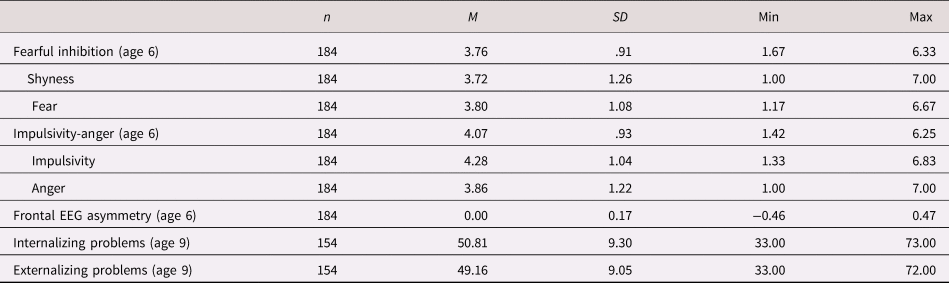
Outliers of FA were handled through Winsorization such that scores that were beyond ± 3 SD of the mean were replaced by the next closest FA score. This technique was applied to one outlier of FA. Descriptive statistics for all variables are shown in Table 1. Bivariate correlations are presented in Table 2. There was significant bivariate association between impulsivity-anger and externalizing problems, and the correlation between fearful inhibition and internalizing problems approached significance. Frontal EEG asymmetry at 6 years was positively associated with internalizing problems but not externalizing problems at 9 years. Internalizing problems and externalizing problems were significantly correlated.
Descriptive statistics

Note: N = 186; Fearful inhibition and impulsivity-anger were scores before standardizing. FA scores were Winsorized.
Bivariate correlations among variables

Note: N = 186; *p < .05.
Moderation Analysis
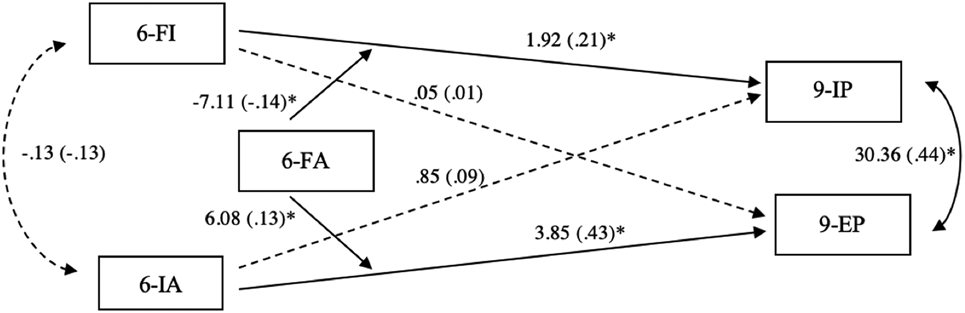
The model provided good fit, χ2 = .1.82, df = 2, p = .40, CFI = 1.00, RMSEA = .00, SRMR = .02. Controlling for gender (b = −2.76, p = .06), maternal education (b = 0.68, p = .35), and maternal employment (b = 1.28, p = .45), fearful inhibition at 6 years significantly predicted internalizing problems at 9 years (b = 1.92, p = .01). The main effect was qualified by a significant interaction effect between fearful inhibition and FA (b = −7.11, β = −0.14, p = .03, f 2 = .04; see Figure 1). Furthermore, controlling for gender (b = 1.13, p = .39), maternal education (b = 0.36, p = .64), and maternal employment (b = −0.57, p = .74), impulsivity-anger at 6 years significantly predicted externalizing problems at 9 years (b = 3.85, p < .01). The main effect was qualified by a significant interaction effect between impulsivity-anger and FA (b = 6.08, β = 0.13, p = .04, f 2 = .05; see Figure 1).
Moderation models: Frontal EEG asymmetry as a moderator between negative temperament and behavioral problems. Solid lines indicate significant path coefficients; dotted lines indicate nonsignificant coefficients. Numbers outside parentheses are nonstandard path coefficients; numbers in parentheses are standard path coefficients. FI = fearful inhibition at age 6; IA = impulsivity-anger at age 6; FA = frontal EEG asymmetry at age 6; IP = internalizing problems at age 9; EP = externalizing problems at age 9. *p < .05.

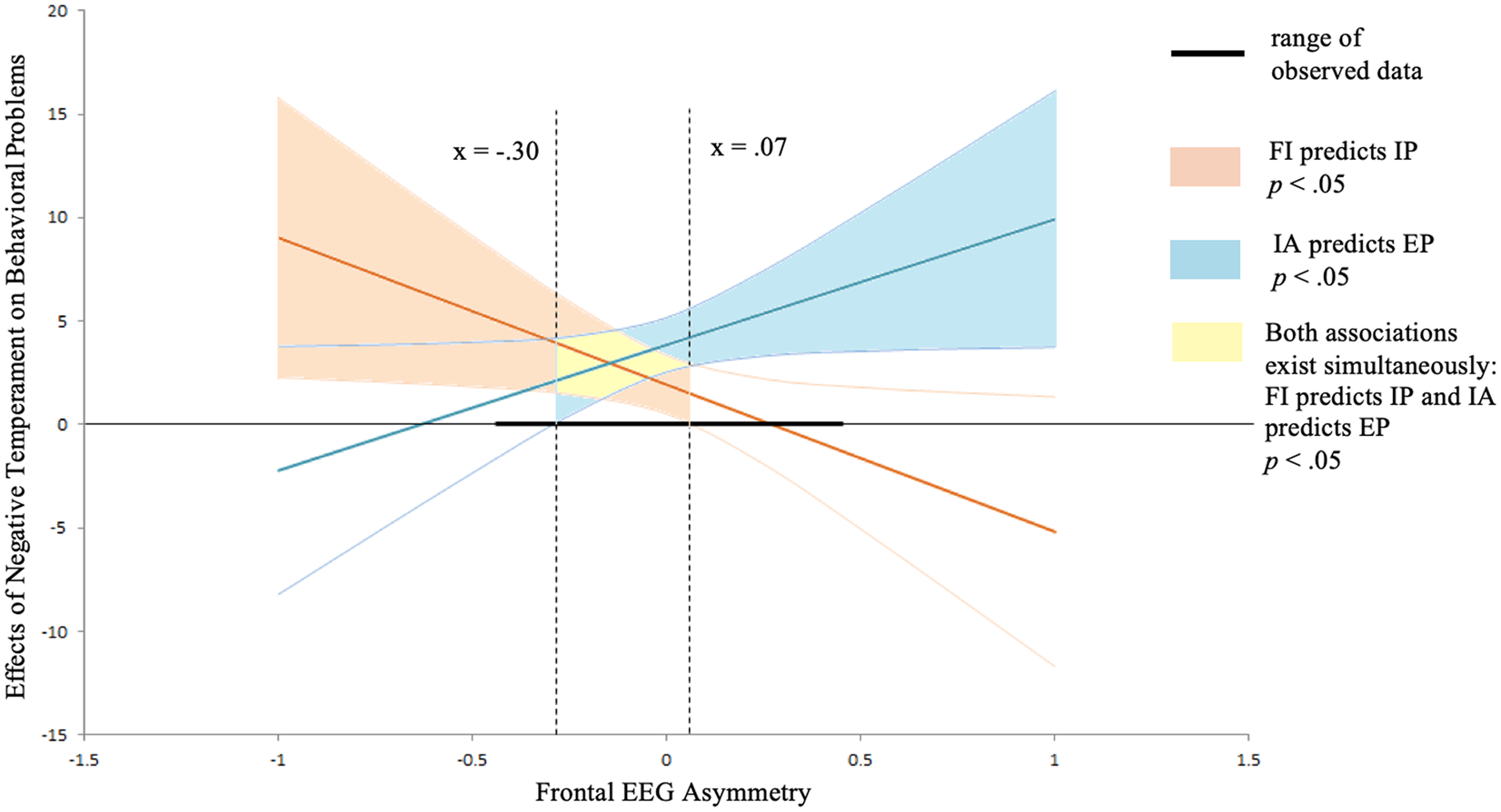
The Johnson–Neyman technique suggested that the effect of fearful inhibition on internalizing problems increased as children exhibited greater right FA (i.e., moved left on the number line toward more negative values; see Figure 2), which was significant when FA was less than 0.07 in this sample. In addition, the effect of impulsivity-anger on externalizing problems increased as children showed greater left FA (i.e., moved right on the number line toward more positive values; see Figure 2), which was significant when FA was greater than −0.30 in this sample. When examining the associations between negative temperament and two types of behavioral problems simultaneously as shown in Figure 2, children could be categorized into one of the three groups based on their FA scores. Specifically, when children exhibited extreme right FA (FA ≤ −0.30 in this sample), fearful inhibition significantly predicted internalizing problems. At this extreme right FA, impulsivity-anger had no significant influence on externalizing problems. When children showed left FA (FA ≥ 0.07 in this sample), impulsivity-anger significantly predicted externalizing problems. At this extreme left FA, no significant association was found between fearful inhibition and internalizing problems. For children who had more hemispheric symmetry (−0.30 < FA < 0.07 in this sample), however, both associations could be significant.
FA at age 6 moderates the associations between negative temperament at age 6 and behavioral problems at age 9. When FA is equal to or less than −.30, fearful inhibition significantly predicted internalizing problems and impulsivity-anger had no significant influence on externalizing problems. When FA is equal to or greater than .07, impulsivity-anger significantly predicted externalizing problems and no significant association was found between fearful inhibition and internalizing problems. When FA is between −.30 and .07, as shown in the yellow area, both associations are significant, suggesting that children whose frontal EEG asymmetry scores fall into the yellow area are at higher risk of co-occurring internalizing and externalizing problems if they have high fearful inhibition and impulsivity-anger. FI = fearful inhibition; IP = internalizing problems; IA = impulsivity-anger; EP = externalizing problems.

To test the level of specificity for these relationships, we also examined whether the interaction between fearful inhibition and FA to predict externalizing problems (rather than internalizing problems) and the interaction between impulsivity-anger and FA to predict internalizing problems (rather than externalizing problems) were significant. The results showed that FA did not significantly moderate the association between fearful inhibition and externalizing problems (b = 3.98, β = −0.03, p = .71) or the association between impulsivity-anger and internalizing problems (b = −1.58, β = 0.08, p = .17). Finally, 12.4% of the variance in internalizing problems was explained by the predictors (p = .02), and 20.1% of the variance in externalizing problems was explained by the predictors (p < .01).
Discussion
The findings from our study are consistent with previous research showing the longitudinal association between negative temperament and emotional and behavioral problems (Eisenberg et al., Reference Eisenberg, Valiente, Spinrad, Cumberland, Liew, Reiser, Losoya and H2009; Wang et al., Reference Wang, Eisenberg, Valiente and Spinrad2016). Controlling for gender, maternal education, and maternal employment, fearful inhibition and impulsivity-anger at 6 years of age significantly predicted internalizing problems and externalizing problems at 9 years of age, respectively. Temperament may be considered an early expression of a child's developing personality and is involved in the etiology of child psychopathology (Muris & Ollendick, Reference Muris and Ollendick2005; Nigg, Reference Nigg2006). It should be noted, however, that psychopathology results from the dynamic interaction of multiple risk and protective factors, rather than from a single vulnerability factor acting in isolation (Muris & Ollendick, Reference Muris and Ollendick2005). Indeed, as shown in our findings, the main effect of negative temperament on behavioral problems is moderated by children's resting FA.
Our study is the first to show that resting FA moderates the associations between two aspects of temperament (i.e., fearful inhibition and impulsivity-anger) and two major categories of behavioral problems (i.e., internalizing and externalizing) during middle and late childhood, a developmental period with limited research on these interconnections. As expected, fearful inhibition predicted internalizing problems when children showed greater right resting FA. Impulsivity-anger predicted externalizing problems when children showed greater left resting FA. The findings with our community sample are consistent with findings from samples selected for high and low behavioral inhibition. Specifically, fearfully inhibited preschoolers who showed greater right resting FA exhibited more internalizing problems compared with inhibited preschoolers who showed left resting FA (Fox, Schmidt, Calkins, Rubin, & Coplan, Reference Fox, Schmidt, Calkins, Rubin and Coplan1996). Similarly, compared with those who are low in shyness, adolescent girls high in shyness reported having higher neuroticism, generalized anxiety, and lower extraversion if they also showed greater right resting FA (Lahat et al., Reference Lahat, Tang, Tanaka, Van Lieshout, MacMillan and Schmidt2018). In addition, adolescents who scored high on behavioral inhibition measures during toddlerhood showed hypersensitivity to errors in a social context at age 12, indicated by EEG patterns, if they had greater concurrent right resting FA (Harrewijn et al., Reference Harrewijn, Buzzell, Debnath, Leibenluft, Pine and Fox2019). According to the motivational direction model, right FA is associated with withdrawal motivation (Harmon-Jones & Gable, Reference Harmon-Jones and Gable2018). Having right FA may foster the inhibition or social withdrawal of fearfully inhibited children and exacerbate the negative influence caused by being shy and fearful. Having left FA indicative of a biological motivation to approach, however, may contribute to the resilience process by suppressing the negative disposition, thus reducing the risks of having internalizing problems.
To the best of our knowledge, our study represents the first report that left resting FA amplifies the association between impulsivity-anger and externalizing problems during middle and late childhood. Similar findings indicate that temperamental exuberance at 36 months significantly predicts externalizing problems at 5 years, with the association stronger for children who show left resting FA (Degnan et al., Reference Degnan, Hane, Henderson, Moas, Reeb-Sutherland and Fox2011). Similarly, high anger-prone infants with greater left resting FA at 9 months show significantly more approach behaviors and less inhibitory control at 4 years (He et al., Reference He, Degnan, McDermott, Henderson, Hane, Xu and Fox2010). Moreover, children who have increased arousal in response to a sad film clip display more externalizing symptoms if they have left resting FA (Gatzke-Kopp et al., Reference Gatzke-Kopp, Jetha and Segalowitz2014). Considering the motivational direction model, the combination of an impulsive-angry disposition and a motivation to approach may lead to a greater level of noncompliant and antisocial behaviors (Harmon-Jones & Gable, Reference Harmon-Jones and Gable2018).
Of note, our study revealed the specific FA values for associations between fearful inhibition and internalizing problems, as well as between impulsivity-anger and externalizing problems, to be significant or not significant in our sample. It is more sophisticated to examine differences between children who have extreme FA and those who have relatively smaller FA than by using simple “positive numbers” for left FA or “negative numbers” for right FA groupings. Frontal EEG asymmetry has been suggested as a potential resilience factor that mitigates the association between negative temperament and behavioral problems (Degnan & Fox, Reference Degnan and Fox2007). As demonstrated for the children in this study, however, FA can only contribute to the resilience process when it reaches stronger left FA or right FA levels. This is especially the case for children with high impulsivity-anger. The predictive effect of impulsivity-anger on externalizing problems is no longer significant when children exhibit extreme right FA (asymmetry scores more negative than −0.30 in this sample). The predictive effect of fearful inhibition on internalizing problems is no longer significant when children exhibit modest left FA (asymmetry scores more positive than 0.07 in this sample).
To the best of our knowledge, our study represents the first attempt at plotting the moderating effect of FA by using the Johnson–Neyman technique and testing the associations between negative temperament and behavioral problems at continuous scores of FA. Previous research either classified individuals into a right FA or left FA group (Henderson et al., Reference Henderson, Fox and Rubin2001) or used the traditional “simple slope” method (Degnan et al., Reference Degnan, Hane, Henderson, Moas, Reeb-Sutherland and Fox2011) to explain the moderation effect. Findings from our study inspire us to think about the meaningfulness of the degree or intensity of FA in addition to its valence (i.e., positive or negative). Having a relative small FA may not serve as a protective factor with respect to the adverse effect of negative temperament on children's socioemotional development. We should emphasize, however, that the FA values are specific to the sample of children in our study. The specific range of significance as indicated by the Johnson–Neyman technique may vary from sample to sample.
For children whose frontal brain activity approached symmetry, they can develop either type of behavioral problems at age 9 depending on their temperament at age 6. If they are highly shy and fearful, they are at high risk of internalizing problems; if they have high impulsivity-anger, they tend to develop externalizing problems. Both examples are regardless of right or left FA. Of note, internalizing problems and externalizing problems are more likely to co-occur for this subgroup of children as well. The comorbidity of two types of behavioral problems is not unusual for children at this age (Willner, Gatzke-Kopp, & Bray, Reference Willner, Gatzke-Kopp and Bray2016). In our study, internalizing and externalizing problems were highly correlated with each other. We emphasize that the two temperament characteristics in this study (i.e., fearful inhibition and impulsivity-anger) are both associated with negative affect. Negative affectivity is a common vulnerability factor for both internalizing and externalizing problems (Rhee, Lahey, & Waldman, Reference Rhee, Lahey and Waldman2015). When children exhibit a high level of negative affect and lack other protective factors, such as having extreme FA indicating a strong predisposition to approach or inhibit, they may be at risk of diverse psychopathology (i.e., both internalizing and externalizing) instead of one type of behavioral problem. This means that our data suggest that extreme FA, in conjunction with corollary negative temperament, might be considered a protective factor against co-occurring internalizing and externalizing behavior problems while at the same time putting children at increased risk for either internalizing (right FA) or externalizing (left FA) psychopathology. This is a different view of FA as currently discussed in the affective neuroscience literature, where extreme FA is typically considered a risk factor for psychopathology. Thus, our data suggest risk for diverse or co-occurring psychopathology at less extreme levels of FA. Of course, the lack of other resilience factors, such as positive parenting, may also contribute to the development of multiple behavioral problems for children with high negative affectivity (Lee & Bukowski, Reference Lee and Bukowski2012).
What makes our study innovative is that we focused on middle and late childhood, a time that has received little empirical attention in the FA literature compared with infancy, toddlerhood, and early childhood (e.g., Fox et al., Reference Fox, Schmidt, Calkins, Rubin and Coplan1996; Henderson et al., Reference Henderson, Fox and Rubin2001; Smith & Bell, Reference Smith and Bell2010). In addition, we included internalizing and externalizing problems into one model for the purpose of examining how early negative temperament is associated with multiple behavioral problems at a continuous level of FA. This model provides us with a fine-grained understanding of the nuanced associations among negative temperament, FA, and either single or co-occurring behavioral problems. Last, we examined the potential behavioral problems of a group of typically developing children, which allowed us to examine the role of FA in the general population. Much of the research on FA has focused on a selected group that is characterized by a stronger potential for later psychopathology such as children selected for behavioral inhibition (e.g., Fox et al., Reference Fox, Henderson, Rubin, Calkins and Schmidt2001), dysregulated fear (e.g., Buss et al., Reference Buss, Davis, Kiel, Brooker, Beekman and Early2013), or parent depression (e.g., Feng et al., Reference Feng, Forbes, Kovacs, George, Lopez-Duran, Fox and Cohn2012).
Although our study had several strengths, some limitations should be mentioned. First, both temperament and behavioral problems were assessed with maternal reports, albeit separated by 3 years. Relying exclusively on maternal report may overestimate the association between the two measures. The inclusion of standard observation assessments might help improve the measurement of children's characteristics and may potentially reflect a more accurate correlation between temperament and behavioral problem outcomes. Second, resting FA was recorded during a 1-min eyes-open condition. Although it is a standard procedure to measure baseline EEG, future research may want to extend the duration to longer periods of brain activity at rest. Third, although we consider the normative nature of our sample as a strength, it may also serve as a potential limitation given the overall low to moderate level of behavioral problems exhibited by children in this study. Last, findings from our study may mainly apply to children from White and highly educated families. More diverse populations whose internalizing and externalizing problem scores are considered in the clinical range are needed for a more encompassing examination of our model.
In addition to the limitations mentioned above, future research may want to follow some potential fruitful directions. In this study, we focused on FA at rest, which was also used by most previous FA studies (e.g., Gatzke-Kopp et al., Reference Gatzke-Kopp, Jetha and Segalowitz2014). According to the capability model, however, task-related FA reflects the interactions between the specific demands of an emotionally challenging context and the emotion regulation skill that people bring to that situation. Thus, individual differences in FA may be more pronounced in emotionally evocative tasks (Coan, Allen, & McKnight, Reference Coan, Allen and McKnight2006). Future research may want to examine how FA measured in emotionally challenging contexts or how changes in asymmetrical frontal activation from rest to task affect the temperament-psychopathology association. In addition, resting FA exhibits low to moderate stability across early childhood (Howarth et al., Reference Howarth, Fettig, Curby and Bell2015; but see Poole et al., Reference Poole, Santesso, Van Lieshout and Schmidt2018). Infants with stable left resting FA from 10 to 24 months, however, had more externalizing problems later, whereas those with stable right resting FA had more internalizing problems (Smith & Bell, Reference Smith and Bell2010). It would be interesting to study how the stability of FA at different developmental periods interacts with temperament in predicting later behavioral problems.
Our study has several important clinical implications. First, it demonstrates the heterogeneity in developmental outcomes by showing that not all fearfully inhibited/impulsive-angry children are at risk for problem behaviors. As such, our study provides suggestions for early screening and intervention services by demonstrating the role of FA in developing behavioral problems. For children with high levels of fearful inhibition, having left FA may be favorable in overcoming the potential adverse effects caused by negative inhibited dispositions. Yet for children with high levels of impulsivity-anger, having extreme right FA is beneficial in that it may balance the approach and withdrawal system, thus eliminating the unfavorable outcomes resulting from being overly impetuous. Our work represents a first step in examining the complex interplay between temperament, FA, and behavioral problems during middle and late childhood. Second, our findings may inspire researchers to investigate ways to increase EEG activation in right or left frontal regions for improving developmental outcomes. A stimulating and important direction for future research is to examine whether and how FA can be effectively manipulated, and whether the change can alter the developmental trajectories toward more adaptive outcomes.
Acknowledgments
The authors would like to thank the research assistants who contributed to the longitudinal data collection. In addition, we are grateful to the families for their participation in our research.
Financial Support
This research was supported by grant R01 HD049878 from the Eunice Kennedy Shriver National Institute of Child Health and Human Development (NICHD) awarded to Martha Ann Bell.
Conflict of Interest
The content of this manuscript is solely the responsibility of the authors and does not necessarily represent the official views of the NICHD or the National Institutes of Health.