BACKGROUND
Radiotherapy as a treatment for breast cancer represents nearly half the workload in UK radiotherapy departments.Reference Winfield, Deighton, Venables, Hoskin and Aird1 Breast irradiation has shown clear evidence of benefit in various meta-analysesReference Vallis and Cannock2 and more effective and efficient treatment methods are sought in clinical practice.
Breast radiotherapy aims to sterilise cancer in the treated area and reduce the risk of local recurrence. In most instances, radiotherapy is administered after breast conserving surgery or mastectomy.Reference Vallis and Cannock2,Reference Dongen, Voogd and Fentiman3 The omission of adjuvant radiotherapy leads to a threefold increase in the risk of local recurrence and as a consequence poorer survival rates.Reference Vinh-Hung4
Breast radiotherapy most commonly uses two opposing tangential photon radiation beams to treat the whole breast or chest wall thus avoiding posterior cardiac tissue. Due to the contour of the breast on the thoracic cage, a small amount of lung is usually incorporated for optimal treatment, especially when the tumour is proximal to the ribs but this should be minimised.Reference Dobbs, Barrett, Morris and Roques5 This being achieved through the combination of accurate localisation and stabilisation of the patient on an immobilisation device. In the department where this research was conducted, the immobilisation device was an inclined breast board with arm and wrist supports, the patients lying supine with the ipsilateral arm abducted. Abduction removes the ipsilateral arm from the path of the radiation; the contralateral arm being adducted to the side of the patient or across her waist. According to Winfield et al., this method lacks stable immobilisation.Reference Winfield, Deighton, Venables, Hoskin and Aird1
Different ways to improve stability during breast irradiation have been considered. Graham et al. randomised 30 patients to immobilisation on a breast board or to an inclined foam wedge.Reference Graham, Elomari and Browne6 Analysis was attained from geometric shifts on treatment (displacement) as the outcome measure based on electronic portal images (EPIs). Graham et al. found a central lung standard deviation (SD) of 2.1 mm in both the test and control group that would appear to be the population random error (σpop).Reference Graham, Elomari and Browne6 The researchers analysed the central lung displacement,Reference Graham, Elomari and Browne6 while Sandwith et al. analysed a cranial caudal and central lung displacement.Reference Sandwith, Bishop, Patenaude, Ludbrook and Truong7 Sandwith et al. compared breast board immobilisation to vacuum bag moulded devices based on the treatment shift (displacement) observed in the EPIs of 40 patients.Reference Sandwith, Bishop, Patenaude, Ludbrook and Truong7 Population systematic errors (Σpop) were reported as the SD of all the mean geometric displacements in all patients in millimetres.Reference Sandwith, Bishop, Patenaude, Ludbrook and Truong7 The population random errors were reported as the root mean square of all SDs in all patients in millimetres. Lower population random errors were recorded from 20 patients on the breast board, in both the anterior–posterior (AP) and superior–inferior (SI) directions (AP: σpop = 1.6 vs. 2.7 mm; SI: σpop = 1.0 vs. 2.1 mm).Reference Sandwith, Bishop, Patenaude, Ludbrook and Truong7 To use anatomical terms, the AP direction is ventro dorsal and the SI direction is cranial caudal. The population systematic errors were lower using the breast board in the AP direction (Σpop = 3.3 vs. 3.8 mm), but larger in the SI direction (Σpop = 2.4 vs. 1.6 mm).Reference Sandwith, Bishop, Patenaude, Ludbrook and Truong7 Greater practicality would have been achieved had the investigators analysed a vector from the SI and AP measurements.
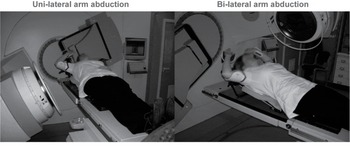
Some radiotherapy centres abduct both arms in the belief that this will provide a more stable position for radiotherapy treatment. It is suggested that the abduction of both arms during radiotherapy administered to the breast means the patient is more stable, resulting in more accurate radiotherapyReference Winfield, Deighton, Venables, Hoskin and Aird1 (Figure 1) although to date there is no published evidence to this effect.
Photo of unilateral and bilateral arm abduction.

The disparity in practice is acknowledged by a UK survey for the START (standardisation of breast radiotherapy) trial in Breast Cancer. The survey suggested positioning may be more accurate if bilateral arms are abducted.Reference Winfield, Deighton, Venables, Hoskin and Aird1 In view of the existing equipoise, a research study was designed to determine whether unilateral or bilateral arm abduction positions provide greater stability during radiotherapy treatment.
The Bi Arm study aimed to investigate whether bilateral arm abduction was superior to unilateral abduction using shifts on treatment (displacements) as the main outcome measure. The word ‘error’ is used to indicate the deviation from the planned outcome and the actual treatment given, and comprises of random and systematic elements.8,Reference Herk9 Before a course of radiotherapy begins, gross errors are eliminated.Reference Herk9
METHODS AND MATERIALS
The Bi Arm study was carried out at the Sussex Cancer Centre in the UK.
Patients
Subjects were recruited after being referred to the Sussex Cancer Centre for breast radiotherapy.
Inclusion criteria
• Diagnosis of cancer (T1–4, N0, M0) of the breast and subsequent breast conserving surgery (not mastectomy)
• Radiotherapy dose prescription of 40.05 Gy in 15 fractions10
• Female, over 18 years old
• Able to give informed consent
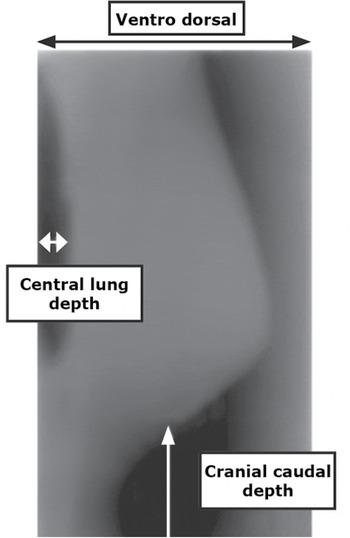
Patients referred for post-mastectomy radiotherapy were excluded since the absence of an intact breast may preclude cranial caudal measurements to assess movement in the SI direction (Figure 2). Patients requiring nodal irradiation were excluded since these patients do not receive radiotherapy treatment featuring tangential beams to the breast alone.
Geometric measurements.

Exclusion criteria
• Patients who have had a mastectomy, or those requiring axillary lymph node irradiation
• Patients unable to give informed consent
• Patients with co-morbidities in contralateral arm preventing bilateral arm abduction
• Patients requiring non-standard immobilisation due to obesity or ptotic breasts.
This study was approved by East Kent NHS Research Ethics Committee and the local research ethics committee approved the Bi Arm study in March 2008. All participating patients gave written and oral informed consent.
Sample and randomisation
Statistically 50 patients were required to observe a 5% difference between the test and control groups with 80% power.Reference Eng11 Fifty consecutive patients fulfilling the inclusion criteria were randomised to the test or control group over 4 months from April to July 2008. Randomisation was by means of pre-allocated sealed envelope technique administered independent of the treatment team.
Breast irradiation technique
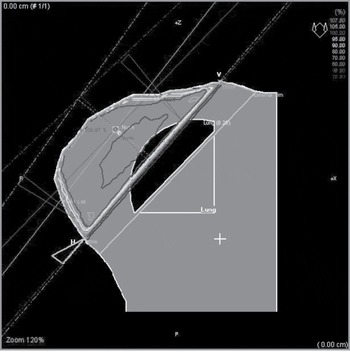
An individually tailored opposing tangential radiation beam technique was planned on an Odelft™ radiotherapy simulator, and administered on a 6–10 MV linear accelerator with electronic portal imaging using i-ViewGT®™. In order to achieve an effective tangential beam arrangement a digital X-ray image was produced by the simulator to choose the optimal breast coverage. This is 1 cm anterior from the breast tissue, 1 cm inferior to the inferior mammary fold, medially to the central sternum, and laterally to cover all palpable breast tissue with a small proportion of lung (maximum 2 cm) (Figures 2 and 3).
Transverse breast plan.

Concurrently each patient had a Qados™ Osiris outline of the central axis breast contour that was uploaded to the Oncentra® Masterplan for dosimetry planning (Figure 3).
Geometric measurement and translational displacement
Geometric measurement
Stability was assessed by comparing geometric measurement of central lung depth (CLD), cranial caudal depth (CCD), on the simulator image with the image during treatment (Figure 2). One simulator image was compared with three EPIs captured during treatment for each patient. An EPI was obtained once during every five fractions. One assigned radiographer, blinded to the group allocation of the respective patient, measured the geometric displacements of the 150 anonymised EPIs.
Translational displacement
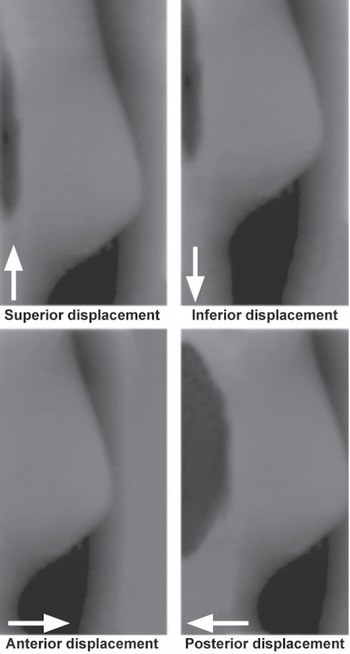
The shifts on treatment in this study are movement without rotation, and can be described as the mean displacement in a particular direction as seen in Figure 4.
Translational displacement.

The translational displacement data was assessed in order to show the position of the patient on the breast board, or how much or how little lung or breast had been irradiated (Figure 4). The direction of displacement in Figure 4 has been graphically exaggerated to illustrate this.
The translational displacement is calculated using the formula in Figure 5 (given by the CLD or CCD geometric data).
Translational displacement formula.

Vector displacement formula
This is a combination of both CLD and CCD translational displacement using the vector formula (Pythagoras) to visualise a two-dimensional shift (Figure 6).
Vector displacement formula.

The mean translational displacement (CLD,CCM or vector) per patient is the individual systematic error (Σind).
Systematic and random errors
The component systematic (Σind) and random (σind) errors were evaluated with respect to the average geometric displacement and SD per patient between the simulator image and the EPI. The SD of all the individual patients (Σind) gives the population systematic error (Σpop). The root mean square of all patients (σind) gives the population random error (σpop).8
The translational displacement data, systematic and random errors were analysed using the Statistical Package for Social Sciences (SPSS 14). To determine statistical significance of this data an independent two-sample t-test was performed with a p value of <0.05 considered significant.Reference Eng11 The independent two-sample t-test met the conditions for use in this study for two reasons. The patients were allocated equally to each group in the sample, and the two distributions were considered to have a normal distribution with similar variance when tested (Kolmogorov–Smirnov with Lillifors significance test and Laven’s test of variance p = 0.6–1.3).
RESULTS
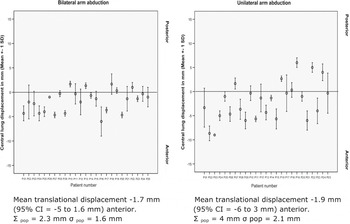
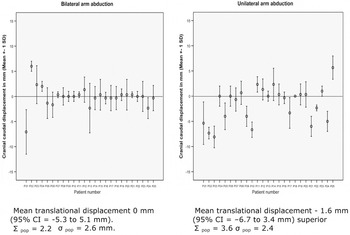
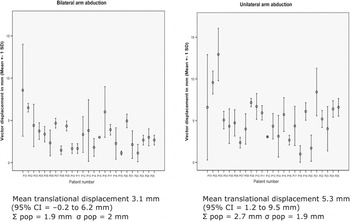
The age range of participants was 41–79 years, and there were 22 and 28 cancers of the left and right breast, respectively. In Figures 7–9, presented below, each individual error bar represents a patient each of whom were numbered 01 to 25 for both test and control groups. Patient one in the unilateral group was different to patient one in the bilateral group. The centre and length of each error bar is the average displacement (Σind) and the SD (σind) per patient respectively.
CLD error bar results.

CCD error bar results.

Vector error bar results.

CLD error bar results (Figure 7)
In the control group (unilateral arm abduction) the error bar representing patient 01 had a large individual CLD random error (σind = 4 mm). Similar individual random errors are seen in patients 17 and 25 (3.8 mm, σind = 4.2 mm), respectively. However, the random error of 0 mm for CLD patient 03 indicates no random error but a systematic error of –9 mm indicates a systematic error from the planned CLD of 9 mm for this patient. The translational displacement was in the anterior direction indicating half the amount of rib cage and lung was being included in the radiotherapy treatment area than was necessary for this patient. Patient 19 demonstrates a low individual random error of 1 mm but a large individual systematic error of 6 mm, when the planned CLD was 10 mm. This shows that potentially excessive lung had been irradiated in patient 19. In the test group the CLD patients 06, 07, 08, 09, 10, 14, 17, 19, 20, 21 have low individual random errors (σind = ranging from 0 to 1 mm). A higher CLD individual random error was seen in patient 02 with a random error of 3.5 mm. The individual systematic error in patient 02 was low at –2 mm and high in patient 16 at –6 mm, which shows a little variability among patients. A high CLD systematic error was also observed in patient 01 (Σind = –4.3 mm).
In total, the CLD data suggest no difference in the mean translational displacements between the test and control group (–1.7 mm, –1.9 mm anterior, p = 0.06), however greater inter-patient variability among patients who abduct unilateral arm. The population systematic error in the control group was double that of the test group (Σpop = 4 mm, Σpop = 2.3 mm, p = 0.005), with a small difference in population random error (σpop = 2.1 mm, σpop = 1.6 mm, p = 0.055).
CCD error bar results (Figure 8)
In the control group the CCD translational displacements were observed in both the SI directions indicating a large amount of variability in the patient position on the breast board. For many patients in the control group, the data indicates that most translational displacements were superior (–1.6 mm) suggesting that these patients are moving inferior on the breast board. Once again, patient 01 had a high random error (σind = 5.3 mm), with a large systematic error of 5.7 mm showing that this patient moved inferiorly down the breast board. In patient 17, the random error was 3 mm, indicating a similar random error as the CLD random error of 4 mm. Patient 25 had a large CLD random error of 4.2 mm, but a lower CCD random error of 2.3 mm. In patient 25 a –6 mm CCD systematic error (inferior), with a similar CLD systematic error, and low random error was observed.
In the test group the average translational CCD displacement was 0, which is 1.6 mm less than the control group, which indicates that patients are not moving on the breast board. There are some exceptions. Patient 02 had a systematic error of 6 mm indicating an inferior move on the breast board, but a low random error. Patient 16 had a low systematic and random error (Σind = –0.3 mm, σind = 1.1 mm). However patient 01 had a high systematic error (Σind = –7 mm), and a random error of 4.4 mm. The infrequently high random errors were also observed in patient 03 and 13 at 3.3 mm and 4.9 mm.
In total a greater translational displacement (control group = –1.6 mm superior, test group = 0 mm, p = 0.045) and double the population systematic error is observed in patients who were immobilised by unilateral arm abduction than bilateral arm abduction (Σpop = 3.6 mm, Σpop = 2.2 mm, p = 0.04). A greater inter-patient variability was observed in the patients who abducted ipsilateral arm, but no difference in population random error between the test and control group (σpop = 2.4, σpop = 2.6 mm, p = 0.056).
Vector error bar results (Figure 9)
The same trends of individual systematic and random error continue in the vector data. The vector data suggest a lower translational displacement (test group = 3.1 mm, control group = 5.3 mm p = 0.002) and population systematic error in patients abducting bilateral arms than unilateral arms (Σpop = 1.9 mm, Σpop = 2.7 mm, p = 0.03). No difference was observed in random error between the test and control group (σpop = 2 mm, σpop = 1.9 mm, p = 0.06).
DISCUSSION
This study tested bilateral arm abduction (test group) against unilateral arm abduction (control group) for whole breast irradiation, in terms of reproducibility and stability. The underlying principle of radiotherapy is that the patient must be in exactly the same position from planning to the completion of treatment. The results of the translational displacement data showed a difference in stability between the test and control group (Figures 7–9). This is also evidenced by a difference in the population systematic error and inter-patient variability between the test and control group. A major pattern arising from the data is that the error bars are highly stratified across the graphs when abducting unilateral arm. This is suggestive of inter-patient variability. However, many of the control group translational displacements seen in Figures 7–9 were still inside recommended guidelines of ±6 mm.8 The CLD error bars in Figure 6 show that there was similar translational displacement and population random error in both the control and test group. Another similarity is that the initial patients in both the control and test group have large individual systematic and random errors. This was seen in all figures (Figures 7–9, and is suggestive that the study could have introduced more efficiently with a pilot or that a larger study group would have compensated better for early random set-up errors. In Figure 7, the CCD translational data showed the impact that bilateral arm abduction has on the patient position. The low average translational displacement (0 mm), low systematic error (Σpop = 2.2), and a reduced inter-patient variability confirm that bilateral arm abduction restricts movement in the SI directions. The opposite is true of the control group with patients abducting unilateral arm (Figure 8), the error bars show a larger translational displacement (–1.6 mm), larger systematic error (Σpop = 3.6) and greater inter-patient variability across the error bar graph. The average translational displacement and population systematic error is proof that patients abducting unilateral arm are moving inferior on the breast board and lack stability. Sandwith et al. also noted a larger SI displacement (2.4 mm) in patients randomised to an inclined breast board.Reference Sandwith, Bishop, Patenaude, Ludbrook and Truong7 It could be suggested that the greater the incline the more the patient will slide inferiorly. A variable that was noted in the Bi Arm study that was equally distributed between the two groups. There is no doubt that the CCD data in Figure 8 confirm a further reduction in population systematic error when patients abduct bilateral arms. A reduction in the average vector displacements for the test group (see Figure 9) was also found, with a reduction of 2.2 mm and a reduced systematic error (Σpop = 1.9 mm) and lowered inter-patient variability. The CLD, CCD, and vector data show distinct reduction in systematic error and inter-patient variability when patients abduct bilateral arms.
The underlying mechanisms of the procedure are that when unilateral arms are abducted, the contra-lateral arm is left in the variable position at the patient’s waistband or across her waist with less immobilisation and stability and hence systematic error. In the test group, the degree of variability from the planned position to radiotherapy treatment position is lower due to the complete restriction of immobilisation when bilateral arms are abducted (lower systematic error). The complete immobilisation of bilateral arm abduction could reduce the effect of patients who are in a tense position at radiotherapy planning.
Potential patient benefits are a lower translational displacement and systematic error in the test group associated with greater accuracy, and potentially less side effects from radiotherapy. Potential side effects may include excess lung dose and an increased systematic error in the control group could lead to a lack of radiation dose to the targeted breast tissue. Assessing the clinical relevance of these dosimetric changes is beyond the scope of this small study.
The results of the Bi Arm study provide evidence in favour of the postulation by Winfield et al. that bilateral arm abduction is a more stable position than unilateral.Reference Winfield, Deighton, Venables, Hoskin and Aird1
For a limited number of patients bilateral arm abduction will not be possible (usually due to musculo-skeletal co-morbidity), and for these cases unilateral arm is still an appropriate technique. There are some limitations to bilateral arm abduction, but this new technique has shown to be suitable for a range of ages and after breast conserving surgery. Further studies could investigate how to further reduce random and systematic errors by improving immobilisation for patients in need of breast irradiation. The breast board used in the BI Arm study was different to the immobilisation used in the studies by Sandwith et al. and Graham et al.Reference Graham, Elomari and Browne6,Reference Sandwith, Bishop, Patenaude, Ludbrook and Truong7 As new immobilisation devices are used they should be tested and the measurements described above are an appropriate measure to compare with any standard technique.
CONCLUSION
The aim of this study was to investigate whether bilateral arm abduction was superior to unilateral abduction using shifts on treatment as the main outcome measure. The reduction of half the systematic error and inter-patient variability observed in the test group is evidence that bilateral arm abduction is a more stable and reproducible position than unilateral arm abduction. There was no difference in random error between the test or control group. The cranial–caudal translational displacement data indicate that patients treated with unilateral arm abduction were moving inferiorly on the breast board. These results support the adoption of bilateral arm abduction as a standard technique. Bilateral arm abduction is a simple adaptation to standard practice. Breast boards may be engineered for the purposes of unilateral or bilateral arm abduction. The clinical use of unilateral arm should be restricted to patients who bilateral arm abduction is not suitable.
ACKNOWLEDGEMENTS
Sussex Cancer Fund funded one radiographer to spend 10 hours to measure the geometric displacement of 150 electronic portal images.