Kawasaki disease is the most common cause of acquired heart disease among the children in developed countries,Reference McCrindle, Rowley and Newburger1 as well as in China.Reference Singh, Vignesh and Burgner2 Giant coronary aneurysms are the most serious complications of Kawasaki disease.Reference Garrido-Garcia, Moran-Villasenor, Yamazaki-Nakashimada, Cravioto and Galvan3 Coronary thrombosis, stenosis, and obstruction may occur in Kawasaki disease patients with giant coronary aneurysms, leading to unstable angina pectoris, myocardial infarction, or even death.Reference Burns, Shike, Gordon, Malhotra, Schoenwetter and Kawasaki4,Reference Miura, Kobayashi and Kaneko5 Follow-up data have been reported from Japan and the United States, with few reports from China.Reference Tang, Yan, Sun, Xu, Ding and Lv6,Reference Tang, Gao, Shen, Sun and Yan7 Evidence regarding outcomes of giant coronary aneurysms in the current era with standardised treatment regimens remains lacking. The most recent guideline of the American Heart Association proposed a new definition for giant coronary aneurysms based on absolute dimensions and z-score adjusted for body surface area.Reference McCrindle, Rowley and Newburger1 Nevertheless, most previous studies were based on only absolute dimensions. Miura et al. reported that the use of the z-score classification was helpful to assess the temporal correlations between the severity of coronary aneurysms and cardiovascular events.Reference Miura, Kobayashi and Kaneko5 The aim of the present study was to describe the outcomes of Kawasaki disease with giant coronary aneurysms in southwest China, defined by the current guidelines of the American Heart Association.
Methods
Study population and data collection
This was a retrospective descriptive study conducted at the First Affiliated Hospital of Guangxi Medical University, a tertiary referral centre in southwest China. All patients diagnosed with Kawasaki disease between December, 2002 and December, 2018 were eligible, including patients who were diagnosed at our hospital in the acute phase and patients referred for follow-up in the chronic phase. We excluded patients with diseases that could cause coronary artery dilatation or affect coronary artery prognosis, including severe CHD, congenital coronary artery fistula, polyarthritis, and systemic lupus erythematosus. In our centre, serial transthoracic echocardiograms were taken three times or more within 2 weeks after diagnosis of Kawasaki disease, and after 2012, coronary CT angiography was routinely performed when coronary aneurysm was detected by echocardiogram. During the chronic phase, follow-up examinations were carried out every 3 to 6 months, including basic clinical evaluations, electrocardiograms, echocardiography, and international normalised ratio if warfarin was given. If there was any doubt regarding the presence of coronary aneurysms or if patients had symptoms that might indicate myocardial ischaemia, coronary CT angiography or invasive coronary angiography was performed.
We gathered clinical data, including demography data, drug therapy, echocardiography, coronary CT angiography, invasive coronary angiography, cardiac intervention, cardiac prognosis, and school activity. Echocardiographic measurements were performed based on the American Heart Association guidelines,Reference McCrindle, Rowley and Newburger1,Reference Newburger, Takahashi and Gerber8 inner edge to inner edge of the vessel. Coronary thrombosis was diagnosed using echocardiography. Drug therapy included acute anti-inflammatory therapy (intravenous immunoglobulin, steroids), antiplatelet therapy (aspirin, clopidogrel, or dipyridamole), anticoagulants (warfarin or low-molecular-weight heparin), and thrombolytic therapy (urokinase). Patients were given urokinase based on echocardiographic evidence of thrombus alone, not symptoms of angina/coronary ischaemia. The effect of thrombolytic therapy (complete resolution, partial resolution, no change) was evaluated using transthoracic echocardiograms. The target international normalised ratio was 1.5–2.5 when giving warfarin. Low-molecular-weight heparin was only used in combination with warfarin at the beginning of anticoagulation. When international normalised ratio reached the target range and lasted for more than 24 hours, low-molecular-weight heparin was stopped. Because of the short duration of use, anti-Xa levels were not routinely monitored in patients on low-molecular-weight heparin. The study was approved by the First Affiliated Hospital of Guangxi Medical University board review and informed consent was waived.
Definition
Kawasaki disease and incomplete Kawasaki disease were diagnosed according to the American Heart Association guidelines.Reference McCrindle, Rowley and Newburger1,Reference Newburger, Takahashi and Gerber8 Giant coronary aneurysms were defined as those with z-score of ≥10 or absolute dimensions of ≥8 mm.Reference McCrindle, Rowley and Newburger1 The z-score was converted using a model derived from the lambda-mu-sigma method based on data from healthy Japanese children.Reference Kobayashi, Fuse and Sakamoto9 We defined regression as normalisation of internal lumen diameter (z-score ≤ 3 or internal diameter of ≤2.5 mm in patients <3 years of age, ≤3 mm in patients 3–9 years of age, and ≤3.5 mm in patients 9–14 years of age for coronary artery segments with an unavailable z-score)Reference Wang, Wang and Gong10 as a result of giant coronary aneurysms luminal myofibroblastic proliferation and layering of intraluminal thrombus. Major adverse cardiac events were defined as acute ischaemic events (unstable angina pectoris, myocardial infarction, and cardiac-related death) or coronary interventions (coronary artery bypass grafting).Reference Miura, Kobayashi and Kaneko5
Statistical analysis
Demographic and clinical data were expressed as median with quartiles, mean ± standard deviation, or number with percentage, as appropriate. We calculated the survival rate of thrombosis, major adverse cardiac events, and coronary aneurysms regression using Kaplan–Meier analysis. The absolute internal lumen diameters and z-scores between groups were compared using the independent Student t-test, and the incidences of thrombosis, major adverse cardiac events, and coronary aneurysms regression between the groups with z-scores < 15 and ≥15 were compared using the Fisher exact test. P < 0.05 was considered statistically significant. All statistical analyses were carried out using SPSS version 21.0.
Results
Patient characteristics
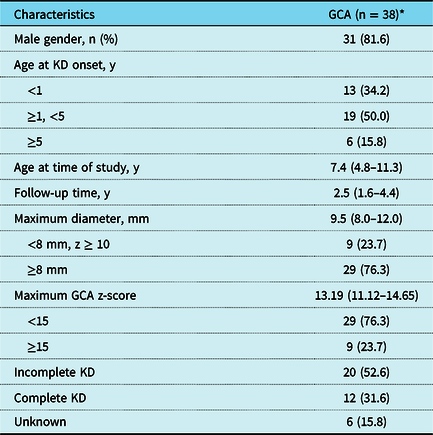
A total of 725 patients met criteria for Kawasaki disease during the study period. Giant coronary aneurysms were found in 38 (5.2%) patients, including six referred patients. No patients were excluded. Characteristics of patients with giant coronary aneurysms are summarised in Table 1. Median follow-up period was 30.5 months (range from 1.7 months to 22.3 years). The z-scores (17.87 ± 2.20 versus 12.13 ± 1.72, p < 0.001) and internal luminal diameters (13.88 ± 3.44 versus 9.07 ± 2.47 mm, p < 0.001) of patients with z-scores ≥ 15 were significantly greater than those of patients with z-scores < 15. The mean age of patients in the group with z-scores ≥ 15 was less than that of the group with z-scores < 15; nevertheless, there was no significant difference (2.4 ± 2.2 versus 3.1 ± 2.9 years, p = 0.486). There was Kawasaki disease recurrence in one 3-year-old child 4 months later with initial successful therapy.
Characteristics of Kawasaki disease patients with giant coronary aneurysms

Abbreviations: GCA = giant coronary aneurysms; KD = Kawasaki disease; y = year
* Data given as n (%) or median (interquartile range)
Medications
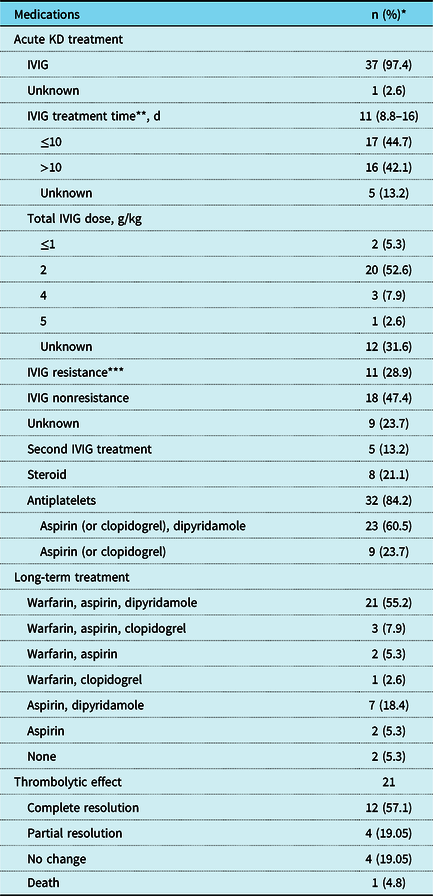
Intravenous immunoglobulin was used in 37 (97.4%) patients, antiplatelet therapy was used in 32 (84.2%), and warfarin was used in 27 (71.0%) patients (Table 2). The majority of patients who did not receive warfarin had an absolute dimension of less than 8 mm or had Kawasaki disease in an earlier period. Two patients experienced bleeding, one had gastrointestinal bleeding and one had nasal bleeding. Fifteen (39.5%) children received a total of 21 rounds of thrombolytic therapy with a median time from Kawasaki disease onset of 5.6 months (range from 0.8 to 47.4 months). One child with asymptomatic thrombosis during the earlier times did not receive thrombolytic therapy, and subsequently the thrombus organised. Intravenous coronary thrombolysis with urokinase was administered at 2000–27,500 IU/kg/d until thrombolysis or thrombus organisation. During thrombolytic therapy, in addition to urokinase and antiplatelet drug, the majority (18 episodes) were given low-molecular-weight heparin combined with warfarin in the early stage of anticoagulation, and a few patients (three episodes) were given warfarin alone for anticoagulation. Most (76.2%) resolved completely or partially, and one (4.8%) died of thrombotic occlusion (patient 2, Table 3). Except for one patient who experienced skin petechiae, there were no major complications from thrombolytic therapy.
Medications

Abbreviations: IVIG = intravenous immunoglobulins; KD = Kawasaki disease
* Data given as median (interquartile range) or n (%)
** Day calculated from first day of fever
*** Any additional therapies required after initial IVIG administration were defined as IVIG resistance
Thrombosis
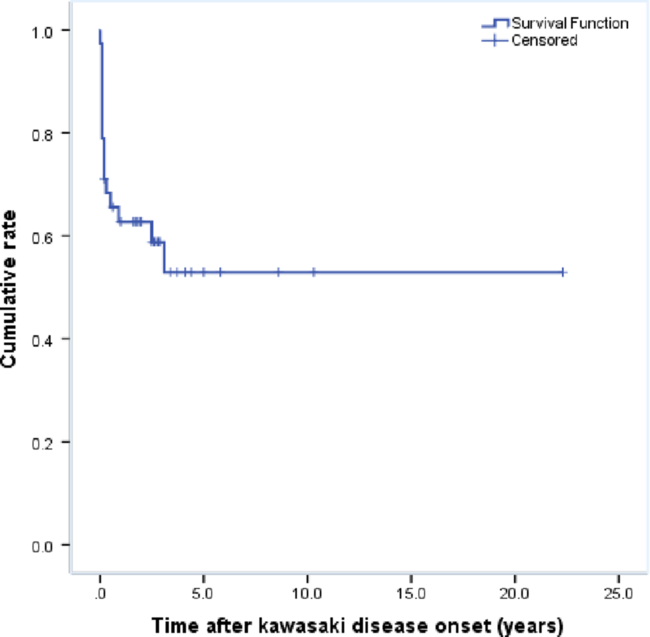
Sixteen (42.1%) children experienced thrombosis, and two later developed thrombotic occlusions. The 1-, 2-, and 5-year thrombosis-free rates were 0.63, 0.63, and 0.53, respectively (Fig 1). Two children whose coronary aneurysms (6.5 and 7.5 mm) would not have been classified as giant coronary aneurysms based on absolute dimension instead of z-score experienced thrombosis. The maximum absolute dimension (12.2 ± 4.1 versus 8.7 ± 1.7 mm, p = 0.005) and the maximum z score (15.1 ± 3.5 versus 12.3 ± 2.2, p = 0.011) in the group with thrombus were significantly greater than those in the group without thrombus. The incidence of thrombosis was significantly higher in patients with z-scores ≥ 15 than that in patients with z-scores < 15 (7/9 versus 9/29, p = 0.021).
Kaplan–Meier curves of thrombosis-free survival of patients with giant coronary aneurysms.

Major adverse cardiac events
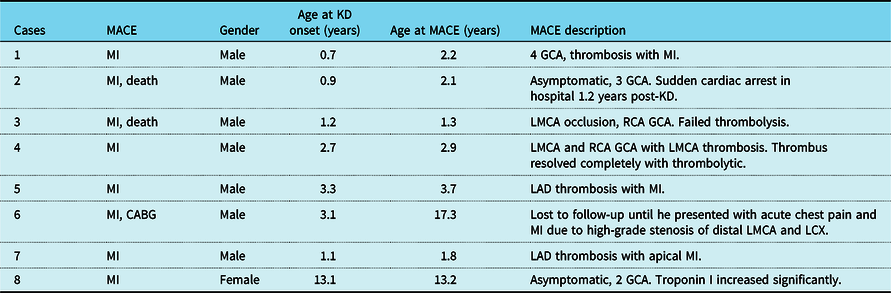
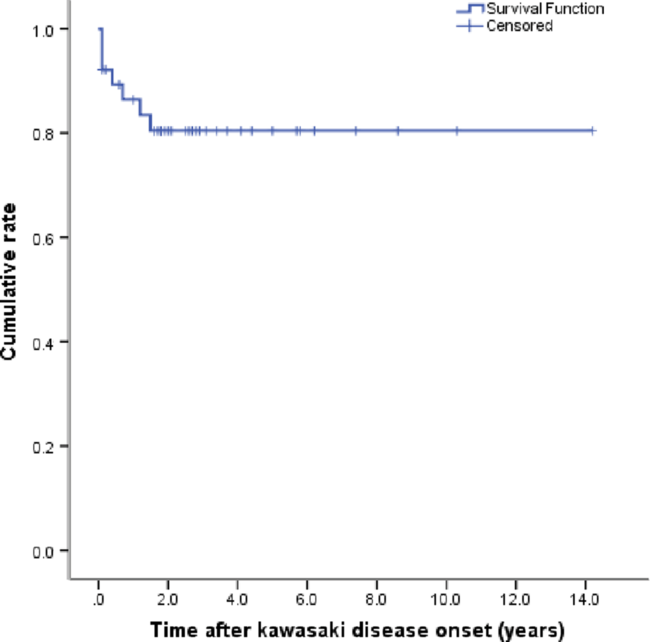
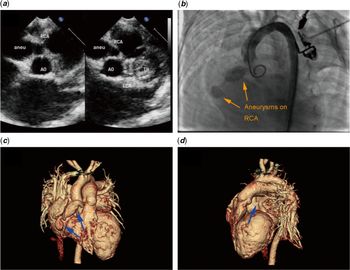
Eight (21.1%) patients experienced major adverse cardiac events (Table 3). The median age of major adverse cardiac events was 2.6 years (range from 1.3 to 17.3 years), and the median time from Kawasaki disease onset was 6.4 months (range from 26 days to 14.2 years). The major adverse cardiac event-free rates were 0.86, 0.81, and 0.81 in 1, 2, and 5 years, respectively (Fig 2). Major adverse cardiac events included two deaths and one coronary artery bypass grafting (Table 3). Both deaths involved coronary thrombosis and obstruction. The first patient (patient 2, Table 3) died suddenly at 2.1 years of age of acute thrombosis of both the right and left coronary artery during thrombolytic therapy, 1.2 years after the onset of Kawasaki disease. The second patient (Fig 3) was a 1.3-year-old child who had a diminished ejection fraction of 34%, 1.5 months after Kawasaki disease onset. This patient showed no effect of thrombolytic therapy and died from myocardial infarction and heart failure. One patient underwent coronary artery bypass grafting having been diagnosed with Kawasaki disease at 3 years of age and after experiencing chest pain at 17.3 years of age. Invasive coronary angiography showed a high degree stenosis of the left main coronary artery and left circumflex coronary artery. In the 7 years after bypass grafting with the internal thoracic artery, the patient remained asymptomatic. The maximum absolute dimensions (14.0 ± 3.7 versus 9.2 ± 2.5 mm, p < 0.001) and z-scores (15.4 ± 3.9 versus 13.0 ± 2.6, p = 0.040) were significantly greater in patients with major adverse cardiac events than in those without. Of the nine children with maximum z-score ≥ 15, four (44.4%) experienced major adverse cardiac events. Of the children with maximum z-score < 15, only four (13.8%) of 29 experienced major adverse cardiac events.
Description of major adverse cardiac events

Abbreviations: CABG = coronary artery bypass grafting; GCA = giant coronary aneurysms; KD = Kawasaki disease; LAD = left anterior descending artery; LCX = left circumflex coronary artery; LMCA = left main coronary artery; MACE = major adverse cardiac events; MI = myocardial infarction; RCA = right coronary artery
Kaplan–Meier curves of major adverse cardiac event-free survival of patients with giant coronary aneurysms.

Echocardiography (a), non-selective coronary angiogram (b) and cardiac CT angiography (c and d) of a 1.3-year-old boy who subsequently died after failed thrombolytic therapy. (a) Echocardiography showing an aneurysm (aneu) in the right coronary artery (RCA). Additionally, there is a 17.8 mm × 17 mm thrombus (TH) in the left coronary artery (LCA). (b) Angiogram showing dilated right coronary artery (RCA) containing two giant aneurysms (arrow) and cardiac dilatation. (c) Three-dimensional reconstruction showing two giant aneurysms in the irregular and markedly dilated right coronary artery (arrow). (d) Three-dimensional reconstruction showing total occlusion of the left main coronary artery (arrow).

The normalisation of internal lumen diameter
The 1-, 2-, and 5-year regression-free rates were 0.94, 0.85, and 0.67, respectively. None of the major adverse cardiac events had regressed to normal internal lumen diameter. Among patients with thrombosis, one with the smallest absolute dimension (6.5 mm) had complete regression after successful thrombolytic therapy. No cardiovascular events occurred after the normalisation of internal lumen diameter. Maximum absolute dimension was significantly smaller in complete regression patients than in those without (7.8 ± 1.3 versus 10.8 ± 3.5 mm, p = 0.033). There was no significantly difference, however, in the maximum z-score (12.45 ± 2.54 versus 13.72 ± 3.17, p = 0.331).
School activity
According to school activity management classification in Japan, patients were classified as follows: patients in category A required hospitalisation or family care and were not allowed to attend any school courses; category B patients were allowed to attend school classes except for exercise; categories C, D, and E were allowed mild, moderate, and strenuous exercises, respectively.Reference Fukazawa, Kobayashi and Mikami11 Thirty-six patients who survived included 13 (36.1%) patients with category D, and 14 (38.9%) patients with category E, and eight (22.2%) patients with unclassified who were too young to enter school. One patient already at work was able to do strenuous exercise. No patients were classified as being in categories A, B, or C. Most of the category D children who were restricted from strenuous activities were taking warfarin. Except the deaths and those that cannot be classified, the remainder (73.7%) was active in daily life.
Discussion
Giant coronary aneurysms caused by Kawasaki disease are severe cardiac sequelae,Reference Patel, Bruce, Harrington and Portman12,Reference McNeal-Davidson, Fournier and Scuccimarri13 with the incidence rate of 0.5–1.0%.Reference Uehara and Belay14 The much higher incidence rate in the current study is possibly related to the fact that our hospital is a Kawasaki disease referral centre for the treatment of coronary complications and the current American Heart Association guidelines were followed, capturing patients with absolute diameter <8 mm but z-scores ≥ 10 who may not have been included in previous similar studies.
Coronary aneurysms can develop into subacute or chronic vasculitis with fibroblastic hyperplasia in the lumen.Reference Iemura, Ishii, Sugimura, Akagi and Kato15 In a Dutch study, the rate of the normalisation of coronary aneurysm internal lumen diameter decreased gradually in patients with z-scores of 10–15, 15–20, and >20.Reference Dietz, Kuipers and Koole16 In the current study, the incidences of cardiovascular events in the group with z-scores ≥ 15 were higher than those of the group with z-scores < 15. Nevertheless, whether there are differences between groups of z-scores ≥ 15 and <15 in other populations remains to be further studied.
A recent national survey of 209 giant coronary aneurysms patients in Japan showed that most myocardial infarctions occurred within 18 months; nevertheless, there were no deaths over 2 years after the onset of Kawasaki disease.Reference Fukazawa, Kobayashi and Mikami11 In our study, the event-free survival rates and the two patients who died suggest that serious consequences may occur in early stages after Kawasaki disease onset.
In our study, 1-, 2-, and 5-year regression-free rates were similar to the rates of 0.86, 0.78, and 0.65, respectively, reported for a Dutch cohort.Reference Dietz, Kuipers and Koole16 This suggests that the normalisation of internal lumen diameter of coronary aneurysms also most often occurs at the early stage of Kawasaki disease. It is worth noting that the normalisation of internal lumen diameter of giant coronary aneurysms is not equal to normalisation of the arterial wall, with the proliferation of luminal myofibroblasts and intraluminal thrombus formation, progressive stenosis can develop.Reference Friedman, Gauvreau and Hamaoka-Okamoto17 We did not observe cardiovascular events after the normalisation of internal lumen diameter, possibly related to the shorter follow-up time.
In giant coronary aneurysms, endothelial dysfunction and activation of platelets facilitate thrombosis, leading subsequently to myocardial infarction.Reference McCrindle, Rowley and Newburger1,Reference Lin, Sun, Wu, Wang, Lue and Wu18,Reference Holve, Patel, Chau, Marks, Meadows and Zaroff19 The majority of giant coronary aneurysms deaths were due to extensive myocardial infarction secondary to coronary occlusion,Reference McNeal-Davidson, Fournier and Scuccimarri13 similar to the mortality reported in our study and supporting the above-mentioned mechanistic explanation. Therefore, one goal of Kawasaki disease management would be to prevent thrombosis and myocardial infarction.
We previously conducted a meta-analysis of several observation studies showing that warfarin plus aspirin reduced the incidence of cardiovascular events.Reference Su, Wang, Qin and Pang20 The incidence of thrombosis in the present study suggested that thrombosis remained common despite long-term anticoagulation. Because of the small number of children requiring thrombolytic therapy, data on thrombolytic therapy for acute coronary thrombosis in Kawasaki disease are relatively sparse.Reference McCrindle, Rowley and Newburger1,Reference Gupta, Leaker and Andrew21 In this study, the high efficacy with no major complications suggests that prompt thrombolytic therapy is safe and effective in most Kawasaki disease patients with coronary thromboses.
Most patients in our study were active in daily life, suggesting that most Kawasaki disease patients with giant coronary aneurysms can achieve disease-free periods with long-term anticoagulation, close cardiac monitoring, and prompt thrombolytic therapy.
Limitation
This was a single-centre retrospective study with relatively short follow-up time. Our accurate estimation of cardiovascular events was limited by censored data and the inability of small children to report myocardial infarction. Some patients with absolute dimensions of less than 8 mm were not treated with anticoagulant therapy, possibly affecting the evaluation of the current guidelines. Nevertheless, to the best of our knowledge, this was the largest study cohort of Kawasaki disease with giant coronary aneurysms in southwest China, adding to this previously published data on cardiac morbidity and mortality in high-risk Kawasaki disease populations under the contemporary treatment regimens.
Conclusion
In the early stages of Kawasaki disease, patients with giant coronary aneurysms often experience major cardiovascular events; however, they are also likely to have normalisation of the coronary internal luminal diameter. With long-term anticoagulation, close cardiac monitoring, and prompt thrombolytic therapy, most patients can achieve disease-free periods.
Acknowledgements
None.
Financial Support
This research received no specific grant from any funding agency, commercial, or not-for-profit sectors.
Conflicts of Interest
None.