Block forcefully illustrates a challenging methodological difficulty inherent in consciousness research: the measurement problem –that is, the fact that any exploration of consciousness depends on some kind of report, either external or through introspection. Consequently, one is invariably faced with the difficult task of disentangling the neuronal mechanisms associated with such reports from those underlying the phenomenal experience (e.g., sensory perception) itself. Human functional magnetic resonance imaging (fMRI), which can provide a highly detailed mapping of the conscious human brain, nevertheless suffers particularly severely from this methodological confound due to its sluggish temporal dynamics.
How then can one disentangle these closely related processes? Block provides an impressive survey of sophisticated experiments suggesting that reportability can be distinguished, and in fact is not necessary for phenomenal experience. Here I will present an alternative approach which nevertheless agrees with the notions proposed by Block – both point to the feasibility of phenomenal perception without a reporting perceiver.
The idea is quite straightforward: If the reporting/introspection stage can somehow be sufficiently segregated in time from the perceptual stage, one may be able to study in isolation the brain areas engaged during perception without confounding them with those involved in reporting and introspection. In such an experimental paradigm, the report/introspection of the percept is obtained only at a later stage, through recollection.
It could be argued that such a clean temporal separation of perception from reporting is simply not feasible. However, there are many instances in which it seems that perception occurs without any overt report or introspection. A striking example is the condition of sensory absorption, in which engagement with the perceptual stimuli is so intense that one gets the strong sense of “losing oneself in the act.” Another, more common type of experience may happen when watching a highly engaging movie – again, one is clearly not in the business of reporting or self-introspection during such states.
Of course, there is no a priori reason to assume that such intuitive impressions of self-loss indeed reflect a true neuronal dissociation of perception from any self-related processes; for example, it could be that implicit activation of cognitive-access areas may occur even during highly absorbing moments. In particular, it has been suggested that neural processes underlying an implicit first-person perspective may be an essential element of any conscious awareness state. Here is where fMRI research may prove useful, because it allows the mapping of any neuronal activity, be it conscious as well as implicit or subconscious during such engaging moments.
So what does brain imaging during absorbing perceptual moments reveal? In an fMRI study of brain activation in subjects watching a highly engaging movie (Hasson et al. Reference Hasson, Nir, Levy, Fuhrmann and Malach2004), the results revealed a robust and wide-spread activation in the back (i.e., sensory part) of the cerebral cortex, in a system of areas we termed the “Extrinsic” system (i.e., cortical regions oriented towards the external environment). In contrast, the front part of the brain remained relatively unresponsive. Indeed, even in the back part we found several relatively unresponsive islands. This entire set of nonresponsive areas constituted a coherent system (largely overlapping with the default mode network; Raichle et al. Reference Raichle, MacLeod, Snyder, Powers, Gusnard and Shulman2001) which we termed the “Intrinsic” system because of its complementary nature to the sensory-driven Extrinsic system. We hypothesized that the intrinsic/extrinsic divide may reflect a fundamental functional organization of the human cortex (Golland et al. Reference Golland, Bentin, Gelbard, Benjamini, Heller, Nir and Hasson Malach2007).
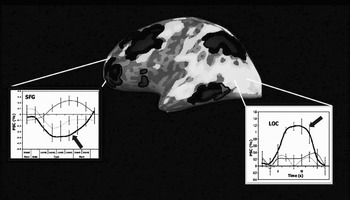
Our research, as well as that of many others, have indicated that the Intrinsic system deals with internally oriented functions – precisely the network one would assume is the most likely candidate for mediating cognitive access, introspection, and reportability, as well as the “first person perspective” (Baars et al. Reference Baars, Ramsoy and Laureys2003). Critically though, the Intrinsic network in fact shows a strong reduction in activity precisely during moments of intense perceptual processing (Goldberg et al. Reference Goldberg, Harel and Malach2006; and see Fig. 1 further on here). Thus, not only do we fail to find fMRI evidence for a synergistic activation of sensory representations in the back of the brain with self-related networks in the front, but intense sensory engagement actually appears to shut off these cognitive access networks!
Intrinsic and extrinsic systems. Antagonistic relationship between the extrinsic and intrinsic systems (light and dark patches, respectively) during an intense visual recognitions task. Arrows point to the high fMRI activation in the LOC region of the extrinsic system (right inset), as opposed to inhibition of activity in the SFG, a self-related part of the intrinsic system (left inset). Lateral view of an “inflated” left hemisphere. Back is to the right. [Modified from Goldberg et al. (Reference Goldberg, Harel and Malach2006) and Golland et al. (Reference Golland, Bentin, Gelbard, Benjamini, Heller, Nir and Hasson Malach2007).]

In summary, fMRI data during perceptual engagement suggests that perceptual awareness can emerge through internal activity in sensory systems, without a need to be “read out” by higher-order cognitive access mechanisms.
Finally, on a cautionary note, it should be emphasized that the present conclusions should be tempered by the methodological limitations of fMRI. Hence, substantial neuronal activity may go undetected by the fMRI method if the neuronal representations are too small (Avidan et al. Reference Avidan, Hasson, Hendler, Zohary and Malach2002), or the signals are too rapid to affect the sluggish hemodynamic fMRI response. Furthermore, cortical regions which do not modulate their activity levels during sensory perception may go undetected using our standard fMRI methodology.
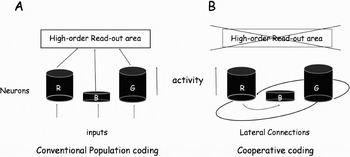
On the other hand, it is tempting to consider the more speculative implication of these recent findings: the notion that phenomenal experience may emerge through internal processing within sensory representations proper has far reaching consequences for neuronal theories of consciousness. To see why, let us consider, first, the concept of population coding, which is a widely accepted notion of sensory representations. In such coding schemes, the combined pattern of activity in a group of neurons (the population vector or state) represents a sensory percept, say a yellow color (see Fig. 1) generated by virtue of the fact that a “green” and a “red” neurons (R and G in Fig. 2) are active while the “blue” neuron (B) is not. Importantly, in conventional models, this network state is then read out by a higher-order station. Such coding allows a huge combinatorial power (e.g., Levy et al. Reference Levy, Hasson and Malach2004).
Two alternative schemes for perceptual representations. In conventional population coding (A) the neuronal state is read out by high-order areas. In the “cooperative coding” scheme there is no hierarchical processing. The neuronal state is both generated and read out by the same neurons through their lateral connectivity. Here I propose that the latter dynamics leads to phemonenal experience.

However, note that here we consider the possibility that phenomenal experience emerges within the bounds of the sensory representations themselves, without assuming a hierarchical flow into a high order read-out area. Instead, I would like to propose that the percept is coded cooperatively by the sensory network itself (see Fig. 2). Therefore, in such a scheme the phenomenal experience emerges when all relevant neurons in a network are informed about their own population state. Note that in such a cooperative coding model (somewhat analogous to a point attractor dynamics) there is no hierarchical processing – each active neuron simultaneously serves the roles of reading out and representing the perceptual state. Intriguingly, this single principle seems to successfully account for a large body of recent experimental data: for example, the high firing rates, relatively long durations, and dense local connectivity which appear to be critical for the emergence of conscious perceptual states.
To summarize, the field of consciousness research appears to be in the midst of an exciting period where the experimental jury is still out regarding such fundamental issues as the minimal spread of neuronal activity that is sufficient to elicit a conscious percept. However, in complete agreement with Block, I believe that these issues are experimentally tractable and will certainly lead to great advances in the construction of testable neuronal theories of conscious awareness.