Introduction
The terms cognitive ability and intelligence are used interchangeably to describe a general mental capability that, among other things, involves the ability to reason, plan, solve problems, think abstractly, comprehend complex ideas, learn quickly, and learn from experience (Gottfredson, Reference Gottfredson1997). Poorer performance on tests of cognitive ability earlier in life tends to be associated with adverse risk factors of cardiovascular diseases (CVDs) later in life (Taylor et al. Reference Taylor, Hart, Davey Smith, Starr, Hole and Whalley2003; Batty et al. Reference Batty, Deary, Schoon and Gale2007; Marmot & Kivimaki, Reference Marmot and Kivimaki2009; Richards et al. Reference Richards, Stephen and Mishra2010; Clouston et al. Reference Clouston, Richards, Cadar and Hofer2015). More consistent is an association with mental distress (Hatch et al. Reference Hatch, Jones, Kuh, Hardy, Wadsworth and Richards2007; Gale et al. Reference Gale, Hatch, Batty and Deary2009). The overrepresentation of adverse health characteristics at lower levels of cognitive ability is a source of health inequality, and underlines the importance of social policies ensuring that everyone has the possibility to obtain their cognitive potential (Gottfredson, Reference Gottfredson1997; Tucker-Drob & Bates, Reference Tucker-Drob and Bates2016).
Alcohol consumption is a complex behaviour in the sense that peoples’ drinking patterns differ widely. It is an even more complex risk factor because these drinking patterns associate differentially with health risk. Chronic and episodic heavy drinking, as well as light-to-moderate drinking, increases the risk of hundreds of diseases and conditions spanning both physical and mental health (Rehm et al. Reference Rehm, Mathers, Popova, Thavorncharoensap, Teerawattananon and Patra2009; Management of Substance Abuse Team., 2014). Light-to-moderate consumption, on the other hand, is also associated with a reduced risk of ischemic heart disease (IHD) (Ronksley et al. Reference Ronksley, Brien, Turner, Mukamal and Ghali2011; Roerecke & Rehm, Reference Roerecke and Rehm2012). Because IHD is the leading cause of death in many countries, this association may propagate into a net beneficial association with all-cause mortality in certain age groups (Knott et al. Reference Knott, Coombs, Stamatakis and Biddulph2015). The beneficial association could result from unaccounted bias in observational studies, such as residual confounding, and few studies have accounted for the potential role of cognitive ability, which influence on CVD has been observed to encompass and surpass that of traditional CVD risk factors (Batty et al. Reference Batty, Shipley, Dundas, Macintyre, Der and Mortensen2009).
To address this, we study the interplay between cognitive ability, alcohol consumption, and different health characteristics, including cardiovascular risk factors and mental distress. The first aim of the study is to assess whether cognitive ability in early adulthood may influence midlife alcohol consumption. The second aim is to assess whether the relationships between alcohol consumption and cardiovascular risk factors and mental distress differ by cognitive ability. We hypothesised that we would find differences that could contribute to the understanding of the alcohol harm paradox, which is a manifestation of social inequalities in health, where individuals with low socioeconomic position, or in this study low cognitive ability, experience more alcohol-related harm from the same level of exposure (Beard et al. Reference Beard, Brown, West, Angus, Brennan and Holmes2016).
Methods
Study population
The source population was Norwegian men born after 1944 and before 1961 who participated in cardiovascular health surveys in midlife. From this population, we selected two samples depending on the type of data available on alcohol consumption phenotypes. The first and main sample was selected from the National Health Screening Service's Age 40 Program (1994–1999) and selected surveys within the Cohort of Norway (1994–1999). Participants were required to have data available on alcohol consumption frequency or alcohol abstaining, cognitive ability from the mandatory evaluation for military conscription as well as data on other relevant covariates from the health surveys and additional covariates obtained by linkages to national health registries. The second sample was selected from the Finnmark III study (1987–1988, part of the Counties Study) and selected surveys within the Cohort of Norway (2000–2003). The statistical analyses performed in the second sample did not require exclusion of individuals with missing covariate data from health surveys and national registries.
Cognitive ability
Most Norwegian males were summoned for mandatory evaluation for military conscription, of which ~90% attended, mostly (95%) between their 18th and 21st birthday (Sundet et al. Reference Sundet, Eriksen and Tambs2008). Reasons for non-summoning or non-attendance included chronic diseases, physical and mental disability, addiction problems, criminal records, or employment abroad or at sea. At the evaluation, the young males were required to complete three cognitive tests in which performance on each test was scored from 0 to 11. The test-retest correlation has been shown to be reliable (0.84 for arithmetic, 0.90 for word similarities, and 0.70 for progressive matrices, respectively). Intercorrelations between the different tests have been shown to range from 0.53 to 0.64 (Sundet et al. Reference Sundet, Tambs, Magnus and Berg1988). The three scores were standardised according to a reference population and then, with equal weight on each test score, combined into a stanine score (range 1–9, mean = 5, s.d. = 2) which provided a measure of general cognitive ability. The stanine score was used to categorise participants into low (1–4), medium (5–6), and high (7–9) ability. The stanine scores were entered in the Norwegian Armed Forces Personnel Data Base and obtained for this study by data linkage. Because the test battery was re-standardised in 1963 and again in 1980 (mean scores lowered on average with 1.02 stanine points (Sundet et al. Reference Sundet, Barlaug and Torjussen2004)), the study population was limited to subjects for which stanine scores could be compared, which included males born after 1944 and before 1961.
Covariates
The health surveys provided self-reported measurements of alcohol consumption, current smoking (yes or no), level of leisure time physical activity (range 1–4, in which 1 reflect a sedentary lifestyle and 4 a very active lifestyle), history of diabetes (any), history of CVD (angina pectoris, myocardial infarction or stroke), family history of IHD, and mental distress. The measure of leisure time physical activity reflected either a general question (with four categories), the combination of two questions on the number of hours of hard and light activity, respectively, or all questions. Objective measurements were obtained for systolic blood pressure (mmHg), heart rate (beats per minute) and body mass index (BMI, kg/m2). Non-fasting biochemical measurements in blood samples (mmol/l) were obtained for serum triglycerides, total cholesterol, and high-density lipoprotein (HDL) cholesterol. Marital status (divorced/separated v. married/never married/widower) was obtained in conjunction with the health survey invitations (Population registry of Norway). The highest level of obtained education (range 1–8, in which 1 equals primary school and 8 equals a completed research education such as a master or doctoral degree, corresponding to the International Classification of Education 1997 categories) was obtained until 2011 from the National Educational Database.
Mental distress
The health surveys provided subjective measurement of mental health by the use of the Cohort of Norway Mental Health Index (CONOR-MHI) (Søgaard et al. Reference Søgaard, Bjelland, Tell and Røysamb2003; Bramness et al. Reference Bramness, Walby, Hjellvik, Selmer and Tverdal2010). The index is based on seven questions assessing whether the person in the past 2 weeks felt ‘nervous and unsettled’, ‘troubled by anxiety’, ‘secure and calm’, ‘irritable’, ‘happy and optimistic’, ‘sad/depressed’, or ‘lonely’. The questions have four possible answers: ‘no’, ‘a little’, ‘quite a bit’, and ‘very’, which are scored from 1–4 (scores for the questions ‘secure and calm’ and ‘happy and optimistic’ are reversed). The index is constructed from the sum (7–28), in which a high score indicates mental distress. Subjects with two or more missing values were excluded, while a single missing value was replaced by the sample mean value for that question. The CONOR-MHI has been validated as a tool for assessing mental distress in epidemiological research by comparison with previously validated instruments of depression and anxiety (Søgaard et al. Reference Søgaard, Bjelland, Tell and Røysamb2003), and the suggested cut-off (mean score >2.15) was applied to define current mental distress in this study.
Alcohol consumption
From the survey questions, we identified current abstainers and current drinkers from the question, ‘Are you a total abstainer from alcohol (yes or no)’. Among current drinkers, we further derived their frequency of total alcohol consumption (0–30 times) from the question, ‘How many times per month do you usually drink alcohol?’ This variable was used continuously and categorically (less than monthly, 1–3, 4–6, 7–15, or 16–30 times per month). We derived data on the consumption frequency of different type of alcoholic beverages (0–50 glasses), including beer, wine and spirits, from the question ‘How many glasses of beer/wine/spirits do you usually drink in the course of two weeks?’ Very high values were recoded to a maximum of 50. From the question, ‘Approximately how often during the past year have you consumed alcohol corresponding to at least 5 small (35 cl) bottles of beer, a bottle of wine, or a quarter of a bottle of spirits?’, we defined a binge drinker, or heavy episode drinker, as someone reporting a frequency of at least once a month, and in some cases at least once per week. Irregular monthly heavy drinking has been shown to cancel out any cardio-protective effects of moderate alcohol consumption (Roerecke & Rehm, Reference Roerecke and Rehm2010).
Statistical analysis
Analyses were performed in RStudio, version 1.0.44 (RStudio-Team, 2015) with additional use of the packages Hmisc and ggplot2 (Wickham, Reference Wickham2009; Harrell, Reference Harrell2013). We do not impose a specific threshold to define statistical significance and have not performed any correction for the number of comparisons made. For both cognitive ability and for alcohol consumption, we presented the distribution of covariates at mean values (standard deviations) or as counts (percentages). Group differences were assessed using analysis of variance and the χ2 test, as appropriate.
The first aim was to assess whether cognitive ability influences alcohol consumption. To address this aim, we regressed alcohol consumption on ability (categorical variable) and age, and in a second model also on obtained education. Two methods of regression were applied depending on the outcome. For dichotomous outcomes, which included a comparison of current abstainers to seldom consumers (less than once per month) and binge drinkers to non-binge drinkers, we used ordinary least squares linear regression models to obtain unstandardised beta coefficients with 95% confidence intervals (CIs). The analysis was repeated for binge drinking defined by a threshold of at least once per month and at least once per week.
For continuous outcomes, which included discrete counts of total alcohol consumption frequency (0–30) and the number of glasses (0–50) consumed in the course of 2 weeks on average for beer, wine, and spirits, we used negative binomial regression to obtain incidence rate ratios (IRRs) with 95% CIs. This was necessary because the continuous variables had greater variance than the mean, which could result in over-dispersion and inaccurate estimation when using linear regression. The influence of ability on these outcomes was also visualised as smoothed means with 95% CIs.
The second aim was to assess whether the relationship between alcohol consumption and different health characteristics differed by cognitive ability, or in other words, whether ability modified the relationships. The characteristics included dichotomous variables (yes/no) for current smoking, family history of IHD, divorced/separated, and current mental distress (CONOR-MHI >2.15), and continuous variables for BMI, systolic blood pressure, serum triglycerides, and serum HDL-cholesterol. We addressed the aim by regressing the health characteristics on alcohol consumption, age, and ability using ordinary least squares regression models to obtain unstandardised beta coefficients with 95% CIs. Two alcohol exposure variables were fitted in separate models. A dichotomous variable comparing current abstainers to seldom consumers, and a continuous variable for total alcohol consumption frequency, in which current abstainers were excluded. The analyses were performed in the full sample and in strata of ability. Lastly, we fitted models that included an interaction term between alcohol and ability to test for effect modification on a multiplicative scale. The interaction term allows the linear slope (marginal effect of alcohol consumption) to vary by ability, and we report the unstandardised beta coefficient of the term with 95% CI and p value.
Results
Participants
From 88 576 potentially eligible males, we included 63 120 current abstainers and current drinkers to the first and main study sample (see online Supplementary Fig. S1). There were only minor differences between the complete cases and the larger groups of excluded participants. Participants (n = 16 220) with no entry in the military data base and thus ineligible for the study were slightly older on average than complete cases (41.1 and 43.5 years), but otherwise similar in terms of alcohol consumption (4.0 and 4.1 times per month) and obtained education (4.2 and 4.0 on a scale from 1 to 8), respectively. Participants excluded for missing values on ability (n = 6932) were comparable in age (41.2 years), but had slightly lower values for alcohol consumption (3.7 times per month) and education (3.8).
From 12 196 males, we included 5425 current drinkers with data on heavy episode drinking (binge drinking) to the second sample. There were more individuals with missing values on alcohol consumption (n = 2495) in the second sample relative to the first and main sample. They were on average of similar age as the complete cases (42.9 and 43.0 years), but had obtained 1 point lower education (4.3 and 3.4), and among the 632 with a value on ability (only 940 had an entry in the military data base), the mean stanine score was 1 point lower than for complete cases (6.2 and 5.2), respectively.
Descriptive statistics
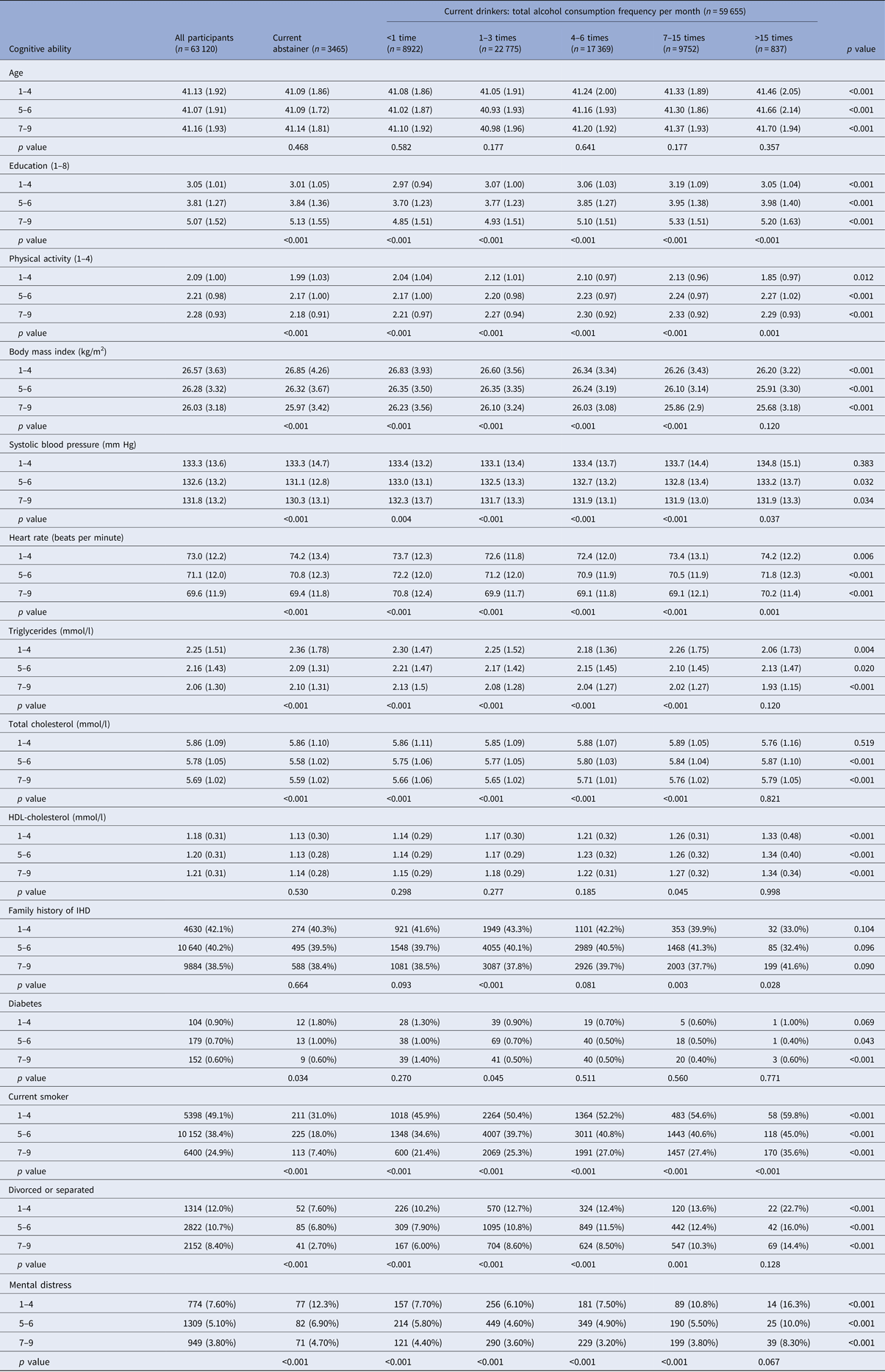
Table 1 presents descriptive statistics for the main sample (n = 63 120) according to categories of cognitive ability and alcohol consumption frequency. Overall, estimates tended to be less favourable in terms of cardiovascular risk factors, divorced/separated, and mental distress for the subjects with low ability (n = 10 986), more favourable for those with high ability (n = 26 455), and in between for those with medium ability (n = 25 679). Differences between categories of alcohol consumption were less consistent, with the exception of HDL-cholesterol, current smoking and divorces/separations, which appeared to follow a linear trend with more frequent consumption.
Descriptive statistics for 63 120 adult males according to cognitive ability and alcohol consumption

Presented as mean (s.d.) and counts (%). Groups of cognitive ability were defined as stanine scores from 1 to 4 (n = 10 986), 5–6 (n = 26 455), and 7–9 (n = 25 679). Mental distress was defined as a CONOR-mental health index ⩾2.15. Group differences were assessed with analysis of variance and the chi-squared test and included both current abstainers and current drinkers. Family history of ischemic heart disease (IHD)
Cognitive ability and alcohol consumption
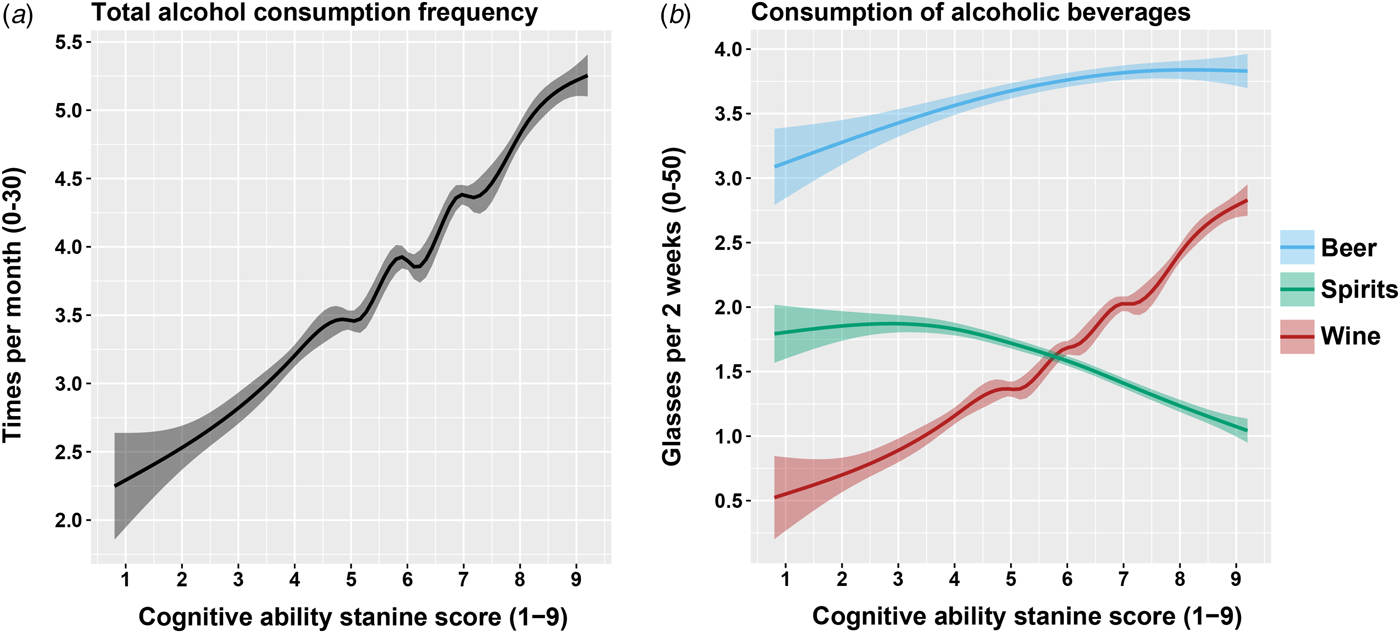
The percentage currently abstaining from alcohol was 5.5% overall and 6.2%, 4.7%, and 6.0% in groups of ability (low, medium, high), respectively. In comparison with the low group, the probability (95% CI) of abstaining in the medium and high groups was −1.45% (−1.96 to −0.95) and −0.22% (−0.73 to 0.29), respectively. Figure 1a depicts the relation of ability with total alcohol consumption frequency. Average frequency per month was 4.0 ± 3.8 overall and 3.0 ± 3.3, 3.7 ± 3.5, and 4.7 ± 4.1 within each group (low, medium, high). In comparison with the low group, the IRR (95% CI) of consumption in the medium and high groups was 1.23 (1.20–1.25) and 1.53 (1.50–1.57) when adjusted for age, and 1.20 (1.17–1.23) and 1.43 (1.39–1.46) when further adjusted for obtained education, respectively.
Cognitive ability and alcohol consumption among 59 655 adult male current drinkers. Smoothed means with 95% confidence intervals for the relation of cognitive ability measured in early adulthood with midlife (a) total alcohol consumption frequency (n = 59 655) and (b) consumption of different alcoholic beverages, including wine (n = 55 432), beer (n = 57 900) and spirits (n = 56 095).

Figure 1b depicts the relation of ability with the consumption of different types of beverages. The number of glasses consumed in the course of 2 weeks were 3.7 ± 4.9 for beer, 1.8 ± 2.9 for wine, and 1.5 ± 2.8 for spirits overall. Within each group of ability (low, medium, high), the number of glasses were 3.5 ± 5.1, 3.7 ± 4.8, and 3.8 ± 4.9 for beer, 1.0 ± 2.4, 1.5 ± 2.6, and 2.3 ± 3.4 for wine, and 1.9 ± 3.4, 1.6 ± 2.8, 1.3 ± 2.5 for spirits, respectively. In comparison with the low group, the age-adjusted IRR (95% CI) of consumption in the medium and high group were 1.06 (1.03–1.10) and 1.10 (1.06–1.13) for beer, 1.49 (1.43–1.56) and 2.19 (2.09–2.28) for wine, and 0.88 (0.85–0.92) and 0.70 (0.67–0.73) for spirits, respectively. When further adjusted for education, IRR were 1.10 (1.06–1.13) and 1.15 (1.11–1.18) for beer, 1.37 (1.31–1.43) and 1.74 (1.67–1.83) for wine, and 0.96 (0.92–1.00) and 0.86 (0.82–0.90) for spirits, respectively.
In the study population with data on heavy episodic drinking (n = 5425), the percentage reporting a binge drinking frequency of at least once per month was 27.8%, while 8.3% reported a frequency of at least once per week. The corresponding percentages in each group of ability (low, medium, high) were 22.9%, 27.2%, and 30.1%, respectively, and 6.5%, 8.0%, and 9.2%. In comparison with the low group, the age-adjusted probability (95% CI) of binging at least once per month in the medium and high group was 6.3% (2.7–10.0) and 9.8% (6.2–13.3), respectively, and 7.4% (3.6–11.1) and 11.0% (6.9–15.1) when further adjusted for education. The corresponding values for binge drinking at least once per week were 1.4% (−0.9 to 3.7) and 2.9% (0.6–5.1) when adjusted for age, and 2.1% (−0.0 to 4.5) and 3.8% (1.2–6.3) when further adjusted for education, respectively.
Interplay between cognitive ability, alcohol consumption, and health characteristics
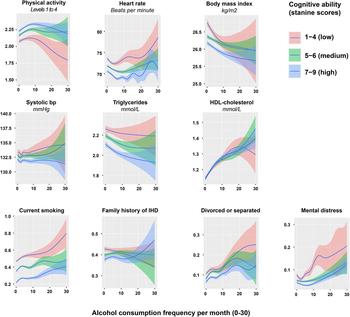
Figure 2 provides a visual presentation of the relation between total alcohol consumption frequency (n = 59 655) and health characteristics within each strata of cognitive ability, including cardiovascular risk factors and mental distress. There is less data and more uncertainty at very frequent intakes, as indicated by the wider CIs. At a glance, the curves indicate linear relationships with BMI, triglycerides, HDL-cholesterol, and the probability of current smoking, being divorced/separated, and current mental distress, and non-linearity for physical activity and heart rate. The relation between consumption and systolic blood pressure and the probability of a family history of IHD appear less consistent in the different strata.
The crude relationship between total alcohol consumption, cardiovascular risk factors, and mental distress, within strata of cognitive ability for 59 655 adult male current drinkers. Regression lines are smoothed means with 95% confidences intervals. The probabilities of current smoking, mental distress, a family history of ischemic heart disease (IHD), and being divorced or separated range from 0 to 1.

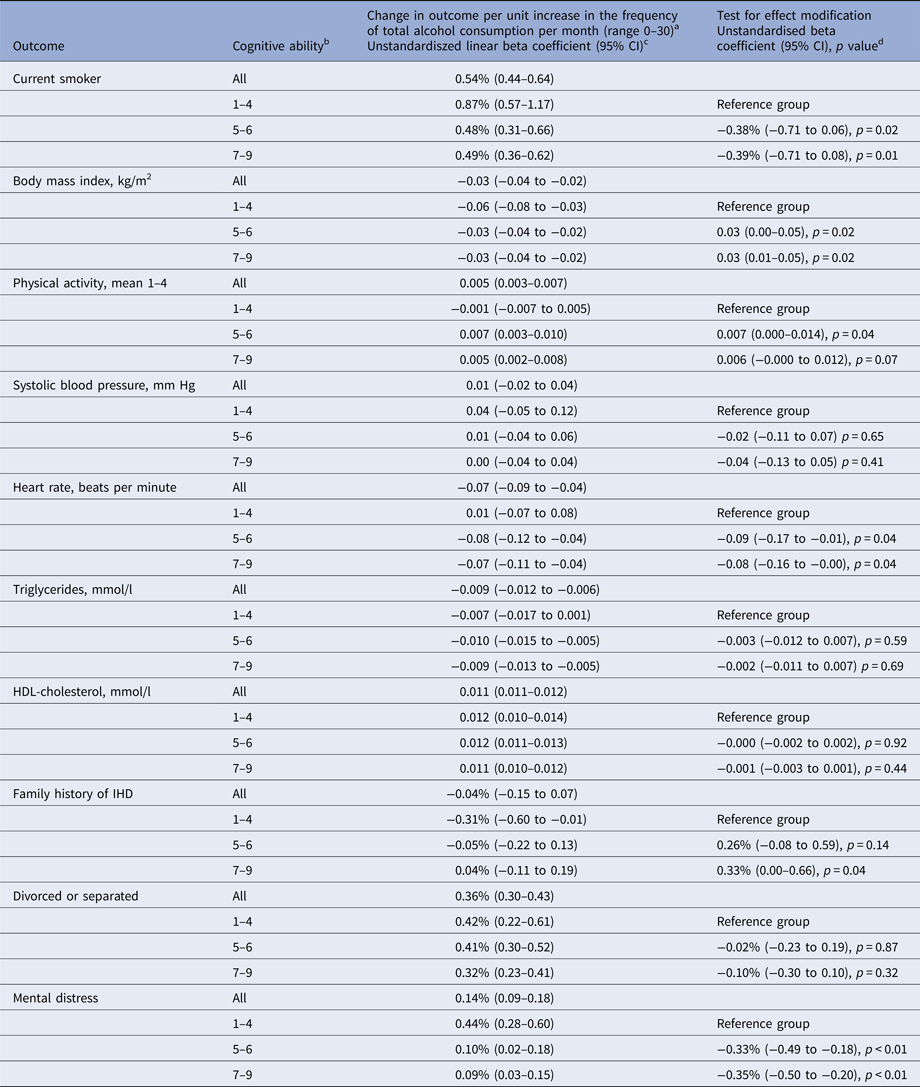
Table 2 provides the linear relations between alcohol consumption and health characteristics overall and within each strata of ability. More frequent alcohol consumption was associated with an increase in the probability of smoking, mental distress and divorce/separation, serum HDL-cholesterol and physical activity, and a decrease in heart rate, BMI and serum triglycerides. There was no association with systolic blood pressure. The slopes in the medium and high strata of ability differed (effect modification) from the low stratum for smoking, BMI, physical activity, heart rate, and mental distress. The increase in current smoking and mental distress with more frequent consumption, as well as the decrease in BMI, was more pronounced in the low stratum. In contrast to the two upper strata, there was no increase in physical activity or a decrease in heart rate in the low stratum.
Linear relation between alcohol consumption and different health characteristics among current drinkers (n = 59 655 adult males) in the full sample and in strata of cognitive ability

a Models adjusted for age and cognitive ability (if not used as a stratifying variable)
b Cognitive ability strata derived from a stanine score (range 1–9)
c Coefficients for dichotomous outcomes are multiplied by 100 and should be interpreted as the percentage point change in the probability of the outcome per one-unit increase in alcohol consumption frequency
d Test for effect modification on multiplicative scale, reflecting whether the linear slope in the medium (5–6) and high (7–9) group of ability differ from the slope in the low group (1–4), respectively
Online Supplementary Table S1 shows the relative comparison of health characteristics between current abstainers (n = 3465) and seldom consumers (n = 8922) overall and in strata of ability. Current abstaining was associated with lower systolic blood pressure, heart rate, the probability of smoking and divorce/separation, and a higher probability of mental distress. Associations in the medium and high strata of ability differed consistently from the low stratum for some characteristics. Current abstainers in the medium and high strata, but not in the low stratum, had lower systolic blood pressure and heart rate than seldom consumers, while current abstainers in the low strata, but not in the medium and high strata, had a higher probability of mental distress.
Discussion
Principle findings
Among Norwegian men, higher cognitive ability in early adulthood was associated with more frequent alcohol consumption in midlife. Higher wine consumption seems to account for this difference, and to some degree higher beer consumption, while consumption of spirits was inversely associated with ability. Heavy drinking episodes, or binge drinking, was positively associated with ability in a smaller separate sample. Aside from alcohol, the individuals with lower ability were more highly exposed to adverse health characteristics such as smoking and mental distress. More frequent alcohol consumption associated with higher levels of physical activity and lower heart rate, but also more tobacco smoking and mental distress. However, the associations were different depending on ability. The association with smoking and mental distress was more pronounced among participants with low ability, and the favourable association with physical activity and heart rate was confined to participants with higher ability.
Cognitive ability and alcohol consumption
The hypothesis that cognitive ability could influence alcohol consumption, and not only the other way around, was stated decades ago (Parker & Noble, Reference Parker and Noble1977). Our findings support the hypothesis and suggest that the relation for Norwegian men is positive. The bulk of previous studies on the topic also support a positive relation in other countries (Fleming et al. Reference Fleming, Kellam and Brown1982; Hunt et al. Reference Hunt, Coggan, Berg and Tianwattanatana1984; Mortensen et al. Reference Mortensen, Sorensen and Gronbaek2005; Hatch et al. Reference Hatch, Jones, Kuh, Hardy, Wadsworth and Richards2007; Batty et al. Reference Batty, Deary, Schoon, Emslie, Hunt and Gale2008; Johnson et al. Reference Johnson, Hicks, McGue and Iacono2009; Kanazawa & Hellberg, Reference Kanazawa and Hellberg2010; Corley et al. Reference Corley, Jia, Brett, Gow, Starr and Kyle2011; Cheng & Furnham, Reference Cheng and Furnham2013; Latvala et al. Reference Latvala, Rose, Pulkkinen, Dick and Kaprio2014; Clouston et al. Reference Clouston, Richards, Cadar and Hofer2015). However, the related studies are very heterogeneous in terms of how and when cognitive ability and alcohol consumption were measured. A few studies observed no relation (Windle & Blane, Reference Windle and Blane1989; Kubicka et al. Reference Kubicka, Matejcek, Dytrych and Roth2001; Wennberg et al. Reference Wennberg, Andersson and Bohman2002; Stautz et al. Reference Stautz, Pechey, Couturier, Deary and Marteau2016), and some observed inverse or non-linear relationships (Batty et al. Reference Batty, Deary and Macintyre2006; Muller et al. Reference Muller, Kowalewski, Metzler, Stettbacher, Rossler and Vetter2013; Sjolund et al. Reference Sjolund, Hemmingsson and Allebeck2015).
Cognitive ability and socioeconomic position are closely related. In adolescence and adulthood, individuals are selected on ability into different socioeconomic environments, such as educational and career trajectories, where social status, income, health consciousness, risk factors, and social support may differ (Deary, Reference Deary2013; Ariansen et al. Reference Ariansen, Mortensen, Igland, Tell, Tambs and Graff-Iversen2015). It is also within this environment that people tend to find their partner, subjecting cognitive ability to assortative mating, and causes it to correlate strongly between partners (Plomin & Deary, Reference Plomin and Deary2015). Cognitive ability is also very heritable, thus when highly educated and intelligent partners reproduce, assortative mating contributes to a positive relation between the offspring's genetic propensity for cognitive ability and the early life socioeconomic position (Plomin & Deary, Reference Plomin and Deary2015). Alcohol consumption has consistently been observed to be more frequent among socioeconomically advantaged groups (Management of Substance Abuse Team., 2014), and this relationship could overlap with the one we observed for ability. However, the influence of ability on total alcohol consumption was only slightly attenuated when we adjusted for the potential mediating effect of obtained education, which is an indicator of socioeconomic position.
The relation between cognitive ability and the consumption of different alcoholic beverages was strongest for wine, which was also observed in Danish men (Mortensen et al. Reference Mortensen, Sorensen and Gronbaek2005) and Scottish women and men (Corley et al. Reference Corley, Jia, Brett, Gow, Starr and Kyle2011). Wine is not produced in Norway, retail is confined to alcohol monopolies, and alcohol taxes are particularly high on a relative scale (Osterberg, Reference Osterberg2011). Socioeconomically advantaged groups may be more inclined to purchase wine for culinary purposes, and afford to do so, which further support heritability and selection as possible mechanisms. The inverse association with spirit consumption is opposite of the findings in the Scottish study (Corley et al. Reference Corley, Jia, Brett, Gow, Starr and Kyle2011). Spirits are, similar to wine, only available for sale through the monopolies, but in contrast, has a history of home production in Norway. Interestingly, when further adjusted for education, the influence of ability on wine consumption remained strong but was notably attenuated. The influence on higher beer consumption increased in contrast, while the influence on lower spirit consumption was attenuated towards the null. This suggests that education mediates in part the influence of ability on wine, and that this role was masked when the relationship was analysed on total consumption level where the different type of beverages were not taken into account.
Cognitive ability may help individuals understand and appreciate the risks and benefits associated with different behaviours, and by that virtue influence cardiovascular health (Marmot & Kivimaki, Reference Marmot and Kivimaki2009; Clouston et al. Reference Clouston, Richards, Cadar and Hofer2015). Drawing rational and healthy decisions when all risks are known, however, also involve aspects not assessed by the measurements which constitute general cognitive ability (Toplak et al. Reference Toplak, Sorge, Benoit, West and Stanovich2010). While the adverse health effects of tobacco are clear, the effects of alcohol are complex, and when applying this perspective, it is not intuitive in which direction cognitive ability may influence consumption. Fifty-eight percent of adult Norwegians believe that a glass of wine is healthy (Norwegian Directorate of Health, 2012), perhaps because of biased media coverage or the tendency to prefer information that confirms existing or wishful beliefs (Nickerson, Reference Nickerson1998). It is plausible that some Norwegians consume wine for perceived health effects, but we did not have information on the relation between cognitive ability, the perception of the healthiness of alcohol and alcoholic beverages, and alcohol consumption. Different type of alcoholic beverages are consumed for pleasure, but there are aspects of wine that might be best appreciated by those with knowledge and skill to taste them. This would again require interest, training, and financial resources, and preferably an environment that shares the interest, which might be a reason why we observe that both ability and education has the strongest influence on wine consumption.
We found a positive relation between cognitive ability and binge drinking. The relation did not change to a large degree when further adjusted for education, and if any resulted in a stronger association. This finding was unexpected, given that the known harmful effects of binge drinking should be an incentive for health conscious groups to avoid the behaviour. It is also in sharp contrast to the inverse relation observed in the limited number of previous studies on the subject, including a prospective Scottish study using hangovers as a proxy for binge drinking (Batty et al. Reference Batty, Deary and Macintyre2006), a prospective study from Great Britain (Cheng & Furnham, Reference Cheng and Furnham2013), and a cross-sectional study of Swedish military conscripts (Sjolund et al. Reference Sjolund, Hemmingsson and Allebeck2015). Although unexpected, comparable studies of the relation between ability in childhood and illegal drug use in adulthood are also mixed (White et al. Reference White, Gale and Batty2012). To explain why ability should cause alcohol and drug use, one study emphasised the co-variation between higher ability and personality traits associated with alcohol and drug use (White & Batty, Reference White and Batty2011; Hakulinen et al. Reference Hakulinen, Elovainio, Batty, Virtanen, Kivimaki and Jokela2015). Given that both cognitive ability and these personality traits are heritable (Devlin et al. Reference Devlin, Daniels and Roeder1997; Ystrom et al. Reference Ystrom, Reichborn-Kjennerud, Aggen and Kendler2011; Polderman et al. Reference Polderman, Benyamin, de Leeuw, Sullivan, van Bochoven and Visscher2015), common genetic factors with pleiotropic effects could explain why subjects with higher ability more frequently binge drink. Another possibility is that the amount of alcohol consumed per episode is different depending on ability, meaning that despite a higher frequency, each episode is less heavy among those with higher ability.
Interplay between cognitive ability, alcohol consumption, and health characteristics
We observed that individuals with low cognitive ability were more highly exposed to cardiovascular risk factors and mental distress. Traditional risk factors are accounted for in studies assessing the relation between alcohol consumption and the risk of cardiovascular events, but mental distress is seldom measured. The consistent differences for measured risk factors indicate that ability might be associated with other risk factors, including those that are subtle, less influential and difficult to measure individually, but which together could constitute an important confounding effect. For example, a Danish study neatly revealed that wine buyers, which is consumed more frequently with higher ability, more often purchase healthy food items than beer buyers (Johansen et al. Reference Johansen, Friis, Skovenborg and Gronbaek2006). The measurement and inclusion of ability would thus be required to account for these subtle differences.
We also observed that the associations between alcohol consumption and health characteristics were different depending on ability, or in other words, that cognitive ability modifies the relation between consumption, risk factors, and mental distress. This implicates ability and alcohol consumption in a more complex interplay with other health characteristics and the risk of cardiovascular events. It further suggests that the relationship between alcohol consumption and the risk of cardiovascular events, and potentially other alcohol-related outcomes, is confounded differently in subjects with low and high ability, and that a combined analysis of these subjects may fail to incorporate this information. It should be underlined that the co-variation did not diverge in opposing directions for any of the health characteristics, which would be the case if alcohol consumption were associated with less smoking in the high strata of ability and more smoking in the low strata.
In light of the cross-sectional data, the interplay may be interpreted from different perspectives. Subjects with low ability could be less able to incorporate alcohol into a healthy lifestyle, as indicated by the lack of co-variation with physical activity and heart rate, and more susceptible or less resistant to the disinhibitory or spillover effects of alcohol, as indicated by the stronger association with more smoking and mental distress. Consequently, more frequent alcohol consumption could worsen the existing tendency of adverse health characteristics to accumulate at lower ability. Cognition is involved in how humans regulate emotions (Ochsner & Gross, Reference Ochsner and Gross2005; Ochsner et al. Reference Ochsner, Silvers and Buhle2012), and subjects with higher ability are more often born and selected into more advantaged socioeconomic environments where the level of social support and health awareness is probably stronger. Another possible interpretation is that the measurement of cognitive ability in this study successfully differentiated the participants according to how adequately they were able to deal with mental distress, in which the steeper increase in alcohol consumption among subjects with the low cognitive ability is a consequence of this difference, not a cause.
Current abstainers consistently smoked less than seldom consumers in all strata of cognitive ability, and in the medium and high strata, current abstaining was also associated with lower systolic blood pressure and heart rate. In contrast, mental distress was more frequent among current abstainers in the medium stratum, and even more so in the low stratum, but no association was observed in the high stratum. These findings indicate that in the medium and high strata of cognitive ability, current abstainers are healthier than seldom consumers are, while differences in the low strata are inconsistent.
Methodological considerations
The study population was limited to Norwegian men who attended both the mandatory evaluation for military conscription and a health survey in midlife, which is likely a somewhat healthier sample than the general population. Participants without an entry in the military database did not differ from complete cases, but participants with missing values on alcohol tended to have lower education and cognitive ability. There were few missing values on alcohol consumption frequency in the main sample, but more missing on binge drinking in the second sample, suggesting that participants with lower ability were somewhat underrepresented in analyses of binge drinking. As it is not possible to elucidate the distribution pattern of binge drinking among those with missing values, we assume that it was comparable with complete cases. It is questionable to which extent the findings apply to women, as they tend to drink less than men do. The relationships observed in this study are context specific and could differ when this changes, such as in sub-populations or other countries.
Alcohol consumption may vary over time and be difficult to recall, leading to measurement errors when using self-reporting. The large sample size provides robustness to account for random errors, but not systematic errors, and cognitive ability could be a source of systematic error. However, if we consider serum HDL-cholesterol concentrations to be a biomarker of alcohol consumption (Brien et al. Reference Brien, Ronksley, Turner, Mukamal and Ghali2011), we observed that the linear increase in HDL-cholesterol concentration with increasing alcohol consumption was comparable in strata of ability (Table 2). When comparing the group consuming alcohol over 15 times per month to the group consuming alcohol 7–15 times within each strata of ability (Table 1), HDL-cholesterol differed between 0.07 and 0.08 mmol/l. This represented an increase of about 25 g alcohol per day (Brien et al. Reference Brien, Ronksley, Turner, Mukamal and Ghali2011), and indicated no particular increase in the low ability group in which alcohol consumption associated more strongly with adverse health characteristics. Therefore, we regard it as unlikely that differential relationships between alcohol and other health characteristics were spurious results of this potential bias.
Cognitive ability was measured in early adulthood, which is evidence to support that it could influence midlife alcohol consumption. However, we are not able to rule out the possibility of reverse causality, in which mental distress or alcohol consumption in childhood and early adolescence could have influenced the development of cognitive ability or the performance on the tests. We limited our study to estimate the overall association with cognitive ability and the potential mediating effect of obtained education, but in contrast to some previous studies, did not attempt to elucidate whether cognitive ability was mediating an effect of childhood socioeconomic position.
We have based inferences on the existence of an overall linear association, which may be somewhat rigid and misguiding, as there were indications for non-linearity for physical activity and heart rate. There could be subjects combining moderate alcohol consumption with a healthy lifestyle at both high and low levels of cognitive ability, as well as subjects combining heavy drinking with an unhealthy lifestyle, but the distribution of these subjects may differ by ability. This could also be the reason why we do not observe an association with systolic blood pressure, despite evidence for a causal effect of alcohol on this cardiovascular risk factor (Chen et al. Reference Chen, Smith, Harbord and Lewis2008).
The current study had a large size, a clear temporal separation where ability was measured prior to alcohol consumption, it measured different types of alcoholic beverages as well as binge drinking, and incorporated the potential mediating role of education. It, therefore, conveys an important contribution to existing literature on the influence of ability on alcohol consumption. It also implicates ability in the development of social inequalities in health, linking together studies showing that individuals with low cognitive ability are more highly exposed to risk factors and mental distress, and studies showing that socioeconomically disadvantaged groups experience more harmful effects of alcohol from a given level of exposure.
Conclusions
Among Norwegian men, higher early adulthood cognitive ability was associated with more frequent alcohol consumption and binge drinking in midlife. More frequent alcohol consumption associated with higher levels of physical activity and lower heart rate, but also more tobacco smoking and mental distress. While the association with smoking and mental distress was more pronounced among participants with low ability, the favourable association with physical activity and heart rate was confined to participants with higher ability. These findings show that ability is involved in how a given level of alcohol consumption relate to major risk factors and mental health, and thereby implicate ability in the development of the alcohol harm paradox and social inequalities in health.
Supplementary material
The supplementary material for this article can be found at https://doi.org/10.1017/S0033291717003543.
Acknowledgements
Norges Forskningsråd (ES530767).