Introduction
Depression is the second most prevalent mental health condition in the United States (Kessler et al. Reference Kessler, Berglund, Demler, Jin, Koretz, Merikangas, Rush, Walters and Wang2003). Major depressive disorder (MDD) afflicts more than one in seven adults over their lifetime and patients with subthreshold depressive symptoms are two to three times as prevalent (Katon & Schulberg, Reference Katon and Schulberg1992; Hays et al. Reference Hays, Wells, Sherbourne, Rogers and Spritzer1995). Combined, this sector of the adult population experiences decreases in well-being and in social and occupational role functioning that are comparable with patients with chronic medical illnesses (Hays, Reference Hays, Wells, Sherbourne, Rogers and Spritzer1995; Spitzer et al. Reference Spitzer, Kroenke, Linzer, Hahn, Williams, deGruy, Brody and Davies1995; Wells & Sherbourne, Reference Wells and Sherbourne1999; Hirschfeld et al. Reference Hirschfeld, Williams, Spitzer, Calabrese, Flynn, Keck, Lewis, McElroy, Post, Rapport, Russell, Sachs and Zajecka2000; Cuijpers et al. Reference Cuijpers, Smit, Oostenbrink, de Graaf, Ten Have and Beekman2007). Nevertheless, most people with depressive disorders receive no treatment (Kessler et al. Reference Kessler, McGonagle, Zhao, Nelson, Hughes, Eshleman, Wittchen and Kendler1994; Bijl & Ravelli, Reference Bijl and Ravelli2000; Andrews et al. Reference Andrews, Issakidis and Carter2001).
About half of American mental healthcare is provided by general healthcare practitioners, who prescribe 70% of psychotropic medications (Strosahl, Reference Strosahl1994). However, a high proportion of patients prefer not to take medications and many who fill prescriptions do not adhere to the prescribed regimen (Kessler et al. Reference Kessler, McGonagle, Zhao, Nelson, Hughes, Eshleman, Wittchen and Kendler1994; Frank et al. Reference Frank, Rush, Blehar, Essock, Hargreaves, Hogan, Jarrett, Johnson, Katon, Lavori, McNulty, Niederehe, Ryan, Stuart, Thomas, Tollefson and Vitiello2002). Concurrently, there is evidence that cognitive-behavioral therapy can provide clinical benefit equivalent to medication and can help prevent relapse (Evans et al. Reference Evans, Hollon, DeRubeis, Piasecki, Grove, Garvey and Tuason1992; Mintz et al. Reference Mintz, Mintz, Arruda and Hwang1992; Shea et al. Reference Shea, Elkin, Imber, Sotsky, Watkins, Collins, Pilkonis, Beckham, Glass, Dolan and Parloff1992; Hollon et al. Reference Hollon, Stewart and Strunk2006).
To help find interventions that can reach more people in need, computer-assisted instructional programs applying cognitive-behavioral therapy techniques (CCBT) have increasingly been trialed (Marks et al. Reference Marks, Cavanagh and Gega2007; Spek et al. Reference Spek, Cuijpers, Nyklicek, Riper, Keyzer and Pop2007; Andersson & Cuijpers, Reference Andersson and Cuijpers2009; Cuijpers & Andersson, Reference Andersson2009). Computer-assisted instruction can efficiently reach wide audiences and can potentially heighten learner engagement by presenting a self-paced learning environment incorporating features such as audio narration, music, graphic design, animation and video. Computer-assisted programs can also provide interactive rather than strictly linear learning environments, presenting personalized responses to user entries and choices. If effective, such a resource could offer a low cost, minimally intrusive adjunct or alternative intervention to usual care that might, in fact, be preferred by patients who commit neither to medications nor therapy.
In recent years, a number of randomized controlled trials have demonstrated the benefits of computer-delivered interventions in comparison with usual treatment and, in some cases, in comparison with therapist-delivered interventions (Proudfoot et al. Reference Proudfoot, Goldberg, Mann, Everitt, Marks and Gray2003; Grime, Reference Grime2004; Kaltenthaler et al. Reference Kaltenthaler, Brazier, de Nigris, Tumur, Ferriter, Beverley, Parry, Rooney and Sutcliffe2006; Seligman, Reference Seligman2006; Kaltenthaler et al. Reference Kaltenthaler, Parry, Beverley and Ferriter2008; Spek et al. Reference Spek, Cuijpers, Nyklicek, Smits, Riper, Keyzer and Pop2008; Andersson, Reference Andersson2009; Green & Iverson, Reference Green and Iverson2009). The accumulating evidence is promising; two recent meta-analyses concluded that a computer-assisted delivery medium can provide a significant clinical benefit (Spek et al. Reference Spek, Cuijpers, Nyklicek, Riper, Keyzer and Pop2007; Andersson & Cuijpers, Reference Andersson and Cuijpers2009). The present study applied a randomized controlled trial to evaluate a computer-assisted instructional intervention entitled the Wellness Workshop (WW). The study evaluated outcomes among adults perceived to be depressed by a primary-care physician as compared with a randomly assigned control group, who received similar care but no computer-assisted instruction.
WW is a National Institutes of Health-supported, stand-alone interactive instructional program on CD-ROM for delivery on a personal computer. The program was designed to present the essential instructional elements of the coping with depression (CWD) intervention model originally developed in 1969 by P. M. Lewinsohn and associates (Lewinsohn et al. Reference Lewinsohn, Weinstein, Shaw, Rubin and Frank1969; Cuijpers et al. Reference Cuijpers, Muñoz, Clarke and Lewinsohn2009). Over the past 40 years, the CWD model has evolved and has been shown to be an effective treatment for depression across adolescent, adult, geriatric, geriatric caregiver, alcohol-dependent and smoking cessation populations (Clarke et al. Reference Clarke, Lewinsohn and Hops1990; Lewinsohn et al. Reference Lewinsohn, Rohde, Hops and Clarke1991; Brown et al. Reference Brown, Evans, Miller, Burgess and Mueller1997). A 2009 meta-analysis of 25 CWD studies concluded that the CWD intervention is efficacious across age, gender and race/ethnic groups and can be effectively delivered using a variety of treatment modalities (Cuijpers et al. Reference Cuijpers, Muñoz, Clarke and Lewinsohn2009).
The content of the WW program combines cognitive and behavioral strategies aimed at ameliorating the types of problems that have been shown to be troublesome for depressed individuals (e.g. negative thinking, low engagement in pleasant activities, social withdrawal, anxiety and tension, problematic social support). The program presents five modules that provide step-by-step instruction on: (1) increasing pleasant activities; (2) using applied relaxation skills; (3) correcting non-constructive self-talk and solving problems proactively; (4) increasing physical activity; (5) applying communications skills such as active listening, I-statements and conflict resolution.
The CD-ROM format was selected because it provides a portable multimedia product that the user can take home and own. Unlike a book, WW combines multimedia elements (music, graphic art, text and audio narration) to introduce and provide examples for applying specific cognitive-behavioral skills. In addition, although the relative salience of the interactivity feature remains undetermined (Christensen et al. Reference Christensen, Griffiths and Jorm2004), the program presents interactive quizzes that reinforce key concepts, opportunities for active practice of skills and the opportunity to track mood self-ratings over time. The instruction presents options for self-directed exploration, while also guiding the user to develop personalized plans for managing mood. A graphic representation of the WW main menu is presented in Fig. 1.
Wellness Workshop main menu screen.

The CD-ROM format cannot offer certain significant advantages of the internet, which has lately become the primary medium for CCBT instruction. For example, on the web, providers and patients can exchange information readily through electronic messaging and common access to patient-specific information. Web-based programs can also provide easy access to almost unlimited information and can be continually updated. Ultimately, whether web-delivered or on a take-home disk, an electronic program offers significant cost-efficiencies compared with direct provider interaction with the patient.
Hypothesis
The current study was designed to test the primary hypothesis that participants assigned the WW would report greater reductions of depression and greater improvements on relevant cognitive-behavioral skills at post-treatment than a control group that received the same usual care, but no exposure to the WW program.
Method
Participants
Participant recruitment was conducted through primary-care physicians (PCPs) in Lane County, Oregon and identified from medical directory listings and the local phone book. The identified physician list was reviewed by a physician consultant, a former medical director for multiple pharmaceutical clinical trials. PCPs included those working within family medicine, gynecology and internal medicine practices. A total of 206 physicians were invited to refer patients to the study and 120 (58%) made participant referrals. A patient was eligible for the study if they were referred by their PCP, met the DSM-IV criteria for depressed mood or anhedonia during the previous 2-week period and were aged between 18 and 65 years old.
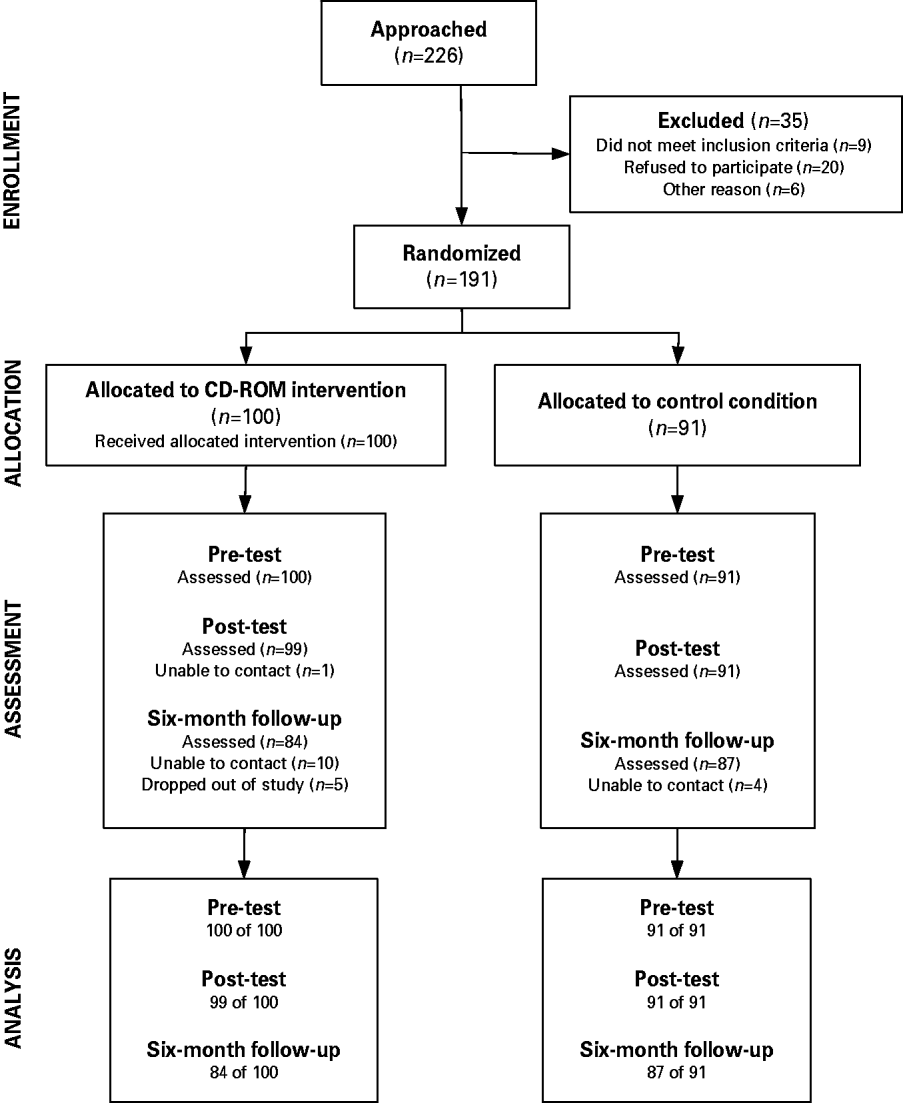
PCPs referred 226 patients to the study; 191 met study inclusion criteria and agreed to participate (see Fig. 2). All participants underwent an informed consent procedure approved by the Institutional Review Board at Oregon Research Institute. A computer-generated random list of numbers matched to study condition was allocated to participants at the intake assessment by a research assistant, resulting in simple randomization to one of the two conditions: (1) ‘treatment as usual’ control (TAU, n=91) or (2) treatment as usual plus the WW CD-ROM program (TAU+WW, n=100). The sample included 77% female, 90% white, 36% married, 30% with bachelor's degree, 49% employed, 57% with MDD, 7% with dysthymia, 49% with an anxiety disorder, 14% with substance abuse/dependence and their mean age was 43.5 (s.d.=12.9) years. There were no significant differences on the demographic characteristics by condition. Referring physicians were not informed by the research team of patient assignments to conditions. Patients in each condition were equally likely to receive medication, mental health intervention and/or other interventions as directed by their physician. There was no attempt to coordinate care with referring physicians. We did not collect data on the independent impact on patient outcomes of these additional interventions.
Flow of participants through each stage of the study.

To minimize attrition, participants were compensated $75 at each data point for completing the questionnaire and interview assessments. Attrition was low, especially considering that minimal direct contact was provided to the treatment participants. At the 6-week assessment, 190 (99%) of the participants completed follow-up protocols. At the 6-month assessment, 172 (90%) participants remained available for assessment.
Intervention
Program distribution
The WW was delivered as a stand-alone product by mail to participants in the treatment condition. Three computer sites at hospital-based health education libraries were set up for the TAU+WW participants who did not have access to a home computer. The three sites were located in different areas of the community and were managed by healthcare librarians. The locations of the computer stations within the libraries were comfortable, quiet and private. All data files generated by participants while using the WW program were secured by password protection.
Participants who were assigned the WW received one brief (⩽5 min) telephone prompt approximately 2 weeks after the WW was mailed. The telephone call was made by a psychologist, who encouraged the use of the program and answered any questions about the navigation or content of the program.
Measurement
Self-report survey data was collected at the intake, 6-week post-treatment and 6-month follow-up assessments and interview data were collected at intake and at the 6-week post-treatment assessment. In addition to basic demographic characteristics (gender, race, marital status, education and employment status) the following six scales were assessed:
Center for Epidemiological Studies – Depression scale (CES-D) consists of 20 items assessing the frequency of depression symptoms that had occurred during the past week on a 4-point scale (Radloff, Reference Radloff1977).
Pleasant Events Schedule (PES), Mood-Related subscale consists of 49 events occurring during the past month that are rated for frequency and pleasantness, both on a 3-point scale (MacPhillamy & Lewinsohn, Reference MacPhillamy and Lewinsohn1982).
State-Trait Anxiety Inventory (STAI) consists of 10 items assessing the degree to which current anxious and relaxed feelings are occurring on a 4-point scale (Spielberger et al. Reference Spielberger, Gorsuch and Luschene1970).
Dysfunctional Attitudes Scale (abbreviated) consists of nine items assessing the degree to which dysfunctional attitudes or beliefs are endorsed on a 5-point Likert-type scale (Weissman & Beck, Reference Weissman and Beck1978).
Hope Scale consists of eight items assessing both agency (belief in one's capacity to obtain and sustain actions) and pathways (belief in one's ability to generate routes) to reach goals (Snyder et al. Reference Snyder, Sympson, Ybasco, Borders, Babyak and Higgins1996).
Consumer opinion survey
A consumer opinion survey, specifically developed for this study, was administered at the post-assessment. Participants were asked to make ratings regarding the program contents and effects based on a 6-point Likert-type scale (strongly disagree – strongly agree). Additional self-report items regarding the amount of program use were added to the survey. No direct electronic records of usage patterns were collected.
Intake interview
Diagnostic interviewers assessed the recruited participants for depression (minor depressive disorder, MDD and dysthymia), substance abuse/dependence and anxiety disorders using the Structured Clinical Interview for DSM-IV (SCID), non-patient version (First et al. Reference First, Spitzer, Gibbon and Williams1994). The SCID is a widely-used semi-structured interview that yields DSM-IV diagnoses for all major Axis I disorders.
Post-treatment interview
At post-treatment (6 weeks after intake) the Longitudinal Interval Follow-up Evaluation (LIFE; Keller et al. Reference Keller, Lavori, Friedman, Nielsen, Endicott and McDonald-Scott1987) was used in conjunction with the SCID to evaluate syndromal or diagnostic changes since the previous interview. The LIFE is a well-established follow-up interview that generates a continuous measure of psychopathology by eliciting detailed information about the longitudinal course of all disorders present at last interview. It also probes for the occurrence of new disorders since the previous interview. By means of careful questioning, the interviewer establishes the approximate dates for critical transition points (i.e. offset of a previous episode; onset of a new episode). On the basis of this information, the interviewer makes weekly ratings of symptom levels for each diagnosis that is being tracked during the follow-up interval. The inter-rater reliability has shown to be satisfactory by the LIFE's authors (Elkin et al. Reference Elkin, Parloff, Hadley and Autry1985; Keller et al. Reference Keller, Lavori, Friedman, Nielsen, Endicott and McDonald-Scott1987).
Interviewers
Diagnostic interviewers were required to have experience in a mental health field and complete a rigorous training programme in the use of the SCID/LIFE procedures, demonstrating an average inter-rater reliability level of κ ⩾0.80 before conducting experimental interviews (κ's ⩾0.70 are generally considered acceptable). Interviewers were blinded to study condition.
Diagnostician
A PhD-level clinical psychologist reviewed all of the information collected by the interviewer to arrive at ‘best estimate’ diagnoses for each participant at each assessment point. This review was essential for establishing validity of the diagnoses made by the diagnostic interviewer. The best estimate diagnosis was used in the statistical analyses.
Statistical analysis
The expectation of baseline equivalency due to random assignment of groups was examined. The two conditions were compared on demographic characteristics, diagnostic status and outcome measures collected at pre-test. Contingency table analyses and t tests were conducted on categorical and continuous measures, respectively. Bias due to attrition was also examined using contingency table and logistic regression analyses. The effects of study condition and gender on the post-test outcome measures were examined using a two-way, between subjects, multivariate analysis of covariance adjusting for pre-test outcomes. A similar analysis was conducted to evaluate the maintenance of intervention gains on outcome measures assessed at 6-month follow-up. Contingency table and hierarchical logistic regression analyses were used to compare differential rates of onset and recovery of MDD and/or dysthymia occurring between the pre-test and post-test. For all tests, α was set to p<0.05, two-tailed.
Results
Preliminary analysis
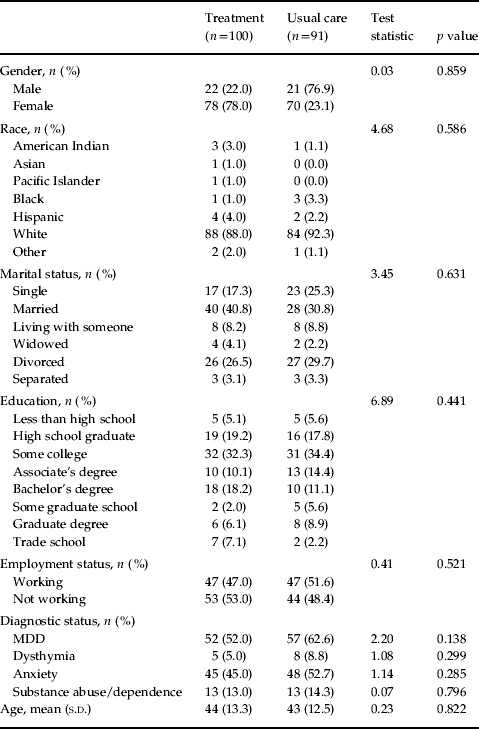
The two intervention groups did not statistically differ with regard to demographic characteristics or rates of diagnoses (see Table 1). However, baseline group differences were found for two of the six outcome measures. MDD symptoms were significantly lower (t 189=−2.18, p=0.031) for TAU+WW participants (mean=4.6, s.d.=3.1) than TAU participants (mean=5.6, s.d.=2.8). In addition, PES cross product scores were statistically higher (t 189=2.18, p=0.030) for the TAU+WW participants (mean=84.0, s.d.=29.2) than the TAU participants (mean=74.8, s.d.=29.3). All subsequent analyses controlled for these baseline differences between conditions.
Baseline demographics by condition

MDD, Major depressive disorder.
Contingency table analyses and independent observation t tests were conducted on categorical variables and age, respectively.
Examination of attrition between pre- and post-test showed only one (1%) of the TAU+WW participants dropped out and none of the TAU participants dropped out [χ2 (1, n=191)=0.91, p=0.339]. From pre-test to 6-month follow-up, a significantly higher attrition rate was observed for the TAU+WW condition compared with the TAU condition [15% v. 4%; χ2 (1, n=191)=5.98, p=0.014]. Participants who dropped out of the study between T1 and T3 (n=19) were also compared with those who continued participating (n=172) on the pre-test outcome measures. Compared with the participants who completed both T2 and T3 assessments, those who dropped out had significantly lower means on the Hope Scale (17.4 v. 19.4; t 189=2.03, p=0.044). However, no significant interactions between condition and baseline measures were found to be significant.
Post-test outcome analysis
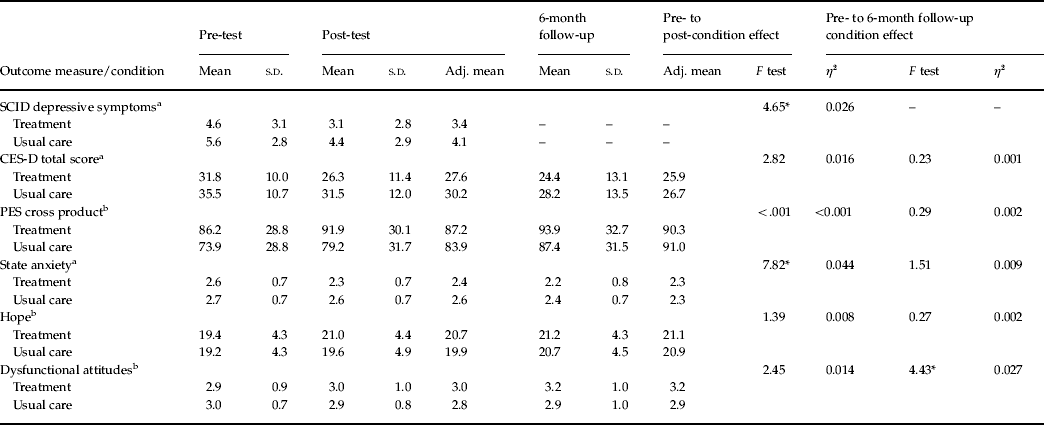
A significant multivariate condition effect was observed in which the TAU+WW participants were found to have greater improvement compared with the TAU participants (F 6,166=2.29, p=0.037, η2=0.077). As can been seen in Table 2, significant condition effects were obtained for MDD symptoms (F 1,171=4.65, p=0.033, η2=0.026) and STAI (F 1,171=7.82, p=0.006 η2=0.044). The multivariate gender effect was not significant (F 6,166=0.91, p=0.490) nor was the condition×gender interaction (F 6,166=0.72, p=0.635).
Pre, post and 6-month follow-up descriptive statistics and analysis of covariance results for the outcome measures

Adj, Adjusted; SCID, Structured Clinical Interview for DSM-IV; CES-D, Center for Epidemiological Studies – Depression Scale.
a higher score represents more dysfunction.
b lower score represents more dysfunction.
* p<0.05.
6-Month follow-up analysis
Neither the multivariate gender nor condition effects were significant at the 6-month follow-up assessment after controlling for pre-tests scores, baseline PES and MDD symptom scores (F 5,157=1.00, p=0.417 and F 5,157=1.33, p=0.253, respectively). As can been seen in Table 2, a significant effect was obtained for dysfunctional attitudes in the predicted direction (F 1,161=4.43, p=0.037, η2=0.027). The condition×gender interaction was non-significant (F 5,157=0.67, p=0.649).
Depressive episode onset and remission
In total, 77 (40%) of the study participants had subthreshold levels of depression at baseline and did not meet full criteria for MDD or dysthymia. Of these participants, onset rates of MDD or dysthymia were 10% for the TAU group and 4% for the TAU+WW group. A hierarchical logistic regression analysis controlling for gender, depressive symptomatology and PES cross product scores collected at baseline was conducted to determine the effect of TAU+WW condition on onset of depressive episode between pre- and post-test. The effect of condition on onset was not statistically significant [likelihood ratio χ2(1, n=77)=0.98, p=0.323; odds ratio (OR)=2.65, 95% confidence interval (CI)=0.37–18.93].
Conversely, 114 (60%) of the study participants were diagnosed with MDD or dysthymia at baseline. Of these participants, differential rates of episode remission were observed between the TAU+WW (23%) and TAU controls (10%). A hierarchical logistic regression analysis controlling for gender, depressive symptomatology and PES cross product scores collected at baseline was conducted to determine the effect of treatment condition on episode remission. The effect of condition on recovery was statistically significant [likelihood ratio χ2(1, n=114)=4.20, p=0.040; OR=3.18, 95% CI=1.01–10.04] suggesting that the TAU+WW participants were three times more likely to remit than the usual care participants.
Program utilization and viewer satisfaction
Based upon self-report data (computer log records were not available) of the 100 participants assigned to the TAU+WW condition, 27 (27%) did not view the program. Of the 73 active TAU+WW participants, the mean total time of program use was 258.1 min (s.d.=294.5, range=10–1500). Active participants used the program for an average of 2.9 weeks (s.d.=1.8, range=1–8), 2.2 times per week (s.d.=1.3, range=1–8) and 40.5 min per use (s.d.=21.1, range=10–120). On a 4-point scale (not at all – most of the time), participants reported they occasionally made use of the journal (mean=1.9, s.d.=0.8) and the tool box (mean=2.0, s.d.=0.8).
On a 6-point scale (strongly disagree – strongly agree), participants reported the program was friendly and easy to use (mean=4.9, s.d.=1.3), instructions were clear and helpful (mean=4.9, s.d.=1.3), the program was relevant to their needs (mean=4.4, s.d.=1.4), the program helped to achieve changes (mean=4.0, s.d.=1.3), they would recommend the program to others (mean=4.6, s.d.=1.5) and all of the individual components were useful (mean=4.5, s.d.=1.4). On a 5-point scale (poor – excellent), participants' overall rating of the CD-ROM was very good (mean=3.8, s.d.=0.9).
Discussion
The findings of the present study suggest benefits for participants using the WW as compared with a TAU control group. The comparison indicated that the WW was associated with significant decreases in self-reported state anxiety symptoms and interview-rated depressive symptoms at 6-week follow-up. TAU+WW participants initially diagnosed with MDD or dysthymia were three times more likely than their counterpart participants in the TAU condition to demonstrate remission of their diagnosis at 6-week follow-up. At the 6-month follow-up, the TAU+WW group continued to demonstrate significant decreases in dysfunctional attitudes, suggesting that cognitive skills acquired during intervention may have been maintained over time. Participants rated the program highly for friendliness and ease of use, relevance to their needs and effectiveness in achieving desired changes.
The present results support prior evidence for the clinical benefit of computer-assisted programs for alleviating depression. The study also demonstrated that the majority of patients identified by PCPs as depressed consistently used the program with satisfaction and perceived it to be helpful. Robust recruitment by PCPs was demonstrated, with 120 out of 206 total physicians making referrals to the study. We had no known negative effects from using a computer-assisted program with a challenging primary-care population.
Given the findings identifying the clinical benefit of CCBT, more recent research is investigating particular contextual considerations. For example, evidence generally suggests that both adherence and efficacy are enhanced when the program is supported with the addition of personal provider contact. However, complexities remain in identifying the most beneficial levels of such contacts for specific programs and populations. One study reported benefit for an unsupported program equal to an intervention that included the program plus provider TAU (de Graaf et al. Reference de Graaf, Huibers, Riper, Gerhards and Arntz2009).
A pilot study with a prototype version of the WW yielded data that bear upon the support issue. A psychologist personally introduced the program and followed up personally with the participant after 6 weeks. In this context of increased support and accountability, all participants used the program. Questionnaire outcomes indicated a much more robust benefit using this more personalized delivery approach (Cohen's d=1.51 for pre-post change in depressive symptomatology) than was reported in the present study, where participants received the CD-ROM in the mail and were given only a brief follow-up (<5 min) phone call. Based on the pilot study, even this minimal degree of contact must be considered as a potential influence on outcomes. Without the possibility of comparison with a non-intervention placebo control group, this influence was not measurable in the current study.
Another critical contextual factor relevant to adherence is the presence and level of incentive provided for program use. In the present study, the strong financial incentive was tied to completing the assessments rather than to using the program and compliance with the assessments was very high; it is less clear to what extent the monetary incentive influenced actual usage of the program.
Unfortunately, the tradition of American primary care presents disincentives for incorporating CCBT interventions into practice. Reimbursement policies effectively punish providers for time spent on education and counseling regarding behavioral health concerns. Incentives are placed to reward brief visits and to encourage reliance on medications. Although a small investment of clinical contact time can possibly enhance clinical benefit, staffing of medical settings is not geared to provide the personal contact that can support adherence to CCBT programs.
Significant changes in models of delivering primary-care services in the United States are in progress as a result of the healthcare reform legislation of 2010. Emerging new models, such as patient-centered medical homes, may improve the prospects for disseminating computer-assisted interventions by increasing availability of primary-care services and integrating behavioral health interventions into primary-care settings. Such entities will increasingly offer ‘bundled’ services, which are reimbursed based upon outcomes rather than quantity of services delivered. Over time, this innovation will increase support for the patient to make life-style behavior changes and will reverse the current disincentives for offering holistic, integrated healthcare services.
There are important limitations to the present study that should be noted. First, as discussed, the study omitted a placebo comparison group that would have helped evaluate the relative influence of factors independent of the WW program that distinguished the TAU+WW group from the TAU group. Second, Lane County, Oregon is highly homogeneous and all major ethnic groups are under-represented. Results may not generalize to black, Hispanic, Asian, and/or Native American populations. Third, the large financial incentive may have disproportionately selected primary-care patients for whom this payment was the principal reason for participating. Attrition rate was quite low, even for participants in the TAU condition. High percentages (50%) of participants in both conditions were unemployed. In a situation where no financial incentive is offered, compliance with using the program may differ. Results may not generalize to populations in other socio-economic categories. Fourth, the present cohort included many participants who did not meet criteria for MDD or dysthymia. Those who did often had co-morbid conditions. Those who did not meet criteria for MDD or dysthymia often met criteria for a variety of other behavioral health disorders. This diversity of participant conditions complicates making generalizations from our results about who is most likely to benefit from a computer-assisted intervention. On the other hand, the co-morbid conditions in the present cohort may reasonably reflect the real world of primary-care referral patterns for depression. Finally, the study would have benefited greatly from the availability of diagnostic interview data at the 6-month follow-up to help draw conclusions about longer range diagnostic trends related to use of the WW program.
The present study and the present state of the literature suggest several directions for future research. There is a need to identify the most beneficial points along the continuum of depression care for providing computer-assisted interventions (e.g. preventive, for subthreshold symptomatology, tertiary delivery, for relapse prevention). Our results support use with more clinically complex populations. In addition, more needs to be learned about how much personal support, or ‘human touch’, is necessary and sufficient for maximizing adherence and providing clinical benefit. As stated, comparison of our present results with our prototype outcomes supports the benefit of personal clinical contact.
The most salient program-specific factors for influencing clinical benefit need to be better identified. Such variables include: (1) instructional content; (2) curriculum design features; (3) degree of interactivity; (4) interactive navigational interface models; (5) participation in exercises; (6) personalized tailoring provided by the program; (7) specific combinations of media elements such as text, graphics, audio narration, music, animation and video (Christensen et al. Reference Christensen, Griffiths and Jorm2004, Reference Christensen, Griffiths, Mackinnon and Brittliffe2006; Danaher et al. Reference Danaher, McKay and Seeley2005; Mayer, Reference Mayer2008; de Graaf et al. Reference de Graaf, Huibers, Riper, Gerhards and Arntz2009).
Establishing innovative ways to deliver treatment adjuncts within the current healthcare system looms as an ongoing challenge. Technology can allow for more efficient points of contact via live media (telephone, videoconference, online chat), electronic messaging (voicemail, email, texting) and/or web-based social media (via computer or mobile device). However, the rapid rate of these developments is outpacing the deliberate timetable required by rigorous clinical trials. In addition, the confidentiality and security concerns for protecting personal information will continually constitute challenges.
The personal attention of a healthcare provider will always be the most valued intervention, but the efficiencies of electronic communication media ensure that their role in healthcare will grow. Fortunately, accumulating evidence suggests that computer-assisted interventions offer the promise of providing clinically beneficial, cost-effective services that can contribute significantly to improving public emotional wellness, health and quality of life.
Acknowledgments
We acknowledge Julie Williams, Ph.D. and James Monroe, Ph.D. for their valuable contributions to this study and Creative Media Development of Portland, Oregon, for their expert production of the WW program. This study was funded by National Institute of Mental Health Small Business Innovative Research Grant numbers 1 R43 MH59440 and 2 R44 MH59440.
Declaration of Interest
D. R. Campbell, Ph.D., W. Levin, Ph.D. and K. B. McGovern, Ph.D. hold shares in mPower, LLC, which retains copyright ownership of the WW program.