This year marks the quincentennial anniversary of when Hernán Cortés seized Tenochtitlan and conquered the Aztec Empire in AD 1521 (all dates are AD). One fallout of the Spanish invasion of Mesoamerica was the interaction and trade between disparate groups on the North American continent that may never have met before that time, including when people in what is now the U.S. Southwest and Northwest Mexico (SW/NW) encountered the Spanish and their Mexican Indian allies in 1540. Even before Spanish arrival, however, SW/NW groups had an extensive interaction and trading network on the continent (Smith and Fauvelle Reference Smith and Fauvelle2015; Vokes and Gregory Reference Vokes, Gregory, Gregory and Wilcox2007).
Documenting the interaction and trade among disparate groups that live large distances from each other is significant for understanding human behavior, and Lekson and Peregrine (Reference Lekson and Peregrine2004; Peregrine and Lekson Reference Peregrine, Lekson and Pauketat2012) have focused on identifying these long-distance connections archaeologically. They recommend a continental perspective for North American archaeology that makes one acknowledge that people in the past were aware of other groups hundreds or sometimes thousands of kilometers away, and events happening in one region may have had an impact on events in another region. In other words, physical distance does not necessarily determine the presence or absence of social relationships. Several researchers have used a continental perspective to document the long-distance movement of people, objects, and ideas across ancient North America (DeBoer Reference DeBoer2004; Gilman et al. Reference Gilman, Thompson and Wyckoff2014; White and Weinstein Reference White and Weinstein2008).
One of the most enduring and debated research topics in American archaeology over the past century has been the scope and scale of interaction and trade between the SW/NW and Mesoamerica (Mathien and McGuire Reference Mathien and McGuire1986; McGuire Reference McGuire1980, Reference McGuire, Glowacki and Keuren2011; Phillips Reference Phillips, Phillips and Ware2002). Archaeologists generally fall into one of three positions on SW/NW-Mesoamerican connections. Some argue that Mesoamerican agents greatly influenced SW/NW cultural evolution as specialist long-distance merchant-spies—or pochteca—infiltrated Chaco Canyon and Casas Grandes (Paquimé) to establish northern trading outposts (Di Peso Reference Di Peso1968; Kelley and Kelley Reference Kelley, Kelley and Frisbie1975). Others challenge that position and maintain that each culture evolved independently because both regions had their own unique in situ histories (McGuire Reference McGuire1980; Whalen and Minnis Reference Whalen and Minnis2003). Finally, some take a middle position and see merit to both the imperialist and isolationist stances but differ on the scale (Lekson Reference Lekson2015). Whichever position one takes, one cannot ignore that maize agriculture and the Uto-Aztecan language spread from Mesoamerica into the SW/NW (Hill Reference Hill2002; LeBlanc Reference LeBlanc, Webster, McBrinn and Carrera2008) and that groups acquired objects of Mesoamerican origin. Nelson (Reference Nelson and Lekson2006; Nelson et al. Reference Nelson, Fish, Fish, Mills and Fowles2017) refers to these as Mesoamerican interaction markers.
Mesoamerican interaction markers include physical objects and raw materials such as copper bells, cacao, marine shell, pyrite-encrusted mirrors, and scarlet macaws (Crown et al. Reference Crown, Gu, Hurst, Ward, Bravenec, Ali and Kebert2015; Gallaga Reference Gallaga2014; Vargas Reference Vargas1995; Vokes and Gregory Reference Vokes, Gregory, Gregory and Wilcox2007). Ideology and iconography are also markers because people in the SW/NW and Mesoamerica revered horned and feathered serpent deities as well as masked dancers, and the Ancestral Pueblo and the Mimbres integrated aspects of the Flower World and the Hero Twins saga into their material culture (Gilman et al. Reference Gilman, Thompson and Wyckoff2014; Hays-Gilpin and Hill Reference Hays-Gilpin and Hill1999; Mathiowetz Reference Mathiowetz2018; McGuire Reference McGuire, Glowacki and Keuren2011). Furthermore, Mesoamerican-like public ritual architecture exists in the form of I- and T-shaped ball courts, platform effigy mounds, and colonnades at some Hohokam, Chaco Canyon, and Casas Grandes sites (Di Peso et al. Reference Di Peso, Rinaldo and Fenner1974; Wilcox Reference Wilcox, Scarborough and Wilcox1991). The presence of Mesoamerican interaction markers implies long-distance connections. However, people at Pueblo Bonito in Chaco Canyon and Snaketown near Phoenix, for example, likely integrated the Mesoamerican elements differently from the traditional use of the objects and ideas originally intended in Mesoamerica. In other words, SW/NW groups often used these nonlocal objects and ideas to fit their own social, political, and ritual practices (McGuire Reference McGuire1980, Reference McGuire, Glowacki and Keuren2011; Nelson Reference Nelson and Lekson2006; Nelson et al. Reference Nelson, Fish, Fish, Mills and Fowles2017; Shepard et al. Reference Shepard, Russell, Schwartz, Weiner and Nelson2021).
If people in the prehispanic SW/NW acquired chocolate drinks, colorful feathers, and horned serpent deities from Mesoamerica, did they also acquire Mesoamerican obsidian? This incredibly sharp, easily knappable volcanic glass is an excellent lithic raw material to elucidate and track SW/NW-Mesoamerican connections because each obsidian source on the landscape has its own unique geochemical signature. Consequently, characterizing the trace elemental composition of obsidian artifacts using one of the many analytical methods available can reliably lead to the identification of individual obsidian sources with confidence, ultimately allowing archaeologists to connect people to places to things on continental scales (Barker et al. Reference Barker, Skinner, Steven Shackley, Glascock and Rogers2002; Dillian et al. Reference Dillian, Bellow, Shackley, Dillian and White2010; Dolan et al. Reference Dolan, Steven Shackley, Wyckoff and Skinner2018).
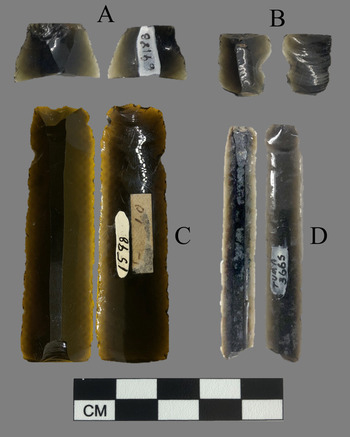
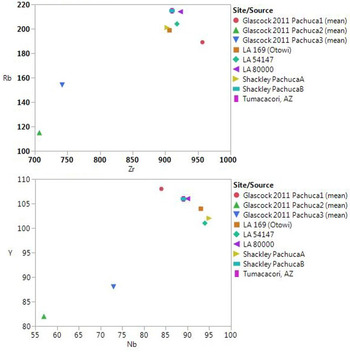
Although people moved obsidian across diverse environmental and cultural regions of North America for millennia, and although archaeologists have analyzed tens of thousands of obsidian artifacts from SW/NW sites, Mesoamerican obsidian from confirmed prehispanic SW/NW contexts has yet to be found and reported. Similarly, no obsidian from the SW/NW has been reported in Mesoamerica. With few exceptions, SW/NW groups only used obsidian from New Mexico, Arizona, Chihuahua, and Sonora (Arakawa et al. Reference Arakawa, Ortman, Steven Shackley and Duff2011; Dolan et al. Reference Dolan, Whalen, Minnis and Shackley2017; Duff et al. Reference Duff, Moss, Windes, Kantner and Steven Shackley2012; Mills et al. Reference Mills, Clark, Peeples, Haas, Roberts, Brett Hill and Huntley2013; Moore et al. Reference Moore, Blinman and Shackley2020; Shackley Reference Shackley2005a). In this article, however, we discuss the implications and significance of four green obsidian prismatic blades and blade fragments from sites in New Mexico and Arizona (Figure 1). Green obsidian is relatively uncommon in this region, and prehispanic groups did not manufacture prismatic blades. Therefore, these four obsidian artifacts are an anomaly when viewed alongside typically chipped stone assemblages. It was essential to determine whether the obsidian was from regional or nonlocal sources, and Shackley (Reference Shackley2008, Reference Shackley2018) used energy-dispersive X-ray fluorescence (EDXRF) spectrometry to determine the source. His analyses confirmed that the four blades match the geochemical signature of Sierra de Las Navajas—also known as the Pachuca source—in Hidalgo, Mexico (Figure 2).
The four green obsidian prismatic blades and blade fragments from (a) LA 54147, (b) LA 80000, (c) Otowi, and (d) Tumacácori. Photo by Sean Dolan. (Color online)

Map of the four sites in New Mexico and Arizona, location of cultural groups in the SW/NW, regions discussed in the text, and the Pachuca obsidian source in Hidalgo, Mexico. Map by Sean Dolan.

Three of the four blades were first reported elsewhere with minimal discussion and without broader contextualization, and the blades are relatively unknown to most SW/NW and Mesoamerican archaeologists. We contextualize them together because they are the only known Mesoamerican obsidian artifacts in the SW/NW, despite centuries of interaction and trade between these two regions. Instead of coming from sites with numerous Mesoamerican interaction markers—such as Pueblo Bonito, Snaketown, or Paquimé—the Pachuca blades were found at four sites that the Spanish and their Mexican Indian allies used or potentially visited beginning with the Francisco Vázquez de Coronado expedition of 1540–1542.
We begin this article with a brief introduction of LA 54147, LA 80000, and Otowi (LA 169) in New Mexico and Tumacácori in Arizona, where the blades and blade fragments were found (Figure 2). Next, we briefly describe EDXRF spectrometry, because Shackley (Reference Shackley2008, Reference Shackley2018) used that method to determine from which source the four blades derive, and then we present the results. Using the EDXRF data, lithic technological organization, and historical narratives, we assess the credibility and likelihood of the different hypothesized models of prehispanic SW/NW-Mesoamerican interaction, and obsidian use by the Mexican Indian allies. We first discuss why people in the SW/NW might have valued Mesoamerican obsidian, mainly green Pachuca blades. We also suggest why Mesoamerican obsidian was not part of the suite of Mesoamerican material culture that moved north into the SW/NW. We then consider why the Mexican Indians may have brought the Pachuca blades into New Mexico and Arizona, and why archaeologists have found so few pieces of Mesoamerican obsidian at post-1540 sites. Based on the available data, Mesoamerican obsidian is not a marker for prehispanic SW/NW-Mesoamerican interaction. Instead, Pachuca obsidian is a time marker for 1540 and later, and it provides evidence that Mexican Indians were likely present. This study contributes to the complicated and long-distance relationship between the prehispanic SW/NW and Mesoamerica by addressing interaction and trade and the extent of Mesoamerican influence on SW/NW groups after 900. This study also provides new perspectives on the material culture of the Mexican Indian allies of the Spanish, who are a very much underrepresented group in the archaeological and historical records (Flint Reference Flint, Flint and Flint1997).
Sites and Artifacts Sampled
LA 54147
As part of a New Mexico State Highway and Transportation Department project in 1986, archaeologists excavated 15 temporary structures—or dugouts—at LA 54147 in Bernalillo, New Mexico (Vierra Reference Vierra1989). Vierra (Reference Vierra1989, Reference Vierra and Vierra1992; Vierra and Hordes Reference Vierra, Hordes, Flint and Flint1997) makes a strong argument that members of the Coronado expedition camped at the site because the pottery assemblage provides an approximate date of 1525–1625, and metal artifacts and sheep bone were found. Three radiocarbon dates also support a sixteenth-century occupation.
Approximately 300 lithic artifacts were recovered during excavations, including a green obsidian blade fragment from Room 14a (specimen number 6918; Figure 1a). This room is a rectangular-shaped dugout with several artifact types, and the fill contained the greatest concentration of metal artifacts at the site. Robert Santley visually identified the source material as Pachuca, and Bart Olinger used XRF spectrometry to confirm (Vierra Reference Vierra1989:vii). Olinger did not report the trace elemental proportions, but Vierra (Reference Vierra and Vierra1992:170) states that the blade's composition is nearly identical to Pachuca. The LA 54147 blade fragment is likely the earliest identification of Mesoamerican obsidian in the SW/NW.
The site report does not include measurements or an image of the blade fragment, but Flint (Reference Flint, Flint and Flint1997:Figure 4.4) provides a line drawing. See Table 1 for length, width, thickness, and mass for all four blade artifacts. Vierra (Reference Vierra1989:212) describes the artifact as the proximal end of a blade with a flat, ground platform that the knapper strengthened by removing flakes along the platform's intersection and dorsal surface. Ground platforms on blades are a hallmark of blade manufacture during the Mesoamerican Postclassic period from 900 to 1521 (Healan Reference Healan2009). The dorsal surface has a medial ridge with two lateral negative flake scars, and the ventral surface has a pronounced bulb of percussion. Both blade edges have damage, and one edge may have unidirectional retouch.
Metric Attributes of the Obsidian Blade Artifacts.

LA 80000
LA 80000 is in downtown Santa Fe, New Mexico, across from the Palace of the Governors, which was built in 1610. During test excavations and data recovery in 2004, archaeologists found intact cultural deposits from the late seventeenth century, the nineteenth century, and the modern era (Lentz Reference Lentz2004). Artifacts recovered include faunal remains, lithics, glass, metal, and ceramics. Impacted musket balls, gunflints, broken stone arrow points, and a broken sword or knife tip suggest conflict may have occurred at the location (Lentz Reference Lentz2004:63). Archaeologists recovered a date of 1660 ± 60 (RCY) from a pit feature, so the site may have been used during the 1680 Pueblo Revolt.
The lithic assemblage includes approximately 300 artifacts of formal and informal manufacture, but Lentz (Reference Lentz2004:41) notes that it was difficult to discern lithics that originated from mixed proveniences, secondary deposition, historic contexts, or prehispanic contexts. One artifact is a green obsidian blade fragment that Lentz (Reference Lentz2004:41) says is from the Pachuca source (specimen number 51673; Figure 1b). He does not, however, discuss or include whether the blade was analyzed to confirm the Pachuca origin, the blade's site provenience, measurements, description, or an image. The LA 80000 artifact is a medial blade fragment that is similar in size and color to the LA 54147 fragment. There is wear on both edges, and the ripple patterns on the ventral surface suggest a manufacturing error. The blade was likely part of someone's personal gear rather than used as part of a weapon.
Otowi
Otowi, also known as Potsuwi'i, is an ancestral Tewa village on the Pajarito Plateau near Los Alamos and White Rock, New Mexico. Dating to the Rio Grande Classic period of 1325–1600, Otowi has five multistoried pueblo room blocks with an estimated combined total of 450 individual ground-floor rooms—or a potential total of 700 rooms—as well as an open plaza, water reservoir, and multiple kivas (Hewett Reference Hewett1906:18–20). Several projects have occurred at Otowi over the years (Hewett Reference Hewett1906; Lister Reference Lister1940; Wilson Reference Wilson1916, Reference Wilson1917, Reference Wilson1918), but details are limited (Mathien Reference Mathien and Kohler2004:84–85; Vierra Reference Vierra2006).
A green obsidian prismatic blade was collected at Otowi, but it is unknown if it came from surface or subsurface contexts (specimen number BAND 1958; Figure 1c). National Park Service archaeologists likely collected it when they managed Otowi from 1932 to 1963 because it is on display at the Bandelier National Monument visitor center. Using EDXRF spectrometry, Ferguson and Skinner (Reference Ferguson and Skinner2006) determined that the Otowi blade is from the Pachuca source. This artifact is the longest and widest of the four blades, and it has a semi-translucent green-yellow hue on the blade edge. It is a medial blade fragment with a ridge along the entire dorsal surface. Both blade edges have wear, although the edges still have use left because they are not entirely dull. Someone could have used the blade as an inset within a weapon or as part of their personal gear as a simple cutting tool.
Tumacácori
Tumacácori National Historical Park in southern Arizona consists of three separate Spanish mission units: San José de Tumacácori, San Cayetano de Calabazas, and Los Santos Ángeles de Guevavi. The Hohokam and O'odham used these lands for centuries before the Spanish arrived. Father Eusebio Francisco Kino established Mission San Cayetano de Tumacácori in 1691 on an existing Sobaípuri-O'odham village near the Santa Cruz River (Kessel Reference Kessel1970; Seymour Reference Seymour2007; Shenk Reference Shenk1976). Scholars debate the location of San Cayetano de Tumacácori (cf. Seymour Reference Seymour2007), but the currently standing Mission San José de Tumacácori was built in the 1750s to replace the original mission.
A green obsidian prismatic blade was collected at Tumacácori, but park archaeologists know little about its context although it was part of leftovers at the end of the 1986 inventory (specimen number 3665; Figure 1d). Jeremy Moss, then at Tumacácori National Historical Park, sent Shackley (Reference Shackley2008) the blade and 19 other obsidian artifacts from multiple park excavations to determine the source. The blade is from Pachuca, but the other artifacts were produced from Arizona, New Mexico, and Sonoran sources. The Tumacácori blade is a proximal fragment of a nearly whole thin blade with a medial ridge along the entire dorsal surface and a transverse break at its distal end. The platform is somewhat flat and ground, and there is wear on both blade edges. Someone used it as a cutting tool, and it still has use left because it is not dull. Unlike the other blades discussed, the Tumacácori blade was one of the last blades off its core, based on its morphology.
EDXRF Spectrometry
The archaeological record indicates that where obsidian was available by obtaining it either directly at the source or through trade, people preferred this lithic raw material because of its predictable conchoidal fracture, razor-sharp edge, and associations with spiritual and cosmic forces (Pastrana and Athie Reference Pastrana, Athie, Levine and Carballo2014; Saunders Reference Saunders2001). As a result, knowing which sources people used can tell us a great deal about past human lifeways. Fortunately, most obsidian sources in the SW/NW and Mesoamerica are well known both geochemically and geographically (Cobean Reference Cobean2002; Glascock Reference Glascock and Shackley2011; Glascock et al. Reference Glascock, Braswell, Cobean and Shackley1998, Reference Glascock, Weigand, López, Ohnersorgen, Ambriz, Mountjoy, Darling, Kuzmin and Glascock2010; Shackley Reference Shackley2005a), and archaeologists have conducted countless obsidian sourcing studies (e.g., Clark Reference Clark and Hirth2003; Dolan et al. Reference Dolan, Whalen, Minnis and Shackley2017; Duff et al. Reference Duff, Moss, Windes, Kantner and Steven Shackley2012).
Several methods exist to determine which obsidian sources people used, including EDXRF spectrometry, neutron activation analysis (NAA), and visual identification. Determining the source based on visual characteristics is more cost effective than geochemical methods, especially if researchers have to source thousands of obsidian artifacts. Most obsidian is black, but other colors—such as gray, mahogany, rainbow, and green—exist throughout the world. In some cases, researchers can tell one source from another based on the color and the presence or degree of banding, translucency, and opaqueness, as well as through petrographic studies of the crystals and microcrystals (Braswell et al. Reference Braswell, Clark, Aoyama, McKillop and Glascock2000; Pierce Reference Pierce2015). Pachuca obsidian is often verified visually because of its distinctive translucent green color, but other obsidians in Mesoamerica are green. For example, there are several green-colored obsidians in West Mexico (Glascock et al. Reference Glascock, Weigand, López, Ohnersorgen, Ambriz, Mountjoy, Darling, Kuzmin and Glascock2010:Table 12.1), and Tulancingo obsidian, also from Hidalgo, can be green but is distinguishable from Pachuca by its opacity and coarser texture (Cobean Reference Cobean2002:47).
Visual identification is not always recommended because the same obsidian source can produce glass of varying colors while having the same geochemical signature. For example, in the SW/NW, Cerro del Medio obsidian is often black, but there is a mahogany variety (LeTourneau and Steffen Reference LeTourneau and Steffen2002). Also, Antelope Wells obsidian has been mistaken for Pachuca because both are peralkaline glasses and are green when viewed with transmitted light (Ferguson Reference Ferguson, Shugar and Mass2012:403; Shackley Reference Shackley2005a:57). Some of the obsidian that Di Peso excavated from Paquimé is green, and he suggested it came from sources in Mesoamerica (Di Peso et al. Reference Di Peso, Rinaldo and Fenner1974:8:189). Thus far, Mesoamerican obsidian has not been reported from Paquimé or other sites in the Casas Grandes region, but Antelope Wells obsidian is common at sites dating to 1200–1450 (Dolan et al. Reference Dolan, Whalen, Minnis and Shackley2017). Therefore, analyzing obsidian artifacts using geochemical methods is the only way researchers can reliably validate the source provenance. EDXRF spectrometry is one of the more popular and established methods because it is nondestructive to the artifact because samples are analyzed whole with little to no sample preparation, it is cost-effective, and the analyst can measure 10 to 20 trace elements and obtain results within minutes (Glascock Reference Glascock and Shackley2011:Table 8.1; Shackley Reference Shackley and Shackley2011).
The trace elemental proportions of the LA 54147 blade fragment were not reported in Vierra (Reference Vierra1989), and it is unknown if the LA 80000 blade fragment had been previously analyzed. In addition, although we do not question Ferguson and Skinner's (Reference Ferguson and Skinner2006) source assignment on the Otowi blade, Dolan wanted all four obsidian artifacts analyzed by the same analyst. Shackley (Reference Shackley2018) analyzed the LA 54147, LA 80000, and Otowi artifacts using a benchtop Thermo Scientific QUANT'X EDXRF spectrometer at the Geoarchaeological XRF Laboratory in Albuquerque, New Mexico. A decade earlier, he analyzed the Tumacácori blade using a benchtop Thermo Scientific ARL QUANT'X EDXRF spectrometer at the Berkeley Archaeological XRF Laboratory at the University of California, Berkeley (Shackley Reference Shackley2008). The blades were analyzed for major oxide, minor oxide (except for the Tumacácori blade), and the trace elements chlorine (Cl), titanium (Ti), manganese (Mn), zinc (Zn), rubidium (Rb), strontium (Sr), yttrium (Y), zirconium (Zr), niobium (Nb), barium (Ba), lead (Pb), and thorium (Th). Shackley (Reference Shackley2008, Reference Shackley2018) used the trace elemental proportions of Rb, Y, Nb, and Zr in parts per million (ppm) to discriminate individual source groups using scatter plots to separate the obsidian sources visually. See Shackley (Reference Shackley2005a, Reference Shackley2008, Reference Shackley and Shackley2011, Reference Shackley2018) for EDXRF instrumentation, protocols, and settings used for this analysis.
EDXRF Results
Three subgroups of Pachuca obsidian exist (Argote-Espino et al. Reference Argote-Espino, Solé, López-García and Sterpone2012; Glascock Reference Glascock and Shackley2011; Glascock et al. Reference Glascock, Braswell, Cobean and Shackley1998:40–43; Ponomarenko Reference Ponomarenko2004), and the trace elemental composition of the New Mexico and Arizona blades compares well with laboratory reference samples of the Pachuca-1 source from the Las Minas block and ash flow (Figure 3; Table 2). Researchers have investigated the geology and archaeology of Pachuca obsidian, making it one of the world's most studied sources (Donato et al. Reference Donato, Barba, De Rosa, Niceforo, Pastrana, Donato, Lanzafame, Mancini and Crisci2018; Levine Reference Levine, Levine and Carballo2014; Pastrana Reference Pastrana1998, Reference Pastrana, Hirth and Andrews2002; Pastrana and Athie Reference Pastrana, Athie, Levine and Carballo2014; Ponomarenko Reference Ponomarenko2004; Spence Reference Spence1981; Tenorio et al. Reference Tenorio, Cabral, Bosch, Jiménez-Reyes and Bulbulian1998). In addition, because of several Spanish priests who documented daily life after the Spanish invasion, researchers have a unique glimpse into the mining, manufacture, trade, ritual use, and function of obsidian tools, including blades from the Pachuca source (Durán Reference Durán1967; Hernandez Reference Hernández1959; Sahagún Reference Sahagún, Dibble and Anderson1959, Reference Sahagún, Dibble and Anderson1963; Torquemada Reference Torquemada1975). Clark (Reference Clark, Gaxiola G. and Clark1989) provides an excellent summary of the sixteenth-century ethnohistoric documents.
Bivariate plots comparing Nb/Y and Zr/Rb of the four obsidian blades, the three Glascock (Reference Glascock and Shackley2011) Pachuca subgroups, and two Pachuca samples from Shackley's Geoarchaeological XRF Laboratory. (Color online)

Elemental Concentrations for the Archaeological Samples, USGS RGM-1 Rhyolite Standard, the Pachuca-1 Source Sample from the Geoarchaeological XRF Laboratory, and Glascock's (Reference Glascock and Shackley2011) NAA and XRF Values Combined for Pachuca-1.

Note: The data from Glascock (Reference Glascock and Shackley2011:180) are the range of mean values for both the NAA and XRF analyses reported. The analysis of the Geoarchaeological XRF Laboratory's Pachuca-1 standard and the archaeological samples is closest due to inter-instrument variability (see Glascock Reference Glascock and Shackley2011; Shackley Reference Shackley and Shackley2011).
a nr = not recorded.
The Pachuca source is 10 km from the modern city of Pachuca, 100 km northeast of Mexico City, and approximately 1,900 linear km south of Otowi, making the Otowi blade one of the farthest-traveled obsidian artifacts in the North American archaeological record. Pachuca obsidian is a peralkaline glass, and it is elementally distinctive with generally high amounts of iron and zirconium. It is also phenotypically distinctive because the color varies from translucent bottle green to green-black to a shimmering gold-green, and a brownish-red variety also occurs at the source (Pastrana Reference Pastrana, Hirth and Andrews2002:21–22; Pastrana and Carballo Reference Pastrana, Carballo, Nichols and Rodríguez-Alegría2017:330; Ponomarenko Reference Ponomarenko2004:78–79). Blocks of Pachuca obsidian range in shape from laminar or tabular to rounded or subangular and can be up to 150 cm in diameter, but nodules can be as small as 10 cm in diameter (Pastrana Reference Pastrana, Hirth and Andrews2002:21). The green Pachuca obsidian had to be mined deep in the ground using extensive shaft and tunnel mines that required a significant investment (Charlton and Spence Reference Charlton and Spence1982; Pastrana Reference Pastrana, Hirth and Andrews2002:19–20). Obsidian blades dominate most Mesoamerican lithic assemblages, and blades made from Pachuca obsidian played a significant role in the state-level economies of Teotihuacan, Tula, and Tenochtitlan. In a world without metal tools, obsidian blades were the most common and effective cutting implement for utilitarian purposes (such as cutting hair) and ritual activities (such as autosacrifice), and as insets within weapons (Clark Reference Clark, Gaxiola G. and Clark1989:311–316). Skilled craft specialists manufactured the prismatic blades, and they preferred green Pachuca obsidian over other materials (Andrews Reference Andrews, Hirth and Andrews2002:49).
In addition to the Pachuca blades from New Mexico and Arizona, there are other Pachuca obsidian artifacts from sites in the United States. In Kansas, Hoard and colleagues (Reference Hoard, Bevitt and McLean2008) report two Pachuca artifacts from the Sharps Creek site (14MP408), two late-stage polyhedral blades from 14MP1, and a large core fragment from 14SN4 (see Shackley Reference Shackley2005b). In Oklahoma,Footnote 1 Barker and colleagues (Reference Barker, Skinner, Steven Shackley, Glascock and Rogers2002) discuss a Pachuca scraper from the prehispanic Mississippian site of Spiro. Hester and colleagues (Reference Hester, Glascock, Asaro and Stross2017) discuss Mesoamerican obsidian in Texas, including Pachuca flakes from two sites in Willacy County. Finally, Robert Jackson (personal communication 2019) reports Pachuca blades in Napa and Mendocino Counties in California that likely come from sixteenth-century Spanish voyages along the Pacific.
Discussion
Material and ideological evidence exists demonstrating that people in the SW/NW and Mesoamerica were “undeniably and inextricably linked” (Schaafsma Reference Schaafsma, Schaafsma and Riley1999:165). The lack of Mesoamerican obsidian at prehispanic SW/NW sites, however, raises questions about the degree of interaction and trade and the extent of Mesoamerican influence on SW/NW groups. Would green Pachuca blades have been valuable to SW/NW elites, if available, and why was obsidian not part of the suite of Mesoamerican material culture that moved north? The limited presence of Pachuca obsidian after Spanish arrival also elicits questions. Who brought the Pachuca blades into New Mexico and Arizona, and why are there so few examples? We address these questions below by using historical narratives and discussing how prehispanic SW/NW groups and the Mexican Indian allies organized their lithic technology.
Green Obsidian and SW/NW-Mesoamerican Interaction and Trade
People in the SW/NW interacted with and acquired objects from Mesoamerica before the 900s (Vokes and Gregory Reference Vokes, Gregory, Gregory and Wilcox2007). There is more evidence, however, for interaction and trade after 900 because this was when the SW/NW “snapped together with Mesoamerica” (Nelson et al. Reference Nelson, Canchola, Punzo Díaz and Minnis2015:47; see also McGuire Reference McGuire, Glowacki and Keuren2011:33–39). Consequently, we suggest that Mesoamerican obsidian should have entered the SW/NW during this time.
Several cultural transformations occurred in both regions after 900. In the SW/NW from 900 to 1450, there were large-scale population migrations (Hill et al. Reference Hill, Clark, Doelle and Lyons2004); the Hohokam, Chaco Canyon, and Casas Grandes regional systems emerged and declined (Crown and Judge Reference Crown and Judge1991; Whalen and Minnis Reference Whalen and Minnis2001); and the circulation of painted pottery and obsidian expanded (Mills et al. Reference Mills, Clark, Peeples, Haas, Roberts, Brett Hill and Huntley2013). This time is also contemporaneous with the Mesoamerican Postclassic, when there were heightened economic connections (Berdan et al. Reference Berdan, Masson, Gasco, Smith, Smith and Berdan2003; Blanton et al. Reference Blanton, Fargher, Heredia Esponoza and Blanton2005; Braswell Reference Braswell, Smith and Berdan2003), the mining of Pachuca obsidian increased (Cobean Reference Cobean2002; Pastrana Reference Pastrana1998, Reference Pastrana, Hirth and Andrews2002), and the efficiency of prismatic blade manufacture improved (Healan Reference Healan2009). As for the control of the Pachuca obsidian mines, Spence and Parsons (Reference Spence and Parsons1972:29) offer that the Toltecs controlled the source during the Early Postclassic (900–1200; see also Sahagún Reference Sahagún, Dibble and Anderson1963:227), and Pastrana and colleagues (Reference Pastrana, García, Parry, Otis Charlton and Alexander2019:31) propose that the Aztec Triple Alliance controlled the Pachuca and Otumba mines in the 1500s. Golitko and Feinman (Reference Golitko and Feinman2015), however, argue that obsidian was not under highly centralized control during the Postclassic, and local groups and towns shared access rights to the Pachuca source (Clark Reference Clark, Gaxiola G. and Clark1989:303–304).
The raw material that people use impacts how they organize their lithic technology because the material size, shape, and quality can structure the reduction strategy (e.g., freehand hard-hammer core reduction versus bipolar percussion) they use, and it impacts the size of tool produced (Andrefsky Reference Andrefsky1994). We suggest that green Pachuca blades would have been valuable to political and religious elites in SW/NW societies because lithic practitioners there did not use obsidian resources and lithic technology in the same manner as those in Mesoamerica. People in Mesoamerica rarely had limits on the size of tool they could manufacture given that obsidian was available in mass volume and large boulder size. Consequently, they manufactured several types of objects from obsidian, such as prismatic blades, arrow points, and ritual or stylized objects such as scepters, earspools, mirrors, and anthropomorphic eccentrics (Clark Reference Clark, Gaxiola G. and Clark1989; Pastrana and Athie Reference Pastrana, Athie, Levine and Carballo2014; Taube Reference Taube1991).
Those in the SW/NW were not as fortunate when it came to the volume and size of regional obsidian sources. Nodules from most sources are approximately 10 cm in diameter or less, but they were still a valuable source of tool stone raw material (Shackley Reference Shackley2005a). We note, however, that Cerro del Medio and Government Mountain obsidian from the primary source outcrops can be up to 100 cm in diameter, but they are rarely that size (Shackley Reference Shackley2005a). SW/NW knappers often used the bipolar percussion method to obtain usable cutting edges on tools from small obsidian nodules, which hindered biface manufacture of larger-sized tools. Although they could have used Cerro del Medio and Government Mountain obsidian to make prismatic blades, there is little evidence for blade production of any kind after Clovis blade technology (Collins Reference Collins1999).
Many lithic studies focus on the environmental or geological factors that affected the organization of lithic technology (Andrefsky Reference Andrefsky1994). Often overlooked, but equally important, however, are the cultural factors that influenced why people used one tool stone material over another. Cultures worldwide valued the location of raw material sources because they were powerful places on the landscape and important to people's cosmology and history (Dillian Reference Dillian, Grattan and Torrence2007; Taçon Reference Taçon1991). Consequently, Pachuca blades would have likely been valuable to SW/NW elites because of both Pachuca obsidian's unique, recognizable green color and its place of origin. Like other culturally significant minerals such as turquoise and jade, obsidian is often found in places that could be dangerous, such as mountains or deep within the ground. SW/NW and Mesoamerican groups revered mountains because they are the homes of ancestors, spirits, and caves, which are connected to the underworld. According to Matos Moctezuma (Reference Matos Moctezuma1988:129), three of the nine levels of the Aztec underworld were characterized by obsidian. There was an obsidian mountain where the dead walked over sharp cutting paths, there was the place of obsidian bladed winds, and an obsidian place of the dead. Green Pachuca obsidian was mined deep in the ground using extensive shaft and tunnel mines that were dangerous. The connection between the Aztec underworld and obsidian was likely inspired by the deep, dark, and dangerous obsidian mines (Clark Reference Clark, Gaxiola G. and Clark1989:299–300). In modern Pueblo mythology, mountains are closer to deities who control thunder, lightning, and rainfall, and lightning forms obsidian when it strikes the ground (Ford Reference Ford and Thomas1992:122). For SW/NW elites, owning green Pachuca blades could have acted as what Bradley (Reference Bradley2000:81–96) calls a “piece of place” that would have connected them to distant places in Mesoamerica. Along with the location of raw material sources as important places, many groups valued the color of lithic materials (Arthur Reference Arthur2021; Taçon Reference Taçon1991). Green Pachuca blades would likely have been valuable to SW/NW elites because green- (or blue-green) colored objects were associated with water, fertility, and directional symbolism (Darras Reference Darras, Levine and Carballo2014; Holeman Reference Holeman2013:62–70; Levine Reference Levine, Levine and Carballo2014:176–177).
In a prestige-goods economy, elites or emerging elites achieved and affirmed their status by controlling access to goods that could only be obtained through external exchange (McGuire Reference McGuire, Mathien and McGuire1986:251). Doyel (Reference Doyel, Crown and Judge1991) argues that Hohokam elites living atop platform mounds facilitated control and redistribution of obsidian because it was a highly valued resource (see Shackley Reference Shackley2005a:134–136). If the local or relatively local obsidian the Hohokam sought were a valued resource, undoubtedly green Pachuca blades would have garnered substantial value because of its color, place of origin, and technology.
People in the Hohokam and Mesa Verde regions often embedded their obsidian procurement in other activities such as shell-collection and scouting trips (Arakawa et al. Reference Arakawa, Ortman, Steven Shackley and Duff2011; Mitchell and Shackley Reference Mitchell and Shackley1995). SW/NW elites could have made the long-distance journey to Central Mexico to acquire green Pachuca blades while gaining esoteric ritual knowledge from Mesoamerican elites. Gilman and colleagues (Reference Gilman, Thompson and Wyckoff2014) have discussed a similar scenario in which people from the Mimbres region may have made the long and dangerous trip to Mexico's Gulf Coast to acquire scarlet macaws and knowledge from the Hero Twins saga. The Mimbres could have acquired obsidian during these trips, but there is no demonstrated evidence for Mesoamerican obsidian in the Mimbres region.Footnote 2
If people, objects, and ideas circulated more freely throughout the SW/NW and Mesoamerica after 900, and if green Pachuca blades were likely valuable to elites, then why was obsidian not part of the suite of Mesoamerican material culture that moved north? One potential reason is that the SW/NW already had sufficient obsidian to produce tools, and people there were only interested in acquiring copper bells, cacao, and scarlet macaws because these objects were not locally accessible. Also, green Pachuca blades were distributed through regional market systems in Mesoamerica, but the pochteca also distributed them using long-distance trade networks (Sahagún Reference Sahagún, Dibble and Anderson1959:Plate 14). The pochteca may not have traveled into the SW/NW, which McGuire (Reference McGuire1980) has proposed, or they did not bring obsidian to trade if they interacted with SW/NW groups. Furthermore, SW/NW elites may not have wanted obsidian blades because they were the most common cutting implement in Mesoamerica and cost so little that they were often discarded after one use (Clark Reference Clark, Gaxiola G. and Clark1989:311; Torquemada Reference Torquemada1975).
Ancient Mesoamerica encompassed a large geographic region and was culturally heterogeneous, much like the SW/NW. An important question regarding SW/NW-Mesoamerican connections is with which part(s) of Mesoamerica did the SW/NW interact after 900? Instead of Central Mexico, where the Pachuca source is located, most objects from Mesoamerica that the SW/NW obtained came from West Mexico (Mathiowetz Reference Mathiowetz2019; McGuire Reference McGuire, Glowacki and Keuren2011; Nelson Reference Nelson and Lekson2006; VanPool et al. Reference VanPool, VanPool, Rakita, Leonard, Nielsen-Grimm and Stavast2008; Vargas Reference Vargas1995). Archaeologists often consider West Mexico to be a peripheral region to Central Mexico, and more work needs to be conducted on the relationships between the SW/NW and West Mexico (Nelson et al. Reference Nelson, Canchola, Punzo Díaz and Minnis2015). People in West Mexico, however, became “Mesoamericanized” around 900, when the Aztatlán tradition developed (Foster Reference Foster, Schaafsma and Riley1999; Kelley Reference Kelley, Foster and Gorenstein2000; Riley Reference Riley2005). This cultural tradition was part of a prestige economy because elites traded obsidian blades, copper, ceramics, and marine shell. Pachuca blades reached West Mexico, particularly at the regional center of San Felipe Aztatán in Nayarit (Pierce Reference Pierce2015, Reference Pierce2021), but the interaction between West Mexico and Central Mexico was minimal. While copper bells, cacao, and marine shell from West Mexico and the Gulf of California moved north into the SW/NW during the Mesoamerican Postclassic, no obsidian from West Mexico has been found in the SW/NW even though there are several high-quality sources (Glascock et al. Reference Glascock, Weigand, López, Ohnersorgen, Ambriz, Mountjoy, Darling, Kuzmin and Glascock2010).
To conclude this discussion, people in the SW/NW and Mesoamerica interacted to some degree. At the same time, however, contact and trade were variable both regionally and through time (McGuire Reference McGuire1980; Nelson et al. Reference Nelson, Fish, Fish, Mills and Fowles2017). We also agree with McGuire (Reference McGuire, Glowacki and Keuren2011:49), who states that the SW/NW and Mesoamerica were both more connected and less connected than many have asserted. If Mesoamerica had had more political and religious influence over the SW/NW, utilitarian items such as obsidian blades might have entered because they are low-bulk goods that are easy to transport over long distances. Elites at Chaco Canyon and Paquimé likely emulated Mesoamerican elites by drinking cacao from special vessels, using colorful scarlet macaw feathers on ritual paraphernalia, and constructing Mesoamerican-like architecture to consolidate their power (Lekson Reference Lekson2009, Reference Lekson2015; Nelson Reference Nelson and Lekson2006). They did not need Mesoamerican obsidian, however, because they had other, more iconic symbols of Mesoamerican culture.
New research also questions the scope and scale of SW/NW-Mesoamerican interaction and trade. First, George and colleagues (Reference George, Plog, Watson, Schmidt, Culleton, Harper and Gilman2018) demonstrate that scarlet macaws were possibly bred in the SW/NW before the 1200s, which is when breeding occurred at Paquimé. This means that Chaco and Mimbres groups may not have needed to travel so far to acquire these colorful and talkative birds. Second, researchers offer that SW/NW groups received Mesoamerican objects in exchange for SW/NW turquoise (Weigand Reference Weigand, Webster and McBrinn2008). But isotopic analyses on turquoise tiles from the Templo Mayor indicate that they are not from the SW/NW, and Thibodeau and colleagues (Reference Thibodeau, Luján, Killick, Berdan and Ruiz2018:6) offer that turquoise may not have been an important long-distance trade item between the two regions. Last, if people in both regions interacted regularly, then we should expect gene flow to have occurred. Ancient DNA studies confirm that most people in the SW/NW were not genetically related to those in Mesoamerica, but a few Mimbres individuals share haplotypes with populations further south (Morales-Arce et al. Reference Morales-Arce, Snow, Kelley and Katzenberg2017; Snow et al. Reference Snow, Shafer and Smith2011).
Mexican Indian Allies, Lithic Technology, and Pachuca Obsidian
Of the four Pachuca artifacts discussed in this article, only the LA 54147 and LA 80000 blade fragments derive from known excavated contexts. The LA 54147 blade fragment is from contexts associated with the Coronado expedition (Vierra Reference Vierra1989, Reference Vierra and Vierra1992; Vierra and Hordes Reference Vierra, Hordes, Flint and Flint1997), and the LA 80000 blade fragment derives from later contexts possibly associated with the Pueblo Revolt approximately 140 years after Coronado (Lentz Reference Lentz2004). We suggest that these Pachuca artifacts were brought into New Mexico by Mexican Indians because there could have been as many as 2,000 Mexican Indian allies accompanying the Coronado expedition in 1540 (Flint Reference Flint2009), and Mexican Indians lived in Santa Fe during the late 1600s at the Barrio de Analco community (Oster Reference Oster, Brown, Barbour and Head2019; Wroth Reference Wroth2010).
Unfortunately, less is known about the Otowi and Tumacácori blades, but there is evidence that the Spanish and their Mexican Indian allies visited those sites. For the Otowi blade, one of Coronado's officers may have inspected Otowi, Puye, Tsirege, and Sankawi'i (Barrett Reference Barrett2002:44). Tewa groups used these four large pueblos into the last few decades of the 1500s, so the Mexican Indians could have traded the blade to those at Otowi. For the Tumacácori blade, the Coronado expedition passed O'odham villages in southern Arizona, and the Spanish interacted with the O'odham in the seventeenth and eighteenth centuries at the missions they established. The blade could have been exchanged or discarded at any time during this period. Obsidian hydration analysis to obtain a relative date for the Otowi and Tumacácori blades was not permitted because this method requires that part of the artifact be cut. The results may also not be conclusive because there are inherent challenges with obsidian hydration dating (Ridings Reference Ridings1996). It is difficult to determine if a Tewa, Hohokam, or O'odham person before Spanish arrival acquired the Pachuca blades through down-the-line exchange or if they traveled to Mesoamerica themselves. However, we offer that the blades likely entered Otowi and Tumacácori by 1540 or later because there is evidence for Spanish visitation, and Mesoamerican obsidian has not been found within confirmed prehispanic contexts at those sites.
It is important to discuss who the Mexican Indian allies were because they most likely brought the four Pachuca blades into New Mexico and Arizona. Unfortunately, there is little archaeological evidence for them despite their large presence on the Coronado expedition (Flint Reference Flint, Flint and Flint1997). What little is known comes from Spanish documents reported by Richard Flint and Shirley Cushing Flint (Flint Reference Flint2009; Flint and Flint Reference Flint and Flint2005, Reference Flint and Flint2019). The expedition included approximately 350 people from several European countries and North Africa, but it would hardly have been possible without an estimated 1,300–2,000 Mexican Indian allies—or indios amigos—from Central and West Mexico, including Mexica, Tarascan, and Tlaxcalan societies (Flint Reference Flint2009; Flint and Flint Reference Flint and Flint2019). They were not coerced into joining the expedition but enlisted freely as guides, translators, and warriors, and they also carried equipment, guarded livestock, and cooked (Flint and Flint Reference Flint and Flint2019:205–208). If as many as 2,000 Mexican Indians entered the SW/NW and likely brought obsidian blades for personal gear or weapons, why have archaeologists only found four blades and blade fragments? There are explanations as to the limited number, and the answer stems from how the indios amigos organized their lithic technology—specifically their obsidian resources.
Few, if any, of the arms, shields, and armor used during the sixteenth century have survived the archaeological record because they were constructed from wood, bamboo, leather, cloth, and feathers. Fortunately, several Spanish accounts describe what the Aztecs used for battle (Clark Reference Clark, Gaxiola G. and Clark1989:313–314; Hassig Reference Hassig1988; Sullivan Reference Sullivan1972). The Mexican Indians were well-trained, fierce warriors who used several weapons, including bows and arrows with stone points, wooden spears or lances (tepuztopilli) with an obsidian point, and—perhaps the most infamous—the obsidian-edged wooden broad sword, also known as the macuahuitl (Clark Reference Clark, Gaxiola G. and Clark1989:313–314; Hassig Reference Hassig1988:75–94; Sullivan Reference Sullivan1972). This weapon was approximately 50–80 cm long and fitted with four to eight obsidian blades on both sides. Starting in the Postclassic period (Cervera Obregón Reference Cervera Obregón2006; Taube Reference Taube1991), warriors used the macuahuitl for close combat. This weapon cuts muscular tissue and fractures bone easily, but experimental studies show its limits. Obsidian is so brittle that the blades inserted into the macuahuitl fracture after striking the opponent once, so the warriors had to replace the blades (Cervera Obregón Reference Cervera Obregón2006; Hernandez Reference Hernández1959:407). According to Durán (Reference Durán1967), the Aztecs would flee from the enemy and repair their obsidian-edged weapons before the next battle, and they would work the used and dull blades into arrow points (Clark Reference Clark, Gaxiola G. and Clark1989:313; Hernandez Reference Hernández1959:407). Each Aztec warrior needed 10–20 blades to renew their weapons (Clark Reference Clark, Gaxiola G. and Clark1989:308). Consequently, if they brought the macuahuitl into the SW/NW, then they must have also brought additional finished blades and polyhedral cores to replenish their stock. The Spanish also used the indigenous weapons of Mesoamerica because European weapons were difficult to acquire on the Coronado expedition (Flint Reference Flint2009:67). The Spanish could have deposited the Pachuca blades at the four sites, but it is more likely that their indios amigos did so because there were so many more of them. We are not certain that the four New Mexico and Arizona Pachuca blades were used as inserts for weapons, but the Mexican Indians could have brought them as personal gear for simple utilitarian tools for cutting, scraping, and possibly even ritual autosacrifice.
Mesoamerican obsidian blades from post-1540 SW/NW contexts are so uncommon potentially because of how blades were made. Few Mexican Indian allies on the Coronado expedition were probably trained in core-blade technology. Mesoamerican craft specialists who manufactured blades were all male and known as navajeros. Along with a high degree of skill and motor control, the navajeros used a wooden crutch to gain a mechanical advantage to detach long blades from polyhedral cores through pressure (Clark Reference Clark1982, Reference Clark, Gaxiola G. and Clark1989; Crabtree Reference Crabtree1968; Titmus and Clark Reference Titmus, Clark and Hirth2003). The indios amigos would have needed to bring wooden crutches on the expedition to make additional blades, but Spanish documents do not mention that they brought them. It is also quite possible, then, that they brought few macuahuitl weapons because they could not replace broken blades. Moreover, the Mexican Indian allies may not have brought a sufficient supply of chipped-stone raw materials from their homeland because they did not expect the expedition to last as long as it did. Once they ran out of their supply, they likely used the locally available lithic materials in the SW/NW. They could have acquired obsidian from several sources as the expedition moved through Sonora, Arizona, and New Mexico. They would not have been able to make prismatic blades due to the small size of obsidian nodules they encountered, but they could have made arrow points and other tools.
The Coronado expedition was a large and expensive endeavor that turned out to be rather unsuccessful. The expedition ended in 1542 when Coronado returned to Mexico City, but some indios amigos stayed in the SW/NW (Flint and Flint Reference Flint and Flint2005:166–167). After Coronado, Spanish expeditions were much smaller, had relatively less conflict with indigenous groups, and included fewer Mexican Indians (Mathers Reference Mathers, Mathers, Mitchem and Haecker2013). Flint (Reference Flint, Flint and Flint1997:53–54) contends that the use of obsidian blades and obsidian-edged weapons diminished given that steel weapons would have been adopted by the 1580s. However, several decades after the Spanish invasion, stone tools were still manufactured, even with the adoption of metal tools. For example, with the Spanish cut off from European raw materials, priests commissioned navajeros to make obsidian tools (Saunders Reference Saunders2001:226). In addition, during this time, stone tool manufacture with Otumba obsidian increased when state-sponsored production of prismatic blades and Pachuca obsidian distribution declined (Pastrana et al. Reference Pastrana, García, Parry, Otis Charlton and Alexander2019). Much earlier, however, craft specialists at Teotihuacan preferred Pachuca obsidian for blade manufacture but used Otumba for bifaces (Andrews Reference Andrews, Hirth and Andrews2002:49). Arrow points and debitage of Otumba obsidian may be present in the SW/NW, but Otumba does not stand out the way green Pachuca obsidian does. Archaeologists may think that the obsidian is local because of its black color and decide not to analyze such artifacts with geochemical methods. Nevertheless, of the tens of thousands of obsidian artifacts analyzed from SW/NW sites, no Otumba—in fact no Mesoamerican obsidian other than Pachuca—has ever been recovered and reported.
Finally, one way to assess the arguments made above would be to increase the sample size of sourced obsidian artifacts from sites where warfare occurred between Pueblo groups in the SW/NW and the Spanish and their indios amigos. For example, at Piedras Marcadas, archaeologists found dozens of Coronado-era crossbow boltheads, metal artifacts, Mexican-style arrow points and slingstones, and numerous obsidian flakes that could be debris from macuahuitl weapons (Schmader Reference Schmader, Douglass and Graves2017:66–67). EDXRF analysis of obsidian artifacts from subsurface and surface contexts at Piedras Marcadas demonstrates that the obsidian is all from New Mexico (Shackley Reference Shackley2013, Reference Shackley2014). It is beneficial to analyze additional obsidian artifacts from this period, but studies already show that Mesoamerican obsidian is not present at other post-1540 sites in New Mexico and Arizona (Liebmann Reference Liebmann2017; Loendorf et al. Reference Loendorf, Fertelmes and Lewis2013).
Summary and Conclusions
We have discussed the implications and significance of four green obsidian prismatic blades and blade fragments from LA 54147, LA 80000, Otowi in New Mexico, and Tumacácori in Arizona. EDXRF spectrometry confirmed that the blades are from the Pachuca source in Central Mexico. The blades were found at sites that the Spanish and their Mexican Indian allies used or potentially visited beginning with the Coronado expedition in 1540. Archaeologists previously reported these artifacts, but most were unaware that they represent the only known pieces of Mesoamerican obsidian in the SW/NW. The Pachuca blades offered us a unique opportunity to assess not only prehispanic SW/NW-Mesoamerican interaction and trade but also the Mexican Indian allies’ lithic technology.
Several archaeologists have discussed Mesoamerican interaction markers in the SW/NW, but it is also equally important to discuss the Mesoamerican elements people chose not to acquire, such as obsidian. We first presented evidence for why SW/NW elites could have valued green Pachuca blades, but we also offered reasons why Mesoamerican obsidian did not enter the SW/NW before Coronado. We concluded that SW/NW elites would have valued green Pachuca blades because (1) they did not have prismatic blade technology, (2) green-colored objects were ritually significant, and (3) owning Pachuca blades would have referenced powerful and faraway Mesoamerican polities. However, we suggested that Mesoamerican obsidian was not traded because people in the SW/NW already had access to obsidian, and obsidian blades were not necessarily high-status Mesoamerican items.
Investigating the earliest encounters between SW/NW groups, the Spanish, and their Mexican Indian allies is significant for understanding the interaction and trade between disparate groups on the North American continent. Regarding the limited presence of Pachuca blades in the SW/NW after 1540, we discussed who may have brought the blades and why there are so few examples from this period. Based on the current evidence, we suggested that the Mexican Indians from the Coronado expedition and the other Spanish-led expeditions brought the Pachuca obsidian because their weapons required blades, and they used blades for utilitarian purposes. We also listed reasons why there are so few examples, such as the lack of skill and the tools required to make blades.
Finally, despite the great geographic distance and vast disparities in sociopolitical scale, people in the SW/NW and Mesoamerica knew each other—or at least knew of each other. Some Mesoamerican material culture moved north, but obsidian did not until 1540. Until archaeologists find Mesoamerican obsidian from confirmed prehispanic SW/NW contexts, Pachuca obsidian is a time marker for 1540 and later in this region. We hope this study contributes to additional thought on the history of SW/NW-Mesoamerican interaction and the material culture of the Mexican Indian allies, who are an underrepresented group in the archaeological and historical records (Flint Reference Flint, Flint and Flint1997). These four Pachuca artifacts discussed here represent the only known pieces of Mesoamerican obsidian in the SW/NW, but there are many obsidian artifacts in museum collections that have yet to be analyzed with EDXRF spectrometry or NAA. Some may be from post-1540 sites and may also derive from Mesoamerica. We encourage researchers to continue to use geochemical methods to study the long-distance movement of people, objects, and ideas across ancient North America.
Acknowledgments
Dolan appreciates the staff at the Center for New Mexico Archaeology, Jamie Civitello at Bandelier National Monument (research permit BAND-2018SCI-0016), and Paige Hoskins at the Western Archaeological and Conservation Center for access to the four obsidian artifacts. We thank Patricia Gilman, Christopher Schwartz, Jeremy Moss, Kaitlyn Davis, and Matthew Schmader for providing comments on earlier drafts. We also thank Debra Martin, John Clark, and two anonymous reviewers, who provided constructive and valuable feedback.
Data Availability Statement
Shackley stores all trace elemental data at the Geoarchaeological XRF Laboratory in Albuquerque, New Mexico (http://swxrflab.net/swobsrcs.htm). The Center for New Mexico Archaeology in Santa Fe, New Mexico, curates the LA 54147 and LA 80000 blades; the Bandelier National Monument visitor center in Los Alamos, New Mexico, curates the Otowi blade; and the Western Archaeological and Conservation Center in Tucson, Arizona, curates the Tumacácori blade.