Introduction
Interstitial cystitis/painful bladder syndrome (IC) is a chronic pain condition characterized by suprapubic pain, urinary urgency and frequency, and nocturia. IC occurs in 0.2–7% of the population (depending on case definition). Individuals with IC have high rates of depression, anxiety, and stress as well as increased health care utilization and costs (Tung, Hepp, Bansal, & Devine, Reference Tung, Hepp, Bansal and Devine2017). There are no consistently effective treatments, and most patients have a chronic course with waxing and waning symptoms, persistent disability and repeated, inconclusive, or failed treatment trials (Berry et al., Reference Berry, Elliott, Suttorp, Bogart, Stoto, Eggers and Clemens2011; Hanno, Erickson, Moldwin, Faraday, & American Urological, Reference Hanno, Erickson, Moldwin, Faraday and American Urological2015). New approaches are needed to break this recidivist cycle.
Despite extensive research, the pathophysiology of IC is poorly understood. IC is generally considered part of a group of commonly termed ‘nociplastic’, ‘unexplained’ or ‘functional’ pain disorders (Fitzcharles et al., Reference Fitzcharles, Cohen, Clauw, Littlejohn, Usui and Hauser2021), so called because there is no apparent anatomical or biological explanation for their symptoms. In addition to IC, other diagnoses in this category include (but are not limited to): irritable bowel syndrome (IBS), fibromyalgia (FM), myalgic encephalomyelitis/chronic fatigue syndrome (ME/CFS), vulvodynia, migraine, dry eye, and temporomandibular joint disorder.
Numerous studies have documented significantly greater than expected comorbidity among nociplastic pain disorders, (Clemens et al., Reference Clemens, Mullins, Ackerman, Bavendam, van Bokhoven, Ellingson and Group2019; Nickel et al., Reference Nickel, Tripp, Pontari, Moldwin, Mayer, Carr and Nordling2010; Rodriguez, Afari, & Buchwald, National Institute of, Diabetes, Digestive, & Kidney Diseases Working Group on Urological Chronic Pelvic, Pain Reference Rodriguez, Afari and Buchwald2009; Warren, Wesselmann, Morozov, & Langenberg, Reference Warren, Wesselmann, Morozov and Langenberg2011), with rates of co-occurrence 3–4 times as high as those expected based on population rates. This excess comorbidity, in combination with the absence of localized pathological findings has led some to the hypothesis that IC and other nociplastic disorders comprise a pleiotropic syndrome with shared underlying causal mechanisms (Buffington, Reference Buffington2004; Clemens et al., Reference Clemens, Mullins, Ackerman, Bavendam, van Bokhoven, Ellingson and Group2019; Mullins, Bavendam, Kirkali, & Kusek, Reference Mullins, Bavendam, Kirkali and Kusek2015; Phillips & Clauw, Reference Phillips and Clauw2011; Warren et al., Reference Warren, Howard, Cross, Good, Weissman, Wesselmann and Clauw2009; Yunus, Reference Yunus2008). This paradigm shift offers significant new pathways for research and treatment development. However, as yet, few empirical studies have addressed the etiologic overlap of these disorders and the question of whether these disorders do share some component of their etiology remains unresolved.
Some support for this hypothesis is provided by several family studies that have found increased risk for other nociplastic disorders in relatives of patients with IC (Allen-Brady, Norton, & Cannon-Albright, Reference Allen-Brady, Norton and Cannon-Albright2015; Kendler, Rosmalen, Ohlsson, Sundquist, & Sundquist, Reference Kendler, Rosmalen, Ohlsson, Sundquist and Sundquist2022; Warren, Jackson, Langenberg, Meyers, & Xu, Reference Warren, Jackson, Langenberg, Meyers and Xu2004; Weissman et al., Reference Weissman, Gross, Fyer, Heiman, Gameroff, Hodge and Wickramaratne2004) suggesting common heritable components. Two population-based twin studies have also found evidence for shared genetic contributions among several nociplastic pain disorders (Kato, Sullivan, Evengard, & Pedersen, Reference Kato, Sullivan, Evengard and Pedersen2009; Vehof, Zavos, Lachance, Hammond, & Williams, Reference Vehof, Zavos, Lachance, Hammond and Williams2014), as has a family-based study using pedigree-based genetic risk scores (Kendler et al., Reference Kendler, Rosmalen, Ohlsson, Sundquist and Sundquist2022), though none of these included specific data on IC.
A related question concerns the source of the frequently observed greater than expected comorbidity of IC and other nociplastic pain conditions with psychiatric disorders, (Bullones Rodriguez, Afari, & Buchwald, National Institute of, Diabetes, Digestive, & Kidney Diseases Working Group on Urological Chronic Pelvic, Pain Reference Bullones Rodriguez, Afari and Buchwald2013; Clemens, Brown, & Calhoun, Reference Clemens, Brown and Calhoun2008; Fond et al., Reference Fond, Loundou, Hamdani, Boukouaci, Dargel, Oliveira and Boyer2014; Warren et al., Reference Warren, Wesselmann, Morozov and Langenberg2011; Watkins et al., Reference Watkins, Eberhart, Hilton, Suttorp, Hepner, Clemens and Berry2011), particularly major depressive disorder (MDD) and panic disorder (PD). Longitudinal data suggest a bidirectional relationship between chronic pain and MDD with each serving as a risk factor for subsequent onset of the other (Bair, Robinson, Katon, & Kroenke, Reference Bair, Robinson, Katon and Kroenke2003; Chang et al., Reference Chang, Hsu, Huang, Su, Bai, Li and Chen2015; Clemens, Elliott, Suttorp, & Berry, Reference Clemens, Elliott, Suttorp and Berry2012; Deidda & Biazzo, Reference Deidda and Biazzo2021; Qiu, Ma, & Huang, Reference Qiu, Ma and Huang2022; Warren et al., Reference Warren, Howard, Cross, Good, Weissman, Wesselmann and Clauw2009). A twin study (Kato et al., Reference Kato, Sullivan, Evengard and Pedersen2009) suggests common genetic factors contributing to both some nociplastic pain and psychiatric conditions (MDD, generalized anxiety disorder). In addition, previous work by our group (Allen-Brady et al., Reference Allen-Brady, Norton and Cannon-Albright2015; Warren et al., Reference Warren, Howard, Cross, Good, Weissman, Wesselmann and Clauw2009; Weissman et al., Reference Weissman, Gross, Fyer, Heiman, Gameroff, Hodge and Wickramaratne2004) and others (Hudson et al., Reference Hudson, Mangweth, Pope, De Col, Hausmann, Gutweniger and Tsuang2003) suggests familial co-aggregation among these disorders (PD, IC, IBS, FM and MDD) implying possible etiologic overlap. However, further research is needed to clarify the relationship among these disorders and whether some cases of anxiety or affective disorders may be part of a nociplastic pain syndrome.
Family studies are a useful strategy to examine etiologic overlap, particularly for disorders where pathophysiology remains unknown (Klein, Riso, & Anderson, Reference Klein, Riso and Anderson1993; Rhee, Hewitt, Corley, & Stallings, Reference Rhee, Hewitt, Corley and Stallings2003; Wickramaratne & Weissman, Reference Wickramaratne and Weissman1993). Here we take advantage of a unique population-based database that includes both extensive genealogy and medical records to further investigate the possibility of a shared causal mechanism that contributes to IC, three other nociplastic pain disorders (FM, IBS, ME/CFS) and two psychiatric disorders (MDD, PD). We hypothesize that relatives of IC probands will have an increased risk for each of these five disorders in their first-, second- and third-degree relatives whether or not the disorders are present in the proband, and that a similar pattern will be seen for each of the other five disorders. If so, this would suggest that there is a shared heritable component that contributes to development of IC and each of these disorders. Additionally, if the increased risk of these disorders is observed among second and third-degree as well as first-degree relatives (FDR) (whether or not the disorders are present in the proband), this would provide evidence of a common, heritable component that is less likely to be attributable to interpersonal or environmental factors. This research extends the previous twin and family studies as it includes a larger sample, uses medical provider rather than self-report diagnoses and the inclusion of extended pedigrees draws data from a wider group of relatives allowing for more generalized conclusions.
Materials and methods
Utah population database (UPDB)
The UPDB (‘Utah Population Database’) links genealogy information to various Utah public health and medical record data sources by a common identifier. Specific to this project, we used genealogy information linked to inpatient and outpatient electronic medical records for the University of Utah Health Sciences Center. The genealogy information extends back to the nineteenth century for Utah pioneer founders and has been updated to present time using parent – child relationships obtained from birth certificates. The University of Utah serves approximately 15% of the insured population in Utah. There are over 11 million unique individuals in the UPDB, and approximately 1.3 million of them have genealogy information for at least 12 of 14 of their immediate ancestors (parents, all four grandparents, and 6 out of 8 great grandparents). Individuals meeting these strict genealogy requirements were included in this analysis so that we could ensure that we were appropriately capturing relevant relatives.
Choice of disorders
The literature suggests a wider number of chronic pain disorders that may share heritable components. We chose to focus on these specific nociplastic pain and psychiatric disorders (MDD and PD) for which we and others have previously observed a significantly increased familial risk (Allen-Brady et al., Reference Allen-Brady, Norton and Cannon-Albright2015; Hamilton et al., Reference Hamilton, Fyer, Durner, Heiman, Baisre de Leon, Hodge and Weissman2003) and for which there is strong evidence in the literature for comorbidity (Hudson, Arnold, Keck, Auchenbach, & Pope, Reference Hudson, Arnold, Keck, Auchenbach and Pope2004; Warren et al., Reference Warren, Howard, Cross, Good, Weissman, Wesselmann and Clauw2009). Of psychiatric disorders PD and MDD have demonstrated the most consistent data on familial transmission with the nociplastic disorders studied here. Our objective was not to demonstrate the extent of the disorders that may show excess familial clustering, but rather to expand previous findings of heritable overlap to more distant relatives in a database that provides medical record diagnoses and to examine risks of these disorders in relatives of probands without the disorder.
Case definitions
The following International Classification of Diseases 9th revision (ICD9) diagnosis codes were used to identify cases for these analyses: IC: 595.1; FM: 729.1; IBS: 564.1; ME /CF: 780.71; PD: 300.01, 300.21; and MDD 296.2, 209.3. These codes will have been assigned to patients by providers and/or by those who do medical coding and billing. Diagnoses data were obtained from 1995 to 2014, a 19-year time span. Medical record numbers were converted to UPDB IDs by an independent oversight group. The UPDB IDs were linked to genealogy information within the UPDB.
Ethics
This study was approved by the University of Utah Institutional Review Board (IRB) and the Utah Resource for Genetic Epidemiological Research, which oversees the usage of UPDB data. All of the data involved in this project were de-identified and waivers of informed consent were granted by the IRB.
Statistical analysis
Estimation of relative risk (RR)
RR estimates for the diseases of interest were computed for first-degree, second-degree, and third-degree relatives of probands involved in an analysis. FDR include parents, children, and siblings; second-degree relatives (SDR) include grandparents, grandchildren, aunts/uncles, nieces/nephews, and half-siblings; third-degree relatives (TDR) include great grandparents, great grandchildren, grandnieces/nephews, grand aunts/uncles and first cousins. As these disorders are mostly diseases of middle age and given our window of diagnosis data availability (1995–2014), TDR mostly includes first-cousins. RR estimates were calculated as the ratio of the observed number of cases diagnosed with a disease of interest for a specific relative type (e.g. FDR) compared to the expected number of cases for that relative type. The observed number of cases was counted as the number of affected for a specific relative type. The expected number of cases was estimated based on population rates of a disease of interest where the population is defined as all patients treated at the University of Utah, grouped into the following cohorts: sex (male/female), birth year (5-year birth cohort) and birth state (Utah or not). Each individual of a specific relative type involved in an analysis was assigned their cohort specific rate of a disease of interest. The cohort specific rates of disease were calculated as the total number of cases divided by the total cohort size. The expected number of cases was determined as the sum of all cohort specific rates for all relatives involved in the analysis. Approximate 95% confidence intervals and hypothesis tests of the null hypothesis (RR = 1.0) were constructed assuming that the number of cases found among the relatives follows a Poisson distribution, using the method of Agresti (Agresti & Coull, Reference Agresti and Coull1998).
Testing the hypothesis of heritable interrelationship
We first identified probands diagnosed with each of the six disorders of interest and computed RR estimates for their FDR, SDR, and TDR for each disorder of interest. However, given both the high rates of comorbidity and known familial aggregation of each of these six disorders (Clemens et al., Reference Clemens, Mullins, Ackerman, Bavendam, van Bokhoven, Ellingson and Group2019; Nickel et al., Reference Nickel, Tripp, Pontari, Moldwin, Mayer, Carr and Nordling2010; Rodriguez et al., Reference Rodriguez, Afari and Buchwald2009; Warren et al., Reference Warren, Wesselmann, Morozov and Langenberg2011), risks in relatives may reflect independent transmission of each disorder rather than heritable interrelationships. Therefore, to test for heritable interrelationships we conducted analyses of familial risk using proband subgroups whose members did not have the diagnosis assessed in their relatives. For example, in the case of IC, we first identified proband subgroups with each of the other five disorders who did not have IC and determined if there was an increased risk for IC in the relatives of each group. In the second step, we identified IC proband subgroups who did not have each of the other disorders and looked within their relatives for excess risk of the disorder that was not present in the proband. An increased familial risk for the disorder that was not present in the proband would indicate a causal overlap between that disorder and the disorder(s) present in the proband. Increased risk in both steps indicates a bidirectional transmission and is consistent with a shared heritable contribution.
Results
Sample
A total of 22 268 individuals in the UPDB had received a lifetime diagnosis of at least one of the six hypothesized syndrome disorders (IC, FM, IBS, ME/CFS, PD, or MDD). Of the 21 887 where race and ethnicity information were available, 21 348 (97.5%) were white and 876 (4%) were Hispanic. IC cases were 97% white, 5% Hispanic, and 91% female at birth. FM cases were 95% white, 6% Hispanic, and 67% female at birth. IBS cases were 97% white, 6% Hispanic, and 74% female at birth. ME/CFS cases were 96% white, 5% Hispanic, and 70% female at birth. Cases with MDD were 96% white, 7% Hispanic, and 60% female at birth. Cases with PD were 96% white, 8% Hispanic, and 66% female.
Comorbidity among probands
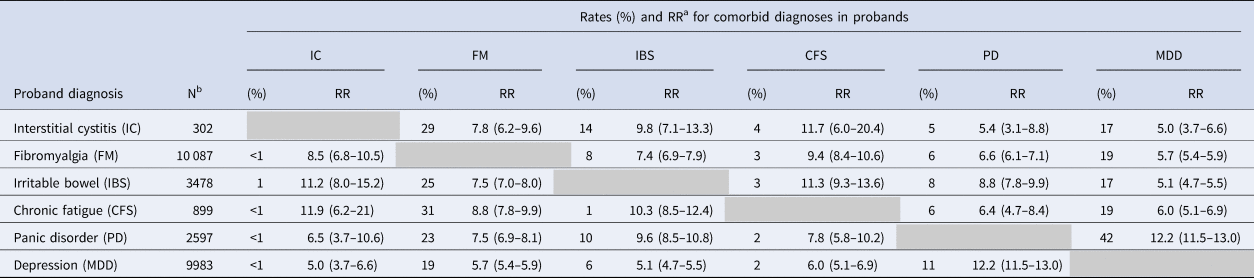
Table 1 shows the number of individuals who received each of the six diagnoses and the rates and relative risk (RR) of comorbidity with the other five disorders. IC probands had significantly (p < 0.0001) increased risks for comorbidity with each of the other five disorders. Among individuals with IC the relative risk for these disorders ranged from 5-fold for MDD to almost 12- fold for CFS. Risks for comorbidity among the other five disorders (FM, IBS, CFS, PD, MDD) were also significantly (p < 0.0001) increased as compared to general population rates (Table 1). Relative risk estimates for the other five disorders ranged between 5-fold for risk of MDD in probands with IBS up to 12-fold for risk of PD in probands with MDD.
Proband comorbidity: rates (%) and pairwise relative risks (RR) of additional syndrome diagnoses in probands

a All relative risks are significant at <0.0001.
b Overlapping groups.
Comorbidity among relatives
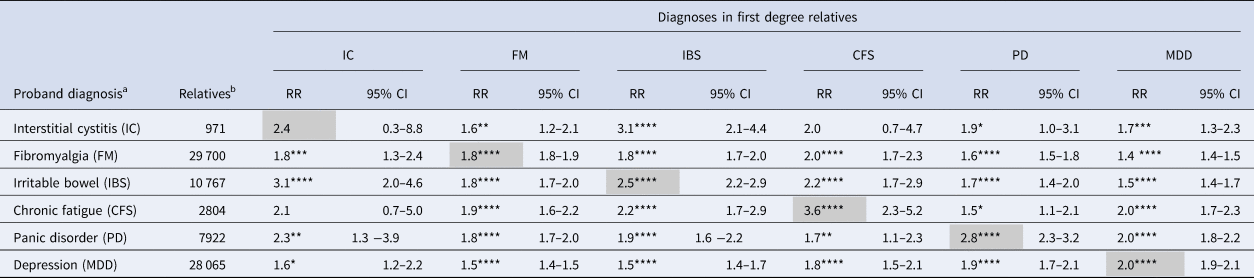
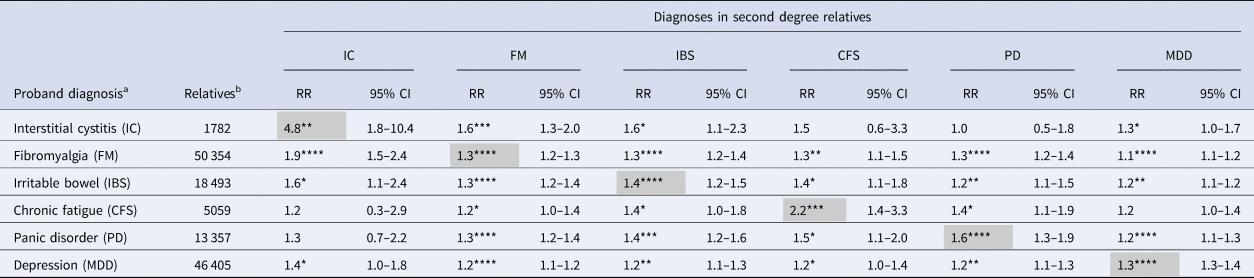
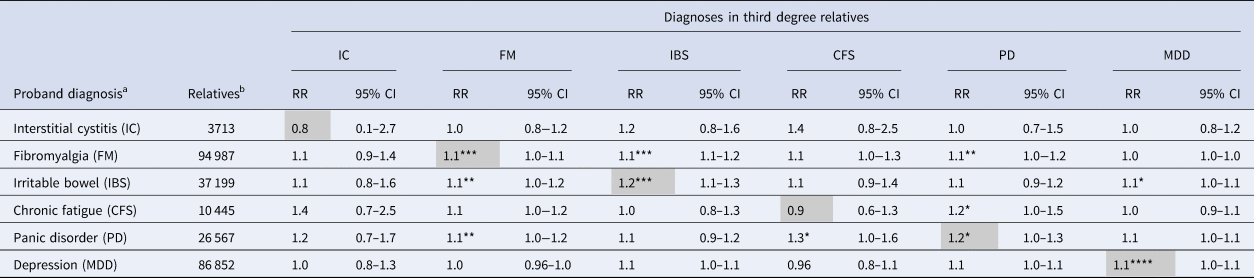
Tables 2–4 show the risk in relatives of probands with each of the hypothesized syndrome disorders with all the other disorders. RR estimates tended to be higher and more likely to be significant among FDR (Table 2) and lowest among TDR (Table 4). FDR of IC probands, for example, were at increased risk of FM, IBS, PD, and MDD. SDR of IC probands were at increased risk for IC, FM, IBS, and MDD. TDR of IC probands were not at increased risk for any of the disorders.
Risk for syndrome diagnoses in first degree relatives of probands with each of the hypothesized syndrome disorders

a Overlapping groups.
b Number of first-degree relatives of each proband group.
*p < 0.05, **p < 0.01, ***p < 0.001, ****p < 0.0001.
Risk for syndrome diagnoses in second degree relatives of probands with each of the hypothesized syndrome disorders

a Overlapping groups.
b Number of second-degree relatives of each proband group.
*p < 0.05, **p < 0.01, ***p < 0.001, ****p < 0.0001.
Risk for syndrome diagnoses in third degree relatives of probands with each of the hypothesized syndrome disorders

a Overlapping groups. Relative risks (RR) indicate increased likelihood of having each of the comorbid disorders if an individual has each one of the other disorders.
b Number of third-degree relatives of each proband group.
*p < 0.05, **p < 0.01, ***p < 0.001, ****p < 0.0001.
Evidence for a Heritable Interrelationship between IC with each of the other five disorders (FM, IBS, CFS, PD, MDD)
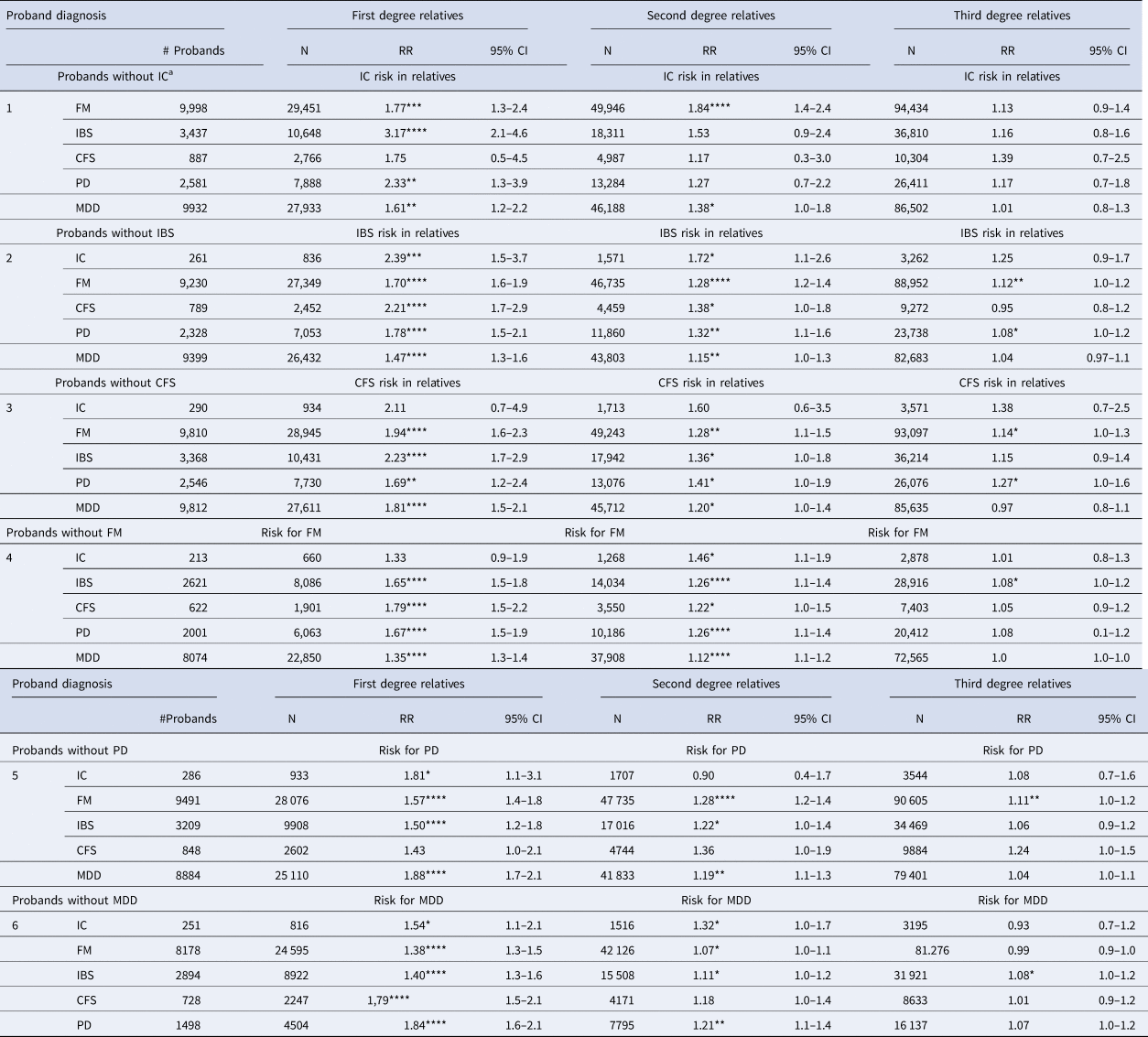
Using only the subgroups of probands who had one of each of the hypothesized syndrome disorders but not IC, we found significantly increased risk for IC among FDR of all proband groups (FM, IBS PD and MDD) except CFS (Table 5, Section 1). Among SDR of these proband groups without IC, increased risk for IC was found only in families of the FM and MDD probands.
Risk of each syndrome disorder in relatives of probands with a syndrome diagnosis but without the syndrome disorder assesseda in relatives syndrome

a For example, the first row describes the relatives probands who have fibromyalgia (FM) but not IC. For first degree relatives the relative risk (RR) for IC is 1.77. Row 9 describes the relatives of probands who have panic disorder (PD) but no IBS. For second degree relatives the RR for IBS is 1.32.
*p < 0.5, **p < 0.01, ***p < 0.001, ****p < 0.0001.
Evidence for heritable interrelationships among the other disorders (FM, IBS, CFS, PD, MDD)
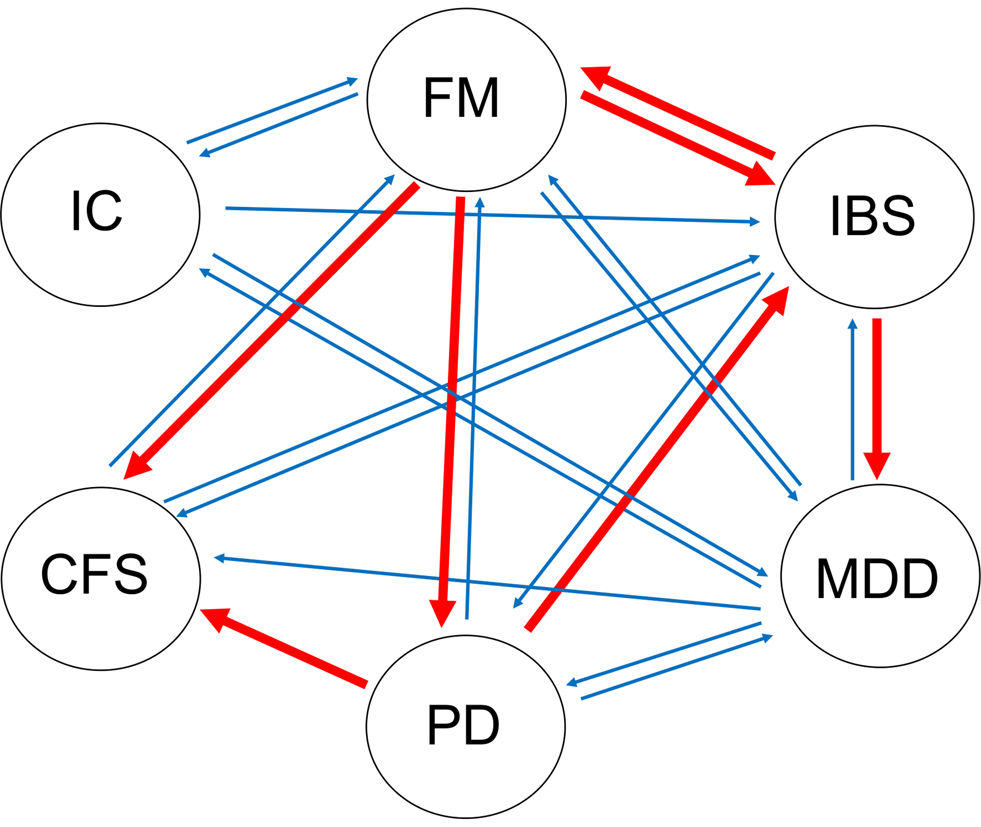
To address the heritable interrelationships among the other five hypothesized syndrome disorders, we repeated the same set of analytic procedures described above for IC for the other disorders. We examined probands diagnosed with one of the hypothesized syndrome disorders, but who did not have another syndrome disorder present, and investigated whether their relatives were at risk for the disorder not present in the proband. Table 5 represents a complete picture of the familial relatedness of these six disorders in first-, second-, and third-degree relatives. Figure 1 illustrates the results for SDR and TDR graphically. As shown in Table 5, there is significant excess relatedness of almost all the disorders with each of the other disorders in both first-and second-degree relatives. Twenty-six of the 30 contrasts in FDR and 23/30 in SDR indicated a significantly (p < 0.05, two tailed) increased familial risk as compared to population rates. A lesser degree of relatedness is seen in the third-degree relative group with only 7/30 of the contrasts showing significance. Figure 1 further shows the extensive overlap among the disorders. At the disorder specific level, there is some variation in the degree of familial overlap and extent of bidirectional transmission with IBS, FM and MDD showing the most and CFS and IC the least extensive relationships.
Presents a graphical summary of the significant results for second and third-degree relatives of the six disorders listed in Table 5. The disorder in each circle represents the disorder present in the proband. The direction of the arrow represents the disorder not present in the proband but in significant excess among relatives of the proband. The most distant significant relationship is represented. Thin lines represent significant second-degree relationships. Thicker lines represent significant third-degree relationships. For example, FDR, SDR, and TDR of probands with FM but without IBS have an increased risk of IBS. Hence, a thicker arrow indicating a significant third-degree relationship is illustrated. As can be seen there is extensive overlap among the disorders with increased prevalence among more distant relatives in families where the probands themselves do not have the disorder of interest. Second-degree relationships exist among all the disorders with most disorders showing bidirectionality (e.g. 2nd degree relatives of FM probands without IC are at increased risk of IC and vice versa, 2nd degree relatives of IC probands without FM are at increased risk of FM).

Discussion
The results of this large study add to a growing body of evidence that a common, heritable component contributes to the overall lifetime risk for IC, nociplastic pain disorders (FM, IBS, CFS) and certain psychiatric disorders, specifically MDD and PD. We observed significant comorbidity of these disorders in individuals, these disorders clustered in both close and distant relatives, and our investigation of disorders in relatives that were not present in the proband showed in most analyses a significantly increased risk in second- and often third-degree relatives. The investigation of familial risk for disorders that were not present in the proband ensured that our significant findings were not due to the known high rates of comorbidity and independent familial aggregation that exists for these disorders (Aaron & Buchwald, Reference Aaron and Buchwald2001; Afari et al., Reference Afari, Buchwald, Clauw, Hong, Hou, Krieger and Network2020; Clemens et al., Reference Clemens, Elliott, Suttorp and Berry2012; Keller, Chen, & Lin, Reference Keller, Chen and Lin2012; Novi et al., Reference Novi, Jeronis, Srinivas, Srinivasan, Morgan and Arya2005; Rodriguez et al., Reference Rodriguez, Afari and Buchwald2009; Watkins et al., Reference Watkins, Eberhart, Hilton, Suttorp, Hepner, Clemens and Berry2011). The observation that each of our six disorders is associated with significant familial clustering of most or all the others even in more distant relatives and in the absence of proband comorbidity for the disorder assessed in relatives is consistent with previous hypotheses that at least a subset of cases of nociceptive disorders comprise a pleiotropic syndrome with shared underlying causal mechanisms. The modest to moderate elevation of relative risk observed in family members is consistent with expectations for the assumed multifactorial etiology and complex polygenic genetic architecture of these disorders.
Our findings are consistent with the previous twin (Kato et al., Reference Kato, Sullivan, Evengard and Pedersen2009; Vehof et al., Reference Vehof, Zavos, Lachance, Hammond and Williams2014) and family based (Kendler et al., Reference Kendler, Rosmalen, Ohlsson, Sundquist and Sundquist2022) studies addressing the question of heritable and genetic overlap of these disorders. Though previous studies differed in methodological aspects (e.g. type of sample, self-report v. physician diagnosis) all indicate a component of shared genetic heritability among several nociplastic pain disorders and depression and/or PD. Kato and colleagues (Kato et al., Reference Kato, Sullivan, Evengard and Pedersen2009) in a volunteer-based sample from the Swedish twin registry found that the best fitting model included two latent genetic variables. One loaded strongly on chronic widespread pain (CWP) (0.79) and the other on MDD (0.76) and generalized anxiety disorder (0.69). Both contributed moderately to IBS (0.44,.54), CFS (0.58, 0.45), and recurrent headache (0.33,.30). Additional specific genetic contributions were also indicated for the pain but not the psychiatric disorders. A second study by Vehof and colleagues (Vehof et al., Reference Vehof, Zavos, Lachance, Hammond and Williams2014) conducted in a UK volunteer twin registry found a common latent genetic variable (h = 0.66) contributing to CWP, chronic pelvic pain (CPP), IBS, and dry eye. Heritability of the individual disorders ranged from 0.19 for IBS to 0.46 for CPP. The interrelationship of genetic risk for these disorders was also addressed in a recent study in the Swedish national registry. Using registered ICD diagnoses, Kendler and colleagues (Kendler et al., Reference Kendler, Rosmalen, Ohlsson, Sundquist and Sundquist2022) calculated family genetic risk scores based on prevalence of disorders in first through fifth-degree relatives and compared the subsequent genetic risk profiles of FM, IBS, CFS, MDD and several potentially related autoimmune (rheumatoid arthritis, Grave's Disease, Hashimoto's thyroiditis) and pain disorders (e.g. back pain, headache). Each of the three index disorders (FM, IBS, CFS) were found to have increased genetic risk not only for the other nociplastic pain disorders but also for autoimmune and internalizing psychiatric disorders with this effect most marked for FM.
The possibility of shared heritability is also supported by findings of most twin and family studies that have had a more limited focus on the relationship of PD or MDD and one or two of the nociplastic pain disorders. Two studies (Allen-Brady et al., Reference Allen-Brady, Norton and Cannon-Albright2015; Weissman et al., Reference Weissman, Gross, Fyer, Heiman, Gameroff, Hodge and Wickramaratne2004) found significantly increased risk for PD among relatives of individuals diagnosed with IC. Twin studies involving both FM and CFS indicate shared genetic contributions between these disorders and MDD (Corfield, Martin, & Nyholt, Reference Corfield, Martin and Nyholt2016). In addition, several investigators have found significantly increased risks for depression in the families of individuals diagnosed with FM (Arnold et al., Reference Arnold, Hudson, Hess, Ware, Fritz, Auchenbach and Keck2004; Hudson et al., Reference Hudson, Arnold, Keck, Auchenbach and Pope2004) and IBS (Yeh et al., Reference Yeh, Bai, Tsai, Chen, Liang and Chen2021). However, of two twin studies that investigated IBS-MDD comorbidity, one found evidence of a strong genetic contribution (Bengtson, Aamodt, Vatn, & Harris, Reference Bengtson, Aamodt, Vatn and Harris2015), the other found no evidence (Wojczynski, North, Pedersen, & Sullivan, Reference Wojczynski, North, Pedersen and Sullivan2007).
To our knowledge there are as yet no molecular genetic studies which could more definitively test this hypothesis by using a phenotype that combines several of the nociplastic pain disorders. Most previous molecular genetic studies of nociplastic pain have focused on either a specific disorder (Eijsbouts et al., Reference Eijsbouts, Zheng, Kennedy, Bonfiglio, Anderson, Moutsianas and Parkes2021; Gerra et al., Reference Gerra, Gonzalez-Villar, Arendt-Nielsen, Sokilde Pedersen, Trinanes, Donnini and Carrillo-de-la-Pena2021; van Tilburg et al., Reference van Tilburg, Parisien, Boles, Drury, Smith-Voudouris, Verma and Diatchenko2020) or on the broader concept of bodily pain (Tsepilov et al., Reference Tsepilov, Freidin, Shadrina, Sharapov, Elgaeva, Zundert and Aulchenko2020). Though the studies of wide spread or bodily pain have demonstrated significant genetic overlap with depression, bodily pain is a much more heterogeneous phenotype than we have considered in the present study so that its relevance in this context remains to be evaluated (Meng et al., Reference Meng, Adams, Reel, Rajendrakumar, Huang, Deary and Smith2020; Rahman et al., Reference Rahman, Winsvold, Chavez Chavez, Borte, Tsepilov, Sharapov and Williams2021). Recent large-scale genome-wide association studies (GWAS) of PD/anxiety and MDD have not examined relationships to pain disorders. An early linkage study found suggestive evidence of linkage in PD families also affected by IC. However, the findings did not reach genome-wide significance (Weissman et al., Reference Weissman, Gross, Fyer, Heiman, Gameroff, Hodge and Wickramaratne2004). Of interest one recent GWAS of IBS identified shared loci that also contributed to risk for mood and anxiety disorders (Eijsbouts et al., Reference Eijsbouts, Zheng, Kennedy, Bonfiglio, Anderson, Moutsianas and Parkes2021). Analyses of additional nociplastic disorders in this and other existing single disorder GWAS would be of great interest in further evaluating our hypothesis.
This study has several limitations. Many of the studies mentioned above include at least some of the same disorders. However, there is significant variation as to which nociplastic pain disorders are included. We chose FM, IBS, IC and ME/CFS because they had the most consistent data on familial transmission and were most often included in studies about nociplastic pain disorders. However, the boundaries of the heritable interrelatedness are not known and there are data supporting the inclusion of a number of other disorders (Maixner, Fillingim, Williams, Smith, & Slade, Reference Maixner, Fillingim, Williams, Smith and Slade2016). Though our findings of increased familial risk in SDR and TDR are consistent with a genetic overlap of these disorders, other confounding factors such as low socioeconomic status, other disease states (e.g. inflammatory diseases) and the family and social environment in the context of shared, similar parenting practices as well as extended families co-habiting or living otherwise closely enmeshed lives could account for these observations. We used diagnosis billing codes to identify cases. While these diagnoses are based on physician generated encounters, coding errors are possible, and some bills may be generated to rule-out diagnoses. These errors may lead to misclassification of the cases. This could also lead to an overestimation of familial aggregation as there may be an initial bias toward considering a diagnosis in individuals whose family members have the disorder. However, this is likely to have a stronger impact on close (e.g. FDR) who are more likely to share medical diagnosis data with their relatives than for more distant relatives. It is also possible that individuals with affected family members may be more likely to come to treatment, thereby skewing the sample toward familial cases, which again is likely more relevant for close relatives. In addition, as the population is predominantly white, our results cannot be generalized to other ethnic and racial groups. Furthermore, individuals with more severe illness may be more likely to seek care, and hence, our results may be biased towards inclusion of individuals with multiple nociplastic pain and psychiatric disorders.
In summary, our findings are consistent with a heritable overlap among nociplastic pain disorders, specifically IC, FM, IBS, and ME/CFS, that also includes MDD and PD. Our data suggest a shared genetic contribution, but there is, as yet insufficient data and a lack of molecular genetic studies to address this question. The demonstration of a shared heritable contribution to the liability for at least a subset of nociplastic pain disorder cases establishes a basis for much needed new approaches to etiological investigation and treatment development. For example, molecular genetic studies might consider using a combined phenotype definition that includes any of these nociplastic pain disorders. Participants could also be prospectively subtyped as to whether they came from ‘syndrome’ families (i.e. families with increased risk for several nociplastic pain disorders). From the research perspective (e.g. clinical trials or pathophysiological characterization) prospective stratification of participants by membership or not in a high-risk syndrome family could also be informative. From a clinical perspective, these findings suggest that screening for family history of nociplastic pain disorders, beyond FDR, may be a useful addition to initial evaluation of patients presenting with pain, anxiety or depression and could lead to earlier diagnosis and treatment for individuals with nociplastic pain. Identification of the mechanisms underlying the etiologic overlap among these disorders may provide new targets for therapeutic development, with the hope of not only treating pain, but also disrupting the steps leading to progression and diagnoses of additional comorbid conditions.
Conclusions
The results of this study indicate significant heritable overlap both among IC and several other nociplastic pain disorders (FM, IBS, and ME/CFS) and the psychiatric disorders (MDD and PD). That this overlap was observed in both close and distant relatives suggests that shared genetic factors contribute to the development of these disorders. Future work investigating shared genetic factors among these disorders is warranted.
Acknowlegements
We thank the Pedigree and Population Resource of Huntsman Cancer Institute, University of Utah (funded in part by the Huntsman Cancer Foundation) for its role in the ongoing collection, maintenance, and support of the Utah Population Database (UPDB). We also acknowledge partial support for the UPDB through grant P30 CA2014 from the National Cancer Institute, University of Utah and from the University of Utah's program in Personalized Health and Center for Clinical and Translational Science. We thank the University of Utah Center for Clinical and Translational Science (CCTS) (funded by NIH Clinical and Translational Science Awards), the Pedigree and Population Resource, University of Utah Information Technology Services and Biomedical Informatics Core for establishing the Master Subject Index between the Utah Population Database and the University of Utah Health Sciences Center.
Disclosures
Drs. Fyer and Weissman have received salary support from New York State Office of Mental Health. No additional funding from any source has been received by them for the research reported in this paper. For the last 5 years Dr Weissman has received funding for her research from NIMH, Brain and Behavior, John D and Catherine T Templeton Foundation, Sackler Institute for Developmental Psychobiology, and royalties from books from Oxford Press, Perseus Press, the American Association of Psychiatry Press and for the Social Adjustment Scale from Multihealth Systems. None of these present a conflict of interest with this paper.
Conflict of interest
None.