Theories of differential susceptibility emphasize that a subset of individuals are characterized by heightened sensitivity to both negative (risk-promoting) and positive (development-enhancing) environmental conditions (Belsky, Reference Belsky1997a, Reference Belsky1997b, Reference Belsky, Ellis and Bjorklund2005; Belsky, Bakermans-Kranenburg, & van IJzendoorn, Reference Belsky, Bakermans-Kranenburg and van IJzendoorn2007; Belsky & Pluess, Reference Belsky and Pluess2009; Boyce et al., Reference Boyce, Chesney, Alkon, Tschann, Adams, Chesterman and Wara1995; Boyce & Ellis, Reference Boyce and Ellis2005; Ellis, Boyce, Belsky, Bakermans-Kranenburg, & van IJzendoorn, Reference Ellis, Boyce, Belsky, Bakermans-Kranenburg and van IJzendoorn2011). The differential susceptibility model differs from the traditional diathesis–stress model (Monroe & Simons, Reference Monroe and Simons1991; Zuckerman, Reference Zuckerman1999), which emphasizes the disproportionate vulnerability of some individuals to negative environments only, and from the vantage sensitivity model (Pluess & Belsky, Reference Pluess and Belsky2013), which describes individual differences in the tendency to benefit from positive features of the environment only. Differential susceptibility, instead, reflects the combination of diathesis–stress and vantage sensitivity. Together with biological sensitivity to context (Boyce & Ellis, Reference Boyce and Ellis2005) and sensory processing sensitivity (Aron & Aron, Reference Aron and Aron1997; Aron et al., Reference Aron, Aron and Jagiellowicz2012), it is part of a number of ways in which variability in environmental sensitivity can express itself (Pluess, Reference Pluess2015).
Differential susceptibility to the environment has been studied at two levels (Pluess, Reference Pluess2015). The first involves developmental susceptibility to the environment, focusing on more long-term developmental changes, such as when experiences early in life affect a person's subsequent developmental trajectory. This long-term approach is well established in the field (Belsky & Pluess, Reference Belsky and Pluess2009; Ellis et al., Reference Ellis, Boyce, Belsky, Bakermans-Kranenburg and van IJzendoorn2011; Slagt, Dubas, Deković, & van Aken, Reference Slagt, Dubas, Deković and van Aken2016) and tends to rely on naturally occurring variation in the environment or interventions. The second level involves more transient fluctuations in functioning, focusing on short-term changes, such as immediate effects of stimuli on behavior or cognition. This second approach to differential susceptibility, which has received little empirical attention, tends to rely on experimental manipulations of the environment (e.g., Quas, Bauer, & Boyce, Reference Quas, Bauer and Boyce2004; Sasaki et al., Reference Sasaki, Kim, Mojaverian, Kelley, Park and Janušonis2013; Slagt, Dubas, van Aken, Ellis, & Deković, Reference Slagt, Dubas, van Aken, Ellis and Deković2017a), although it could also include immediate responses to normally occurring stimuli or events.
To differentiate between these two levels of analysis, we refer to the long-term approach as differential susceptibility (per Ellis et al., Reference Ellis, Boyce, Belsky, Bakermans-Kranenburg and van IJzendoorn2011) and the short-term approach as differential reactivity. Differential susceptibility is a specific form of what has been referred to in the literature as developmental plasticity (Snell-Rood, Reference Snell-Rood2013) and ontogenetic plasticity (Stamps, Reference Stamps2016), whereas differential reactivity is a specific form of what has been referred to as activational plasticity (Snell-Rood, Reference Snell-Rood2013) and contextual plasticity (Stamps, Reference Stamps2016). It is unclear what relation exists, if any, between differential susceptibility and differential reactivity. One challenging issue is that indices of differential reactivity (especially differential magnitude of physiological responses to laboratory challenges, per the biological sensitivity to context literature; Boyce & Ellis, Reference Boyce and Ellis2005) have also been used as indicators of differential susceptibility. Thus, in the physiologically oriented biological sensitivity to context literature, differential reactivity of biological stress responses is presumed to form the basis of differential susceptibility.
No such presumption is made in relation to behavioral indicators of differential reactivity versus susceptibility. Indicators of temperament, defined as “constitutionally based individual differences in reactivity and self-regulation, in the domains of affect, activity, and attention” (Rothbart & Bates, Reference Rothbart, Bates, Eisenberg, Damon and Lerner2006, p. 100), have been the most commonly used behavioral markers of differential susceptibility (Belsky & Pluess, Reference Belsky and Pluess2009; Slagt et al., Reference Slagt, Dubas, Deković and van Aken2016). Variation in temperament emerges early in life, is relatively stable across time and situations, and is presumed to have a genetic or neurobiological basis (Goldsmith et al., Reference Goldsmith, Buss, Plomin, Rothbart, Thomas, Chess and McCall1987). This is very different from differential reactivity, which in the current research was operationalized as immediate reactivity to parenting (as manifest in transient changes, for better and for worse, in child emotion or behavior in response to parents during parent-child interactions).
The central question guiding the current research was whether differential reactivity to parenting translates into differential susceptibility to parenting across development. This question has not been previously addressed. Our primary aim was to investigate whether children who show stronger immediate reactions to their mothers during observed parent–child interactions (differential reactivity, as coded in 5-s intervals) are also the ones whose development over a year is more strongly predicted by parenting at the beginning of that year (differential susceptibility). In other words, we tested whether observed differential reactivity operates as a differential susceptibility marker in a longitudinal study, moderating associations between parenting and child behavior.
Differential Reactivity
One form of differential reactivity is emotional reactivity. Emotional reactivity refers to an individual's threshold, intensity, and duration of affective arousal in reaction to changes in the environment (Rothbart & Derryberry, Reference Rothbart, Derryberry, Lamb and Brown1981). Emotional reactivity is a core facet of sensory processing sensitivity, which has previously been advanced as a potential susceptibility marker (Aron & Aron, Reference Aron and Aron1997; Aron et al., Reference Aron, Aron and Jagiellowicz2012; Slagt, Dubas, van Aken, Ellis, & Deković, Reference Slagt, Dubas, van Aken, Ellis and Deković2017b). Children high on emotional reactivity show stronger, more frequent, and prolonged emotions in response to input from their environment. A key element of children's environment is the social behavior of caregivers, particularly as communicated through their expressed emotions, because parenting in particular is an emotion-laden process (Teti & Cole, Reference Teti and Cole2011). Compared with less reactive children, highly emotionally reactive children should be more likely to respond intensely to negative emotions from parents, such as parental expressions of irritability or anger (El-Sheikh, Reference El-Sheikh2001), by increasing their own negative behaviors or emotional expressions. If these same children also responded more intensely to the positive emotions of their parents, then they would be defined as differentially emotionally reactive.
In this study, we focused on children's observed emotional reactivity to positive as well as negative parental emotions (i.e., a form of emotion contagion; Hatfield, Cacioppo, & Rapson, Reference Hatfield, Cacioppo and Rapson1993; Neumann & Strack, Reference Neumann and Strack2000). Previous research among adults has shown that, across time, positive and negative affect are two distinct (albeit moderately negatively correlated) factors instead of bipolar (Crawford & Henry, Reference Crawford and Henry2004; Diener & Emmons, Reference Diener and Emmons1985). Among infants and children, negative and positive emotionality also appear to be two distinct constructs (Belsky, Hsieh, & Crnic, Reference Belsky, Hsieh and Crnic1996; Durbin, Hayden, Klein, & Olino, Reference Durbin, Hayden, Klein and Olino2007; Hernández et al., Reference Hernández, Eisenberg, Valiente, Spinrad, Van Schyndel, Diaz and Piña2015).
These previous studies have used a variable-centered approach, showing that positive and negative affect load on separate but correlated factors, which differentially predict outcomes. Although variable-centered approaches (which describe associations among variables) are well-suited to study the relative contributions that predictor variables make to an outcome, person-centered approaches can identify groups of individuals that share a set of characteristics, and are better suited for studying the configuration of these characteristics within a person (Laursen & Hoff, Reference Laursen and Hoff2006). A person-centered approach could add to a variable-centered approach by showing that despite a negative association between negative and positive emotional reactivity on a population level (Crawford & Henry, Reference Crawford and Henry2004; Diener & Emmons, Reference Diener and Emmons1985), several groups of individuals could coexist within that population: High on both negative emotional reactivity and positive emotional reactivity, high on one, high on the other, and low on both. Our first aim in this study was therefore to examine whether a subset of children would be both more likely to respond with negative emotions to the negative emotions of their mothers and with positive emotions to the positive emotions of their mothers (which together would constitute differential reactivity). Using naturalistic observations of mother–child interactions, we coded mothers’ and children emotions and analyzed these using state space grids (Hollenstein, Reference Hollenstein2013), yielding for each child the probability of reacting with increasingly positive emotions in response to increasingly positive emotions of mothers (positive emotional reactivity), and the probability of reacting with increasingly negative emotions in response to increasingly negative emotions of mothers (negative emotional reactivity). To test for differential reactivity, these two indices were subsequently analyzed using latent profile analyses (LPAs; Lanza, Flaherty, & Collins, Reference Lanza, Flaherty, Collins, Schinka and Velicer2003). The LPA enabled us to determine whether profiles of highly emotionally reactive children (high-high), negatively reactive (low-high), positively reactive (high-low), and low reactive (low-low) children existed in the data. In contrast to most differential susceptibility research, this approach did not involve testing interactions between an environment and a proposed differential susceptibility marker, predicting an outcome. Instead, it involved testing whether associations of positive and negative environments with positive and negative outcomes, as captured by positive emotional reactivity and negative emotional reactivity, are both relatively strong among a subgroup of children.
Differential reactivity in relation to parenting and temperament traits
Next, as a second aim, we were interested in whether membership of these profiles would be associated with more traditional temperament markers (negative emotionality, surgency, effortful control, sensory processing sensitivity; see Aron et al., Reference Aron, Aron and Jagiellowicz2012; Slagt et al., Reference Slagt, Dubas, van Aken, Ellis and Deković2017b), as well as whether there would be potential demographic differences among the profiles. In addition, we tested whether profile membership would differ with respect to the parenting individuals received. Certain models of individual differences in susceptibility have emphasized that differences in susceptibility may develop in response to the amount of stress versus support experienced during childhood (the biological sensitivity to context model, Boyce et al., Reference Boyce, Chesney, Alkon, Tschann, Adams, Chesterman and Wara1995; Boyce & Ellis, Reference Boyce and Ellis2005; Ellis, Essex, & Boyce, Reference Ellis, Essex and Boyce2005; the adaptive calibration model, Del Giudice, Ellis, & Shirtcliff, Reference Del Giudice, Ellis and Shirtcliff2011; Ellis, Oldehinkel, & Nederhof, Reference Ellis, Oldehinkel and Nederhof2016).
Differential reactivity and differential susceptibility
What happens in a child's life in real time, for instance the daily interactions between parents and their children, is said to form the basis for development over years (Bronfenbrenner & Morris, Reference Bronfenbrenner and Morris1998). From a dynamic systems perspective, development is a nested process that unfolds over many time scales, from milliseconds to years, and in studying development, it is important to examine how different timescales interact (Smith & Thelen, Reference Smith and Thelen2003). To understand differential susceptibility and its implications for child development, relations between reactivity on a micro time scale and susceptibility on a developmental time scale need to be tested. Yet the way parents and children interact with each other on a micro time scale and how this relates to susceptibility across longer time scales remains unexamined to date. Our third and main aim is therefore to examine whether the same children that react most strongly to their mothers’ emotions during moment-to-moment interactions are also the ones whose development over a year is most strongly predicted by parenting at the beginning of that year. In other words, we examine whether reactivity for better and for worse” is related to susceptibility for better and for worse and thus functions as a marker underlying differential susceptibility.
In addition to different time scales, researchers have also distinguished different levels at which to study susceptibility markers: genotypic, endophenotypic, and phenotypic (Belsky & Pluess, Reference Belsky and Pluess2009, Reference Belsky and Pluess2013; Ellis et al., Reference Ellis, Boyce, Belsky, Bakermans-Kranenburg and van IJzendoorn2011). Within the phenotypic level, most research on differential susceptibility has focused on the temperament trait of negative emotionality, although this trait has been suggested to function as a susceptibility marker in infancy only (Slagt et al., Reference Slagt, Dubas, Deković and van Aken2016). In line with this, previous research on the sample used in this study has shown that associations between parenting and child behavior did not depend on children's negative emotionality (Slagt et al., Reference Slagt, Dubas, van Aken, Ellis and Deković2017b). Sensory processing sensitivity, however, did interact with both changes in negative and changes in positive parenting in predicting changes in externalizing behavior, in a manner consistent with differential susceptibility. Thus, another reason we chose to focus on reactivity for better and for worse, and not on “negative reactivity,” is that markers that encompass a broader sensitivity to the environment, regardless of valence, might be more promising (Slagt et al., Reference Slagt, Dubas, van Aken, Ellis and Deković2017b). Further, temperament traits reflect a general style of interpreting and reacting to the environment. In this study, however, we focus on how temperament is expressed in everyday life (“temperament in action”; compare Poorthuis et al., Reference Poorthuis, Thomaes, Denissen, van Aken and Orobio de Castro2014), for instance, expressed emotions in interactions with parents (McAdams & Pals, Reference McAdams and Pals2006). In this sense, our conceptualization of differential reactivity as a susceptibility marker adds to other approaches focusing on more traditional measures of temperament.
To test whether differential reactivity operates as a susceptibility marker in longitudinal associations between parenting and child adjustment, we measured both negative and positive aspects of parenting and child adjustment. Negative parenting entailed behaviors reflecting negative control and hostility, whereas positive parenting entailed behaviors reflecting positive control and warmth (Maccoby & Martin, Reference Maccoby, Martin and Mussen1983). Child externalizing problem behaviors were used as the index of negative child adjustment, whereas prosocial behavior was used as the measure of positive child outcomes. Externalizing behaviors can be described as outer directed, generating discomfort and conflict in the surrounding environment. They include hyperactive, oppositional, and aggressive behavior (Achenbach & Edelbrock, Reference Achenbach and Edelbrock1978). Prosocial behaviors are voluntary behaviors intended to benefit others (Eisenberg & Fabes, Reference Eisenberg, Fabes and Damon1998).
In sum, in this study, we tested whether observed differential reactivity operates as a differential susceptibility marker in a longitudinal study among a sample of kindergartners. To this end, we addressed three questions that build on each other:
1. Does a subset of children exist that are both more likely to respond with negative emotions to the negative emotions of their mothers and with positive emotions to the positive emotions of their mothers (i.e., a differentially reactive group defined in terms of their emotional reactivity)?
2. How do other temperament markers, parenting, and demographic characteristics relate to observed emotional reactivity?
3. Do children that react more strongly to their mothers’ emotions during moment-to-moment interactions show stronger longitudinal associations between parenting and development?
Methods
Participants
Information about the study was distributed to parents of children in Grades 1 and 2 at 49 regular elementary schools in the province of Utrecht, the Netherlands. Parents could voluntarily sign up their children for the study on a website, where they gave active informed consent, filled out their contact information, and completed a short screening questionnaire inquiring after children's negative emotionality and surgency. In this way, 280 children (N = 264 mothers) signed up for the study. The study on emotional reactivity was part of this larger longitudinal study.
For the more time-intensive study on emotional reactivity, we selected a subsample of 192 children to visit at home and observe during parent–child interactions. We also performed an experiment (not relevant to this study; see Slagt et al., Reference Slagt, Dubas, van Aken, Ellis and Deković2017a) following these observations. The number of children for this home visit was based on power analyses for the experiment. Selection was based on children's low/high scores on negative emotionality and surgency (see the Measures section of this article for a description of these scales; see Slagt et al., Reference Slagt, Dubas, van Aken, Ellis and Deković2017a, for further details), using an extreme group approach (Preacher, Rucker, MacCallum, & Nicewander, Reference Preacher, Rucker, MacCallum and Nicewander2005). A total of 185 parents consented to participate in the parent–child interactions, of which 168 were mothers. Nineteen video clips were of insufficient quality to use (low-quality image and sound, or siblings walking in on the interaction while both children had their backs to the camera, making it hard to distinguish between the siblings based on sound alone). Combining all of these criteria (questionnaire data on parenting filled out by mothers, mothers participating in observations, high-quality video clips) resulted in a final sample of 144 children.
Participating children were boys (54.9%) and girls (45.1%) between the ages of 3.79 and 5.96 years at the start of the study (M = 4.70, SD = 0.56). Most of the children (97.2%) were born in the Netherlands, as were their mothers (93.8%). Mothers of participating children were between the ages of 25.29 and 47.85 years (M = 37.56, SD = 4.37) at the start of the study, and were mostly married (77.8%) or cohabiting (17.4%). Mothers were highly educated, with 4.2% having no high school diploma or having finished lower vocational education, 20.1% having finished intermediate vocational education, and 75.7% having finished higher vocational education or university. Gross annual household income was less than the national mode (€35,000) for 4.9% of families, between 1 and 1.5 times national mode for 17.1% of families, 1.5–2 times national mode for 35.0% of families, and more than 2 times the national mode for 43.1% of families.
The final sample for the emotional reactivity study (N = 144) did not differ from children excluded from this study (N = 136) on negative emotionality, surgency, effortful control, sensory processing sensitivity, positive or negative parenting at time 1 (T1), prosocial behavior at T1, child gender, parent age, country of birth child, country of birth parent, marital status, education level, or income of parents, as indicated by χ2 and independent samples t tests. The two exceptions were that children participating in the study were younger than children excluded from the study, M = 4.96, SD = 0.56 versus M = 5.20, SD = 0.60, t(245) = 3.29, p < .001, d = 0.41, and had higher levels of externalizing behavior at T1, M = 3.77, SD = 3.69 versus M = 2.25, SD = 2.89, t(212) = –3.28, p < .001, d = 0.46. Complete data on study variables (observed emotional reactivity, child temperament traits, mother-reported parenting, and teacher-reported child behavior across three waves) were provided by 100% of the 144 participating families at screening and by 74% of the participating families at wave 1, 67% at wave 2, and 65% at wave 3. Children with complete data across waves did not differ from children with missing data on demographic variables or on study variables, as indicated by χ2 and independent samples t tests. Missing values were handled in Mplus 7.4 using Full Information Maximum Likelihood (Enders & Bandalos, Reference Enders and Bandalos2001).
Procedure
Parents filled out a screening questionnaire, based upon which children were selected for home visits. The home visits occurred approximately 4 months later and included an experiment (see Slagt et al., Reference Slagt, Dubas, van Aken, Ellis and Deković2017a, for a description) and observations of parent–child interactions. Children were visited at home twice by a researcher (the first author or a trained research assistant). During the first of these visits, the observations took place. A standard set of toys was brought in (puzzles, a train and railroad set, a tea set, and dominoes) and children and parents were asked to start playing with it. After a warm-up episode of 5 min, parents were asked to tell their child that it was their turn to pick a game, and encourage their child to play along with them (parent-directed play, 5 min). Finally, parents were asked to tell their child it was time to stop playing and that the toys should be put away. It was emphasized that they should try to have their children collect the toys and put them away (clean-up, 5 min). All parent–child interactions were videotaped and coded afterwards.
The home visits coincided with the first wave of questionnaire data collection, after which two more waves of data collection took place, all spaced 7 months apart. At each of these three waves (T1, time 2 [T2], and time 3 [T3]), mothers reported on their parenting behaviors, whereas teachers reported on children's externalizing and prosocial behavior. In addition, mothers provided information on children's negative emotionality and surgency during the screening, and on children's sensory processing sensitivity and effortful control at T1. Families were given a gift certificate after completing T1 and T3, and a lottery was organized in which two families who had participated in all three waves could win tickets to a theme park. Finally, regular newsletters were sent to the participating families and schools, keeping them informed on the progress of the study.
Measures
Emotional reactivity
Two 5-min situations, parent-directed play and clean-up, were coded for each mother–child duo. Mothers and children were coded by different coders, using the Relationship Affect Coding System (Peterson, Winter, Jabson, & Dishion, Reference Peterson, Winter, Jabson and Dishion2008). The Relationship Affect Coding System can be used to code verbal behavior, physical behavior, and emotions. For the purpose of this study, emotions were coded, namely anger/disgust, distress, ignoring, validation, positive affect, and neutral (see Peterson et al., Reference Peterson, Winter, Jabson and Dishion2008, for elaborate code descriptions). Both mothers and children received a code for each 5-s segment of the interaction. Mean coded trajectory length was 450 s (ranging from 40 to 600 s, SD = 99 s).
Coding was done by nine coders that had each received five 1-hr training sessions. Interrater reliability with the main researcher was calculated on 10% of the sample, and was high: Cohen's kappa .66–.72, interrater agreement 83–86%. Halfway through the coding process, one video was coded by all coders and discussed during an additional training session to assess and prevent observer drift.
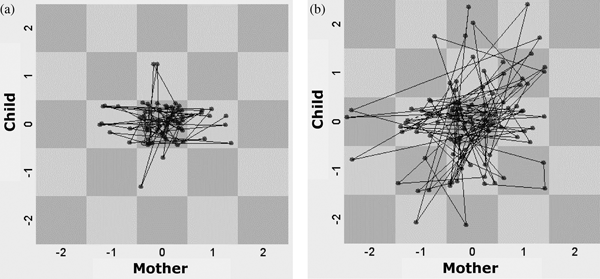
Because we were interested in more general negative and positive affect, we combined anger/disgust, distress, and ignoring into negative emotions, and validation and positive affect into positive emotions, resulting in three potential codes: negative emotions, neutral, or positive emotions. Further, to capture emotional reactivity, we focused on changes in emotions between 5-s intervals. More specifically, emotional reactivity was operationalized as changes in children's emotions given prior changes in maternal emotions. Changes in emotions could range from –2 to 2: positive to negative = –2 (becoming more negative); positive to neutral = –1; neutral to negative = –1; positive to positive = 0 (stable); neutral to neutral = 0; negative to negative = 0; neutral to positive = 1; negative to neutral = 1; and negative to positive = 2 (becoming more positive). Figure 1 displays two examples of what different interactions can look like, with changes in maternal emotions on the x-axis and changes in children's emotions on the y-axis. The dyad in Figure 1a is mostly stable in their emotions, whereas the dyad in Figure 1b changes more in their emotions over the course of the interaction. In our analyses, we collapsed categories –2 and –1 into –1, and 1 and 2 into 1, to increase the number of observations in each cell. Thus, when examining changes in emotions, mothers and children could either become more positive (1), more negative (–1), or remain stable (0).
Two examples of mother–child interactions in Gridware. Changes in maternal emotions are displayed on the x-axis; changes in children's emotions are on the y-axis. They range from –2 (more negative), to 0 (stable), to 2 (more positive). (A) The dyad in is mostly stable in their emotions, whereas (B) the dyad changes more in their emotions over the course of the interaction.

Child externalizing and prosocial behavior
Teachers reported on externalizing behaviors and prosocial behaviors at each wave using the Dutch version of the Strengths and Difficulties Questionnaire (Goodman, Reference Goodman2001; van Widenfelt, Goedhart, Treffers, & Goodman, Reference van Widenfelt, Goedhart, Treffers and Goodman2003). Each subscale consists of five items, measured on a 3-point scale (1 = not true to 3 = definitely true). The subscales conduct problems (“Often has temper tantrums or hot tempers”) and attention problems (“Easily distracted, has trouble concentrating”) were summed to an externalizing behavior score, whereas the items in the subscales prosocial (“Considerate of other people's feelings”) were summed to a prosocial behavior score. Cronbach's α values for externalizing behavior and prosocial behavior were .83 and .77 at T1, .84 and .83 at T2, and .82 and .75 at T3.
Negative parenting
Negative parenting was measured using four scales. The Overreactivity scale from the Parenting Scale (Prinzie, Onghena, & Hellinckx, Reference Prinzie, Onghena and Hellinckx2007) contains nine items (e.g., “When my child misbehaves… . I speak calmly to my child vs. I raise my voice or yell”) answered a 7-point Likert scale, ranging from a high probability to use an effective discipline strategy to a high probability of making a discipline mistake. The Power assertion scale from the Parenting Dimensions Inventory (Power, Reference Power1993) contains 12 items consisting of short scenarios to which the parent is asked to indicate the likelihood of responding in a specific way (e.g., “After an argument about toys your child hits his/her play mate… . How likely is it that you will use physical punishment”). Answers can range from 1 (very unlikely) to 5 (very likely). The Ignoring scale from the Nijmegen Parenting Questionnaire (Gerrits, Deković, Groenedaal, & Noom, Reference Gerrits, Deković, Groenendaal, Noom, Rispens, Hermanns and Meeus1996) consists of five items (e.g., “When my child does something that is not allowed, I oftentimes look angry and pretend like he/she is not there”), with answers ranging from 1 (totally disagree) to 6 (totally agree). Finally, the inconsistent discipline from the Parenting Dimensions Inventory (Power, Reference Power1993) contains eight items (e.g., “My child oftentimes manages to convince me to punish him/her lighter than I intended”), with answers ranging from 1 (totally disagree) to 6 (totally agree). Confirmatory factor analysis in Mplus 7.2 shows that these four scales can be combined into one construct, with factor loadings ranging between .46 and .90. Following van de Schoot, Lugtig, and Hox (Reference van de Schoot, Lugtig and Hox2012) and Widaman, Ferrer, and Conger (Reference Widaman, Ferrer and Conger2010), we established partial strict measurement invariance across waves (χ2 (318) = 443.66, p < .001, Comparative Fit Index (CFI) = .962, Tucker Lewis Index (TLI) = .958, root mean square error of approximation [RMSEA] = .040), which entails invariant factor loadings, measurement intercepts, and unique factor variances. Factor scores were saved and used for further analyses. Cronbach's α values of the total scale were .87, .88, and .88 at T1, T2, and T3, respectively. Previous research has shown that negative and positive parenting were negatively correlated, and that negative parenting was negatively correlated with prosocial behavior and positively correlated with externalizing behavior (Slagt et al., Reference Slagt, Dubas, van Aken, Ellis and Deković2017b).
Positive parenting
Positive parenting was measured using five scales. The Responsiveness scale from the Nijmegen Parenting Questionnaire (Gerrits et al., Reference Gerrits, Deković, Groenendaal, Noom, Rispens, Hermanns and Meeus1996) contains eight items (e.g., “I help my child well when he/she has difficulties”) with answers ranging from 1 (totally disagree) to 6 (totally agree). The Autonomy granting scale from the Nijmegen Parenting Questionnaire (Gerrits et al., Reference Gerrits, Deković, Groenendaal, Noom, Rispens, Hermanns and Meeus1996) consists of four items (e.g., “I regularly encourage my child to explore things”), with answers ranging from 1 (totally disagree) to 6 (totally agree). The Positive interactions scale from the Parenting Practices Scale (Strayhorn & Weidman, Reference Strayhorn and Weidman1988) contains five items (e.g., “How often do you and your child laugh together”), with answers ranging from 1 (never) to 5 (several times a day). The Positive parenting scale from the Alabama Parenting Questionnaire (Essau, Sasagawa, & Frick, Reference Essau, Sasagawa and Frick2006) contains six items (e.g., “You praise your child when he/she behaves well”), with answers ranging from 1 (never) to 5 (always). Finally, the Inductive discipline scale from the Parenting Dimensions Inventory (Power, Reference Power1993) contains 12 items consisting of short scenarios to which the parent is asked to indicate the likelihood of responding in a specific way (e.g., “After an argument about toys your child hits his/her play mate…. How likely is it that you will point out the consequences of your child's behavior to your child”). Answers are given ranging from 1 (very unlikely) to 5 (very likely). Confirmatory factor analysis in Mplus 7.2 shows that these five scales can be combined into one construct, with factor loadings ranging between .34 and .67. We established partial strict measurement invariance across waves (χ2 (318) = 443.66, p < .001, CFI = .962, TLI = .958, RMSEA = .040). Factor scores were saved and used for further analyses. Cronbach's α values of the total scale were .84, .84, and .86, at T1, T2, and T3, respectively.
Reported temperament
Children's negative emotionality, surgency, and effortful control were assessed using the Dutch version of the Children's Behavior Questionnaire—Short From (Putnam & Rothbart, Reference Putnam and Rothbart2006; Rothbart, Ahadi, Hershey, & Fisher, Reference Rothbart, Ahadi, Hershey and Fisher2001). Mothers reported children's Anger/frustration (“Has temper tantrums when s/he doesn't get what s/he wants”), Soothability (“Is very difficult to soothe when s/he has become upset”), Fear (“Is afraid of burglars or the ‘boogie man.’”), Sadness (“Cries sadly when a favorite toy gets lost or broken”), Impulsivity (“Usually rushes into an activity without thinking about it”), Activity level (“Seems always in a big hurry to get from one place to another”), Approach (“Becomes very excited while planning for trips”), High intensity pleasure (“Likes going down high slides or other adventurous activities”), Attentional focusing (“Is easily distracted when listening to a story”), and Inhibitory control (“Can easily stop an activity when s/he is told ‘no’”). Items could be answered on a 7-point scale ranging from 1 (extremely untrue of your child) to 7 (extremely true of your child). A not applicable response option was also available, for when the child had not been observed in the situation described. Scale scores were created by averaging applicable item scores. Following previous research (Rothbart et al., Reference Rothbart, Ahadi, Hershey and Fisher2001), the Anger/frustration, reversed Soothability, Fear, and Sadness scales were subsequently averaged into a negative emotionality score (α = .85). The Impulsivity, Activity level, Approach, and High intensity pleasure scales were averaged into a surgency score (α = .90). The Attentional focusing and Inhibitory control scales were averaged into an effortful control score (α = .74).
Sensory processing sensitivity
Children's sensory processing sensitivity was assessed using a Dutch 12-item parent-report version (adapted from Pluess & Boniwell, Reference Pluess and Boniwell2015; Pluess et al., Reference Pluess, Assary, Lionetti, Lester, Krapohl, Aron and Aron2018) of the Highly Sensitive Person scale (Aron & Aron, Reference Aron and Aron1997), which was back-translated together with the second author. Items could be answered on a 7-point scale ranging from 1 (not at all) to 7 (extremely), with higher scores indicating higher sensory processing sensitivity. Internal consistency was satisfactory (α = .79).
Analyses
Before analyses, outliers (N = 9) were recoded to three SDs from the mean. To control for inflation of Type I error rates, we applied a false discovery rate procedure to all results, which takes into account the proportion of expected false-positive results among a set of significant findings (Benjamini & Hochberg, Reference Benjamini and Hochberg1995).
Question 1: Does a subset of children exist who are both more likely to respond with increasingly negative emotions to increasingly negative emotions of their mothers and with increasingly positive emotions to increasingly positive emotions of their mothers?
Raw coded data were imported into Gridware (Lamey, Hollenstein, Lewis, & Granic, Reference Lamey, Hollenstein, Lewis and Granic2004; Lewis, Lamey, & Douglas, Reference Lewis, Lamey and Douglas1999), yielding trajectories of mother–child interactions for each mother–child duo. Trajectory length was controlled for in all analyses. Next, several new variables were exported from Gridware to SPSS. These included the percentage of interaction time children or mothers showed negative, neutral, or positive emotions (six variables, for descriptive purposes), the percentage of interaction time children or mothers changed their emotions to become more negative or more positive, or remain stable (six variables, for descriptive purposes), and finally, changes in children's emotions given prior changes in maternal emotions (for latent profile analyses; for a precise description of these variables, see the Results section and Table 2).
Emotional reactivity profiles were created using LPA in Mplus 7.4 (Muthén & Muthén, Reference Muthén and Muthén1998–2012). We used Mplus default settings, apart from increasing the number of initial stage random starts (400), final stage optimizations (100), and initial stage iterations (20). Models were compared using Akaike Information Criterion (AIC), Bayesian Information Criterion (BIC), entropy, the Lo-Mendell-Rubin Likelihood-Ratio Test (LMR), and the Bootstrapped Likelihood-Ratio Test (BLRT). Lower AIC and BIC indicate better fit. Entropy closer to 1 is an indicator of higher accuracy with which participants are assigned to profiles. Significant LMR and BLRT indicates that a model with K profiles fits the data significantly better compared with a model with K-1 profiles. In addition, we took into account the size of the profiles, checking whether solutions contained profiles consisting of 5% or fewer participants.
Question 2: How do other temperament markers, parenting, and demographic characteristics relate to observed emotional reactivity?
To further characterize the profiles, we tested whether profiles differed on outcome variables, namely negative emotionality, surgency, effortful control, sensory processing sensitivity, child age, gender, parental education level, and negative and positive parenting. We used the recommended three-step approach, which involves deciding upon an LPA solution, determining the measurement error of the most likely profile membership variable, and finally using this variable to predict distal outcomes (Asparouhov & Muthén, Reference Asparouhov and Muthén2014).
Question 3: Do children who react more strongly to their mothers’ emotions during moment-to-moment interactions show stronger longitudinal associations between parenting and development?
To answer this research question, we used latent growth curve modeling (LGM; Duncan, Duncan, & Strycker, Reference Duncan, Duncan and Strycker2006) and the latent moderated structural equation technique (LMS; Klein & Moosbrugger, Reference Klein and Moosbrugger2000) in Mplus 7.2 (Muthén & Muthén, Reference Muthén and Muthén1998–2012). LGM provides mean levels (i.e., intercepts) and change rates (i.e., slopes) that represent the developmental trajectories of variables. Variances of these growth factors reflect interindividual variation in the level or rate of change (Duncan et al., Reference Duncan, Duncan and Strycker2006). LMS allows for testing interactions between observed (i.e., temperament) and latent (i.e., intercept and slope of parenting) variables. All models were estimated using robust maximum likelihood estimation, which yields standard errors that are robust to non-normality.
Analyses proceeded in five steps, leading up to the actual test of this third research question. First, we fitted four univariate growth curves to model changes in positive parenting, negative parenting, prosocial behavior, and externalizing behavior. At least two slope factor loadings must be fixed to two different values to identify the model (Duncan et al., Reference Duncan, Duncan and Strycker2006). For positive and negative parenting, we specified a change trajectory by fixing the slope factor loadings for T1 and T3 to 0 and 1, with the factor loading for T2 freely estimated. Freely estimating the second factor loading enabled us to model an unspecified trajectory in which the shape of the trajectory is determined by the data. For prosocial and externalizing behavior, we specified a change trajectory by fixing the slope factor loadings for T1 and T3 to –1 and 0. By fixing the slope loadings in this way, the slopes represent the rate of change (increase or decrease) from T1 to T3. Further, the intercepts now correspond to the initial level (at T1) in the case of parenting, and to the level at the end of the study (T3) for child behavior, in line with our hypotheses. To retain enough degrees of freedom, error variances were set equal.Footnote 1
Second, we examined the associations between parenting and child behavior using bivariate LGM, combining the univariate growth models. Given concerns about the large number of parameters being estimated if all constructs had been included in the same model, four separate models were estimated: (a) positive parenting with prosocial behavior, (b) positive parenting with externalizing behavior, (c) negative parenting with prosocial behavior, and (d) negative parenting with externalizing behavior.
Third, we added main effects of emotional reactivity profiles found under question 1 to each of the four bivariate LGM's described under step 2, yielding four new multivariate models. A precise description of the emotional reactivity variables that resulted from the LPA and that were entered into the LGM's is provided in the Results section; for brevity, we refer to this variable as “emotional reactivity.” We used χ2, CFI, and RMSEA to assess model fit in steps 1–3.
The actual test of this third research question involved testing interactions using LMS in this fourth step. Four models were estimated, namely the four models as described in step 3 with interactions of parenting behaviors with emotional reactivity added. Typical fit indices are not available with models that use latent variable interactions because of adjustments made during estimation (Muthén & Muthén, Reference Muthén and Muthén1998–2012). As such, measures of relative fit (e.g., Bayesian information criteria) were used to compare models with and without interactions, as well as log likelihood ratio difference tests using an appropriate correction for the maximum likelihood estimation estimator (Satorra & Bentler, Reference Satorra and Bentler2001).
Finally, significant interactions were followed by estimating the relation between the predictor and the outcome in different emotional reactivity groups (Cohen, Cohen, West, & Aiken, Reference Cohen, Cohen, West and Aiken2003). Furthermore, to demonstrate a differential susceptibility effect, we calculated the region of significance with respect to the predictor (i.e., parenting) in case of a significant interaction (Preacher, Curran, & Bauwer, Reference Preacher, Curran and Bauer2006; Roisman et al., Reference Roisman, Newman, Fraley, Haltigan, Groh and Haydon2012). This region identifies the range of predictor values for which regression lines estimated for different emotional reactivity groups significantly differ from each other. When differential susceptibility is warranted, these lines should differ significantly both at low values (M = –2 SD) of the predictor (“for worse”) and at high values (M = +2 SD) of the predictor (“for better”) (Roisman et al., Reference Roisman, Newman, Fraley, Haltigan, Groh and Haydon2012). If diathesis–stress is warranted, these lines should differ only at the “for worse” side of the predictor. If vantage sensitivity is warranted, these lines should differ only at the “for better” side of the predictor.
Results
Question 1: Does a subset of children exist who are both more likely to respond with increasingly negative emotions to increasingly negative emotions of their mothers and with increasingly positive emotions to increasingly positive emotions of their mothers?
Describing emotions
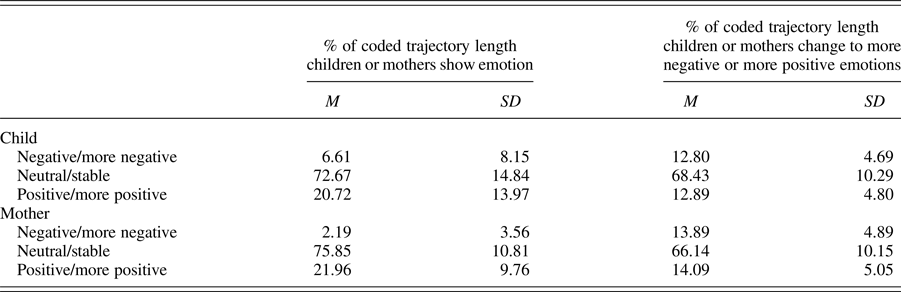
Before the latent profile analyses, we first examined the emotions children and mothers showed during the interactions, the extent to which they changed their emotions during the interactions, and children's emotional reactivity to maternal emotions. In Table 1, the first two columns display the percentage of time children and mothers show negative, neutral, or positive emotions. Of note is that mothers and children display few negative emotions. The second two columns display the percentage of time children and mothers change their emotions to become more negative or more positive, or remain stable. Here the distribution seems more normal, with mothers and children becoming more negative or more positive in their emotions approximately one third of the time. Note that these statistics are not about emotional reactivity yet, because they do not describe children's reactions to maternal emotions.
Descriptive statistics of emotions of mothers and children

Next, we examined how changes in mother's emotions were associated with subsequent changes in children's emotions. In doing so, we took into account baseline emotions of children. Thus, for a given 5-s interval Tn, we examined how changes in maternal emotions from interval Tn to interval Tn+1 would co-occur with changes in children's emotions from interval Tn to Tn+2.
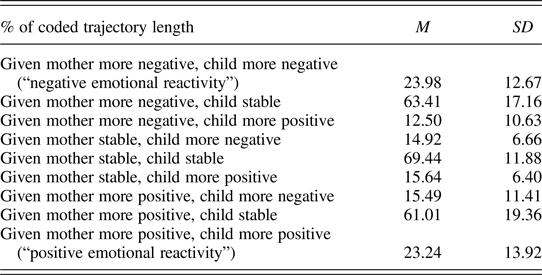
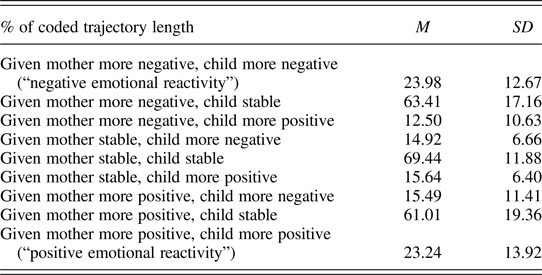
Table 2 presents all possible combinations of changes in mothers’ emotions with subsequent changes in children's emotions, expressed in percentage of coded trajectory length). Not all of these variables were relevant to use as input for the latent profile analyses.Footnote 2 In essence, we were interested in whether subsets of children would exist that (a) show more negative emotions when their mothers show more negative emotions, (b) show more positive emotions when their mothers show more positive emotions, (c) do both, or (d) do neither. The two variables that most directly describe these hypothesized classes are “given mother more negative, child more negative” (i.e., negative emotional reactivity) and “given mother more positive, child more positive” (i.e., positive emotional reactivity). Negative and positive emotional reactivity correlate .33, and it is therefore plausible that a general emotional reactivity profile could emerge.
Descriptive statistics of changes in children's emotions given changes in mothers’ emotions
LPA
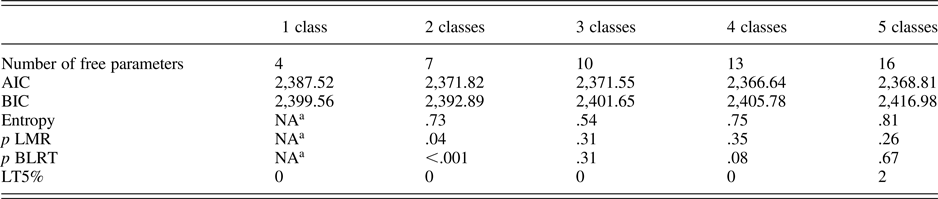
Emotional reactivity profiles were created using LPA in Mplus 7.4 (Muthén & Muthén, Reference Muthén and Muthén1998–2012). We used the negative emotional reactivity (“given mother more negative, child more negative”) and positive emotional reactivity variables (“given mother more positive, child more positive”) reported in Table 2 as profile indicators. As recommended by Marsh, Lüdtke, Trautwein, and Morin (Reference Marsh, Lüdtke, Trautwein and Morin2009), we based our final choice regarding the number of profiles on the fit indices reported in Table 3 in combination with the theoretical consistency, parsimony, and interpretability of results. As is often the case with LPA (e.g., Flaherty & Kiff, Reference Flaherty, Kiff and Cooper2012), the different fit indices were ambiguous regarding the best fitting model. AIC continued to decrease up to a model with four profiles, whereas BIC, LMR, and BLRT suggested that a two-profile model best fit the data. Entropy was quite stable over different solutions, only the three-profile solution had a lower value. Visual inspection of the various solutions indicated that the model with two profiles included one “average reactivity” profile and one “high reactivity” profile. The four-profile solution included an additional severity profile (“low reactivity”) and a distinct “negative reactivity” profile (high on negative emotional reactivity, average on positive emotional reactivity). However, this last profile only included 6% (N = 9) of the participants. Moreover, the four-profile solution was favored by only one out of five fit indices. We therefore retained the two-profile solution to describe our data.
Model fit statistics of latent profile analysis
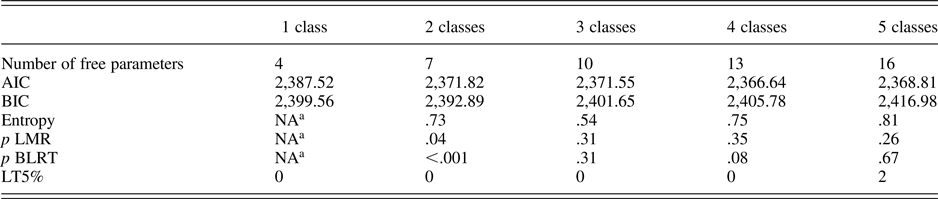
a Entropy, LMR, and BLRT not available for the one-class model.
AIC = Akaike Information Criterion; BIC = Bayesian Information Criterion; NA = not available; p LMR = p value for the Lo-Mendel-Rubin likelihood ratio test for K versus K-1 classes; p BLRT = p value for the Bootstrapped likelihood ratio test for K versus K-1 classes; LT5% Number of classes containing <5% of cases.
Description of the two-class LPA model
The average probability of profile membership in the two-profile membership was high: 93% for profile 1 and 85% for profile 2, which implies good discrimination among the classes. Profile 1 consisted of 87% (N = 130) of the participants. Children in this profile displayed negative emotional reactivity during 21.44% of the coded trajectory length and positive emotional reactivity during 19.11% of the coded trajectory length. Profile 2 consisted of 13% (N = 20) of the participants. Children in this profile displayed negative emotional reactivity 35.31% of the coded trajectory length and positive emotional reactivity 42.63% of the coded trajectory length. We named children in profile 1 “average reactive” and children in profile 2 “highly reactive.”
Question 2: How do other temperament markers, parenting, and demographic characteristics relate to observed emotional reactivity?
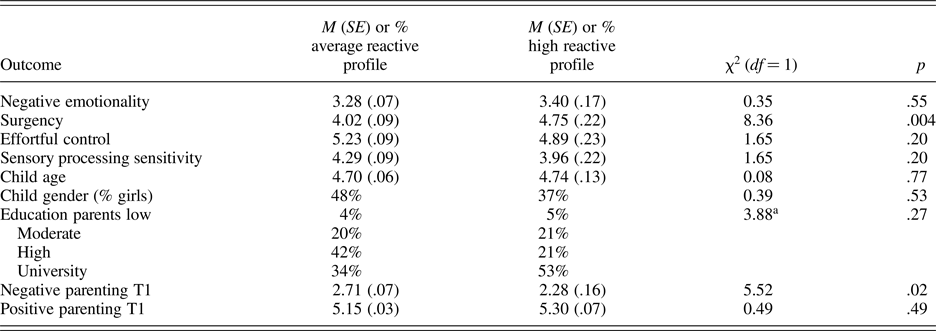
To further characterize the profiles, we tested whether profiles differed on distal outcome variables. Children in the high reactivity profile scored higher on surgency compared with children in the average reactivity profile (Table 4). Children in the average reactivity and high reactivity profiles did not differ from each other on negative emotionality, effortful control, sensory processing sensitivity, and age or gender. Finally, children in the high reactivity profile received lower levels of negative parenting, and similar levels of positive parenting, compared with children in the average reactivity profile.
Differences between latent profiles
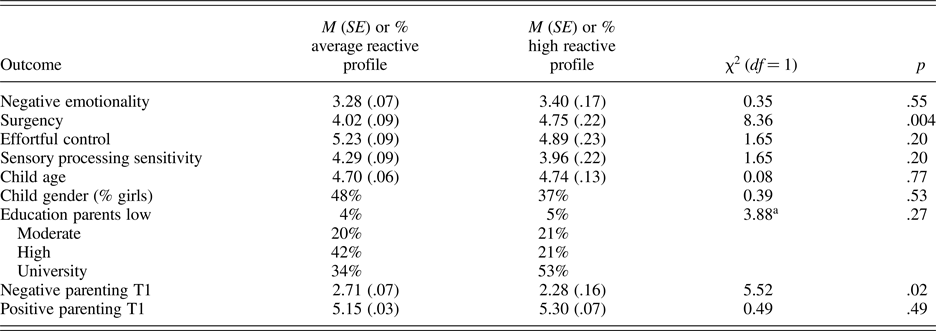
adf = 3.
Question 3: Do children who react more strongly to their mothers’ emotions during moment-to-moment interactions show stronger longitudinal associations between parenting and development?
In subsequent analyses, children's predicted profile membership (0 = average reactivity, 1 = high reactivity), is referred to as “emotional reactivity.” To answer the final and most fundamental question of this study, we tested whether emotional reactivity acted as a moderator of associations between parenting and child behavior.Footnote 3
Descriptive results
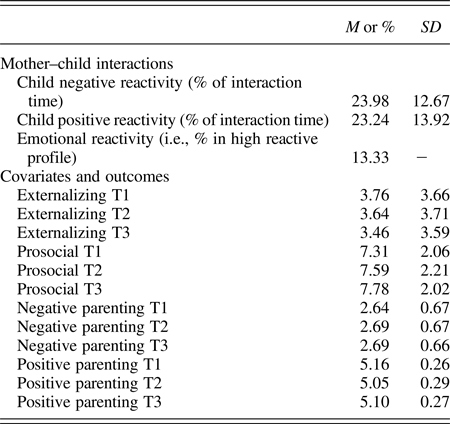
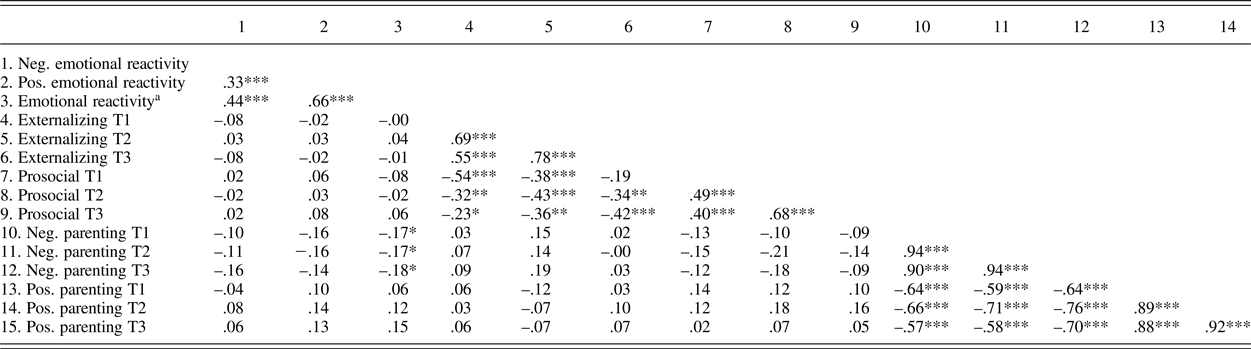
Descriptive statistics for measures of child behavior, parenting, and emotional reactivity are presented in Table 5, with correlations in Table 6. Children's externalizing and prosocial behavior as well as mothers’ positive and negative parenting all displayed high rank-order stability, both from T1 to T2 and from T2 to T3. Further, children high on emotional reactivity had mothers who reported lower levels of negative parenting across all three waves.Footnote 4
Descriptive statistics of emotional reactivity, child behaviors, and parenting (N = 144)
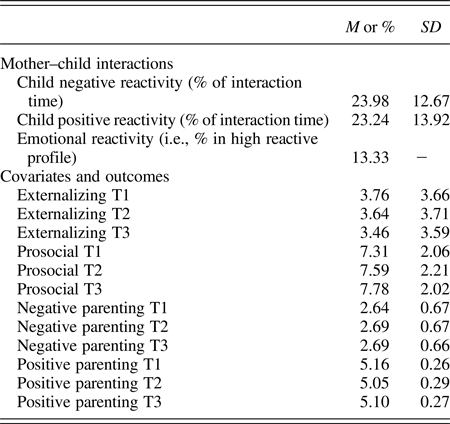
Note. T1 = time 1; T2 = time 2; T3 = time 3.
Correlations among observed emotional reactivity, child behaviors, and parenting
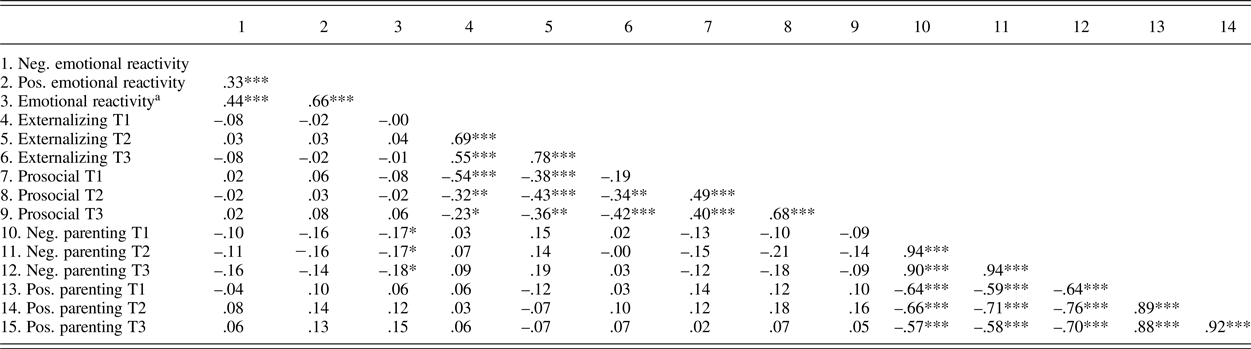
Note. T1 = time 1; T2 = time 2; T3 = time 3; neg. = negative; pos. = positive.
aCorrelations with emotional reactivity are point-biserial correlations.
* p < .05; ** p < .01; *** p < .001.
Change in parenting behavior and child behavior
We started by modeling change in parenting behavior and child behavior and by examining whether participants would vary in both their initial score as well as in how much they change. Significant variability is a prerequisite that must be met before intercepts and slopes can be used as predictors or outcomes in subsequent models (Duncan et al., Reference Duncan, Duncan and Strycker2006). When the nonlinear model did not provide significant incremental fit, a more parsimonious, linear, model was selected (in which the T2 slope loading was constrained to 0.5). Linear growth models were preferred for negative parenting (χ2(3) = 3.20, p = .36, CFI = 0.99, RMSEA = 0.02, compared with nonlinear model, Δχ2(1) = 0.05, p = .82), externalizing behavior (χ2(3) = 0.22, p = .98, CFI = 1.00, RMSEA = 0.00, compared with nonlinear model, Δχ2(1) = 0.00, p = . 99), and prosocial behavior (χ2(3) = 0.34, p = .95, CFI = 1.00, RMSEA = 0.00, compared with nonlinear model, Δχ2(1) = 0.09, p = .76). A nonlinear growth model was preferred for positive parenting (χ2(2) = 1.80, p = .41, CFI = 1.00, RMSEA = 0.00, compared with linear model, Δχ2(1) = 51.71, p < .001).
Parameter estimates of the final univariate models are shown in Table 7. On average, mothers decreased in positive parenting across the study, although this decrease took place between T1 and T2, followed by a slight increase between T2 and T3 (see the Slope loading section). Further, mothers linearly increased in negative parenting. Mothers varied in their level of positive and negative parenting at the beginning of the study, but not in the extent to which their parenting behaviors changed across the study. Together, this indicates that variation in the intercepts of parenting behavior can be used as a predictor of child behavior, but variation in the slopes of parenting behavior cannot. Children's level of externalizing behavior remained stable throughout the study, but their prosocial behavior increased. Further, children varied in their level of externalizing and prosocial behavior at the beginning of the study (intercept) and in how much their behavior changed over the course of the study (slope).
Parameter estimates of the univariate latent growth models

Note. T2 = time 2.
*p < .05; **p < .01; ***p < .001.
Associations between parenting behavior and child behavior
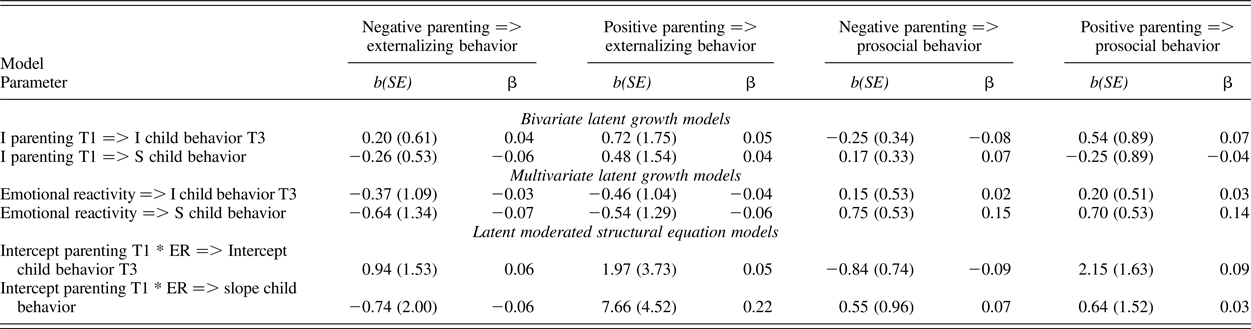
Next, we examined associations between parenting behavior and child behavior in four bivariate models (Table 8). All models showed good fit (negative parenting => externalizing behavior: χ2(13) = 9.29, p = .75, CFI = 1.00, RMSEA = 0.00; positive parenting => externalizing behavior: χ2(12) = 12.77, p = .39, CFI = 1.00, RMSEA = 0.02; negative parenting => prosocial behavior: χ2(13) = 15.49, p = .28, CFI = 1.00, RMSEA = 0.04; positive parenting => prosocial behavior: χ2(12) = 20.53, p = .06, CFI = 0.99, RMSEA = 0.07). None of the parenting behaviors predicted (changes in) externalizing or prosocial behavior.
Parameter estimates of the bivariate and multivariate latent growth models and latent moderated structural equation models
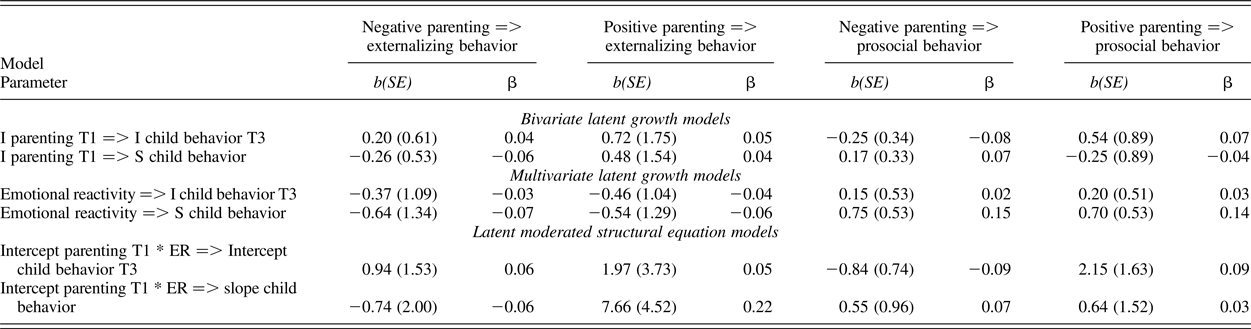
Note. T1 = time 1; T3 = time 3; I = intercept; S = slope. For brevity, only the structural parameters of the models are displayed. Slope loadings, intercept and slope means and variances, and intercept–slope covariances can be requested from the first author.
*p < .05; **p < .01; ***p < .001.
Associations between emotional reactivity and child behavior
Associations between emotional reactivity and child behavior were examined next, in four multivariate models.Footnote 5Footnote 6 These models also included the associations between parenting behaviors and child behaviors estimated in the previous step. All models showed good fit (negative parenting => externalizing behavior: χ2(17) = 15.26, p = .58, CFI = 1.00, RMSEA = 0.00; positive parenting => externalizing behavior: χ2(16) = 19.14, p = .26, CFI = 0.99, RMSEA = 0.04; negative parenting => prosocial behavior: χ2(17) = 21.41, p = .21, CFI = 0.99, RMSEA = 0.04; positive parenting => prosocial behavior: χ2(16)= 26.69, p = .05, CFI = 0.98, RMSEA = 0.07). Children's emotional reactivity did not predict their externalizing or prosocial behavior (Table 8).
Interactions between emotional reactivity and parenting
Finally, we examined interactions between parenting and emotional reactivity predicting child behavior in four latent moderated structural equation models. In each model, we tested interactions between emotional reactivity and one parenting behavior, predicting the intercept and slope of child behavior. Table 9 shows that none of the models containing interactions between parenting and emotional reactivity demonstrated better fit compared to their corresponding models without interactions. That is, the loglikelihoods were not significantly closer to zero in the models with interactions (estimated in this step) compared with models without interactions (estimated in the previous step). Parameter estimates in Table 8 confirm this and indicate that emotional reactivity did not interact with either positive or negative parenting, in predicting externalizing and prosocial behavior.
Fit statistics comparing models with and without interactions with emotional reactivity

Note. BIC = Bayesian Information Criterion.
aIntercepts of parenting were constrained to zero for centering in the models testing interactions.
Discussion
How children differ in susceptibility to environmental influences in terms of developmental outcomes has mostly been studied focusing on long-term changes, spanning months or years. Whether children can be susceptible for better and for worse within parent–child interactions, and whether this translates into differential susceptibility to parenting in developmental time, is unclear. In this study, we used a combination of micro level observation data and longitudinal questionnaire data to study the relationship between differential reactivity and differential susceptibility. We found a group of children (13%) that was emotionally reactive for better and for worse. Highly reactive children, compared with average reactive children, scored higher on the temperament trait of surgency, but not on other potential markers of differential susceptibility: negative emotionality, effortful control, or sensory processing sensitivity. They also received lower levels of negative parenting. Most importantly, our primary guiding hypothesis was not supported: Associations of negative and positive parenting with externalizing and prosocial behavior were similar (and nonsignificant) for highly reactive children and average reactive children, suggesting that that children who are reactive for better and for worse are not necessarily developmentally susceptible for better and for worse.
Differential reactivity for better and for worse
In response to our first question concerning emotional reactivity profiles, latent profile analysis identified two profiles of children: a high reactivity and an average reactivity profile. Children in the high reactivity profile (13%), compared with children in the average reactivity profile (87%), were both more likely to respond with increasingly negative emotions to increasing negative emotions of their mothers (i.e., “for worse,” short-term) as well as with increasingly positive emotions to increasingly positive emotions of their mothers (i.e., “for better,” short-term). Individual differences in susceptibility to the environment have been studied at long-term (differential susceptibility) and short-term (differential reactivity) levels. Although previous research has found support for some children being more susceptible to positive and negative parenting as reflected in their development over the years (Ellis et al., Reference Ellis, Boyce, Belsky, Bakermans-Kranenburg and van IJzendoorn2011; Pluess & Belsky, Reference Pluess and Belsky2010; Slagt et al., Reference Slagt, Dubas, Deković and van Aken2016), the current results suggest that certain children also respond more strongly to their parents’ positive and negative emotions within day-to-day parent–child interactions, as reflected in their own positive and negative emotions. Thus, we found support for differential reactivity, with some children being more emotionally reactive for better and for worse.
Especially interesting in light of the current results is the work by Ellis, Oldehinkel, and Nederhof (Reference Ellis, Oldehinkel and Nederhof2016), testing the adaptive calibration model: A theory that focuses on how environmental conditions early in life can calibrate individuals’ stress response systems, resulting in distinct responsivity (or susceptibility) profiles. Using latent profile analyses and based on several measures of the stress response system, they found support for four responsivity profiles among a sample of adolescents. The sensitive profile (10%) was characterized by heightened stress responsivity across all stress response subsystems, but also fast recovery of these systems. This pattern of responsivity is believed to enhance social learning and engagement with the environment. Importantly, this profile was also characterized by a childhood environment involving high levels of warmth and low levels of stress. The high reactivity profile found in the current study seems most similar to this sensitive profile in terms of reactivity levels, low levels of negative parenting, and percentage of the sample belonging to this group. Next, the buffered profile (74%) had moderate scores on basal arousal, reactivity, and recovery across stress response subsystems, and was associated with conditions of moderate childhood environmental stress. Individuals with this pattern of stress responsivity are thought to strike a balance between the costs (e.g., immune, energetic) and benefits (adaptation to environment) of responsivity. The average reactivity profile found in the current study seems most similar to this buffered profile. Two further profiles emerged that were both associated with stressful childhood environments: a vigilant profile (6%), which was hypothesized to enable people to cope with dangers and threats in the physical and social environment, and an unemotional profile (10%), representing a general unresponsivity to the environment (for instance, blocking information about dangers and threats).
That we found two profiles that were most similar to the sensitive and buffered profiles is perhaps not surprising. In our well-functioning sample of high socioeconomic status (SES) families, where parents displayed relatively high levels of positive and relatively low levels of negative parenting, sensitive (in our study emotionally reactive) and buffered (in our study average reactive) profiles would be most likely to emerge. Future research should strive to use samples that have more environmental variance, especially at the stressful, harsh end of the spectrum. Perhaps negative reactivity and low reactivity profiles, in addition to the current high reactivity and average reactivity profiles, would be more likely to emerge in such samples. Another plausible option would be for three sensitivity groups to emerge: orchids (high sensitive), dandelions (low sensitive), and tulips (medium sensitive) (Lionetti et al., Reference Lionetti, Aron, Aron, Burns, Jagiellowicz and Pluess2018; Pluess et al., Reference Pluess, Assary, Lionetti, Lester, Krapohl, Aron and Aron2018). However, these three groups emerged based on data obtained using the Highly Sensitive Child questionnaire, which measures the trait of environmental sensitivity (i.e., developmental sensitivity), instead of the moment-to-moment positive and negative emotional reactivity within parent–child interactions that was observed in this study (i.e., short-term reactivity). Thus, it is plausible that these two sets of results may differ, while both being valid.
Differential reactivity and temperament traits
With respect to our second question concerning associations between emotional reactivity profiles and other temperament markers and demographic characteristics, we found that highly emotionally reactive children were higher on surgency compared with average reactive children. Surgency reflects a predisposition to be actively involved with the environment, as can be seen in, for instance, the tendency to approach novelty, to enjoy intense activities, and to be sociable, active, and impulsive (Putnam, Ellis, & Rothbart, Reference Putnam, Ellis, Rothbart, Eliasz and Angleitner2001). Although it is presently impossible to distinguish whether emotional reactivity gives rise to surgency, surgency gives rise to emotional reactivity, or whether underlying neurobiological factors generate both, these findings provide a first indication of how to conceptualize the emotionally reactive children in this study.
Children in the average reactivity and high reactivity profiles did not differ from each other on negative emotionality, effortful control, sensory processing sensitivity, and age or gender. Previous research, however, has found children higher on negative emotionality (Belsky & Pluess, Reference Belsky and Pluess2009; Slagt et al., Reference Slagt, Dubas, Deković and van Aken2016) or on sensory processing sensitivity (Pluess & Boniwell, Reference Pluess and Boniwell2015; Slagt et al., Reference Slagt, Dubas, van Aken, Ellis and Deković2017b) to be more susceptible to environmental influences.
Emotional reactivity as found in this study seems to be unrelated to these markers of developmental susceptibility. This suggests that it may be unlikely for children who are identified as susceptible for better and for worse using negative emotionality and sensory processing sensitivity, to be the same ones who are also reactive for better and for worse within parent–child interactions. However, theoretically, it would be possible that emotionally reactive children are also susceptible, but that negative emotionality/sensory processing sensitivity and emotional reactivity are picking up on different subsets of susceptible children. This notion is consistent with our final question, where we tested whether reactivity for better and for worse is related to susceptibility for better and for worse.
That the emotional reactivity grouping was not associated with established markers of susceptibility remains surprising. Although the data show a group of children that responded with increasingly positive emotions to their mothers’ increasingly positive emotions and with increasingly negative emotions to their mothers’ increasingly negative emotions, much remains unknown about this conceptualization of emotional reactivity. It is possible that the current operationalization of emotional reactivity was insufficient and future research should aim at measuring reactivity in more extensive and detailed ways.
Differential reactivity and differential susceptibility
Associations between parenting and the development of prosocial and externalizing behavior turned out to be similar for children in the high reactivity and average reactivity profiles. Thus, it seems that children who are reactive for better and for worse within parent–child interactions are not necessarily more susceptible to parenting on a developmental time scale, although caution is warranted here because there were no main effects of parenting on either prosocial or externalizing behavior.
Differential susceptibility has been studied focusing on more long-term developmental changes (e.g., Belsky & Pluess, Reference Belsky and Pluess2009; Ellis et al., Reference Ellis, Boyce, Belsky, Bakermans-Kranenburg and van IJzendoorn2011) and, to a lesser extent, focusing on short-term changes (e.g., Quas et al., Reference Quas, Bauer and Boyce2004; Sasaki et al., Reference Sasaki, Kim, Mojaverian, Kelley, Park and Janušonis2013; Slagt et al., Reference Slagt, Dubas, van Aken, Ellis and Deković2017a). This study provides a first indication that these two groups of studies may have been tapping into different constructs, or may have been studying different children. Previous research using this sample found support for differential susceptibility, with children higher on sensory processing sensitivity being more susceptible for better and for worse as expressed in externalizing behavior (Slagt et al., Reference Slagt, Dubas, van Aken, Ellis and Deković2017b). In the current study, using the same sample, we found support for differential reactivity for better and for worse. Yet children in the high reactivity profile were not found to be more susceptible for better and for worse. Thus, it seems that sensory processing sensitivity and emotional reactivity are picking up on different subsets of susceptible children in this sample. Together, these results indicate that it may not be justified to assume that differential reactivity and differential susceptibility are related.
Although our findings point to emotional reactivity to both negative and positive parental emotions being unrelated to susceptibility, they constitute no more than a first attempt at trying to answer this fundamental question. Future research should try to replicate, but also extend, our findings. For instance, our operationalization of emotional reactivity was less broad compared with the definition mentioned in the literature, which encompasses threshold, intensity, and duration of emotional responses (Rothbart & Derryberry, Reference Rothbart, Derryberry, Lamb and Brown1981). Moreover, we focused on emotional reactivity to both negative and positive stimuli in the environment, but other forms of reactivity exist, too, such as reactivity in behavior or cognition (e.g., Quas et al., Reference Quas, Bauer and Boyce2004; Sasaki et al., Reference Sasaki, Kim, Mojaverian, Kelley, Park and Janušonis2013; Slagt et al., Reference Slagt, Dubas, van Aken, Ellis and Deković2017a). How other expressions of differential reactivity relate to differential susceptibility should be studied before drawing final conclusions about the extent to which differential reactivity and differential susceptibility are related.
Limitations
The results of this study should be considered whilst keeping in mind four limitations. First, the number of children in the high reactivity group was relatively small. This may have limited the power to find group differences when comparing with the average reactivity group, or to find moderation by reactivity group. Yet although the absolute number of highly reactive children was small, the percentage of highly reactive children was comparable to what has been found in previous studies on individual differences in reactivity (Aron et al., Reference Aron, Aron and Jagiellowicz2012; Ellis et al., Reference Ellis, Oldehinkel and Nederhof2016; Woodward, Lenzenweger, Kagan, Snidman, & Arcus, Reference Woodward, Lenzenweger, Kagan, Snidman and Arcus2000). Moreover, a candidate gene variant that has been repeatedly associated with increased susceptibility to negative as well as positive experiences (Belsky & Pluess, Reference Belsky and Pluess2009; van IJzendoorn, Belsky, & Bakermans-Kranenburg, Reference van IJzendoorn, Belsky and Bakermans-Kranenburg2012) has a comparable frequency: 18.4% of a large Dutch sample were homozygous for the 5-HTTLPR short allele (Pluess et al., Reference Pluess, Velders, Belsky, van IJzendoorn, Bakermans-Kranenburg, Jaddoe and Tiemeier2011), although the actual relation between this polymorphism and emotions remains unclear (Palma-Gudiel & Fañanás, Reference Palma-Gudiel and Fañanás2017; Raab, Kirsch, & Mier, Reference Raab, Kirsch and Mier2016). In general, however, the sample size was small given the complexity of the analyses. Future research will have to ascertain whether similar results would be obtained using a larger sample. Second, we operationalized emotional reactivity as children's changes in emotions in response to maternal changes in emotions. The level of emotional reactivity children could maximally display was therefore limited by the level of emotional reactivity mothers displayed. More broadly speaking, both the range and the valence of parental behaviors and emotions may affect children's emotional reactivity within a given situation, and ultimately across situations and time. Moreover, it could very well be that children's emotional reactivity predicts emotional reactivity in mothers as well. Studies in which emotional reactivity of the interaction partner is systematically varied (perhaps using an experimental manipulation consisting of different episodes exposing children to different levels of emotional reactivity of the interaction partner) could reveal if and how this influences children's emotional reactivity. Third, the LPA solution had a low entropy, which indicates that even though the two-group solution seemed to fit the data best, it was not a very strong solution. Perhaps a more heterogenous sample would yield a four-group solution, including negative reactivity and low reactivity profiles (Ellis et al., Reference Ellis, Oldehinkel and Nederhof2016). Finally, the current sample was relatively homogeneous in terms of SES. Results may thus be limited to high-SES samples, and it remains to be seen whether they can be generalized to more at-risk or diverse samples. Perhaps in more diverse samples, a wider range of parenting and child behaviors would be observed, enabling detection of parenting-by-emotional reactivity interactions, should they exist.
Conclusion
In this study, we used a combination of micro level observation data and longitudinal questionnaire data (reported by parents and teachers) to examine whether children who show stronger immediate reactions to their mothers during parent–child interactions (differential reactivity) are also the ones whose development over a year is more strongly predicted by parenting at the beginning of that year (differential susceptibility). All in all, examining how children respond to parents within parent–child interactions and using person-centered analyses to detect different reactivity profiles appears to be a promising way to examine differential reactivity. Moreover, using the combination of data collected on micro and macro time scales allowed for examining the association between differential reactivity and differential susceptibility.
In conclusion, we found a group of children that was emotionally reactive for better and for worse within parent-child interactions. Highly reactive children, compared with average reactive children, scored higher on the temperament trait of surgency and received lower levels of negative parenting. Finally, it seemed that children who are reactive for better and for worse within parent–child interactions are not necessarily more susceptible to parenting on a developmental time scale. These findings constitute a first step in answering the question of whether short-term reactivity “for better and for worse” moderates associations between parenting and child development in the long term. They provide a starting point, drawing attention to this important issue and suggesting methods and analyses strategies to study it. Now, future research using larger and more diverse samples and a more comprehensive operationalization of emotional reactivity is needed to bear out the findings presented here.