The medieval rite of a venerated replica of the cross of Calvary is a solemnisation that honours the instrument of Christ's Crucifixion. The music featured in this rite, especially its specialised antiphons and their several series, is significant because of its prominence in the order of worship. This study traces the development of these chants, taking into account their use to accompany movement, that is, the worshippers' act of processing as they approach to kiss a wooden replica and return to their places. In this respect, the antiphons became agents of liturgical activity. The Adoration ceremony, which continues to be practised on Good Fridays, commands the attention accorded to special ‘orders’, notably the Maundy Thursday ritual whose metonymous Mandatum (a new commandment) opens with a series of antiphons. In their texts, these reflect Jesus's foot-washing at the close of Feria V. In much the same way, the Adoration antiphons at the close of Feria VI describe Christ's Crucifixion, the solemnity of which climaxes Holy Week.
To examine this development, we turn first to the Ordines Romani for the genesis of the antiphons for the Adoratio crucis and their presentation during Good Friday observances at Rome.Footnote 1 According to a series of these orders, the ceremony of Adoration began at Vespers in a designated local secular church (titulus) where the pope pronounced the Good Friday prayers.Footnote 2 Continuing, the rubric directs that after the prayers, a wooden cross be set up in front of the altar. Space between the cross and altar provided sufficient room for the symbol to be bolstered by the two acolytes assigned for its veneration.Footnote 3 Next, once the prayer desk (oratorium) was in place, the pope comes forward and kisses the revered replica; next, the bishops, priests, deacons, the rest of the clergy in order, and finally the laity come and return.Footnote 4 The Adoration is thus carried out in motion, from proverbial locus to statio crucis and back, an activity evidently appropriate for the accompaniment of plainchant.
The exhortatory antiphon Ecce lignum crucis in quo salus mundi pependit. Venite adoremus (Behold the wood of the cross on which the salvation of the world hung. Come, let us adore) was ‘sung at all times’ (canitur semper) during this solemn ritual. Also from its inception, the Good Friday ordo assigned Psalm 118 (Beati immaculati) to this antiphon, the verses of which, appropriate for the aforementioned Mandatum novum on Feria V, also served for Feria VI.Footnote 5 This pairing of antiphon and verses was authorised for the action of proceeding to and returning from the sacred symbol, with the pope and clergy, followed by lay worshippers, paying respects to (salutante) the metonymic wood. Ecce lignum remained the recognised and inaugural antiphon which the aforementioned Ordo Romanus XXIV introduced into the ceremony.
This tradition was appropriated by the succeeding OR XXVII, XXVIII and XXIX.Footnote 6 The last of these shows signs of alteration, specifically the opening hour (hora octava) and the lower rank of the priest (sacerdos) conducting the ordo, but the previously described Adoration ritual (with Ecce lignum) remains unchanged. OR XXIX is directed to a monastic community, clearly to adapt to monastic use a rite that had been originally intended for episcopal churches.Footnote 7 The exhortative tone of the chant text, shaped by its first and last words (‘Behold’ and ‘Let us adore’), establishes this antiphon as emblematic. The authority of antiphon Ecce lignum to honour the cross is thus vested in the earliest development of the Adoratio crucis calling for a solitary antiphon.
In the years after 800 to the second third of the tenth century, the Roman form for the veneration of the cross underwent change in its chant repertory and arrangement: OR XXXI and OR XXXII are no longer reliant simply on one antiphon. Like a sequel to the early Roman order, advanced to c.850–900, OR XXXI amplifies the aforementioned orders by contributing the ‘Thrice holy’ Trisagion of Gallican usage, sung in Greek by two cantores and in Latin by the chorus, and Venantius Fortunatus's hymn, Pange lingua … certaminis.Footnote 8Ecce lignum is sung excelsa voce by the pope, who suddenly lifts the cover from the cross, which is then moved to the altar area. Once the cross is in place, the same Ecce lignum, together with the customary Psalm 118, is repeated while priests and deacons (levitae) kiss the salvific cross. Pange lingua … certaminis follows, its verses sung by two cantores; ‘Crux fidelis’ functions as a refrain repeated by the chorus between the hymn's verses.Footnote 9
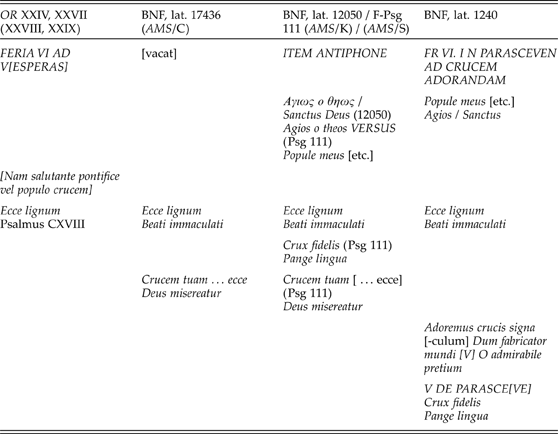
Further witnesses to Roman tradition, tinged with Gallican imports, are the antiphonalia missarum BNF, lat. 17436 (AMS/C), dated 860–880; BNF, lat. 12050 (AMS/K) from Corbie, somewhat after 853; and F-Psg 111 (AMS/S) from Senlis (Sainte Geneviève), after 871 and before 900.Footnote 10 The first of these three orders, though not preceded by a rubric, concludes with one which directs: ‘as much as is needed [of] the psalm in like manner’.Footnote 11 This indication connects Beati immaculati to the duration of the action of moving to and from the cross. The latter two orders include the Trisagion and Pange lingua … certaminis. Table 1 summarises the development of music of the Adoratio through its first two centuries. It outlines these Frankish orders as well as that of an early troper, BNF, lat. 1240, from Saint Martial de Limoges, to be discussed below.
Development of music for the Adoratio crucis, 750–933
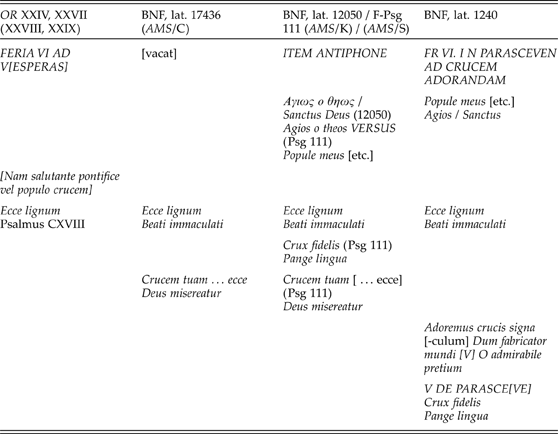
After Ecce lignum with Ps Beati immaculati, BNF, lat. 17436 and F-Psg 111 begin to extend the rite with a growing list of antiphons starting with Crucem tuam adoramus paired with Psalm 66, Deus misereatur.Footnote 12 The antiphon occurs with two distinct texts, both employing a similar melody. Crucem tuam … ecce enim is the longer, evidenced by its complete text in the Mass portion of the antiphonale missarum, BNF, lat. 17436; the shorter, Crucem tuam … quia venit, appears in the antiphoner portion of the same manuscript.Footnote 13
Before the mid-tenth century, the chant repertory and form had stabilised somewhat through annual repetitions of the recognised antiphons, often abbreviated in the sources as incipits. Repertory and form, however, advanced towards a greater selection and a freer sequence of antiphons. The portion of the Aquitanian troper BNF, lat. 1240 that includes the Adoratio, written between 931 and 934, repeated the ubiquitous Ecce lignum as a neumeless incipit.Footnote 14 A second incipit sine neumis in this manuscript, and adopted in other sources, widely separated in locus of origin, is Adoremus crucis signaculum.Footnote 15 BNF, lat. 1240 added a complete third antiphon, a typically prolix processional chant, Dum fabricator mundi, its melody entered in crude Aquitanian neumes, with an additional verse beginning ‘O admirabile pretium’.Footnote 16 The rite thus includes the aforementioned prefatory Trisagion, the antiphon series, and ‘Crux fidelis’ plus governing rubric, DE PARASCE[VE].Footnote 17 BNF, lat. 1240, a reference pointing to monastic liturgical customs and chant content, is a significant link between development of the Adoratio in cathedrals and monasteries. This manuscript became an important monastic witness to an incipient tradition for the Good Friday Adoration rite signified by the evolution of the music in Table 1.
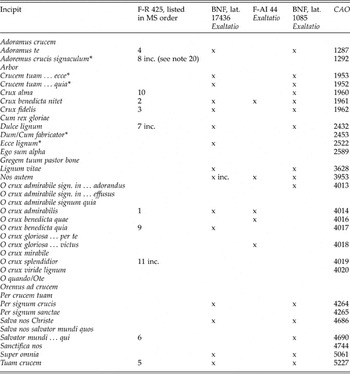
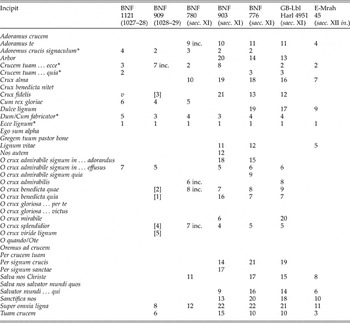
The increasing appearance of Office antiphons in the Adoratio crucis heralds a process of proliferation in which antiphons were borrowed from the Offices of the Invention of the Cross (3 May) and its Exaltation (14 September).Footnote 18 The rationale, practically speaking, would have been to appropriate additional Office antiphons to accommodate a greater number of clergy, laity (populus) and cenobites to ‘exalt’ the ritual, commensurate with its radiant and lofty status ‘over all cut cedar-wood’, Super omnia ligna cedrorum. Table 2 lists antiphons for the Adoratio crucis associated with the Exaltation, the repertory of which is larger (in sources examined) than that connected with the Invention of the Cross. (The antiphon list used in Tables 2 and 3 is based on the most comprehensive group of processional antiphons for the Adoration I have yet found, namely that of BNF, lat. 776 with BNF, lat. 903. See Table 3c.)

Table 2 lists the antiphons in four sources beginning with a Norman inventory found in a ninth-century liturgical miscellany from the abbey of St Ouen, Rouen (F-R 425), which provides eleven antiphons for Offices of the Cross.Footnote 19 (The incipits of the five antiphons previously discussed are marked by asterisks in Tables 2 and 3.) Reviewing the differences between secular and monastic practices, Table 2 also gathers data from three Office antiphoners, one of which, BNF, lat. 1085 (from St Martial) is monastic (Rouen F-R 425 was likewise intended for monks). The two other antiphoners, namely BNF, lat. 17436 (for Compiègne) and F-AI 44 (for Albi), adapting to cathedral use, include separate Office antiphoners besides their Mass gradual complements. Attention to both the Mass and Office, with the duplication of certain items (as the following tables show), sheds light on the nature of liturgical activity at the turn of the tenth century. The adjacency of Mass and Office chants in their respective sources suggests a possible inter-reliance, the correspondences between the antiphonale missarum and antiphonarium officii arguing for a certain mutuality for acknowledging the cross.
Early in the establishment of the Good Friday ritual, and as seen in the Sextuplex sources in Table 1, the rite was completed by the addition of Crucem tuam adoramus … quia and Crucem tuam adoramus … ecce with correspondence between Exaltatio (rite 110, CAO/C) as directed by the title rubric EXALTATIO CRUCIS and Adoratio in BNF, lat. 17436 (rite 78b, AMS/C) rubricated AD CRUCEM ADORANDAM, and BNF, lat. 12584 rubricated ET [DUO CLERICI] DISCOÖPERIANT CRUCEM (rite 147c, CAO/F). Taking the … quia form, Crucem tuam completed the Adoratio series independent of Office counterparts.
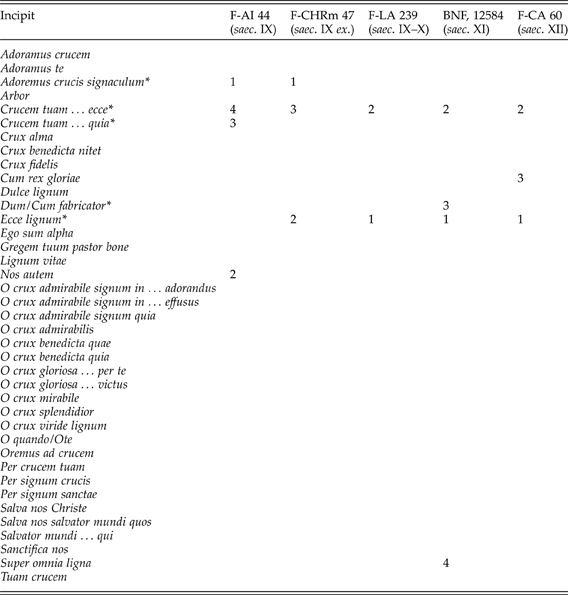
We observe empty spaces for chants patently not for the Office, but newly introduced into the Adoratio and associated with the Mass that appear in BNF, lat. 1240, giving way to differences of repertory that stretch beyond their ecclesiastical milieu. Examining Table 2, one discovers that four of the five antiphons listed in Table 1 (indicated by asterisks) were not used in St Ouen. Moreover, the fifth, Adoremus crucis signaculum, was probably not the same title legitimately slated for the Adoratio in Table 1 but was instead associated with the Office chants of Rouen.Footnote 20 Inasmuch as the other chants from St Ouen stem from the Office, they were presumably among Exaltatio or Inventio antiphons that independently reached the Adoratio and borrowed by the sources listed in Table 3. Drawing a complete blank in Table 2, the aforementioned Dum/Cum fabricator mundi, a responsorial type chant with the verse ‘O admirabile pretium’, is associated with the Mass and processional in character. It is ascribable directly to the Adoratio, bypassing the Exaltatio and Inventio, as confirmed by Hesbert's CAO (rite 147), derived from non-Office antiphons. The prominence of such a chant, found in troper-proser-hymnal BNF, lat. 1240, foreshadowed its development as a processional antiphon in the troper-proser-processioner BNF, lat. 909 (Table 3c). This category of chant on a Eucharist theme evolved in embryonic ninth-century graduals. Table 3a surveys three of these, together with two from the eleventh to twelfth centuries that, though temporally dispersed, nonetheless reveal similar reliance upon the five starred chants traditional to the Adoratio.
Antiphons for the Adoratio crucis in Frankish sources
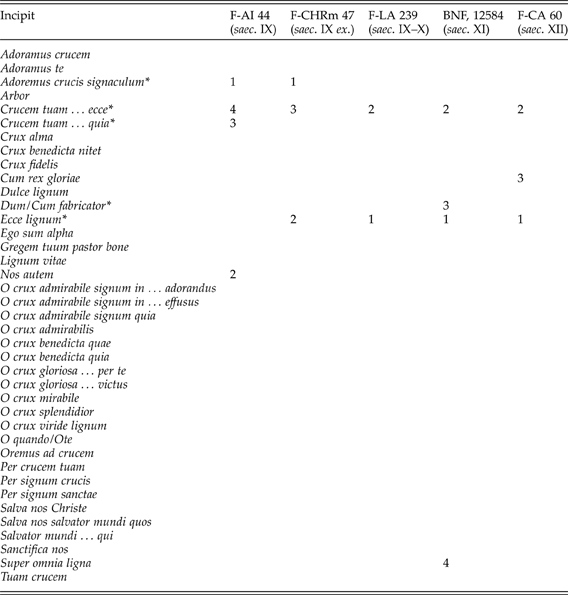
The sources surveyed in Table 3a cling to the earlier repertorial stratum, as indicated by the asterisks. The series in the first, the gradual portion of F-AI 44 (from Albi), expectedly does not concur with its antiphoner, revealing a separation of Mass from Office chants; in this case, processional from non-processional antiphons. Unexpectedly but indicatively, however, this differentiation does not hold for the Adoratio and Exaltatio (Mass and Office) repertories of BNF, lat. 17436 (Tables 1 and 2), where Ecce lignum and both antiphons with the incipit Crucem tuam are found. Appearing in the Albi gradual (Table 3a) is the Adoratio antiphon Nos autem, directed to the Easter procession, while in the Cambrai gradual with processioner, another antiphon, Cum rex gloriae, is transferred from the Easter aggregate to the Adoration series (both antiphons are listed in Table 3a).Footnote 21 The presence of these processional pieces in the Albi and Chartres (F-CHRm 47) graduals suggests a Francian origin. In fact, the Albi manuscript is claimed to possess signs of Carolingian ancestry, namely Franco-Saxon decoration and proto-Aquitanian paleofrankish musical notation.Footnote 22 The Laon gradual (F-LA 239) adhered to the conventional repertoire, but heralded the future by adopting, in margine, the incipits of Cum fabricator and a recent antiphon, Super omnia [ligna] (PAL 10, p. 101).
All the sources listed in Table 3a are associated with cathedrals save BNF, lat. 12584 (CAO/F), which originated at Saint-Maur-les-Fossés. Abbeys such as this, and notably those influenced by the rapidly proliferating Cluniac Order and its form of Adoratio, inclined towards the Frankish schema (but opposed to those we shall survey in Table 3c). In fact, Michel Huglo, following Hesbert, contended that the earlier stratum of Cluniac processional chants would be comparable to the content of the ‘ensemble of processional antiphons’ in BNF, lat. 12584, a standard of four antiphons for the Adoratio.Footnote 23 This archetypal form (omitting Improperia and Trisagion) may be outlined as follows:

Attentive to tradition, BNF, lat. 12584 followed the earliest developments (shown in Table 1), but more austere than this is a relatively late (fifteenth-century) Cluniac processioner, whose Adoration inventory is noticeably confined to the Improperia and Trisagion.Footnote 24 No less laconic is the eleventh-century Gradual of Cluny, BNF, lat. 1087, altogether lacking in Adoration antiphons, duly showing the restraint for which its monastic reform is known. It is the ordering of the Saint-Maur-des-Fossés codex from which Huglo trusts the lost Cluniac processioner's ‘lacunae can be reconstructed with confidence’.Footnote 25 The dearth of processional chants in the Cluniac gradual led Dumas to suspect that Cluny, like Limoges with its comparable repertory, may have completed ‘one or several’ processioners that have not survived.Footnote 26
Along with this representative Saint-Maur-des-Fossés repertory is the similar gradual-processioner from Cambrai, F-CA 60 (RISM 2, no. F-26/2), which further reduced the scope of the Adoratio to three antiphons, omitting Super omnia. But deviating still further from possible models, the Cambrai liturgy adopted the ubiquitous Cum rex gloriae (see note 21). Such preferential changes to the liturgical framework became a factor in maintaining a quasi-compressed order of the Adoratio. Noticeably, monasteries established their influence through standardisation such as found in BNF, lat. 12584. This result resembles Germanic witnesses.
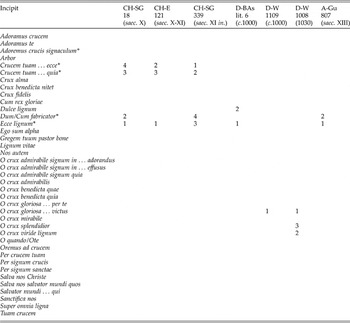
The Swiss/German/Austrian liturgical concept of the Adoratio and its antiphons, shown in Table 3b, an inconspicuous reversion to OR XXIV, XXVII, XXVIII and XXIX, followed monastic premises. This is especially true with OR XXIX, the transmission of which is owed to a monk in Rome, apparently under the pope's surveillance (note 6). The representative Swiss manuscripts in Table 3b have Benedictine credentials; the Austrian source was produced under an Augustinian aegis.
Antiphons for the Adoratio crucis in Swiss, German and Austrian sources

The tenth-century Saint Gall codex 18, the first source in Table 3b, is a processioner-type libellus that features a complex of antiphons. Among those for the Adoratio, CHs 18 adds Cum fabricator, not in the Roman group but probably borrowed from west of the Rhine; it is also found in neighbouring sources including other graduals at Saint Gall, Einsiedeln and Regensburg.Footnote 27 Comparison of Tables 3a and 3b reveals a concentration in the latter of four of the five starred antiphons in the Swiss columns (Cum fabricator missing under CH-E 121), one in the German column (Regensburg) and two in the Austrian (Klosterneuburg Gradual, now at Graz). Table 3a, however, shows no more than three asterisked chants in all its columns, and furnishes only two references to Adoremus crucis signaculum which, barring further evidence, is probably not of Germanic origin.Footnote 28 The manuscripts from Trier (St Matthias) and Minden (from St Gall), D-W 1109 and D-W 1008, include none of the more ‘traditional’ chants; both manuscripts recognise O crux gloriosa … victus, an antiphon that the CAO (4018) associates exclusively with the Invention and Exaltation (see note 42). The most obvious peculiarity in arrangement of texts revealed in Table 3b is the shift in the Gradual of Saint Gall, CH-SGs 339, which removes Ecce lignum from its position as lead antiphon.
The last in the sequence of Ordines Romani dealing with Holy Week to recognise the Adoration, its terminus a quo, is from the late tenth century with a terminus ad quem as late as the late eleventh.Footnote 29 This text, OR XXXIII, 7, admits four new ‘latest’ antiphons, given as follows: Novissime autem an[tiphone]: Crucem tuam adoramus, domine; Ecce crucem domini; O crux benedicta, super omnia ligna caedrorum [sic].Footnote 30
Ecce crucem domini appears neither to have any pre-1200 concordances in the corpus of processional chants nor among the antiphons for the Adoration outside OR XXXIII. Super omnia ligna, however, has a history in the latter connection; it appeared in BNF, lat. 17436 (Table 1) and the Good Friday observance in BNF, lat. 12584 (Table 3a). It may have been the key that opened an entry gate for other crossovers destined to flood the Adoration series, as seen in Table 3c. Consequently, such transfers became ‘processional’ owing to their acceptance for the Adoration and distinguished as antiphonae processionales.
Antiphons for the Adoratio crucis in Aquitanian sources

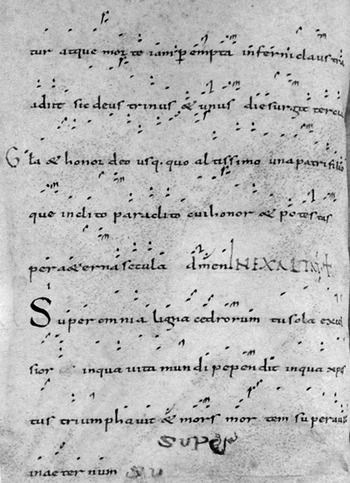
The addition of a borrowed Office chant such as Super omnia ligna into the Adoration, a Eucharistic solemnity, was effected by rubric in the troper-proser-processioner BNF, lat. 909: IN EXALTATI[ONE]+(see Fig. 1). The image shows that Super omnia transferred from an Office antiphoner, conceivably BNF, lat. 1085 prepared at Saint Martial, to that abbey's troper. In the troper, this antiphon, which concludes the set, is distanced from eight others of the Adoratio which precede Fortunatus's Pange lingua … certaminis (strophe ‘Crux fidelis’). Also shown in Fig. 1, Super omnia trails the hymn's doxology ‘Gloria et honor Deo … Patri Filio … inclito Paraclito’ rather than some other antiphon.
Super omnia ligna with rubric in BNF, lat. 909, fol. 149v.

Super omnia not only bears witness to an expansionist trend for the Adoration through an open adoption of an antiphon from the Office antiphoner, but also attains a special position in the progression of antiphons, that is, at the end. Acting as a foil to Ecce lignum, which served as the head of the antiphon cluster, Super omnia became the foot of the body – the series – conventionally, having detoured, as it were, around the other ‘latest’ antiphons. (Tables 3c and 3d indicate that Super omnia was last in every source examined except the Bologna gradual.)
A contemporary of BNF, lat. 909 in Table 3c, namely BNF, lat. 1121, the chosen repertory of which was neumed by Adémar of Chabannes, includes irregularities not necessarily unknown to other scribes. One is the transfer of Easter antiphons into the Adoration series, an association earlier hinted by the vacant applied in Table 2 dealing with Exaltatio antiphons. Peculiar to BNF, lat. 1121 is the assignment of Dum fabricator to Easter. Another anomaly is the designation of a verse erroneously rubricated A[ntiphona] such as the aforementioned ‘O admirabile pretium’ (note 16). Also noted in BNF, lat. 1121 is the designation of the verse ‘Crux fidelis’ as antiphona in this manuscript (marked v on Tables 3c and 3d).Footnote 31 Emendation and correction, which could have involved Adémar, results in the processioner's content: BNF, lat. 909 records two Adoration series, the first occurring (at 146v–149v) QUANDO SCA+PRESENTAT. Agios o theos … A[ntiphona]. Ecce lignum, and the second (at 155v–156r) AD SCAM CRUCEM. A[ntiphona] O crux benedicta. (Brackets enclose antiphons in the second set.)
Regardless of authorship, activity such as borrowing Super omnia to enhance the veneration of replicas of the cross suggests that an enlargement of processional music was underway at St Martial. This trend towards augmentation of the repertory was in force there by the turn of the millennium. In James Grier's opinion, the abbey's fragmentary processioner from the year 1000 evidences the start of a project to collect and qualify a repertory of processional antiphons. Such a project was instilled ‘for the first time at Saint Martial’ and in fact was ‘the earliest extant witness to that expansion of repertories’ of processional music, representing an enlargement of liturgical matter preserved in writing from this industrious abbey.Footnote 32 Whether this was the only such activity beyond its walls, clearly the content in the tropers, dated to August 1029, shows strong interest in these chants a century after BNF, lat. 1240 was written.Footnote 33
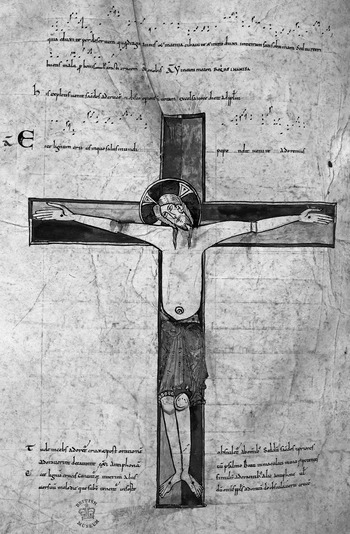
Processional antiphons, when interspersed with proper tropes in BNF, lat. 1240, advance the kind of liturgical continuity manifest in the Aquitanian processioner-troper-gradual types Dumas investigated.Footnote 34 Complemented by processioner libelli, graduals from the Aquitaine copied well after F-AI 44 became initial witnesses to the Adoration antiphon corpus.Footnote 35 A quartet of Aquitanian graduals of the eleventh to twelfth centuries – from Narbonne, Saint Yrieix, Gaillac and Toulouse – arranged in that order in Table 3c, integrates the Adoration precedent into the liturgy of the Temporale; one of these, BNF, lat. 903, furnishes rubrics for finishing the rite AD CRUCEM. Its directive is patent: ‘After the cross has been adored by all, the ministers raise it and deposit it in its place singing thus: Super omnia [etc.],’ concluding the order.Footnote 36 The polarity implicit in the opening chant Ecce lignum – whose textual import has been recognised earlier – and Super omnia brings attention to a complement of unnamed antiphons sung in between. In Fig. 2, this banner traverses the cross above the crucified Christ's head in a gradual from the Cathedral of St Stephen in Toulouse.
Gradual of Saint Stephen of Toulouse, BL, Harleian 4951, fol. 208v.

The extravagance of veneration and eventually singing a plethora, indeed a whole series, of antiphons before the cross is implicit in the rubric at the foot of the Toulouse cross, also shown in the plate. Its rubric is particularly informative (emphasis mine):
Next, let the cross be adored successively, and after a prayer [unspecified], be kissed by all. But after the priests and priors have adored, let the rest sing the antiphon with psalm Beati immaculati in via repeating Ecce lignum crucis and meanwhile, while others likewise adore, sing other antiphons or verses with melody that are contained below, inserted until all persons have kissed the adored cross.Footnote 37
This rubric, in effect, applies the proposition in the antiphonale missarum (BNF, lat. 17436) to bind the psalm (Beati immaculati) doctrinally in a way to the antiphon. More importantly, it advertises the veritable cluster of antiphons, unnamed here but availed in this source, for singing between Ecce lignum and the concluding Super omnia, counting twenty-one in the penultimate column of Table 3c. Although related to the Aquitanian census through newly imported ‘Gregorian’ antiphons after the re-conquest, the Aemilianensis series in the far right column is unified with transPyrenean chants' ordering only by its first, second and last antiphons and its melodies' representation in Aquitanian superposed-point neumes.Footnote 38
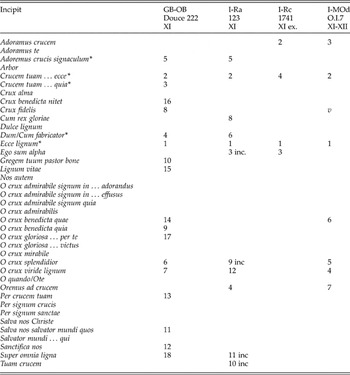
A northern Italian panoply of antiphons for this solemnity during the eleventh century shows considerable dispersion, especially in the first two of four sources surveyed in Table 3d.
Antiphons for the Adoratio crucis in Northern Italian MSS

First, the Benedictine troper-sequentiary-versiculary of Novalesa, richly enhanced by processional music, aligns more closely with the Aquitanian sources of Table 3c than the other three sources. For example, in its singular adoption of Crux benedicta nitet, noted in Table 2 (Rouen), the scribe of GB-Ob Douce 222 selectively produced a processional chant, not previously assigned as such, out of the Exaltatio antiphon (CAO 1961).Footnote 39 The Novalesan repertory features a probable unicum, O crux gloriosa … per te, whose theme depicts Hell and the Devil destructus. An unrelated and more widely circulated monastic Compline antiphon, Gregem tuum pastor bone, is curiously fitted into this source's liturgy of the Adoration.
A notable exception to the usual attachment of Ps 118 occurs in this and other Italian sources. Beati immaculati was assigned to the third antiphon, Crucem tuam … quia, displaced from the customary opening Ecce lignum that consequently here lacks a psalm assignment. The ensuing Crucem tuam … ecce retains Deus misereatur. This interchange, involving the two initial antiphons, is also present in the Roman graduals to be discussed later.
Crucem tuam … ecce, Ps Deus misereatur occurs unexceptionally in a secular Bolognese gradual-processioner-calendarium now in Rome's Biblioteca Angelica in (I-Ra 123), appearing in the second column of Table 3d.Footnote 40 This processional source seems to rely less on the substance of those studied above, if we take for granted that certain of their antiphons were relegated to mere incipits. Two of its assignments of psalm and non-psalmic verses differ from the usual course of antiphons. Deus in nomine tuo (Ps 53) is uniquely assigned to Adoremus crucis signaculum and the aforesaid verse ‘O admirabile pretium’ is termed an antiphon.
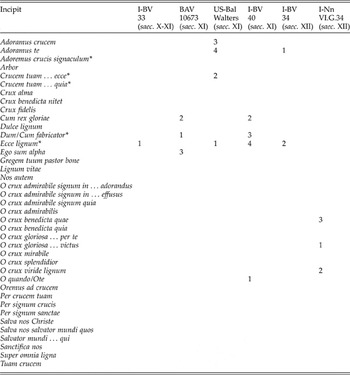
In the third column, the Benedictine gradual-troper-sequentiary-kyriale from Nonantola, now in Rome's Biblioteca Casanatense, partly resembles a Beneventan text through its incorporation of Adoramus crucem found in two Beneventan manuscripts.Footnote 41 The Greek Ote ton stauron and its Latin equivalent O quando in cruce do not appear among Nonantolan chants in a troper-sequentiary-processioner-kyriale in the Biblioteca Nazionale Centrale Vittorio Emanuele in Rome (I-Rn 1343, a virtual twin of the preceding manuscript).Footnote 42 Yet there is a Byzantine import in the antiphon pair Proskynumen ton stauron su / Adoramus crucem tuam. This dual text in all Beneventan-notated manuscripts differs melodically in all three versions: the Nonlantolan in column 3, the Ravennate next in column 4, and the authentically Beneventan form in Table 3e.
I-MOd O.I.7 is presumed to have come from Forlimpopoli, territorially part of the exarchate of Ravenna.Footnote 43 This last of the quartet of northern Italian sources of Table 3d interrupts the progression of Adoration antiphons after Crucem tuam … ecce by injecting the Greek-Latin pair, Proskynumen ton stauron / Adoramus crucem, in front of O crux viride. The inclusion of this Eastern text shows a certain latent correspondence (not descent) of liturgical repertory through geographical axes: Nonantola with Forlimpopoli/Ravenna, and with the Beneventan south (e.g. I-BV 40).
The Adoration liturgy of the Beneventan order contained in the six manuscripts in Table 3e, influenced by Byzantine liturgical increments, is distinctive but not altogether construed as old Beneventan chant. This liturgy, studied by Thomas Forrest Kelly, presents two Adorations (at the third and ninth hours) with different formats in comparing Beneventana for the Triduum with other feasts, treating its music with ‘considerable variation of repertory and placement’.Footnote 44 Concerning the latter, a less systematic arrangement across primary sources – I-BV 33, BAV, lat. 10673, and BV 40 – originating between the late tenth and late eleventh centuries, represents the variance in scribal practices. Evidence of such variety in placement inheres in the order of I-BV 40, where Ecce lignum is last owing to a hiatus in the rite itself. In this space, the Greek antiphons in Beneventan chant intervene at Terce, before the Adoration's observance at Sext, calling for the traditional Ecce to begin the service of the cross then.Footnote 45
Antiphons for the Adoratio crucis in Beneventan script

A palpable result of the variation in repertory noticed by Kelly is the promotion of Gregorian Adoration antiphons within the Beneventan order.Footnote 46 In its final column, Table 3e reveals a processioner from Troia that diverges from the rest by introducing non-traditional antiphons (i.e. apart from the asterisked items and notably excluding Ote recorded under I-BV 40). With a responsorial style, O crux gloriosa … victus, incomplete in a Nonantolan processioner (I-Rn 1343) and labelled an antiphon, exists in the well-known Worcester Cathedral antiphoner (PAL 12) and the York processioner (GB-Ob e Museo 126, ed. David Hiley), but attaches two verses plus repetendum, which the manuscript also transmits O crux viride lignum, inventively altered to O crux sacratissima.Footnote 47 Further evidence of infiltration of certain Gregorian antiphons into the Beneventan IN PARASCEVE repertory is apparent in Table 3e, expectedly Ego sum alpha and Cum rex gloriae, traditionally for Easter, and unexpectedly the ultramontaine Cum fabricator.
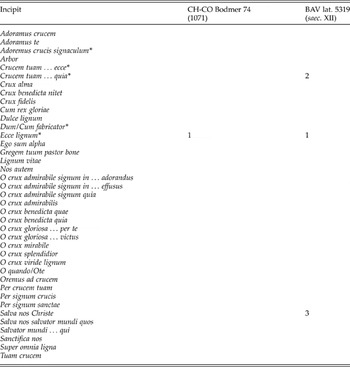
Roman versions of the Adoratio after OR XXXIII direct us to the graduals from the church of Saint Cecilia in Trastevere (titulus beatae Ceciliae) and, putatively, the basilica of Saint John Lateran, as seen in the two columns of Table 3f.Footnote 48
Antiphons for the Adoratio crucis in Roman sources

Of interest is the divergence of the Roman graduals from northern exemplars, and especially from the Ordines Romani themselves, which as we have seen unanimously attached Ps 118, Beati immaculati to Ecce lignum. The Roman liturgical canon of the earlier Middle Ages, two centuries past by virtue of the substitution by both graduals, and by the third Roman gradual, BAV San Pietro F. 22 (late twelfth century), preferred the psalm Deus misereatur to Beati immaculati. We recall the similar circumstance at Novalesa (Table 3d), where the order cast Ecce lignum without psalm incipit first, Crucem tuam … ecce with Deus misereatur second, and Crucem tuam … quia with Beati immaculati third. More unconventionally, BAV, lat. 5319 attached Miserere mei Deus to the antiphon Crucem tuam … quia [read: qui] venit, while relegating Beati immaculati to Salva nos, a third antiphon that did not figure in any of the Ordines Romani. Its incipit is, however, preserved in BAV, San Pietro F. 22 after Ecce lignum crucis and Crucem tuam adoramus, with the psalm incipits copied exactly as in BAV, Vat. lat. 5319. The common link between psalm and antiphon, only significantly broken in OR XXXII with a different psalm, Confitemini domino (see note 8), is one feature that the Roman Adoratio antiphons normally share with Northern counterparts. Yet this custom applies generally only to the first three antiphons – Ecce and the two Crucem tuam – despite the impression from the rubric in Fig. 2 (Gradual of Toulouse) that set no limit for versus following Ecce; no psalm is mentioned after Beati immaculati in this gradual.
Although the universal acceptance of Ecce lignum established this antiphon as the iconic text for the Adoratio crucis, its liturgical assignment is another matter whereby preferences distinguish the Roman from the Gregorian. The former's employment of the ensign Ecce lignum, confirmed by OR XXIV, XXVII, XXVIII, XXIX and XXXII, is patented for the Adoratio by inclusion in the three extant Roman graduals, but denied for both Offices of the Cross – Invention and Exaltation – by the Roman antiphoners.Footnote 49 The Gregorian Exaltation Office of BNF, lat. 17436 adopted it, however, and thus certified this association.
Gregorian, neo-Beneventan and Roman versions of Ecce lignum

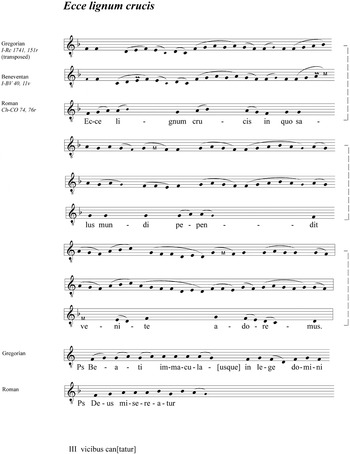
A ‘foreign’ aspect of Ecce lignum, relevant to its textual tradition and persistent through all Gregorian or Beneventan sources studied, is its melodic settings which differentiate cisalpine from transalpine. Unlike the dual presence in text and liturgical form, this antiphon's melodic shape at Rome turned towards individuality, as shown in the following transcriptions that compare its Gregorian, neo-Beneventan and Roman treatments.
These transcriptions show that the case of Ecce lignum in the Roman graduals is an unusual one; its counterparts reveal a melismatic Gregorian melody of noticeably different length. Ecce lignum exemplifies the topos of the simpler syllabic-to-neumatic-textured melody. The transcription poses sixty-six notes and sixty-eight in the Beneventan-scripted and neumed manuscript against thirty-one notes in the Roman version.Footnote 50 Although generalities concerning lengths may not be admissible when other processional antiphons (and indeed Roman Mass Proper chants) are submitted to comparison, the statistics for Ecce lignum bear out Kelly's observation that Roman melodies are more foreign to the Beneventan course than are Gregorian ones.Footnote 51
Ending where it began – at Rome – the present survey of antiphons that accrued to the Adoratio crucis in the wake of Ecce lignum completes a cycle that increases inventories of a single chant to twenty-three and back to this one. These range respectively from OR XXIV, XXVII, XXVIII and XXIX, to the Gradual of Toulouse, and back to the Gradual of S. Cecilia in Trastevere. Although the decrease of antiphons was not a fait accompli, reductions to three antiphons such as in the twelfth-century BAV, lat. 5319 and to four in the antiphoner of Saint-Maur-les-Fossés – the last perceived as the Cluniac standard – have traversed the evolution of the repertory like some controlling trend. The exceptionally prolix Ps 118, with its twenty-two strophes captioned by Hebrew letters, would have provided ample time to accommodate an adoration ritual before other antiphons were added. Thus Beati immaculati anchored the Adoration's Ecce lignum as it did the Mandatum of the Last Supper commemoration, ritual counterparts of Holy Week. Both accrued special antiphons for approaching and recessing inside the church for Holy Week functions set one day apart. On its own merit, the original form of the Adoratio crucis yielded to the adoption of other antiphons, whether borrowed from the Invention or Exaltation of the Cross or altogether novel and found in such abundance in no other Western rite. The ‘Cross’ thus advanced through its cultivation of antiphons as well as its display of the indisputable symbol of Christian salvation.