INTRODUCTION
Shallow marine waters constitute crucial environments for a diversity of fish species (Valesini et al., Reference Valesini, Potter and Clarke2004). Although the surf zones of sandy beaches are considered habitats of low complexity and high dynamics, several authors have also found them to be important recruitment and nursery zones (Ayvazian & Hyndes, Reference Ayvazian and Hyndes1995; Harris et al., Reference Harris, Cyrus and Beckley2001; Strydom, Reference Strydom2003), as well as migratory paths to other nearshore habitats (Monteiro-Neto et al., Reference Monteiro-Neto, Cunha and Musick2003; McLachlan & Brown, 2006; Nanami & Endo, Reference Nanami and Endo2007; Inoue et al., Reference Inoue, Suda and Sano2008). Other possible reasons for fish to use the surf zones are the abundant supply of potential prey and shelter from predators (Beyst et al., Reference Beyst, Hostens and Mees2002; Silva et al., Reference Silva, Araujo, Azevedo and Santos2004; Sato et al., Reference Sato, Asahida, Terashima, Hurbungs and Ida2008). These reasons suggest that the surf zones of sandy beaches play an important role as coastal habitats, mainly those located near estuaries (Beck et al., Reference Beck, Heck, Able, Childers, Eggleston, Gillanders, Halpern, Hays, Hoshino, Minello, Orth, Sheridan and Weinstein2001, Reference Beck, Heck, Able, Childers, Eggleston, Gillanders, Halpern, Hays, Hoshino, Minello, Orth, Sheridan and Weinstein2003; Bell et al., Reference Bell, Cowley and Whitfield2001; Able et al., Reference Able, Grothues, Rowe, Wuenschel and Vasslides2011; Moraes et al., Reference Moraes, Paes, Garcia, Möller and Vieira2012).
The littoral zone in the southernmost state in Brazil is characterized by a 620 km long, straight coastline with a north-east–south-west orientation, and is located between 29° and 34°S latitude. These sandy beaches are completely exposed to wave action, have a microtidal regime and semidiurnal tides with a mean range of 0.3 m (Figueiredo et al., Reference Figueiredo, Cowell and Short2007; Pereira et al., Reference Pereira, Calliari and Barletta2010). This coastline is interrupted by five estuaries (Vieira & Rangel, Reference Vieira and Rangel1988; Ramos & Vieira, Reference Ramos and Vieira2001) and is wave-dominated with significant wave heights of 1.5 m HS (Calliari & Klein, Reference Calliari and Klein1993). A major feature in this region is ~5 km-long rocky jetties, connecting the Patos Lagoon (PL) estuary with the Atlantic Ocean. Sandy beaches adjacent to each side of these jetties have different hydrological dynamics. The west side has beaches that are exposed to predominant winds from the north-east (Tomazelli, Reference Tomazelli1993) and predominant waves from east–south-east (Calliari & Klein, Reference Calliari and Klein1993), whereas sandy beaches located on the east side are more sheltered from prevailing winds and waves, creating a shadow zone with less intensity of wind, waves and longshore currents from east–north-east.
The structure and dynamic of the fish assemblage from the surf zone of the west jetty (Cassino Beach, hereafter CB) is relatively well known, being composed mainly by juveniles of approximately 37 species (with nine dominant species) with sizes ranging from 15 to 150 mm total length (e.g. Monteiro-Neto et al., Reference Monteiro-Neto, Cunha and Musick2003; Lima & Vieira, Reference Lima and Vieira2009). Since the jetties may influence the fish fauna inhabiting the sandy beaches near the PL estuary (Lima & Vieira, Reference Lima and Vieira2009), and there is no information on the fish assemblage of the east jetty sandy beach (Mar Grosso Beach, hereafter MGB), it is necessary to investigate if fish assemblages inhabiting the surf zone of these two sandy beaches, with different degrees of wave exposure (sheltered versus exposed) and separated by long rocky jetties, have differences in terms of fish abundance and diversity patterns.
In this paper, we evaluated the null hypothesis that there are no significant differences in fish abundance and diversity between sheltered (CB) and exposed (MGB) marine sandy beaches. We also described and compared the fish community structure on sandy beaches adjacent to the PL jetties and identify the relationships between environmental variables and fish assemblages at each side of the jetties.
MATERIALS AND METHODS
Study area and field sampling
The southernmost coastline of Brazil is characterized by extensive wave-dominated, straight sandy beaches, with sediments ranging from very fine to medium sand (Siegle & Calliari, Reference Siegle and Calliari2008). The sandy beaches near the mouth of the PL estuary are classified as dissipative (Pereira et al., Reference Pereira, Calliari and Barletta2010) and are associated with one or two longshore sandbars (Calliari & Klein, Reference Calliari and Klein1993). The pattern of coastal water circulation along this coastline undergoes strong seasonal influences. During the winter, south-westerly (SW) winds force the Rio de La Plata waters with low salinities and temperatures to lower latitudes (~28°S); while in the summer, dominant north-easterly (NE) winds bring tropical waters with high salinities and temperatures to ~32°S (Möller et al., Reference Möller, Piola, Freitas and Campos2008). The predominant pattern in the NE winds directs the plume of the PL estuary in a southern direction. Fine sediments provided by this plume are transported to the south and deposited offshore as fluid mud. Stormy conditions, such as cold front passages, can rework and transport the fluid mud from the inshore to the surf zone and offshore of CB, attenuating the wave energy (Calliari et al., Reference Calliari, Holland, Pereira, Guedes and Santo2007). MGB is different from CB because there is no record of fluid mud deposits on the former, which is located northward of the jetties.
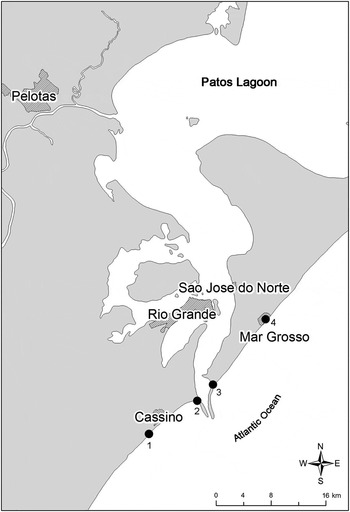
Samplings were performed from two beaches, CB on the west and MGB on the east side of the jetties, with two fixed sampling sites at each beach (Figure 1). Fish were collected monthly from May 2001 to May 2002 from the early morning until noon. A beach seine net (9 m long; 1.5 m high) with a 13 mm stretch mesh in the wings and a 5 mm stretch mesh in the centre 3 m section was pulled perpendicular to the beach at depths less than 1.5 m, covering an area of approximately 120 m2 per haul. At each sampling site, three hauls were performed, always avoiding the previously swept areas. Surface water temperature (°C), salinity and transparency (Secchi depth) were recorded before sampling. Fish were preserved in 10% formalin and later identified and counted. The total length (TL) of each fish was measured to the nearest 1 mm, and the total wet weight (g) of each species in each sample was recorded.
Location of the study areas with the four sampling sites: 1 and 2 at Cassino Beach (CB) and 3 and 4 at Mar Grosso Beach (MGB), Rio Grande do Sul State, Brazil.

DATA ANALYSIS
Fish were considered abundant when the numeric percentage (N%) was greater than or equal to 100/S, where S is the total number of species captured on each beach. Fish were considered frequent when the percentage of frequency of occurrence (FO%) was greater than or equal to ∑%FO/S on each beach. Based on this classification, fish species were grouped into the following categories: frequent and abundant (%FO ≥ ∑%FO/S; %N ≥ 100/S); frequent but not abundant (%FO ≥ ∑%FO/S; %N < 100/S); not frequent but abundant (%FO < ∑%FO/S; %N ≥ 100/S); present (%FO < ∑%FO/S; %N < 100/S); and absent (no fish captured) (Garcia & Vieira, Reference Garcia and Vieira2001).
Similarity of fish composition between beaches was based on the ratio of the presence/absence of species calculated by the Jaccard coefficient (Sj) (Magurran, Reference Magurran2004) and on Percent Similarity (%Min) (Krebs, Reference Krebs1999). The diversity was evaluated using Fisher's α because its value is relatively easy to calculate for communities that contain a comparatively large number of species that are rare (Magurran, Reference Magurran2004). Fisher's α was calculated as: α = N(1 − x)/x, where α is the diversity index from a logarithmic series, N is the total number of individuals in the sample and x is a parameter of a logarithmic series. The large-sample variance of the diversity index α was calculated as: Var(α) = 0.693147 × α / [ln (x/(1 − x) − 1)]2. For each beach, we constructed species accumulation curves to determine the efficiency of the sampling effort in assessing the species richness of fish assemblage.
Environmental variables and fish abundance data (number) were transformed [Log10 (x + 1)] to meet assumptions of normality and homoscedasticity for statistical tests (analysis of variance (ANOVA), permutational analysis of variance (PERMANOVA) and canonical correspondence analysis (CCA)). One-way ANOVA was performed to test differences in environmental variables among sites and differences in abundance for the three frequent and abundant species, between beaches. Two-way ANOVA was employed to test differences in total fish abundance between beaches (two levels) and seasons (five levels). Previously, the 13 months were grouped in seasons as follows: autumn 1 = May and June; winter = July to September; spring = October to December; summer = January to March; and autumn 2 = April and May. Permutational analysis of variance (PERMANOVA + for PRIMER: Anderson et al., Reference Anderson, Gorley and Clake2008) was used to test the effects of different factors (sites, beaches and season) on the fish assemblage composition. A PERMANOVA analysis was performed using Bray–Curtis distance as a resemblance measure and P values were calculated using 9999 permutations. This method analyses the variance of multivariate data explained by a set of explanatory variables (categorical or numerical) and is used to create a distribution of F and obtain P values (Anderson, Reference Anderson2001).
Canonical correspondence analysis was applied to environmental variables, species abundance and beaches (triplot) to assess environmental influence on fish assemblages. Only environmental variables that were significant were included in the analysis. Only species with occurrences >1% were included in the CCA to reduce the importance of rare species. The significant variables were assessed using a Monte Carlo permutation test (N = 9999; P < 0.05) (Lepš & Šmilauer, Reference Lepš and Šmilauer2003).
RESULTS
Environmental variables
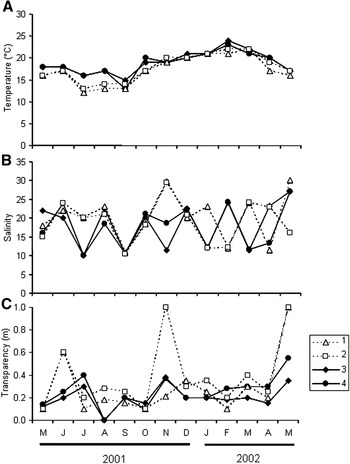
The mean values of seawater surface temperature did not differ among the four sampling sites, but showed seasonal fluctuations with a clear annual cycle (Figure 2A). No significant differences were observed among sampling sites at CB (ANOVA, F = 0.09; P = 0.76) or at MGB (ANOVA, F = 0.24; P = 0.63); however, MGB presented higher temperatures compared with CB. For both beaches the highest temperature values were recorded from November to April and the lowest values from May to October (Figure 2A).
Temporal fluctuations in environmental variables between May 2001 and May 2002: (A) surface water temperature; (B) salinity; (C) transparency of each of the sampling sites. Legend: 1–2, Cassino Beach; 3–4, Mar Grosso Beach.

Salinity showed no seasonal pattern, ranging from 10 to 30 (Figure 2B). No significant differences occurred between sampling sites at the same beach (CB: ANOVA, F = 0.07, P = 0.79 and MGB: ANOVA, F = 0.32, P = 0.58). The lowest salinity values were registered in July and November 2001 (MGB) and in September 2001 (CB). The highest salinities were found at CB in November 2001 and at MGB in May 2002.
Water transparency values were low, ranging from 0 to 1 m, with sampling sites at CB showing the highest water transparency values (Figure 2C). No significant differences were observed among sampling sites at both beaches (CB: ANOVA, F = 1.13, P = 0.30 and MGB: ANOVA, F = 0.94, P = 0.34). The highest transparency values were registered in November and May 2002 for sampling sites at CB.
Because no differences were found with regard to the environmental variables measured at the two sampling sites at each of the two beaches, we grouped sampling sites from the same beach to compare fish abundance and diversity between beaches (CB versus MGB).
Spatial and seasonal variations in fish assemblage structure
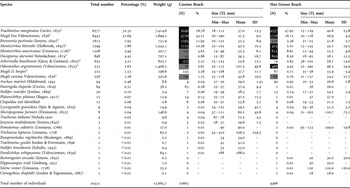
A total of 20,331 fish from 29 taxa, representing 14 families, were caught in 260 beach-seine hauls during the study period. Only Clupeidae (N = 12) had a group of individuals not identified at the species level. Most fish were juveniles, mainly young-of-the-year with sizes ≤60 mm TL (95.6%). However, individuals of a wide range of sizes (12 to 410 mm TL) were collected (Table 1). Eight species were abundant and comprised 95.6% of the total catch. They were the La Plata pompano Trachinotus marginatus, the striped mullet Mugil liza, the Argentine menhaden Brevoortia pectinata, the Gulf kingfish Menticirrhus littoralis, the Southern kingfish Menticirrhus americanuş the Brazilian silversides Atherinella brasiliensis and Odontesthes argentinensis, and the Remo flounder Oncopterus darwinii.
Total species composition of fishes caught at both beaches (number of individuals, percentage abundance, weight and size-ranges) and at each individual beach between May 2001 and May 2002. TL, total length; Max, maximum; Min, minimum; SD, standard deviation; N, number of individuals.

■ frequent/abundant.;  frequent/not-abundant.; □ present. – absent.
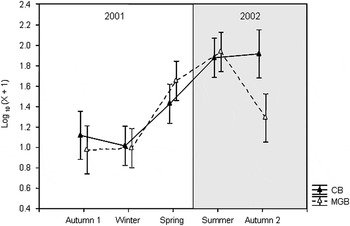
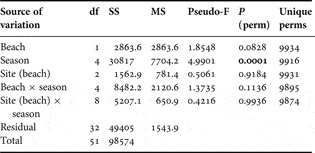
Although the highest captures were registered at CB, no significant difference for total abundance was found between CB and MGB (ANOVA, F = 2.28, P = 0.13). Nevertheless, there was a seasonal difference in the overall number of individuals for both beaches (ANOVA, F = 4.14, P = 0.003), and when seasons were analysed separately, differences between the beaches were found only in the second autumn 2 (Figure 3). The PERMANOVA results performed on the complete fish abundance data set showed a significant effect of season and there were no significant interactions between beaches, seasons and sites between beaches (Table 2). These results are in accordance with one-way ANOVA performed with environmental variables between sites and corroborate the previous choice of grouping sites of the same beach, and analyse CB versus MGB.
Spatio-temporal variation in total abundance between beaches.

Permutational analysis of variance results for fish abundance considering the whole species data set.

df, degrees of freedom; SS, sum of squares; MS, mean squares; Pseudo-F, pseudo-f ratio; P (perm), permutation P value; bold value denotes significant difference at P<0.0001.
Despite no differences in overall fish abundance between CB and MGB, the analysis showed that B. pectinata and A. brasiliensis were frequent and abundant only at CB, whereas M. americanus, O. darwinii and O. argentinensis were frequent and abundant only at MGB, showing a spatial difference in the structure of fish assemblage (Table 1). Trachinotus marginatus, M. liza and M. littoralis were frequent and abundant at both beaches. The white mullet Mugil curema was considered frequent/not-abundant at both beaches, whereas the remaining species were recorded seasonally or occasionally.
Mugil liza represented 43.5% of the total catch at CB and 18.1% at MGB, with significant differences between beaches (ANOVA, F = 10.42, P = 0.001). Trachinotus marginatus showed an inverse pattern of abundance, with higher values at MGB (47.9%) and lower values at CB (18.8%) but no significant differences between beaches (ANOVA, F = 3.17, P = 0.08). Menticirrhus littoralis showed clear differences in overall abundance (ANOVA, F = 39.17, P < 0.01) represented 70.4% of the total catch at CB and 29.6% at MGB, confirming the spatial difference in the structure of the ichthyofauna. For these three species, it seems that the mean size of T. margiatus and M. littoralis were larger at MGB than at CB, whereas the mean size of M. liza were the same for both beaches (see Table 1).
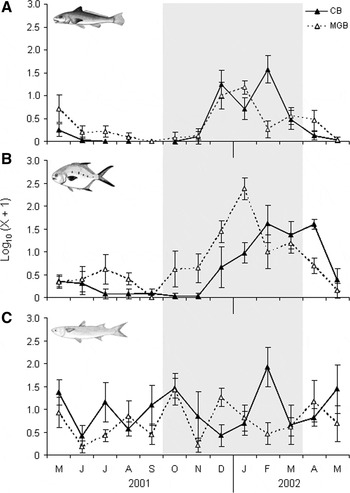
Seasonal differences in relative abundance of the three dominant species were also found for each beach (Figure 4). Menticirrhus littoralis showed the lowest relative abundance in the coldest months (May to November), with an increase in relative abundance during warm months (December to March) (Figure 4A). Trachinotus marginatus displayed the same seasonal pattern (Figure 4B) as M. littoralis, whereas M. liza did not show a clear seasonal pattern of distribution during the study period and was caught all year-round (Figure 4C). Furthermore, M. liza, which relative abundance was higher at CB (N = 4726) than MGB (N = 1716), presents peak of abundance occurring in July, November, February and May.
Mean abundance of three dominant species in both beaches, between May 2001 and May 2002: (A) Menticirrhus littoralis; (B) Trachinotus marginatus; (C) Mugil liza.

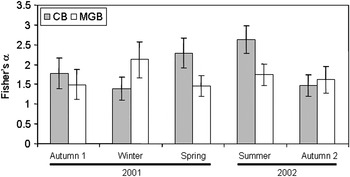
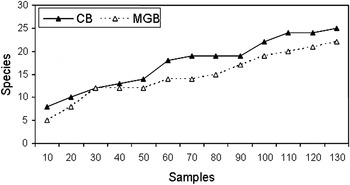
The species composition between beaches revealed 18 common species among 29 taxa captured (%Min = 52.3% and Sj = 62.1%). The number of species at CB (S = 25) was higher than at MGB (S = 22), and there was a seasonal and spatial trend in diversity estimated by Fisher's α (Figure 5). Differences in diversity between both beaches were observed only during spring and summer. The species accumulation curve did not stabilize towards asymptotic values for either beach (Figure 6), indicating that more species may be found with an increase in fish sampling effort.
Seasonal Fisher's α index of diversity with standard deviation for both beaches.

Species accumulation curves for Cassino and Mar Grosso beaches.

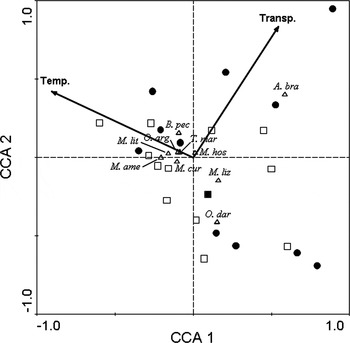
The CCA revealed that the most significant environmental variables related to fish abundance were water temperature and transparency. Species–environmental correlations from CCA were higher for the first (0.83) and second (0.72) axes. Environmental variables explain 30.0% of the fish abundance, and the axis 1 explains 60.0% of the explained variability (Figure 7). Species such as T. marginatus, M. littoralis, M. americanus, M. curema, Mugil cf. hospes, B. pectinata and O. argentinensis seem to be more associated with the warmer season (on the left), whereas M. liza and O. darwinii were associated with the colder season (on the right). Atherinella brasiliensis was associated with higher transparency waters related mainly to the colder season (autumn and winter) and sampling sites at CB.
Canonical correspondence analysis (CCA) ordination diagram of two environmental variables (represented by vectors), 10 species (represented by symbol Δ) and two beaches (•, Cassino Beach; □, Mar Grosso Beach). Legend: Temp., temperature; Transp., transparency. Species codes: A. bra, Atherinella brasiliensis; B. pec, Brevoortia pectinata; M. ame, Menticirrhus americanus; M. lit, Menticirrhus littoralis; M. cur, Mugil curema; M. liz, Mugil liza; M. hos, Mugil cf. hospes; O. arg, Odontesthes argentinensis; O. dar, Oncopterus darwinii; T. mar, Trachinotus marginatus.

DISCUSSION
This work analysed the influence of long rocky jetties (~5 km) in the surf zone fish assemblage structure of two sandy beaches that differ in terms of wave exposure and dynamics: Cassino Beach (CB) more sheltered and Mar Grosso Beach (MGB) more exposed. The structure and dynamics of the fish community from CB is relatively well known (e.g. Monteiro-Neto et al., Reference Monteiro-Neto, Cunha and Musick2003; Lima & Vieira, Reference Lima and Vieira2009), but there is no information on MGB, and we expected differences between both fish assemblages in terms of fish abundance and diversity. Our results demonstrated that there is no difference in total fish abundance and diversity between more sheltered and more exposed sandy beaches. Both beaches presented a low diversity of fish species, with a very similar fish composition, consisting mainly of small-sized juveniles (95.6% ≤ 60 mm TL), and that only eight species were numerically dominant. This pattern seems to be similar to several other surf zones around the world (Robertson & Lenanton, Reference Robertson and Lenanton1984; Gibson et al., Reference Gibson, Ansell and Robb1993; Suda et al., Reference Suda, Inoue and Uchida2002; Inoue et al., Reference Inoue, Suda and Sano2008; Selleslagh & Amara, Reference Selleslagh and Amara2008). In fact, surf zones are considered nursery area, transit routes, and feeding grounds for several species (Lasiak, Reference Lasiak1986; Santos & Nash, Reference Santos and Nash1995; Layman, Reference Layman2000; McLachlan & Brown, 2006; Nakane et al., Reference Nakane, Suda and Sano2011), and dominated mainly by small-sized juvenile fishes (Nanami & Endo, Reference Nanami and Endo2007; Lima & Vieira, Reference Lima and Vieira2009; Mont'Alverne et al., Reference Mont'Alverne, Moraes, Rodrigues and Vieira2012).
Three species (Trachinotus marginatus, Mugil liza and Menticirrhus littoralis) were frequent and abundant at both beaches, but with distinct abundance patterns between beaches. Trachinotus marginatus and M. littoralis showed higher abundance during early spring/summer, but M. liza show no seasonal pattern in peak abundance. Juveniles of T. marginatus and M. littoralis are typically found at the surf zones of southern Brazil (Rodrigues & Vieira, Reference Rodrigues and Vieira2010; Lemos et al., Reference Lemos, Varela, Velasco and Vieira2011), whereas the juveniles of M. liza use the surf zones during their recruitment from the ocean towards shallow areas (Vieira, Reference Vieira1991) and probably as transient habitats before recruitment into the PL estuary (Monteiro-Neto et al., Reference Monteiro-Neto, Cunha and Musick2003).
Man-made structures like rocky jetties could affect the water circulation (Roberts, Reference Roberts1997), modify surf zone conditions (Martin et al., Reference Martin, Bertasi, Colangelo, Vries, Frost, Hawkins, Macpherson, Moschella, Satta, Thompson and Ceccherelli2005) and enhance connectivity between different environments (Cenci et al., Reference Cenci, Pizzolon, Chimento and Mazzoldi2011). In spite of that, species composition and densities of fish assemblages at sandy beaches adjacent to the PL jetties seem to be not affected by this man-made structure. However, there are some effects on the relative abundance of some species at each side of the jetties, which could be related to differences in physical conditions. For instance, the presence of the PL plume, intensified by the PL jetties, favours a more estuarine condition at CB than at MGB (Möller et al., Reference Möller, Castello and Vaz2009), which allows a greater concentration of estuarine-dependent species at this beach (Lima & Vieira, Reference Lima and Vieira2009). This situation is intensified during El Niño Southern Oscillation (ENSO) episodes, when estuarine fishes are frequent at the coastal marine sites adjacent to the PL estuary (Garcia et al., Reference Garcia, Vieira and Winemiller2001, Reference Garcia, Vieira, Winemiller, Moraes and Paes2012). Even in non-ENSO years the flooding of the PL occurs after different levels of precipitation (Vieira et al., Reference Vieira, Garcia and Grimm2008), which could also explain the high catches of A. brasiliensis and B. pectinata at CB in the present study. In contrast, MGB is more exposed to wave energy and less influenced by the PL plume than CB (de Oliveira & Calliari, Reference de Oliveira and Calliari2006; Pereira et al., Reference Pereira, Calliari and Barletta2010), which apparently favours those fishes associated with more exposed sandy beaches, like members of the Carangidae and Sciaenidae families (Vasconcellos et al., Reference Vasconcellos, Santos, Silva and Araújo2007).
The wave exposure (wave energy) is considered an important environmental variable influencing surf zone fish assemblages and there is strong evidence in the literature of an inverse relationship between wave action, coastal currents and species abundance (Romer, Reference Romer1990; Clark, Reference Clark1997; Félix et al., Reference Félix, Spach, Moro, Hackradt, de Queiroz and Hostim-Silva2007; Vasconcellos et al., Reference Vasconcellos, Santos, Silva and Araújo2007; Inui et al., Reference Inui, Nishida, Onikura, Eguchi, Kawagishi, Nakatani and Oikawa2010). On MGB, four of the six dominant species (T. marginatus, M. littoralis, Menticirrhus americanus and Oncopterus darwinii) are directly associated with moderate to high wave energy sandy beaches (Lima & Vieira, Reference Lima and Vieira2009; Rodrigues & Vieira, Reference Rodrigues and Vieira2010). Although wave energy was not measured in this study, we believe that high catches of abovementioned species, at MGB, can be an indicator of wave energy conditions.
The surf zone fish community structure in southern Brazil seems to be spatially homogeneous along the 620 km straight coastline (Ramos & Vieira, Reference Ramos and Vieira2001). Thus, the jetties that connect the PL estuary with the Atlantic Ocean are one of the few obstacles that could create distinct environmental conditions along this littoral zone. On the east side of the jetties, MGB is more influenced by the predominant NE wind and wave patterns, whereas on the west side, CB experiences lesser wave action, and it is more influenced by the plume of the PL estuary, which passes through spaces among the granite rock boulders used to build the jetties. These two contrasted conditions may occur at both sides according to wind conditions (Lima & Vieira Reference Lima and Vieira2009; Mont'Alverne et al., Reference Mont'Alverne, Moraes, Rodrigues and Vieira2012) resulting in no overall differences in fish assemblage structure in both sides of the jetties. In fact, some recent studies have suggested that surf zone fish assemblage is not particularly affected by the presence of jetties or breakwaters (Cenci et al., Reference Cenci, Pizzolon, Chimento and Mazzoldi2011; Mikami et al., Reference Mikami, Nakane and Sano2012).
We found a pattern of lower fish abundance associated with colder months (winter and autumn) and higher abundance in warmer months (spring and summer), with no differences between beaches. The only exception was autumn 2 when the large abundance of M. liza, Atheriella brasiliensis and Brevoortia pectinata at CB remained similar to the previous winter, but the abundance level at MGB dropped significantly. Like in other subtropical zones, our results show that seasonality plays a role in structuring the fish assemblage near PL jetties. Patterns of species abundance are predominantly cyclical, as observed by Lima & Vieira (Reference Lima and Vieira2009), and temperature appeared to be the primary factor regulating species abundance after the breeding season, which occurs in early spring to summer (Young et al., Reference Young, Potter, Hyndes and de Lestang1997; Beyst et al., Reference Beyst, Buysse, Dewicke and Mees2001; Amara, Reference Amara2003; Wilber et al., Reference Wilber, Clarke, Burlas, Rubenc and Will2003; Moraes et al., Reference Moraes, Paes, Garcia, Möller and Vieira2012).
In summary, our results suggested that: (1) fish abundance and diversity are not influenced by long rocky jetties, although the two beaches differ in terms of wave exposure and dynamic; and (2) fish assemblage descriptors (mainly abundance and diversity) showed marked seasonal pattern. Future studies, including additional environmental variables (e.g. wave energy, wind and coastal current) and the use of other complementary sampling gears (e.g. larger beach seine nets, trammel nets and gill nets) are needed in order to advance the current knowledge about the structure and dynamics of fish assemblage at sandy beaches in southern Brazil.
ACKNOWLEDGEMENTS
The authors thank the Conselho Nacional de Desenvolvimento Científico e Tecnológico (CNPq), the Ichthyology Laboratory staff, the Institute of Oceanography (FURG), and the anonymous referees of this manuscript. We also thank to L.G. Fisher for the fish drawings.